All abandoned: Chernobyl / Pripyat, Nara Dreamland, Anti-Zombie Fortress, Japanese Sex Museum – and many, many more! Plus: North Korea Special – 2 trips, 16 days / 14 nights! As seen on CNN…
The Shidaka Utopia was a well-kept secret for many years – until about three or four years ago, when explorers gave away its full name and with it its exact location. I visited this often overlooked abandoned amusement park in spring of 2012, but kept it to myself until now. What better time to present it on Abandoned Kansai than right after the little April Fools’ joke involving *Nara Dreamland*?
Shidaka Utopia started business in 1968 in competition to the nearby Rakutenchi, one of Japan’s oldest existing amusement parks, opened in 1929! 35 years later it closed its doors due to the usual lack of customers. Sadly there is not much known about the park, probably because it’s a little bit off the beaten track. The next train station is more than 10 kilometers away and Kyushu in general is not exactly a super popular tourist destination, though I have to say that I love Japan’s third largest island as I had some great times there!
20 years ago it was a lot easier to get to the Shidaka Utopia as there was a gondola / lift combination leading right to its entrance, but now you have to take a bus that runs about five times a day to this thinly populated mountainous area.
Upon arrival I checked out the Utopia’s entrance (more or less thoroughly barricaded, including some kind of locked door…) and had a look down at the park’s former go kart track – where a fox was patrolling what I think he thought was his. I had seen my share of Japanese wildlife over the years (monkey, boars, spiders, snakes, maybe a bear, not sure about that one…), but the fox was a first. Sadly I wasn’t only completely taken by surprise, I also had my ultra wide-angle lens mounted on my camera, so by the time I was able to take a picture, it was a pretty bad one. But still a photo of a wild fox! At a place I was about to explore…
A couple of minutes later I figured out a way to get in and the fox was out of sight, so what the heck! I didn’t travel 500 kilometers to be stopped by a small dog with red fur and big ears!
Instead I was stopped by two mid-aged Japanese dudes about an hour into my exploration. They were definitely neither security nor urban explorers, but made it pretty clear that I should better leave – with a certain authority, as if they were in a position to actually be in charge there. I politely asked them to let me finish taking photos of the collapsed wooden maze and although I am pretty sure they had no idea what I said, they granted my wish and continued to walk towards the huge building that once was a restaurant / gift shop / rest house, making gestures that lead me to the conclusion that they might have had plans with the property. I on the other hand had no interest in the big building at all, neither short term nor long term, as I had seen photos of it before; and it looked like the typical empty and vandalized abandoned Japanese restaurant / gift shop / rest house that you can find by the dozen in the countryside… just bigger. Anyway, I continued as if our conversation never happened and when I heard them coming back, I hid in what I would call the rest room area. And there I found THEM, the two most awesome rest room signs ever created. Probably the two most awesome signs ever created overall! I took pictures of them, so you can look at them yourself, but what made them so awesome was the Japanese writing on them. The male version said “オチンチンのあるひと“ and even with my limited command of Japanese I instantly understood what that meant: „(for) people with a penis”. And the female version of course said “オチンチンのないひと“ – „(for) people without a penis”! Bathroom signs… at an amusement park! In public! Only in Japan…
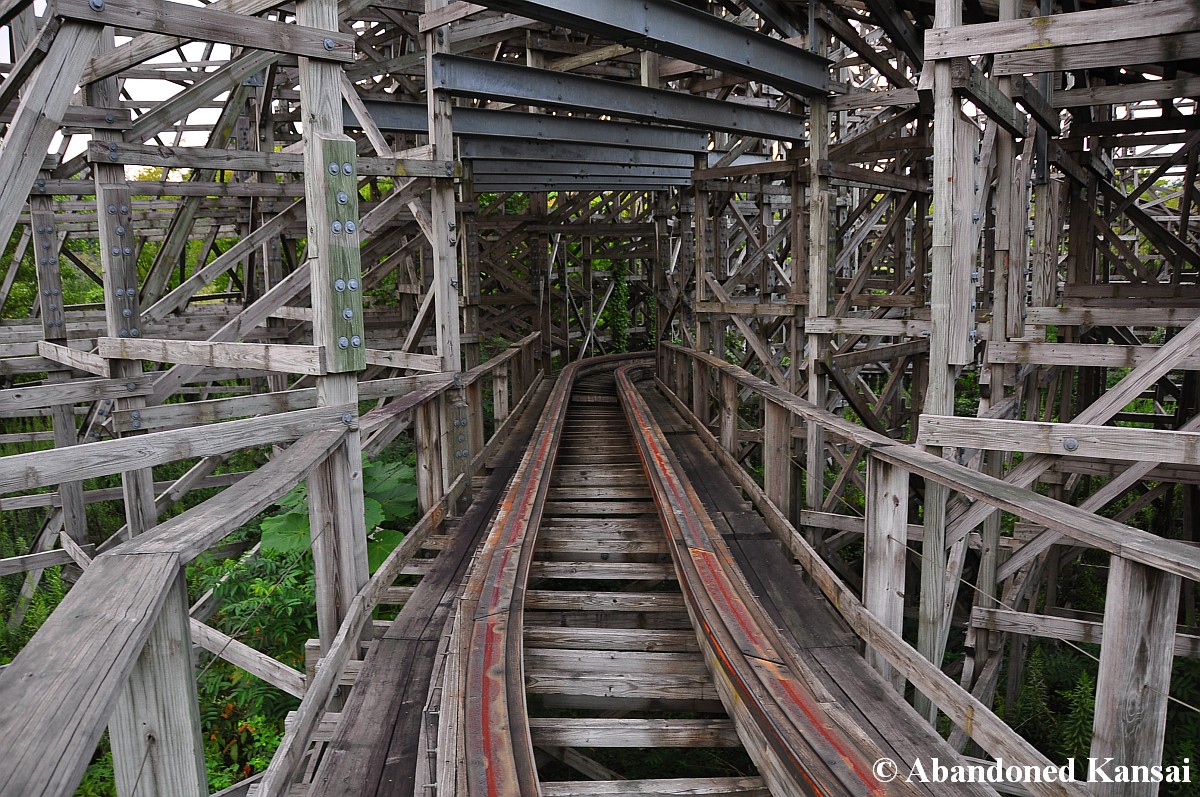
It turned out though that those two signs were the absolute highlights of the exploration. A good decade after being abandoned, the Shidaka Utopia had suffered from the forces of nature, was partly demolished, severely vandalized and in great parts overgrown even in spring. What I loved about it though were the countless items left behind. The roller skates, the kiddy rides, the gum display, the handwritten signs – wherever I let my eyes wander, I had my feet follow. There were so many small things to explore and to discover that I totally forgot that it was basically a pretty rundown place. But it was big and it was abandoned and it was an amusement park and it was a gorgeous spring day in the mountains and it was in Japan, so it was awesome!
After two and a half hours I left Shidaka Utopia to get some lunch and to check out a few other locations in the area, before I returned in the afternoon to have a look at the fox hideout a.k.a. go kart track, where I found more items: a fire distinguisher on wheels, Dunlop tires, racing helmets, a Japanese Mercedes Benz 300E ad – in the end I had to hurry back to the bus stop to catch the last ride back to civilization, just before the sun was setting.
The whole day in the Oita countryside will have a special place in my heart – but it’s the bathroom signs that will stick out with their glorious epicness for all eternity! (Epicness is a word, right? If it isn’t it should be!)
Believe it or not, I am really not a fan of April Fools’ jokes – probably because I equally don’t like lying and being being lied to, which is really tough sometimes in a country that glorifies being a two-faced bastard with the term “honne and tatemae”. Nevertheless I couldn’t resist coming up with my own April Fools’ joke yesterday… 🙂
It all began in late 2013 when I was writing and scheduling the articles about my *second trip to North Korea*. I had to spread them out in a way so I would be able to publish the next regular urbex article on a Tuesday, because I pretty much always update Abandoned Kansai on Tuesdays – and that’s when I realized that April 1st would be on a Tuesday in 2014, too. At around the same time I found out that *Igosu 108* had been dismantled in autumn of 2013 and that it was shipped to Vietnam to be rebuilt there. But… what if it would have been *Nara Dreamland* instead of Vietnam? So I wrote the first draft of my April Fools’ joke story.
The piece was resting for months until coincidence helped me bringing it to a whole new level. Some weeks ago I found out that on January 31st the Nara Shimbun wrote a story about Nara Dreamland being foreclosed, because the current owner “Dreamland” owed the city 650 million Yen in taxes, that negotiations about tax reductions failed and that neighbors opposed the city’s idea to buy the property and build a crematorium. All of this is actually true – it’s just that Dreamland still owes the money as the auction hasn’t happened yet. So I updated the article by incorporating those new facts.
Since I tend to write or at least polish articles last minute, I went over it again just before I published it, adding some details you might have or have not found interesting. The company’s name for example, Nara Dreamland: The New, is a reference to “Biohazard: The Real” a.k.a. “Resident Evil: The Real” – a haunted house style attraction at Universal Studios Japan in Osaka. Not only is it extremely bad use of English in both cases, but USJ is one of the reasons why Nara Dreamland had to close. The CEO’s name, Katsuhiro Yuenchi, is a combination of the real first name Katsuhiro and the Japanese term for amusement park, Yuenchi. Japanese business years indeed usually start on April 1st and most outdoor water parks here are in fact open for only two months, completely ignoring that it is hot enough to make money from at least June till late September. Of course I really asked Japanese friends to write letters to the owners of Nara Dreamland to get permission to take photos there, maybe even to interview somebody – still no answer though… Oh, and the article ends with a quote from Vanilla Sky, one of the few Hollywood remakes I liked better than the original.
As you can see, most of the article is true, and I guess that’s one of the reasons why so many people believed it. I am actually quite flattered by that fact, because it makes me believe that I enjoy quite a bit of credibility out there on the interwebz. And I hope I didn’t jeopardize it with my little joke. (I even waited till 10 p.m. Japanese time to publish yesterday’s the article, to make sure that it would be April 1st in most countries in the world – I could have posted it at 0.01 a.m. Japanese time, still March 31st in most Asian countries and in all of Europe, Africa and America…)
On the other hand I have to say that the April Fools’ joke about Nara Dreamland turned out to be one of the most read articles I have ever written – because people happily spread the word. *My posting on Facebook* was seen by three times as many people as I have subscribers there! Usually about 40% of my subscribers see my postings, which already is a lot more than the 6% Facebook average that we all read about in the media recently. 300% vs. 40% vs. 6% – so please keep Liking and Sharing stuff, if you think Abandoned Kansai is worth supporting! On Facebook and Twitter, by posting links on forums, in comment sections or by sending them to friends. I really appreciate it – and I really don’t like making up big stories to get attention…
By the way: April 1st will be a Tuesday again in 2025… so be careful when reading Abandoned Kansai in 11 years! 🙂
Oh, and since the sour was actually the April Fools’ joke, I’ll give you lots of sweet this week! The gallery below consists of previously unpublished photos I took at Nara Dreamland plus an exclusive one photo preview at tomorrow’s article about another abandoned Japanese amusement park you probably haven’t heard about yet!
Nara Dreamland soon to be reopened – all the details exclusively on Abandoned Kansai! (Unless you speak Japanese…)
For almost eight years people were wondering: Why do the owners of *Nara Dreamland* pay for a nasty security guard to keep intruders away? Some thought they had too much money while others claimed that they wanted to avoid vandalism, so they could rent out the place as a movie set – Japanese horror movies are famous all over the world, or at least they were for a while, before they were beaten by the descendants of their common Korean ancestors. For years I tried to get in contact with the owners (first Daiei, then a company called “Dreamland”, represented by “L.A. Investment” in Nara) to get official permission to shoot there, just to run into a wall of silence. On January 31st 2014 the Nara Shimbun reported that the city of Nara foreclosed Nara Dreamland and put it up to auction as Dreamland owed about 650 Million Yen (currently 4.6 million EUR or 6.3 million USD) in taxes; previous negotiations about tax reductions failed – and local residents opposed the city’s idea of buying the property to build a crematorium (no kidding!).
The new owner, a company called “Nara Dreamland: The New” (Japanese people and English, always good for a laugh!), went to work quickly. Not only did they finally answer the letters I wrote months ago to their predecessors, they also invited me and a couple of well-known Japanese urban explorers over to Nara on Sunday, March 30th, as they appreciated “the support of our most devoted fans”, so CEO Katsuhiro Yuenchi. I went to Nara with a bilingual friend and the story embargo was just lifted seconds before this article went online… it will probably hit the mainstream news tomorrow. And news they had for us, unexpected big news! (In case you wonder about the timing: In Japan most companies start their business years on the first day of the second quarter.)
As you already know from the headline, Nara Dreamland is about to re-open soon! Renovations began right after the acquisition in January to make a ridiculously tight deadline: April 26th, just in time for Golden Week, one of the most important vacation periods in Japan. Mainstreet USA and the Cinderella Castle are already almost completely renovated, dozens of experienced woodworkers and technicians currently make sure that the Aska roller-coaster will be ready to go, while the park’s other famous ride, the Screw Coaster… is getting screwed. After almost a decade of negligence the coaster was so rusted and overgrown that new management decided to demolish and replace it. The merry-go-rounds and other small rides in the back of the park are under repair as we speak, so are the BBQ area and the monorail, for which brand-new trains will be imported from the States, hopefully arriving on time for the grand reopening. New attractions include a freefall tower and a Ferris wheel – although the latter one will actually be an old friend! A couple of months ago the giant wheel *Igosu 108* disappeared from Shiga prefecture *as I mentioned on Facebook a while ago*. Structurally sound and completely repainted it now makes Nara Dreamland visible from far away. At least one major attraction like that will be added every year, according to the new management of Nara Dreamland. Sadly they guys were also a bit stuck up and told us to leave our cameras behind in the bus before they gave us the grand tour. Well, most of the attractions and buildings were under construction and partly or completely scaffolded anyway, but I am sure official promo photos will be released soon.
To stick with the park’s tradition and to stand out from the competitors, the new Nara Dreamland will be a pay-as-you-go amusement park, which means that the entrance fee will be only 500 Yen (free during Golden Week 2014!) and that you’ll have to pay for every ride – between 200 and 800 Yen. Dreamland’s water park is currently fenced off and will open completely overhauled from early July till late August / early September, like most other water parks in Japan, too.
Personally I am very excited about this news! I’ve been to Nara Dreamland at least once a year since 2009 and I am happy that I can finally enter for a small fee without sneaking around. Sure, it is a loss for the whole Japanese urbex community – but at the same time it is such a big win for Nara and all of Kansai! (Sorry, no “new” abandoned location today. Just remember: The sweet is never as sweet without the sour!)
After a long day of exploring, my buddy Dan and I wanted to spend a few relaxing minutes on a shore enjoying the sunset before heading back to Osaka, when we came across the abandoned Japanese Flower Park – and grabbed our cameras one more time…
I actually don’t remember what was drawing us to this location, as neither Dan nor I had heard about it before. I guess it was just coincidence, like it’s the case with most original finds. While driving around we saw a huge empty parking lot and decided to check it out. It was already late in the day, so empty parking lots were nothing unusual, but I somehow had a hunch that there was something special about this one.
Pretty much from the parked car we saw a wooden pay booth in really good condition, a big greenhouse towering in the background. The combination of both gave us a general idea about the purpose of the place, but was it closed for the day or closed for good?
Well, it quickly turned out that it was closed for good. While all buildings were in really good condition, the park itself suffered quite a bit of damage. There were basically two areas – indoors (greenhouses) and outdoors (the park). The flower park was about 50 meter by 50 meters big and consisted of a (once) beautiful garden with several wooden rest areas. The lack of maintenance and regular typhoons though did quite some damage to the outdoor area. The greenhouses on the other hand were spared, much to my surprise. Not only were they spared, they were also locked, like the pay booth at the entrance. Except for one door of the main greenhouse, as Dan told me when I was about to wrap taking photos of the park.
Despite being just early summer with still moderate temperatures outside, the greenhouse was blazing hot. I was wearing jeans and a T-shirt, but I started dripping almost instantly. Turns out that the greenhouse was not only another flower exhibition area for the more delicate genera, but it was also host to a snack shop – still stocked with Tetra Paks full of soft serve ice cream mix; I’m sure that stuff was an easy sell back in the days… Heck, I guess it wasn’t a surprise that most plants inside the greenhouse were dead as a dodo. And I was so happy when I finally got out of the main greenhouse!
Based on some pamphlets I found there and a little internet research afterwards, I was able to reconstruct at least a little bit of the place’s history. The Japanese Flower Park obviously had a different name, but it was opened halfway through 2006 with the goal to attract between 200.000 and 400.000 tourists per year. When only 30.000 showed up in 2007, the park sadly was closed just a year later after being in business for less than 2.5 years – which isn’t really a surprise considering the steep admission charge of 1500 Yen for adults and 700 Yen for kids!
You should think that an abandoned flower park must be extremely boring to explore, but like the abandoned cactus paradise *Himeyuri Park* in Okinawa it was everything but. It was actually one of the most pleasant explorations I ever did, just for the facts that I could just walk in without jumping fences and then was surrounded by plants – some beautiful, some not, but all of them were interesting to look at. More than an hour later I left with a heavy heart, hoping to come back one day…
An old GPS system can be a blessing in disguise. For the longest time my buddy Dan’s car was equipped with a navigational system that must have been about ten years old, maybe 15 – you know, from an era when Japan was a magical place with color screen mobile phones, by far the best video games in the world and… well… the first navi systems in regular cars. But what was so great about an ancient GPS device in 2013? Well, pretty much all the abandoned places we visited together were still in the system as active locations, making it very easy to find them. But one day last summer it got even better! Dan and I were cruising through the countryside, when I saw the name of a ski resort appearing on the screen – a ski resort I had never heard of, neither as active nor as abandoned. So we went on a little detour…
… and the resort turned out to be abandoned. By the looks of it pretty much around the same time Dan’s GPS was installed, maybe even before that. Located at a half-overgrown side-road in the middle of nowhere and covered by the most blurry satellite shot on online maps you can imagine, this rather small ski slope is close to impossible to find; unless you know where it is or you have a GPS system so old that it’s still marked there. (It isn’t on GoogleMaps…)
Sadly this also means that I know nothing about the Kyoto Ski Resort, which is obviously a shortened name to protect its exact location. Absolutely nothing. Not when it was opened, not when it was closed, and of course I can only assume the reasons why it was shut down, which are probably the same everywhere. Not enough snow, not enough customers, outdated equipment, short piste.
Exploring an abandoned ski resort in summer is a bit strange as a location like that looks out of place at that time of the year, but if you are (un)lucky like I was, it still can make a good story.
At the bottom of the slope were two wooden buildings, a restaurant and what looked like a gear rental / general shop. From there we walked up the mountain to a smaller restaurant / snack bar in questionable condition; the wooden beams outside were crumbling away and we had to be very careful where we stepped. After passing some shacks in extremely poor condition, used as restrooms and storages, I reached the now rusty ski lift.
I took some photos up there, minding my own business, when I was hit in the head what felt like a golf ball or a tennis ball, right after I heard something buzzing. This surprising event caused me to make a noise that can be described as “less than manly”, but hey, despite my explorations in the middle of nowhere I actually like nature tamed or grilled, not kamikaze attack me. Anyway, my less than manly outcry caused Dan to laugh his ass off, which was kind of good as we actually had lost sight of each other. Minutes later Dan’s head popped up behind one of the shacks, still laughing. And while he came closer, all of a sudden I heard that buzzing noise again, followed by Dan yelling “SUZUMEBACHI!!!” – and him running down the slope as if the devil himself was after him! Not so funny all of a sudden, if they are after you… (Just in case you don’t know: suzumebachi, also known as Japanese Giant Hornets or just Killer Hornets, are gigantic hornets with a body length of about 50 millimeters, a stinger of 6 millimeters and a wingspan of about 75 millimeters; they kill 40 people in average every year in Japan, especially in the countryside.)
I followed my fellow explorer down the hill for a while, but I hadn’t taken a video yet – so I went back up to the abandoned ski lift, where the suzumebachi probably had their nest. Aware of the dangerous situation I started the video right away and did the usual tour…
Urban exploration is not a fun thing to do in Japan during summer – not only are there giant killer hornets, there are also huge spiders and pretty big snakes as well as all kinds of non-venomous critters. From June till September the whole country‘s wildlife is buzzing and it seems like all of those buzzers are eager to have a look at you when you visit their habitats; and some like to have a bite! So after the suzumebachi incident we had a quick look at the restaurant at the lower end of the slope; a wooden building in dilapidated state, the floor arching and a HUGE old suzumebachi nest right under the ceiling. And then we left. There was not much to see anyway – and everything was in rather bad condition.
Overall the Kyoto Ski Resort was a neat original find. Nothing you would rent a car for and spend a day on finding / exploring, but it did a good job as a bonus between two locations we were eager to see.
Sex sells. Especially in Japan. Well, sex and quirkiness sell in Japan – and the latter one actually a lot more, at least in advertising. But despite having one of the lowest birth rates in the world (220 out of 224 according to the CIA World Factbook), Japan is obsessed with sex. Not at first sight though. At first sight the country is all about temples, shrines, concrete buildings and neon lights. But if you dig deeper and have an eye for details, you’ll understand why Japan is famous all around the globe for bondage, tentacle sex, bukkake, (the not existing) worn underwear vending machines, *love hotels* (that alone is a 50 billion USD business!) and the borderline child pornographic lolicon – not to forget the *quirky sex museums*!
Mostly untouched by puritan Christian morals for centuries (until Japan sucked up to the West during the Meiji Restoration and succumbed to the Allied Forces in 1945) today’s Japan is widely oversexed and underfucked, a prime example being the co-called herbivores; young men with “a non-assertive, indifferent attitude towards desire of flesh” according to freelance writer Maki Fukasawa, who coined the term in 2006. Yet there is this 50 billion dollar love hotel industry… Which makes Japan the North Korea of sex lives – mysterious, full of contradictions and with some serious amount of covered-up pain!
Anyway, let’s focus on the century old traditions for now – one of them being the Hōnen Matsuri (or hounen matsuri, 豊年祭), literally the „prosperous year festival“, celebrating the blessings of a rich harvest and all kinds of prosperity and fertility in general; and for promotional reasons often called penis festival, because… well, sex sells better than harvest and fertility. Who cares that it is actually not the phalli that are worshipped, but the power of the earth to regenerate? Symbolized by penises, because… well, probably nobody would travel for hours to look at a pile of dirt being carried through a small town.
Like the number of sex museums in onsen towns, the number of those fertility festivals is declining, the most famous one being celebrated at the Tagata Shrine in Komaki, a suburb of Nagoya, just a short walk away from Tagata-jinja-mae Station. (There are also similar festivals in Kawasaki on every first Sunday in April (Kanamara Matsuri at the Kanayama Shrine) as well as the slightly less phallic Bonden Matsuri in mid-February in Yokoteand and the Kawatari Bonden Matsuri in mid-May in Tagawa.)
The exact history of the Tagata Shrine and the Honen Matsuri lie in the dark, but it is assumed that shrine is more than 1500, the festival at least 650 years old.
Last year the Honen Matsuri started at around 10 a.m. at the Tagata Shrine with some preparations and celebrations, including the usual array of festival food stands. While chocolate bananas are popular at public festivals all over Japan, you can imagine that they sell especially well at a penis festival – especially at those stands going the extra mile by carving the tip of the banana and adding two marshmallows to the bottom. Sex sells, especially at a phallus festival! And of course 95% of those bananas were used as accessories for photos before being eaten… and so were tons of other penis shaped items for sale, like candy dicks and phalli carved out of wood.
At 1 p.m. celebrations began at the Kumanosha with the blessings of the procession participants as well as the portable shrines (mikoshi, 神輿 or 御輿) and the gigantic wooden penis (280 kg heavy and 2.5 meters long) carved out of a cypress. At 2 p.m. the parade to the Tagata Shrine started there, lead by chanting priests carrying banners and followed by a demon called Tengu; musicians playing traditional gagaku music also join the procession. And if a gigantic wooden penis carried by chanting and dancing men wouldn’t be enough to go nuts, the centerpiece was accompanied by countless helpers handing out free snacks and sake to everybody who wanted a cup… or two! Traditionally clothed women carrying 60 cm long wooden phalluses proved to be extremely popular amongst the watching crowd, altogether thousands of people. All of those women were 36 years old, which is considered an unlucky age that requires spiritual intervention. (The men carrying the giant phallus were all 42 for the same reason.)
The parade was supposed to arrive at the Tagata Shrine at 3.30 p.m. in 2013, but with all those happy people it took a little bit longer, so the who schedule was delayed by about 20 minutes. At around 4 p.m. people came together at a central square of the shrine, where the mochi nage was about to begin; a rice cake throwing ceremony, in which the crowd was showered with special mochi. You might know table lychee sized mochi as small soft sweets, but those at the festival had the consistency of clay and looked more like a big dumpling with the diameter of a CD – nevertheless the crowd went crazy over catching one of them. Sadly I have to say that this was mainly the fault of the countless foreigners attending the festival. While most Japanese attendees kept standing in place just trying to catch one of the dangerously heavy sweets thrown by officials from elevated platforms, a lot of the foreigners kept pushing and shoving; some even starting arguments. It was quite embarrassing to watch, to be honest – just because you’re at a penis festival doesn’t mean you have to act like a dick! (Officials actually asked women, children and elderly several times to leave the area to avoid getting hurt by the impact of the rice cakes or the rest of the crowd!) In the end there were rice cakes for maybe one in four people, yet when the ceremony was over, I saw single foreigners with up to seven of them, some of them carrying them in plastic bags… (It was also very apparent that the amount of foreigners attending the festival was a lot higher than the nationwide average of three percent.)
When the mochi nage ended, so did the festival – most people hurried to the nearby train station, others (like myself) had a last minute snack… or got their injuries treated at one of the ambulances. Most people who were actually there for the serious aspect of the festival, not the spectacle, prayed for successful pregnancies and bought good luck charms in the morning, but the shrine continued to offer those services to the remaining guests, while about two dozen helpers stored the gigantic wooden penis in the main shrine…
But why in the world did I write this report now, after spending several weeks on writing about North Korea? Because the Honen Festival is held every year on March 15th, which means that the next one will be in less than two weeks from now – just in case you are in Japan and interested in joining. Going last year I actually had to take a day off to attend as the 15th was a Friday in 2013, but that also means that the Penis Festival will be held on a Saturday in 2014 and on a Sunday in 2015; which won’t hurt the numbers of people joining for sure!
Finally a word of warning – the following photos and videos will show quite a few phalli, but there is absolutely nothing pornographic about them. Traditional? Yes! Commercial? For sure! Artistic? Definitely! But not pornographic… Enjoy!
Finding abandoned places is 95% hard work in the form of long hours doing research – and 5% luck; unless you count the limitless amount of dilapidated and rather uninteresting shacks you pass by driving around the Japanese countryside. Then the ratio is probably more like 50/50…
The Wakayama Beach Hotel was one of those 5% lucky finds. An amazing find actually, and it became my favorite abandoned hotel instantly. In spring of 2012 I was on a day trip with a friend of mine from Germany, Dom, when we saw this rather big hotel somewhere along the nearly endless coast of Wakayama prefecture. Abandoned or not? That’s always the exciting question after discoveries like that. The front of the hotel looked like it was just closed for lunch break, but something was strange about the building; for example the fact that hotels usually don’t close for lunch. They are either open or not. So I decided to have a closer look at the back of the hotel, where we ran into a woman walking her dog – since all of us were still on public ground, more or less, we exchanged greetings and went separate ways. From the back Dom and I were able to have a look at the heating room through an open window and at a small greenhouse-like garden over a wall – both looked like they had been abandoned years ago. A pristine, but shut down hotel building on the one hand, an unkempt garden on the other. This was a strange case. At the back of the hotel was also a scary spiral staircase, not really up to modern security standards. Luckily it was Dom’s first urbex experience, as noobs tend to be braver – or they are scared to pieces, but it turned out that Dom belonged to the first group. Before I could even think about it, he went to the closest emergency exit door, grabbed the handle, turned it and… opened the door! I wasn’t surprised that emergency doors were unlocked, I just didn’t expect that they could be opened from the outside…
Seconds later Dom and I were inside the Wakayama Beach Hotel, bright light shining through windows to the left, a rather dark hallway with guest rooms to the right. Since I didn’t have a flashlight with me, the choice was easy: we headed left first. Another turn to the left and I knew we hit the jackpot as we entered an entertainment room with dried out plants – as well as two billiard tables, a table tennis plate, some toy vending machines and half a dozen video game arcade machines. This was so awesome and I was 99% sure that the place was abandoned, until… I heard a strange BANG! A friggin cat outside was hitting her damn tail against the window, almost giving me a heart attack.
From the entertainment room I headed over to the public baths. Both the male as well as the female versions were in almost spotless condition – sweep through and replace the dried out plants with fresh ones and you would be good to go. Same with the rooms along the dark hallway. A couple of minutes of dusting and voila, you’d be able to welcome guests again. Since I didn’t bring a flashlight I was unable to take photos in most of the rooms as it was too dark for my camera to focus – and the videos turned out to be dark and grainy and a bit blurry, too; sorry for that, but it might help you understand how I felt wandering through this spooky, unknown territory. As exciting as it is to make an original find, it’s also nerve-wrecking as you don’t know anything about the place – the layout, the security status, the biohazard lab in the basement… And the next shock followed soon, when I realized that the red emergency light near the fire hydrant in the hallway was still burning! One element of a building being abandoned is that nobody feels responsible for paying the electricity bill – and when nobody pays the electricity bill, usually the power gets cut. But according to several calendars in the kitchen and other places, the hotel wasn’t used anymore for at least three years… yet there was still power, at least for the HAL-like lights.
That in mind Dom and I went downstairs to the ground floor, with its lobby, a bar stuck in the 70s and a gift shop – and an irregular sound in the background, as if two pieces of wood were hit against each other. It was spooky, especially when I saw a cat running across the room and down the small staircase to the basement. I totally fell in love with the bar area, so I took a couple of photos there, but that clicking wooden sound started to drive me nuts!
When Dom and I finally left the Wakayama Beach Hotel we had spent more than two hours there, constantly changing our minds whether this place was really abandoned or just closed – which didn’t really matter in the end, as urban exploration is one big grey area in that regard anyway; the hotel was definitely out of use for several years. (*Nara Dreamland* and tons of famous “abandoned” places all over the world still have security, which makes them “not abandoned” by definition; if they were, nobody would pay for security…)
Over the past four and a half years I’ve been to several abandoned hotels in really good condition, but what made the Wakayama Beach Hotel so special was its amazing 70s style lobby, the beautiful shared baths and of course the entertainment room with the arcade machines – the whole hotel had this exciting vibe of several past decades, but in almost new condition, as if it was time-warped to 2012; with its own power source for the HAL lights…
“What kind of place did I just leave that entering China feels like gaining freedom?!”
That’s what I was thinking upon leaving North Korea for the second time – because leaving the second time definitely felt different.
When I crossed the border at Dandong a few months prior I felt a bit wistful. Something was dragging me back instantly, I was mesmerized by my experiences. Dandong felt very surreal, like a completely different world. And although I wasn’t 100% serious that I would visit the DPRK again when I promised to do so to my Pyongyang guides, I somehow had a feeling that it wasn’t totally out of question.
When I was leaving North Korea for the second time I was actually glad to get out of there. The trip had been way too interesting to be considered a bad one, but this time was much more intense, I witnessed and found out things that would take me much longer to process than the lifetime worth of experiences I made in Pyongyang.
After Pyongyang I started writing right away. I went there ignorant on purpose, I wanted to enjoy the show and embrace the deception – which is so not me as I hate being lied to, but I figured it would be easier to go with the flow when visiting North Korea. (It’s definitely tough going against it when living in Japan…)
After the Northeastern Adventure I took a lot more time, hoping that I would be able to use it to process and structure my thoughts – to make sense of what I saw, heard, tasted, smelled, felt. In hindsight probably not a good idea as I don’t think it helped much, but I started to forget details. Details that weren’t essential, but details nonetheless. At least it gave me the confidence to write everything as I remembered it, because after my return to Japan (and seeing how messed up in its own way this country here is) it took me less than a week until the urge to go back rose. I wasn’t lying awake night after night trying to find a way to “go back to the island”, but North Korea is a decent size country that is opening up to tourism more and more, which is great for the half dozen travel agencies offering trips, because they can lure customers back easily. “You’ve been to Pyongyang, Kaesong, North Hamgyong and Rason, but… XYZ is open now – and you can be part of the first tourist group to get there!” And that is one of the selling points of North Korea, to boldly go where hardly any man has gone before.
Do I want to go back to North Korea? Heck yeah! I’m a sucker for remote and unusual places that offer photo opportunities, that’s what this blog is all about! Of course I would love to go back to North Korea, despite the fact that I was really angry (and happy to leave!) last time.
Will I go back to North Korea? Most likely not. Not under the current regime.
Why? Because I have the ability to remember. I remember Robocop and how he treated that boy at the market in Rason, I remember how I felt being ratted out by that old woman in Rason, I remember looking at GoogleMaps, realizing how close we came to some of the death camps – which hopefully will be remembered as a stain on the history of humankind once this ridiculous regime dissolves and all Koreans enjoy (relative) freedom.
There are some voices out there on the internet who are convinced that North Korea can be opened little by little if more and more tourists visit the country – sadly most of those voices are actually either fooled Pyongyang tourists or western tour guides to the DPRK. And I am not sure what to think of the idea. North Korea is so full of contradictions, yet the system survived for so long – can a couple of thousand tourists driven around in busses with tinted windows really make a difference? After thousands of tourists before didn’t make a difference?
When visiting Pyongyang you kind of get the image that the DPRK is a misunderstood country which is struggling to survive and doesn’t want no harm to nobody in the world; but that’s the microcosm Pyongyang, where only the elite is allowed to live and where resources from all over the country get concentrated. In North Hamgyong and even in the comparatively rich Rason I felt transported 20 or 30 years back in time – and I started to wonder why North Korea even allows those tourist tours, because like so many things in the country, the tours don’t really make sense. I don’t think it’s about the money, because there are not nearly enough tourists to the DPRK to justify the effort. In Pyongyang I can see it being about changing foreigners’ minds. The regime will never win over the western media, but they can create positive word of mouth. But why allowing western tourists to North Hamgyong and Rason? Korean is not the most common language in the world, but there are always one or two people in each group who are able to speak it – and if not, people know people who know the language. Sure, while at the clothing factory in Rason I didn’t know that one of the slogans on a pillar said “Ideology First”, but it didn’t matter, because I knew a few days later, so congratulations to the factory management, you fooled me for a couple of days! But that didn’t keep me from telling a couple of thousand readers that, while you seem to treat your workers well, you also bombard them with propaganda music and propaganda slogans – and that you use “Made in China” labels. And that’s just the tip of the iceberg as you know, since I mentioned all the little things in the previous eight articles.
So why is North Korea allowing foreign tourists in the country, when it fails to deceive them and continues to indoctrinate its citizens. When things like the electric fence are continuously brought up (or maybe even revealed) by tourists? Why allowing small scale foreign aid that doesn’t get mass media attention, when Juche, Korea’s autarky, is the state’s ideology and most important goal?
The answer is: I don’t know. North Korea is full of contradictions, almost everything there is tied to a contradiction. The more you know about North Korea, the less it makes sense. And I’ve spend a lot of time in 2013 talking about North Korea and actually being there…
That being said I am very glad that I did those two trips. I made a lifetime worth of experiences, good and bad, met some extraordinary people (also good and bad…), saw and did things I wouldn’t have thought of in my wildest dreams. First I went there during the political crisis of 2013 and then again just weeks before Merrill Newman was arrested and Kim Jong-un had his uncle executed – and in-between I could understand very well why some friends and my whole family were worried about my security.
If you are interested in visiting North Korea, I hope my two travel reports were helpful to you. If you are just interesting in North Korea, I hope I was able to show you a different, a neutral side of what it is like to be a tourist there. And if you are mostly interested in urban exploration, I hope you enjoyed both series nonetheless – thanks for sticking with Abandoned Kansai, I promise I will make it up to you on Tuesday with a mind-blowingly amazing deserted hotel! (There will be two or three more articles about North Korea in the future, but none of them will put my urbex articles on hold for weeks…)
Since I came back from my second trip I’ve been asked a lot of times where I will go next, by both friends and strangers. Where can I go next after I went to North Korea? For a while I didn’t have an answer, I was considering Siberia or Alaska, but now I can tell you what the main event this year will be: I will go back home to Germany for almost three weeks (a.k.a. annual leave) to celebrate the wedding of one of my best friends – and I can’t wait to do so!
My last day in North Korea started with another unpleasant experience. Since I was early at the bus in front of the Pipha Hotel, I used the waiting time to walk 30 meters down the driveway and take a picture of the carved in stone hotel sign. I kept in sight of both the hotel and the bus, yet Robocop was slightly upset when I came back three minutes later. What I was taking pictures of, he asked me. So I told him and offered to show him the pictures. “No, it’s okay.” Thank you so much, Sir, how generous!
When everybody was ready, we drove down to that snack shop looking building at the beach and walked across a bridge to Pipha Island – or Pipa / P´ip´a / Pípá / Bipa Island, depending on the sign. Fun fact: The Chinese characters the Koreans used on signs were 琵琶, as in Lake Biwa (琵琶湖), Japan’s largest freshwater lake, just across the mountains from Kyoto and home to many abandoned places, like the *Biwako Tower & Igosu 108* – all the places and hotels are named after the same item, a lute. After about 20 minutes of easy hiking we reached the Pipha Island Hotel (which reminded me a little bit of a pink painted *Nakagusku Hotel*) and some landing piers for boats. The most interesting thing there was a large container painted in silver – and when you walked around it, you could see that the back wasn’t painted over and still showed the logo of its original owner, Mitsui O.S.K. Lines, part of the Mitsui Group and one of Japan’s largest companies…
But we weren’t going to Pipha Island to discover more about the crazy relationship between North and East Korea, we were there to have a look at the island itself (our guides talked about it for two and a half days!) and to go on a boat ride. Just north off the coast was North Korea’s only nature reservation site… for seals! Of course they charged us an additional 100 RMB per person, but how many people can claim they went on a boat ride in North Korea? Although the question should probably be “How many people want to claim that?” as the landing stage was an equally rusty and brittle construction of metal tubes and planks. The boat itself didn’t look too trustworthy either, but hey… no risk, no fun! So we headed out to seals, followed by a swarm of seagulls, Robocop being happy like a child. (Well, happy like a happy child, not like the child he yelled at the day before!)
Speaking of seals: Out dear guideguards kept referring to the Russian tourists visiting Rason as “seals” – mainly because, according to them, they are fat and lie at the beach all day; which is kind of funny and hilariously unprofessional at the same time. I guess you don’t need to know much about the world to be a racist…
After spending almost three days in Rajin we finally drove to Sonbong, the second name-giving part of Rason. There, at the Sonbong Revolutionary Site, I should make my scariest run-in with the local authorities.
Sonbong (a.k.a. Unggi) is famous for being the harbor Kim Jong-il landed at upon his return from Russian exile at age 4. Now there is a nicely gardened revolutionary site at the city center, including the former house of a Japanese businessman. While Mr. Kim was talking I had a look around and went to the backside of the house, taking a couple of photos out of sight of the rest of the group. When I returned to the group I saw a local senior citizen talking to Robocop and I knew I was in trouble. After finishing the conversation Robocop came straight at me, demanding to see my photos. Not “Can I please have a look at the last photos you took?” – no, “Show me your photos!”. I didn’t have a guilty conscience, so I happily showed him the last dozen photos I took, but it was nevertheless a friggin scary moment! Getting denunciated by a North Korean woman in North Korea… Wow, that was so weird. But it also shows how deeply rooted their obedience is, and this culture of ratting out other people. Rason is a Special Economic Zone for about 20 years, there are foreigners (Russians) around for much longer. Western tourist groups are becoming more of a regular sight in Rason, some foreigners running joint ventures are living there – yet that old lady felt the urge to run to the authorities right away (even when she saw the big group of tourists accompanied by three Korean officials in suits!) and report that one foreigner, who was taking photos when nobody was around. It’s actually quite sad and one of the countless hardly visible difficulties Korea will face if the country ever gets reunited. But of course I didn’t take any problematic photos (in Sonbong), so Robocop got off my case with a simple “It’s okay.” after he went through my photos – no explanation, no apology.
At that point I was actually happy to finally leave the country. Between the delusional guides in North Hamgyong and the paranoid-lying bunch in Rason I was so tired of all those crazy characters you had to experience yourself to believe that they were real. (My fellow travelers were lovely though. I usually don’t like bigger groups, or smaller groups, but hanging out with this gang 24/7 never felt like a burden.)
After lunch at a restaurant with a small Christmas tree we left Sonbong for the countryside. With that it was clear that Mr. Kim lied to me for the past two days and we were not going to another local store. Most people spent their remaining local currency on water and other drinks at the restaurant, but I had too much left, which I wasn’t happy about. It was completely out of the question to give it to the guides as an additional tip, so I was contemplating what to do with it. Leave it somewhere? Flush it down a toilet? Burn it?
Luckily I didn’t do the latter! After I got back from the trip I read all kinds of articles about Yanji, Rason and North Hamgyong. One was about a journalist in Yanji interviewing refugees. In 2009 North Korea undertook a currency reform, replacing old won with new won. There was an exchange limit of 500.000 won, but even poorer people were worried that having too much cash might raise questions, so they got rid of it. One interviewee reported that one guy burned a couple of bills and got caught. Shortly after he was executed – because he burnt the image of Kim Il-sung… So aside from not being practicable, it’s generally not a good idea to burn local money in North Korea!
I ended up handing the remaining won to Mr. Kim, along with a huge stack of RMB and 15 postcards – as I mentioned before, postage was 2.5 EUR per card, and he promised to take care of them as we never made it to a post-office or shop. “It is my honor and my duty!” were his words when I thanked him. The cards were supposed to arrive after six to eight weeks, two weeks longer than from Pyongyang in spring. Guess what! Four months later not a single one of them has arrived; not mine, not those of my fellow travelers! (I wrote them an e-mail last week to find out about it…) I don’t know if Mr. Kim took our money and never posted the cards, if the person he gave them to just threw them away, or if the postal operators in Australia, Canada, Germany, Hong Kong, Japan, the States and New Zealand all failed – but I am absolutely not happy about it!
Last tourist destination of the trip was the Three Border Viewpoint in the far northeast corner of North Korea, where the DPRK borders China and Russia. Landmarks were a watchtower in China and the railroad bridge across the river Tumen between North Korea and Russia. On the Korean side it was the Sungjondae, a memorial in honor of Yi Sun-sin, who invented the turtle ship and repeatedly defeated the Japanese invaders in sea battles at the end of the 16th century.
After a 90 minute drive to the Chinese border at Wonjong / Wonchong (passing smaller towns like *Tumangang*, which I secretly filmed), we went through what was supposed to be the most nerve-wrecking luggage check. On the way in we had nothing to lose, but on the way out each and every one of us had tons of photos, videos, books, magazines and other things. To my surprise this border check was complete mayhem. They collected all the foreign books and electronics again, but it was so chaotic that they missed people and weren’t very thorough with the rest of us – dozens of Russians and Chinese just added to the turmoil. The suitcases were x-rayed, but without much attention. In the end the check was a lot less thorough than eight days prior. Then we boarded a really crowded bus with a lot of cross-border commuters and off we went. The 600 meter ride took about 15 minutes as first there was some struggle over the bus fee and then somebody took photos on the bus, much to the dislike of some officials. Entering China was a piece of cake and after eight days on horrible roads it was so nice to drive for two hours straight without bouncing in your seat like a bobblehead.
Upon arrival at the Ryugyong / Liujing Hotel in Yanji we watched one final North Korean performance (without being dragged into it!) while having dinner together, before one after another said goodbye to the group. Most of them were flying to Beijing early next morning, but I had to stay another night in Yanji since there were no flights by Korean Air to Seoul on Tuesdays – a blessing in disguise as I was able to explore the *amazing half-abandoned amusement park in Yanji’s city center*.
Rason being surrounded by mountains and me being an avid hiker, I asked Mr. Kim (not comrade Kim, we were not in North Hamgyong anymore!) on Saturday if hiking was a popular hobby in the DPRK – he said no, and his answer wasn’t a surprise. When you have to walk everywhere because hardly anybody has a car and only a few more have bikes, the one thing you don’t want to do in your rare spare time is walking… up a mountain. At least in that regard 99.9999% of humans are the same, because when you look at the history of mountaineering, it’s basically just 200 years old; and it weren’t the poorest of the poor who started it.
Interestingly enough sightseeing on Day 7 started in front of a gigantic hiking map. Mount Sahyan is overlooking Rajin and promised to offer stunning views. Surprisingly North Koreans and Japanese are quite similar when it comes to mountain climbing, and so our dear hosts built a road to the top of the damn thing – much like Mount Ibuki, one of Japan’s 100 Famous Mountains. Luckily Mr. Kim remembered my question from the day before, so he stopped the bus and we walked the last few hundred meters, the mountain still partly cloaked in clouds. I loved it!
The view from the observation platform was stunning and thanks to the additional height I was finally able to make use of my 200mm zoom. Not that there was something secret to take pictures of… at least not looking down the mountain. Maybe up there? It seems like somebody was living right under the platform (clothes drying in the sun, a photo I had to take secretly), and two of my fellow travelers spotted an electric fence in the middle of some scrubs – and close to the mountain top was some shell construction going on. Of course nobody mentioned anything, so we left without bringing up tricky questions.
Rason’s pride and joy clearly is its harbor – not the more or less abandoned one in Sonbong, but the one in Rajin, especially the Russian pier. At the time of our visit the place was one big chaotic construction site, but that didn’t keep our hosts from showing us all the modernizations – mostly done by Russians with Japanese equipment. A dredger was deepening the harbor basin and a dozen new cranes were prepared for their tasks. After finally reconstructing the train line between Rason and Russia, the harbor’s tracks were modernized, too – and unlike in spring nobody kept us from taking photos of those trains, which were about 1/20 as old as the ones I saw between Pyongyang and the Chinese border.
One pier east of the Russian one we made another stop to take some photos. The most interesting motif there was a really old ship towards pier #1. Upon closer look you could see four different names, some of them overlapping. A Japanese one, a Chinese one, a Korean one, then a layer of white paint and the current Chinese one written in black letters. Not really a surprise to see such a vessel in North Korea (I think I’ve seen more barely swimming ships than decent ones in the DPRK), nevertheless a nice find.
Right before lunch we stopped by at the Foreign Language Bookshop in Rajin, which was nothing like the one in Pyongyang or the stamp shop in Kaesong. No propaganda postcards, just relatively dull photo postcards of Mount Chilbo. No English books, or hardly any. A couple of out of date maps and quite a decent collection of DVDs (music and movies) as well as Korean comics – since those turned out to have at least some insight value (western characters were clearly unflattering caricatures) I got half a dozen of those and a set of postcards to send home. The reunification postcard I sent to myself from Pyongyang is still one of my favorite souvenirs ever, which left 14 for family and friends. Of course capitalism is strong in Rason and so it wasn’t really a surprise that postage was 2.5 EUR per postcard! I don’t remember 100%, but I am pretty sure that I paid one EUR per card half a year prior in Pyongyang… let alone that the nominal value of the stamps were 155 North Korean won, less than 2 cent! (31 times the price of *a subway ride in Pyongyang*, but at the same time more than 125 times of what they actually charge tourists.)
After lunch we visited the Hae’an Park in Rajin’s city center (not to be confused with the significantly more famous Heian Park in Kyoto!). But of course it wouldn’t have been North Korea if things wouldn’t have been twisted there, too. First of all: Hae’an Park wasn’t free, although it looked like any generic public park anywhere else in the world; except for the big screen showing a North Korean movie. Locals as well as foreigners had to pay a fee at the gate, of course at a special rate for foreigners. Since it was included in the tour fee it shouldn’t matter to me, but stuff like that annoys me quite a bit under certain circumstances. Special rates for foreigners – postage, entrance fee, everything. Sure, I’m from a rather rich country and I don’t consider myself a stinted person… I basically don’t mind paying a markup in poorer countries, although I don’t get a discount when I travel in richer ones. It actually only really pisses me off when lying or cheating is involved. Like at that one park in Beijing, where the entrance fee was 2 RMB; I gave 10 and received 7 back. I honestly don’t care if the entrance fee is 2 RMB, 3 RMB, 5 RMB or 10 RMB, especially when on vacation. But don’t cheat me out of 50%! But who would argue over 1 friggin yuan when you don’t know Chinese? I didn’t, but I will forever remember Beijing as a city of liars and cheaters! (It wasn’t the only “incident”. The Beijing leg of my *spring trip to North Korea* was one big nightmare… Whereas people in Yanji were rather lovely.)
Anyway, Hae’an Park charging an entrance fee. How ironic. Of all the countries in the world, I expected parks in North Korea to be free of charge…
Guess whom we met just minutes later! Tomas The Brewer. The brewpub he was responsible for was (and still is) located in Hae’an Park, so we did a little detour and had a closer look. Brand-new building close to the beach, two containers with equipment just a stone’s throw away. Everything imported from the Czech Republic, down to the hop and malt, in a joint venture between the Rason government and Zvu Potez. Tomas was there for about half a year to supervise the construction / installation and to teach a couple of locals how to brew beer. (Another similarity between North Korea and Japan! When the latter opened to the west in the 19th century, it hired experts from all over the world to import knowledge – among them were German brewers at what is now known as Kirin.)
Back at the main area of the Hae’an Park I ran into more acquaintances: two of the three girls I talked to at the Foreign Language School the day before were roller skating! They obviously had no idea that we would be at the park, you could clearly see it on their faces when they saw us – and they always kept their distance. Makes me wonder how good their English really was. When we stayed on-topic it was pretty good, way better than mine at age 13 actually, but they succeeded at not risking the good impression they made 24 hours earlier.
Mind-blowing highlight of the day was visiting the market in Rajin, the only market in North Korea open to foreigners. Most of the time our Korean guardguides were calm and collected, but all of a sudden they became tense – no camera, no cell phone, no bag, no nothing! Wallet and jacket, that’s it, everything else we had to leave back at the bus. People always tell me that my photos of North Korea look so empty. It’s because usually we were not allowed to take photos in more crowded areas. And that market was crowded! We were basically pushed and shoved through the halls and along the paths between the outdoor stalls. Split into sections, the market offered basically everything you can imagine – from clothing to office supplies, from electronics to food. While people all over country (except for the political elite) were eating kimchi or corn for half of the year, the food section at the market in Rason was stocked like a Japanese supermarket, including some fruits I had never seen before in my life. The whole experience was like a rollercoaster ride, everything rushed by in no time. Sadly the following story, too, so I report it to the best of my memory:
You have probably heard about North Korean street children. Every once in a while short sequences of shaky low quality video pop up, taken by undercover aid agencies. There are orphanages in North Korea, but I am not familiar enough with the social structure of the country or how interested the state really is in picking up additional eaters it has to take care of. Maybe it’s easier to have them living in the streets – or maybe everything just South Korean propaganda (I doubt that though!). Anyway, I was so distracted by all the chaos of the market, that I didn’t pay attention whether there were children or not. Our “big” group (of 12 at this point… plus guides) split into two or three smaller groups, reunited, split, reunited. Some of us westerners spent remaining local currency on small purchases, like cigarettes, sweets, fruits and vegetables – even with rather little money we got rather big amounts of chestnuts, roasted peanuts, banana chips and other things. We were already on the way out when I saw how someone from our group gave a huge handful of chestnuts to a young boy, maybe six or seven years old, not exactly well-dressed; the first kid I consciously saw there at the market. Then everything happened even faster. One of our guardguides must have observed that act of kindness, bawled at the group member and at the same time slapped the chestnuts out of the kid’s hand. He then started yelling at the boy, who ran away. Everything happened so fast that I am still not 100% sure if everything really happened that way, but it was the straw that broke the camel’s back. You have to deal with a lot of bullshit when visiting North Korea, I think I have been pretty clear about it here, and most of it I accepted as part of the experience. But there is absolutely no reason, under no circumstances, for a highly privileged party member (who could buy whatever he wanted at the market, just from the tips he was about to receive the next day from a dozen western tourists!) to slap food out of the hand of a skinny boy with a dirty face. Behavior like that disgusts me beyond believe – and what made it even worse was when the same guardguide fed pieces of steamed buns to seagulls the next day with childish joy on his face!
(Since I still had local money when leaving the market I asked Mr. Kim twice that day, if we could visit the same or another mixed goods store again, so I could spend those won – he said yes, but didn’t follow through.)
After visiting the market our whole group was kind of deflated. We drove to the Rajin Hotel, years ago the prime tourist accommodation in the area, for a cup of coffee. What once might have been the pride of Rajin was just a shadow of its former glory. I’ve actually been to abandoned hotels in Japan that were in better condition. Most windows were cracked and some walls were moldy, even in the area we sat in. More than an hour we wasted this way before we continued to…
… another accommodation we didn’t stay at. This time the (in)famous Emperor Hotel & Casino, Rason’s only 5 star hotel, built and run by the Hong Kong based Emperor Group. Opened in 2000 after an investment of 64 million USD, the hotel targets rich Chinese businessmen and tourists who are able to afford one of the more than 100 rooms at a rate between 780 and 1680 RMB (between 128 and 276 USD). According to our guides most guests actually don’t leave the hotel much and instead spend their time gambling at the casino – which kind of explains the condition of the beach behind the hotel and the path leading there.
I was bored in the hotel lobby within seconds, so I asked Mr. Kim if we were allowed to have a look outside. He said yes and I bolted instantly without even having a look at the casino. (Especially since we had to buy chips to get in – of course we could return them without playing, but why the hassle? There are casinos everywhere in the world.) Outside I took a few photos up the mountain where our hotel was and then I went to the seaside to have a look at the back of the Emperor Hotel. Within a couple of minutes Robocop showed up. “What are you doing out here alone”, he asked me, sounding like a Russian mobster who was going to whack me. “You shouldn’t do that!” So I dug as deep as I could and told him how much I enjoy nature in the DPRK and that I couldn’t stand to spend more time inside of that building. Robocop bought it and we actually had a nice conversation – the only nice conversation, as our stiff third guardguide usually wasn’t much of a talker… unless he yelled at poor children. I’m actually pretty sure that the girls at the Foreign Language School spoke better English than him. Anyway, while we were outside pretending to have a natural conversation, Robocop talked on his cell phone two or three times – and even within knowing any Korean it wasn’t really a surprise when five minutes later the rest of the group showed up. Felt like being back in Japan, you are nothing without your group…
As a group we finally made it to the beach, which clearly hadn’t seen any cleaning or other kind of maintenance in quite a long time, despite it being a really nice beach with crystal clear water. Since most people were making small talk, one of our more investigative members went on a walk along the beach towards a small building, probably a snack shop. After a while Robocop’s spider senses must have tingled, because he was bolting after the fleeing “sheep” – who sped up when realizing what was happening. It was actually quite funny to watch and gave a couple of other people the opportunity to have a closer look around. Not that there was much to see, but it was always nice when Robocop was distracted. Five minutes later guard and guarded came back, “having a nice conversation”. A busy day for minder #3…
The day’s entertainment program ended at the Pipha Folk Hotel. Before dinner we had a little workshop about how to make kimchi, after dinner (sometimes with electricity, sometimes without) I took the opportunity to write the postcards I bought earlier that day. When we were about to leave, the waitresses “insisted” on performing for us in a separate karaoke room with the nastiest laser show I’ve ever seen – the kind where you are in constant fear of going blind, which isn’t exactly unlikely given the close relationship between North Korea and China. Of course the performance turned into a join-in party and I was just glad when we finally made it back to the Pipha Hotel…




 Abandoned Kansai