Feeds:
Posts
Comments

Archive for the ‘Baden-Württemberg’ Category

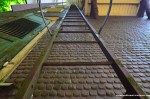
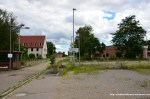
Sometimes you just gotta be lucky. Like my friend Nina and I were when we were walking up to the former Ammunition Depot Achern in the southern part of Germany. We didn’t know anything about the location except that it was there – and when we tried the handle of the gate it opened to our surprise. Right next to the entrance we found a small building in excellent condition, locked, a bicycle inside, the logo of the Technisches Hilfswerk (THW) on the side. In case you are not familiar with German institutions – the THW is a Federal Office, the official English name is Federal Agency for Technical Relief; the THW helps in cases of floods, earthquakes and other disasters. So the depot wasn’t part of the Bundeswehr (Federal Armed Forces) anymore, but now belonged to the THW… interesting, from military to civil protection. Right next to the building the road split 3 ways and we walked down the most southern one, towards the 17 former ammunition bunkers of different sizes and an abandoned train used for training missions. We took a couple of photos and then we heard voices… Damn! When we reached the end of the road we headed north to the middle road and saw a couple of guys on a training mission. Since they didn’t see us and we didn’t want to cause any trouble we took the most northern road and headed back to the entrance, continuing to take photos as we made a strange discovery in that area: A huge aviary inhabited by dozens of exotic birds. The former ammunition depot really wasn’t that abandoned…

I forgot how we knew, but when we came back to the entrance we realized that somebody must have had entered or left since we got inside. Maybe the gate was not fully closed anymore or we left it open and it was closed now. Maybe there was another bike… I forgot, but I remember that we knew that people were still coming / going. Being back to safety I got gutsier again while Nina decided to wait at the entrance just in case somebody would show up and lock the gate without us knowing; which would have been bad, because the place once was a restricted military area and still is in the possession of the German state – if we would have gotten caught we most likely would have been in trouble; but if we would have gotten locked in, there most likely wouldn’t have been a way out due to lots of barbed wire everywhere… and probably motion detectors on the fences. Nevertheless I went back inside to take a quick video before we finally left after about half an hour altogether.

I mentioned it before and I’ll stick with it: I don’t like infiltration and this was (hopefully…) the last time I did it; mainly because I misjudged the situation – I actually wasn’t aware that the THW is a Federal Agency, I thought it was a private NGO / NPO like the Red Cross, probably because 99% of its members are volunteers… So I guess I dodged at bullet at the abandoned ammunition depot! 🙂

(If you don’t want to miss the latest article you can *follow Abandoned Kansai on Twitter* and *like this blog on Facebook* – and of course there is the *video channel on Youtube*…)

Read Full Post »

Every once in a while you come across words in English that are actually German. Some of them you might know, like kindergarten or rucksack, others are not that well-known, like schadenfreude (malicious joy). Given that Great Britain is the home of modern rail transportation I didn’t expect to find a German term that doesn’t have an equivalent in English, but here we are: Ausbesserungswerk (composed of Ausbesserung = repair / correction and Werk = plant / facory). I never found a spelling with a lower case A, so I guess unlike the previous examples Ausbesserungswerk never became officially an English term, but there is an English Wikipedia entry, so that’s good enough for me…
So, what’s an Ausbesserungswerk? Well, an Ausbesserungswerk is a repair and upgrade shop for railway vehicles and their components. While the so-called Bahnbetriebswerke (train yard / depot / engine terminal – you get the idea…) take care of maintenance, small repairs and cleaning, the Ausbesserungswerke are responsible for bigger repairs, general inspections and modernization. Originally there were 84 Ausbesserungswerke all over Germany, but today there are only 18 left.

One of the closed, abandoned and partly demolished one is / was in the lovely town of Schwetzingen, famous for its palace Schloss Schwetzingen.
On October 14th 1912 the citizen’s committee of Schwetzingen unanimously decided to build an Ausbesserungswerk northeast of the train station. Construction began in 1913 and was finished in 1917 to be opened in 1918. Perfect timing, because due to World War I there was a huge demand for the repair of railroad vehicles and from its opening on the Ausbesserungswerk was the biggest employer in the Schwetzingen area for decades to come, with about 1100 people in 1920.
During World War II the Ausbesserungswerk was fortified with bunkers, some of them are still in existence today. Armored observation towers against air raids were installed on the top of some buildings and in late 1943 a shooting range was built on the business premises – resulting in air raids by the Royal Air Force on March 19th 1945, damaging the buildings and killing 22 employees.
From the 1960s on the Ausbesserungswerk Schwetzingen was in decline. The German post-war economic miracle was in full bloom and a lot of employees switched to more lucrative jobs. At first they were replaced by guest workers, but when there was less and less work the amount of employees was continuously reduced from 1974 with the objective to close the Ausbesserungswerk; against the will of the staff council and the works management. But resistance was futile and on October 11th 1983 the Federal Minister of Transportation signed a document to close the Ausbesserungswerk Schwetzingen. In April of 1987 some employees were relocated to the Ausbesserungswerk in Karlsruhe (closed in 1997, mostly demolished by now) and on December 31st 1989 more than 70 years of railroad history ended in Schwetzingen…
In the following years some of the buildings were used as a half-way house for ethnic German immigrants and applicants for asylum, but most of them were just left to decay and rot – kind of insane, since a couple of buildings of the Ausbesserungswerk were put under monumental protection, which means that they can’t be torn down just like that. That came into effect when in Mai of 2011 all the other buildings were demolished, to make room for a logistics center of the manufacturer of sports equipment, Decathlon, scheduled to be opened in April of 2013. The protected buildings were handed over to the city of Schwetzingen for free, shifting the responsibility (and cost…) to the general public. The federal state of Baden-Württemberg granted 1.5 million Euros in 2010 to redevelop the protected area in the southern part of the Ausbesserungswerk and the city of Schwetzingen is deciding these days what to do with the money and the buildings – most likely a mixed use for both residential and commercial purposes. Those plans might have been affected by a case of arson committed by an 18 year old homeless guy on March 21st 2012, causing damages to the amount of 100.000 Euros, but I’m not sure how or if at all.

The Ausbesserungswerk Schwetzingen was the first urbex location in Germany I ever visited. My trip back home in 2011 was rather rainy and disappointing in general, so when there finally was a sunny day I took my chance and had a look. It was a weird feeling though, since everything felt a bit “more real”. In Japan I can always pretend to not being able to read signs, that I got lost, that I don’t understand a word. In Germany those excuses are a lot harder to make, especially since I am not a good bullshitter in the first place. (On the other hand some things are a lot easier – on later explorations I was able to ask people passing by about the history of places and even ask for permission to take photos, both rather impossible for me to do in Japan…)
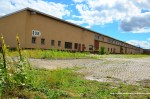
Sadly there wasn’t much to see anymore. Most buildings were either in really bad condition or completely bolted up with metal plates. There was an abandoned TV, some instructions signs on walls and a rule book regarding laundry and other aspects of daily life living in the half-way house, but that’s pretty much it. A nice stroll, 1.5 to 2 hours, the most interesting part probably the small playground for children in the back of the half-way house – nothing spectacular, but far from being a disappointment…

(If you don’t want to miss the latest article you can *follow Abandoned Kansai on Twitter* and *like this blog on Facebook* – and of course there is the *video channel on Youtube*…)

Read Full Post »

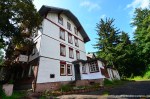
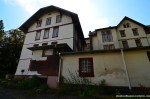
Since I’ve been terribly busy recently both at work and with several urbex projects / explorations it sadly has to be a short article this week; a location that took me just a couple of minutes to shoot, actually – the Kurhaus Sand (or Hotel Sand).

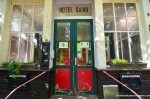
When I went on vacation to Germany in summer this year I met up with a kindergarten friend of mine, Nina. She became a regular reader of this blog and was eager to explore with me, so I planned a daytrip to the Schwarzwald (Black Forest) area of Germany. I had several leads there and thanks to an early start we managed to visit 7 (!) different locations on one day – possible only because some of them weren’t accessible; one of them being the Kurhaus Sand. Strangely enough a name that works both in English and German, but since kurhaus isn’t nearly as common as kindergarten let me give you a quick translation: health resort.

And that’s basically what the Kurhaus Sand was – a health resort in one of Germany’s most beautiful regions, the Black Forest. Not much more than a couple of houses in the middle of nowhere, Sand isn’t even a village. Its origin though is the now abandoned kurhaus. Around 1845 a mountain shelter was build on sandy soil (hence the name Sand, which means sand… Captain Obvious strikes again!) as a refugee for forestry workers. A couple of years later somebody started to sell beverages, with little success (the hut was subsidized by the city…), but after some state investments in 1874 the hut was turned into an inn under the direction of the retired country constable Josef Martin Weis at the age of 57. The place became more and more popular amongst hikers and in 1884 the previous head chef August Maier became the new tenant. In the early 1890s Maier bought, enlarged and enhanced the inn and re-opened it as the Kurhaus Sand in the presence of Frederick II, Grand Duke of Baden – the last Grand Duke of Baden. The area continued to thrive, so around 1920 a gas station was added, in 1930 a post office opened and in 1936 a police station started its service. During those days the ownership of the Kurhaus Sand changed several times, but I’ll spare you the details.

Nowadays all of these installations are closed. Only the 1949 opened Bergwaldhütte (Mountain Forest Hut), a convalescent home for children and later for policemen, is still in business – offering food and drinks for all travelers coming through on the popular Schwarzwaldhochstraße (Black Forest High Street).

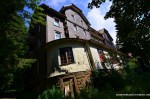
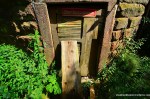
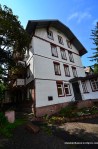
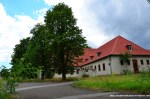
When Nina and I drove up to the Kurhaus Sand we were forced to stay inside the car for a couple of minutes as a cloudburst made it impossible to start our exploration right away. When we were finally able to get close we were still not sure if the Kurhaus Sand was really abandoned or not as the place isn’t really popular amongst German urban explorers. The building was in pretty good condition, but since there was no activity during a time that is considered the busiest vacation time in Germany it must have been abandoned… We were able to walk around the building clockwise once – no signs of anybody, no signs of vandalism, but also no way to enter the building…

It wasn’t until my return to Japan that I found out that a family named Wiedemann were the owners of the Kurhaus Sand from the 1930s on. In 1977 Günter Milz took over and turned the place into a popular destination for day trippers – he modernized the hotel part (baths, elevator, …) and his restaurant became famous for the cuisine of Baden; like Flädlesuppe, Käsespätzle, Maultaschen and Schupfnudeln. Milz retired in 1994, but I couldn’t find any information about the almost 20 years since then. Given the decent condition the Kurhaus Sand is still in it must have been opened for business for another couple of years, but who knows? Thanks to its remote condition hardly anybody would go there just to vandalize it… Luckily there are many local historians in Germany – maybe one of them finds this article and can add some information?

Read Full Post »

The Taylor Barracks in Mannheim-Vogelstang are one of those locations that are not really abandoned, but have the looks and feel of a deserted place. Cleared by the US Army on August 30th 2011 the Taylor Barracks are now under the administration of the BImA (Bundesanstalt für Immobilienaufgaben / Institute for Federal Real Estate), which has to decide what will happen to this former military base.

The Taylor Barracks, named after Private 1st Class Cecil V. Taylor who died in the last days of World War II and who posthumously received a Silver Star for courage in the face of the enemy, were built in 1939/40 by Nazi Germany’s Wehrmacht as Scheinwerfer-Kaserne (Searchlight Barracks) – most likely because it was home to the Flakscheinwerfer-Abteilung 299 (299th Anti-aircraft Searchlight Detachment) to defend Mannheim from bombings. From April 1948 on many, many US Army units were stationed at the Taylor Barracks; way too many to name them all. In the early years most of them were Ordnance Companies and Engineer Companies, later on a lot of supply and service battalions found their homes in Mannheim-Vogelstang.

(Fun fact: When I told my dad, a musician basically all of his life, that I had a look at the Taylor Barracks he told me that he played there on the opening night of a military club. When he asked for a whiskey coke the bartender handed him half a gallon of Jim Beam! The 70s must have been an interesting time…)

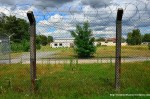
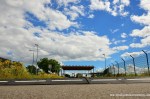
In the summer of 2012 the Taylor Barracks stood there waiting for a new purpose. Most of the buildings were in pristine condition, only some metal started to rust here and there. Also in pristine condition was the fence around the 46ha big premises – about 2.5 meters high and secured by barbed wire there was no way to enter the closed base. In areas considered a special security risk, like fence sections with streetlights, additional rolls of razor tape were installed on top of the fence and / or on the ground. And so the exploration I hoped for turned into nothing more than just quite a long walk…

Addendum 2013-09-09: It turns out that the good people at the BImA are great sports – instead of going after me for taking photos they link to Abandoned Kansai on their official page about the Taylor Barracks! 🙂 They also link to newspapers, the official homepage of the city of Mannheim and several others… but Abandoned Kansai is first! You can *have a look here*, but be aware that their website is in German…)

(If you don’t want to miss the latest article you can *follow Abandoned Kansai on Twitter* and *like this blog on Facebook* – and of course there is the *video channel on Youtube*…)

Read Full Post »

« Newer Posts