Feeds:
Posts
Comments

Archive for the ‘Kansai’ Category

When Conan was asked “What is best in life?” he answered “To crush your enemies, see them driven before you, and to hear the lamentation of their women.” – I’m pretty sure if the Mongol general would have asked him “What is worst in life?” Conan would have answered “To marry a Japanese woman, see her taking your paycheck, and to hear the lamentation about setting the AC to a ‘freezing’ 28° C in the middle of summer.”

Please forgive this provocative generalization of an introduction, but whenever I stumble across an abandoned love hotel I can’t help but be reminded of how different Japan is in so many ways to my home country Germany. Especially in the relationship department. What I wrote so far and will write in the lines to come is not an analysis of the Japanese society or even just its love life – I’m just describing what I see and hear as an expat living in Japan, which is quite different from the things one sees and hears as a tourist visiting Japan. After six years in Japan I tend to compare this country to a big amusement park – it’s shiny, it’s tidy, it’s expensive and everybody seems to be nice. But visiting an amusement park and working in an amusement park are two completely different things…

Last time I visited an abandoned love Hotel (*Love Hotel Gion*) I wrote about the love hotel industry in Japan in general – this time I will rant a little bit about relationships in Japan. Back home in Germany, when you talk about your girlfriend or wife, you are usually in the range of being honest to being more positive than it actually is; unless you have a beer with your best buddy, then it might turn into a bitchfest. Not so in Japan! The vast majority of people married to a Japanese woman, no matter if they are foreigners or Japanese, bitch openly about their significant others to everybody – constantly! For every happily married couple I can name two or three where the guy calls his wife “The Dictator” or at least doesn’t feel that it is a waste of time to feed his new-born kid after being pressured into having children… It’s depressing sometimes. (Maybe I should add that I never did any of the above and find Japanese women rather sweet and caring… but I was never married to one.)
While pretty much every woman’s biological clock starts to tick at a certain age that certain age is definitely lower in Japan. The big 3-0 seems to be the current number where cute, open-minded girls turn into little monsters obsessed with marriage – if you meet a woman past 35 you better look for rings right away and get prepared to father a child or two. But that actually is progress in comparison to a derogatory term popular for decades in Japan: Leftover Christmas Cake. Leftover Christmas Cake was a not so flattering way to call an unmarried Japanese woman over the age 25. In Japan Christmas is kind of an additional Valentine’s Day you spend with your significant other eating a beautiful, but extremely overpriced cake – and Leftover Christmas Cake is something nobody wants… Since the ticking deadline is now 30 instead of 25 the term isn’t as popular anymore and you can always see the surprise or even shock on a Japanese person’s face when you mention it.

But even if you get married before the age of 30 it seems like people just follow set behaviors, no matter if they make sense or not; like hardly anybody goes swimming in the ocean after September 1st because according to Japanese definition it’s autumn now – it doesn’t matter that it’s still 32° C outside, you don’t go swimming in autumn since it’s a summer thing to do. And it’s the same with married Japanese women. They quit their jobs, they dress differently, they behave differently. Again: Not all of them, but a lot. A couple of years ago a Japanese friend of mine, a cute girl in her mid 20s, wrote me something along these lines: “I know it’s a horrible thing to say, but I don’t want to work anymore. Maybe I should get married…” – I’m not making this up! In Japan the women have control over the money. No matter how much the husband makes or how high he is on the career ladder: The woman gets the paycheck and the husband gets some pocket money. And if he needs more he has to ask his wife – if he’s lucky enough to have access to a bank account he better remembers when and why he used the ATM, because it’s highly likely that he will have the justify the use of that card. One of the reasons guys married to Japanese women tend to bitch about their wives…

Wives that they sometimes barely know. While arranged marriages are not common in Japan it is not exactly unusual that parents introduce their daughters to suitable candidates – especially when their daughters have passed the devilish age of 30. Traditionally men and women are not platonic friends with each other – and if a couple isn’t working at the same company it’s not really rare that they see each other only once or twice a week, because they are both super busy at work; especially the guys. And that’s another big difference to what I’m used to – unless you are having a long distance relationship you see (and get to know) your significant other on 5, 6, 7 days a week where I come from; way more often than in Japan. With the result that a lot of men (including foreigners) are marrying Japanese women they don’t know nearly as much about as if they would have been in a relationship with a woman in a western country for the same amount of time. On the other hand that fact makes it easier to stay at work till 9, 10 or 11 p.m. every night… Who wants to go home to a wife and kids they barely know…?
For a lot of Japanese men it almost seems to be a hassle to have a relationship after all – the so-called Herbivore Men (草食(系)男子, sōshoku(-kei) danshi) are described as having an “indifferent attitude towards desire of flesh”. Whenever you think you’ve heard it all…

Don’t get me wrong, I’m sure there are many, many, many happy (happy!) marriages in Japan, but when I listen to co-workers and friends hardly anybody seems to be really happy in their marriage – and a lot of them cheat on their wives.

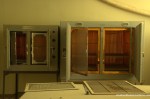
And that finally brings us to the exploration of the Furuichi Love Hotel in Hyogo prefecture – an original find I’ve never seen anywhere else before, including Japanese haikyo blogs! Like the *Love Hotel Gion* the Furuichi Love Hotel was more like a motel. You drove into a garage (this one even had closable doors!) and entered a small apartment from there – on the right side was a Japanese style toilet, on the left side a bathroom, straight ahead the fun room with the king size bed and all the other extras. Like the Love Hotel Gion the Furuichi Love Hotel was in pretty bad shape. Most garages were locked and the dozen rooms were accessible via a two small hallways in abysmal state – some vandals used a pickaxe for some remodeling. They did surprisingly little damage to most of the rooms, so I was able to take photos in three of them. Sadly the light from the hallway wasn’t enough to see anything there, so I had to use my flashlight again to bring some light to those abandoned love caves.

The rest of the area was in a state of destruction, too. Right at the entrance was a small house for the manager of the hotel, the interior covered by some smelly pink powder – most likely somebody emptied a fire extinguisher there. The backyard was turned into a junkyard, but if you are looking for a Japanese style toilet you might find an undamaged one there. Glass shards and pieces of porcelain were all over the place, but what really caught my eyes was a sex toy with a cable remote hanging in one of the trees – Merry XXX-Mas everybody!

(If you don’t want to miss the latest article you can *follow Abandoned Kansai on Twitter* and *like this blog on Facebook* – and of course there is the *video channel on Youtube*…)

Read Full Post »

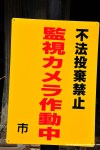
The Restaurant Kent, on Japanese haikyo blogs mostly known as the Good Omen Garden, is one of the staples of urban exploration in Japan. Located on quite a long country road connecting Osaka with Miyazu (home of the famous sandbar Amanohashidate, one of Japan’s three scenic views) the Restaurant Kent was one of the most popular local haikyo when I started doing urban exploration three years ago. Nowadays it lost quite a bit of its popularity, probably because it was photographed to death over the years – or maybe because there are a couple of signs announcing camera surveillance… which I totally respect if it’s true.
In this case the claim was complete bullshit, which annoys the heck out of me as it just cost me time and nerves. The signs looked rather new, so maybe they were put up before the local city administration set up the cameras (government involvement, even on the lowest level, is always a bad thing since it usually means serious business – private companies might hire some slackers, but you don’t want to mess with bureaucrats, especially in a country like Japan…), but when I visited the Restaurant Kent in March of 2011 there were no cameras or other forms of security; a topic I usually leave out, but if somebody lies to me blatantly I have to set the record straight!

Sadly there is not much else to report about the Restaurant Kent, since nobody seems to know a lot of facts about the place. I don’t even know if it was named after the county of Kent in South East England – or after the hugely popular cigarette brand “Kent”, which famously used carcinogenic blue asbestos in their filters from 1952 till 1956 (I guess at least British American Tobacco made cigarettes healthier after all…). The restaurant area itself seemed to be quite small, but neat. Previous explorers set up some tableware in front of a chair with armrests, but other than that there was not much to see.
The Good Omen Garden seemed to be much bigger – one of those festivity locations Japan so desperately needs when you want to be loud and / or with some friends. My buddy Dan and I found several party rooms of various sizes (Western Style and Japanese style, i.e. either carpet floor and tables or tatami floor and furniture that is long gone now…) equipped with all kinds of electronics including laser disc karaoke machines, beamers, microphones (not for karaoke as they were installed to the ceiling…) and mountings for camera and / or additional lighting. One room even featured a disco ball, although it was quite severely damaged – and so was the fake wedding cake one floor down outside. At the first look the Good Omen Garden didn’t seem that big, but then it turned out that there was a second building behind the first one, connected by a kitchen on the upper floor. There were more rooms, including some guest rooms for overnight stays and the usual array of baths for men and women.
My favorite item though wasn’t in the building, it was outside in the backyard – a wooden electronic organ, beyond repair thanks to years of abuse from vandals and weather; nevertheless an unusual and strangely beautiful sight.

Since the Kent Restaurant / Good Omen Garden was along a busy road, but not within a city, town or even village, there were almost always cars parked outside. But nobody had the intention to bother us, I guess the camera warning signs outside worked. When Dan and I were about to leave though, a pickup-truck with a small crane parked next to the building. We “escaped” through the front entrance while two or three men entered the building through the restaurant. On official order or to loot? We’ll never find out. Dan and I were kind of in a hurry anyway, since on the way to the Kent Restaurant we spotted a location I’ve never seen anywhere else before. But that’s a story for another time. Probably Christmas time…

(If you don’t want to miss the latest article you can *follow Abandoned Kansai on Twitter* and *like this blog on Facebook* – and of course there is the *video channel on Youtube*…)

Read Full Post »

Momijigari (紅葉狩, red leaves / maple leaves hunting) is almost as popular in Japan as the worldwide way more famous hanami (花見, flower viewing). In spring even the biggest couch potato leaves the house to view first the plum and then the cherry blossoms, in autumn they go to different spots to have a look at the autumn leaves. Of course every bigger city has special spots for both, but some countryside towns are pretty much dead for 50 weeks a year and completely swamped on two or three weekends. In Kansai prime examples would be Yoshino (hanami) and Minoh (momijigari). Why? Because those two spots are considered the best – or at least amongst the best. Surprisingly many Japanese people pursue the best of everything – the best food, the best company as an employer, the best spots to view nature. Or at least they pursue what the majority considers the best. With the result that some food is insanely expensive, employers with famous names exploit their employees (because they can!) and the best spots to view nature are so overrun that it’s not really fun anymore going there – you stand in crowded trains for hours just to be pushed past gorgeous trees and through crowded streets with souvenir shops.
So while half of Kansai “enjoyed” autumn leaves in Minoh and Kyoto (just to put up photos on Mixi and Facebook to let everybody know where they went for momijigari…) I made my way to the Hyogo countryside in late November of 2011. My goal was to climb a small mountain with an abandoned temple on top. 15 months prior I was able to explore an abandoned shrine (*you can your all about it here*), so I guess it was only natural to follow an abandoned Shinto site with an abandoned Buddhist site. (I know that there are plenty of abandoned churches – but how about mosques? Has anybody ever heard of an abandoned mosque?)

The Shuuhen Temple popped up on two or three Japanese haikyo blogs before, but it was surprisingly hard to locate. Even more surprisingly since the place is still marked on GoogleMaps, and when you are rather close you can find guide signs – which left me rather puzzled for a couple of minutes about how abandoned the place really was. I guess now it’s more abandoned than ever, because in September of 2011 the street up the mountain was closed. Halfway up the mountain a landslide flushed away the small asphalt road on a length of about 5 or 6 meters – even tiny cars could barely pass here anymore safely.
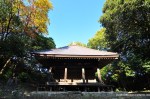
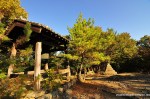
When I reached the mountain top I must have been one of the happiest people in all of Kansai: A stunning view, gorgeous autumn leaves and a temple all for myself. Sure, I couldn’t tweet “I’m in Arashiyama! (Be jealous!)”, but I wasn’t bothered by souvenir shops and crowded locations. Quite the opposite. When I was walking around I had to be careful not to run into one of many one square-meter large spider webs with a nasty middle finger long black and yellow spider in it. The abandoned temple itself was rather unspectacular. All buildings were closed, in rather good condition, and I didn’t even have a closer look if there was a way to open them. I’m not very religious myself, but I respect the beliefs of others and try to be respectful. (Which doesn’t keep me from making fun of them if it’s getting too ridiculous – you know, thetans, magic underwear and stuff like that…)

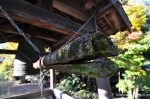
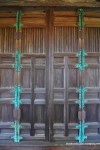
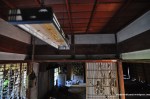
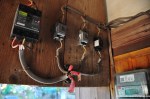
Open and rather interesting was the house of the monk that lived near the Shuuhen Temple. It’s hard to tell when it was abandoned. Some buildings in Japan fade away in no time, others withstand the ravages of time as if they couldn’t care less. It looked like it was built in the 60s or 70s, given the black and white photos of the bell and the belle; judging by the wiring maybe even earlier. The decay there was clearly natural, because thanks to the temple’s location the average bored youth vandal spares the place. Strangely enough the digital display of the power meter still worked…

The temple itself seems to have quite a long history. According to the homepage of the city it is located in, the Shuuhen Temple dated back to Emperor Kotoku’s days (596 – 654) and was first built in 651. In 1578 it was burnt to the ground and stayed a ruin for more than a century until 1682, when it was revived again. Not much information, but way more than one could get for most other temples and shrines in Japan… Now it is famous not so much amongst urban explorers, but more amongst Japanese fans of ghost spots (心霊スポット). I guess it makes sense to look for paranormal activity where people traditionally believe(d) in spirits.

Exploring the Shuuhen Temple was one of those nice, mellow urbex experiences. Sleeping in, taking some local trains, a nice and sunny autumn day, some hiking, some solitude, cold temperatures, but warm sun, beautiful countryside. A relaxed Japanese Indian Summer day…

(*Like Abandoned Kansai on Facebook* if you don’t want to miss the latest articles and exclusive content – and subscribe to the *video channel on Youtube* to receive a message right after a new video is online…)

Read Full Post »

„There is no vandalism in Japan!” is one of the most untrue urbex clichés – and whoever still thinks that I will prove wrong with this posting, especially when compared to the previous one. When I visited the *Tuberculosis Hospital For Children* for the first time three years ago it was hardly abandoned and barely touched. No signs of vandalism, no signs of protection. 8 days ago on the other hand…
When my haikyo buddy *Michael Gakuran* came to Kansai to explore my old urbex nemesis *Nara Dreamland* I was devastated I couldn’t join him since I made other plans for that day weeks ago. But I was free the next day, so we met up and I showed him my most closely guarded secret location, the abandoned tuberculosis sanatorium for children I visited and never talked about. Ever. To anybody.
Walking up a gentle slope I didn’t expect a lot of change. Sure, by now two Japanese explorers posted inside shots of the haikyo hospital, so there must be a way in now… But that’s it, right? WRONG!

Approaching the tuberculosis clinic the once locked gate was wide open… and 100 meters down the road we found a brand-new barricade. Well, it was brand-new at one point, now it was grotesquely bended and nevertheless almost flat on the ground. It actually looked like a truck ran over it. Again and again. Not one of those Japanese mini trucks! A massive, manly American one! Most windows of the building were boarded up – or smashed after somebody ripped off the solid wooden panels. A half-open box of plastic syringes was scattered in front of a side entrance and glass was basically everywhere. If I wouldn’t have known better I would have said that this location was abandoned forever and a day.
With all the doors broken up and half the windows smashed in, the Tuberculosis Hospital For Children was exposed to the weather for a couple of years – and it showed. A lot of rooms were moldy, in some the wallpapers were falling off already. To make things worse the hordes of vandals (or a single very serious one!) emptied several fire extinguishers in several key rooms (like the radiology and the laboratory), making it hard to breathe after a short while. And of course some areas were swarmed by gnats, but that’s kind of a given for abandoned places in Japan during autumn…
Although the concrete building featured quite a few glass fronts, a couple of areas were still boarded up and therefore dark; darker than a black steer’s tookus on a moonless prairie night. I didn’t expect that and left spare batteries for my flashlight at home, which didn’t influence the photo shooting, but the second video I took for your viewing pleasure.

Exploring an abandoned place I always try to relate to the place I visit – which wasn’t exactly easy at a tuberculosis clinic for children, especially since I just read an article about the Goiania accident in the Brazilian city of Goiânia. (In 1987 two metal thieves stole a cylinder from an abandoned hospital. They punctured it and scooped out some grams of a glowing substance before selling everything to a nearby scrapyard. There the cylinder was opened and people loved the fascinating material they’ve never seen before and spread it all over town by taking some home. To make a long story short – the substance was cesium chloride, a highly radioactive inorganic compound. To this very day the accident is considered one of the most catastrophic nuclear disasters; 4 people dies, more than 110.000 were examined for radioactive contamination.) So here I was, strolling through an abandoned hospital, fascinated by the countless medical equipment that was left behind…
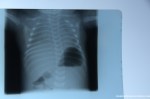
The Tuberculosis Hospital For Children turned out to be a treasure chest of objects big and small. While some rooms were (almost) completely empty, like the swimming pool and the cafeteria, others were stuffed with analysers, boxes of laboratory glassware and even private items like photos and drawings. Without a doubt one of the highlights was right next to the pool, a small room full of boxes containing envelopes filled with X-rays, MRIs and CTs – all of them taken at a hospital in Osaka, which kind of leads to the conclusion that Tuberculosis Hospital For Children was just an extension of a much larger clinic probably still existing… (More about the hospital haikyo’s history in a future posting, this is all about the exploration!)
Pretty much all of the images came with handwritten doctor’s notes, some of them bilingual (Japanese and English). *Michael* seemed to be quite fascinated by the found, so I left for the other building and only took a few quick shots right before we left. It’s a strange feeling going through other people’s medical files, picking up radiographs of potentially terminally ill people and holding them against the sun to take a photo – most of the MRIs seemed to be of adults, but especially the roentgenograms of kids were… eerie.
The massive concrete construction housing the hospital was connected by a bridge with a rather narrow lightweight building (remember the *previous article*?). Typical Japanese architecture of the 1940s / 50s with walls you could punch through. The floor was kind of yielding, but the huge hornets (or maybe suzumebachi?) flying through the smashed windows made my hurry anyway. As expected the lightweight building turned out to be rather unspectacular. One part was in catastrophic condition, so I didn’t even try to enter it. The rest was a couple of bathrooms, lots of empty rooms and some storage rooms – most likely the school part of the hospital in the 40s before it got its own building down the road. But like I said, that’s a story for another time…

(If you don’t want to miss the latest article you can *follow Abandoned Kansai on Twitter* and *like this blog on Facebook* – and of course there is the *video channel on Youtube*…)

Read Full Post »

Waverly Hills Sanatorium in Kentucky is without a doubt the most famous abandoned tuberculosis sanatorium in world (directly followed by the Beelitz-Heilstätten in Berlin), but a rather small Kansai clinic abandoned 20 years ago is slowly rising to fame – the Japanese Tuberculosis Hospital For Children in Osaka. (Of course the official name was euphemistic and translated to something like “Osaka City Resort House For Children”…)

I first visited the Japanese Tuberculosis Hospital For Children almost three years ago – the third abandoned place I’ve ever been to and the first I took video of. So please excuse the quality of both the stills as well as the film material. Back then I had no clue what I was doing… Hell, I barely knew the term haikyo! (Japanese for “ruin” and used as a synonym for urban exploration.)

It was an exciting time, my second day of urban exploration. Back then I spent countless hours doing research on locations and somehow I stumbled across this clinic nobody seemed to know about. It took almost two years after my visit till it appeared on a Japanese blog and almost three before it appeared on another one – and I guess that’s it, from now on it’s only a matter of time until the once secret place becomes public knowledge…

When I walked up to the clinic I had no idea what to expect. I didn’t even know how to enter the premises and if I was at the right location. I found a hole in the fence guarding an overgrown area, so I slipped through – the first time I ever slipped through a fence to get to an abandoned building. Sadly the terrain was so overgrown that I had to retreat and find another way in. So I followed several roads and small paths, slipped past a closed gate with my heart beating like crazy and then it finally appeared through the bushes, the Japanese Tuberculosis Hospital For Children.

I approached the building carefully since I read somewhere that it was still used on weekends for emergency drills. And indeed I heard some sounds from the first floor. Not voices, but machinery; probably some kind of generator. I calmed down a little bit and explored the area. All doors were locked and the shades of all windows I could get close to were down. Some doors had glass elements and looking through them I could see that the interior was spare, but in good condition. No signs of vandalism whatsoever – which kind of confirmed the claim that the building complex was only part-time abandoned. So I took a couple of photos and short videos before I got the heck out of there, keeping the location to myself , trying to prevent it from being damaged…

Recently I revisited the Japanese Tuberculosis Hospital For Children *haikyo* – what I found when I returned I will write about in the near future. If you would like to have a sneak peak please *like Abandoned Kansai on Facebook*, where I will post a short preview later this week. I’m sure it’ll send a shiver down your spine!

(If you don’t want to miss the sequel to this article you can *follow Abandoned Kansai on Twitter* and *like this blog on Facebook* – and of course there is the *video channel on Youtube*…)

Read Full Post »

Mukainokura is probably the most famous ghost town in all of Japan as it was featured in many books and by many websites. It is also quite easily accessible by ghost village standards – it’s less than 10 kilometers away from the next train station (more like 6 km actually) and you can drive right up to it if you have a car. And since it’s on top of a hill in the mountains of Shiga prefecture, there are millions of potential visitors from all over Kansai.

Mukainokura was the first ghost town I ever visited, back in the spring of 2010 – and the last location I ever visited with my colleague and dear friend *Enric*, since only weeks later his fugue kicked in and he left the company we both worked for back then.

Spending a sunny spring day hiking with a friend in the Japanese countryside is as good as a day can get in my book. And so Enric and I passed several beautiful temples, shrines and rice fields on our way to the mountains. Back then there was way less information about Mukainokura on the internet, including GoogleMaps, so of course we overshot the side road taking us to the deserted town by a couple of kilometers. After walking back on the beautiful valley road along a small river we finally hiked up the mountain. Almost 200 meters height difference on a length of about 700 or 800 meters – I can see why that village was abandoned! The location was beautiful, but going up and down that slope on a daily basis must have been a pain… Which applies to a lot of villages in the area, about a dozen, all abandoned. Mukainokura is just the most famous one.

Mukainokura was founded halfway through Japan’s most famous era, the Edo Period (or Tokugawa Period), in the early 18th century. Back then people were living off agriculture and by producing charcoal. Growing slowly for one and a half centuries Mukainokura was home to 95 people in 1880, living in about 20 houses. Although in the 1920s the production of ogatan, Japanese charcoal briquettes made from sawdust, brought a more advanced source of income to Mukainokura, the number of inhabitants decreased quickly when gas, oil and electricity replaced charcoal everywhere in Japan after World War 2 – and younger people moved from mountain towns to the big cities in the plains. Mukainokura had:
52 inhabitants in 1960
43 inhabitants in 1965 (12 households – 17 male, 26 female)
10 inhabitants in 1970 (3 households – 5 male, 5 female)
3 inhabitants in 1975 (2 households – 2 male, 1 female)
2 inhabitants in 1980 (2 households – 1 male, 1 female)
0 inhabitants in 1985

After more than 25 years of abandonment there was not much left of Mukainokura. About a dozen wooden houses (half of them completely collapsed, the other half partly), scattered across an area of several hundred square meters, connected by tiny paths, short staircases and terraces. More than two dozen winters with heavy snowfalls left the remaining houses in a dilapidated state – beyond repair actually. Nevertheless a couple of houses were still accessible and full of everyday items like magazines, china, photos, bottles, boxes and cans.

I guess in 2010 Mukainokura had more visitors than in 1980. During our two hour long visit Enric and I ran into four different groups having a look at the abandoned town. From a elderly couple that might have been born here to an early twen couple wearing designer clothes – the guy behind the wheel of the sports car showing his trophy girlfriend the spooky dark side of their home country… All of them were driving up the paved road, not walking, like us and for centuries the inhabitants of Mukainokura did.

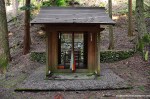
The two most vivid memories I have of Mukainokura involved nature though. When Enric and I strolled through the ghostly remains of the village Enric spotted a wild monkey in the forest. It was ignoring us completely, minding its own business – sadly I wasn’t able to get a photo of the furry fella. Right before we were leaving Mukainokura we were following signs to the Ido Jinja, the “Well Shrine” (井戸神社). Turns out that this shrine near Mukainokura’s well is quite famous till this very day, featuring signs that were clearly put up after Mukainokura was abandoned (one was dated, 1991, others looked even newer). The shrine was (and is) accompanied by a Katsura tree 39 meters tall and 11.6 meters in girth, according to the sign 400 years old. A wonderfully tranquil place and the perfect location to stop by before heading home…

(If you don’t want to miss the latest article you can *follow Abandoned Kansai on Twitter* and *like this blog on Facebook* – and of course there is the *video channel on Youtube*…)

Read Full Post »

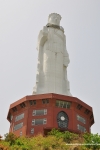
Ruins in Japan are often in such good condition that they are not recognizable as ruins at first sight. One example would be the World Peace Giant Kannon on Awaji Island, Hyogo prefecture – Kannon not being a spelling mistake, but the Japanese name for the bodhisattva associated with compassion, Guanyin. Other spellings include Kan’on, Kanzeon and Kwannon with the latter being the name giver for Canon, which was founded as Kwanon in 1934 and had the bodhisattva in its logo. I guess a World Peace Giant Cannon only exists in the minds of some really crazy people…

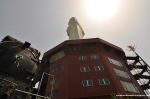
In 2010 I actually drove past the 80 meters tall World Peace Giant Kannon on its 20 meters tall socket building. Sure, it looked interesting, but the bright white statue seemed to be rather new in the warm sunlight of that day, so I didn’t even consider stopping. When I got back home and looked up what the statue really was I found out that most important of all it was abandoned… (It’s the 4th tallest statue in Japan and the 13th tallest in the world. Including the socket it ranks 3 and 10.)

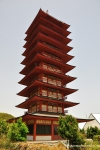
The World Peace Giant Kannon is actually part of the Heiwa Kannon Temple (heiwa meaning peace…), which was founded and funded by Toyokichi Okunai, a realtor who became rich dealing with office buildings, private apartments and business hotels in Osaka. The basis is a 5 storey building, 20 meters tall. The first floor was home to all kinds of religious exhibits as well as well as information about the famous Shikoku Pilgrimage (consisting of 88 temples along a 1200 kilometers long hiking course which usually takes between 30 and 60 days to complete). The other floors were stuffed with Mr. Okunai’s private collections – transportation, watches, china, art, armors. The fourth floor was home to a sightseeing restaurant, a banquet hall and a souvenir shop. If you look up the 80 meters tall statue on top of the building you can see some kind of a “collar” right below the statue’s head – that turned out to be an observation platform.

Although attracting up to 2000 visitors per day it seems like a lot of people were appalled by this mix of religion and commerce, some even accused Mr. Okunai of heresy. When Mr. Okunai died in 1988 his wife took over the management of the World Peace Giant Kannon until her death in February of 2006. After her death the Okunais’ real estate company closed the place right away and the Heiwa Kannon Temple started to fall in disrepair quickly, probably due to the lack of management of Mrs. Okunai during her final years. The Lehman Brothers took over, but they failed badly themselves at the time. Put to auction several times in 2007 and 2008 by the Kobe District Court nobody bid any money (which reminds me of the *Former Iranian Consulate* in Kobe…), so the temple was shifted to a separate company in September 2008. Since the World Peace Giant Kannon was liable to collapse (its exterior is molded of gypsum and resulted in the statue’s nickname Whiplash Kannon”) a committee was established in May 2009 by the local government, which took measures against the further deterioration of both the World Peace Giant Kannon and the nearby 10-storey pagoda in September of 2011. Just a couple of months after my buddy Gianluigi and I explored the place…

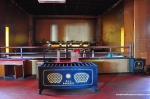
Walking up to the Heiwa Kannon Temple is actually quite impressive. The huge pagoda is right next to a parking lot and a closed restaurant. From there we had to walk up a hill to the back of the socket building. There we found all kinds of statues and items that didn’t go together very well, including a miniature version of the Statue of Liberty and an original Class D51 steam locomotive, the D51 828. We circled the socket building quickly and found an easy entry. The first floor was almost empty as most religious exhibits were gone. A quick look at the office on that floor didn’t give us much insight, so we headed up one of two staircases (one in the north, one in the south) that connected the floors. Some of them were locked, but we gained access to the restaurant on the fourth floor and the tatami room on the fifth floor. Approaching the fifth floor we heard voices, so we talked loudly to make ourselves heard. A minute or two later a young couple in their early 20s rushed past us, the guy holding a photo camera and the girl’s clothes not really being in order – your guess here is as good as mine…

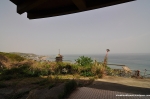
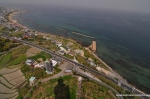
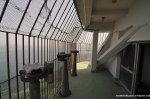
The tatami room once held the Mr. Okunai’s armor, but nowadays well armored soldiers of another kind were all over the floor: suzumebachi, Japanese Giant Hornets, 5 centimeters long killer machines. Luckily they were dead and it wasn’t summer yet, so Gian and I concentrated on the task at hand. In one of the hallways leading to the staircases we found an elevator – and nearby a mysterious claustrophobically narrow und pitch-black staircase that began to wind upwards. After spending a couple of minutes on the rooftop of the socket building admiring the beautiful gigantic Kannon statue we headed back inside and up the staircase. It was dark, the air was bad and some door-like openings revealed unpleasant views at the inside of the statue – even without knowing that people were discussing repairing the Kannon it was pretty clear that investments were necessary. After climbing stairs for about 10 minutes (it felt much longer…) we finally reached the observation platform, which offered both stunning and scary views. The location of the World Peace Giant Kannon between the coast of Awaji Island and the gentle hills was breathtaking – and so were the cracks in the gypsum everywhere. Buildings in Japan are barely constructed for eternity, but this one definitely has seen better days!

And so Gian and I walked down stairs for about 85 meters and left after spending surprisingly much time at this obviously quite popular abandoned statue – passing the also abandoned pagoda a group of about half a dozen Japanese twens was walking up the hill to have a look themselves. And I am sure they weren’t the last visitors as the maintenance work at the Heiwa Kannon Temple started not earlier than four months later…

(If you don’t want to miss the latest article you can *follow Abandoned Kansai on Twitter* and *like this blog on Facebook* – and of course there is the *video channel on Youtube*…)

Read Full Post »

The Tohoku Earthquake of March 11th 2011 was a horrible, horrible event. I was on the 16th floor of an office building in Osaka at the time, almost 1,000 km away from the epicenter – but looking at the faces of my Japanese colleagues I could see that most of them remembered another horrible earthquake: the Great Hanshin Earthquake (a.k.a. Kobe Earthquake), January 17th 1995; the second worst earthquake in Japan of the 20th century with about 6,500 casualties. 200,000 buildings collapsed, the total damage was more than 100 billion US-dollars – with massive consequences for all of Kansai as many companies moved to Tokyo and other parts of Japan, closing subsidiaries in Kobe, Osaka and Kyoto out of fear of another earthquake; which is kind of strange since a major earthquake is overdue in Tokyo for quite a while now…

One of the buildings that were severely damaged in Kobe was the former Iranian general consulate or Persia House, as it was known in its later days. In the 19th century Kobe opened its ports quickly for oversea trade and became host of one of the biggest foreign communities in all of Japan. Especially an area now known as Kitano was the home of many, many merchants from all over the world. Nowadays a major tourist attraction Kitano is the home of small antique shops, fancy bakeries, lots of wedding halls and bridal gown boutiques as well as countless French bistros – or whatever Japanese people think French bistros should be like… And of course there are the old merchant houses. The Weathercock House (German style…), the Denmark House, the Original Holland House – and before the Great Hanshin Earthquake happened there was the already mentioned Persia House.

The Persia House was a 2 storey wooden building with a kiritsuma style roof. Until 1981 it was the home of the Iranian general consulate in Kobe, afterwards it was opened to the public as a tourist attraction, housing the Persian Art Museum which showcased pottery of the Persian Empire. In 1983 the Persia House received three sets of leaded glass windows from Roger Nachman Glassworks, making it even more beautiful than before.

Unlike the neighboring foreign residences the Persia House wasn’t rebuilt after the Great Hanshin Earthquake hit Kobe – nor was it demolished. It seems like the ruin was left alone for almost a decade until in 2004 city of Kobe seized the premises since the owner didn’t pay taxes for quite a while. Since from that point on the ruin was a problem of the city a green stockade was erected to keep people from hurting themselves; and to make it harder for the ruin to catch the innocent tourists’ attention. Hardly anybody likes an “eyesore” like that in a preppy area like Kitano, but it seems like nobody had the will or authority to get rid of it completely – and that assumption would have been dead wrong as the city in fact tries hard to get rid of the whole problem. So far the premises were up for public auction nine times, but there was never a taker, although the minimum bid was lowered in six steps from 159 million Yen to 95,4 million Yen. (1.5 million Euro / 1.9 million US$ to 0.88 million Euro / 1.56 million US$)

When I was visiting the Persia House it was kind of funny to watch dozens of tourists pass through the narrow street the former art museum is located at without even realizing that there was a ruin. But as soon as I took my camera to take some photos over the picket fence 80% of the people passing by did the same. After a while I left trying to take pictures from another angle – when I came back to the front again none of the passing tourists seemed to see the ruins…

I guess those tourists are basically the main reason why the location is one of the least photographed haikyo considering its exposed location in the heart of Kobe. Hopping the fence wouldn’t have been a problem, although a cable and a connected electronic device might have been some kind of alarm system. But even if you made it past the fence you could always be seen by people passing by. On the adjacent estate to the north is actually the Original Holland House (and with that I can as well mark the *location on the map*…) – looking down from its back porch you probably have a pretty good view at the side of the ruins of the Persia House. Sadly the teenager at the entrance wouldn’t let me take a couple of photos and I wasn’t willing to pay the 700 Yen entrance fee for 2 minutes of not entering the friggin house. I recently spent 15.000 Yen on a roundtrip train ticket expecting to see a demolished amusement park, so I don’t consider myself cheap, but come on! The Dutch being of German blood I would have expected a little bit more solidarity…

Anyway: board fence + uncontrolled plant growth + tourists + shooting in west direction in the afternoon = a picture set I’m not very proud of.

To end this article on a funny note, please have a look at the last photo of the set. I took this nearby at one of Kobe’s major tourist spots. It’s the map of a public restroom. Not a map showing public restrooms in the area – a map of ONE public restroom. If your sense of direction is below par you better study the map before you enter to avoid getting lost… unless you are a man. The gentlemen’s section is so small it really is your own fault if you get lost!

(Update 2013-01-05: The Persia House was demolished since I took the photos – I’ll write a RIP article as soon as possible…)

Read Full Post »

The Mt. Hiei Artificial Ski Slope is an abandoned ski resort near the top of Mount Hiei on the border between Kyoto prefecture and Shiga prefecture. Famous for its Enryaku Tempel and the Kokuhoden Museum this holy mountain was once thought to be the home of gods and demons in the Shinto belief system. Interestingly enough the predominantly religion on Mt. Hiei has always been Buddhism. The monk Saicho founded the Enryaku-ji in 788 as the first outpost of the Tiantai / Tendai sect and it remained the Tendai headquarters till this very day, although it was famously destroyed by Oda Nobunaga in 1571 to vanish the rising power of the local warrior monks, killing about 20,000 people (including civilians) in the area. The temple was rebuilt soon after and is one of the main tourist attractions in Shiga prefecture today, accessible via two cable car lines, several beautiful hiking trails and a toll road for cars, motorcycles and busses.

Along the “Kitayama East Course” lies the Mt. Hiei Artificial Ski Slope, probably the most visited haikyo in all of Japan. On an average day during the hiking seasons in spring and autumn you’ll never be alone in the area as people are constantly passing by – about half a dozen hiking trails meet here and a close-by cable car station, serving the longest funicular line in Japan, attracts hundreds of people a day. Most hikers barely notice the abandoned ski lift and ski slope, hardly anybody peeks through the broken windows of the gear rental store or has a look at the undamaged closed restaurant. Why wasting a thought on that ugly stain when the surrounding nature is of such beauty? Because beauty lies in the eye of the beholder and though the ski resort on Mount Hiei was rather small it nevertheless offers a few neat angles now that it is abandoned.

Wanna know some facts about the resort? Okay, this is what I was able to find out: The Mt. Hiei Artificial Ski Slope was opened in 1964 and on November 1st of 2002 the newspaper Kyoto Shimbun reported that the ski resort was closed for good after a hot summer in 2000 and a way too warm winter in 2001 – followed by a year of temporary closing; which explains why both the restaurant and the rental store are still stocked with all kinds of items. In the almost 40 years of operation the already mentioned facilities welcomed customers for both a summer and a winter season. In winter a combination of natural and artificial snow (provided by a snow gun) offered fun for the whole family, in summer grass skiing was the business of choice. A lift transported guest for a distance of 170 meters so they could enjoy the pretty short slope of up to 200 meters with a vertical drop of 38 meters.

Oh, before I forget: The nearby “Garden Musem Hiei”, a flower park, once was an amusement park with a haunted house, a small Ferris wheel and a viewing platform, but I guess it was converted quickly enough to never been considered abandoned.

And that’s it for now from Mount Hiei. For now, because the ski resort was actually my second urbex trip there and my fourth or fifth overall – I really like Mount Hiei! Next time I’ll take you there I’ll either show you an abandoned rest house on a steep slope or a mysterious construction I’ve never seen anywhere else on the internet…

(If you don’t want to miss the latest article you can *follow Abandoned Kansai on Twitter* and *like this blog on Facebook* – and of course there is the*video channel on Youtube*…)

Read Full Post »

Sometimes you just gotta be lucky. Like I was on February 11th 2011.
Living in central Kansai you kind of forget about winter. Temperatures drop to 5° Celsius and people complain about how cold it is. There are barely ever minus degrees. Sure, if you hop on a train and go to the nearby mountains you can enjoy some snow. But in the Osaka Plain? Not so much. In the first 4.5 years of me being in Japan it happened once that it snowed strong enough for the white beauty to accumulate on the ground – but that was long before I started urban exploration.
On February 10th I met with some current and former colleagues to have a couple of drinks as the next day was a national holiday – a flip dark chill winter bastard though dry. I remember mentioning how much I missed snow and that there hasn’t been some in three years. Well… When I woke up the next morning at around 9.30 a.m., slightly hung over, I opened the curtains so see… snow! Everywhere! And it was still coming down in beautiful large flakes. I slightly panicked as it was already quite late (for a haikyo trip). Where should I go to? A new place or revisiting one? And which one of them? Would there be snow, too? I always wanted to see *Mt. Atago* covered in snow, but in addition to the train ride I’d need to take a bus… and they were most likely cancelled. My mind spun for a couple of minutes before I came to the conclusion that there was only one place to go. A place I never wanted to go back to: Nara Dreamland!
So I took a quick shower, made sure that my equipment was ready and headed to the train station. 80 minutes later I was in Nara, pleased to see that the whole city was covered by a thick layer of snow, too. Reaching the Dreamland it was still snowing heavily and I went straight for the *Eastern Parking Lot* with the parking garage, the hotel and the iconic main entrance. The DreamStation in the background was definitely a welcomed bonus, but most important of all: You can enter without jumping fences or ignoring “No trespassing!” signs; you just have to know where – definitely a plus in case security shows up with the police… About half an hour later it stopped snowing and almost instantly I heard dripping water. Yes, even before the sky turned from dark grey to light grey the snow began melting! I sped up to take some more pictures of this oh so familiar place (noticing unpleasant changes like the ugly graffiti at the former pachinko parlor) and hurried over to the western parking lot, another one of my (rather risk-free) favorites. By the time I was actually ready to enter Nara Dreamland itself half of the snow was already gone. Happy with the pictures I already took and not willing to risk them I decided to call it a day and went back to JR Nara Station – where I found barely any proof that this was a very snowy day…
But I really was lucky that day. Lucky that it snowed. Lucky that it was a national holiday and I didn’t have to work. Lucky that I didn’t oversleep completely. Lucky that I decided to go to Nara Dreamland. While a Japanese blog was quicker than I taking and posting night shots of Nara Dreamland I’m happy to present the first snow photos of Nara Dreamland, although it took me almost a year to post them. Please enjoy and tell your friends!
(For all your Nara Dreamland needs please have a look at the Nara Dreamland Special. For a look at the area around Nara Dreamland on GoogleMaps, including some fancy icons linking to articles on Abandoned Kansai and videos on YouTube, please *click here*. If you don’t want to miss the latest postings you can *follow Abandoned Kansai on Twitter* and *like this blog on Facebook* – and of course there is the*video channel on Youtube*… Oh, and don’t worry: Nara Dreamland is neither Japan’s last abandoned theme park nor is it in immediate danger of being demolished. NDL will make many more appearances on this blog, most likely all of them with unique videos…)

Read Full Post »

« Newer Posts - Older Posts »