One thing Japan is famous for all over the world is its bathing culture – which is hard to believe if you ever had to spend some time on a rush hour train…
While surprisingly little of Japan’s vast coastline is used for swimming (due to pollution, rocky shores or cement tetrapods) there are three different main terms to describe Japanese baths:
furo (風呂): usually the polite form “ofuro” is used for this traditional wooden bathtub
onsen (温泉): hot spring, sometimes translated as spa, especially when part of a hotel, ryokan (Japanese inn) or minshuku (Japanese bed and breakfast)
sento (銭湯): communal bath house – onsen and ofuro can be part of a sento
The use of those three terms can be confusing at times. While (o)furo technically describes a bathtub (traditional ones made of wood, modern ones made of plastic) with steep sides of about 60 cm height used for a relaxing soak at 38°C to 42°C after (!) you cleaned yourself, it can also be used for the public bath at a gym – although those baths fit more what is describes by the term sento.
A sento is a communal bath with a locker room and a bathing area – gender separated! You get undressed and lock your clothes before you enter the tiles bathing area with a hand towel. Near the entrance you usually find small stools, buckets and faucets. There you sit down and clean yourself before you enter the bathtub, which can be tiled or wooden – and therefore resemble ofuro. (To see what not to do, watch the movie Mr. Baseball…) Modern sento also include small saunas similar to the ones you know from your home country.
Onsen are hot springs and the most famous part of the Japanese bathing culture. Indoor onsen look much like sento and their number is quite low – the vast majority and well-known to everybody even slightly interested in Japan are outdoor onsen, also known as roten-buro (露天風呂). The behavioral code at an onsen is pretty identical to the one at a sento – the main difference is that onsen are fed by natural hot springs, not by heated tap water; and that they are usually more luxurious and beautiful – dozens of countryside towns all over Japan are famous for their onsen resorts and a lot of places to stay charge several hundred bucks per person and night (including breakfast and dinner).
Personally I am not a big fan of ofuro, sento and onsen – mainly because the water is just way too hot for my taste. I’m sweating enough as it is in Japan thanks to the rather high humidity here. I really don’t need to soak myself in water that is higher than my body temperature. The other reason, to be honest with you, is the fact that you stick out there as a foreigner – and I am really tired of being stared at. It’s bad enough at the subway sometimes, even in a city like Osaka. Imagine you being the only foreigner in a countryside bath then… If I’d be the last man on earth and would show up in my birthday suit at the “World Congress of Nudist Nymphomaniacs” near a naturist beach of your choice – I couldn’t earn more stares that way! I get it, most Japanese men don’t have the opportunity to see a naked foreigner and they have an urge to find out if the cliché is true and everything is smaller in Japan, but come on! It’s really impolite…
(Fun fact: Most Japanese people don’t know that public bathes in Japan were mixed until the Meiji era (1868-1912) when the nation started to open to the west. Germany, especially the eastern part, has a long naturist tradition and when I tell Japanese friends that we have mixed nudist beaches and bathes in Germany they are totally shocked and claim that they would never go there since people must stare at each other all the time, which isn’t the case at all. Fact of the matter is that I get way more stares fully clothed on a train in Japan than naked at a beach in Germany…)
Exploration
The Meihan Health Land technically was an onsen since it was fed by a natural hot spring, but it lacked most of the idyllic countryside aesthetics that come to mind when hearing the term – it looked more like a western spa trying to copy some Japanese flair. Located right next to one of the few free of charge highways in Japan and at least 30 minutes away by foot from the next train station it was clearly targeting the masses – families and busses full of tourists; a gigantic parking lot of more than 20.000 square meters supports that claim. The building itself, constructed in 1987 during the Japanese asset price bubble, was about 5.700 square meters big – it seems like it was the first “super sento” in Japan (or at least one of the first) and quite a lot followed. The Health Land closed 2 decades later with a renewal open planned for July of 2008 or 2009, but now it is on sale for 430 million Yen (currently about 3.5 million Euros / 4.6 million Dollars) – a sum it might have been worth right after it was closed, but a mere 2 years later, during my visit in November of 2011, it was already in abysmal condition.
The regular entrance fee for adults was 1300 Yen with an additional surcharge of 1050 Yen for guests staying overnight – yes, the Health Land was a 24/7 facility, offering loungers for tired guests. And of course the usual services like restaurants, shops, karaoke, …
Located in the mountains of Mie prefecture the running expenses must have been insanely high (considering that there is much isolation, but hardly any insulation in Japan…) and I am not surprised at all that the Health Land went bankrupt. I am surprised though how fast it fell into disrepair. The few photos I saw before exploring the place myself made me expect a super sento in good condition. What I found when I arrived with my buddy Hamish was a shock. From the outside the building still looked amazing, easy to see from far away thanks to two gigantic Chinese dragons on the top of the roof. The huge red lantern in front of the Health Land had seen better days, but the full amount of damage the place had suffered was only visible after entering.
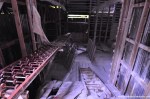
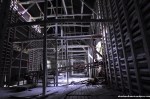
The yakiniku (grilled meat) restaurant in the same building was smashed to pieces and so was the lobby of the former spa. There the ceiling was high, maybe 5 or 6 meters – nevertheless it looked like it saw an outburst of violence with damage far beyond anything natural decay could do within a year or two. I have no idea what happened there. Some of the damage, especially the water on both 1F and 2F, could have been explained by the holes in the roof – but how did those holes get into the roof in the first place? The place really looked like as if a supernatural force ripped it apart…
Next to the lobby we found a snack bar and deeper into the darkness of the building was a staircase to 2F as well as the separated bathing areas for men and women, both severely vandalized. The steam room of the men’s area featured some neat female nude drawings – drawings that attracted some homeless people, or at least one person. We found some belongings there, including a newspaper barely 2 weeks old..
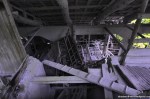
Sadly the whole area, for both men and women, was smashed beyond recognition. Windows were kicked in, mirrors were broken, metal installations were ripped apart. Carpets and wallpapers were moldy and water was dripping everywhere.
The upper floor was in even worse condition. The restaurant area was only recognizable due to some signs, the former party room with a stage looked like it was vandalized and abandoned a decade ago. Pretty much all interior was either gone or smashed. Water and mold everywhere. Not really a pleasant exploration, but you never know in advance what you’ll find…
Like that taxidermy bull in some kind of concrete storage underneath the Health Land. We were already ready to leave when we found that half-overgrown door that lead into the building again… and there it was, a stuffed bull, covered by what looked from the distance like an Ostfriesennerz (“East Frisian Mink”, a yellow hooded heavy-duty medium-length PVC rain coat – and you thought German terms were long!). Of course it wasn’t the famous German clothing item, just a simple tarp. Nevertheless a neat find that put smiles on our faces, before we walked to the next train station; wondering how the Health Land could get into that kind of state so quickly.
(If you don’t want to miss the latest article you can *follow Abandoned Kansai on Twitter* and *like this blog on Facebook* – and of course there is the *video channel on Youtube*…)













 Abandoned Kansai