When *Michael* and I approached the Nakagusuku Hotel Ruin I knew we were in for a treat. I’ve explored enough ruins (about 200 so far…) to recognize a triple A, a five star, a first class abandoned place. But in this case I had no clue about the epic glory that was waiting for us. I actually didn’t find out until 5 hours into our exploration. At that point I was lying on the hot concrete roof of the hotel in the merciless Okinawan sun, hiding from a group of tourists visiting the Nakagusuku Castle, when a gigantic Lockheed C-130 Hercules (Edit: Thanks to La Mian World I now know that it was a C17 Globemaster! Which replaced the Hercules…) was heading towards me as if it was trying to bomb both the castle and the hotel…
“But how did it come to this?”, I hear ya say. Well, it’s a long story. Come closer, and I’ll tell ya. It all started… earlier that day. And what a day that was. It’s what I call… an excellent exploration day. (To everybody not admiring Conker’s Bad Fur Day: Sorry for this silly paragraph, I just had to do it. And if by any chance Robin Beanland and / or Chris Seavor read this: Thanks for creating one of the best platformers ever, a true masterpiece!)
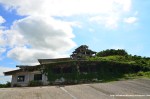
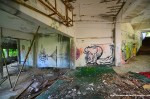
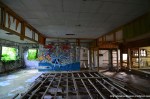
If I would have judged Nakagusuku Hotel Ruin after the first two hours I would have been disappointed. Yes, it was big. Yes, it was made of concrete. Yes, it was abandoned. Yes, it was overgrown. But entering the place and following the beaten paths countless urban explorers and by-chance-visitors have walked along for more than 30 years was actually quite disillusioning. The hotel looked awesome from the distance, but the entrance area was rather dull. It even had a burned-out area, though there was hardly anything to burn. I didn’t want to stray too far away from Michael since last time he visited the place he saw a white pick-up truck driving by and I read in one report that there was security. So at one point, probably two hours into our little adventure, I walked up to Michael and told him that I was bored – after he spent about half an hour taking pictures of a column of ants at the wall of a small room. My highlight up to that point? Taking photos of a singing bird sitting at one of the smaller roofs outside…
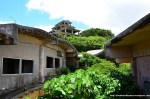
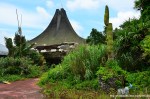
We continued to the north across a little covered bridge over a small road (leading up the hill to the top part of the hotel) – and there things started to become interesting. While the architecture at the entrance area was quite quirky (wide aisles, small rooms and corners that didn’t have a clear purpose) all of a sudden it became downright weird. The annex wasn’t properly connected to the main building, it was about a meter too low. And there were no stairs, not even a ladder. But it got stranger… and stranger… and stranger. (You can see all of that in the video I published with *the first article about the Nakagusuku Hotel Ruin*.) The staircase in the annex… it wasn’t high enough for an adult to walk upright and it was freakishly narrow. Nevertheless that’s where we headed next. If we were incautious Michael and I could have been seen from the castle, but we had a great view at the overgrown lower parts of the hotel and at the landmark top of it. Michael wasn’t happy with the cloud situation, so while he killed some time on the roof I took the long video I published with the last article – we agreed to meet in the burned out main hall later. From there we walked up the mountain and entered the annex complex again. Basically the area you can see in the first half of the third video. Michael and I left the building to take some photos when all of a sudden we heard voices. We ducked down, being as quiet as possible. The voices came closer… two female, one male – obviously American tourists who saw the hotel ruin when visiting the castle ruin. They passed by us without noticing us when Michael realized that the cloud was finally gone, so we went back to the little tower of the annex building. While still on a lower floor the family came back and we decided to scare them a little bit. Sadly we were quite indecisive about it, so by the time Michael yelled at them in Japanese with a low aggressive voice right out of a classic samurai movie they were already too far down the road for us to see their reaction. Well, it wasn’t that funny anyway…
So up the annex building and taking more photos outside. That’s when Michael realized that he could walk across the roof of the covered bridge to reach the roof of the main building. I’m sure it was perfectly safe, but since I saw another way to reach the main building’s roof I made my way through the main building when I received a phone call from Michael – he was pinned down on the roof thanks to a bunch of tourists at the castle. So I went back to get his tripod and finally made it to the upper part of the main building to get onto the roof myself. Five minutes later I was lying there with the C-130 Hercules flying over my head… and I couldn’t get a close-up since I had my ultra wide-angle lens mounted and not a snowball’s chance in hell to switch it in time. (Edit: Thanks to La Mian World I now know that it was a C17 Globemaster, not a Hercules…)
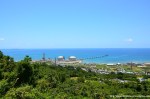
After having seen most of the Nakagusuku Hotel Ruin Michael and I were willing to take more risks and finally walked up the hill to the exposed skeleton part of the hotel ruin. On the ground floor there we made an unexpected discovery – a completely burned out and rusted car INSIDE the building. It definitely was a car, but in absolutely abysmal condition, so I have no idea which manufacturer or model it was. Then we went to the top of the building and enjoyed a spectacular view – the hotel, the castle, the small cities and of course the Pacific Ocean and the East Chinese Sea. A slight breeze and the gorgeous view almost made us forget that we were completely exposed.
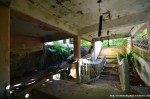
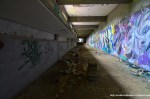
On the way back to the exit I shot the second and the third video, both published with this article. Although the exploration was great I was kind of eager to get out of the deserted hotel after seven hours when Michael found a building we hadn’t been to yet. Which lead to a lower floor, which lead to a balcony, which lead to a whole new world. The annex building we explored 4 hours earlier was actually the gateway to an area mostly overgrown and lower than the rest of the construction, reminding me of Mayan or Aztec temple in the middle of the jungle. The sun was already setting (it was past 5 p.m. which basically prefaces the end of the day in Japanese spring time…) and bathed the area in warm light. As much as I wanted to get out of there, this part of the hotel was just way too gorgeous to be left behind without us having seen it. So we went deeper and deeper, up and down staircases, through walls of green and past all kinds of weird and sometimes dangerous architecture (one photo shows a flight of stairs separated by a massive concrete handrail – if you would have walked up the right side you would have banged your head unless you are smaller than 30cm…). I really wonder if there was no construction supervision agency in Japan back in the 70s… or what they did all day. Or what the architect was paid for. If there was an architect. Why nobody on the construction site said “If we do it like that people won’t be able to use it properly…”. But whatever, for people with a predilection for the surreal it’s a mind-blowing place to see, although some things don’t make sense at first. Like when Michael jumped into the now empty pool and had no clue where he was, because things just didn’t made sense at first sight. From the pool we had an awesome view looking up to the hotel complex, some overgrown concrete water slides in the background. At that point we were in such a hurry that we didn’t even set up our tripods for good photos – snapshots, snapshots, snapshots. When we finally left the lost civilization area we did it via a part of the building that was home to the cage like installations you can see at the end of the last video where my camera ran out of memory space. It seems like the hotel had a rather decently sized half-underground zoo, although I’m pretty sure that no animal ever lived there. The main area there was composed of a maze of stairs, most of them basically unusable thanks to the ubiquitous misplanning – I loved it, though I’m about 1.90 meters tall. It’s hard to believe that a place like that exists, especially when coming from a country where the state’s building control department is such a powerful institution.
After about eight hours Michael and I finally left the Nakagusuku Hotel Ruin, exhausted but happy.
When Michael told me about the hotel *two months prior to our visit* I was skeptical. When I saw it that morning I was excited. After two hours I was slightly disappointed – and from that point on it grew on me. And it actually kind of still does. The Nakagusku Hotel Ruin is one of the most amazing places I ever had to the pleasure to explore. The location was gorgeous, the fact that most of it was never finished lessened the effect of the always present vandalism, the warm and sunny spring day and a couple of singing birds following us up the mountain was heartwarming, no security present was a pleasant surprise, the size of the site was enormous (I think it would take about an hour of straight ambling without stopping to look at details to see the whole complex) – but what really separated the Nakagusuku Hotel Ruin from most other places was the constant flow of surprises. The architecture of the place was mind-blowing in so many ways, and items like the wrecked car made it such a unique exploration. It actually made it an exploration. At so many other urbex spots you get what you expect and once you’ve seen one floor you’ve basically seen 90% of the site. The Nakagusuku Hotel Ruin put exploration back in urban exploration – I never knew what to expect behind the next corner, on the next floor, below the next overgrown flight of stairs. And although I spent about eight hours on the premises the Nakagusku Hotel Ruin became one of the few places I really want to revisit, if possible in late winter (whatever that means in Okinawa…) when there is a little less vegetation – without the shadow of a doubt the best abandoned hotel I’ve ever been to, probably the most amazing urbex hotel in the world!
(If you don’t want to miss the latest article you can *follow Abandoned Kansai on Twitter* and *like this blog on Facebook* – and of course there is the *video channel on Youtube*…)
ADDENDUM 2013-2-12: On February 9th user stuzbob left a comment on one of the videos, shedding some light on the car remains: “The engine appears to be a Nissan J-series and the remains of the leaf springs and solid frame at the back lead me to conclude that it was, at one time, a Nissan 520 or 521 pickup.” Thanks a lot stuzbob, much appreciated!





















 Abandoned Kansai