Feeds:
Posts
Comments

Archive for the ‘Rhineland-Palatinate’ Category

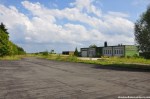
After a couple of explorations with family and friends during my summer vacation 2011 it was about time to fly solo for the first time in Germany. The place to go: an abandoned shipyard along the river Rhine in a really nice little town called Germersheim, the city of syringa and the nightingale, just south of the way more famous Speyer. Germersheim was first mentioned in written form in 1090, but it was most likely founded more than a 1000 years prior to that. One of many beautiful small towns in the Rhine-Neckar Metropolitan Region.

It was kind of by chance that I stumbled across the place since I never saw it on the usual German urbex blogs and homepages – but the more excited I was about it. So enjoy, dear German urban explorers. While you can…

At first I was actually thinking about calling this location Shipyard G# – but that would have prohibited me from writing about the long and and turbulent history of the Shipyard Germersheim. Founded as “Oberrheinische Schiffswerft Spatz & Co GmbH” (Upper-Rhenish Shipyard Spatz & Co., Ltd.) in 1927 the company was renamed to “Germersheimer Schiffswerft” (Shipyard Germersheim) in 1953 after the “Reederei Reichel & Co” (Shipping Company Reichel & Co.) bought into the dockyard – but for whatever reasons the sign on top of the buildings says “Schiffswerft Germersheim”. In 1989 the company had to file for bankrupcy, but a rescue company with the creative name “Neue Germersheimer Schiffswerft” (New Shipyard Germersheim) was founded. Interesting fact: When Germany granted a guarantee to build two ships it was ordered by Brussels in December of 1990 to withdraw it since the whole procedure was repugnant to the Treaty of Rome (the whole thing was rather complicated, but it had something to do with a development aid project for the benefit of Senegal – we’ll kinda get to that topic later on again…). The new company was nevertheless successful for a couple of years, but finally failed in 2002. In 2009 a few scenes of an episode of the most popular German crime TV show “Tatort” (there is an English Wikipedia entry about the series if you wanna look it up… more than 800 episodes since 1970 – eat that, CSI!) called “Tod auf dem Rhein” (Death on the Rhine) was shot at the abandoned (New) Shipyard Germersheim and broadcasted in early 2010. A guy passing by on his bike told me that there are plans to tear everything down to build some mansions (with marinas, I guess), but nothing has happened yet to my knowledge…

The shipyard started by building inland cargo ships and pusher crafts, but later added tugboats, tankers and passenger ships to their portfolio. In the Spatz years the dockyard was also famous for (and a European leader in) repairing and conversions. More international fame was gained with the towboat Zongwe and the coastal motor vessel Lukuga, both built in pieces at the shipyard in Germersheim and assembled on location at Lake Tanganyika. In 1990, after the reboot, the ferry Le Joola (80 meters long, 12.5 meters wide, designed for 536 passengers and and a crew of 44) was built to cruise the coast of Senegal – one of the biggest ships ever to be built on the Upper-Rhine. 2002 turned out to be a horrible year for both the shipyard and the Le Joola. The ferry capsized and sank off the coast of Senegal, more than 1800 people died while 65 were rescued, making it the second largest naval desaster since World War 2.

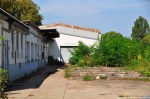
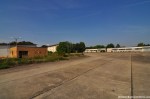
I actually didn’t know any of that background when exploring the shipyard on a hot and humid late summer day. The gate to the area with access to the Rhine was wide open, so I had a look at the backside first. Later I spotted some anglers and probably some geocachers at the waterfront, too (there is a cache on the premises or at least very close by… lost places geocaches are becoming more and more popular and people go there with their whole families). Back at the main street I saw that the sliding gate at the entrance and the porter’s office were closed – the door to the management office building was secured by an additional chain with a heavy lock. I decided to have a look at the rest of the area from the outside to think about how to enter, so that’s what I did. After visiting the *Kawaminami Shipyard* just a couple of months prior it was interesting to see a dockyard that survived way longer although it was founded earlier. Some of the construction buildings were very old, probably from the founding days – too bad they were pretty much empty. So was the office building – way more modern, but empty. And moldy! I’m sure the hot and humid day didn’t help, but I could actually feel how it became more difficult to breathe inside of the building – that’s why I kinda hurried to get out of there again.

It’s hard to imagine that once 140 people were planning, constructing and welding ships at this quiet, almost tranquil place. All the machines were gone and about half of the former dockyard area was already taken over by another business – one that continues the metal work and painting: a car tuning and repair shop. (At least that’s what it looked like from the distance, I didn’t get really close to avoid drawing any kind of attention.)

Visiting the Shipyard Germersheim was a great experience overall. Sunny weather, a pretty much unknown and rather unique location with a long history und barely any hazards – it’s good to know that there are still places to uncover back home in Germany…

(*Like Abandoned Kansai on Facebook* if you don’t want to miss the latest articles and exclusive content – and subscribe to the *video channel on Youtube* to receive a message right after a new video is online…)

Addendum 2014-08-06: Three years later I *revisited the Shipyard Germersheim* – only to find it completely vandalized… 😦


Read Full Post »

Japan is one of only 25 countries in the world without military – at least by some people’s definition. Others see it a little bit different thanks to Japan’s Self-Defense Force (自衛隊, Jieitai) with active personnel of about 240,000 people – plus about 60,000 in reserve. Abandoned military institutions are nevertheless rare in Japan, usually places (partly) given up by the Americans, like the Tachikawa Air Base, the Fuchu Air Base or Camp Drake – all located in the Tokyo / Yokohama area.
So when I was back in my home country of Germany for vacation I was eager to explore a military basis of the Federal Armed Forces / Federal Defense Force / German armed forces – or just Bundeswehr (that’s what they are called in German). While the Jieitai are still going strong the Bundeswehr had to deal with several structural reforms over the past two decades, main reasons for that being the fall of the Iron Curtain and the German reunification in 1990. Back in the 1980s the Bundeswehr had about half a million employees (career soldiers and conscripts), in 2010 the number was down to 250,000 – with plans to reduce further to a little as 175,000 soldiers; about a quarter of what both German armies (Bundeswehr and NVA (Nationale Volksarmee – National People’s Army)) had combined in the late 1980s… Reducing personnel that seriously you can’t (and won’t…) maintain all the military bases. A lot of them were demolished, some got reconverted to housing projects and business parks – but a few slipped through the cracks and became abandoned; because nobody took proper care or because there were problems reusing the property.
The Federal Armed Forces Depot Pfeddersheim (Bundeswehr-Depot Pfeddersheim – officially “Wehrbereichsgerätelager IV”) is one of these cases where the infamous German bureaucracy took its toll; on a personal note: German bureaucracy actually isn’t that bad, especially when compared to other countries. Built to house Car Pool Company 621 (Fahrzeugpark-Kompanie 621 – and by company I mean the military unit, not the business…) in the early 1950s on the site of the the cannery Braun AG (Konservenfabrik Braun AG), a factory of international fame in business from 1871 till 1951, the depot was one of the main Bundeswehr storages in Germany for many decades. It was closed with effect from 2004-12-31 with the last employees leaving by 2005-03-31 – at that point only 14 people were working at the depot.
Of course early on local politicians were aware what was going to happen and they tried to make use of the location as smoothly as possible, even visiting the still active depot in late 2004. Since Pfeddersheim lost its indepence in 1969 and now is part of the venerable city of Worms a lot of people have a say in what’s going to happen – the Institute for Federal Real Estate (Bundesanstalt für Immobilienaufgaben / BIMA), a city planning officer from Worms, a municipal administrator from Pfeddersheim and of course the citizens of Pfeddersheim; just to name a few. And while everybody was debating whether the depot should be turned into a housing project with a supermarket or being used by established and new businesses the usual hordes of bored youth vandals trashed the place – seven years later the property is still for sale, one of the latest suggestions was to build a showcase project for climate protection housing.
Well at least the buildings were still standing when I paid them a visit in July of 2011 with my high school friend Ira. The main gate was wide open when we arrived and as we were about to enter a building we saw a guy on a bike coming towards us. Judging by his shirt he must have worked for the local public utility company and brought back one of the municipal vehicles. So I told him what I was doing (urbex, Japan, photos…) and if we could take some pictures – he didn’t seem to like the idea, but after some more explanation he said that the main gate actually isn’t locked sometimes; so I told him that we didn’t see him if he didn’t see us – and off he went, with a word of warning that his colleague will lock the gate in the near future. So while I was exploring the first building Ira got familiar with the area and had a look for the colleague to come. When we were about to enter the second building the other guy actually showed up in a car – he stopped next to us, so I told him what I was doing (urbex, Japan, photos…) and if it was okay to take some pictures. He said it was and drove away only to be back a couple of seconds later. “Why?” Well, to keep the memories about those places alive – it’s always nice to hear from people who have been to / worked at places that I visited in their abandoned state. He put up a “those young, crazy people – I’m going to have a beer now and do better things with my time” smile and drove away, this time for good. So Ira and I explored the second building, the open repair shop and strolled along the sealed warehouses and garages. When we were about to leave we found the main gate closed – and locked. The second guy forgot to mention that he would actually do that! Luckily we found an alternative way in and out of the depot while exploring the location – and now was the time to make use of that knowledge…
(If you don’t want to miss the latest article you can *follow Abandoned Kansai on Twitter* and *like this blog on Facebook* – and of course there is the*video channel on Youtube*…)

Read Full Post »

The now abandoned Sembach Air Base has quite a long history. The location was first used as an airfield after World War I by the French occupation troops in 1919 with 10 sheet-iron barracks and 26 wooden hangars. When France retreated from Germany in 1930 the air base was abandoned on June 15th and the land was returned to farmers who used it as a hay field. (The area around Sembach is very rural and agriculture is an important economic factor till this very day.)
In preparation of World War II the Nazi-German Luftwaffe deemed the area proper to build a fighter base and claimed the land in early 1940, but gave it back to the owners in June of 1940 after France was conquered in a blitzkrieg now known as the “Battle of France”.
After the defeat of Nazi-Germany in May of 1945 Sembach was part of the French occupational zone. In April of 1951 German surveyors along with French officers were looking for suitable locations for air bases. The Cold War had begun a few years prior and both the NATO and the Warsaw Pact armed themselves at a remarkable speed. The NATO’s lack of air fields suitable for modern jets made it necessary to build new military airports – so the French authorities began with the construction of a hard surface airfield in June of 1951, much to the protest of local farmers, who demonstrated in Mainz, the capital of Rhineland-Palatinate, without much success. On September 1st the United States took over the construction site, naming it Sembach Air Auxiliary Field, and pushed hard to finish the base – completing the 8500 foot concrete runway by the end of the month working round the clock using nighttime illumination. The rest of the airfield (tower, hangars, repair shops, storages and other buildings) were built during the winter. Local protests rose again when plans for the construction of barracks and office buildings surfaced in April of 1952 – this time with a little bit more success: Instead of using valuable farm land the new buildings were constructed on a sandy area with little agricultural value about 1.5 kilometers away from the airfield (Heuberg). Everybody was happy and after another year of construction the American flag was finally raised at the base now known as Sembach Air Base on July 8th 1953, when a RB-26 Invader arrived from Shaw Air Force Base in South Carolina. It was part of the 66th Tactical Reconnaissance Wing, the first of many units to be stationed in Sembach.
40 years after Sembach Air Base was opened protests rose again – this time because the Americans announced plans that the base will only be used as a substation of Ramstein Air Base; a huge economical setback for the town and nearby cities, directly (German civilian employees at the base) and indirectly (soldiers spending money in the area). The airfield was returned to German control two years later on March 30th 1995, the installations in Heuberg were renamed Sembach Annex. In summer of 1998 the demolition of the base began, the runway being the first “victim” of this process. Since then most of the buildings on the former air base have been demolished – but not all of them, at least not by the time Gil and I arrived at the location.
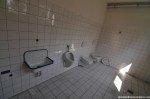
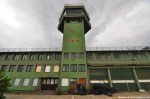
After the *Deportation Prison Birkhausen* and the *USAREUR Communication Facility Lohnsfeld* turned out to be quick stops we decided to tackle another big one and drove to Sembach to have a look at what was left of the air base. First we went to the western part and found some half-underground bunkers, inaccessible of course. Next was a small office building (?) that looked like it was made of corrugated cardboard. Quite interesting was the former Fire Station, part of the Fire and Emergency Service. I was rather surprised by the coloring of the toilets – white and pink. Seriously? The restrooms of the fire department on a US Air Force base were pink?
In the afternoon, when we left the fire station, the weather started to turn drastically. The sunshine was gone and dark grey clouds approached quickly. While we were making our way to the abandoned tower the wind sped up massively – to my favor as I should find out minutes later. I just finished shooting the tower building when a wall of rain came closer quickly and before I had the chance to take shelter it poured liked I was standing in the shower; a first class cloudburst. At that time I was close to the eastern wall of the tower, so I pressed myself against the high wall while the wind was blowing so hard that it actually blew the rain over my head. About 15 minutes I was standing there, hoping for the wind to continue and the rain to stop. When the heavy rain turned into light drizzling I started to look for Gil, who found shelter in a nearby building I assumed was inaccessible. That building was boarded up (almost) completely and its massive walls made me wonder right away what it was used for. Sadly it was pretty much empty, nevertheless we found some interesting items – a sleeping bag and other signs of a homeless person being there for a while, a perforated cardboard character and some documents with rather sensitive information; like special travel orders, granting individuals the permission to hand-carry a M16 rifle. I have no clue how those documents escaped the shredder, but I guess I better refrain from posting photos since each sheet of paper contained several names including ranks and addresses…
Going on an exploration trip with Gil was absolutely fantastic (thanks, man!). While the first two locations were quite disappointing from an urbex point of view Sembach Air Base made up for it big time. It was the first US military base I was able to explore (yes, I went to a second one, so stayed tuned!) and I had a blast – no pun intended. The locations in Germany differ quite a bit from the places I usually get to see in Japan, so I really enjoyed this refreshing experience!

Addendum 2013-08-27: If you liked this article, check out the one about the nearby *Hochspeyer Munitions Storage*!
(If you don’t want to miss the latest article you can *like Abandoned Kansai on Facebook* and *follow this blog on Twitter* – and of course there is the *video channel on Youtube*…)

Read Full Post »

Urbex in France? Urbex in Luxembourg? Urbex in Belgium? Or urbex in Germany? That was the big question after our visit to the *Deportation Prison Birkhausen* was a unexpectedly short one – where should we continue our urban exploration day trip? There were plenty of options, but since Kaiserslautern (a.k.a. K-Town, especially amongst American military) was rather close we decided to continue our explorations there. The next place to visit: The USAREUR Communication Facility Lohnsfeld.
Very little is know about this former US military installment. The Energy Engineering Analysis Programm (EEAP) from August 1986 prepared for the Department of the Army, European Division, Corps of Engineers described it as “Located at Lohnsfeld, the station consists of a barracks and receiver building”. The facility was open from at least 1953 and on 1998-09-03 the U.S. Department of Defense announced that the Lohnsfeld Communications Station will be returned to the host nation, in this case Germany. It seems like my home country didn’t have any use for it and left the comm fac in the middle of nowhere abandoned, until… it was demolished in October of 2007. Which I found out about after I went there with my old buddy Gil – after we drove through the middle of nowhere for maybe half an hour, including dirt roads along some fields and an airport for model aircrafts. So maybe urbex in France, urbex in Luxembourg or even urbex in Belgium would have been a better alternative. (The place I really wanted to go, Villa Viktoriastift, one of the few abandoned mansions in Germany, became inaccessible a week prior when the new owner of the place was fed up by geocachers swarming the place – so he informed the police, threatened to sue some people (including the person who put the cache there!) and hired security…) Luckily Lohnsfeld wasn’t our last stop on our trip to Palatinate – and the last location made up big time to the first two less successful ones…

Read Full Post »

The first time I heard about the abandoned deportation prison Birkhausen in the forest near Zweibrücken-Ixhausen, within a stone’s throw from The Style Outlets mall and Zweibrücken Airport, I got really excited. Abandoned prisons are rare… but an abandoned deportation prison? I’ve never heard of a place like that before! Even better: Zweibrücken was in rather close proximity of where I was staying during my yearly vacation to Germany, so I could easily get there by car in about 90 minutes – after I had to wait about 8 month to visit family and friends back home gain…
I met my old friend Gil at a high school reunion and we talked about urbex – he just failed entering an abandoned mill (the huge, early industrial kind from the late 19th century) due to lots of nosy neighbors and the place being boarded up, so I suggested to go on an urbex trip together. I guess it’s no suprise we decided to break into the prison! (And by “break in” I mean “enter through an open door or window” – I’ve never broke or even destroyed anything to access an urbex location and I never will! Vandalism isn’t my thing…)
The history of the prison in Birkhausen was short: The premises were used for decades to house a day-parole building with a market garden and a tree nursery (as a branch of the correctional facility Zweibrücken) before the buildings were converted into a deportation prison in 1996. About 900 people obliged to leave Germany passed through the facilty each year before it was closed in 2005 – from now on Ingelheim was the only deportation prison in Rhineland-Palatinate (no, dear Star Wars fans, not Palpatine…). Instead of demolishing the prison the Justice Department decided to keep it, considering plans to turn it into a prison for senior citizens.
When Gil and I walked along a forest road a truck with an empty construction waste container passed us by – and our hearts sank. A couple of minutes later we had certainty that the prison was in the process of being demolished. We approached the (de)contruction workers and they waved us through to their foremen. As always in situations like that honesty is the way to go, so I explained them what I am doing as a hobby and that I came to take pictures of the prison. The guys were really nice, but blocked right from the beginning – no photos, not without permission from the authorities; which would take way too long even if we could get it since they were about to finish they job by the end of the week. I asked them why the prison was taken down and they told us that geocachers were swarming the place ever since a cache was hidden there (later I found out the cache had almost 1400 logs on geocaching.com alone!) – all of a sudden the prison was kind of famous and irresponsible people brought their whole families, not even thinking about the dangers a place like that would hold. So the State decided to tear it down. So I explained that I have nothing to do with geocaching – urban exploration is about taking nothing but pictures and leaving nothing but footprints, about keeping places secret (unless they were demolished or turned into tourist attractions…). My reason to come here was to take some nice photos to keep the memory about the place alive. The older guy started thinking and said that he wanted to take pictures himself, but never had the chance since they were so fast tearing everything down – so he asked his younger colleague to stay with us while we took some quick shots to prove that the place was gone and to spread the word about it; but no pictures of people or equipment! Gil and I happily agreed and had about five minutes to take some quick shots. All of a sudden the foremen’s boss showed up, so the two guys gave us a sign and we took our equipment to head towards the exit – quickly greeting the boss while hurrying away…
Leaving the deportation prison I was devastated at first. Such a great location gone because it grew to popular – not even amongst urban explorers, but amongst geocachers! Such a shame… (To be fair: Another reason to demolish the place might have been the serious amount of vandalism – and on 2009-08-24 there was a case of arson that burned down half a building. Where those vandals came from? I have no idea, but the cache called Alcatraz was hidden back in 2006…) At least Gil and I were able to take some photos due to our successful conversation with the demolition squad – unique pictures I might add since altogether it took them about 3 weeks to get rid of the whole facility and I don’t think they gave permission to photographers before…

Read Full Post »

« Newer Posts