Feeds:
Posts
Comments

Archive for the ‘Ski’ Category

“Japan has four seasons, you must know, which is unique!”
Without warning you just got hit over the head with an example of nihonjinron, “theories about the Japanese” – a conglomerate of BS rooted so deeply in Japanese society that most people in the land of the rising sun don’t even realize how stupid the majority of those theories are… and yet they are a popular conversation topic; especially when somebody tries to impress you with how unique Japan is. Not only are there plenty of other countries with four seasons, Japan stretches across several climate zones from the Kuril Islands to close to Taiwan, and therefore the weather differs drastically depending on where in Japan you reside. In my personal experience, living for more than eight years in Kansai, Japan has only two seasons – “nightmarish hot and humid” and “kind of bearable”. The beginning and the end of “kind of bearable” are marked by two periods of about 15 days each, which are really lovely… other countries would call them spring and autumn, but in my book those phases are way too short to be called seasons! (Hey, the Japanese have nihonjinron and I have my own set of theories about this country!)
Anyway, for about one month per year it’s actually really nice outside – then the sun feels like a warm hug instead of a laser beam trying to kill you, and people are having lots of BBQs. Those four to five weeks are also the best time to hike… and one of my favorite hikes is up Mount Atago in the outskirts of Kyoto.

Mount Atago Cable Car Revisited
Before I picked up urban exploration as a hobby, I enjoyed hiking a lot – and so it was no surprise that my first exploration ever in November of 2009 was the *Mount Atago Cable Car*, basically combining *haikyo* and hiking. Almost a year later, in October 2010, I went back as I really wanted to see the cable car station in full green, also taking advantage of the beautiful weather during that time. Walking along the abandoned track was still tiring, but the steep climb around the collapsed tunnel #5 was a lot easier then, because somebody strained new ropes. On my third visit in total I took some time to have a closer look at some of the bridges leading up the mountain, and I have to say that they were in pretty bad shape after almost 70 years of abandonment. I got that feeling walking along the uneven and sometimes dangerously eroded track, but having a look from below didn’t exactly make me feel more comfortable. One of the bridges had already collapsed in parts and I guess more damage by natural decay follow since then – especially at those parts not protected by trees and therefore at the mercy of wind, rain and snow.
The still existing cable car station at the top didn’t change a lot in those 11 months, although the weather (and maybe some people who couldn’t leave their hands off the concrete pillars) contributed to the progressing decay there. This time I shot most of the station with my ultra-wide angle lens I didn’t have last time, which allowed me to explore the place with a different set of eyes.
Going to the Mount Atago Cable Car again wasn’t spectacular, but I didn’t expect it to be any other way – it was a nice autumn hike with some wonderful views and a trip down memory lane, a perfect way to start a day at Mount Atago.

Mount Atago Hotel Revisited
What a surprise: The ruins of the *Mount Atago Hotel* were still just a stone’s throw away from the Mount Atago Cable Car – and again nothing had changed, except for the lens on my camera. The mosaic at the entrance seemed to be a bit more loose than during my first visit… and the pile of broken dishes in the back was more spread out, partly covered by freshly cut trees. Woodworkers in action, I guess…

Ryokan Mizuguchi
At first I wondered if I should write about the Ryokan Mizuguchi at all, as there was little to nothing of it left – but then I came up with this 4 in 1 idea, and now I am really happy that I took some photos back in 2010. While the Mount Atago Hotel and the Mount Atago Cable Car are all over the internet, barely anybody bothers with this couple of concrete walls a few hundred meters away from the hotel, towards the famous Mount Atago Shrine. I saw the remains last time I went up the mountain, but since I was tired and running out of time then, I didn’t have a closer look. During this visit I was more relaxed and took a few rather vacuous pictures… until I found a bottle that caught my eyes. What really intrigued me about it was the fact that it had a metal cap that looked like it was never off. An old unopened bottle at the top of a mountain isn’t something you find every day! If it ever had a label, of course it was long gone, but on the lower end of the bottle the glass had some kanji – later I found out that the company (日本麦酒鉱泉株式会社 – something like “Japanese Beer Mineral Spring Company”) only existed from 1922 till 1933, before becoming part of Mitsuya Foods – nowadays famous in Japan under the name Asahi and for brands like Mitsuya Cider, Bireley and Wonda (coffee). Since the hotel and the cable car both opened in 1929, it’s rather likely that this water hole went into business around the same time, which means that the bottle I had in my hands was up there for about 80 years, manufactured at a time when my grandmother went to elementary school or middle school.
The few Japanese pages on the internet covering the Mizuguchi Ryokan speculate that the place must have been made of wood with only the cellar being cast of cement. There are no pictures, no blueprints and hardly any information in general, and therefore I can only assume that the place closed down together with the hotel and the cable car in 1944. So while the pictures still might not be that spectacular, it was just an awesome feeling to hold that bottle in my hand – and I hope somebody will have a similar experience when the bottle is 90 or 100 years old…

Mount Atago Ski Resort
The fourth and final stop of my haikyo hiking at Mount Atago was the Mount Atago Ski Resort; one of the reasons the hotel and the cable car were built in the first place. Located about 45 minutes away from the hotel, the Mount Atago Ski Resort would be almost impossible to find nowadays, if it wasn’t for a few signs that were put up in 2006 and that direct hikers to the middle of nowhere – although I doubt many people will walk 190 meters up an earth wall and along an overgrown plain. While the area with its gentle slopes looked perfectly suited for a ski area targeting beginners, there were barely any hints left that the place once was populated by hundreds of sport freaks. You really have to explore thoroughly to find signs like red plastic posts, concrete sockets, scattered china and even some solid ramune glass bottles (ramune is a Japanese lemonade – the opening gets blocked by a marble when you drink, making it extremely popular amongst kids). Construction of the ski resort began in 1928 and like the hotel and the cable car, it opened in 1929 and closed in 1944, when the latter was demolished for scrap in a last futile attempt to support Japan’s war efforts.
On my way back to the Mount Atago Shrine I found some collapsed shacks and a Komatsu D205 bulldozer, though I can’t say for sure if they were in any way related to the ski resort.

The Ruins Of Mount Atago might not be the most spectacular ones in Japan, but if you enjoy hiking and are interested in (pre-)WW2 history, this is the place to visit in Kansai on a sunny spring or autumn day. You probably won’t get an adrenalin kick (unless you get lost bypassing the two collapsed tunnels of the cable car track), but you’ll return from the mountain with a deep comforting feeling of accomplishment. (Oh, and don’t be as stupid as I was – bring at least one friend, because the cable car part of the hike really is quite dangerous!)

(*Like Abandoned Kansai on Facebook* if you don’t want to miss the latest articles and exclusive content – and subscribe to the *video channel on Youtube* to receive a message right after a new video is online…)

Read Full Post »

With hanami parties everywhere, spring is officially conquering Japan, quickly ending skiing season in almost all parts of the country for the first half of the year – time to have a look at one of the most impressive abandoned ski areas I’ve ever visited!

Ski resorts are a dime a dozen in Japan; abandoned ones, too. Sadly not in the Kansai area, where I live. There are a few places where you can ski in day trip range, but serious skiers go as far as Hakuba (near Nagano) even for weekend trips. Abandoned ski resorts date back to the 1940s (that’s when oldest one I found was closed, not opened!), but there are not many of them. In the past I wrote about the *Kyoto Ski Resort*, the *Mt. Hiei Artificial Ski Slope* and one called *Alpen Rose* – this time let’s head north, towards Hakuba, but stop about halfway in Gifu prefecture.

The Gifu Ski Piste was actually part of a bigger resort, but closed down about half a decade ago, most likely due to the lack of customers, while the rest of the resort kept running; only 4 kilometers closer to civilization. Fully autonomous, the Gifu Ski Piste had its own lift(s) and its own rest house with a fully functional hotel and ski / snowboard rental. All the owner had to do to save money was shut everything down and have the few guests ski on the remaining slopes. And if business would have picked up again, it would have been quite easy to revive the dormant slope after a season or two. But business didn’t pick up and there is only so long you can wait before buildings suffer damages just from sitting there… and so the ski lift was dismantled, sealing the fate of this once fine place. Sometimes a 4 kilometer ride up and down rather narrow roads can make the difference between success and failure.

I had little to no expectation when arriving at the Gifu Ski Piste, mainly because the place is virtually unknown to the internet and has only appeared on a Japanese ski blog, but not on any urbex blogs, at least to the best of my knowledge. Furthermore I hadn’t seen any inside photos in advance, which is usually a sign for inaccessibility, alarm systems or security. This was urban exploration in its truest exploration form. (Quite a few abandoned places in Japan, and I guess it’s the same worldwide, are photographed to death – I prefer those rather unknown locations, where you can let your eyes wander to find new angles and new things to take pictures of.)
At first sight the rest house looked in really good condition, luckily the dismantled ski lift was stored in the former parking lot, so it was pretty clear that this ski area was abandoned. Yet no windows were broken, no doors were smashed… and after having a peek inside through windows, it was clear that this place was shut down on purpose with the option to reopen.
We finally gained entrance through an unlocked door in the back, but taking photos inside turned out to be much more difficult than anticipated, since the building was massive and didn’t have that many windows, except for the huge glass panels in the front. Strong light / darkness contrasts almost everywhere, and being in the middle of the mountains on a spring afternoon didn’t help either; neither did the lack of a tripod. Sadly most photos didn’t turn out nearly as well as I thought they did – because at the time of this exploration, it was definitely my favorite abandoned ski resort, and exploring it was a blast. (Since then I went to the *Gunma Ski Resort* and an even better one still unpublished…)

(*Like Abandoned Kansai on Facebook* if you don’t want to miss the latest articles and exclusive content – and subscribe to the *video channel on Youtube* to receive a message right after a new video is online…)

Read Full Post »

The skiing season in Japan started just recently – time to present one of three rather big abandoned ski resorts I visited this year!

Opened in December of 1990 (according to a commemorative stone attached to the spotless bright white building with its turquoise window frames) the Gunma Ski Resort was partly shut down in 2004 and closed in early 2006 – during those years, parts of the property were turned into a soccer camp (in addition to the regular camping site from June till October).
Originally the resort offered four courses for beginners and advanced skiers. A 100 meter long Family Hill, a 1800 meter long Easy Rider Path, a 1000 meter long Challenger Path and a 6000 meter long Heli Ski Course – yeah, those were the good old days of the Japanese asset price bubble; only the best was good enough! Four lifts (and at least one helicopter…) transported guests up the mountain, the main one with a capacity of 2400 passengers per hour. The lifts were 3800 Yen per day (or 300 Yen per ride), the helicopter charged 7000 Yen per person and ride. The rental shop was equipped with 500 sets of skis and 150 snowboards, charging 3000 Yen or 4000 Yen per day respectively – skiwear rental was an additional 3000 Yen.
Interestingly enough the resort didn’t feature any private hotel rooms – just a few large bunk bed halls called Rest Rooms, charging 2000 Yen per night and small bed; at first I thought they were for children napping, but it seems like they were for all skiing guests small enough to fit, available from 9 p.m. till 10 a.m.
At the base lodge there were two restaurants on the second floor. The buffet style Grille Buffalo and the cafeteria style Café U.S.A – yes, no third dot! Strangely enough the latter one sold predominantly stuff like ramen, udon and soba. Both restaurants had separate kitchens that were connected in the back… and both restaurants suffered quite a bit from vandalism and airsoft matches.

Overall the Gunma Ski Resort was still in surprisingly good condition at the time of my visit, considering that it was closed and subsequently abandoned almost a decade ago.
The main floor with the ski rental, ski school and gift shop suffered from some severe vandalism as windows and doors were smashed (I guess it didn’t look *haikyo* enough to some people…), things were thrown around and stolen, mold started to take over one room or the other. At the end of one hallway there was the wooden silhouette of a person against a window, in a position that clearly indicated “dead” – and if you had a closer look at the window you could see a bullet hole there. Spooky!
The restaurant floor was nice overall – some minor vandalism, especially in the kitchens, countless airsoft bullets and a few barricades. Unspectacular (my personal favorite: the cracked open tea machine), but nice. The rest room floor suffered again from a couple of broken windows, resulting in slightly moldy sheets, walls and carpets. Personally I would have preferred to see it in spotless condition, but I guess you could say that the green banana has ripened, if vandalism is what you are looking for in abandoned places. Luckily the elevator control room on the roof gave me what I wanted as it was basically pristine. But the general rule of thumb was: the closer you got to the entrance, the more noticeable the stench of mold and spilled gasoline became. Actually to a point that I was worried about potential health issues, that’s why I didn’t film the lowest floor when I did the video tour at the end of the exploration. I only had a quick look, following my fellow explorer friend *Hamish* – and actually something good came out of it. In one of the office rooms, Hamish heard kind of a rattling metal noise, coming from a trash can under a window. It turned out that a rodent caused it, desperately trying to escape the fatal trap – another rodent already dead next to it. They must have fallen from a window sill, unlikely as it seemed, because that was the only way to get even close to the opening of the trash can. Strange little fella, like a mouse, but with a much longer nose – please have a look at the last video, maybe you can identify it? Of course we did the right thing, so Hamish carried the trash can outside and toppled it over to free the little fella. After the *hedgehog at the abandoned shipyard* the second animal life I was part of saving this year. “Abandoned Kansai – exploring since 2009, saving lives since 2014!”

(*Like Abandoned Kansai on Facebook* if you don’t want to miss the latest articles and exclusive content – and subscribe to the *video channel on Youtube* to receive a message right after a new video is online…)

Read Full Post »

An old GPS system can be a blessing in disguise. For the longest time my buddy Dan’s car was equipped with a navigational system that must have been about ten years old, maybe 15 – you know, from an era when Japan was a magical place with color screen mobile phones, by far the best video games in the world and… well… the first navi systems in regular cars. But what was so great about an ancient GPS device in 2013? Well, pretty much all the abandoned places we visited together were still in the system as active locations, making it very easy to find them. But one day last summer it got even better! Dan and I were cruising through the countryside, when I saw the name of a ski resort appearing on the screen – a ski resort I had never heard of, neither as active nor as abandoned. So we went on a little detour…

… and the resort turned out to be abandoned. By the looks of it pretty much around the same time Dan’s GPS was installed, maybe even before that. Located at a half-overgrown side-road in the middle of nowhere and covered by the most blurry satellite shot on online maps you can imagine, this rather small ski slope is close to impossible to find; unless you know where it is or you have a GPS system so old that it’s still marked there. (It isn’t on GoogleMaps…)

Sadly this also means that I know nothing about the Kyoto Ski Resort, which is obviously a shortened name to protect its exact location. Absolutely nothing. Not when it was opened, not when it was closed, and of course I can only assume the reasons why it was shut down, which are probably the same everywhere. Not enough snow, not enough customers, outdated equipment, short piste.

Exploring an abandoned ski resort in summer is a bit strange as a location like that looks out of place at that time of the year, but if you are (un)lucky like I was, it still can make a good story.
At the bottom of the slope were two wooden buildings, a restaurant and what looked like a gear rental / general shop. From there we walked up the mountain to a smaller restaurant / snack bar in questionable condition; the wooden beams outside were crumbling away and we had to be very careful where we stepped. After passing some shacks in extremely poor condition, used as restrooms and storages, I reached the now rusty ski lift.
I took some photos up there, minding my own business, when I was hit in the head what felt like a golf ball or a tennis ball, right after I heard something buzzing. This surprising event caused me to make a noise that can be described as “less than manly”, but hey, despite my explorations in the middle of nowhere I actually like nature tamed or grilled, not kamikaze attack me. Anyway, my less than manly outcry caused Dan to laugh his ass off, which was kind of good as we actually had lost sight of each other. Minutes later Dan’s head popped up behind one of the shacks, still laughing. And while he came closer, all of a sudden I heard that buzzing noise again, followed by Dan yelling “SUZUMEBACHI!!!” – and him running down the slope as if the devil himself was after him! Not so funny all of a sudden, if they are after you… (Just in case you don’t know: suzumebachi, also known as Japanese Giant Hornets or just Killer Hornets, are gigantic hornets with a body length of about 50 millimeters, a stinger of 6 millimeters and a wingspan of about 75 millimeters; they kill 40 people in average every year in Japan, especially in the countryside.)
I followed my fellow explorer down the hill for a while, but I hadn’t taken a video yet – so I went back up to the abandoned ski lift, where the suzumebachi probably had their nest. Aware of the dangerous situation I started the video right away and did the usual tour…
Urban exploration is not a fun thing to do in Japan during summer – not only are there giant killer hornets, there are also huge spiders and pretty big snakes as well as all kinds of non-venomous critters. From June till September the whole country‘s wildlife is buzzing and it seems like all of those buzzers are eager to have a look at you when you visit their habitats; and some like to have a bite! So after the suzumebachi incident we had a quick look at the restaurant at the lower end of the slope; a wooden building in dilapidated state, the floor arching and a HUGE old suzumebachi nest right under the ceiling. And then we left. There was not much to see anyway – and everything was in rather bad condition.

Overall the Kyoto Ski Resort was a neat original find. Nothing you would rent a car for and spend a day on finding / exploring, but it did a good job as a bonus between two locations we were eager to see.

(*Like Abandoned Kansai on Facebook* if you don’t want to miss the latest articles and exclusive content – or subscribe to the *video channel on Youtube* to receive a message right after a new video is online…)

Read Full Post »

Abandoned ski resorts are everywhere in Japan! I never specifically wanted to go to one, nevertheless I ended up at about half a dozen of them on the way to other places; one of them being the Alpen Rose Ski Resort.

The Alpen Rose Ski Resort is (or rather: was) a nursery slope in the middle of a busy skiing area in northern Hyogo prefecture. It opened in 1965 under a different name and apparently without a lift. In 1970 a lift was built, extended to the summit in 1971. In 1978 the ski resort was renamed to Alpen Rose, before it was closed in March 2000 or some time in 2001, depending on the source. (Since an abandoned vending machine still has “collectible” Star Wars Episode 1: Phantom Menace Pepsi Cola cans on display, the 2000 date is more likely, as the movie was released in Japan on July 10th 1999.)

After 13 years of abandonment and with the lower part of the ski lift gone, the Alpen Rose Ski Resort became one of those *haikyo* perfect for a break on the way to other places. After an hour or two in a car it’s nice to stretch your legs and take photos for a couple of minutes – in that case you don’t need a spectacular location that keeps you busy for several hours, just some dilapidated building with a couple of items and a landscape easy on the eyes.
Before entering the lodge I had a look at the surroundings – a little shack near the end of the former slope and a rather big foundation made of solid concrete; most likely the lower station of the now demolished lift. Not really much to see.
The lodge on the other hand was pretty nice, despite being partly collapsed already – and I guess the rest will follow soon, given that the building was almost completely constructed on pillars; especially the handful of guest rooms on the southern side. Partly covered by a crashed projecting roof and now exposed to Mother Nature were dozens of skis and skiing boots, right next to a Coke machine in decent condition. Next to it on the veranda was the already mentioned Pepsi machine and quite a few other items, like a Technics amplifier and a Panasonic hi-fi system – nothing fancy, but probably still working. The price list inside the lodge displayed rather steep, touristy prices. 350 Yen for a Coke and 800 Yen for curry rice would be normal prices today, but we are talking 13 years ago… Also definitely worth mentioning were the two snowmobiles right at the entrance, getting rusty and dusty.

The Alpen Rose Ski Resort was exactly what I hoped it would be – a nice break on a long car ride to the Sea of Japan. Nothing spectacular, but then again, not all of them can be like the *Abandoned Dynamite Mine* or the *Japanese Sex Museum*

(If you don’t want to miss the latest article you can *follow Abandoned Kansai on Twitter* and *like this blog on Facebook* – and of course there is the *video channel on Youtube*…)

I planned to publish a video with this article, but Youtube seems to be a bit bitchy again on this computer – I will upload it most likely on August 26th.

Read Full Post »

When exploring abandoned places you are barely ever the first to visit, mainly because you have to find out about them somehow, which means that somebody had to write or tell you about them – so pretty much the best case scenario is that you haven’t seen too many photos and videos about a location before visiting it. That applied for most spots on my *haikyo trip to Hokkaido*, which is quite unusual, but Hokkaido isn’t exactly popular amongst foreign urban explorers (or Japanese haikyoists…) since it is rather off the beaten tracks. Those barely spoiled locations are especially exciting to explore, since there is only little known about them – how to get in, condition, size, dangerous parts, security…
Whether that’s a good thing or not lies in the eye of the beholder. I like my explorations with as little surprises as possible, to be honest with you, but at the same time I favor locations that haven’t been photographed to death; preferably places that are in the middle of nowhere with not a soul within a couple of kilometers. About 75% of the locations I visited in Hokkaido I knew little more about than their names and a handful of photos before exploring them myself – but the Mount Teine Ski Lift was special and stood out of even that group. Before walking up to the *Olympic Ruins Of Sapporo 1972* I had a look at the surroundings via GoogleMaps and saw a ski lift with two photos of abandoned constructions – but they weren’t named properly and I didn’t even know if they were just misplaced and in fact part of the Olympic Ruins. It turned out that they were a separate location, but although I know its name now researching it wasn’t exactly easy.

When I was walking up to the Mount Teine Ski Lift (which most likely was part of the still active Sapporo Teine Resort) I saw an old bus stop sign of the JR Hokkaido Bus line, although the staff at the JR Teine Station told me there were no busses running; maybe an old sign that was never removed… Not worthless though, as the sign had the name of the stop written on it: 千尺. The first kanji is common – sen, one thousand. But the second I couldn’t read, so I took a photo to find out later. Now I know that it means shaku, which is a traditional unit of measure in Asia, not in daily use anymore in Japan; about 303 mm or almost one foot. So the place was basically called “303 Meters”, although the slope was actually much longer; about 2 kilometers to be more specific. To get to the top you had to use two different lifts and it turned out that the mountain station of the second left was in proximity of the former start of the Olympic Bobsleigh track before it was dismantled, while the *Olympic Ruins Of Sapporo 1972* were the goal – it’s all connected…
If you google the term you’ll end up with links to the Gosenshaku Hotel, a rather high end accommodation in the Japanese Alps, about 1000 km away from the Senshaku ski lift. If you do some more googling in Japanese you might stumble across two year old photos on which the rest house is in way better shape. Now almost completely collapsed it was in decent condition just 24 months prior to my visit – and several (now unreadable) signs revealed more information; sadly the Japanese guys hosting those photos didn’t care to write anything about the place. It seems like the full name was “Teine Olympia Senshaku Highland”. Unlike the bobsleigh ruins, this ski lift didn’t show off the Olympic Rings, so it’s safe to say that it wasn’t part of the official venues; even more so since according to the Japanese Wikipedia the Olympia Highland was established in 1974 and opened in 1976, four years after the games were held. Instead it was a skiing slope for the general public – with lockers, rental gear, food and arcade machines. The chartered shuttle bus service was stopped in August of 2001 and 15 months later Kamori Kanko bought the place (they also own Noboribetsu Bear Park and Noboribetsu Marine Park Nixe near the *Tenkaen, Japan’s Lost China Theme Park*). And at that point I got lost a bit as I found contradictive information about combining two skiing areas, about places getting closed that still have active homepages, about areas that look the same, but have different names… Long story short: I still have no idea when Senshaku was closed!

All I know is that it was exciting walking up to the Senshaku area as I had little to no idea what to expect. While Sapporo itself was still basically snow free the 150 meters of additional elevation and not being in the city anymore made a difference of about 5 to 10 cm – just enough to be fun without being annoying. Of course a car was parked in front of the entrance upon my approach, but I decided to ignore the guy and just walked straight up the hill. I also ignored the mostly collapsed building to the left and had a quick look at the dilapidated ski lift to the right – being all by myself and already rather cold I refrained from climbing that death trap and made my way up the mountain to take some photos of the towers and to take some ultra-wide angle shots of the whole place. Up there I found a big cart with several ropes connected to it, probably used to transport goods up the mountain, though I didn’t find any information about it, even during the research I did for this article. While taking photos of the wagon I heard some wild noises that didn’t sound too friendly. I didn’t see any animals, but I wasn’t exactly eager to have any confrontation, so I grabbed my video camera and walked back down the hill. The video ended abruptly when I turned down the camera as soon as I saw a man standing between the lift and the rest house – preemptive obedience, Japan’s unofficial motto. It turned out that the guy didn’t mean no harm and just had a look himself, but it was good to stop anyway since him walking through the video several times or even talking to me wouldn’t have been good either. Obviously he wasn’t eager to talk to me… and left before I was done taking more photos of the ski lift.
The former rest house was in horrible condition and I only spent a couple of minutes exploring it – because it looked more dangerous than interesting, and because the sun was already setting behind Mount Teine and I still had to walk up the mountain to see the *Olympic Ruins of Sapporo 1972*

(If you don’t want to miss the latest article you can *follow Abandoned Kansai on Twitter* and *like this blog on Facebook* – and of course there is the *video channel on Youtube*…)

Read Full Post »

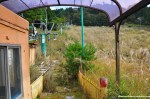
The Mt. Hiei Artificial Ski Slope is an abandoned ski resort near the top of Mount Hiei on the border between Kyoto prefecture and Shiga prefecture. Famous for its Enryaku Tempel and the Kokuhoden Museum this holy mountain was once thought to be the home of gods and demons in the Shinto belief system. Interestingly enough the predominantly religion on Mt. Hiei has always been Buddhism. The monk Saicho founded the Enryaku-ji in 788 as the first outpost of the Tiantai / Tendai sect and it remained the Tendai headquarters till this very day, although it was famously destroyed by Oda Nobunaga in 1571 to vanish the rising power of the local warrior monks, killing about 20,000 people (including civilians) in the area. The temple was rebuilt soon after and is one of the main tourist attractions in Shiga prefecture today, accessible via two cable car lines, several beautiful hiking trails and a toll road for cars, motorcycles and busses.

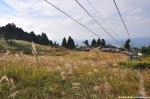
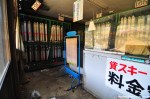
Along the “Kitayama East Course” lies the Mt. Hiei Artificial Ski Slope, probably the most visited haikyo in all of Japan. On an average day during the hiking seasons in spring and autumn you’ll never be alone in the area as people are constantly passing by – about half a dozen hiking trails meet here and a close-by cable car station, serving the longest funicular line in Japan, attracts hundreds of people a day. Most hikers barely notice the abandoned ski lift and ski slope, hardly anybody peeks through the broken windows of the gear rental store or has a look at the undamaged closed restaurant. Why wasting a thought on that ugly stain when the surrounding nature is of such beauty? Because beauty lies in the eye of the beholder and though the ski resort on Mount Hiei was rather small it nevertheless offers a few neat angles now that it is abandoned.

Wanna know some facts about the resort? Okay, this is what I was able to find out: The Mt. Hiei Artificial Ski Slope was opened in 1964 and on November 1st of 2002 the newspaper Kyoto Shimbun reported that the ski resort was closed for good after a hot summer in 2000 and a way too warm winter in 2001 – followed by a year of temporary closing; which explains why both the restaurant and the rental store are still stocked with all kinds of items. In the almost 40 years of operation the already mentioned facilities welcomed customers for both a summer and a winter season. In winter a combination of natural and artificial snow (provided by a snow gun) offered fun for the whole family, in summer grass skiing was the business of choice. A lift transported guest for a distance of 170 meters so they could enjoy the pretty short slope of up to 200 meters with a vertical drop of 38 meters.

Oh, before I forget: The nearby “Garden Musem Hiei”, a flower park, once was an amusement park with a haunted house, a small Ferris wheel and a viewing platform, but I guess it was converted quickly enough to never been considered abandoned.

And that’s it for now from Mount Hiei. For now, because the ski resort was actually my second urbex trip there and my fourth or fifth overall – I really like Mount Hiei! Next time I’ll take you there I’ll either show you an abandoned rest house on a steep slope or a mysterious construction I’ve never seen anywhere else on the internet…

(If you don’t want to miss the latest article you can *follow Abandoned Kansai on Twitter* and *like this blog on Facebook* – and of course there is the*video channel on Youtube*…)

Read Full Post »

« Newer Posts