Feeds:
Posts
Comments

Archive for the ‘Video’ Category

Some locations just have a sound to them that is irresistible, places you want to visit purely based on their names. Like the *Abandoned Japanese Sex Museum*, *Nara Dreamland* or the *Zone of Alienation* – names that create images even without knowing anything about them. When I heard about the Olympic Ruins Of Sapporo I knew I had to see them at one point or the other. There have been only 21 Olympic Winter Games so far and although the ones in Sapporo were held 40 years ago I was stunned to hear that some of the locations were abandoned – which, admittedly, is kind of naïve given the fact that even some event locations of the Olympic Summer Games in Athens (2004!) are already abandoned!

Since my first day in Sapporo was surprisingly sunny and I had some time to kill till my fellow explorer would arrive, I took the opportunity to not wait for a second trip to Hokkaido and have a look at the Olympic ruins right away. Sadly the whole thing sounded a lot better in theory than it ended up to be…
First of all: The skiing season in Hokkaido starts in early December, but I was in Sapporo in late November – so there were no buses running, only taxis. When I told the (female) train station staff that I will walk instead I was taken away by a prime example of a typical wave of Japanese surprise and disbelief. Still hilarious even after six years…

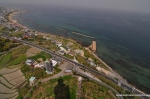
5 kilometers, 400 meters altitude difference and 1.5 hours later (I took my time…) I finally reached the Olympic Ruins Of Sapporo 1972. In the 1972 Winter Olympics this area was the bobsleigh goal house – the track was constructed from reinforced concrete between October 1969 and January 1972 for 433 million Yen and highlighted by 127 lamps for night runs. After Nagano was rewarded the 1998 Winter Olympics the bobsleigh track in Sapporo (1563 meters long, 132 meters vertical drop, 14 turns) was dismantled in 1991, but the goal house wasn’t.
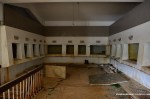
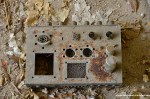
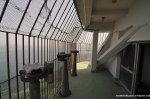
Since I was stopping by at another location first it was already getting dark by the time I arrived halfway up Mount Teine. The area around the bobsleigh goal house was covered by snow completely, making it difficult to approach safely and impossible to reach the back area and the green shack halfway up a slope. I was able to enter the basement though, where all kinds of crap and some heavy machines were rotting and rusting. Sadly I forgot my flashlight at the hotel, so I wasn’t able to enter the ground floor or the first floor, both in a quite dilapidated state anyway. It also made me hurry quite a bit so I would get back to civilization at daylight to limit the risk of breaking some body part due to black ice or getting run over by one of the few cars speeding up and down the mountain. Furthermore I am a jeans and T-shirt guy all year round, not well prepared for winters since there are no winters in Osaka… and it got pretty friggin cold up there after a while, especially after the sun was hiding from about 3 p.m. on!
So in the end it was a quick look at an unspectacular location, but I was able to take some photos of an abandoned building with the Olympic rings on it – and that made me feel like a winner!

(If you don’t want to miss the latest article you can *follow Abandoned Kansai on Twitter* and *like this blog on Facebook* – and of course there is the *video channel on Youtube*…)

Read Full Post »

When I wrote about the *Abandoned Japanese Sex Museum* in spring a lot of people seemed to enjoy my article – on Sunday I had the chance to visit the Hokkaido House Of Hidden Treasures, Japan’s other abandoned sex museum. It wasn’t bigger, but it was less artsy and a lot more explicit! This haikyo gave the term “ruins porn” a way deeper meaning…

“House of hidden treasures” – a Japanese euphemism to describe sex museums. In the 1960s pretty much every of the 47 prefectures in Japan had a sex museum, usually located in a small spa town somewhere in the mountains. Video did not only kill the radio star, it also made pornography widely available and started the decline of many sex museums – the internet finished the job 20 years later. Nowadays there are only a handful of sex museums in Japan (although you can barely call them museums as most of them are bizarre collections of art and what some weird people think art is…) and they are fighting for survival. The Hokkaido House Of Hidden Treasures (HHOHT) was no exception in that regard. Opened at a time when other sex museums started to close (1980), the HHOHT was equipped with the latest technology of the time (including a huge 3D pussy, created by a plastic, a gigantic lens and a mirror), but ran into financial trouble in the new millennium – closing was considered in 2007 (after lowering the entrance fee by 1000 Yen to 1500 Yen), but it seems like it was kept open for business until March of 2010, when thieves stole a Marilyn Monroe wax figure, a female wax figure with a snake around her neck, a belly dance doll and two travelers’ guardian deities. While most other sex museums get rid of their exhibits (by throwing them away or selling them) and then become another parking lot, the Hokkaido House Of Hidden Treasures became the haikyo Hokkaido House of Hidden Treasures – one of two known abandoned sex museums in Japan.

Much to my surprise the HHOHD was quite different from the *Abandoned Japanese Sex Museum* in Japan’s south. Instead of featuring dozens of wooden and stone statues the Hokkaido House of Hidden Treasures was stuffed with taxidermy animals – most of them copulating: Horses, elks, zebras, boars, lions, monkeys, all kinds of birds… I’ve never seen that many stuffed animals anywhere. And while most of the sculptures at this museum didn’t even seem to be made from real stone, all the taxidermy animals were real and in pretty good condition – if not for the sex part the museum should have been famous for its stuffed animals. But of course there was so much more to see: paintings, drawings, animatronics, a shooting game called “French Ponpon” (5 shots with a gun: 100 Yen), a huge vibrating penis to sit on, sculptures, shrines (dedicated to birth or equipped with penis shaped statues), and wax figures in a bizarre forest scene – starring a big red demon (with a surprisingly small dick) and a naked woman, being watched by horny, peeping or even mating animals. The most strange thing though was found on the basement floor – it appeared to be another shooting game. This time participants had to shoot “water” from a huge golden penis at a naked female doll. I’m sure when the Hokkaido House of Hidden Treasures was still in business it was all fun and games, but this time there was a victim. My haikyo buddy *Michael Gakuran* wanted to have a closer look at the naked woman and stepped into what seemed to be a concrete pool – except that the surface wasn’t concrete, but gypsum floating on top of the still intact pool; resulting in a mild shock and lots of wet clothes. In hindsight the water in the shooting game must have been colored white for a more “realistic” approach; a closer look at the female doll confirmed that assumption. (Luckily Michael’s equipment wasn’t damaged thanks to a water-proof camera!) Instead of going back to the car and changing clothes Michael dried himself and his stuff up as good as possible and continued shooting for 45 minutes with one bare foot! What a trooper, especially since the place was literally freezing cold. Most of the rooms had dripping water, and on the lower floor the water froze to icicles or drops on the ground! It was so cold I could see my own breath and after a while my fingers started to hurt – I can only imagine how Michael must have felt; who even refused to leave right away when we both heard some noise from the upper floor, followed by footsteps – because he hadn’t shot a pitch black room in the back yet…

The Hokkaido House Of Hidden Treasure was a massive location and a real photography challenge thanks to lots of dark areas, massive amounts of glass and really weird setups; not challenging but weird BTW was the sukiyaki and ramen restaurant above the museum – I left that part out completely as it wasn’t nearly as interesting as the sex museum itself. All in all Michael and I spent almost 5 hours at the HHOHT – more time than at any other place before except for the *Nakagusuku Hotel* in *Okinawa*. And it was well worth it – I barely ever shot as many interesting and unique photos before. I also recommend watching the walking tour I shot as it shows the setup of the museum much better than I could describe it with words and photos. Speaking of which – here they are…

(If you don’t want to miss the latest article you can *follow Abandoned Kansai on Twitter* and *like this blog on Facebook* – and of course there is the *video channel on Youtube*…)

Addendum 2014-07-11: According friends of mine the museum has been severely vandalized since I visited it – R.I.P.!
Addendum 2015-08-18: I revisited the sex museum in late 2014 and wrote an article about it – Hokkaido House Of Hidden Treasures Revisited (The Rape And Death Of An Abandoned Sex Museum)

Read Full Post »

The Papierfabrik Knoeckel, Schmidt & Cie. (Papierfabrik = paper mill) was without the shadow of a doubt the urbex highlight of my vacation to Germany in 2011. Ever since I moved to Japan in 2006 I spend a couple of weeks in summer back home in Germany, visiting family and friends. As much as I love Japan – I really hate the summers there. It’s hot, it’s humid and it’s dark at 8 p.m. the latest. German summers are less hot, way less humid and you can have a BBQ outside till 10 p.m. or even later. There’s actually stuff you can do after work, not just crawling under the next air-condition – which most likely is set to a smoldering 28° Celsius anyway since Japan pretends to save energy ever since Fukushima happened. (Ironically the ACs are set to 28°C in winter, too – heating is no problem, but if you wanna have some cool air you are considered the devil…) I started with urban exploration in late 2009 and when I came back to Germany in 2010 I visited *Pripyat and Chernobyl* as well as two locations in Luxembourg I yet have to write about. No urbex in Germany in 2010 for me. 2011 on the other hand saw me visiting places like the *Clubhotel Messel* and the *Cambrai-Fritsch Kaserne* – and the latter one almost prevented me from actually entering the Papierfabrik Knoeckel as I ran into some security trouble at the CFK the day before I visited the paper mill with my old friend *Gil*.

Located on both sides of a valley in the Palatinate region of Germany the Papierfabrik Knoeckel is virtually impossible to miss – if you found the right valley you are golden. The downside of that fact is the traffic ahead and behind you. Getting a parking spot is not the problem – entering the factory without being seen is. Like I said, I ran into some trouble the day before (on a former military basis, to make things worse), so I wasn’t exactly eager to jump a fence and run while being watched by potentially dozens of people. The backside of the factory seemed to be a bit quieter, so we walked along a forest road up a slope… only to run into a house where a dog started to bark and didn’t stop for at least an hour! We followed another road leading down to the factory, the damn dog still barking. Now we were separated from the factory by a small river (maybe three meters wide), once a fundamental element of every paper mill as water ran machines. Two bridges and a building span across that river, but our options were limited soon – one bridge was fenced off and the other was equipped with a modern security camera. Caught the day before, dog barking in the background, an active security system. My urge to enter the factory went down to zero and in the end it became another key moment regarding my dislike of infiltration. Not nearly as bad as the experiences at the *Noga Hotel* or the *Sunset View Inn Shah Bay Resort*, but another stepstone…
To make a long story short: We entered somehow, it was an amazing location, and it took us four hours to leave. Four overly cautious, nerve-wrecking hours that weren’t really fun at all – in hindsight it’s always easy to say that it was totally worth it since nothing went wrong, but the potential for disaster was there…
In the end I took some really neat photos at the Papierfabrik Knoeckel. Photos that work very well in both monochrome and color – which makes it one of my favorite locations in Germany, at least now that I am sitting in front of my PC. The reasons why the photos turned out that way, is because the Papierfabrik has a lot of history and grew organically. Old buildings weren’t demolished, they were reused and new buildings were constructed in addition. Some buildings still had large ciphers fitted to their walls – 1914 and 1952 I remember vividly. But the paper mill was older. Much older. 1888 saw the founding of the Knoeckel, Schmidt & Cie. GmbH (GmbH = Gesellschaft mit beschränkter Haftung, which equals a modern Limited = company with limited liability) which turned into the Knoeckel, Schmidt & Cie. Papierfabriken AG on January 29th of 1923. (Papierfabriken means paper factories, AG = Aktiengesellschaft = joint-stock company) In 1945/46 production was partially stopped due to a shortage of raw materials and coal – the company survived World War 2 without any damages. Which is even more surprising since the factory had its own railway siding. The reason for that is the fact that paper is incredibly heavy and larger amounts are easier and more cheaply transported by trains. At one point the rival Robert Cordier AG (which produces paper since 1836!) bought 99.78 percent of the Knoeckel, Schmidt & Cie. shares (which was turned back into a GmbH in 1995 after a loss of 1.4 million Deutschmarks (0.7 million Euros) within half a year), but on August 18th of 2000 the Robert Cordier AG filed for bankruptcy. Knoeckel, producing glassine, translucent vellum paper and special papers for technical applications, wasn’t making money anymore after 112 years…
On May 30th of 2006 a conflagration that took 9 hours to extinguish destroyed several disused production sheds, making the abandoned buildings even more dangerous due to a higher risk of collapse.
Today the Papierfabrik Knoeckel shares the fate of many abandoned buildings – potential private investors, local politicians and citizens’ groups are arguing what to do with the 55.000 square meter area, but can’t agree on anything. And so the paper mill continues to decay, attracting more and more urban explorers, graffiti sprayers and vandals…

This is the *second time* I decided to publish a photo set in monochrome. I actually converted all photos and selected two sets – one in color, one in monochrome. There were hardly any overlaps, so I might publish a color set in the future, maybe along with an update on the state of the paper mill. I even converted the videos to monochrome, just for the sake of atmosphere. Exploring this location I felt like being transferred back in time to the 40s, 50s or 60s; decades most of us associate with monochrome photography. I hope you welcome this decision…

(If you don’t want to miss the latest article you can *follow Abandoned Kansai on Twitter* and *like this blog on Facebook* – and of course there is the *video channel on Youtube*…)

Read Full Post »

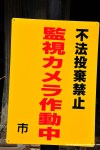
The Restaurant Kent, on Japanese haikyo blogs mostly known as the Good Omen Garden, is one of the staples of urban exploration in Japan. Located on quite a long country road connecting Osaka with Miyazu (home of the famous sandbar Amanohashidate, one of Japan’s three scenic views) the Restaurant Kent was one of the most popular local haikyo when I started doing urban exploration three years ago. Nowadays it lost quite a bit of its popularity, probably because it was photographed to death over the years – or maybe because there are a couple of signs announcing camera surveillance… which I totally respect if it’s true.
In this case the claim was complete bullshit, which annoys the heck out of me as it just cost me time and nerves. The signs looked rather new, so maybe they were put up before the local city administration set up the cameras (government involvement, even on the lowest level, is always a bad thing since it usually means serious business – private companies might hire some slackers, but you don’t want to mess with bureaucrats, especially in a country like Japan…), but when I visited the Restaurant Kent in March of 2011 there were no cameras or other forms of security; a topic I usually leave out, but if somebody lies to me blatantly I have to set the record straight!

Sadly there is not much else to report about the Restaurant Kent, since nobody seems to know a lot of facts about the place. I don’t even know if it was named after the county of Kent in South East England – or after the hugely popular cigarette brand “Kent”, which famously used carcinogenic blue asbestos in their filters from 1952 till 1956 (I guess at least British American Tobacco made cigarettes healthier after all…). The restaurant area itself seemed to be quite small, but neat. Previous explorers set up some tableware in front of a chair with armrests, but other than that there was not much to see.
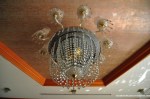
The Good Omen Garden seemed to be much bigger – one of those festivity locations Japan so desperately needs when you want to be loud and / or with some friends. My buddy Dan and I found several party rooms of various sizes (Western Style and Japanese style, i.e. either carpet floor and tables or tatami floor and furniture that is long gone now…) equipped with all kinds of electronics including laser disc karaoke machines, beamers, microphones (not for karaoke as they were installed to the ceiling…) and mountings for camera and / or additional lighting. One room even featured a disco ball, although it was quite severely damaged – and so was the fake wedding cake one floor down outside. At the first look the Good Omen Garden didn’t seem that big, but then it turned out that there was a second building behind the first one, connected by a kitchen on the upper floor. There were more rooms, including some guest rooms for overnight stays and the usual array of baths for men and women.
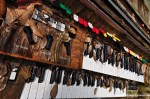
My favorite item though wasn’t in the building, it was outside in the backyard – a wooden electronic organ, beyond repair thanks to years of abuse from vandals and weather; nevertheless an unusual and strangely beautiful sight.

Since the Kent Restaurant / Good Omen Garden was along a busy road, but not within a city, town or even village, there were almost always cars parked outside. But nobody had the intention to bother us, I guess the camera warning signs outside worked. When Dan and I were about to leave though, a pickup-truck with a small crane parked next to the building. We “escaped” through the front entrance while two or three men entered the building through the restaurant. On official order or to loot? We’ll never find out. Dan and I were kind of in a hurry anyway, since on the way to the Kent Restaurant we spotted a location I’ve never seen anywhere else before. But that’s a story for another time. Probably Christmas time…

(If you don’t want to miss the latest article you can *follow Abandoned Kansai on Twitter* and *like this blog on Facebook* – and of course there is the *video channel on Youtube*…)

Read Full Post »

Momijigari (紅葉狩, red leaves / maple leaves hunting) is almost as popular in Japan as the worldwide way more famous hanami (花見, flower viewing). In spring even the biggest couch potato leaves the house to view first the plum and then the cherry blossoms, in autumn they go to different spots to have a look at the autumn leaves. Of course every bigger city has special spots for both, but some countryside towns are pretty much dead for 50 weeks a year and completely swamped on two or three weekends. In Kansai prime examples would be Yoshino (hanami) and Minoh (momijigari). Why? Because those two spots are considered the best – or at least amongst the best. Surprisingly many Japanese people pursue the best of everything – the best food, the best company as an employer, the best spots to view nature. Or at least they pursue what the majority considers the best. With the result that some food is insanely expensive, employers with famous names exploit their employees (because they can!) and the best spots to view nature are so overrun that it’s not really fun anymore going there – you stand in crowded trains for hours just to be pushed past gorgeous trees and through crowded streets with souvenir shops.
So while half of Kansai “enjoyed” autumn leaves in Minoh and Kyoto (just to put up photos on Mixi and Facebook to let everybody know where they went for momijigari…) I made my way to the Hyogo countryside in late November of 2011. My goal was to climb a small mountain with an abandoned temple on top. 15 months prior I was able to explore an abandoned shrine (*you can your all about it here*), so I guess it was only natural to follow an abandoned Shinto site with an abandoned Buddhist site. (I know that there are plenty of abandoned churches – but how about mosques? Has anybody ever heard of an abandoned mosque?)

The Shuuhen Temple popped up on two or three Japanese haikyo blogs before, but it was surprisingly hard to locate. Even more surprisingly since the place is still marked on GoogleMaps, and when you are rather close you can find guide signs – which left me rather puzzled for a couple of minutes about how abandoned the place really was. I guess now it’s more abandoned than ever, because in September of 2011 the street up the mountain was closed. Halfway up the mountain a landslide flushed away the small asphalt road on a length of about 5 or 6 meters – even tiny cars could barely pass here anymore safely.
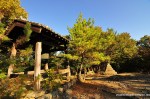
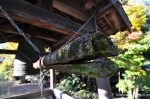
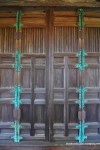
When I reached the mountain top I must have been one of the happiest people in all of Kansai: A stunning view, gorgeous autumn leaves and a temple all for myself. Sure, I couldn’t tweet “I’m in Arashiyama! (Be jealous!)”, but I wasn’t bothered by souvenir shops and crowded locations. Quite the opposite. When I was walking around I had to be careful not to run into one of many one square-meter large spider webs with a nasty middle finger long black and yellow spider in it. The abandoned temple itself was rather unspectacular. All buildings were closed, in rather good condition, and I didn’t even have a closer look if there was a way to open them. I’m not very religious myself, but I respect the beliefs of others and try to be respectful. (Which doesn’t keep me from making fun of them if it’s getting too ridiculous – you know, thetans, magic underwear and stuff like that…)

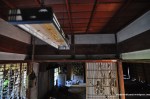
Open and rather interesting was the house of the monk that lived near the Shuuhen Temple. It’s hard to tell when it was abandoned. Some buildings in Japan fade away in no time, others withstand the ravages of time as if they couldn’t care less. It looked like it was built in the 60s or 70s, given the black and white photos of the bell and the belle; judging by the wiring maybe even earlier. The decay there was clearly natural, because thanks to the temple’s location the average bored youth vandal spares the place. Strangely enough the digital display of the power meter still worked…

The temple itself seems to have quite a long history. According to the homepage of the city it is located in, the Shuuhen Temple dated back to Emperor Kotoku’s days (596 – 654) and was first built in 651. In 1578 it was burnt to the ground and stayed a ruin for more than a century until 1682, when it was revived again. Not much information, but way more than one could get for most other temples and shrines in Japan… Now it is famous not so much amongst urban explorers, but more amongst Japanese fans of ghost spots (心霊スポット). I guess it makes sense to look for paranormal activity where people traditionally believe(d) in spirits.

Exploring the Shuuhen Temple was one of those nice, mellow urbex experiences. Sleeping in, taking some local trains, a nice and sunny autumn day, some hiking, some solitude, cold temperatures, but warm sun, beautiful countryside. A relaxed Japanese Indian Summer day…

(*Like Abandoned Kansai on Facebook* if you don’t want to miss the latest articles and exclusive content – and subscribe to the *video channel on Youtube* to receive a message right after a new video is online…)

Read Full Post »

„There is no vandalism in Japan!” is one of the most untrue urbex clichés – and whoever still thinks that I will prove wrong with this posting, especially when compared to the previous one. When I visited the *Tuberculosis Hospital For Children* for the first time three years ago it was hardly abandoned and barely touched. No signs of vandalism, no signs of protection. 8 days ago on the other hand…
When my haikyo buddy *Michael Gakuran* came to Kansai to explore my old urbex nemesis *Nara Dreamland* I was devastated I couldn’t join him since I made other plans for that day weeks ago. But I was free the next day, so we met up and I showed him my most closely guarded secret location, the abandoned tuberculosis sanatorium for children I visited and never talked about. Ever. To anybody.
Walking up a gentle slope I didn’t expect a lot of change. Sure, by now two Japanese explorers posted inside shots of the haikyo hospital, so there must be a way in now… But that’s it, right? WRONG!

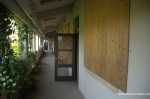
Approaching the tuberculosis clinic the once locked gate was wide open… and 100 meters down the road we found a brand-new barricade. Well, it was brand-new at one point, now it was grotesquely bended and nevertheless almost flat on the ground. It actually looked like a truck ran over it. Again and again. Not one of those Japanese mini trucks! A massive, manly American one! Most windows of the building were boarded up – or smashed after somebody ripped off the solid wooden panels. A half-open box of plastic syringes was scattered in front of a side entrance and glass was basically everywhere. If I wouldn’t have known better I would have said that this location was abandoned forever and a day.
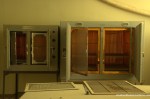
With all the doors broken up and half the windows smashed in, the Tuberculosis Hospital For Children was exposed to the weather for a couple of years – and it showed. A lot of rooms were moldy, in some the wallpapers were falling off already. To make things worse the hordes of vandals (or a single very serious one!) emptied several fire extinguishers in several key rooms (like the radiology and the laboratory), making it hard to breathe after a short while. And of course some areas were swarmed by gnats, but that’s kind of a given for abandoned places in Japan during autumn…
Although the concrete building featured quite a few glass fronts, a couple of areas were still boarded up and therefore dark; darker than a black steer’s tookus on a moonless prairie night. I didn’t expect that and left spare batteries for my flashlight at home, which didn’t influence the photo shooting, but the second video I took for your viewing pleasure.

Exploring an abandoned place I always try to relate to the place I visit – which wasn’t exactly easy at a tuberculosis clinic for children, especially since I just read an article about the Goiania accident in the Brazilian city of Goiânia. (In 1987 two metal thieves stole a cylinder from an abandoned hospital. They punctured it and scooped out some grams of a glowing substance before selling everything to a nearby scrapyard. There the cylinder was opened and people loved the fascinating material they’ve never seen before and spread it all over town by taking some home. To make a long story short – the substance was cesium chloride, a highly radioactive inorganic compound. To this very day the accident is considered one of the most catastrophic nuclear disasters; 4 people dies, more than 110.000 were examined for radioactive contamination.) So here I was, strolling through an abandoned hospital, fascinated by the countless medical equipment that was left behind…
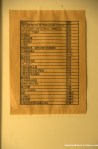
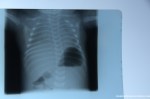
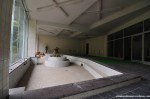
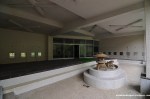
The Tuberculosis Hospital For Children turned out to be a treasure chest of objects big and small. While some rooms were (almost) completely empty, like the swimming pool and the cafeteria, others were stuffed with analysers, boxes of laboratory glassware and even private items like photos and drawings. Without a doubt one of the highlights was right next to the pool, a small room full of boxes containing envelopes filled with X-rays, MRIs and CTs – all of them taken at a hospital in Osaka, which kind of leads to the conclusion that Tuberculosis Hospital For Children was just an extension of a much larger clinic probably still existing… (More about the hospital haikyo’s history in a future posting, this is all about the exploration!)
Pretty much all of the images came with handwritten doctor’s notes, some of them bilingual (Japanese and English). *Michael* seemed to be quite fascinated by the found, so I left for the other building and only took a few quick shots right before we left. It’s a strange feeling going through other people’s medical files, picking up radiographs of potentially terminally ill people and holding them against the sun to take a photo – most of the MRIs seemed to be of adults, but especially the roentgenograms of kids were… eerie.
The massive concrete construction housing the hospital was connected by a bridge with a rather narrow lightweight building (remember the *previous article*?). Typical Japanese architecture of the 1940s / 50s with walls you could punch through. The floor was kind of yielding, but the huge hornets (or maybe suzumebachi?) flying through the smashed windows made my hurry anyway. As expected the lightweight building turned out to be rather unspectacular. One part was in catastrophic condition, so I didn’t even try to enter it. The rest was a couple of bathrooms, lots of empty rooms and some storage rooms – most likely the school part of the hospital in the 40s before it got its own building down the road. But like I said, that’s a story for another time…

(If you don’t want to miss the latest article you can *follow Abandoned Kansai on Twitter* and *like this blog on Facebook* – and of course there is the *video channel on Youtube*…)

Read Full Post »

Waverly Hills Sanatorium in Kentucky is without a doubt the most famous abandoned tuberculosis sanatorium in world (directly followed by the Beelitz-Heilstätten in Berlin), but a rather small Kansai clinic abandoned 20 years ago is slowly rising to fame – the Japanese Tuberculosis Hospital For Children in Osaka. (Of course the official name was euphemistic and translated to something like “Osaka City Resort House For Children”…)

I first visited the Japanese Tuberculosis Hospital For Children almost three years ago – the third abandoned place I’ve ever been to and the first I took video of. So please excuse the quality of both the stills as well as the film material. Back then I had no clue what I was doing… Hell, I barely knew the term haikyo! (Japanese for “ruin” and used as a synonym for urban exploration.)

It was an exciting time, my second day of urban exploration. Back then I spent countless hours doing research on locations and somehow I stumbled across this clinic nobody seemed to know about. It took almost two years after my visit till it appeared on a Japanese blog and almost three before it appeared on another one – and I guess that’s it, from now on it’s only a matter of time until the once secret place becomes public knowledge…

When I walked up to the clinic I had no idea what to expect. I didn’t even know how to enter the premises and if I was at the right location. I found a hole in the fence guarding an overgrown area, so I slipped through – the first time I ever slipped through a fence to get to an abandoned building. Sadly the terrain was so overgrown that I had to retreat and find another way in. So I followed several roads and small paths, slipped past a closed gate with my heart beating like crazy and then it finally appeared through the bushes, the Japanese Tuberculosis Hospital For Children.

I approached the building carefully since I read somewhere that it was still used on weekends for emergency drills. And indeed I heard some sounds from the first floor. Not voices, but machinery; probably some kind of generator. I calmed down a little bit and explored the area. All doors were locked and the shades of all windows I could get close to were down. Some doors had glass elements and looking through them I could see that the interior was spare, but in good condition. No signs of vandalism whatsoever – which kind of confirmed the claim that the building complex was only part-time abandoned. So I took a couple of photos and short videos before I got the heck out of there, keeping the location to myself , trying to prevent it from being damaged…

Recently I revisited the Japanese Tuberculosis Hospital For Children *haikyo* – what I found when I returned I will write about in the near future. If you would like to have a sneak peak please *like Abandoned Kansai on Facebook*, where I will post a short preview later this week. I’m sure it’ll send a shiver down your spine!

(If you don’t want to miss the sequel to this article you can *follow Abandoned Kansai on Twitter* and *like this blog on Facebook* – and of course there is the *video channel on Youtube*…)

Read Full Post »

If you are a regular reader of this blog you might remember my *rant about Golden Week* a while ago. To refresh your memory: I went to Kyushu for some urban exploration – my plan was to stay for four days, but I had to return to Kansai the same day, because I couldn’t find a hotel room; partly because I’m Caucasian, probably because my Japanese skills are limited.

Between the devastating news from the Sasebo Tourist Information Center (their staff was great though!) and me returning home I visited the abandoned Saikaibashi Public Aquarium, a location that gained quite a bit of popularity on Japanese *haikyo* blogs recently.

Sadly only a couple of urban exploration blogs, Western as well as Japanese, really care about the history of the places they present – a fact that sometimes makes it tough for yours truly to give you proper facts about the places I showcase on Abandoned Kansai. I’ve seen a really old photo of the aquarium taken in summer of 1965, so it’s pretty safe to say that it was in business already back then. The oldest photos of the abandoned aquarium dated as far back as 1996 – and on those photos the place already looked like nobody took care of it for a decade or two. The small floating platform in front of the aquarium did not have the wood and barbed wire installation yet, and the handrail on the waterfront was still there, but the concrete holding it up was already severely damaged.

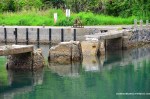
I can’t remember the last time I’ve been to a public aquarium still in business, but passing by the ones on *Mount Yashima* and the Kaiyukan in Osaka (which is one of the biggest aquariums in the world) I was under the impression that those installations are pretty big. The Saikaibashi Public Aquarium wasn’t big at all. Probably 6 or 7 meters by 35 meters, 2 floors (steps, no elevator). There was one huge tank combining both floors and several smaller ones on each floor. None of them were filled with water, hardly any had intact windows. The amount of vandalism was severe – no graffiti, but most of the smashable items were destroyed. The building being exposed to the elements didn’t help either – even on the upper level the massive concrete floor felt kind of unsteady due to the damages done in the past decades. And outside it was more than clearly visible how fragile concrete can be: the bridge leading to the aquarium collapsed at two different segments and I really hope nobody was walking there when it happened. Which is rather likely since I’ve seen photos of the intact bridge that weren’t that old – maybe 1.5 or 2 years. The chance that a fellow explorer took an involuntary bath is rather high…

What really surprised me, not to say shock me, was a fact I found out about only after I visited the Saikaibashi Public Aquarium. As small as the aquarium was, it seems like the main attraction of the place was a dolphin show! The now broken bridge, fitted with metal grids, limited an area known as the “Dolphin’s Cove” (イルカの池), show time was at 10:00, 12:00, 14:00 as well as at 16:00 on normal weekdays and at 10:30, 12:00, 13:30, 15:00 and at 16:30 on weekends, public holidays and during the six week long school summer break that to the best of my knowledge usually starts in July when the weather becomes too hot and humid to spend time in a building without AC, which applies for most Japanese schools.

Though small and vandalized, the one hour I had to explore and document the Saikaibashi Public Aquarium felt a bit short. How often do you have the chance to visit an abandoned aquarium? But at that point I was still hoping to get a hotel room in Fukuoka, so I had to leave prematurely and hurry to save my third Kyushu trip…

(If you don’t want to miss the latest article you can *follow Abandoned Kansai on Twitter* and *like this blog on Facebook* – and of course there is the *video channel on Youtube*…)

Read Full Post »

Ruins in Japan are often in such good condition that they are not recognizable as ruins at first sight. One example would be the World Peace Giant Kannon on Awaji Island, Hyogo prefecture – Kannon not being a spelling mistake, but the Japanese name for the bodhisattva associated with compassion, Guanyin. Other spellings include Kan’on, Kanzeon and Kwannon with the latter being the name giver for Canon, which was founded as Kwanon in 1934 and had the bodhisattva in its logo. I guess a World Peace Giant Cannon only exists in the minds of some really crazy people…

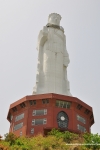
In 2010 I actually drove past the 80 meters tall World Peace Giant Kannon on its 20 meters tall socket building. Sure, it looked interesting, but the bright white statue seemed to be rather new in the warm sunlight of that day, so I didn’t even consider stopping. When I got back home and looked up what the statue really was I found out that most important of all it was abandoned… (It’s the 4th tallest statue in Japan and the 13th tallest in the world. Including the socket it ranks 3 and 10.)

The World Peace Giant Kannon is actually part of the Heiwa Kannon Temple (heiwa meaning peace…), which was founded and funded by Toyokichi Okunai, a realtor who became rich dealing with office buildings, private apartments and business hotels in Osaka. The basis is a 5 storey building, 20 meters tall. The first floor was home to all kinds of religious exhibits as well as well as information about the famous Shikoku Pilgrimage (consisting of 88 temples along a 1200 kilometers long hiking course which usually takes between 30 and 60 days to complete). The other floors were stuffed with Mr. Okunai’s private collections – transportation, watches, china, art, armors. The fourth floor was home to a sightseeing restaurant, a banquet hall and a souvenir shop. If you look up the 80 meters tall statue on top of the building you can see some kind of a “collar” right below the statue’s head – that turned out to be an observation platform.

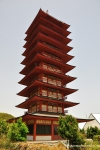
Although attracting up to 2000 visitors per day it seems like a lot of people were appalled by this mix of religion and commerce, some even accused Mr. Okunai of heresy. When Mr. Okunai died in 1988 his wife took over the management of the World Peace Giant Kannon until her death in February of 2006. After her death the Okunais’ real estate company closed the place right away and the Heiwa Kannon Temple started to fall in disrepair quickly, probably due to the lack of management of Mrs. Okunai during her final years. The Lehman Brothers took over, but they failed badly themselves at the time. Put to auction several times in 2007 and 2008 by the Kobe District Court nobody bid any money (which reminds me of the *Former Iranian Consulate* in Kobe…), so the temple was shifted to a separate company in September 2008. Since the World Peace Giant Kannon was liable to collapse (its exterior is molded of gypsum and resulted in the statue’s nickname Whiplash Kannon”) a committee was established in May 2009 by the local government, which took measures against the further deterioration of both the World Peace Giant Kannon and the nearby 10-storey pagoda in September of 2011. Just a couple of months after my buddy Gianluigi and I explored the place…

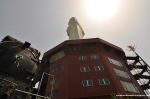
Walking up to the Heiwa Kannon Temple is actually quite impressive. The huge pagoda is right next to a parking lot and a closed restaurant. From there we had to walk up a hill to the back of the socket building. There we found all kinds of statues and items that didn’t go together very well, including a miniature version of the Statue of Liberty and an original Class D51 steam locomotive, the D51 828. We circled the socket building quickly and found an easy entry. The first floor was almost empty as most religious exhibits were gone. A quick look at the office on that floor didn’t give us much insight, so we headed up one of two staircases (one in the north, one in the south) that connected the floors. Some of them were locked, but we gained access to the restaurant on the fourth floor and the tatami room on the fifth floor. Approaching the fifth floor we heard voices, so we talked loudly to make ourselves heard. A minute or two later a young couple in their early 20s rushed past us, the guy holding a photo camera and the girl’s clothes not really being in order – your guess here is as good as mine…

The tatami room once held the Mr. Okunai’s armor, but nowadays well armored soldiers of another kind were all over the floor: suzumebachi, Japanese Giant Hornets, 5 centimeters long killer machines. Luckily they were dead and it wasn’t summer yet, so Gian and I concentrated on the task at hand. In one of the hallways leading to the staircases we found an elevator – and nearby a mysterious claustrophobically narrow und pitch-black staircase that began to wind upwards. After spending a couple of minutes on the rooftop of the socket building admiring the beautiful gigantic Kannon statue we headed back inside and up the staircase. It was dark, the air was bad and some door-like openings revealed unpleasant views at the inside of the statue – even without knowing that people were discussing repairing the Kannon it was pretty clear that investments were necessary. After climbing stairs for about 10 minutes (it felt much longer…) we finally reached the observation platform, which offered both stunning and scary views. The location of the World Peace Giant Kannon between the coast of Awaji Island and the gentle hills was breathtaking – and so were the cracks in the gypsum everywhere. Buildings in Japan are barely constructed for eternity, but this one definitely has seen better days!

And so Gian and I walked down stairs for about 85 meters and left after spending surprisingly much time at this obviously quite popular abandoned statue – passing the also abandoned pagoda a group of about half a dozen Japanese twens was walking up the hill to have a look themselves. And I am sure they weren’t the last visitors as the maintenance work at the Heiwa Kannon Temple started not earlier than four months later…

(If you don’t want to miss the latest article you can *follow Abandoned Kansai on Twitter* and *like this blog on Facebook* – and of course there is the *video channel on Youtube*…)

Read Full Post »

The Shimizu Onsen Center was the last stop on a road trip to Shikoku my buddy Gianluigi and I did in the spring of 2011. Usually I write a short road trip summary in advance, but these days I’m a bit busy, so maybe I’ll make up leeway some day in the future – after all it was quite a busy road trip with six locations in two days.

Onsen is the Japanese term for hot spring, but usually it is more about the hotel / restaurant that is making use of the water. The Shimizu Onsen Center is one of those hidden gems of the beaten tracks deep in the mountains of Shikoku – and the name is just perfect, because shimizu actually means “pure water”. Pure water that won’t be soiled by many visitors, because the Shimizu Onsen Center closed a couple of years ago. If you try to find some information about it yourself, make sure to not confuse it with several other towns named Shimizu all over Japan (like in Fukui, Hokkaido, Kochi, Shizuoka, and Wakayama). You can imagine that the name is quite popular…

When Gian and I drove onto the already slightly overgrown parking lot we had no idea at all what expect – I had never seen photos of the Shimizu Onsen Center and I’ve never seen any since I’ve been there, so please consider it an original find that hasn’t appeared on any blog about Japanese ruins, neither in English nor in Japanese. As we got out of the car it just started to rain and we were pretty tired after a series of exciting but energy-sapping explorations. Nevertheless we closed in quickly, but carefully, just in case the low buildings nearby were home to some curious spectators. But we were lucky and able to enter the Shimizu Onsen Center without trouble of any kind. Not only that, but there was a note taped to the entry glass door of the spa, explaining a little bit about the place’s history. According to this it was opened in 1981 and operated for 14 years before it was sold to a new owner. Financial trouble began in 2003 and in late November of 2007 the place closed with 160 million Yen of debt – just three and a half years before Gian and I visited.

The Shimizu Onsen Center was fed by a sodium hydrogen carbonate spring with a temperature of 17 degrees Celsius, helpful to treat rheumatism, neuralgia, diabetes, and skin diseases. It targeted mainly day-trippers and tourists who booked accommodations nearby. Opening hours were from 9 a.m. till 9 p.m. (closed every 1st and 3rd Thursday of each month) and the entrance fee was 600 Yen. In the northern part I found a couple of Japanese style guest rooms with tatami mats and small TVs, but I’m not sure if they were used for overnight stays or just to relax between two baths.

Gian and I entered through the normal entrance on the second floor and went straight downstairs to the first floor, where the baths were. Both the one for males as well as the ones for females were equipped with a sauna and featured several frog statues. The Japanese word for frog is “kaeru”, which can also mean “to return”, and that made them good luck charms / symbols for money and coming back safely. This floor also featured the already mentioned guest rooms, which could be reached through a very, very dark hallway. The whole floor and all the items there looked a bit old and run down (like the massage chairs in the hallway and vending machine for razors), but there were no signs of vandalism or theft.

That also applied for the second floor with the front desk and a huge tatami room with a stage – a typical Japanese party room for long karaoke sessions with dozens of attendees. The tiny coop next to the stage even still had all the music equipment including countless tapes. No vandalism, no theft. In the entrance area we found a bin stuffed with umbrellas, slippers were still lined up and the front desk was neat and tidy.

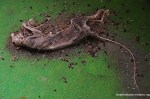
The rather small third floor was exciting and disappointing at the same time. On the one hand the former bar was removed and so were the arcade machines that one day must have been there. On the other hand I finally found some dead animals, in amazingly good condition actually. Two skeletonized birds and a rat with some of the skin left, surrounded and partly covered by dead maggots. One of the bird skeletons was on the stairs on the way up, but the other one was just a couple of centimeters away from the rat – it looked like hunter and prey died at the same time at the same place. And that rat was huge! Maybe 30 centimeters long, and by that I mean the body alone. Since it was grey outside and I had to bring my tripod for the interior shots anyway I set up my little equipment to a comfortable height and zoomed to get a decent picture, being the lazy photographer I am sometimes. I was aware that the exposure time was rather long (a quarter of a second), but I didn’t realize that I zoomed to a point where gravity took over and the lens continued to zoom on its own – and so I accidentally created one of my favorite photos ever, one that still makes me a bit dizzy to this very day. Excited by this new discovery (commonly known as radial blur) I took some additional similar shots with both the rat skeleton and the bird skeleton next to it before we finally ran out of time – we were in the middle of nowhere in Shikoku on a rainy day and had less than 3.5 hours to get the car back to the rental company. Which really reminded me of my *first trip to Shikoku*, but this time the car rental was in Osaka, not in Kobe – and due to Golden Week the roads were a lot busier…

(If you don’t want to miss the latest article you can *follow Abandoned Kansai on Twitter* and *like this blog on Facebook* – and of course there is the *video channel on Youtube*…)

Read Full Post »

« Newer Posts - Older Posts »