Feeds:
Posts
Comments

When visiting the Mt. Atago Cable Car you should have a look at the Atago Hotel, too – there’s not much left, but after climbing about 640 meters 20 more won’t kill you.

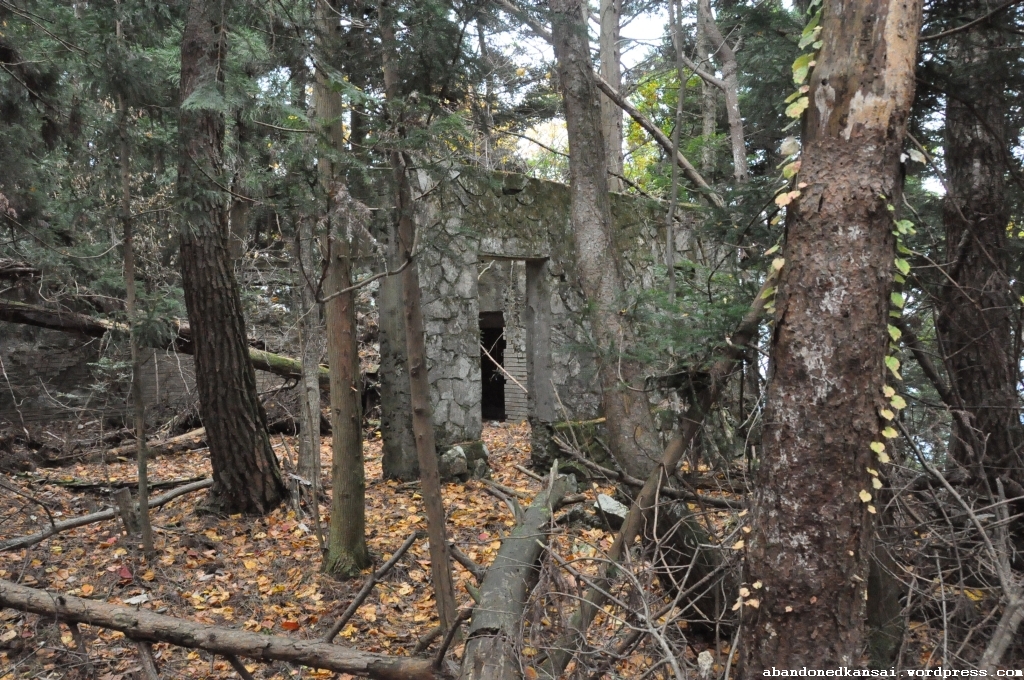
The Atago Hotel was opened on 1930-07-20, shortly after the cable car, and closed down together with it in 1944. Like the top station of the cable car the Atago Hotel is nothing more but a bunch of walls, just in a slightly better condition – but without floors. It seems like the hotel, located at a slope, was built with the entrance at the ground floor and an “open basement”. The ground level is almost completely gone whereas the walls of the basement are still there, or at least some of them are; including openings for windows and doors. If you get to the hotel from the southern side and on a lower level the remaining walls look very massive, almost like an ancient Japanese castle.

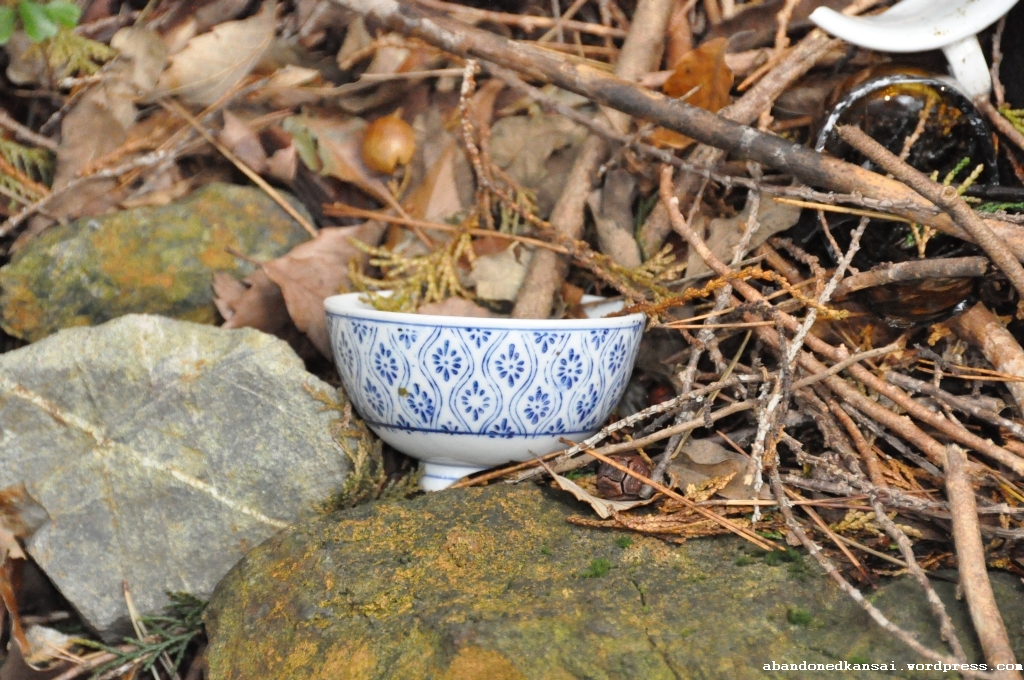
Overall the place is quite unspectacular and only worth going there since the cable car station is so close-by. At one side of the hill is kind of a dump with lots of old cans, cups and plates. I’m not sure if everything there is from the time when the hotel was still open or if later visitors left their garbage there, but it’s nevertheless interesting and offers quite a few items worth taking pictures of – if you are into that kind of stuff.

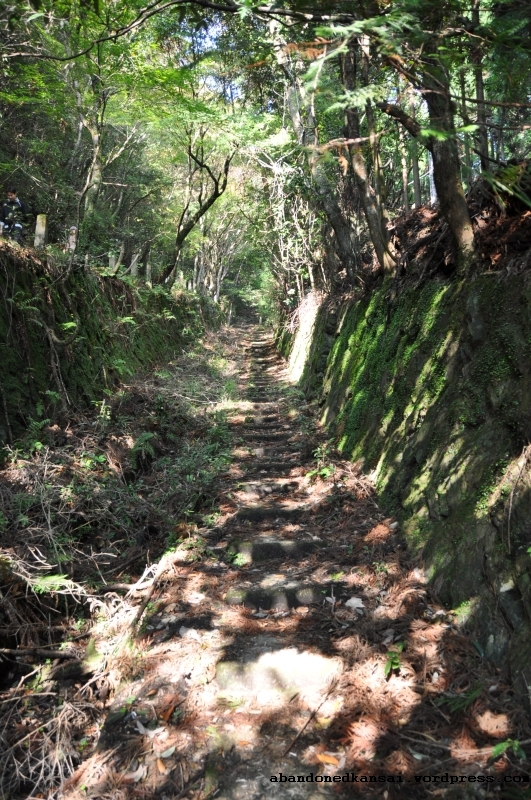
My first real *haikyo* is still one of my favorite as it combines a quite unique type of abandoned place with a scenic hike. Wrapping itself around sacred Mt. Atago in Kyoto from south counterclockwise this abandoned cable car track offers breathtaking views, six tunnels and a great leg workout – steps for about an hour as well as two short but quite steep climbing sessions. If you are not in decent shape you might wanna think about visiting this haikyo… When I started to research abandoned places in Japan on the internet I pretty quickly found the Mt. Atago Cable Car since it is, next to the *Mt. Maya Tourist Hotel*, one of the most covered haikyo in Kansai – and one of the most accessible. Instead of taking the pilgrim’s path to Atago Shrine just take the abandoned track right next to it. You can’t miss it! (If you are able to find out where exactly Mt. Atago in Kyoto is…) There even is a great (Japanese) homepage covering the history of the Mt. Atago Cable Car – built in 1929 it was already abandoned in 1944. If you are interested in the background of the places you go to you should have a look, especially at the old pictures from the time the cable car was still used. (If you are not able to read Japanese just click around and c/p the text into a translation homepage. More people than you might think do it that way…) On the way up there are two challenges – the steep incline (most of it concrete steps) and two collapsed tunnels, forcing you to leave the track and climb the hill by holding on to everything nature offers. Both detours have colorful markers giving you hints which way to get up. But while the one around tunnel 3 will bring you directly back to the track, the one around tunnel 5 will lead to a path close to the already mentioned pilgrim’s way. Without spoiling your search back to the track too much: Just go straight ahead, maybe a bit to the east. A small trail will lead you back to the track. After the sixth tunnel you almost made it to the still existing top station. Just a few minutes before that your breathtaking climb will be rewarded by a breathtaking view not visible from the pilgrim’s path – just after a partly collapsed bridge. More than 65 years after giving up this wonderful piece of transportation history, parts of it are in pretty bad shape. Nothing to worry about, but nevertheless worth mentioning. The top station itself is in pretty bad shape, too, but unlike the completely vanished valley station it is still standing. Basically it’s a bunch of outside walls and floors: no machines, no interior, no internal walls. To me it was nevertheless impressive, maybe because it’s a place with a history. A short one, but still a history, an entertaining one actually since this cable car lead directly to a *tourist hotel* and a ski resort – but that is another story…

Hello and welcome to Abandoned Kansai!

My name is Florian and I’m a German expatriate living and working in the Osaka area.
This is my first blog and I am not a native English speaker, so please don’t be too harsh with comments – I’m still learning. That also applies for the pictures I’ll put onto this blog: Until October 2009 I only used compact cameras with their standard settings. That’s when I found CJW’s great blog about hiking and climbing in Japan and I decided that I wanted to take better pictures myself. At that time I was hiking in the Kansai area for about a year and the more beautiful places I saw the stronger my urge to take good pictures grew – CJW’s pictures are amazing and I hope one day mine will be nearly as good.
Coincidentally around the same time I was talking to a friend back home about abandoned places. I was always fascinated by them, especially since I attended a seminar at the Zeche Zollverein in Essen, Germany, but I never took any actions exploring them as I was a couch potatoe at that time. Anyways, we talked about the topic and it inspired me to research abandoned places in Japan, although I failed miserably when I first came here three years ago. Since then Michael John Grist started his homepage, which is mainly about the Kanto area and also includes some interesting pictures. I continued my research (dozens of hours so far actually, with an incredible amount of dead ends – urban explorers tend to be quite secretive…), found an abandoned place that combined hiking and *haikyo* (the Japanese term for ruin, used by local urban explorers) and got hooked ever since.
Now that I have about a dozen abandoned places under my belt I decided to start this blog – inspired by the two blogs I’ve mentioned before; and by the fact that there is no (English) blog about urbex in Kansai. I’ll try to present as many abandoned places in Kansai as possible, but sadly the number of locations around here is very limited – so (hopefully…) I will go on short trips to cover other parts of Japan now and then, too.
Long story short: Please enjoy – and come back once in a while…