Feeds:
Posts
Comments

Archive for September, 2011

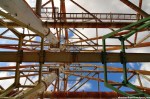
Abandoned ferris wheels usually come with abandoned theme parks. But when I visited *Expoland* in Osaka the ferris wheel was just demolished. And so were the giant wheels in all the other *abandoned amusement parks* I visited – except for the *big wheel in Pripyat* – which was actually pretty small… So usually the ferris wheel is one of the first things to be demolished when an amusement park closes – to be re-built at another park or to be sold for scrap metal. Not in the case of Igosu 108…
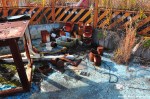
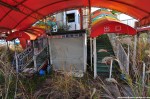
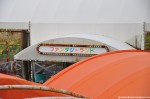
You might have seen photos of this abandoned ferris wheel at other blogs and you might ask yourself “Why is Florian calling the ferris wheel ‘Igosu 108’ – it says びわ湖タワー (Biwako Tower) in huge letters right in the middle of the thing and everybody calls it that way when writing about it?!”. Well, my Japanese might not be the best, but just because something is written somewhere doesn’t mean it’s the name of the place. And in this case it isn’t. The name of the ferris wheel is Igosu 108 – the name of the surrounding amusement park, now mostly gone, was Biwako Tower. To be more precise: The name of an observation tower, now gone, was Biwako Tower. This tower was 63.5 meters high and had a rotating observation platform that went up and down to give visitors a spectacular view across Lake Biwa, the largest freshwater lake in Japan. Biwako Tower was built in 1965 and extended to an amusement park in 1967. In addition to the observation platform there was a small ferris wheel, a rollercoaster, a pachinko parlor, water bumper car and several other small rides. But that’s not all! Biwako Tower also included an onsen (hot spring / spa) and a wedding hall – plus the usual array of restaurants, shops and stuff like that. Thanks to free parking and no entrance fee Biwako Tower was hugely successful and attracted up to 50.000 people a day!
In 1992 the last attraction was built – now the last one standing: Igosu 108 (イーゴス108). I can’t say for sure, but I guess the name is a combination of sugoi (すごい, meaning “great”) backward and 108 – the height of the ferris wheel, at the time the largest ferris wheel in the world. It was soon considered a landmark of Shiga prefecture and Lake Biwa, but couldn’t stop the downfall of Biwako Tower. Speaking of which: Since the ferris wheel was higher than the name-giving attraction Biwako Tower was transformer into a bungee jumping platform.
On August 31st of 2001 Biwako Tower finally closed its doors – just half a year after Universal Studios Japan opened in Osaka. Most of Biwako Tower was demolished in late 2003 / early 2004 with the exception of Igosu 108. Some small attractions survived partly (like a fortune teller booth, Fantasy Land and Bumper Boat), but the rest was transformed into big supermarkets and other stores, their parking lot replacing the pachinko parlor. Two sources claim that Igosu 108 still has an owner who announced in 2007 that the ferris wheel will re-open in 2008, but that never happened. According to them an operator puts Igosu 108 into motion once a month to make sure that everything is still working.
Having visited what’s left of Biwako Tower in December of 2010 (together with Damon and Andrew right after leaving the *Love Hotel Gion*) I kinda doubt that claim. While the outer part is easy to access Igosu 108 is protected by a typical Japanese orange site fence. The noisy kind that doesn’t have a door to let people in and out easily. I didn’t have a closer look at the controls of the ferris wheel, but the whole place looked quite rusty and run-down. To reactivate Igosu 108 you would need way more than just a bucket of paint and a “Reopened!” sign…
(If you don’t want to miss the latest postings you can *follow Abandoned Kansai on Twitter* and *like this blog on Facebook* – and of course there is the*video channel on Youtube*…)

Addendum 2013-11-28: Igosu 108 was dismantled in autumn of 2013…


Read Full Post »

Love hotels always fascinated me. From the first time I heard about them and even more so after the first time I visited one. So of course an abandoned love hotel was always quite high on my “Places I want to go to” list, but while Kanto is swamped with that type of haikyo there seem to be barely any in Kansai. It took me more than a year to find the love hotel Gion, and technically I guess it’s more like a love motel…
Since I guess not everybody reading this blog is familiar with that kind of “popular Japanese subculture”. So, what is a love hotel? First of all – the love hotel industry is not a subculture at all, it’s one of the biggest money makers in Japan! A love hotel (also known as fashion hotel, amusement hotel, boutique hotel, couples hotel, romance hotel or leisure hotel) is a hotel where you can get rooms not only for a whole night, but also by the hour. They originated in the Edo period in Edo (nowadays Tokyo) and Kyoto, the then-capital – appearing to be tea rooms or normal inns, used by both prostitutes and normal couples. When prostitution was abolished in 1958 love hotels (then known as “bring-along inns”) started to boom – litte known fact: Even Nintendo ran a love hotel in 1963, just about 10 years before they started entering and revolutionizing the video games industry. The modern term “love hotel” derives from the “Hotel Love”, which was built in 1968 and attracted customers with a rotating sign. While some love hotels are basically more or less normal hotels without windows (if you see a hotel without windows in Japan you can be sure it’s a love hotel…) and an extremely discrete front desk other love hotels have very creative theme rooms for almost every taste – from princess bedrooms to BDSM stuff, from train compartments to whatever cliché fantasy you can imagine. The furnishing and equipment of those rooms vary heavily on the price – in addition to the standard stuff you have in a normal hotel room (TV, free tea, hairdryer, …) you usually get a games console, a karaoke machine and some condoms; some hotels have vending machines with sex toys in the hallway or the lobby. If you are willing to pay more there are basically no limits – insanely huge HDTVs, jacuzzis, massage chairs, private balconies on the top floor to enjoy the night sky and in some cases even a private swimming pool. While “rests” are about 2000 to 4000 Yen an hour “stays” cost about 8000 to 16000 Yen per room per night (usually from 10 or 11 p.m. on for 10 or 12 hours, depending on the hotel) – super luxurious rooms can cost up to 60.000 Yen per night in cities like Kyoto or Tokyo. (1000 Yen = 9 Euros / 13 US-$)
Nowadays the turnover of the love hotel industry in Japan is a whopping 4 trillion Yen per year, equivalent to about 36,000,000,000 Euros or 52,000,000,000 US-$ as of September 2011 – generated by 500 million visits to 37,000 love hotels all over the country. Love hotels are considered a whacky underground thing by many foreigners, while in fact they are part of daily life, turning over double of what the anime industry does.
Why are love hotels so successful in Japan? Because Japanese walls are thin and a lot of even not so young Japanese people are still living with their parents; the so-called parasite singles (パラサイトシングル, parasaito shinguru) enjoy the carefree and comfortable life of living at home up till their early 30s when even the late bloomers are getting married. If they want to have some passionate hours with their girlfriends, boyfriends or club acquaintances they go to a love hotel (and so do most adulterers…). It’s clean, it’s anonymous (most lovel hotel visitors don’t see any staff person!) and it’s affordable, especially if you have a job and still live with your parents. And the novelty factor of the rooms is a big plus, too!
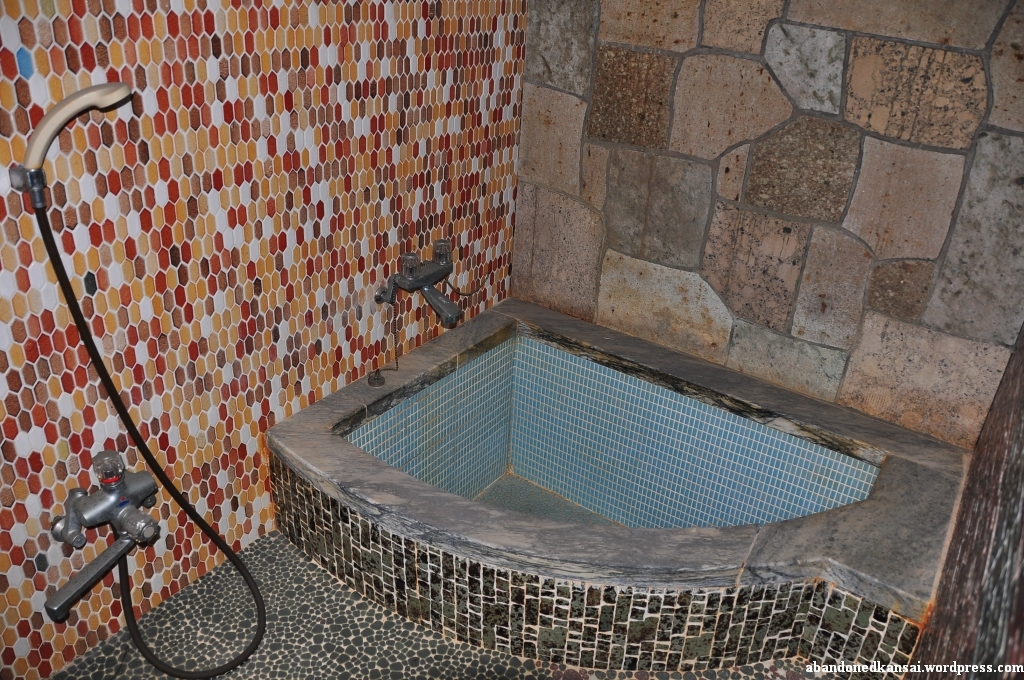
So one day in November I met up with Damon and Andrew at a small train station somewhere in Shiga – all three of us were eager to finally explore an abandoned love hotel; especially Damon, who seems to find secret porn stashes at pretty much every location he goes to. Sadly the haikyo Love Hotel Gion didn’t have any of the (fake) glamour and sexiness you experience at a fashion hotel that’s still in business. It wasn’t even a real hotel, more like a motel – 8 row bungalows with rather deep open garages in front of them to prohibit people from getting an easy look at the license plates of the parked cars. The lot in front was quite big, so I guess another row bungalow or two were already demolished. And the one still standing was in pretty bad shape overall. Some of the “rooms” I didn’t fully explore, because the floors and roofs were falling apart, but one or two were barely touched. The downside of that was that it was pitch-black in there – luckily I brought my tripod. The layout of the bungalow sections was pretty much the same for all of them. A little lobby at the entrance, a windowless bath including a tiled tub to the left and then a bedroom straight ahead. Most of the bedrooms were covered by landscape wallpapers while the rest of the rooms had crimson wallpapers. Very, very 70s porn! (Or how an innocent young man like myself imagines something filthy like that!) Sadly most of the rooms were empty except for fixtures and solid bed frames. In one of the mini apartments we found a jukebox in questionable condition, but the most interesting detail was the wall mosaic in one of the bathrooms – it depicted two nude women in front of a horse, of one of them you could see the pubic area. Shaved, with just a little bit of hair left; except for the final stone – that one was red…
(If you don’t want to miss the latest postings you can *follow Abandoned Kansai on Twitter* and *like this blog on Facebook* – and of course there is the *video channel on Youtube*…)

Read Full Post »

Today I had a look at some rather old videos shot at locations I already wrote articles about. None of them were intended to be published, so the camera work might be a bit rushed occasionally, but I decided to upload them anyways as I think there might be some interest in them out there in the world wide web. While some of my videos only get a couple of dozen views quite a few of them were watched by thousands of people – *this one* will actually reach 30.000 views soon. Please enjoy!
*Nara Dreamland – Aska Rollercoaster*

*Koga Family Land*

*Jumbo Club Awaji Island*

*Ohmi Lodge*

*Young People’s Plaza & Museum*

*Takada Ranch Ruin*

Read Full Post »