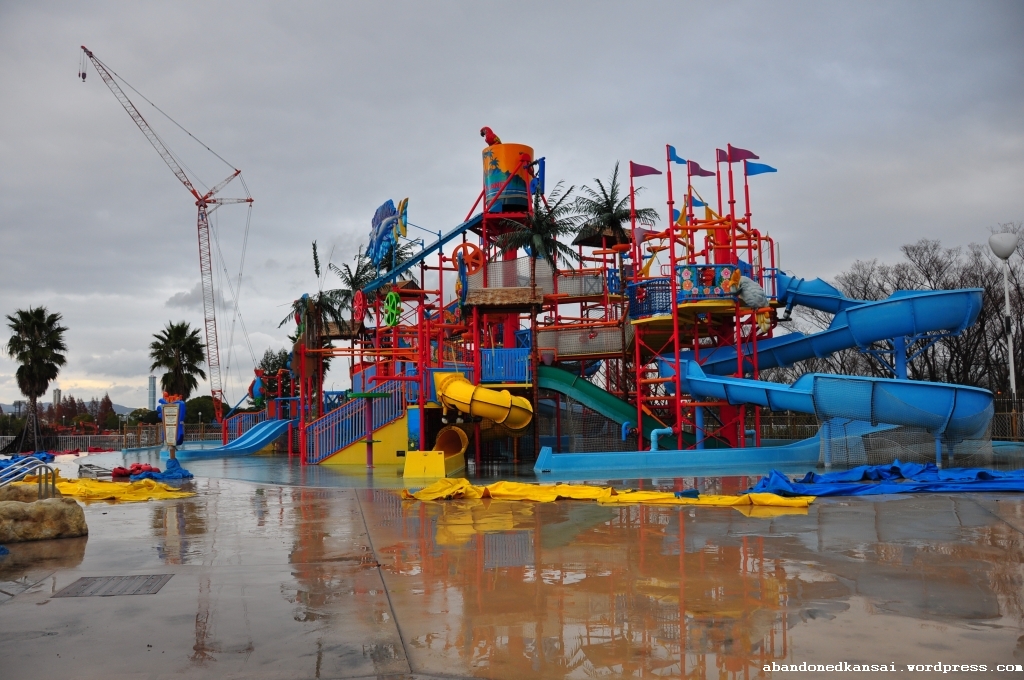
Today I had a look at some rather old videos shot at locations I already wrote articles about. None of them were intended to be published, so the camera work might be a bit rushed occasionally, but I decided to upload them anyways as I think there might be some interest in them out there in the world wide web. While some of my videos only get a couple of dozen views quite a few of them were watched by thousands of people – *this one* will actually reach 30.000 views soon. Please enjoy!
*Nara Dreamland – Aska Rollercoaster*
Archive for the ‘Amusement Park’ Category
New (Old) Videos!
Posted in Abandoned, Amusement Park, Asia, Haikyo, Hotel / Ryokan, House, Hyogo, Japan, Kansai, Museum, Nara, Restaurant, Shiga, Urbex, Video, Visited in 2009, Visited in 2010 on 2011/09/03| 2 Comments »
Navelland
Posted in Abandoned, Amusement Park, Asia, Demolished, Fukuoka, Haikyo, Japan, Kyushu, Map, Restaurant, Urbex, Video, Visited in 2011 on 2011/08/19| 4 Comments »
There’s nothing like abandoned theme parks. Everybody seems to love them, including yours truly. No matter if just recently closed (*Doggy Land*), closed a while ago (*Nara Dreamland*), mostly demolished (*Koga Family Land*), completely demolished (*Sekigahara Menard Land*), under deconstruction (*Expoland*) or left behind after a nuclear catastrophe (*Pripyat Amusement Park*) – each and every one of them has a unique, absolutely stunning atmosphere; even if they were just waterparks (*Tokushima Countryside Healthspa* / *Kyoto Waterland*). “New” abandoned amusement parks barely every show up – it’s more likely that well-known ones get demolished. Here’s an exception to the rule: Navelland. (ネイブルランド)
You would think that Navelland (or Navel Land), a science themed amusement park with an aquarium and a greenhouse that welcomes its guests with a huge half-“diving” whale in front of the entrance, most likely should have been called Navalland (or Naval Land) – but you would think wrong. The Japanese investors and creators chose the name on purpose, at least to some degree. Initially it was supposed to be called GeoBio World in the “BioCity” (or “Bio-City”) Omuta – but the name of the executing company was called Navel Land for three reasons, all related to its location in Omuta, Kyushu: GeoBio World was considered the “belly button project” (heso jigyo, 臍事業) of Omuta’s revitalization efforts with several other projects being based on it, Omuta’s history is strongly connected to coal (mined from the “belly” of the earth…) and Omuta is located in the center of Kyushu (or so the makers thought – to me it looks more like the “nipple of Kyushu”). At which stage of developement did GeoBio World become Navelland? I don’t know. But I guess a lot of things wrent wrong planning and executing the project, so the naming issue was just one of many, considering that Navelland was open to the public for less than two years…
Omuta’s economy was intertwined with coal for more than five centuries, for the longest time it was actually based on it. In 1467 a local farmer named Denzaemon found coal when making a bonfire in the hills of his home – like many Japanese cities Omuta is spread from the sea to the mountains. Mining on a larger scale didn’t begin until 1721 when Ono Harunobu (most likely not related to the producer of the series of “Street Fighter” games) was granted coal mining rights. When the age of industrialization finally reached Japan after the Meiji restauration the number of mines in the area was increased. In 1872 the Meiji nationalized the mines, most of them in the township of Miike (三池), nowadays part of Omuta. Towards the end of the 19th century the Japanese state privatized a lot of their model companies und sold them way under value. Mitsui, for centuries successful in finance and trade, got into heavy industries just a couple of decades prior when they aquired a mine as collateral for a loan they gave, bought the mine cheaply and turned it into the Mitsui Miike Coal Mine (三井三池炭鉱) in 1899.
The mine’s history is similar to most coal mines – a huge success in the early 20th century it became less and less profitable thanks to the fact that coal was replaced by oil as the most important natural resource in highly industrialized countries. So when the local politicians realized that the industry that provided the area with both jobs and wealth for centuries would be gone soon they looked for alternatives and came up with several ideas – one of them being Navelland, which ironically closed in 1998, only one year after the Mitsui Miike Coal Mine. (A rather interesting fact that shouldn’t be swept under the rug: The Mitsui Miike Coal Mine was also home of Fukuoka 17, a Japanese prisoner of war camp, mostly for Americans, Australians, British and Dutch – soldiers of the latter three nationalities survived the construction of the Burma Railway in Thailand; nowadays still famous thanks to a movie based on a book by the French author Pierre Boulle, The Bridge over the River Kwai. The camp was opened on August 7th 1943 and help up to 1735 prisoners. It was liberated on September 2nd 1945, almost a month after the atomic bombing of Hiroshima. The camp’s commandant, Asao Fukuhara, was later executed for war crimes.)
In 1988 it was more than obvious that coal wouldn’t be Omuta’s future. Mining it just wasn’t profitable enough anymore. At that time amusement parks were the current money makers, biotechnology the future ones. So why not combine both? Throw in some history and you’d get GeoBio World – split up into Geo Zone to remember Omuta’s coal history and Bio Zone to celebrate Omuta’s biotechnological future at the Ariake Sea. An amusement park with affiliated research labs and a mining museum. Turning Omuta from a dirty coal city into “BioCity”. In Kitakyushu, another former center of heavy industries only 1.5 hours away by car, a similar concept called “Spaceworld” was about to open, so the planners in Omuta spared neither trouble nor expense with about 82 million dollars to spend and about four years to plan and execute.
Navel Land (not the park, the company behind it) was finally established in September 1989 with the sole purpose of constructing and managing GeoBio World – to get the idea off the ground they even sponsored a large bio symposium in Omuta in November 1989. But four rejected concepts, one of them being presented by Futurist Light and Show who worked on Tokyo Disneyland, and more than two years later, Navel Land decided to come up with a concept by themselves, since none of the previous ones could convince the Japan Development Bank – the main backer of the project.
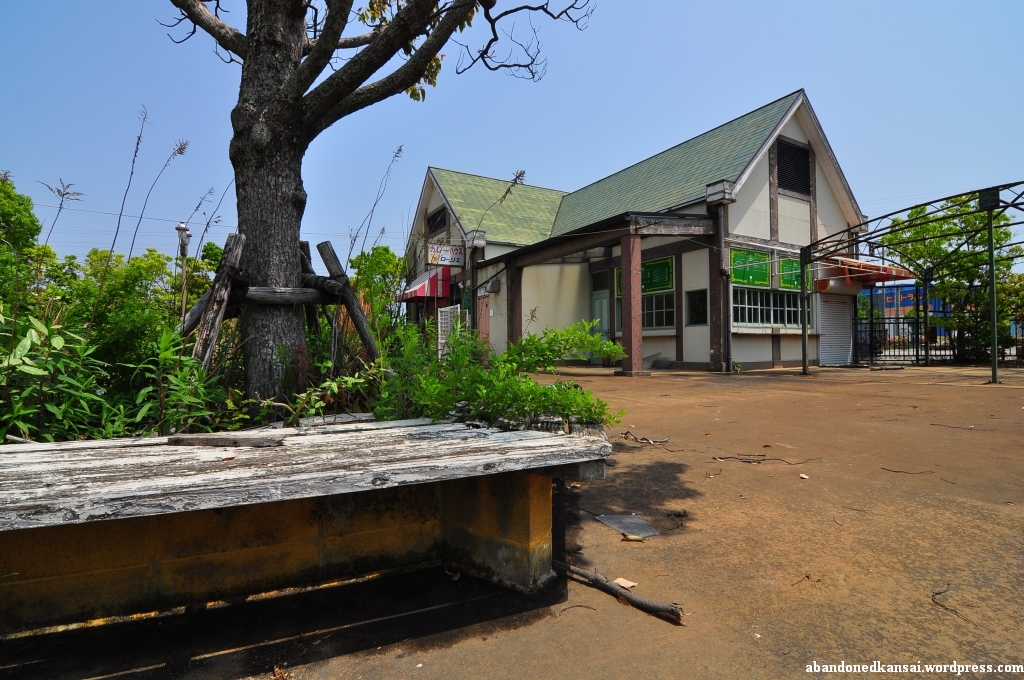
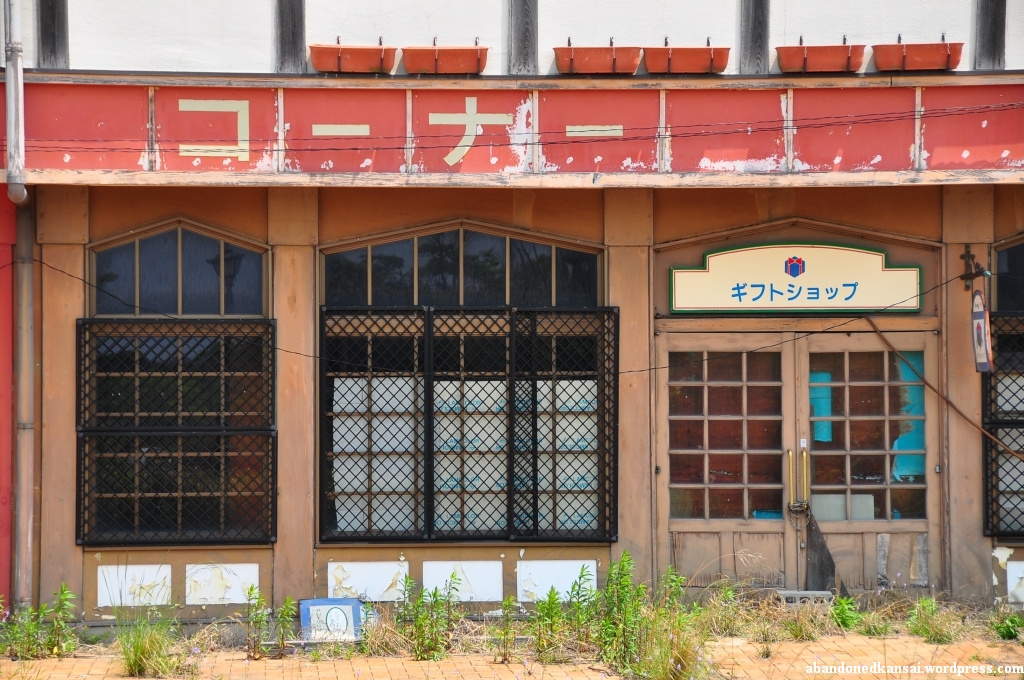
At this point information about GeoBio World and Navel Land becomes vague. While it’s a fact that the park finally opened under the name “Navelland” it seems like everybody agrees that it was closed down on December 25th 1998. What happened to GeoBio World and the biotechnology concept between the early 90s and 1998? I have no idea. All I know is that by the time Navelland closed its costs went way over budget (between 100 million and 200 million US-$ – or up to 160$ od debt for each Omuta resident) and that the visitor numbers never came close to the projected 600,000 per year. One of my sources said Navelland was opened in July of 1995, another one stated that it closed after less than two years – all three agreed it closed in late 1998. Maybe we will all find out more about Navelland soon since it is becoming more and more popular as a haikyo, a Japanese ruin, recently. Until then I’ll leave you with some photos and a quick video walking tour. The “House of Coal” exists as well as an aquarium and a greenhouse, so I guess the main concept was realized and not yet demolished. The amusement part of Navelland is mostly gone by now – both rollercoasters can only be seen on maps and the one thing that’s left of Kiddie Land is the entrance…
Addendum 2012-1-30: Navelland was demolished in late 2011 / early 2012. Now you can find its exact location on my *map of touristy and demolished ruins in Japan*.
(If you don’t want to miss the latest postings you can *follow Abandoned Kansai on Twitter* and *like this blog on Facebook* – and of course there is the *video channel on Youtube*…)




Back From The Island(s) – Again…
Posted in Abandoned, Amusement Park, Demolished, Factory, Haikyo, House, Japan, Kyushu, Mine, Nagasaki, Shipyard, Transportation, Urbex, Visited in 2011 on 2011/06/02| 4 Comments »
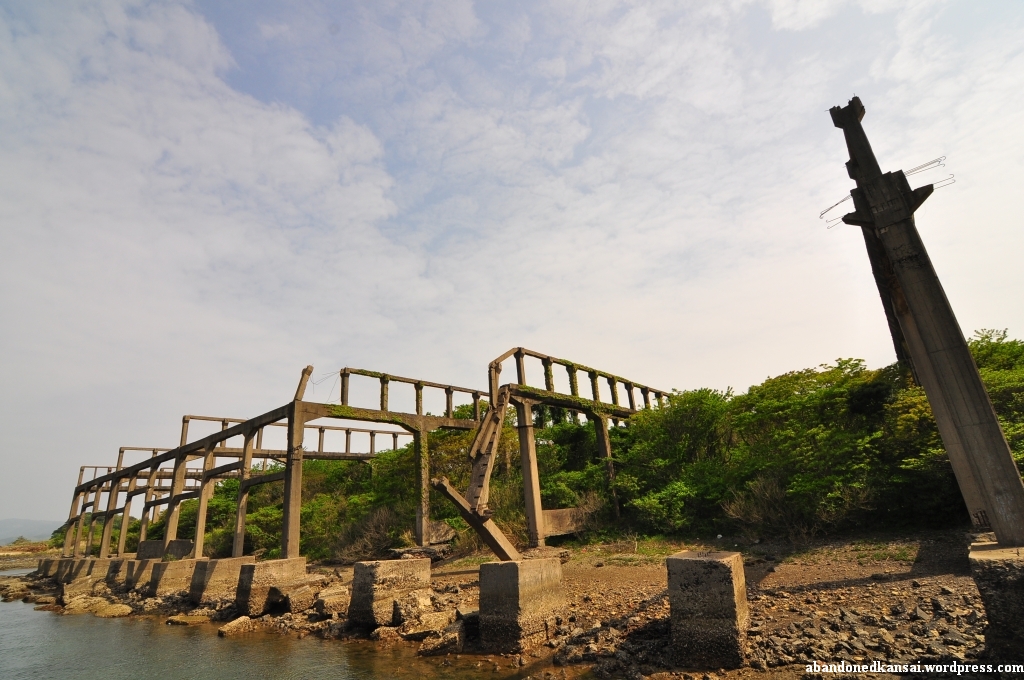
About 15 months ago I went on my first multi-day urban exploration trip: 3 days to Kyushu with my buddy Enric. A trip with lots of up and downs, visiting some amazing locations – Gunkanjima, the Katashima Suicide Training School and the winding tower of the Shime Coal Mine, now known to some people as the Anti-Zombie Fortress. But March was kinda cold, last year as well as this year. So when Golden Week came up (late April / early May) and my company forced me to take two of my paid vacation days to install a new AC I took the lemon and made lemonade – it was time to go back to Kyushu!
Since Enric left Japan and returned to Spain a couple of months ago, I went on my own this time. Remembering the best burger I’ve ever had I set up my base in Sasebo after a long day of exploring an abandoned shipyard and the abandoned leftovers of the dock of a mine close to it. The next day I explored one of the most amazing places I’ve ever been to: an almost abandoned island, once the home of several thousand people – and as exciting as that day was as disappointing was the next one when I walked through drizzle for hours without an umbrella to look for remains of a mine and its workers’ housing-estate; but they were gone forever – as research after my return confirmed… Luckily the weather turned around on my last day, so I was able to visit an abandoned amusement park on my way back home. Thank heavens for sunscreen, because without it the harsh Kyushu sun would have burned me crisp within half an hour…
Exploring all day I spent my three evenings in Sasebo at Base Street to enjoy some burgers. While the regular sized ones are good I’ll definitely recommend the so-called “Special Size” – this 15 centimeters in diameter monster is a classic Sasebo style burger that will fill you up with pure deliciousness; if you ever wanna spend 1100 Yen (yep, that’s 9.50 Euros or 13.60 Dollars!) on a single burger without even considering regretting it then this is the place to go! I just hope I’ll find more abandoned places close to Sasebo so I can have a good reason to go back there once more…
(Oh, and greetings to the tourist office in the Sasebo! It sells a variety of souvenirs, but not the awesome huge plush hamburgers that fill half of their display window. To get one of those you have to ride a bus for about half an hour to get to a small store at a shopping mall in the middle of nowhere. And since I had to wait 45 minutes for the next bus they lost a customer who would have happily paid 200 Yen more to avoid the hassle of a 2.5 hour long round trip to get a cute present for his even cuter niece. A no-win situation… and pretty much the worst sales strategy ever!)




The Tokushima Countryside Healthspa (お水荘ヘルスピア)
Posted in Abandoned, Amusement Park, Asia, Haikyo, Hotel / Ryokan, Japan, Shikoku, Spa / Onsen, Sports, Tokushima, Urbex, Video, Visited in 2010, Zombies on 2011/04/06| 8 Comments »
Bathing is a very important aspect of Japanese culture, deeply rooted in centuries-old traditions. Although most apartments and houses have their own baths nowadays (unlike 30 years ago), public bath houses are still popular even in residential areas of big Japanese cities. Onsen and sentō are gender-separated places of tranquility where people enjoy a relaxing hot bath (usually around 40°C) after a hard day of work or an intense workout. Onsen towns in the middle of nowhere are popular vacation destinations for the Japanese domestic tourism and a must see / do for many foreign visitors.
Waterparks with slides and wave pools on the other hand are not nearly as popular in Japan as they are in the States or Europe. Most of the time they are considered one amongst many attractions of amusement parks (like at Nara Dreamland) – and indoor waterparks are even more rare.
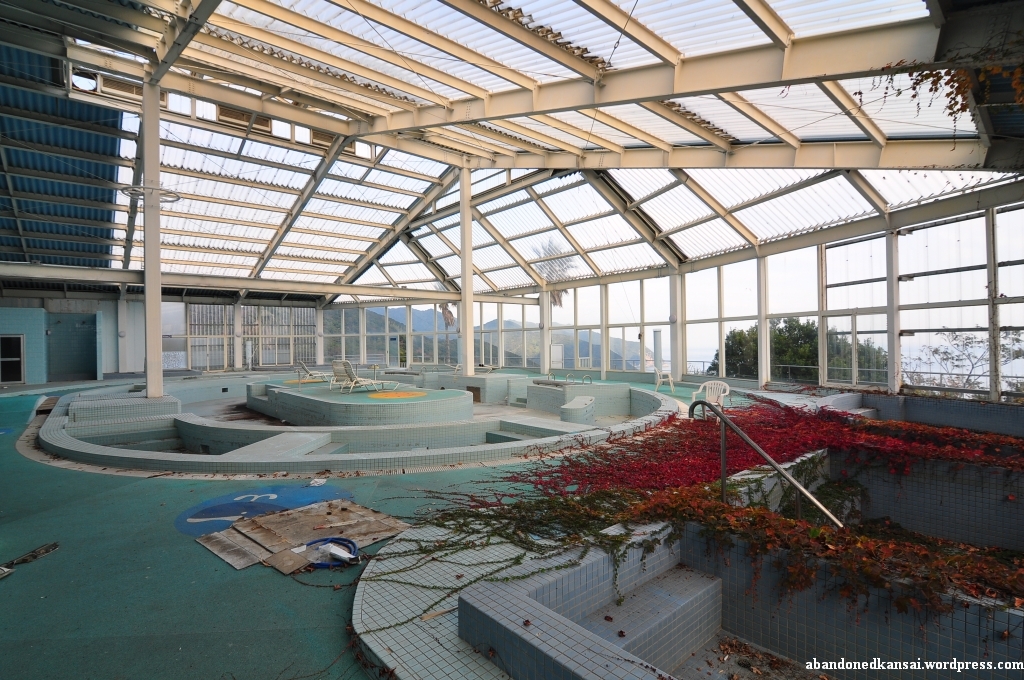
From what I was able to find out the Tokushima Countryside Healthspa (お水荘ヘルスピア), an indoor water park with some hotel rooms, was opened in 1975 (under a different name) to complement a countryside farm, attracting visitors with millions of flowers. It was renovated and expanded in 1994 to be re-opened under its current name – making dance shows and karaoke new selling points. Due to its remote location (35 minutes by bus from the next train station) and the economic crisis the number of guests decreased while the debt piled up to 800 million Yen – and lowering the entry fee from reasonable 1700 Yen per day (10 a.m. to 10 p.m.) with special promotions (Ladies Day on Thursdays for 850 Yen and Friends Day on Fridays for 1000 Yen) didn’t help either – at the end they reportedly sold tickets for as low as 100 Yen… So in 2002, after 27 years, the lights went out at Tokushima Countryside Healthspa.
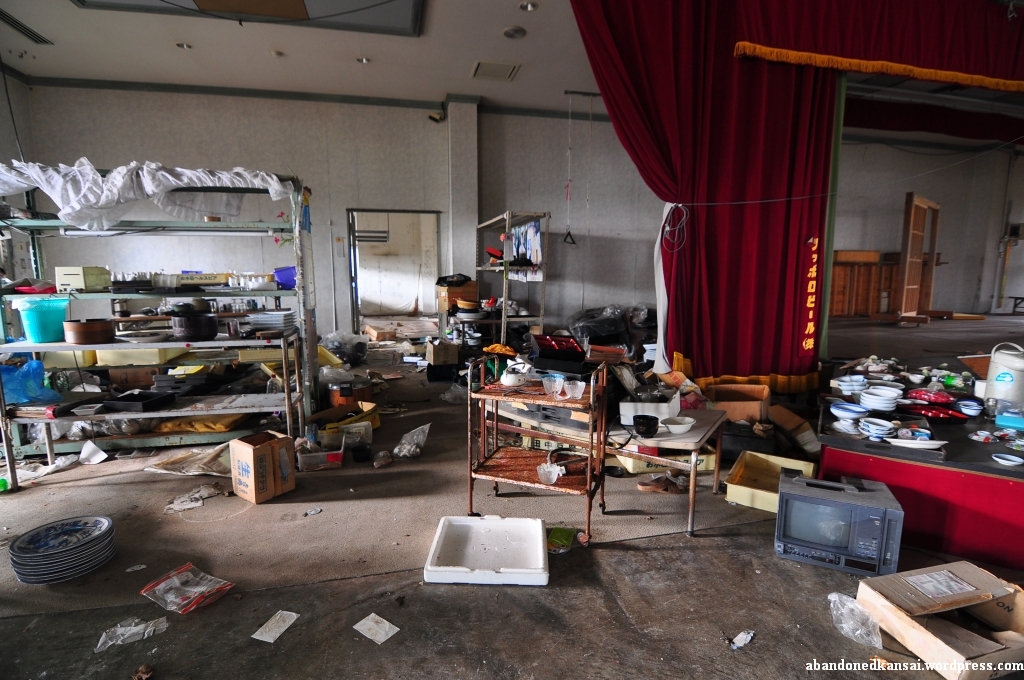
I have to admit: I love indoor waterparks. It’s one of the few leisure activities I really miss living in Japan. Back home in Germany you can find quite a few abandoned public swimming pools, indoor and outdoor, but no abandoned waterparks. So I enjoyed every minute of the two hours I spent there. The hotel part was quite vandalized and rather boring, so I left it rather quickly to go over to the swimming pools and the waterslide. On the way I passed a kitchen and some functional rooms. In two of them quite a few goods and training equipment were lined up, here and there I found price tags scattered all over the place – it seems like the owner tried to sell as much as possible before closing for good. The now empty main pool looked pretty much like a rather local indoor water park in Germany and I loved how red and green leafed plants were growing inside; if there ever was a zombie attack you know where to go to if the Shime Coal Mine is already occupied – if you know what I mean…
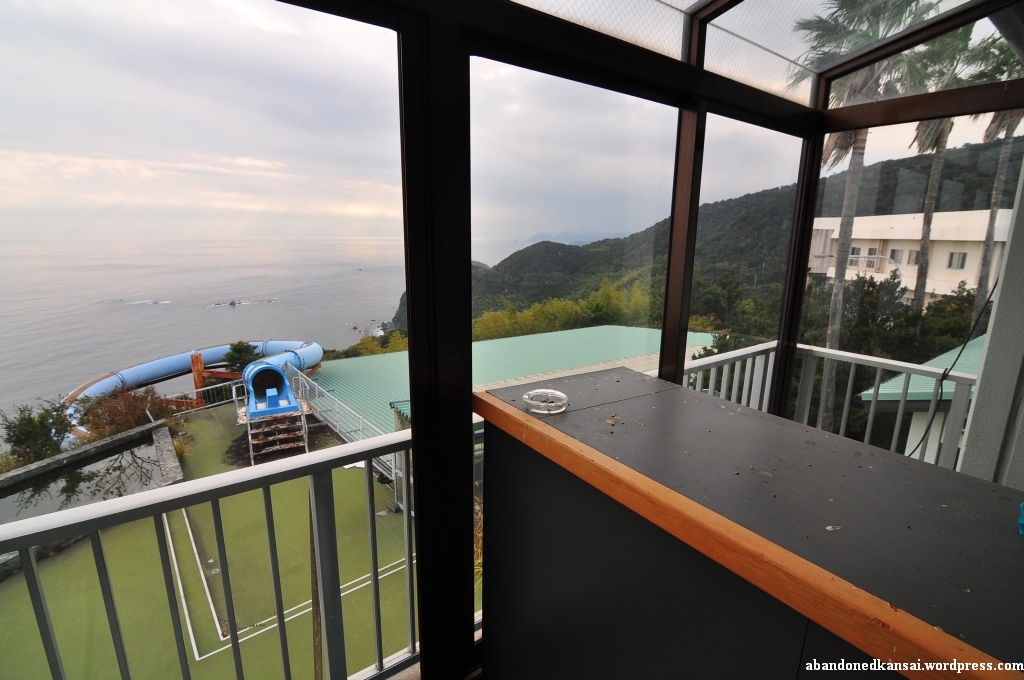
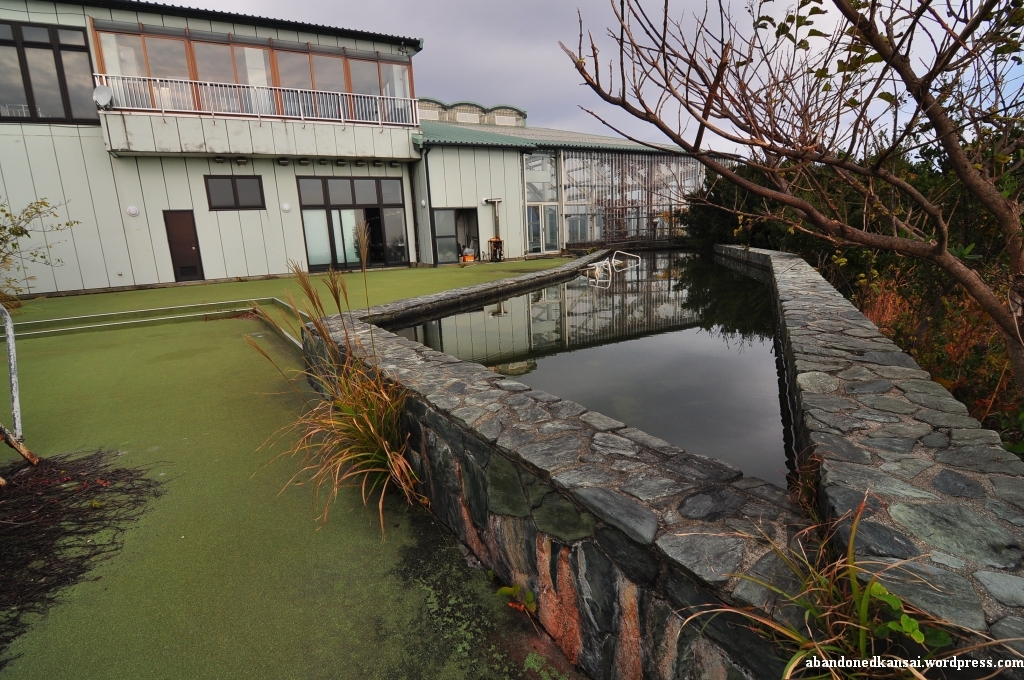
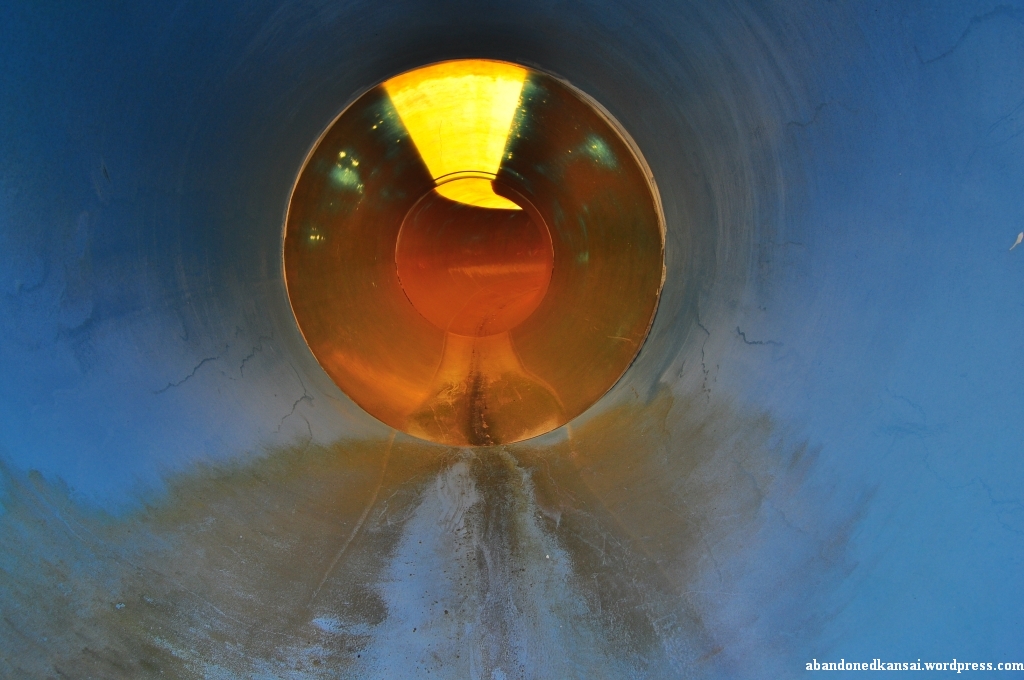
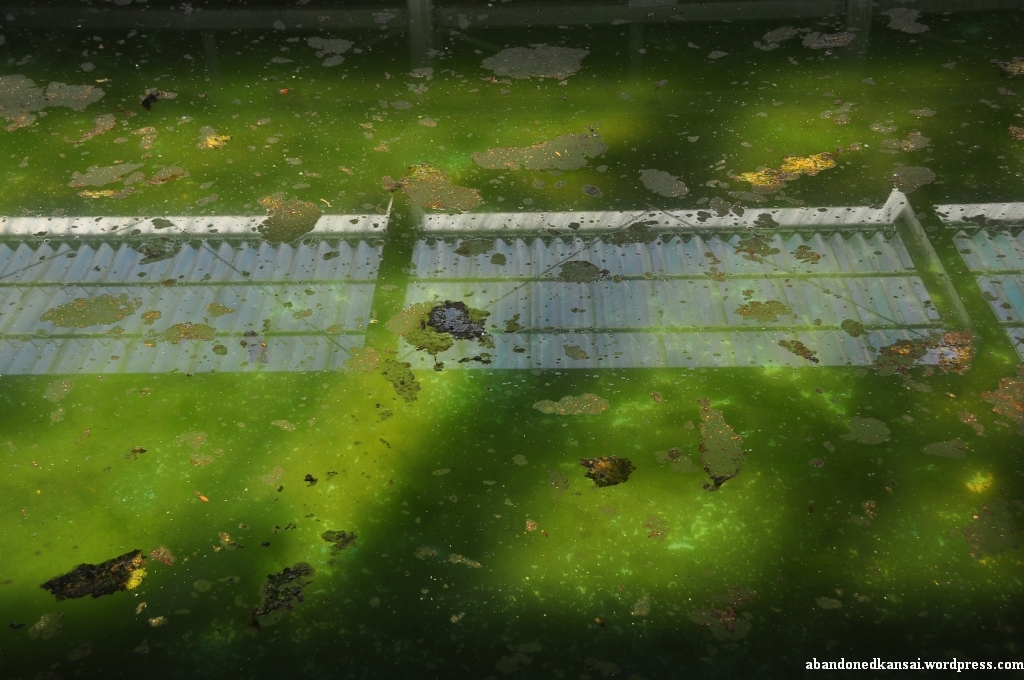
The outside waterslide at the bold cliff looked absolutely amazing, the weather just contributing to the atmosphere, so please have a look at the videos, too. Next to the waterslide was a staircase leading down to a pool, now filled with moldy brackish water, two dead greenish doves lying at the pool edge. Again, amazing atmosphere – kinda spooky, but not dangerous at all; neither physically nor in the form of security or other “guests” thanks to the remote location.
Like pretty much all of the previous and upcoming locations of my Haikyo Road Trip To Shikoku the Tokushima Countryside Healthspa was a unique, relaxed and fascinating place to explore. Shikoku, an urbex heaven!








Zone Of Alienation – Pripyat: Amusement Park
Posted in Abandoned, Amusement Park, Europe, Map, Pripyat, Ukraine, Urbex, Video, Visited in 2010, Zone Of Alienation on 2011/01/16| 20 Comments »
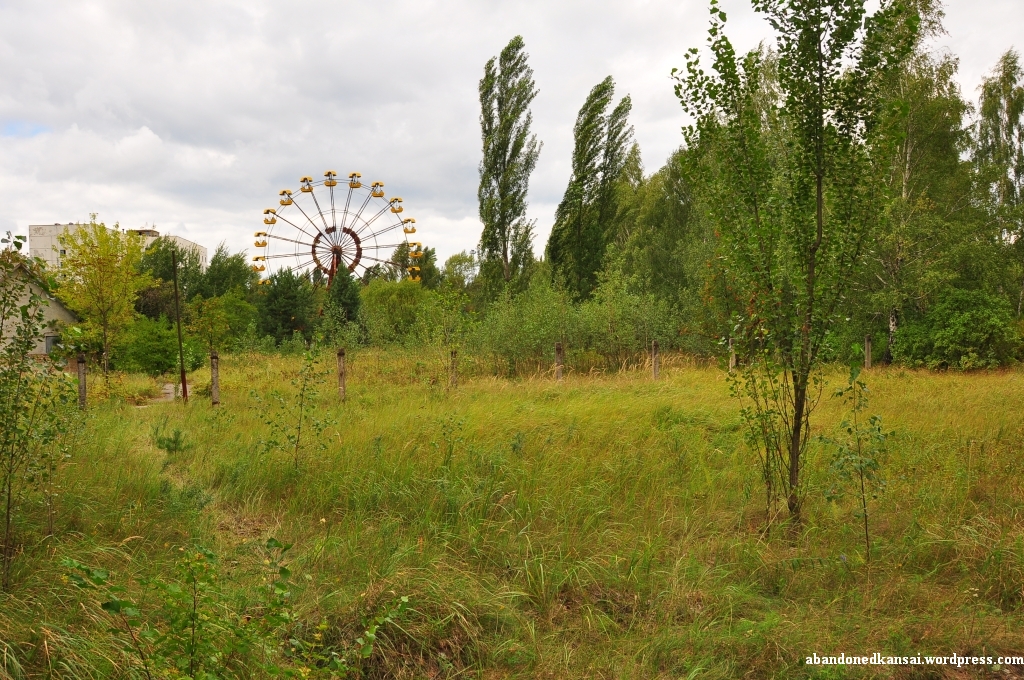
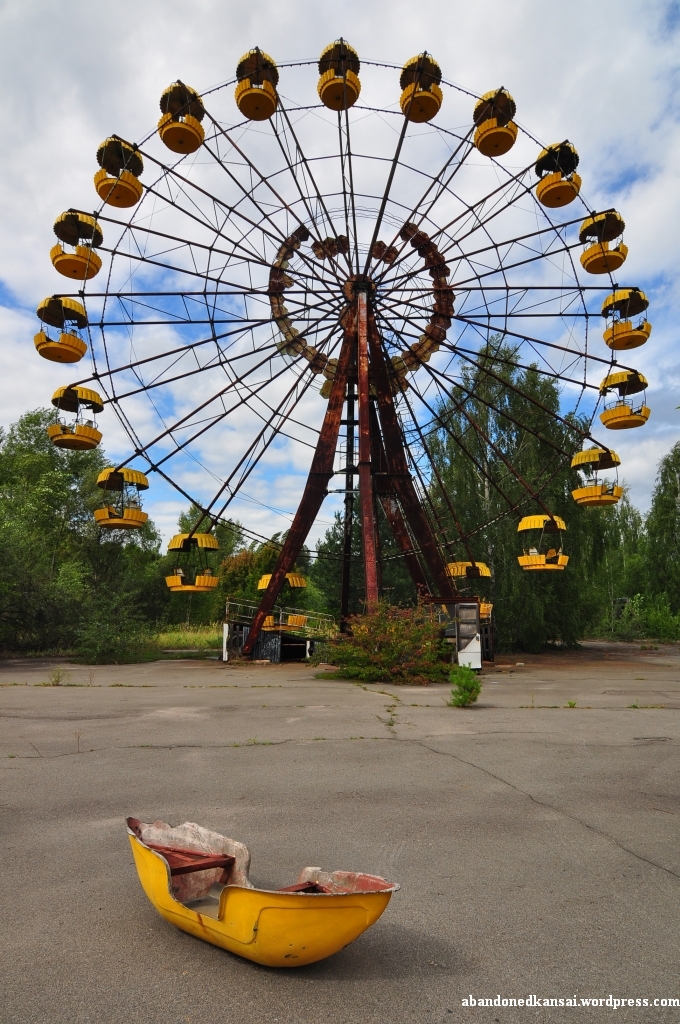
Did you ever wonder why the famous Pripyat amusement park is almost always about the ferris wheel? Well, the answer is simple: There is not a lot more to see.
The amusement park actually barely deserves that title, since it wasn’t a Disneyland or Universal Studios type of theme park, but more like a travelling, temporary kind of old-style amusement park. It was set up in celebration of May Day 1986, but the tragedy happening on April 26th was cause for a change of plans: The park was opened for one day to distract people from what was happening only a few kilometers away at the nuclear power plant. When the city of Pripyat was abandoned on April 27th so was the amusement park. (This is a fact widely unknown – most sources state that the park was never opened, but there are pictures in existence showing people standing in line in front of the rides.)
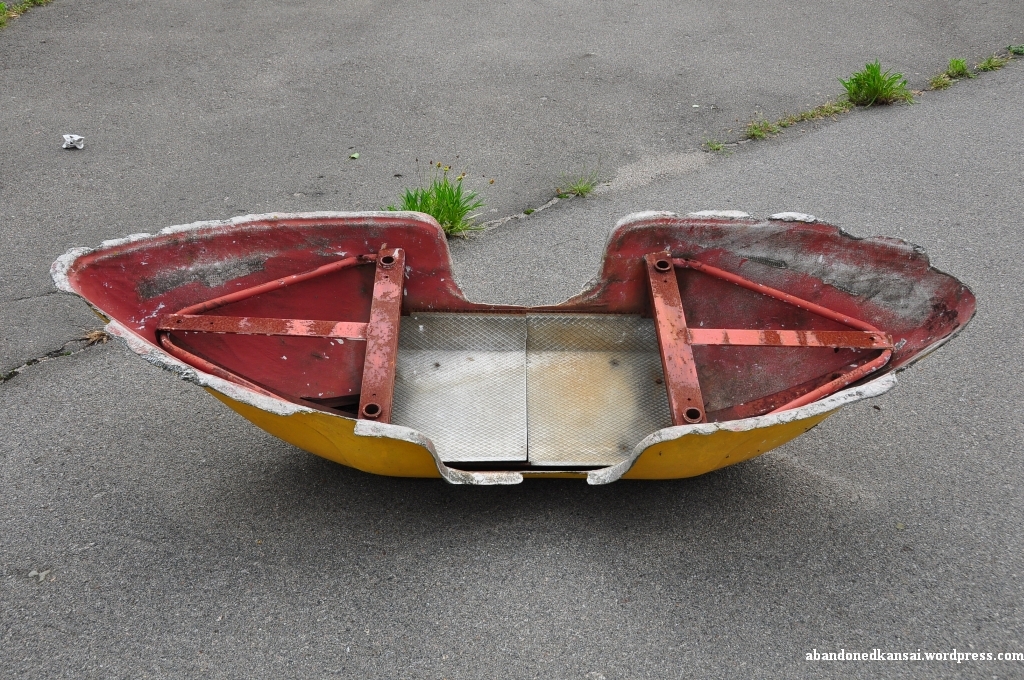
Now the (actually not so big, but nevertheless beautiful) ferris wheels rusts away next to a small and simple merry-go-round, a boat swing and a bumper car – hard to imagine that this small collection of rides was once considered an attraction for 50,000 people…
Another fact people usually don’t know about the amusement park: It’s one of the most contaminated areas in Pripyat. Parts of it are perfectly clean, but others are still highly radioactive. While the concrete parts are mostly safe nowadays, the surrounding moss can be as high as 25 µSv/h (microsievert per hour) – the radioactive particles were simply washed into the soil. Walking across such a spot like that won’t harm you instantly, but you don’t wanna build a house there as it is about 400 times the normal terrestrial radiation…
The amusement park is one of the standard locations included in pretty much every Pripyat tour – especially since it gained massive popularity after it was rebuilt in video games like “S.T.A.L.K.E.R.: Shadow of Chernobyl” and “Call of Duty 4: Modern Warfare”.
Before you start looking at the pictures below I hope you will enjoy an Abandoned Kansai first: I uploaded a short video of about 75 seconds to Youtube. Unedited, 720p. I hope it’s a worthy addition to this article…
(If you would like to know more about my trip to the Zone Of Alienation please *click here* to get to the “Chernobyl & Pripyat” special. For a map of the area please *click here*. If you don’t want to miss the latest article you can *like Abandoned Kansai on Facebook* and *follow this blog on Twitter* – and of course there is the *video channel on Youtube*…)




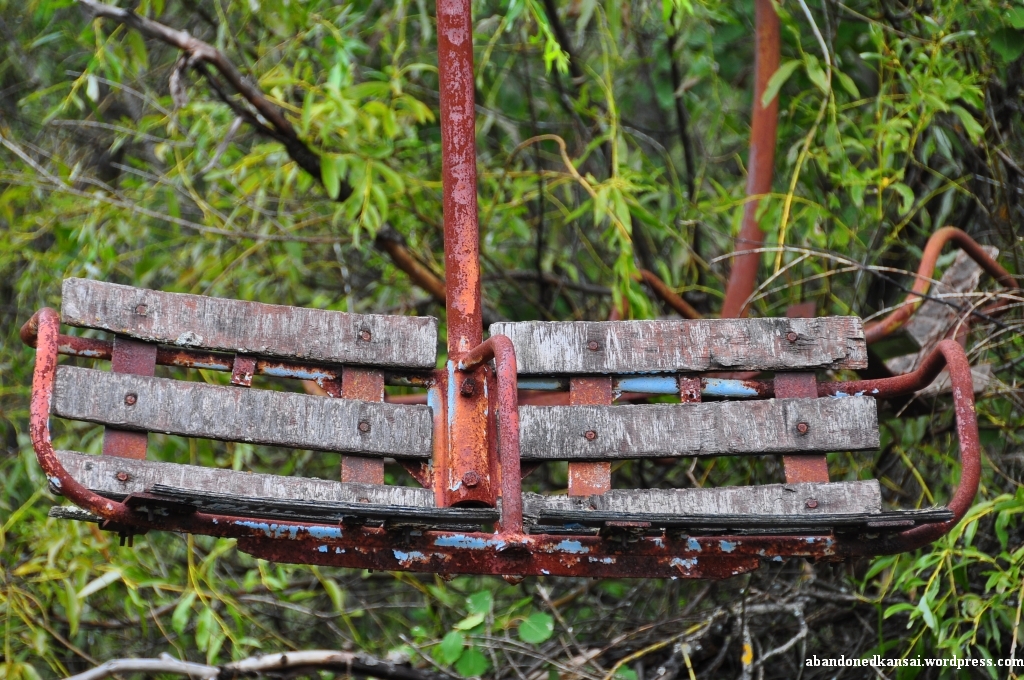


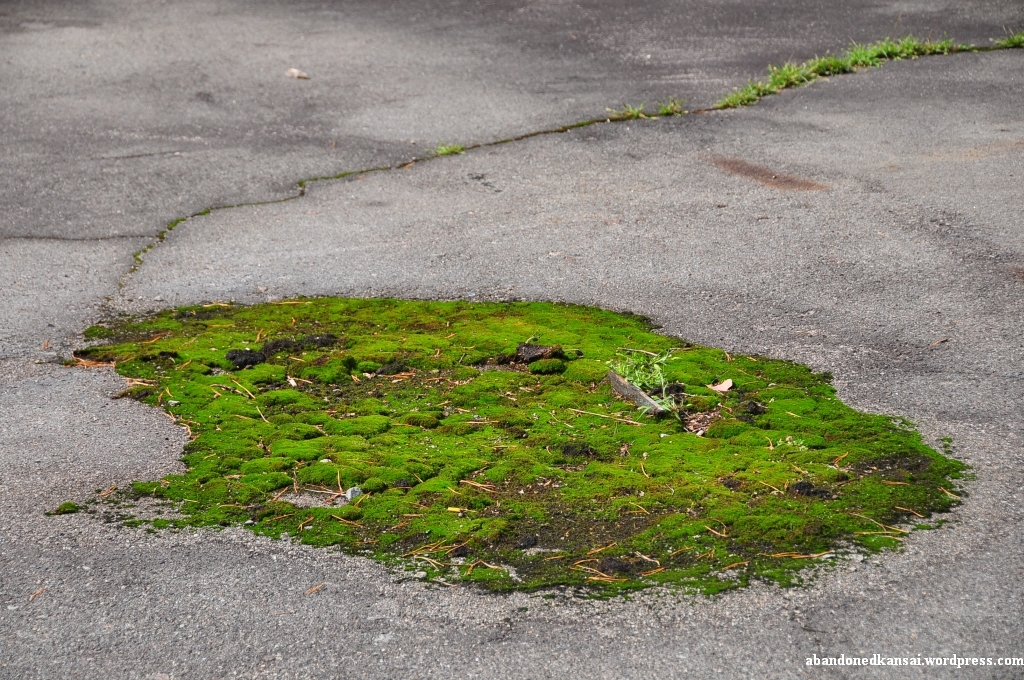


Nara Dreamland Revisited: Daytime
Posted in Abandoned, Amusement Park, Asia, Haikyo, Japan, Kansai, Map, Nara, Urbex, Video, Visited in 2010 on 2010/10/11| 10 Comments »
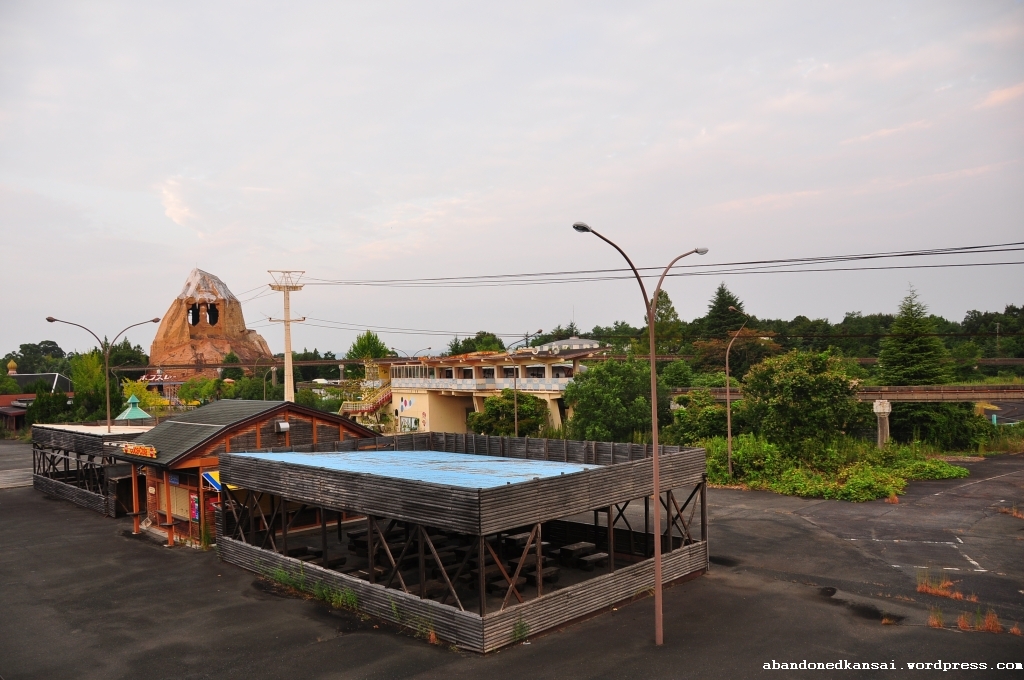
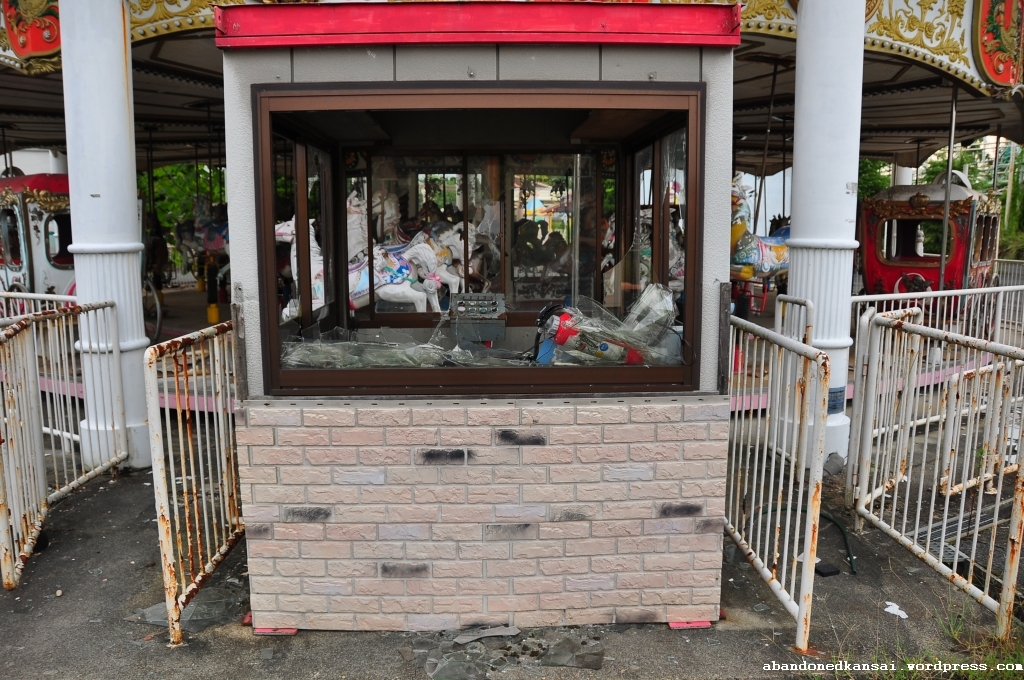
After spending a whole night at Nara Dreamland it dawned at around 5.30am, so Mike and I went straight to the entrance area near the Dreamstation to begin our second round through the park. The atmosphere at Dreamland early in the morning is almost creepier than it is at night. The light was kind of blue-ish, the sky slowly turned to overcast and we could finally have a closer look at the state of this huge abandoned amusement park – it looks horrible! The main street is so fake it would make an Ed Wood movie look cheap(er) and the amount of vandalism and decay is almost shocking considering the place was closed down for good only four years ago. If you want to see pictures of an undamaged Dreamland you’ll have to find some that are at least one or two years old. Pretty much all the windows in the park are smashed in, most of them just for the sake of destroying them – and that’s why places like Doggy Land or the Doctor’s Shack don’t get published with their real names or hints on how to find them… Too late for Dreamland though, the damage is done and I think it will get worse every month. And I totally understand now why the security guard was quite aggressive when he caught me taking pictures in February since it’s impossible to know who’s a vandal and who’s a harmless urban explorer. It would seriously piss me off and I guess even scare me when I’d come to work in the morning only to see doors and windows smashed in!
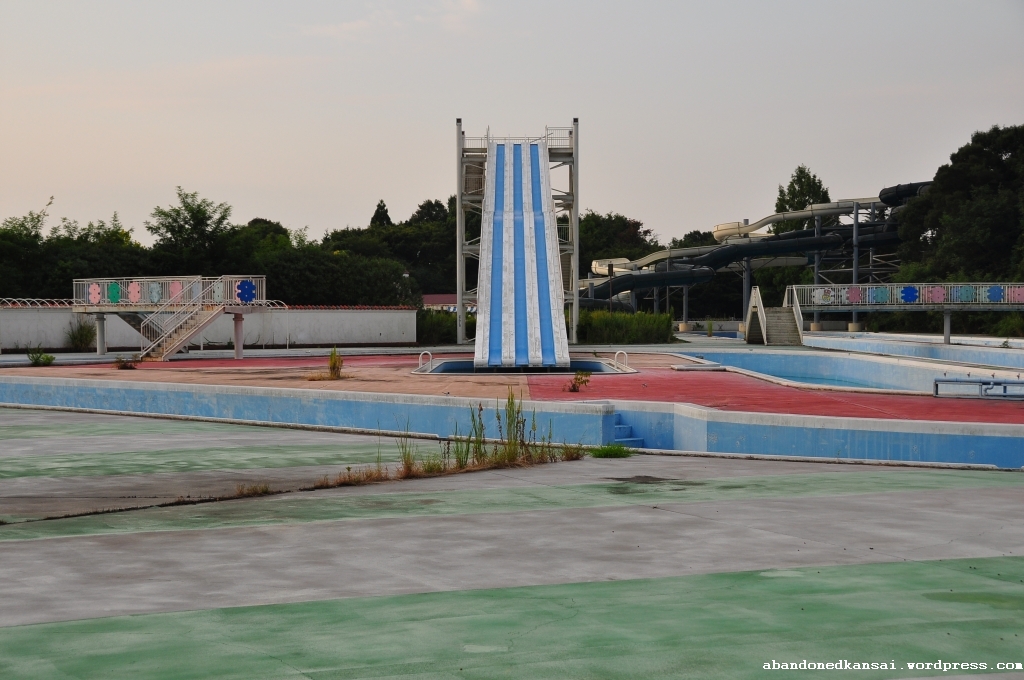
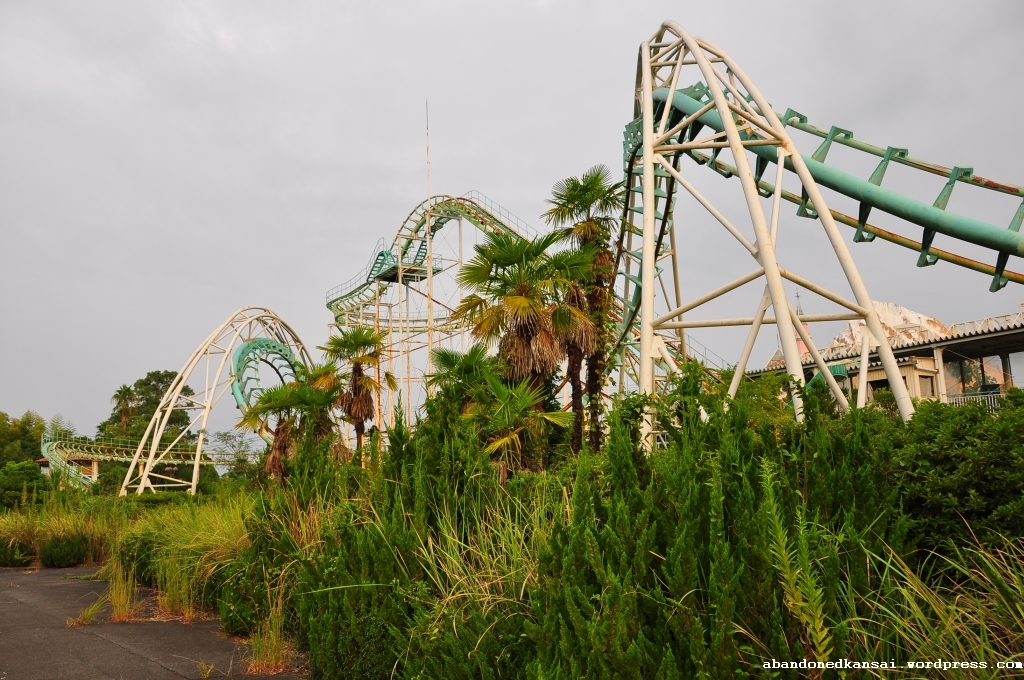
Mike and I, of course, just minded our own business and took a few pictures here and there – but to be fully honest, I was a little bit disappointed. Maybe it was because at that point we already spent four and a half hours there and of course we were tired and worried that security will show up at any minute, but Nara Dreamland (at daylight) is just a miserable place to be. It’s widespread, it’s run-down, it’s ugly and it’s full of weird items. Like the statue of Abraham Lincoln in front of the castle, that doesn’t make sense at all. (Maybe it does – if you know an explanation please drop me a line!) The really shocking part about it is that the place most likely felt weird even when it was still open. I can see the Aska rollercoaster being fun, maybe the water park with the pools and slides, too. But the rest looks like a real embarrassment for everybody involved. Again, love and hate at the same time: It’s a huge amusement park with all the attractions still standing – but at the same time it feels like one of the cheap weird reality shows on TV you don’t really want to watch, but you do it anyways and feel a bit guilty for doing so. So I guess it was no surprise that Mike left after about an hour to wait for me outside and I followed maybe ten minutes later. For some reason the daytime version of Nara Dreamland wasn’t nearly as captivating as I hoped it would be – I defeated my haikyo nemesis, but it was a bitter-sweet victory to find out that “the enemy” didn’t live up to the expectations…
Overall my (most likely) last visit to Nara Dreamland was an ambiguous experience. It was great to hang out with Mike and being at an abandoned amusement park at night is an awesome experience – it just wasn’t nearly as fulfilling as my explorations of other places like the Taga Mine, the Takada Ranch Ruin or the mostly demolished Expoland.
And don’t even get me started on the Zone of Alienation, including Chernobyl and Pripyat! Oh… well… now that I think about it: Maybe it’s time to write up a couple of stories about radioactivity, gas masks and some of the most amazing places I’ve ever been to!
(For all your Nara Dreamland needs please have a look at the Nara Dreamland Special. For a look at the area around Nara Dreamland on GoogleMaps, including some fancy icons linking to articles on Abandoned Kansai and videos on YouTube, please *click here*. And since this article is quite popular: You can *follow Abandoned Kansai on Twitter* and *like this blog on Facebook* – and of course there is the *video channel on Youtube*…)
http://www.youtube.com/watch?v=aWIeBW2SYBg
http://www.youtube.com/watch?v=aWIeBW2SYBg
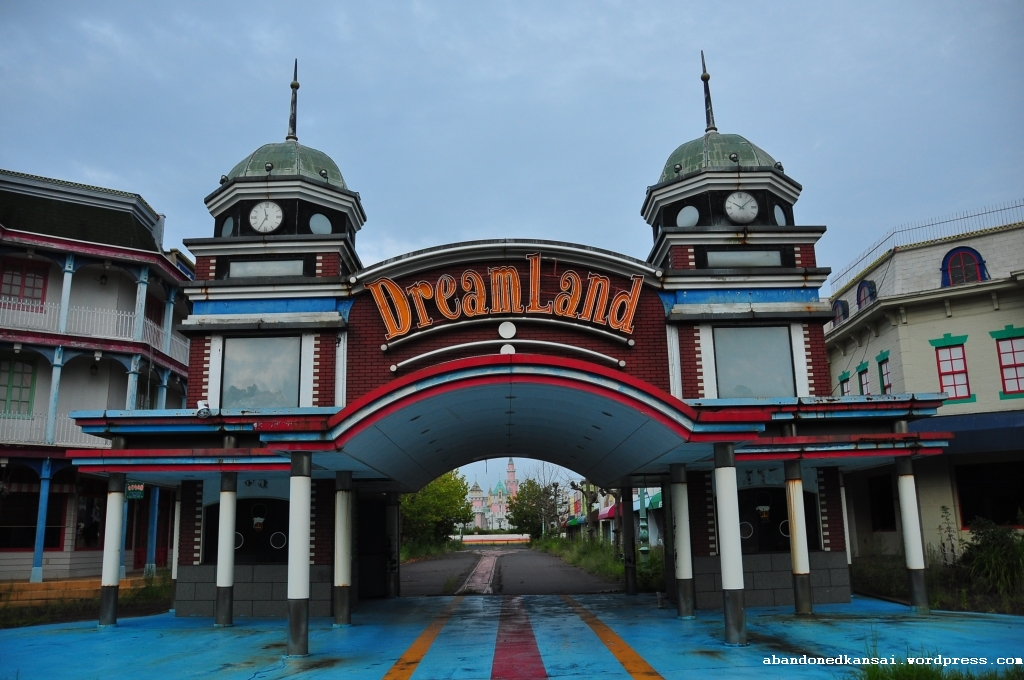


-

- Nara Dreamland
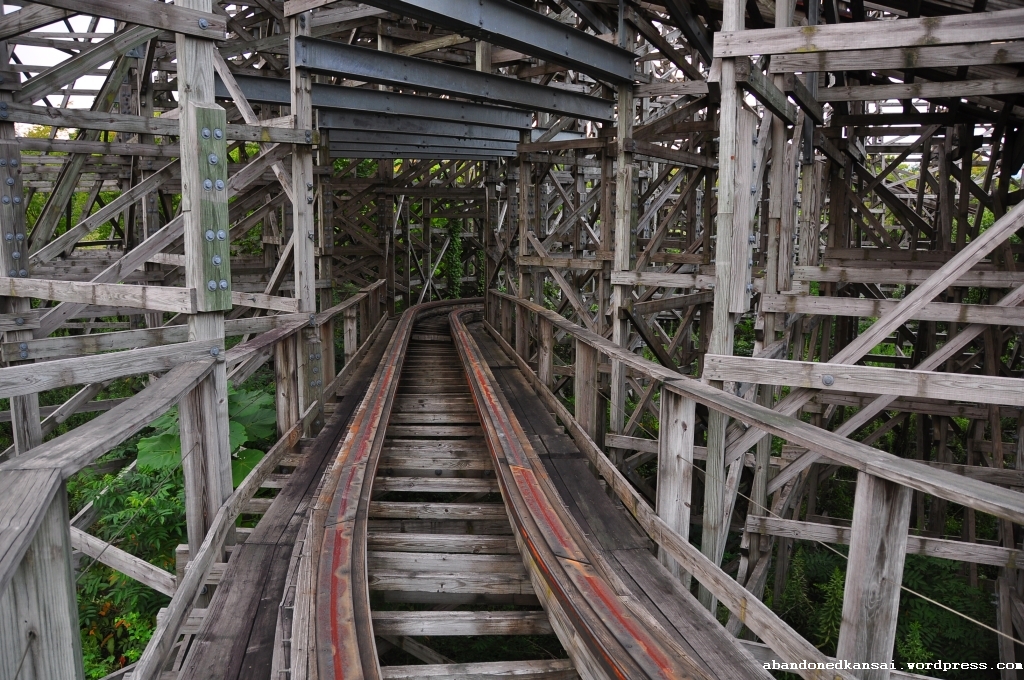




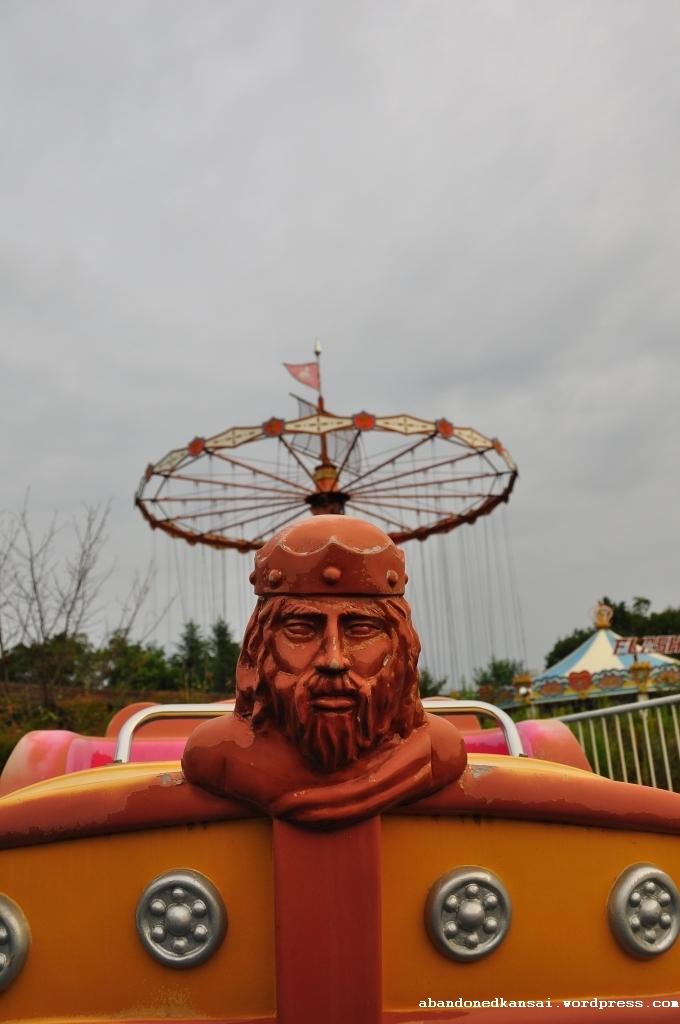
Nara Dreamland Revisited: Nighttime
Posted in Abandoned, Amusement Park, Asia, Haikyo, Japan, Kansai, Map, Nara, Night, Urbex, Visited in 2010 on 2010/10/03| 21 Comments »
If you are a regular reader of this blog then you know that I have a love-hate relationship with Nara Dreamland. Abandoned amusement parks are quite rare, especially those without any destroyed or sold attractions. Sadly both times I went there I spotted a security guard. Once he spotted me, too – a very, very unpleasant experience. To me the chapter “Nara Dreamland” was closed. I wasn’t able to post pictures taken inside of Dreamland on this blog (since I had to delete the ones I took), but I’ve seen quite a bit of it and that is what is important to me. But when Michael John Grist wrote me a message that he would be in Kansai soon and asked me if I was interested in tackling Nara Dreamland again of course I couldn’t resist. Learning from previous explorations I suggested to meet in Nara late to do a shooting at night and get out of Dreamland before the guard(s) even show up. Mike agreed and so that’s what we did…
We met at JR Nara Station at around 0.30am and made our way to the park. Since I’ve been there twice before I knew exactly where to go and how to get in, but there were some changes since I last came to Dreamland. For example all the “If you see somebody entering Nara Dreamland: Call the police!” signs were replaced by new “If you get caught we’ll fine you 100,000 Yen” signs. Which I thought was interesting in two ways:
1.) It kind of seems like the police in Nara isn’t really interested in trespassers.
2.) Why 100,000 Yen (currently about 900 Euro / 1150 Dollars) and not 50,000 / 200,000 / 1,000,000 Yen? The number seems so random…
Anyways, it would really surprise me if the new signs keep anybody from entering. (“I don’t care about being sued for trespassing, but 1000 bucks scare me back to where I came from!”)
After entering Nara Dreamland the next difference was obvious: If you lift your car over the fence you won’t be able to drive into the park anymore as the road is now blocked by a fence of maybe 50cm height! If you are on foot you just step over it or use the non-blocked pedestrian walkway – which is perfect for all you urban explorers on bikes, motorcycles and unicycles, too! Seriously, WTF? I can understand why you want to keep people from entering Nara Dreamland, but if your effort ends with knee high fences you deserve to be ridiculed! I would have laughed out loud, but I guess my mean spirit was punished right away when a car passed the road under the bridge while we were walking across – in the middle of the night, in the middle of nowhere. Small sins get punished right away…
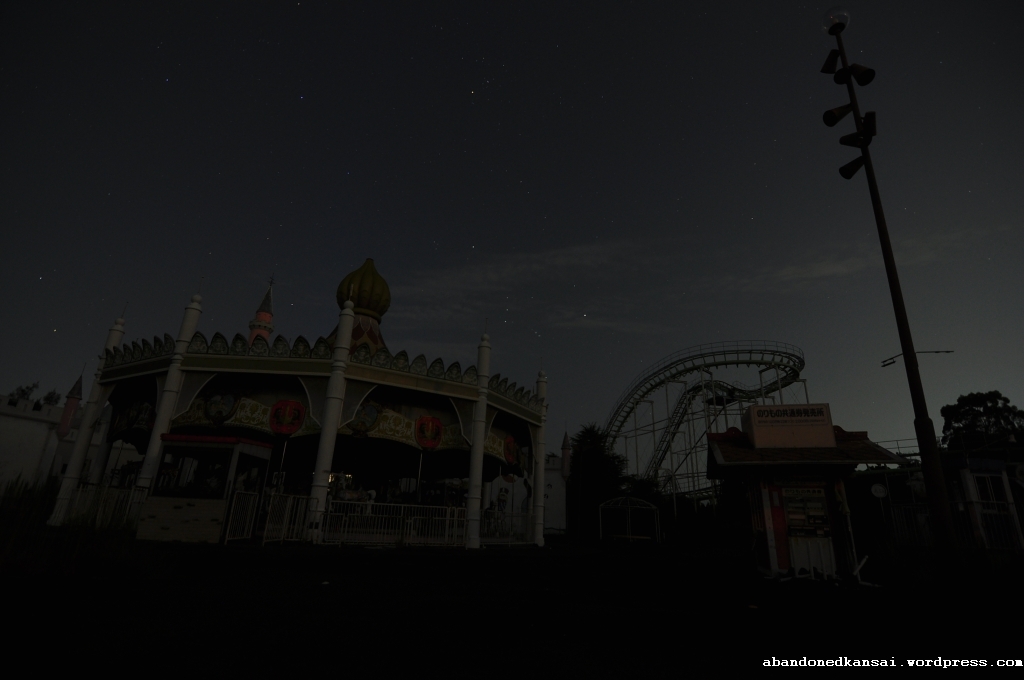
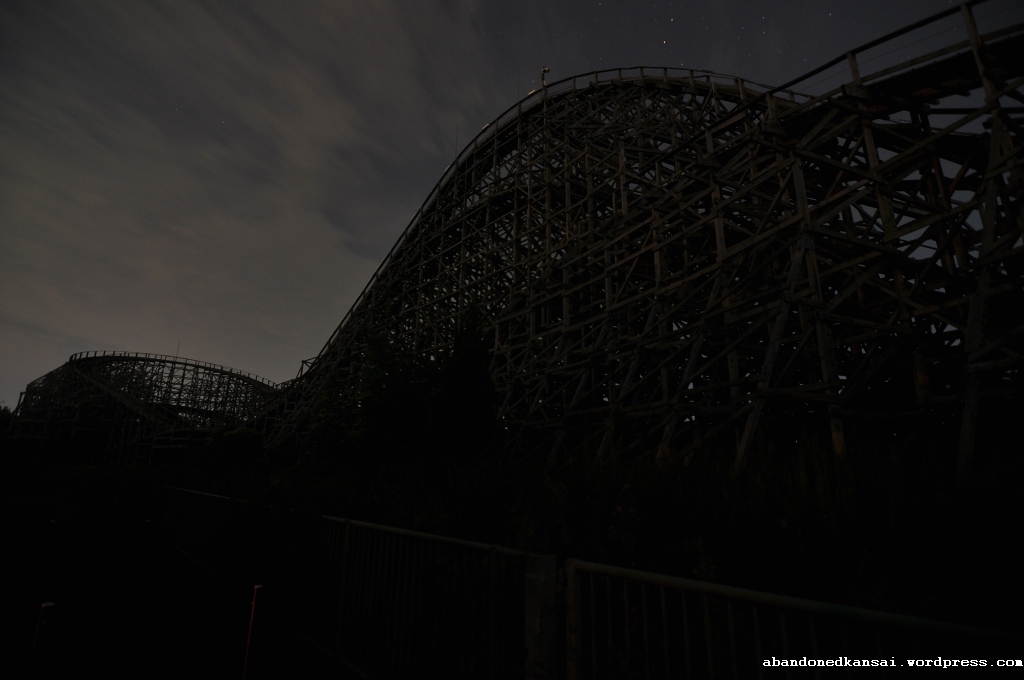
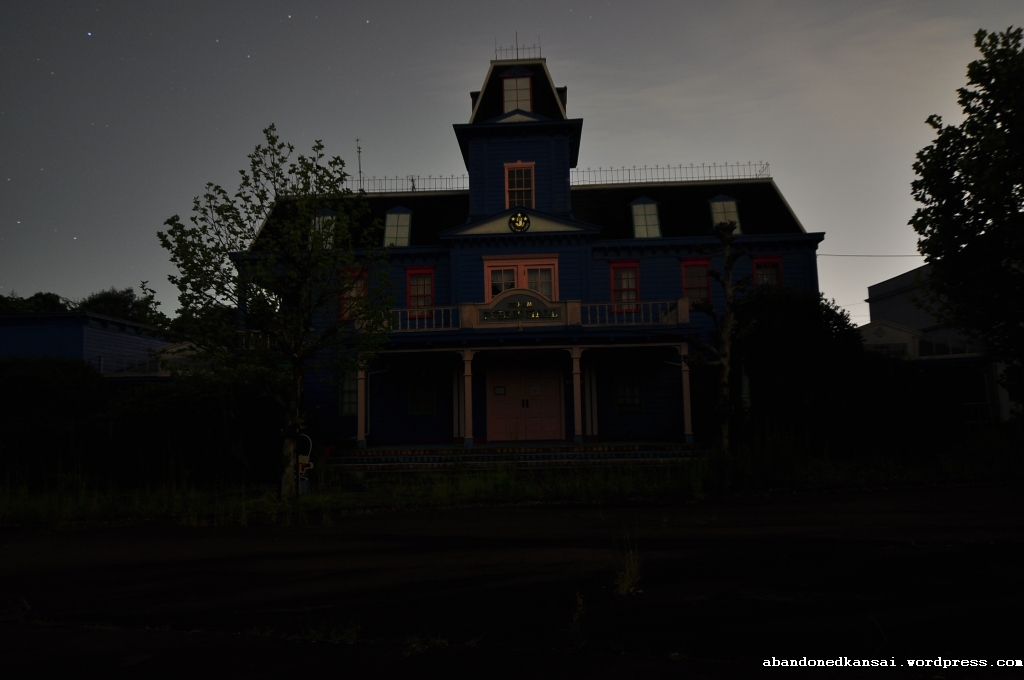
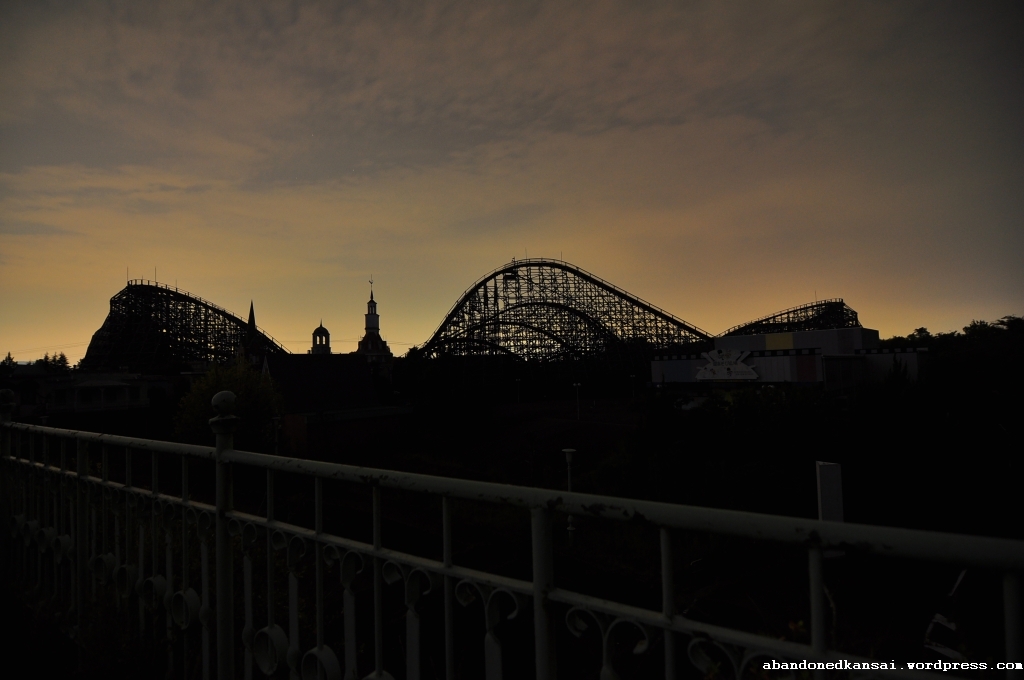
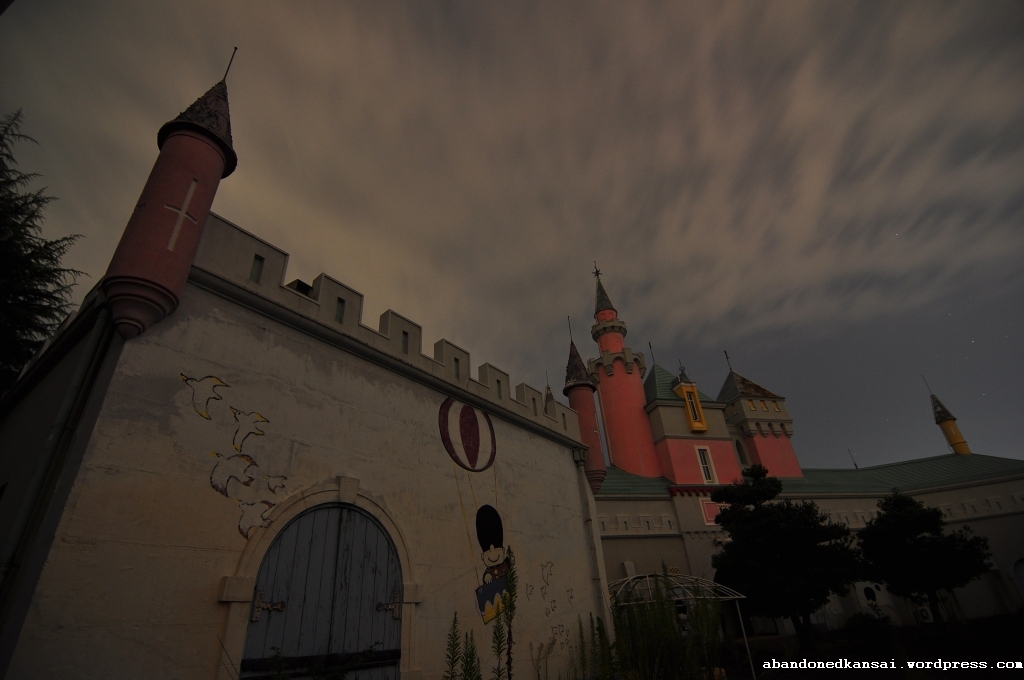
It was a strange feeling to enter Nara Dreamland that way since last time I was there I was running from a security guard. Shortly after the bridge we came across the merry-go-rounds and finally reached the mirror maze called “Mirror-Puzzle” where the yellfest happened in February. I would like to say that I felt more comfortable the longer we stayed at the park, but I didn’t. Not after one hour, not after two, not till we left. But at least this time I was able to see the whole park. We took at few pictures near the Mirror-Puzzle, passed through the castle and then went on to pay a visit to the park’s main attraction: the gigantic wooden roller-coaster named Aska. From there we went back to the castle and down the main road to the main entrance / train station. After that we returned to the area filled by merry-go-rounds to have a little rest and wait for the sun to come up.
The safety of exploring Nara Dreamland at night came with the price of a way more demanding shooting: Neither Mike nor I had shot any haikyo at night before, so we spent quite a while at each attraction. Basically learning by doing. It wasn’t pitch black dark and the sky was slightly lit in some parts due to light pollution, so most of the pictures turned out to be blurry or terribly lit, but could there be a better place to figure out stuff like that than an abandoned amusement park? The answer is “YES!”, but hey, some things just don’t work out as planned…
Exploring an abandoned amusement park on a warm night in late summer is nothing but an amazing adventure – and I guess it is even more so if you can suppress the uneasy feeling of not being wanted there. I can’t say that I really enjoyed shooting Nara Dreamland at night, but I nevertheless cherish it as an exciting and educational experience.
“Wait a minute!”, you might say at this point. “If you felt uneasy all the time, why did you even wait for the sun to come up?” Well, the answer is simple: Since the sun rises at about 5.30am in Japan even in late September we though we could kill two birds with one stone and do a second round through the park, shooting it under way easier lighting conditions – and that’s what we did. So come back soon and don’t miss the second part of Nara Dreamland Revisited!
(*Like Abandoned Kansai on Facebook* if you don’t want to miss the latest articles and exclusive content – or subscribe to the *video channel on Youtube* to receive a message right after a new video is online…
For all your Nara Dreamland needs please have a look at the Nara Dreamland Special. For a look at the area around Nara Dreamland on GoogleMaps, including some fancy icons linking to articles on Abandoned Kansai and videos on YouTube, please *click here*.)
For all your Nara Dreamland needs please have a look at the Nara Dreamland Special. For a look at the area around Nara Dreamland on GoogleMaps, including some fancy icons linking to articles on Abandoned Kansai and videos on YouTube, please *click here*.)






-
- Nara Dreamland

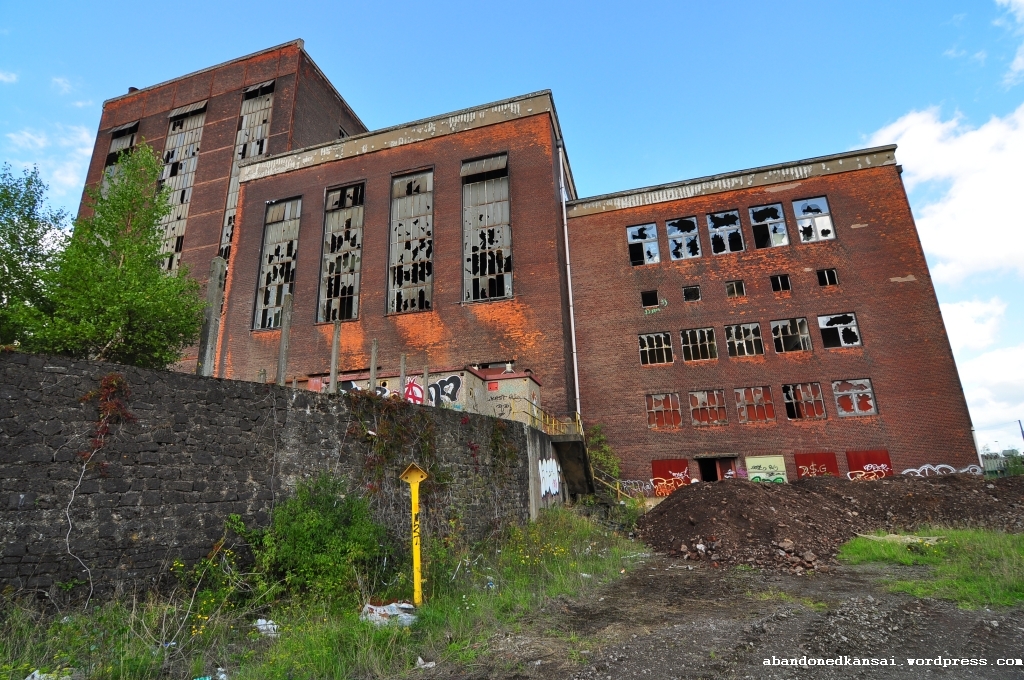
Location Teaser 2
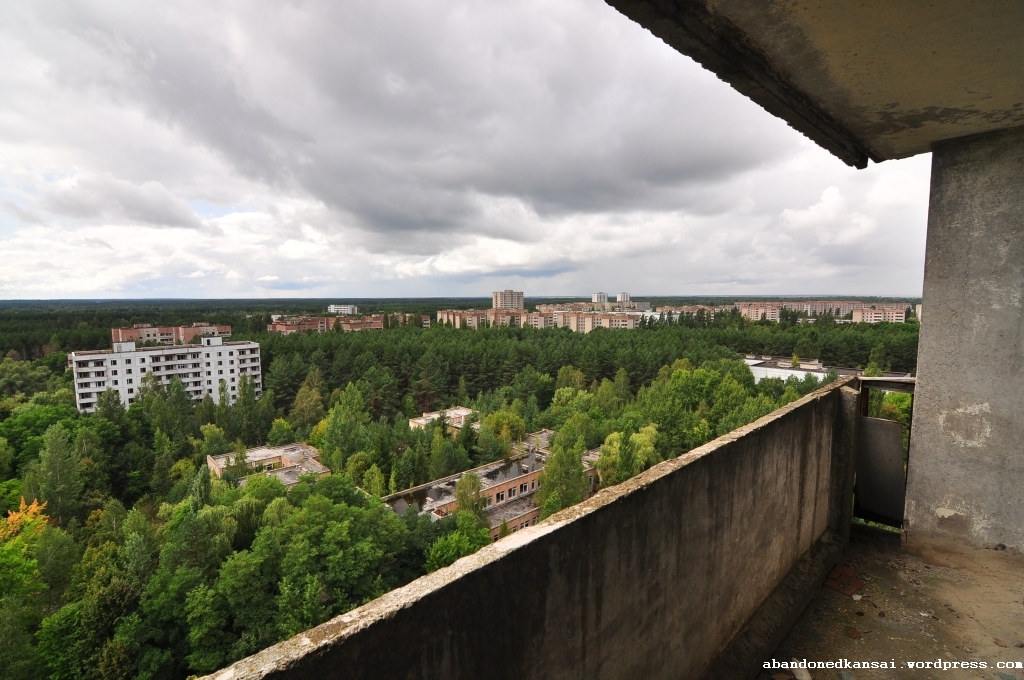
Posted in Abandoned, Amusement Park, Asia, Chūbu, Europe, Factory, Gifu, Haikyo, Hospital, Hotel / Ryokan, House, Hyogo, Japan, Kansai, Luxembourg, Map, Nara, Pripyat, Ukraine, Urbex, Visited in 2010, Zone Of Alienation on 2010/09/28| 4 Comments »
Looking at my urban exploration log I realized that I had a pretty good run lately.
It all started when I met Michael of Gakuranman fame in late July – he was in Kansai and suggested to take on the famous Maya Hotel together. Since I already scouted the surrounding, but never went in, it was a fun exploration of an impressive location; followed by a revisit of the Takada Ranch Ruin. Two weeks later I started my summer vacation to Europe which included a side trip to the Zone of Alienation with its famous cities Chernobyl and Pripyat. Back to Germany I went to Luxembourg for two more explorations with a kindergarden friend of mine.
Soon after I got back to Japan I received an e-mail from Michael John Grist who planned to come to Kansai to tackle my haikyo nemesis, Nara Dreamland. I wanted to meet the guy more than I wanted to avoid the Dreamland, so we went there on a warm late summer night and for the first time I got in and out without spotting security… And finally I went on a little trip myself again to visit the Gakuranman in the Nagoya area to take pictures of the mysterious Doctor’s Shack, one of the few haikyo that are kept a real secret in Japan – even if it appears somewhere on the net or in a book there are barely any hints about its location and I’m really grateful Michael took me there; another awesome exploration, punished with about 30 mosquito bites!
Maya Hotel, Pripyat, Luxembourg, Nara Dreamland and the Doctor’s Shack in a row… it’s hard to do better than that! Now it’s time to write up the stories and show you some really, really interesting pictures!
(You can find all the articles related to Chernobyl and Pripyat by *clicking here* – the picture was taken *here*.)


Expoland Revisited
Posted in Abandoned, Amusement Park, Asia, Haikyo, Japan, Kansai, Map, Osaka, Urbex, Visited in 2010 on 2010/09/16| 6 Comments »
I’m terribly sorry that it took me a while to publish this article, but I finally finished to write the sequel to the blog entry about Osaka Expoland I announced quite a long time ago.
On my way back from my second trip to Sekigaraha Menard Land I thought it would be a good idea to pay Expoland (エキスポランド) another visit. It had been a couple of months since I explored it for the first time and I just wanted to have a short look again – to find out what happened to the Caribbean Resort and the other remaining buildings. Like with my first trip there I expected it to be a quick stop, maybe even without taking pictures. But again I was wrong…
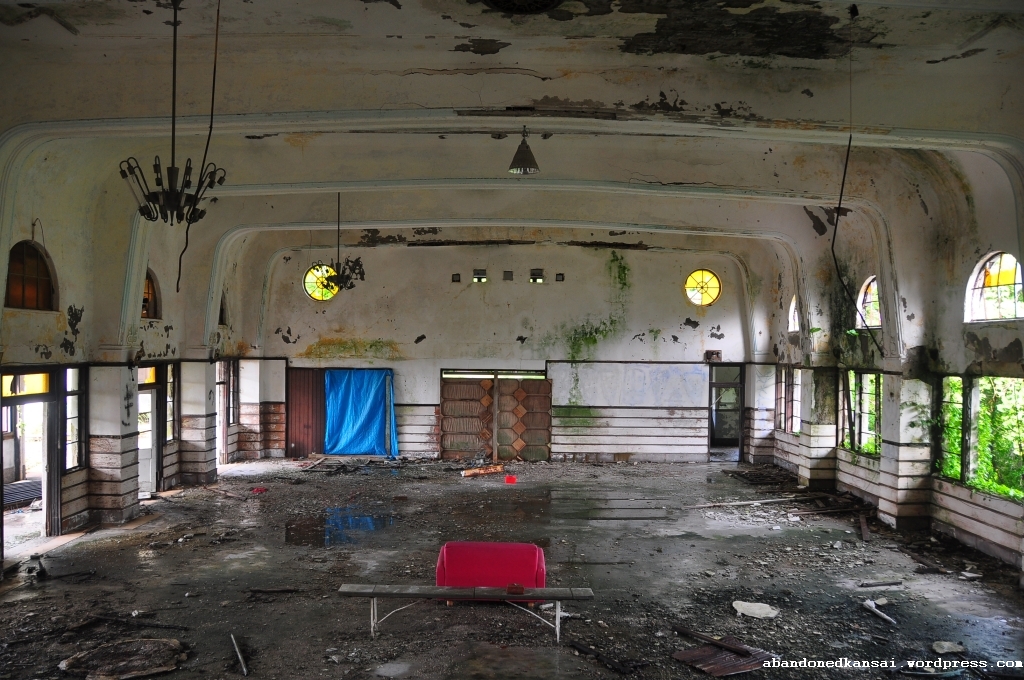
I rode the Monorail from Minami Ibaraki to Banpaku-Kinen-Koen and pressed my camera against the window to get some elevated shots of the park. Since I accidentally changed the settings of my camera right before I reached Sekigahara Menard Land the pictures turned out to be very blurry and while I was wondering about that I realized that there were people in the park! In a park that was closed down for good more than two years earlier and that was being demolished during my first visit in December of 2009 – what an intriguing surprise! (I’m sorry for the picture quality of this posting again – it wasn’t my day…)
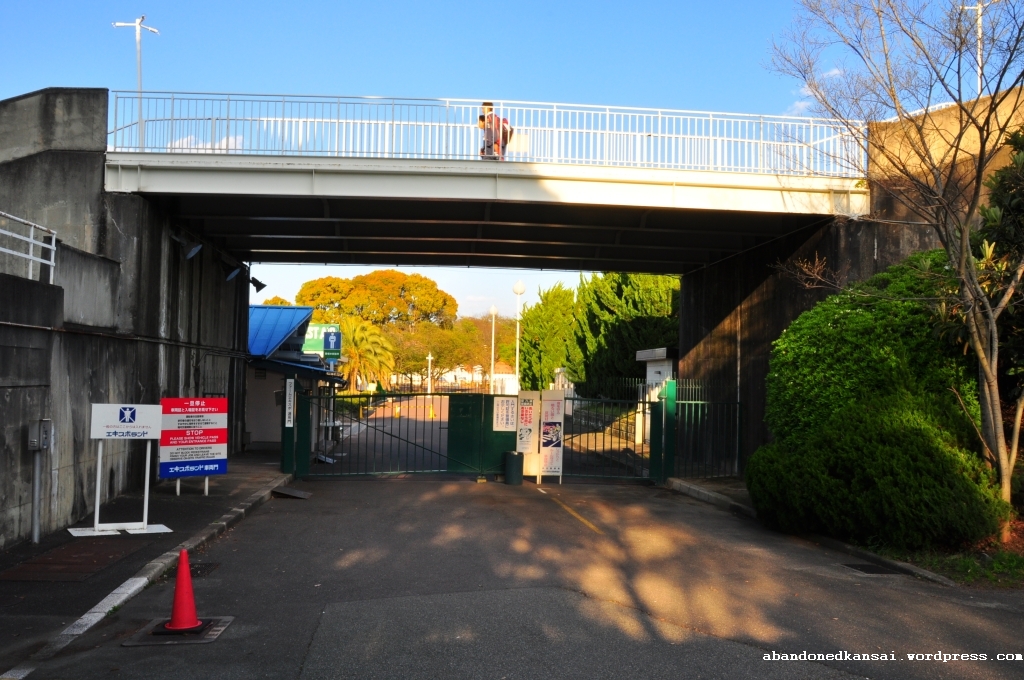
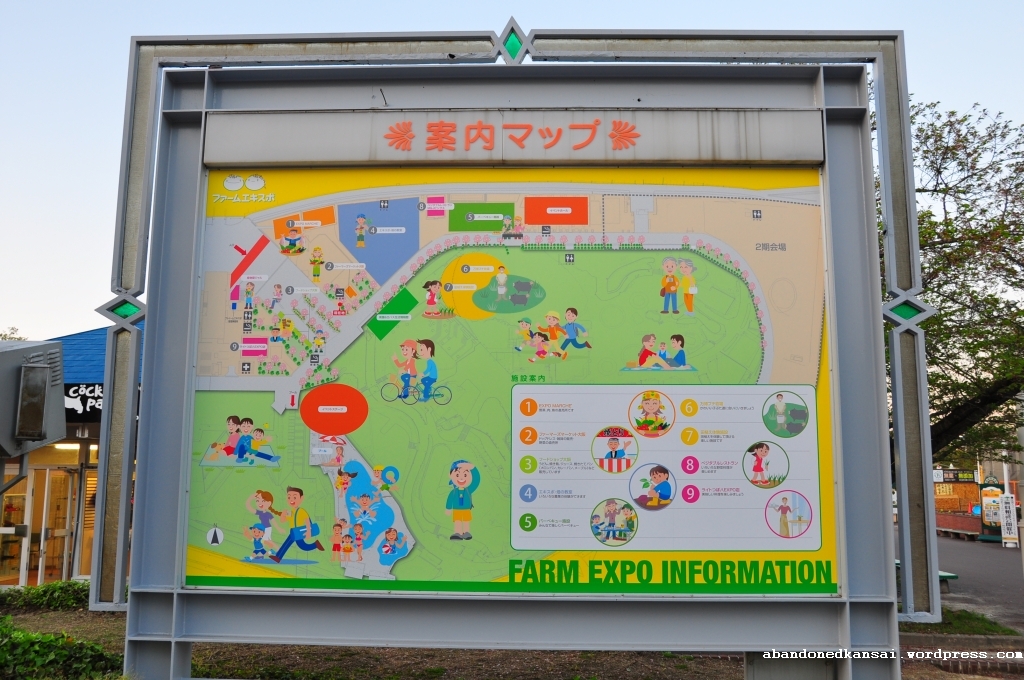
This time the main gate to the park was wide open. On top there was a sign that informed all people passing by about the newly installed Farm Expo. So what they did was cutting off about 20% of the park with typical Japanese site fences, revamped the existing buildings in the area into shops, painted and reopened the restaurant and heaped up some soil to use as a planting area. One of the former water rides was converted into a stable for pigs and halfway between that stable and the organic food stands were a couple of chickens in a cage for children to pet. The former clown house was converted into a farmer’s market, selling all kinds of herbs and produce.
The first time I went to Osaka Expoland the sky was overcast (later it started to rain) and the place was empty except for a few construction workers and a guard – quite a depressing sight. During my second visit the whole area was flooded by warm light and crowded by happy families enjoying a nice spring day. The atmosphere couldn’t have been more different and I was kind of glad that they actually made good use of this really nice location as I thought they would tear down the whole place to build more apartment buildings and a shopping mall. It’s the first time I’ve seen a formerly abandoned place being reconverted and at least in this case it was a really good decision – although it means that I’ll have to go back there one day to find out what the future holds for Osaka Expoland.
Oh, and in case you are wondering what happened to the Caribbean Resort: It wasn’t demolished, but fenced off and therefore not accessible during my second visit in April.
(You can find out where Expoland was by clicking here.)





Location Teaser
Posted in Abandoned, Amusement Park, Europe, Haikyo, Map, Urbex, Visited in 2010 on 2010/09/01| 18 Comments »
Recently I’ve been on a trip to Europe and of course I couldn’t resist to do some urban exploration outside of Japan for the first time. This posting is just a teaser, but there will be more pictures soon. Lots of them. Maybe you can guess where I went?
(Or you can find out where the picture was taken by *clicking here*.)

Abandoned Kansai on Facebook
-
Join 4,970 other subscribers
Pages
Archives
Categories
Recent Comments
gred_cz on Brutalist Greenhouse BulldozedFuture on Upside Down House Florian / Abandoned… on Brutalist Greenhouse ETSR on Brutalist Greenhouse Florian / Abandoned… on Brutalist Greenhouse culprit on Brutalist Greenhouse Stealthflower on Brutalist Greenhouse ETSR on Brutalist Greenhouse gred_cz on Shin-Hakodate Golf Club Emily on Shin-Hakodate Golf Club