Japan is one of only 25 countries in the world without military – at least by some people’s definition. Others see it a little bit different thanks to Japan’s Self-Defense Force (自衛隊, Jieitai) with active personnel of about 240,000 people – plus about 60,000 in reserve. Abandoned military institutions are nevertheless rare in Japan, usually places (partly) given up by the Americans, like the Tachikawa Air Base, the Fuchu Air Base or Camp Drake – all located in the Tokyo / Yokohama area.
So when I was back in my home country of Germany for vacation I was eager to explore a military basis of the Federal Armed Forces / Federal Defense Force / German armed forces – or just Bundeswehr (that’s what they are called in German). While the Jieitai are still going strong the Bundeswehr had to deal with several structural reforms over the past two decades, main reasons for that being the fall of the Iron Curtain and the German reunification in 1990. Back in the 1980s the Bundeswehr had about half a million employees (career soldiers and conscripts), in 2010 the number was down to 250,000 – with plans to reduce further to a little as 175,000 soldiers; about a quarter of what both German armies (Bundeswehr and NVA (Nationale Volksarmee – National People’s Army)) had combined in the late 1980s… Reducing personnel that seriously you can’t (and won’t…) maintain all the military bases. A lot of them were demolished, some got reconverted to housing projects and business parks – but a few slipped through the cracks and became abandoned; because nobody took proper care or because there were problems reusing the property.
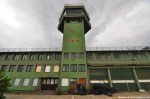
The Federal Armed Forces Depot Pfeddersheim (Bundeswehr-Depot Pfeddersheim – officially “Wehrbereichsgerätelager IV”) is one of these cases where the infamous German bureaucracy took its toll; on a personal note: German bureaucracy actually isn’t that bad, especially when compared to other countries. Built to house Car Pool Company 621 (Fahrzeugpark-Kompanie 621 – and by company I mean the military unit, not the business…) in the early 1950s on the site of the the cannery Braun AG (Konservenfabrik Braun AG), a factory of international fame in business from 1871 till 1951, the depot was one of the main Bundeswehr storages in Germany for many decades. It was closed with effect from 2004-12-31 with the last employees leaving by 2005-03-31 – at that point only 14 people were working at the depot.
Of course early on local politicians were aware what was going to happen and they tried to make use of the location as smoothly as possible, even visiting the still active depot in late 2004. Since Pfeddersheim lost its indepence in 1969 and now is part of the venerable city of Worms a lot of people have a say in what’s going to happen – the Institute for Federal Real Estate (Bundesanstalt für Immobilienaufgaben / BIMA), a city planning officer from Worms, a municipal administrator from Pfeddersheim and of course the citizens of Pfeddersheim; just to name a few. And while everybody was debating whether the depot should be turned into a housing project with a supermarket or being used by established and new businesses the usual hordes of bored youth vandals trashed the place – seven years later the property is still for sale, one of the latest suggestions was to build a showcase project for climate protection housing.
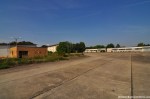
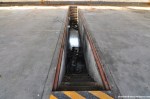
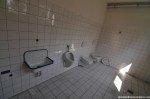
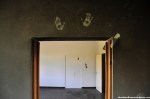
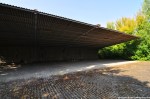
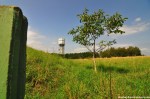
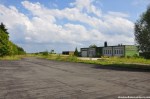
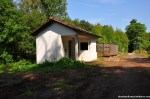
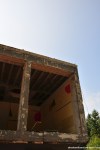
Well at least the buildings were still standing when I paid them a visit in July of 2011 with my high school friend Ira. The main gate was wide open when we arrived and as we were about to enter a building we saw a guy on a bike coming towards us. Judging by his shirt he must have worked for the local public utility company and brought back one of the municipal vehicles. So I told him what I was doing (urbex, Japan, photos…) and if we could take some pictures – he didn’t seem to like the idea, but after some more explanation he said that the main gate actually isn’t locked sometimes; so I told him that we didn’t see him if he didn’t see us – and off he went, with a word of warning that his colleague will lock the gate in the near future. So while I was exploring the first building Ira got familiar with the area and had a look for the colleague to come. When we were about to enter the second building the other guy actually showed up in a car – he stopped next to us, so I told him what I was doing (urbex, Japan, photos…) and if it was okay to take some pictures. He said it was and drove away only to be back a couple of seconds later. “Why?” Well, to keep the memories about those places alive – it’s always nice to hear from people who have been to / worked at places that I visited in their abandoned state. He put up a “those young, crazy people – I’m going to have a beer now and do better things with my time” smile and drove away, this time for good. So Ira and I explored the second building, the open repair shop and strolled along the sealed warehouses and garages. When we were about to leave we found the main gate closed – and locked. The second guy forgot to mention that he would actually do that! Luckily we found an alternative way in and out of the depot while exploring the location – and now was the time to make use of that knowledge…
(If you don’t want to miss the latest article you can *follow Abandoned Kansai on Twitter* and *like this blog on Facebook* – and of course there is the*video channel on Youtube*…)


























 Abandoned Kansai