All abandoned: Chernobyl / Pripyat, Nara Dreamland, Anti-Zombie Fortress, Japanese Sex Museum – and many, many more! Plus: North Korea Special – 2 trips, 16 days / 14 nights! As seen on CNN…
Alone at that beach on a rough coast, the sun rising, an ice-cold wind blowing – Day 4 of the Northeastern Adventure was off to a perfect start!
At first it didn’t look like it though. I am not an early riser, yet my third night in North Korea ended 10 minutes prior, when our host brought hot water to our room at around 6.20 in the morning. At the same time a dog started to bark and all of a sudden I knew that I wouldn’t go back to sleep, so I jumped into my clothes instead. Still a little bit sleepy and not yet used to the cold (in Osaka it was still around 30°C!) I stumbled down the dirt road for a few dozen meters until I reached the beach, slightly irritated by the patches of frost on the grass ground – you see that about two days a year in Osaka… which means that Osakans start to wear North Face jackets when the temperature falls below 10°C; at night! I was looking up then, the sun still scratching the horizon, when happiness about my decision not to stay at the room and to head outside instead rose within me. There is something about the combination of nipping air, solitary and beautiful raw nature that puts a smile on my face.
It turned out that Day 4 was actually all about the stunning nature of Mount Chilbo, so we headed out to the Hadok Falls and several viewing points within the Inner Chilbo area. Some we drove up to, but sometimes we hiked for a while (up to a kilometer or two) to reach our destinations. Again a beautiful autumn day at gorgeous locations! Irritating and amusing at the same time were the explanations of our guideguards, when they continued to telling us stories about pretty much every rock in sight. “This we call XYZ, because it looks as if ABC is doing DEF with GHI!” – and of course in most cases there were just rocks with no resemblance or relation to whatever we were told happened there. But Mr. Li came up with one mythological story after another. Stories he really seemed to believe in…
Quite a rare sight was the Kaesim Temple! North Korea isn’t exactly a religious country, so most “sacred” buildings surviving the Japanese occupation and the Korean War were destroyed afterwards. Not so this temple, founded in 826. Restored in 1377 and equipped with a bronze bell from 1764, the temple is an important depository for scriptures, sculptures and paintings.
An unexpected sight was a huge portrait of Kim Jong-il and three other guys halfway up a hill, depicting the group in the Mount Chilbo area. It seemed terribly out of place, but I guess with an increased amount of tourists in the future you have to remind people who was the boss and who started to develop the area for comrades on vacation. It was never mentioned specifically during the tour, but it seems like Kim Il-sung never visited Mount Chilbo as it was too rural and undeveloped during his days.
After a rather late lunch at the Outer Chilbo Hotel (with a group of exile North Koreans living in Japan on the next table – probably pachinko people…) we spent almost two hours on the bus on our way to Kyongsong. We arrived at the Yombun Revolutionary Site during dusk, with just enough light left to take a couple of photos before heading to the Kyongsong Local Hot Spa House (part of the Kim Jong-suk Sanatorium), where some of us took a hot bath. After seven years in Japan still not a fan of the onsen culture there, two other guys and I headed for the Kyongsong Guest House, the local and really basic accommodation – no blackouts, but again neither hot nor running water.
(Funny story: At least one of my fellow travelers took their camera with them into the spa house, but for obvious reasons not into the bath. Later that evening they were told by our western guide that the Korean guides recommended to delete some of their photos! Nothing like privacy, eh?)
The night at the Kyongsong Guest House was not only our last evening with our first set of guides, it was also the 40th birthday of Mr. So, who did a good job keeping us on schedule and ironing out any problems in the background, while Mr. Li kept us entertained and within limits. Dinner was even bigger than usual and after a rather melodramatic speech by Mr. So the celebrations began – including lots of alcohol and songs. Even our third guide, Mr. Sin, loosened up and wouldn’t stop singing, dancing and drinking…
(Speaking of third guides: A third guide is only present if Americans are part of the group! The western tour guides were always vague about it and kind of made it sound as if it was coincidence whether or not a third guide would be with a group, but according to more experienced fellow travelers it really depends on the presence of Americans…)
My twelfth day in North Korea across both trips was probably my favorite one overall. I love spending time in the countryside and this day had it all. A wonderful sunrise at a gorgeous beach, light hiking at a stunning mountain range and a beautiful sunset at the wild cliffs of a revolutionary site – in addition to that good food and interesting conversations. An almost perfect day…
Do I write and publish the article I have been thinking about for several weeks now – or do I keep my mouth shut? In October I went back to the DPRK for a second time, an experience even more intense than *the first trip in spring*, way more disturbing, way more conflicting. On the one hand I enjoyed both trips tremendously, on the other hand I saw and experienced things I would like to share with all of you. But if I do it in an honest way, I probably shouldn’t show my face again in North Korea for a third time…
When I first visited the “Hermit Kingdom” in spring of 2013 I did it with a slightly ignorant attitude, willing to enjoy the experience, knowingly accepting that I will be fooled and restricted. And I actually enjoyed the tour. A lot! So much that I visited the DPRK again in October of 2013, this time the northern parts; North Hamgyong province and Rason.
The guides in Pyongyang were nice and surprisingly open-minded, the food was fantastic, Pyongyang with its high-rise buildings and solar-powered streetlights was a lot more modern than expected, the photography and video limitations were a lot more loose than (almost) everybody claims… and the bowing in front of statues, the bumpy countryside roads, the regular power-cuts outside of Pyongyang, the restrictions of free movement – all of that was commonly accepted as North Korean quirkiness in a combination of group effort and voluntary Stockholm Syndrome; it became natural within hours, everybody always gave the home team the benefit of the doubt. And I was intrigued, I wanted to see and experience more… despite my friends and family universally thought that it wasn’t a good idea, some of them being worried about the articles I wrote about my first trip, about remarks I made in the comments.
Of course I went anyway, fueled by what appeared to be authentic moments – and I still think that some of them actually were honest and unstaged, like the *picnic at the Taesongsan Park & Fun Fair*. I also believe that life in Pyongyang is decent, but I had to come back with a clear mind and travel to the countryside to get a look at the costs of it, because Pyongyang isn’t a typical example of North Korean progress – it’s an exception, a severely subsidized prestige project that only exists because the almighty political elite doesn’t care much about, and in some regards even sucks dry, the rest of the country. The power-cuts in Nampo and Kaesong weren’t the exceptions, they were just small glimpses at reality in the DPRK outside of Pyongyang – and the southern parts of North Korea are quite blessed. The temperatures are rather mild in comparison to North Hamgyong, the economy is comparatively successful thanks to the train and ship connections to China, and the much larger amount of Western tourists doesn’t hurt either…
Fool me once…
I really enjoyed my first trip to the DPRK, but after going there a second time, I have to admit that I’ve been fooled a lot more than I thought while writing about my experiences. The strange thing is: I liked my second trip to North Korea even more than the first one! Despite (or maybe because?) it dawned on me that this trip was a lot more real – a much better look at the current state of the DPRK, yet still just a scratch on the surface. On the first trip pretty much everybody ate up what the guides / guards / guardguides / guideguards had to say, but this time the vibe was different. People behaved even better, but for different reasons. Some were hardcore North Korea fans, others just wanted to allay all the worries our constant companions might have had about us to get a little bit more freedom and insight than previous visitors. I don’t think the minders were blatantly lying to us, but they were controlling all information – what we heard, what we saw, what we smelled, what we tasted. And when you are in almost total control and nobody questions that power, it is actually quite easy to shape impressions just by leaving things out. Some of it became very apparent during this second tour, some of it only while I was reconstructing the experience with the help of my photos, the adjusted itinerary, GoogleMaps and Wikimapia. (I added lots of new locations to my original GoogleMap about North Korea. *Please click here to have a look.*)
The fact that shocked me the most after my return was that we passed three of the biggest concentration camps in North Korea by less than 10 km! When we visited the city Hoeryong right at the beginning of the tour, our guide kept repeating that the city is famous for its three beauties: Beautiful women, beautiful white peaches and beautiful earthenware. I knew that he was bullshitting us just by looking at photos of Hoeryong’s most famous daughter, Kim Jong-suk, the wife of Kim Il-sung and mother of Kim Jong-il – no offense, but when I talk about the beauty of German women I don’t get Angela Merkel associated! (And after this comment I guess I better not return to North Korea…) Luckily Germans are more forgiving and Mrs. Merkel won’t throw me and my family into jail for the rest of our lives. Speaking of which: Hoeryong is famous for another thing, though it’s everything but beautiful – Kwan-li-so 22, Labor Camp 22; one of North Korea’s biggest and harshest concentration camps, where (according to two defected eyewitnesses) 1500 to 2000 people per year get worked or tortured to death, up to 4% of its total population. Maybe got, as the camp might have been closed in 2012 – which means that those prisoners were either killed or continue their sufferings in other camps. All of that I didn’t know at the time when I was spending a night at a hotel in Hoeryong, just about 5 kilometers away from the camp’s gate… (BTW: Prisoners only receive(d) a small amount of the food per day, despite a food factory in the camp’s labor colony Haengyong-ri. Like everywhere else in the country most of it was delivered to the capital Pyongyang, even if the locals and prisoners were starving, like during the Arduous March between 1994 and 1998.)
Get them while they are young!
Other examples for leaving out information we experienced at two kindergartens, where we were about to watch typical performances by local children; singing, dancing and playing musical instruments. At the first kindergarten we walked through long hallways on the first floor with Hello Kitty and other colorful child-oriented images painted to the walls, then we were rushed through a staircase directly to the third floor, where the children were waiting to perform for us. I was able to sneak five meters down a hallway on the second floor and took quick photos of a painting depicting two snowmen being attacked by armed children, a subject that didn’t go along well with the stuff I saw on the first floor. Back home I asked friends what was written on the snowmen: American Bastard and a derogatory play on words about a former president of South Korea…
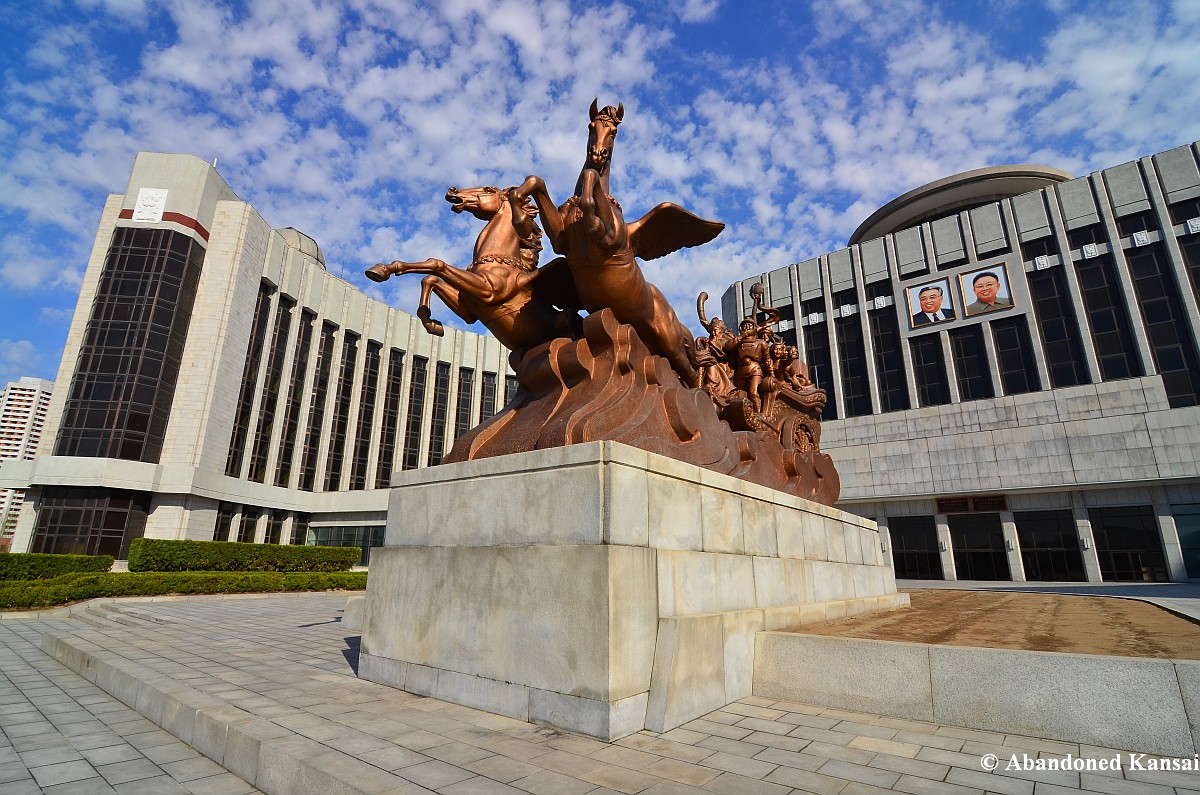
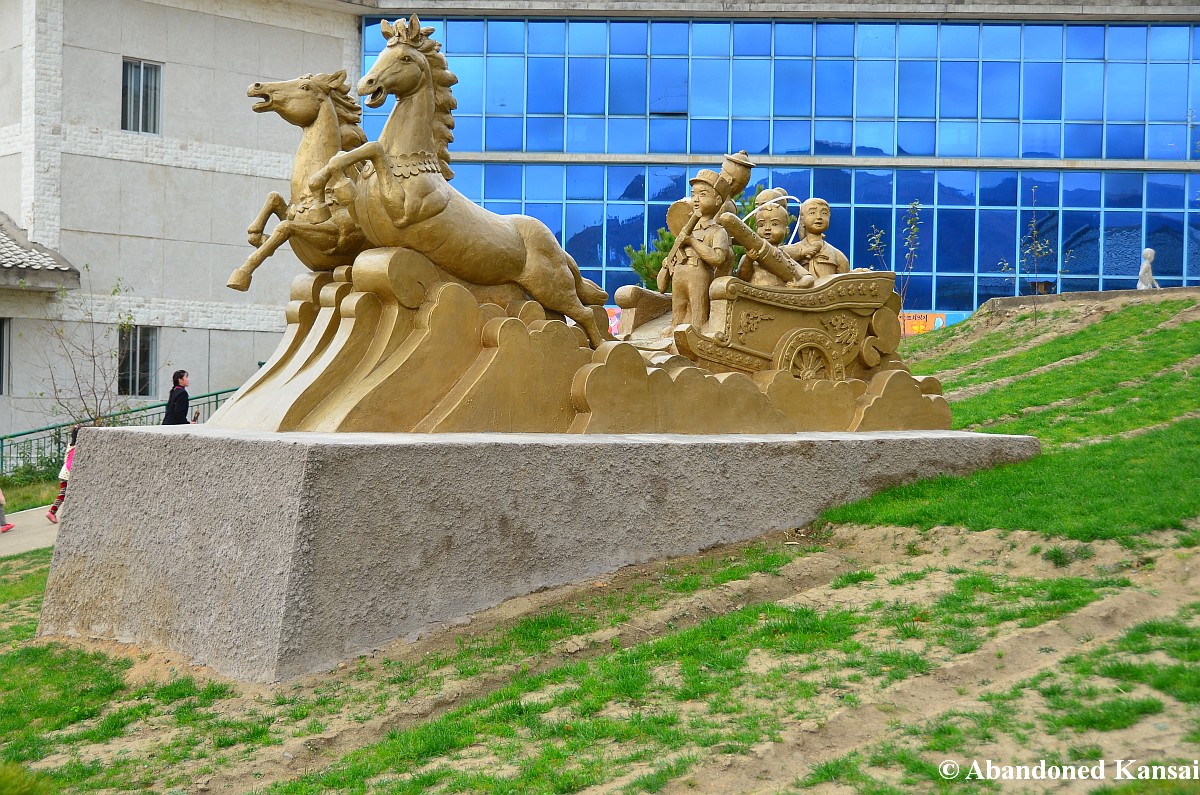
At the other kindergarten (with a different layout) we weren’t shown much of the second floor neither – and this time it was a fellow traveler who found a room she later described as “a war museum”. Sadly I wasn’t able to see it myself, but it goes without saying that our Korean guides didn’t mention it. They also didn’t mention the huge chariot sculpture in front of the kindergarten. At first sight it looked a lot like a simplified version of the one in front of the *Mangyongdae Schoolchildren’s Palace* in Pyongyang, which is all about the future and having fun. The one in Rason? Well, the first child is holding an automatic rifle in his hand, the second one a missile. Nobody pointed out those details…
Instead we went through yet another musical performance, because North Koreans like to sing and dance – I don’t. Malicious gossip has it that it’s because they don’t have anything else, but hey, they love it, so if it helps the understanding among nations I suffer through 20 minutes of creepily smiling kids at a kindergarten… or a guide singing the national anthem / their favorite NK pop song. Usually both the kids and the adults (guides, waitresses…) are pretty good at what they are doing, which eases the suffering. What really started to irritate me is that you never know when you get dragged into the whole thing. You are never safe… not at kindergartens, not at schools, not at restaurants, not at BBQs, not even on the bus. What is announced and starts as a more or less harmless performance can end with you starring it – and I HATE that kind of attention. At the same time you don’t want to be impolite, so you basically have to choose between the devil and the deep blue sea. One time on the first trip all the guides, one after another, were singing the national anthem of North Korea on the bus – and then kept nagging all tourists into singing theirs. My only way out was to claim that Germany is so anti-nationalistic now, that it is actually punishable to sing the national anthem without written permission by the government; interestingly enough not only the Korean guides but also some of my fellow travelers from all over the world believed that story… (And yes, the singing and dancing was even more intense on the second trip!)
While I visited North Korea for a second time in October I felt like being part of “Hunger Games – The Musical”: A totalitarian system concentrating all the power and wealth in the capital… and everybody was singing and dancing all the time! This wasn’t the rather cozy Pyongyang bubble anymore, this was a glimpse at a system that is plain and simple batshit crazy. Back in spring I actually thought that the DPRK was a little bit misunderstood and just needs some good PR, that Pyongyang was just a sample of what’s going on in all of North Korea, but obviously I was wrong. North Korea needs massive change from the inside, the mindset of the population has to change drastically. And I don’t blame individual average people, most of them are just doing what they are told to do (look at the communism loving Russians that now hump capitalism like a pet bunny does its favorite plush toy…), they are simply trying to survive without getting into trouble themselves, probably being traumatized by decades of subjugation from psychotic despots! I’m sure it’s not all bad in North Korea, but it definitely isn’t as good as tourists are made believe when visiting Pyongyang…
It will take me a couple of months to write about my second trip, especially since this time I want to have the whole set written before I start publishing it. Like last time I have no political or financial agenda, and I will write about my vacation as I experienced it. I just wanted to give all of you a heads up that this time it won’t be as positive and naïve – it will be full of love for the coast and the mountains, for fearless toddlers and curious language students. But you will also read some completely messed-up stories about extreme poverty and regular power-outs, about electric fences along the coastline and despicable acts towards children, about denunciation, double standards and deception – and about how I will rather never go back to North Korea again than deliberately ignoring or even sugar-coating the things that I’ve experienced…
Border guards don’t like to be filmed, yet I managed to tape me walking from China into North Korea. (As far as I know we were the second Western tourist group ever to enter North Korea on foot from Tumen, China!)
At the end of the video you can hear a guideguard approaching me after he caught me taking this video, despite him announcing that it’s okay to take pictures from the bus just 5 minutes earlier…
One of the most beautiful hours I had in North Korea – sunrise at the beach of the homestay village while most of my fellow travelers were still sleeping.
After *a surprisingly successful recent exploration in China* it’s about time to write about a surprisingly unsuccessful exploration in Japan I did 3.5 years ago.
On a nice spring day I made my way to Wakayama prefecture to check out the Kuratani Onsen, which had a reputation for being one of the most beautiful abandoned onsen in all of Japan. The next train station was about 1.5 hours away, but I didn’t mind the walk towards one of Wakayama’s gorgeous mountain ranges. Along the way I saw a small abandoned house, emptied, windows smashed – rather uninteresting, despite me being rather inexperienced back then. Probably somebody’s weekend home in the 1990s.
A few minutes later I finally reached the Kuratani Onsen… and I was shocked by its condition. Parts of the building complex were collapsed, probably under the weight of snow in the winter – the downside of unmaintained wooden buildings, gorgeous as they usually are. The rest was trashed beyond believe. But not just vandalized, filled with trash up to my knees in parts. It’s generally amazing how much garbage you find in remote areas in Japan as waste disposal can be quite expensive in the land of the rising sun. But what kind of person would drive to an abandoned building and get rid of their trash there?
Not only was the whole place nasty because of it, the trash also attracted all kinds of animals – spiders, flies, bugs; probably some rodents, too. This was probably the most disgusting abandoned place I’ve ever visited – and since it was before my “jeans and hiking boots even in summer when doing urbex” habit, I didn’t even try to make my way across all that garbage. Instead I took a path on the right side of the building to make it to the upper floor, smashed to pieces and probably not safe either… The metal entrance part was already too rusty for me to trust it on a solo exploration. And so I left with a couple of crappy photos after about half an hour. Not my shortest exploration ever (that title still belongs to the more or less failed *Sekigahara Menard Land* snow expedition earlier the same year), but probably one of the most disappointing ones.
And that’s pretty much it… One man’s trash is another man’s treasure, so I hope you were not too disappointed by this week’s article (though I wouldn’t blame you, but not all of my explorations are spectacular, so sometimes I have to write about duds, too) – but if you were, you might consider *liking Abandoned Kansai on Facebook*. Especially in weeks with an unspectacular location I upload some exclusive preview material there – the photos scheduled for later this week will show you some amazing locations that I’m sure you will like as much as I do!
Asahi beer is popular all over the world, the Asahi Shimbun is a famous Japanese newspaper and Asahi TV is a somewhat known TV station – but the Asahi Sports Center nobody seems to know. Or seemed to know at the time my buddy Dan and I explored the place in October 2012. (If you google the term you will find tons of fitness clubs in Germany and Japan, despite the fact that I use the real name of the place here.)
Japanese summers are hot, humid, full of insects… and they drag on forever, especially in the Kansai region. While back home in Germany friends and family start to complain about grey days and having to wear windbreakers, I spend most late autumn days wearing T-shirts – and risking sunburns. Last year October was no different when Dan and I were approaching the Asahi Sports Center somewhere in the Japanese mountains. Despite wearing a T-shirt I was sweating like a hog, the vegetation still lush, green and thick. Before going to the sports center I only had seen a handful of bad photos on a Japanese blog, the satellite view on GoogleMaps basically useless due to its blurriness. With only a vague idea of what to expect the sheer size of the Asahi Sports Center took us by surprise, making it an all-time favorite at the time of its exploration.
After paying some serious amount of money for highway fees and driving for half an hour through tiniest towns and past forgotten fields we finally reached the Asahi Sports Center – being kilometers away from the next living soul we just parked the car in front of the first building we saw and headed in. It seemed like this was some kind of service center / administrative building. The kitchen on the ground floor was half unrigged, half ripped apart, the restrooms were dark and gloomy, vandalism everywhere; not exactly a warm welcome. The first floor, too, had not been spared by vandals and mould, but at least there we found some flyers and posters including maps, giving us an idea how big the sports center really was – the answer: about 450 by 200 meters. Pretty friggin big!
Two things on the map caught our eyes immediately: the huge swimming pool and the tennis courts. To our misfortune the combination of a drawn map (including artistic freedom…) and rampant nature didn’t make it easy to navigate, so it took a while until we found our way south via several flights of steps and an overpass – across a now completely overgrown kart track!
It was actually this outdoor area that made the Asahi Sports Center so spectacular. The service center was vandalized, but the sports area was just abandoned and overgrown. This part looked like people just didn’t show up anymore and nature took over again – natural decay at its best.
You should think that an abandoned tennis court wouldn’t be very interesting. The ones I saw on *Okunoshima* and near an abandoned retirement home in Germany (yet to come…) were actually quite dull places, but these courts here… amazing! They were located down a slope, lower than the visitor center, and the fences were almost completely overgrown, while the courts including the nets were… well… withered and rusted, but overall in decent condition. Somebody dragged the rusty umpire chairs away, but other than that everything looked eerily normal. The atmosphere was just wonderful, with the sun shining and birds singing; a perfect place to go to for reading a book without getting disturbed.
The huge pool west of the tennis courts was even spookier, thanks to a couple of little buildings surrounding the place, most vandalized and / or overgrown. A perfect place to shoot a horror movie on a grey hazy day… The dark green water looked like you could dump a body there without it ever being seen again once it sank down half a meter or so – a strong contrast to the white painted edge surrounding the creatively shaped pool. Just in sight of the pool we found about half a dozen wooden huts the sports center called Swiss Chalets. (The first video shows a walking tour of both the chalets and the pool.)
Shimmering through the profuse vegetation were some metal constructions, most likely part of the amusement park like rides visible on the posters and tickets at the visitor center. Sadly there was no way to get through, the undergrowth was just still too thick.
Dan and I went back up to the main road and followed it for a while. There we found another set of bungalows and some other buildings. Sadly they were completely vandalized and I had no motivation to take any photos there after enjoying the gorgeous sports area – but I kept the video camera rolling while I was going through the buildings for the first time. Usually I do the walking tours after I have seen everything, so this is a rare opportunity to explore live with me. To see what I saw when I actually saw it for the first time. After about 3 hours on the premises I didn’t expect any trouble anymore, exploring a building for the first time nevertheless is an exciting experience, even if the building is far from being spectacular!
In the neighborhood we also found the so-called convention center – basically a party space with an open fireplace on the ground floor and some rooms with tons of bunk beds upstairs. The Christmas party photos I found at the visitor center were clearly taken here.
Last but not least we followed a road down the mountain to what once was the goal of a summer ski slope – but this area was also completely overgrown, making it rather likely that I will revisit the sports center again one winter; before it starts to snow, but after the vegetation is weakened… 🙂
The Minsok Hotel in Kaesong (a.k.a. the Folk Hotel) is the standard accommodation for foreign visitors to Korea’s ancient capital. It’s located in the old part of Kaesong, one of the few places in the DPRK not destroyed during the Korean War, since it was part of South Korea for the first part of the conflict and the allied forced had hoped to get it under control again (the other half of Kaesong was destroyed nonetheless). The Kaesong Folk Hotel was opened in 1989 and consists of about 20 hanok style courtyard houses along a small river – many date back to the Joson Dynasty (1392-1897) and offer their guests a traditional Korean experience, which means that people sleep on padded mats on the floor, heated by the traditional ondol system. By far the most beautiful of the three hotels I stayed at in North Korea (the other two being the *Yanggakdo Hotel* and the *Ryonggang Hot Spring House*), it was also the one where it was most evident that our freedom of movement was strictly limited. Although (or rather: because) the Minsok Hotel is located in a rather busy residential area, none of us was allowed to leave the premises. Years ago it was possible to go on a stroll when accompanied by the Korean guides, but that tiny little bit of freedom was taken away when an American tourist decided it was a good idea to sneak out alone at night…
In the morning we were allowed to step outside the hotel’s massive wooden gate to take a couple of photos of the street, but that was it. We tried everything to convince our guides to go on a walk with us, but they shut us down completely; politely, but firmly.
The most surreal moment of my stay in North Korea, way weirder than visiting the *Kumsusan Palace Of The Sun*, also happened at the Minsok Hotel: I was approaching the hotel’s gift shop, a small building near the gate, when I heard music from a big speaker on the ground. Western music. English text, written, produced and partly sung by a German. Imagine the trashiest europop possible, created in the 80s, stuff that still haunts you after more than 25 years and almost overshadowed a whole decade of legendary pop and rock songs. Only one band can come to mind, at least when you are from a German speaking or a Scandinavian country – Modern Talking! The song playing: Brother Louie. At first I thought it was Cheri, Cheri Lady since all Modern Talking songs kind of sound the same, but no, here I was… in Kaesong, North Korea, the Hermit Kingdom, the most secluded country in the world, where you never hear a single western tune except for half a Beatles song at the *Grand People’s Study House* in Pyongyang – and I had to listen to Brother Louie by Modern Talking…
Nampo / Nampho is the center of the North Korean shipbuilding industry and has a population of about 370,000, making it the fourth biggest city in the DPRK; other important employers are the Nampo Fishery Complex, the Nampo Smelter Complex and the Nampo Glass Corporation as well as several sea salt producing companies.
My trip to Nampo began, like most trips there, on the Youth Hero Motorway, a 46 kilometer long expressway between Pyongyang and the industrial city on the north bank of the river Taedong. Construction started in November 1998 with the massive support of young Korean volunteer workers; hence the name Youth Hero Motorway. While on the highway Mr. Yu told us that he was one of the volunteers when he was a university student – you could read between the lines that it must have been an excruciating project for everybody involved… Opened in October 2000 the widest motorway in North Korea (5 lanes in each direction!) already is in really bad condition. At least half of it is full of potholes, so we were able to drive faster on most countryside roads. (A video taken on the Youth Hero Highway came with *the first article of this series*.) I didn’t have a look at the watch how long it took us to get from Pyongyang to Nampo, but I guess it was about 2 hours, probably longer…
Nampo itself looked a lot more like how most people imagine North Korea to be – a bleak industrial city full of decay, with a lot less of those colorful apartment blocks and post-futuristic buildings I loved in Pyongyang; the streets being in a lot worse condition, too. We never stopped anywhere within the city limits, but parts of Nampo would be a perfect location to shoot a remake of Michael Radford’s 1984. When we drove past the Nampo soccer stadium I thought that most of the abandoned buildings I visit were in better condition – the FIFA would never approve of that one! (A *look at GoogleMaps* confirmed that the stadium basically is a ruin…)
The sun was setting and it was a beautiful evening, but quite a bit of Nampo looked rundown and rather depressing. Some government buildings and the huge paintings of Kim Il-sung and Kim Jong-il looked nice, but overall it was pretty clear that Pyongyang had priority over Nampo in many ways. I am actually a bit surprised that we drove through Nampo as there is a bypass north of the city center – so they could have avoided showing us stuff like the soccer stadium if they really wanted to… (I took some photos and both videos published with this article the next morning on the way to the West Sea Barrage, just in case you wonder about the different lighting conditions.)
The Ryonggang Hot Spring House (in most itineraries referred to as the “Dragon River Hot Spa Hotel” is not in Nampo city, but 20 kilometers northwest in a small town called Onchon – and like so many rather modern things in Korea it dates back to when the country was under Japanese occupation; which also might explain why you take off your shoes at the entrance and switch between house slippers, apartment slippers and bathroom slippers… The House actually is a resort, consisting of seven small villas with four apartment units each, and a so-called service center with a restaurant, a karaoke room, a pool room, and all the other usual stuff. Each apartment has its own private hot spring tub; the water is said to treat “hyperpiesia, non-tubercular arthritis, neuralgia, neuritis, lumbago, varieties of wound (sic!), sequelae of operations, chronic gynecologic inflammation, functional disorder of nidamental gland, sterility, chronic gastritis, chronic colitis, skin diseases including eczema and prurigo” according to the spa’s brochure. Speaking of the brochure – it was too large to scan as a whole since it was three big pages each side wide. So I scanned the more interesting two connecting pages on each side, leaving out the pages that mainly consist of water analysis data and tourist spots nearby.
Upon arrival Mr. Yu, Mr. Kim and Sarah started to set up the famous petrol clam BBQ *I wrote about in the food article*. By then it was pitch-black and rather cold outside, but the soju and vodka warmed everybody from the inside. Half an hour later the whole group went to the main building to enjoy dinner – a pitch-black dinner at times as Nampo, unlike Pyongyang, suffers from regular blackouts. But the food was good and the company was nice, so it was a really successful evening again…
Oh, one last thing about the Ryonggang Hot Spring House: The tree covered resort is surrounded by a barbed-wire fence and the main entrance (facing open fields, not the town’s center) is guarded by an armed soldier – your guess whether he is there to protect guests from locals or locals from guests is as good as mine!
The Yanggakdo International Hotel is North Korea’s biggest and most popular hotel. Well, until they finally open the Ryugyong Hotel, Pyongyang’s most famous unfinished building for more than two decades; named after an old name for Pyongyang itself, meaning “capital of willows”. The Yanggakdo Hotel on the other hand is named after the island it is on, Yanggak – located in Pyongyang’s main river, Taedong. Nicknamed “Alcatraz of Fun” due to the fact that foreign guests are not allowed to leave the Yanggak Island, the hotel features several restaurants and bars, a couple of shops (books, alcohol / imported food / local cigarettes, postcards / stamps, …), a tailor, a Chinese run casino basement and a Korean run basement with a three lane bowling alley, billiard tables, a pool, a karaoke bar, a massage parlor and much more.
Built from 1986 to 1992 by a French company called Campenon Bernard Contruction Company (now: Vinci) the Yanggakdo Hotel and its 1000 rooms (spread across 47 floors) opened in 1995; though you can imagine that half of the hotel is not used, given that there are less than 50000 tourists visiting all of North Korea per year – and there are several other hotels in Pyongyang, like the Koryo Hotel, the Sosan Hotel, the Ryanggang Hotel and the Chongnyon Hotel. Looking at the itineraries of several travel agencies it seems like the Yanggakdo Hotel is extremely popular to house the 3500 Western tourist per year. Probably due to the fact that it is located on an island – which means that they can prohibit random contact with locals without having to lock up people at the hotel.
Contrary to many other travel reports you are actually allowed to leave the Yanggakdo Hotel. Most people prefer getting drunk or getting some sleep after doing sightseeing for 12 to 14 hours a day, but on two evenings I decided to stroll around a bit – which admittedly requires some balls as the area doesn’t have any signs and potentially interesting places, like the tip of the island, are not easy to find; and at night you need a flashlight, too…
The first time I went for a walk I was the only member of my tour group at the Yanggakdo Hotel as the rest of them decided to have dinner at a pizza restaurant at Pyongyang – so I decided to go back to the hotel and have Korean food for dinner with the other May Day Long Tour group. I like pizza as much as the next guy, but I didn’t come to North Korea to eat pizza… (And although the restaurant was generally praised before the group went, my fellow travelers seemed to be a bit disappointed afterwards.) Poor Mr. Kim had to come with me to the hotel, too. You know, just in case… (One of those situations you can interpret both ways. Depending on your attitude you can claim had he had to go with me to keep an eye on me – or you can say it was a form of service, just in case I needed something. We actually parted in the lobby right after the arrival, even before dinner, where Mr. Kim did something tourist guides never do – he gave me his room number in case I had a question.) Since the pizza restaurant took more time than my Korean dinner at the hotel I told Mr. Kim that I wanted to go to the tip of the island to take some night shots of Pyongyang while waiting for the rest of my group to arrive – no problem.
Getting to the tip of Yanggak Island wasn’t that easy, especially at night, since entrance of the hotel is on a much higher level and there are no hints on how to get there. Luckily I met two of my dinner companions on my way there, so somehow we made it after a couple of minutes and several concrete staircases, narrow paths and dark corners. The view from the tip of Yanggak Island is absolutely gorgeous and totally worth the hassle of getting there, so I took a couple of photos and left when the wind got too cold to being outside with just jeans and a T-shirt.
The next night I went there again. This time prepared, i.e. wearing a jacket. I took the exact same route as the night before (*and marked it on the GoogleMap I created*), but this time I didn’t mention it to anybody and I was without company – to my surprise I triggered an alarm on the eastern side of the Yanggakdo Hotel. Sound, light, guard with a flashlight coming outside through a door. Since I didn’t do anything wrong I kept walking and the guy didn’t even try to make contact, but it felt kinda weird. On my way back I kept as far away from the building as possible without stepping on the grass – nevertheless I triggered the alarm again, with the exact same result. It was an interesting experience, because until then I didn’t feel surveillance at all. Especially after the two days in Beijing, where they have security checks at every train and subway station plus countless cameras everywhere. I don’t think I ever saw “security cameras” anywhere in the DPRK except for a couple of days later at the DMZ. But this little episode proofed that just because you don’t see surveillance it doesn’t mean that there is none – and it made me wonder if and how the system would kick in if I would have gone in the other direction, towards the Yanggak Bridge, which marks the southern limit of freedom on Yanggak Island…
Urban exploration is a dangerous hobby. How dangerous it really is I found out at the Daieikaku, a rather big abandoned ryokan south of Osaka. I was literally and figuratively one step away from my demise…
The Daieigaku was the first location Damon and I went to together back in 2010. Later we continued to explore the *Gion Love Hotel*, the Ferris wheel *Igosu 108*, the *K-1 Pachinko Parlor*, the *Tsuchikura Mine* as well as the *Kasuga Mine A* and *Kasuga Mine B* – but first the Daieikaku, a hotel that turned out to be quite hard to get to.
Back then I had done all my explorations using trains, but the Daieikaku was too far away from the closest station to walk to, so we had to take a bus. Which is a hassle in pretty much every country, especially if your command of the local language is… sub-par. Sometimes it’s close to impossible to figure out schedules and stops. When I wanted to get to a place near a university campus in Hokkaido last year it took the local tourist information at JR Sapporo Station 15 minutes to figure out which bus to take – and I knew the name of the bus stop I wanted to go to! Figuring out which bus to take to the Daieikaku wasn’t easy, but it wasn’t the only problem: The Daieikaku was located at a slope on the other side of a river, but the bridge leading to the ryokan was completely overgrown. Even in autumn with weakened flora we weren’t able to get to the other side, especially without being seen by locals and day visitors. So we crossed the river via another bridge, climbed up the slope and got to the back of the Daieikaku at the level of the third floor. Instead of taking some steps down to the ground floor we entered through a smashed in window right where we were. Starting up there was as good as anywhere else we thought…
Big mistake! The first room was one of those tatami party rooms you have in pretty much every hotel in Japan. Thanks to open doors and windows everywhere in the Daieigaku the place was in rather bad condition with leaves all over the place. I went to the side of the building, looking for a staircase. Found it, passed it and opened a door… a restroom. I went inside to have a closer look, but although the floor looked a lot more solid than the one in the tatami room it didn’t feel like it. Halfway into the room I had a very, very bad feeling, so I went back to the hallway, down one floor via the staircase, opened the door to the restroom below the one I just entered and… it was gone! There was no friggin restroom! Only one wall with some urinals hanging mid-air! And the bathroom I was in basically was attached to the rest of the building by its walls. I guess I don’t have to mention that the floors below were gone, too, so if I would have walked further into the restroom two minutes earlier (or probably just would have stayed where I was) there would have been a good chance that I would have crashed through a thin layer of tiles and wood three floors down to my death. After I recovered from that realization I went straight to Damon to warn him about the death trap on the third floor. Luckily he didn’t put himself in danger, so we continued our exploration without further incidents, although we continued to take risks every once in a while – especially Damon, who was exploring the hotel like a honey badger. Through tiny broken windows with shards left, up and down rotting wooden stairs, … Which lead us down to the onsen part of the ryokan, a part of the hotel I probably wouldn’t have gotten to if I would have gone there on my own, especially after that little shock right at the beginning. There we saw some major cracks in the ceiling and the wall, which didn’t exactly help to ease my mind – parts of the Daieigaku already collapsed, so being in the middle of the building with unstable floors above and below wasn’t exactly the place I wanted to be in. But the former lobby didn’t look any better. We first saw it from 2F and looked down – staircases gone, walls caved in… The whole building was in worse than dilapidated condition and I guess every single step could have been our last!
Looking back at the exploration of the Daieikaku I have to say that we were terribly naïve and really lucky. The term “Daieikaku” means big glorious building and it is often used for restaurants serving a charcoal grilled meat dish called yakiniku – and while the ryokan Daieikaku was indeed a big building it was everything but glorious. It was a deathtrap and by far the most dangerous location I have ever explored. It also was rather unspectacular overall, that’s probably the reason why I never wrote about it, almost forgot about. Back then I just did a pre-selection of my photos, deleting only the worst, so I had to go through almost 150 of them to make a final selection for this article – and it actually makes me wanna go back there. Three years ago I shot without a tripod and the Daieikaku was pretty dark in some places, though it was a bright and sunny autumn day. Furthermore several earthquakes hit Kansai since then, including the Tohoku Earthquake that caused the Fukushima Incident and a recent one that struck Awaji Island. Plus Mother Nature had 30 months to do additional damage… Well, we’ll see – if time allows I’ll stop by there again to give you an update on what happened to the Daieikaku. For now I hope you’ll enjoy the photos I took during my visit. I’m sure you are eager to see what the collapsed bathroom looked like… 🙂
The Kuroshio Lodge is one of the oldest and most famous abandoned places in Japan – even pioneer *haikyo* blogs who haven’t been updated in years feature this almost completely trashed hotel with the iconic bar; a beautiful photo opportunity thanks to its rusty stools and bright orange and yellow lamps. Nevertheless I struggled for about a year to find out where the Kuroshio Lodge was… and then another six months to find a ride as it is close to impossible to get to the place by public transportation – luckily it was *on the way to Shikoku* for Gianluigi and I, so we made a stop to stretch our legs and to take some photos.
Kuroshio means “black tide” and is also the name of a northeast-flowing ocean current stretching from Taiwan past Japan to the North Pacific Current – hence the nicknames Black Stream and Japanese Current, deriving from the deep blue of its waters and the country it flows by.
It’s pretty safe to say that the Kuroshio Lodge was named after the current – despite the fact that the Kuroshio (current) isn’t visible from where the lodge is located. The lodge on the other hand isn’t visible from the beautiful coastline of Awaji Island. You can get as close as 100 meters (beeline) on a busy street, look up a hill and see nothing but trees. At the same time you have a gorgeous view at the mountains of Awaji Island and the stunning Seto Inland Sea from the rooftop of the lodge… It’s all a matter of location!
At first and third sight the Kuroshio Lodge is a big disappointment. After huffing and puffing up a rather steep mountain road on foot, Gianluigi and I reached the back of the mid-size grey building. After years without maintenance the outside walls looked dirty, but that was nothing in comparison to what we saw when peeking through some open windows – the exposed rooms were filled with rotting vandalized futons and other interior. Not exactly a great start.
In close proximity of the abandoned hotel we found a couple of small houses at the slope; hut-sized, most likely the former living quarters of employees. We entered one of them, but the lighting in there was horrible and neither of us brought a tripod. There was not much to see anyway – I didn’t even bother to take a video.
Back up the slope we finally entered the Kuroshio Lodge – and were positively surprised by the lobby area with its famous turquoise chairs and the bar with its even more famous lamps and stools. You could take 100 interesting photos there and still won’t be bored!
Sadly disappointment stroke again right behind the counter. The kitchen next to the lobby / bar was completely vandalized and rotten, so we made our way up to 2F (first floor in Europe, second in Japan). No wonder that you barely ever see other rooms than the lobby when people post about the Kuroshio Lodge. The whole rest of the place was either vandalized and rotten or completely boring. I took a couple of snapshots here and there (like the lamp and the bath, although they were not really exciting subjects…) and then called it a day, taking the obligatory video on the way back to the lobby.
Since I visited the Kuroshio Lodge almost two years ago I found several Japanese articles about the hotel claiming that the area is overrun by wild dogs from a former dog breeder close to the hotel. They also claim that those dogs were involved in some rituals… whatever that means. Luckily I didn’t run into any mad dogs, crazy cultists or bloodthirsty sadists – although I remember seeing some kind of triangular sign on a metal plate in the boiler room (the one at the beginning of the video below, I just missed to catch the symbol on film… sorry for that, I didn’t think it was on any significance). The whole thing sounds a little bit like an exaggerated version of the usual ghost story surrounding basically every abandoned hotel in Japan. A lot of Japanese people are surprisingly superstitious, so whenever a place is abandoned you get some variation of the “owner committed suicide” story. Stories that are virtually impossible to verify. Nevertheless I thought I better mention the wild dogs. You know, just in case you walk up to the Kuroshio Lodge one day, get surrounded by them and think “Florian never mentioned those damn dogs!”…
To me the Kuroshio Lodge was a rather disappointing location. I loved the entrance area, but the rest of the building gave me a “been there, done that” kind of vibe – which is not what I was hoping for after putting so much time and effort into finding the place. But hey, what can you do? At least the bar and the lobby didn’t fail to deliver. And sometimes one room is all you need to make a visit worthwhile…
One of my favorite things about urban exploration is travelling. Most of the time I do day trips within Kansai, but every couple of months I go on mini vacations to other regions. *Okinawa*, *Kyushu*, *Hokkaido*, *Shikoku* … and a couple of more that will be revealed in the future.
I lived in Japan for several years before I started to visit abandoned places – and in those first years I barely travelled within Japan. Kansai has plenty of castles, temples and shrines, some of the most famous in all of Japan. More than enough to get templed out, shrined out and castled out, so I didn’t feel the urge to spend hundreds of bucks on train tickets – and then a similar amount on hotels. Only to see more castles, temples and shrines that look similar to what I can see down the street. Abandoned places on the other hand are unique – and some of them are actually worth spending a couple of hundred bucks, at least to me.
The spring of 2011 saw my second overnight trip to Shikoku. *During the first one* my favorite location on Japan’s least populated main island was the spectacular *Tokushima Countryside Clinic*, a small town doctor’s house, barely harmed by vandals and the ravages of time. My friend Gianluigi, an avid photographer for almost two decades, loved the photos I took at the clinic, so I convinced him to go on a road trip – I would show him that wonderfully spooky gem if we would stop on other abandoned places along the way…
If you are a regular reader of Abandoned Kansai you might remember two articles I wrote about really unique haikyo about half a year ago – the abandoned Japanese spa *Shimizu Onsen Center* and the giant Buddha statue / viewing platform *World Peace Giant Kannon*; both of them were actually part of this second trip to Shikoku.
So here is a complete list of all the locations: Amano Hospital Daiwa Pottery Kuroshio Lodge Shimizu Onsen Center Tokushima Countryside Clinic Revisited World Peace Giant Kannon
One of these places has been demolished since I visited it two years ago – you’ll find out soon which one… and then I’ll add it to my *GoogleMap of Demolished Haikyo*.





 Abandoned Kansai