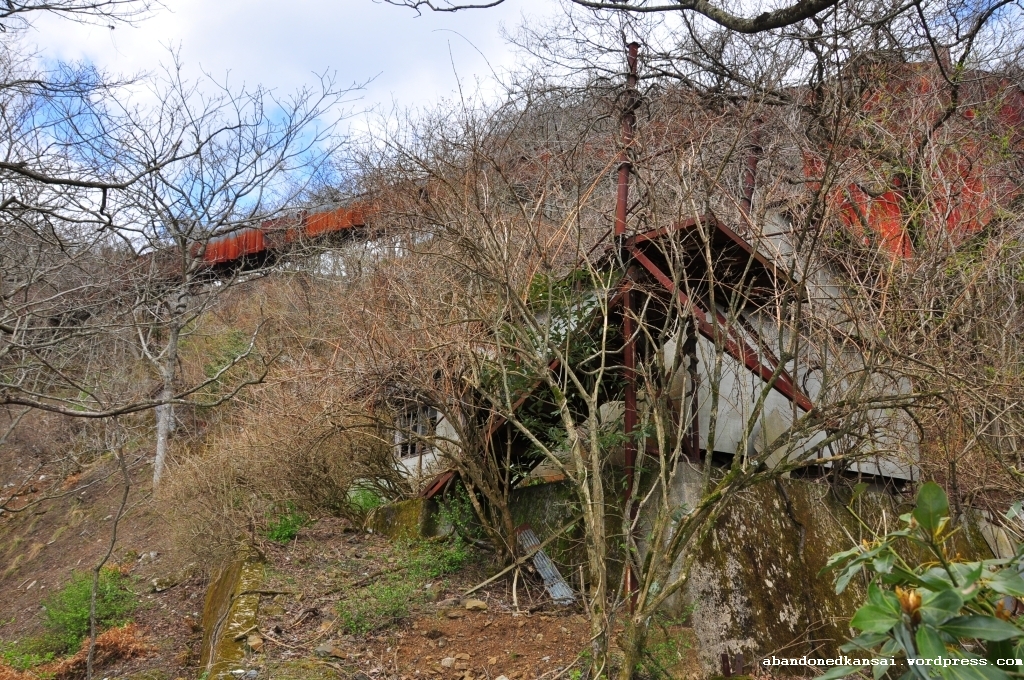
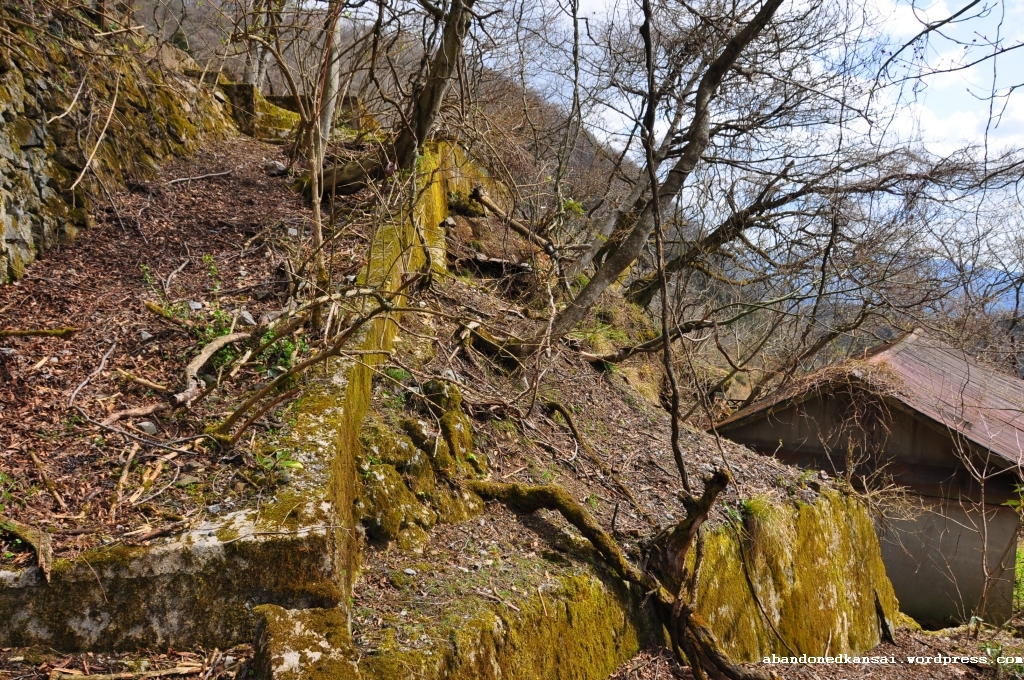
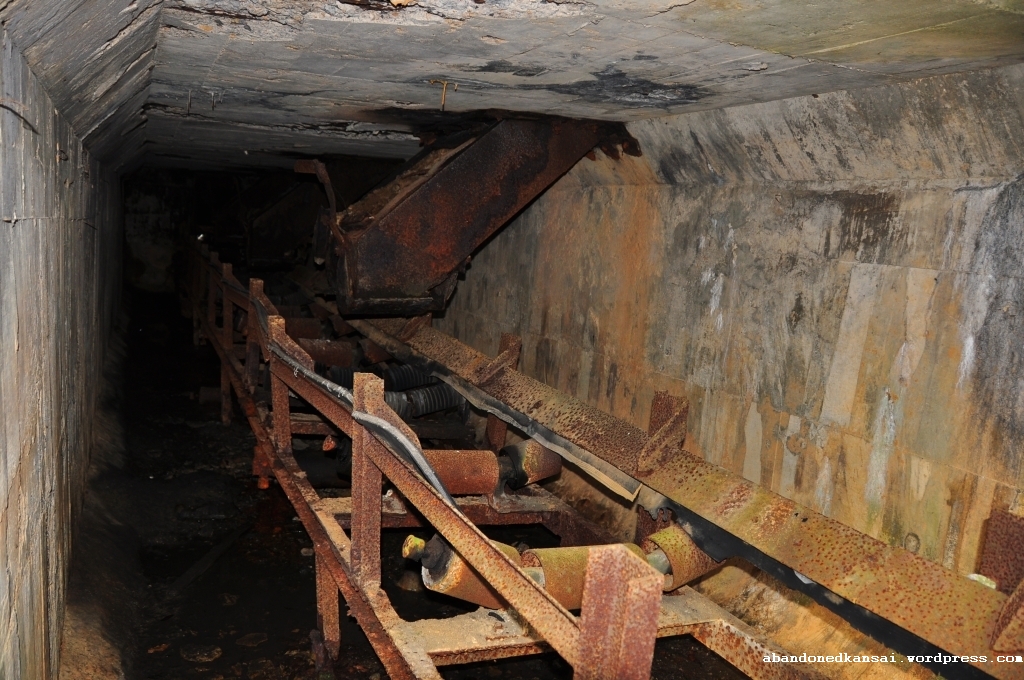
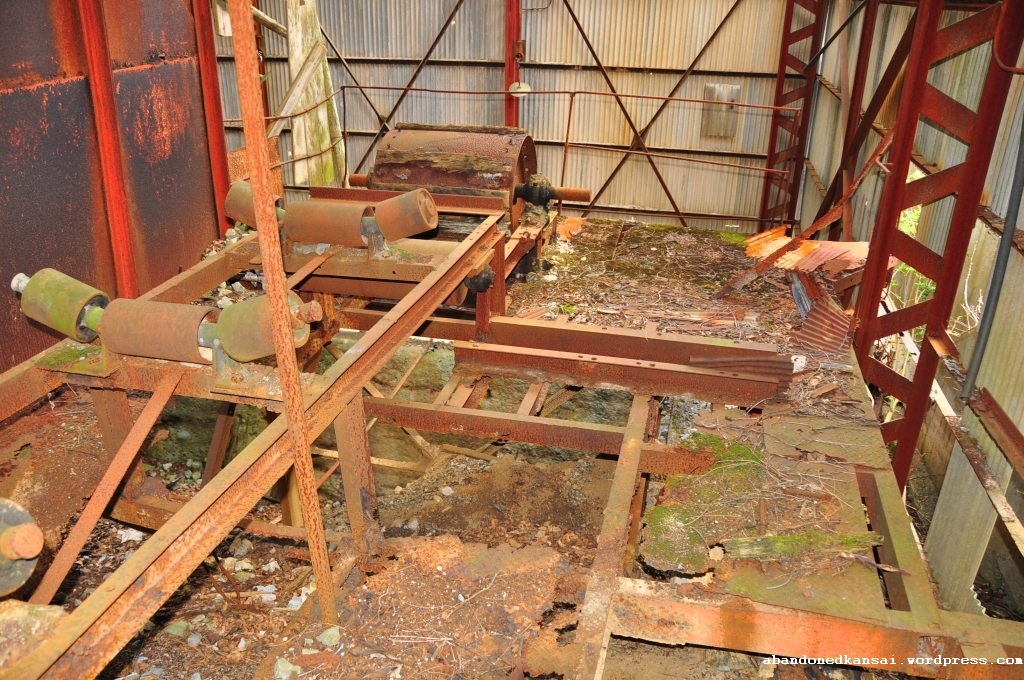
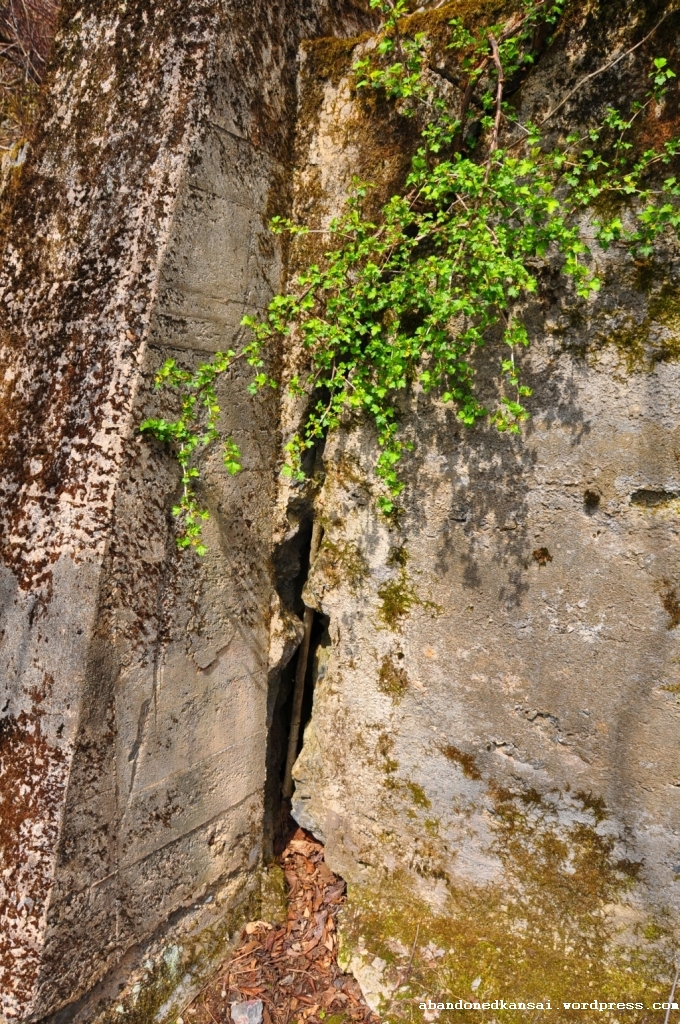
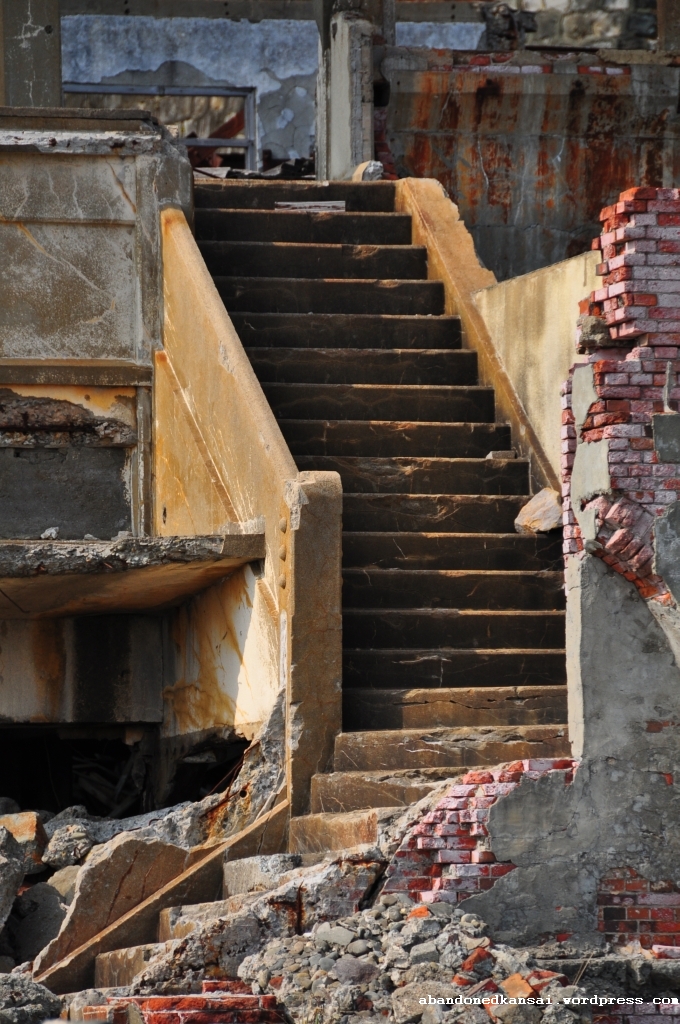
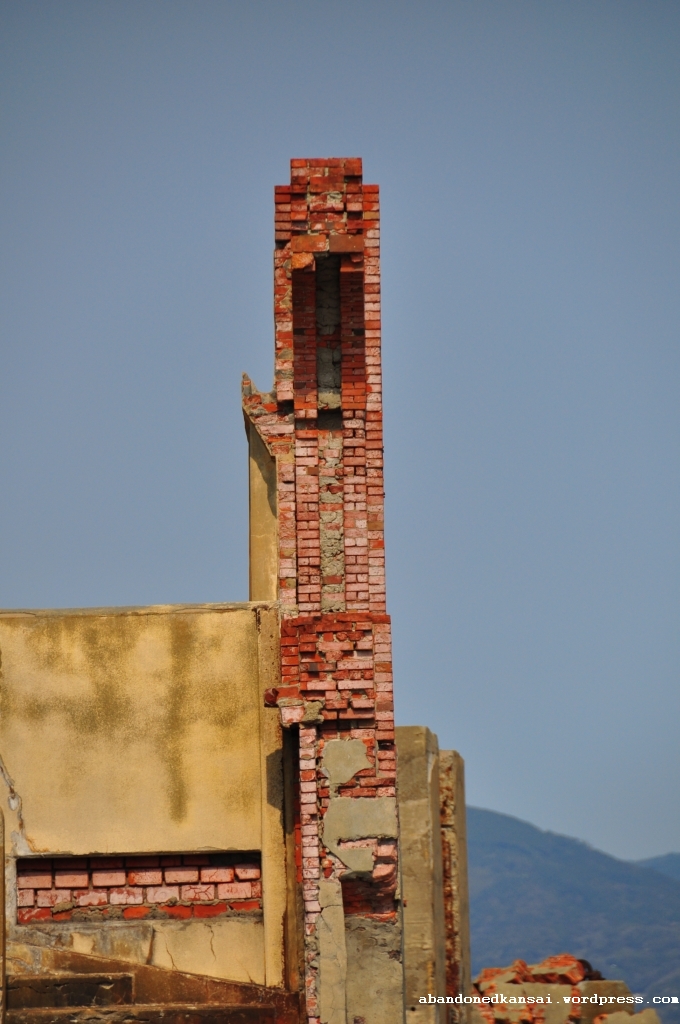
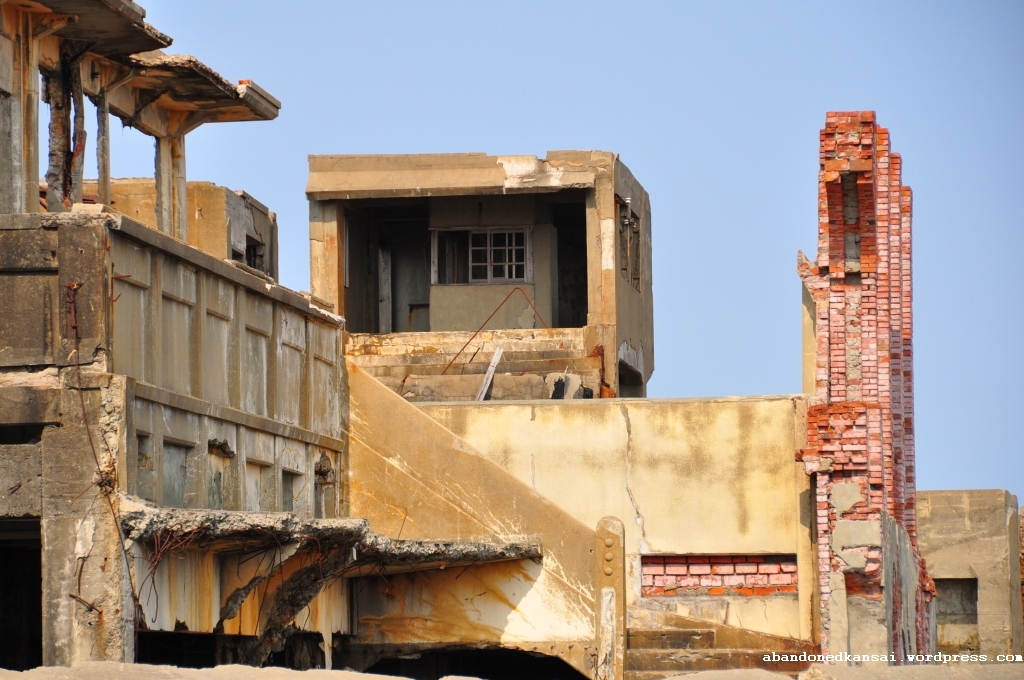
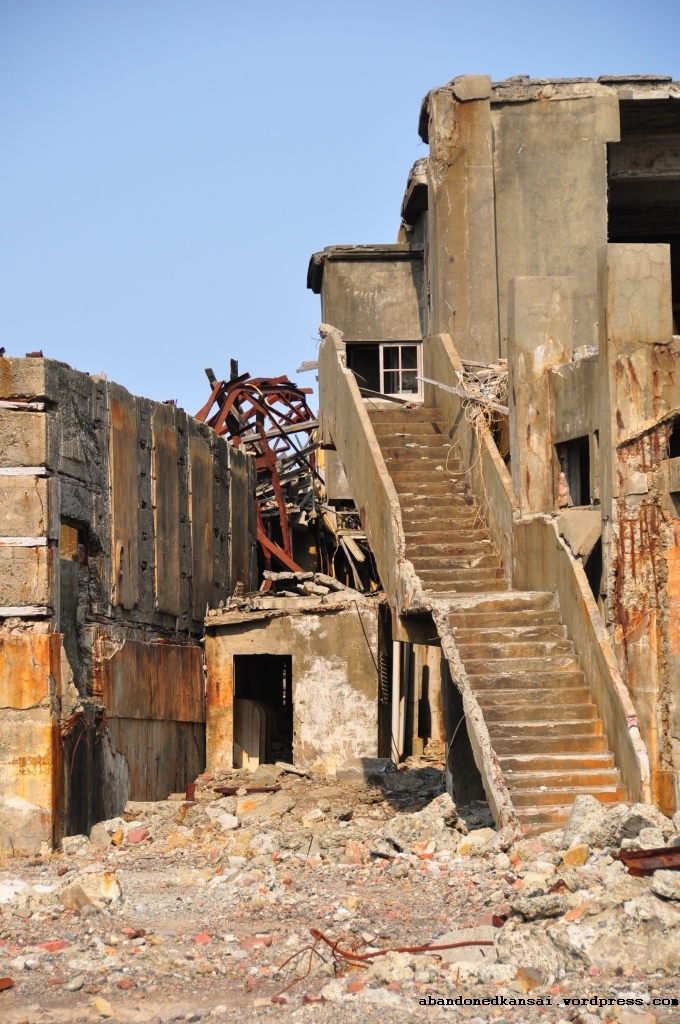
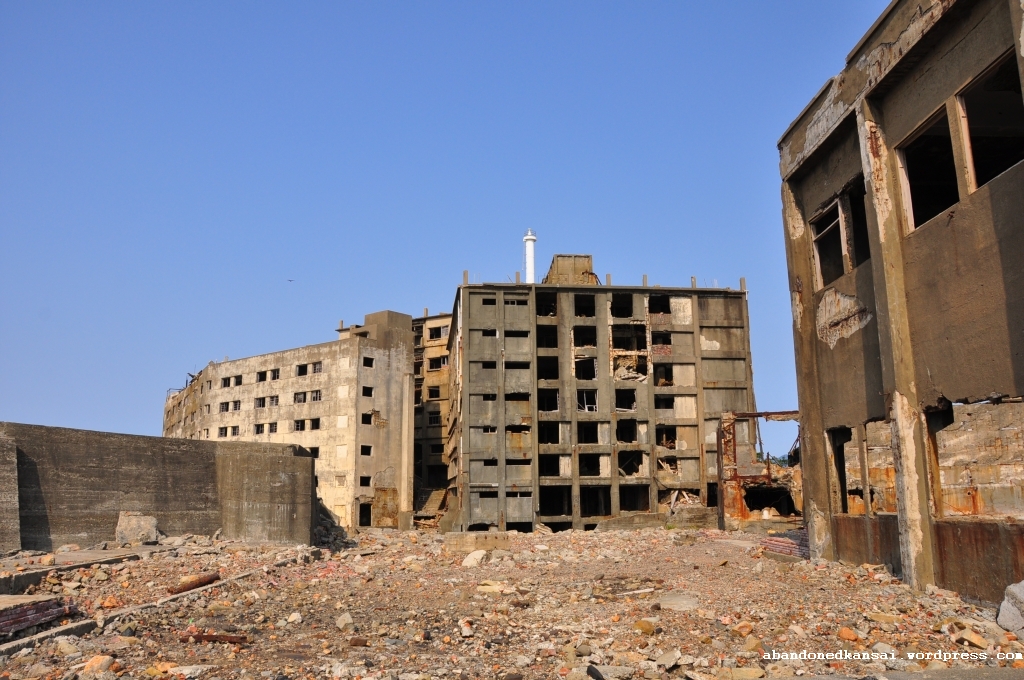
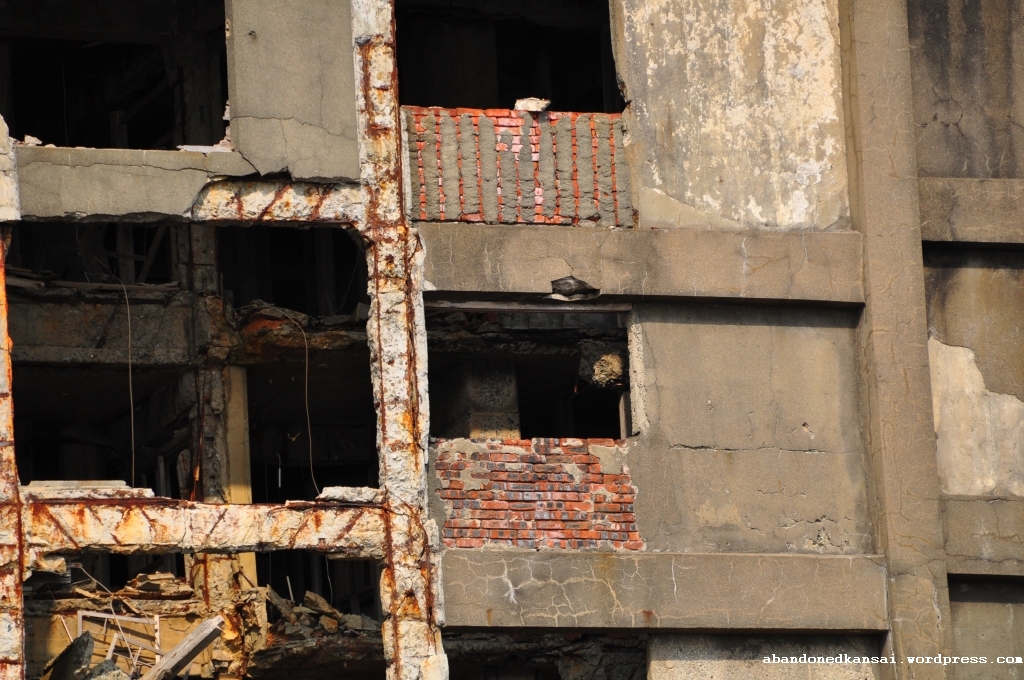
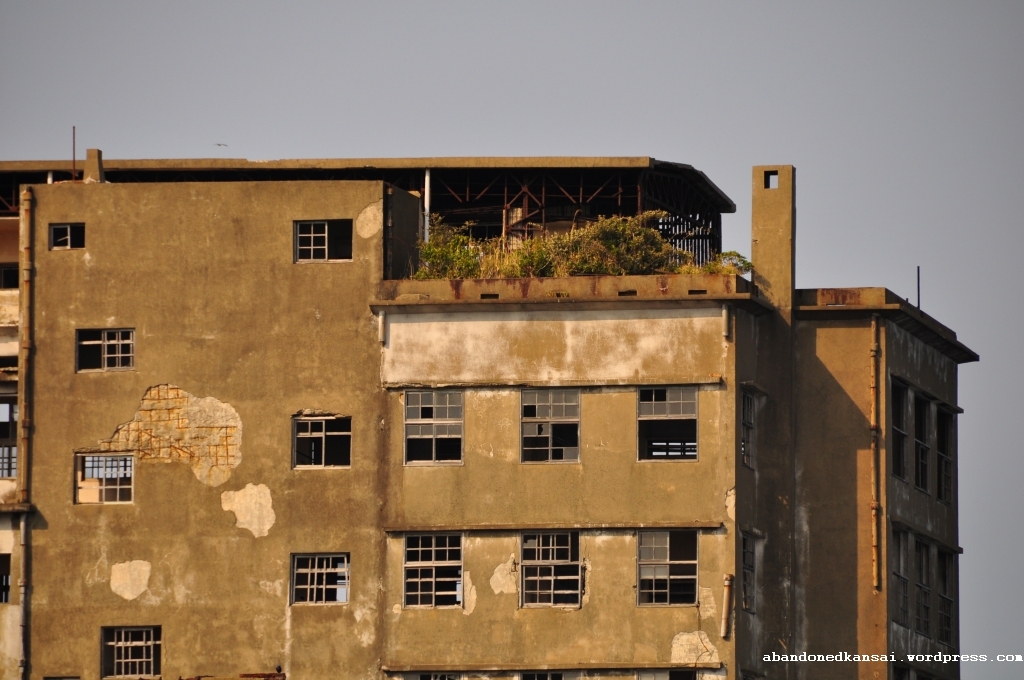
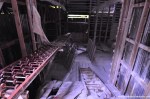
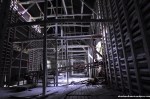
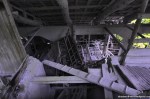
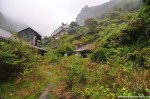
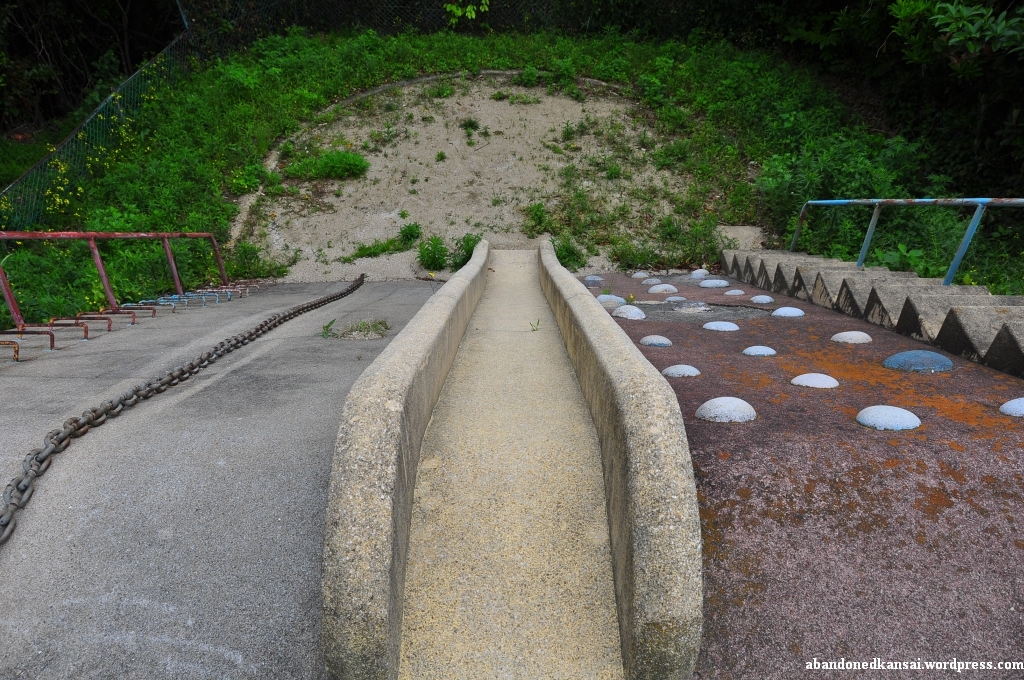
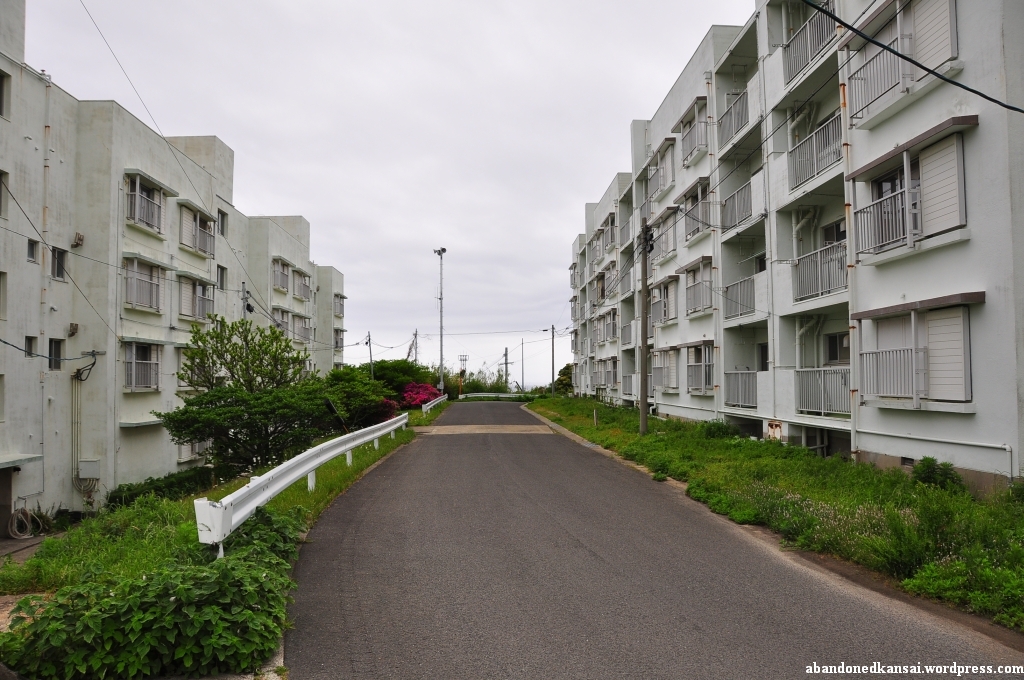
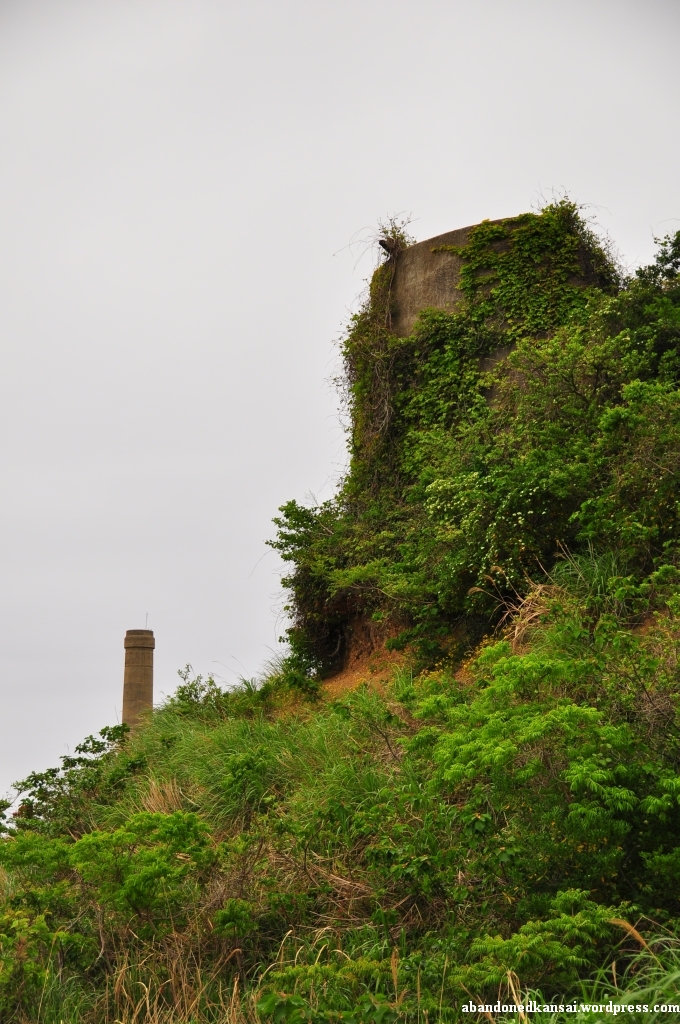
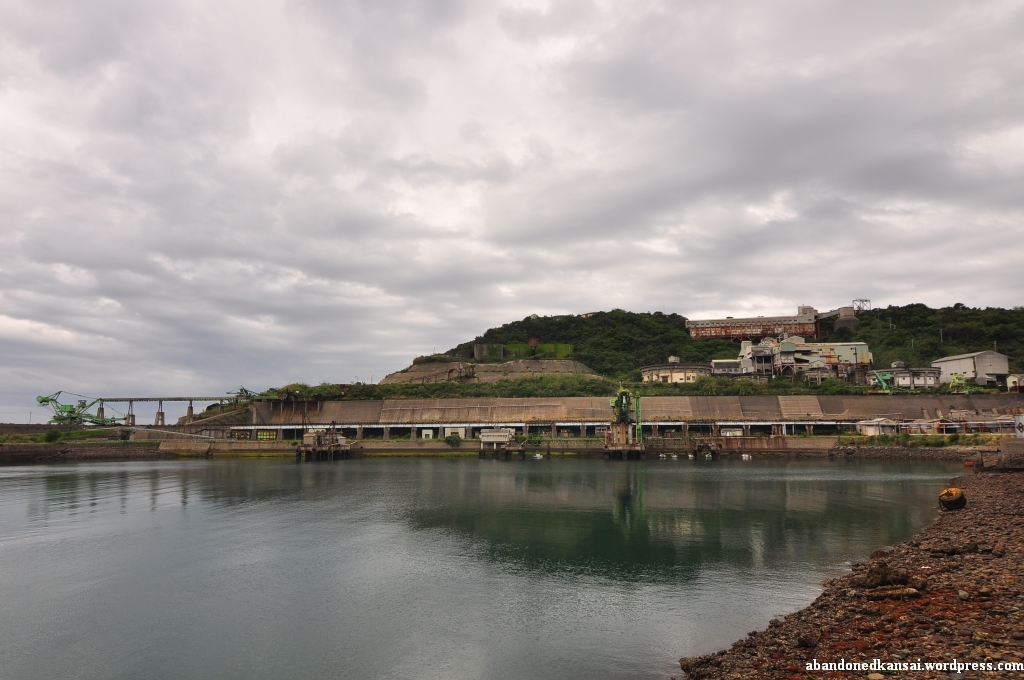
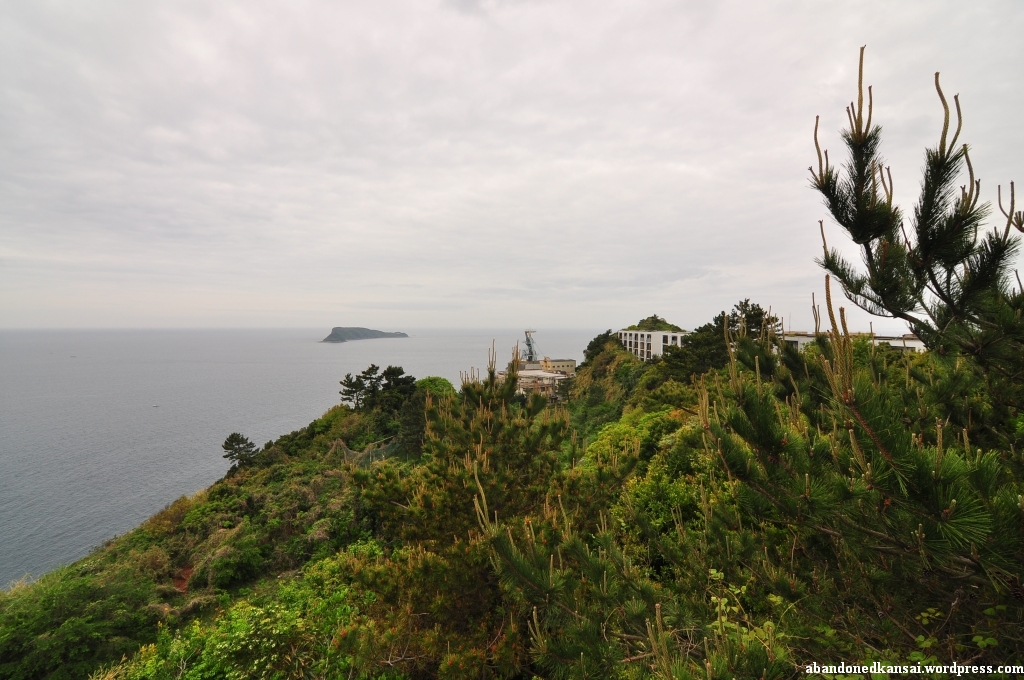
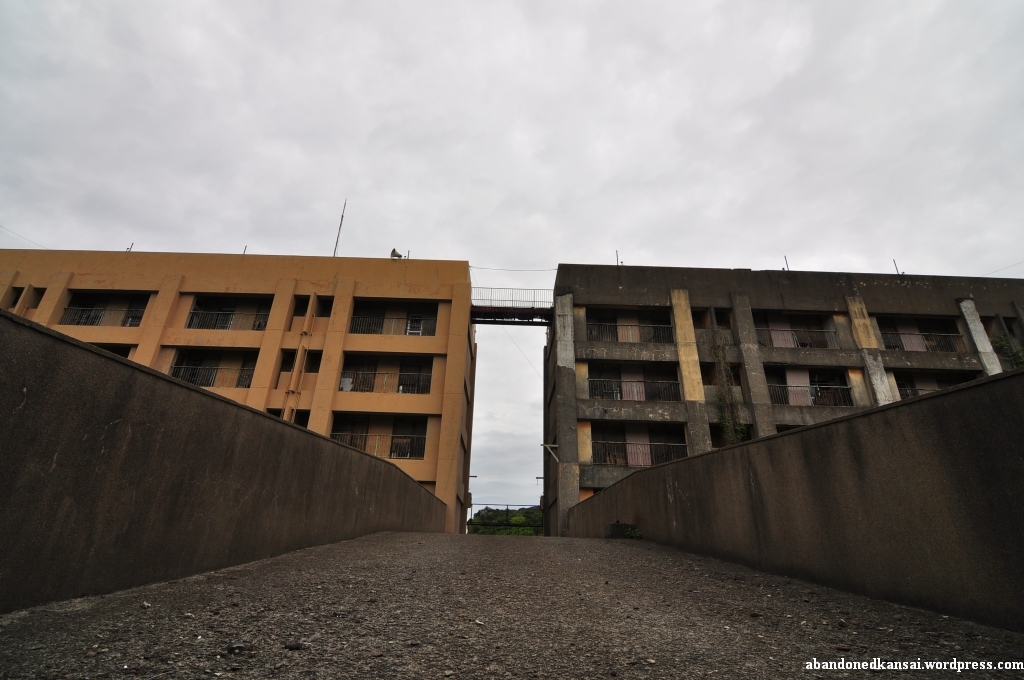
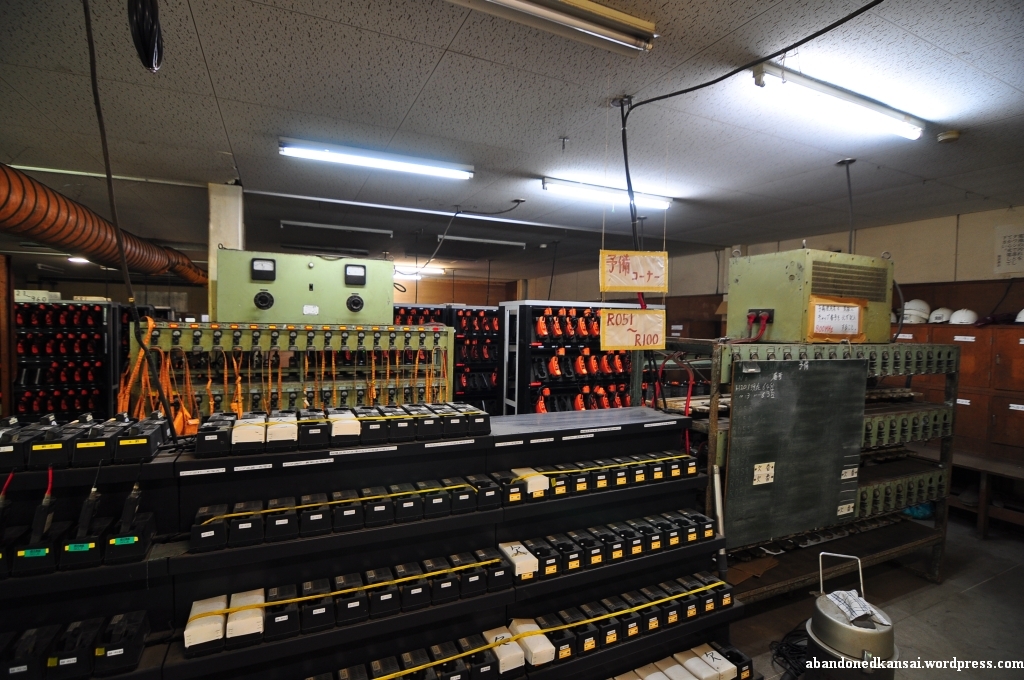
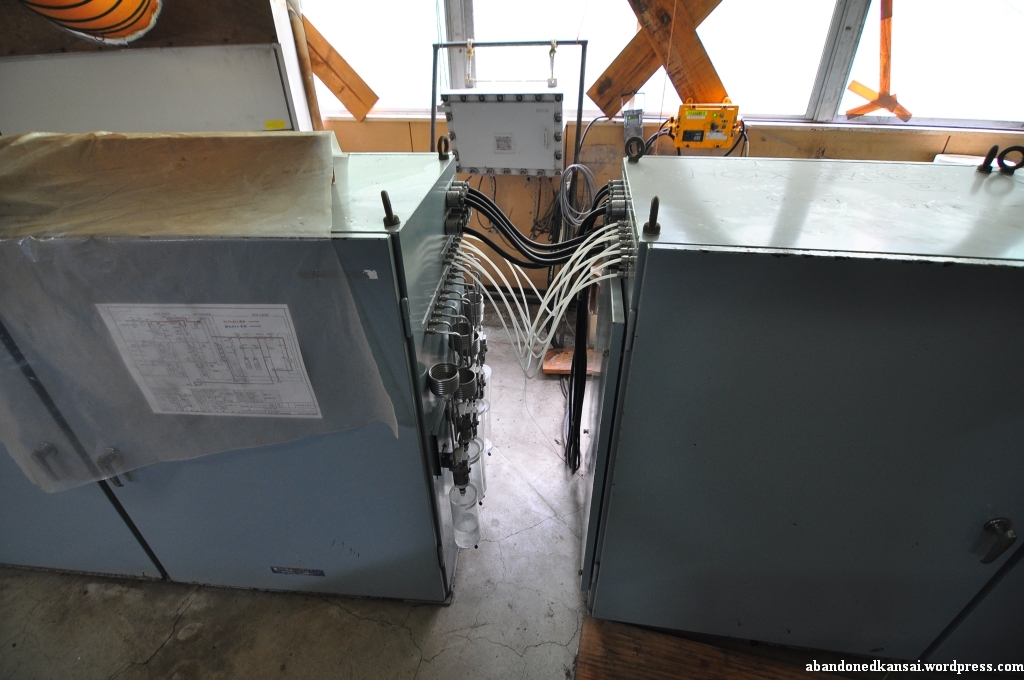
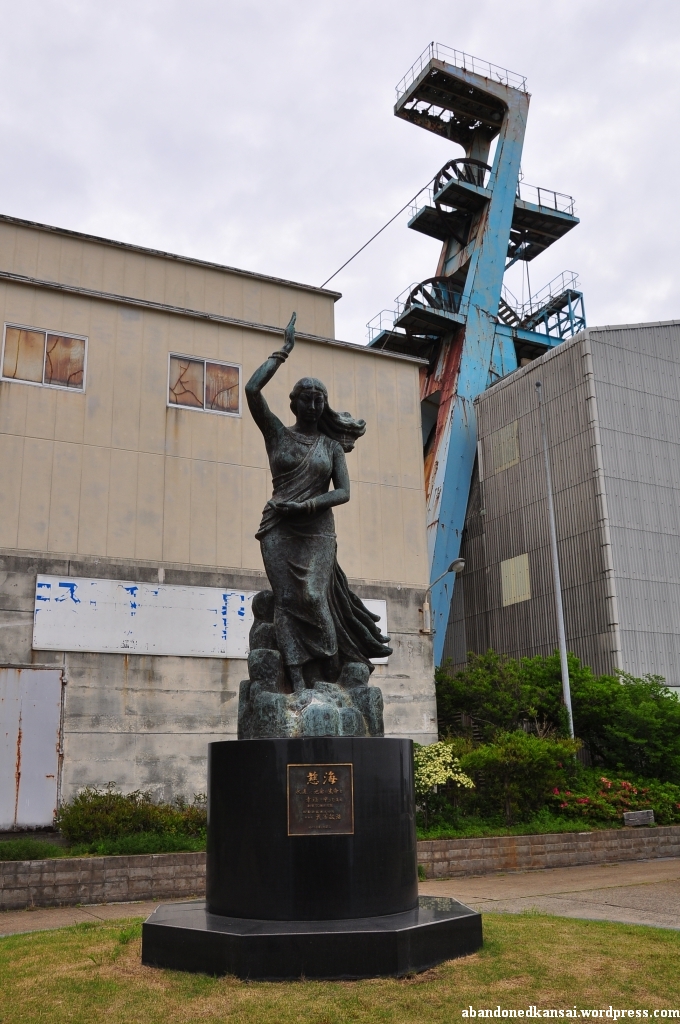
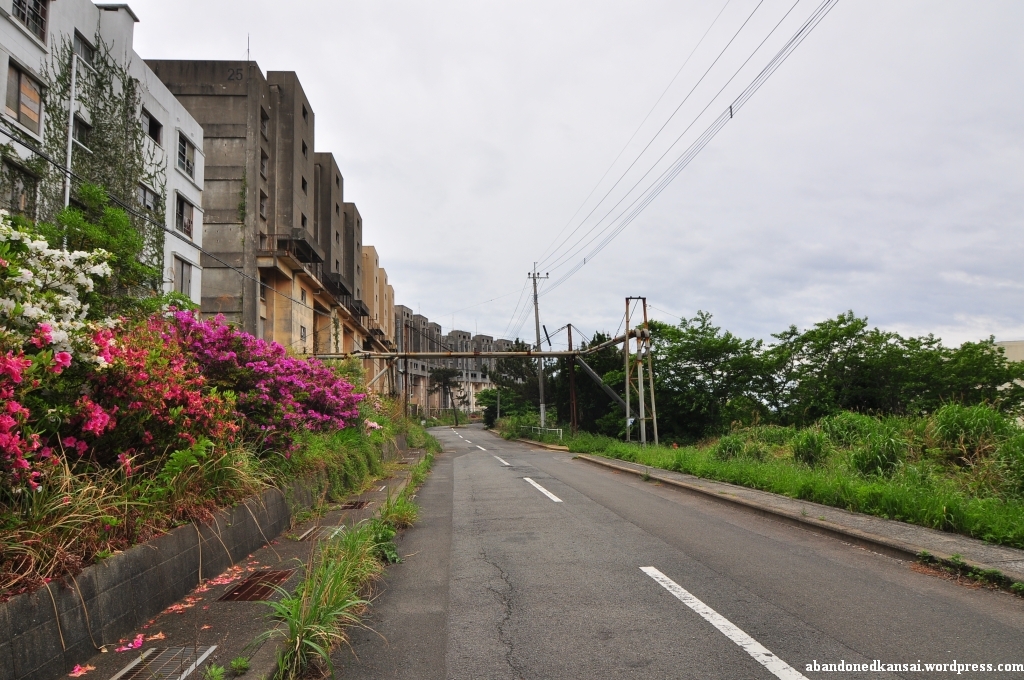
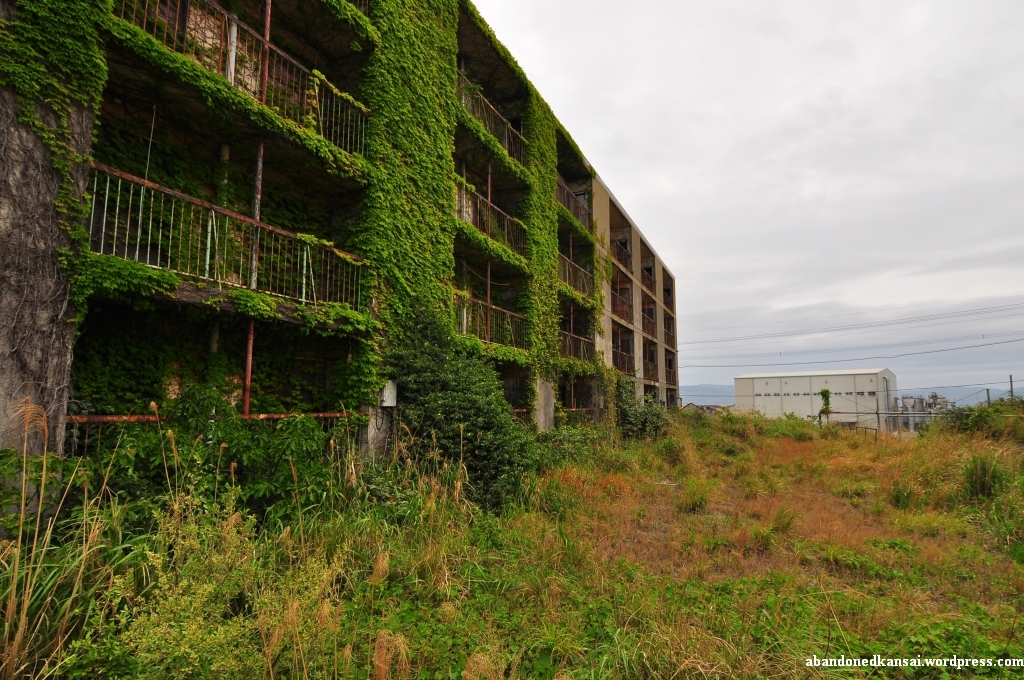
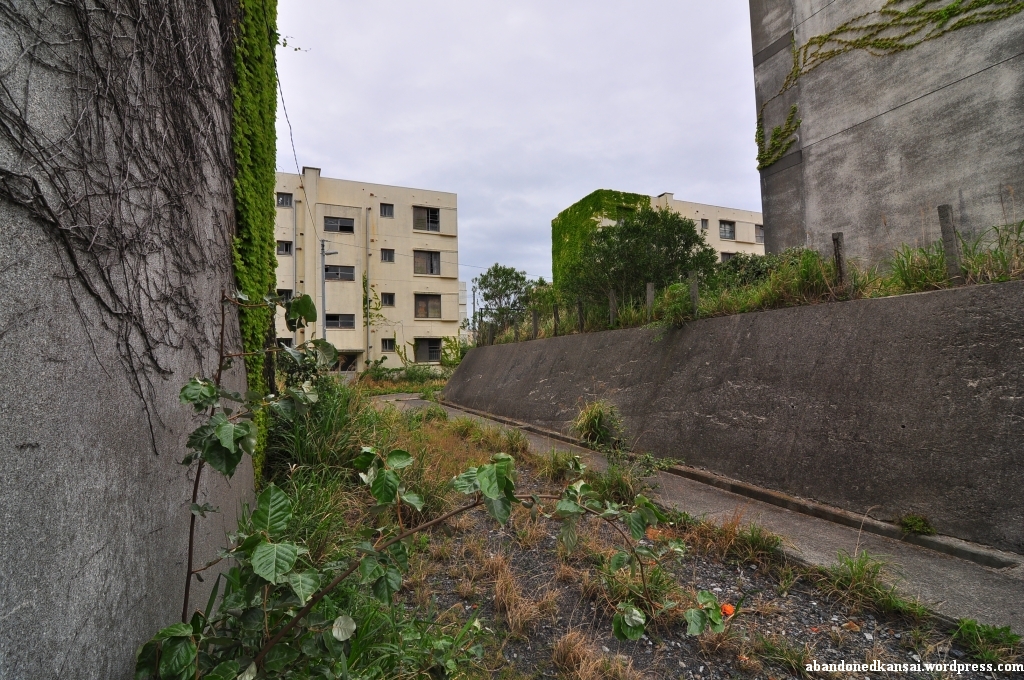
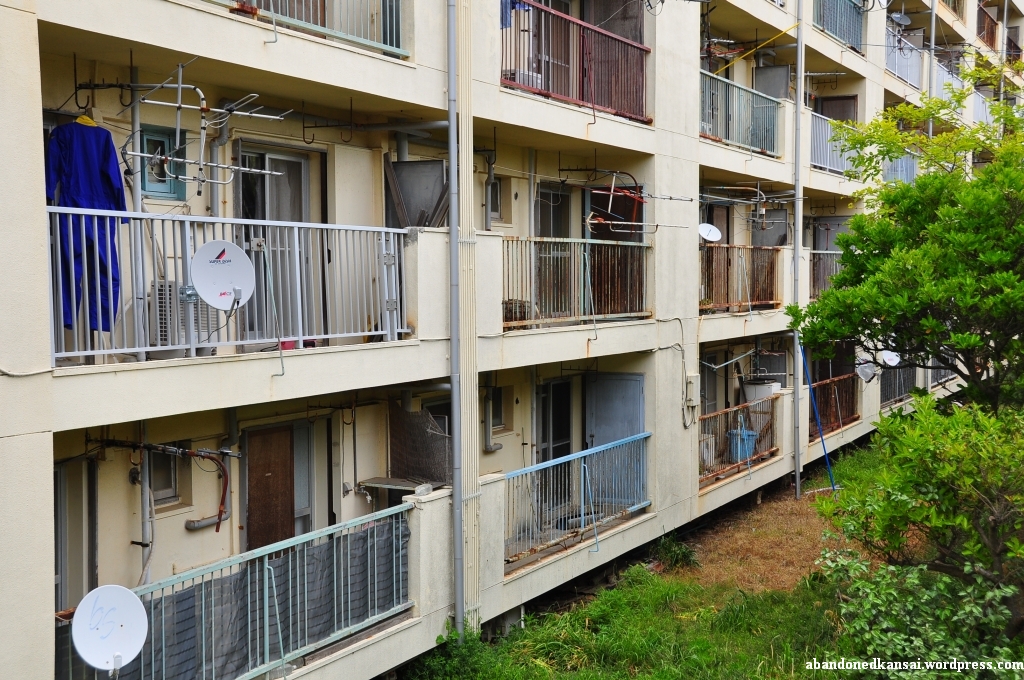
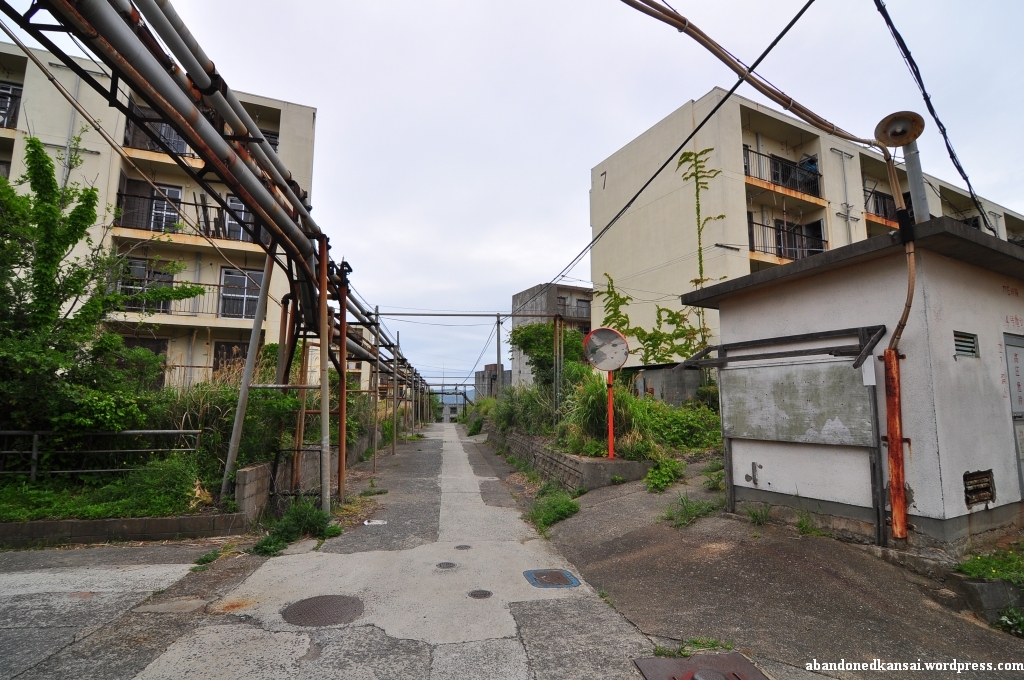
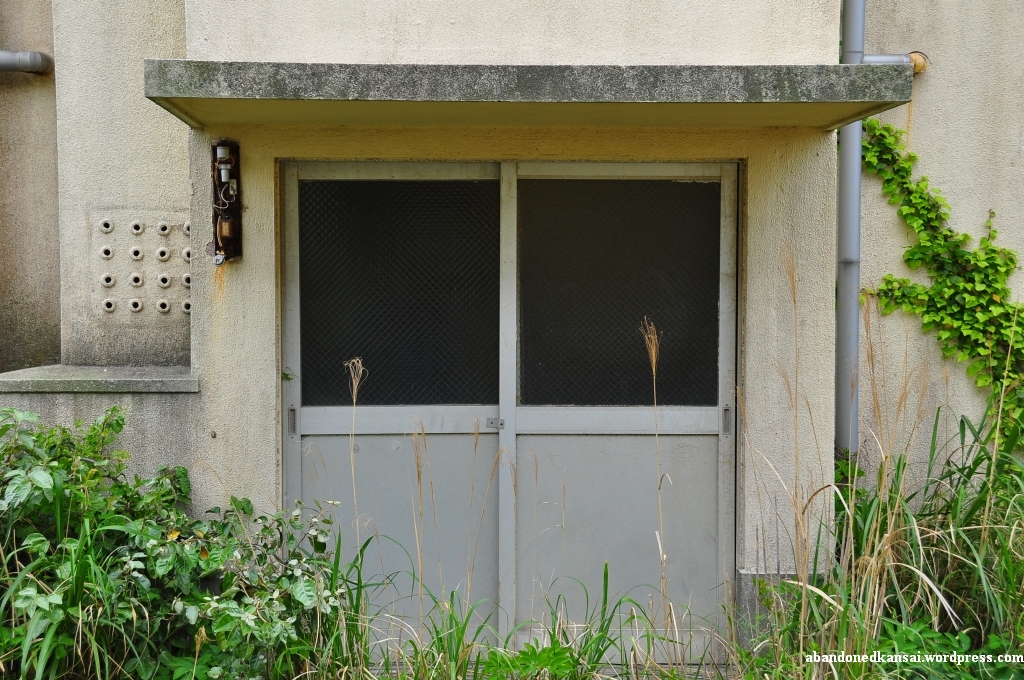
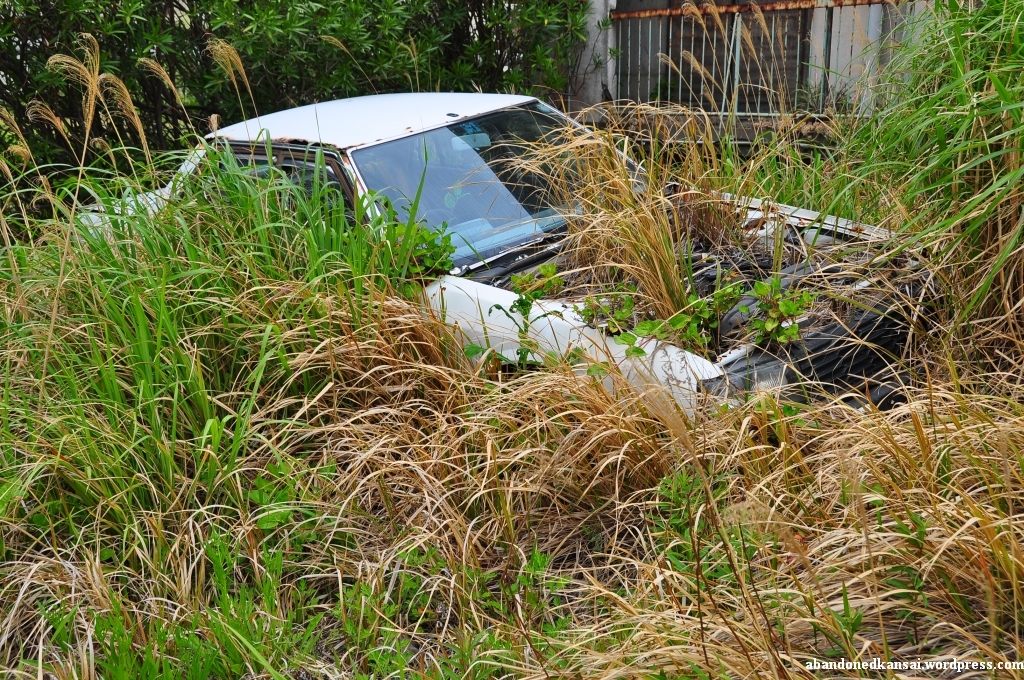
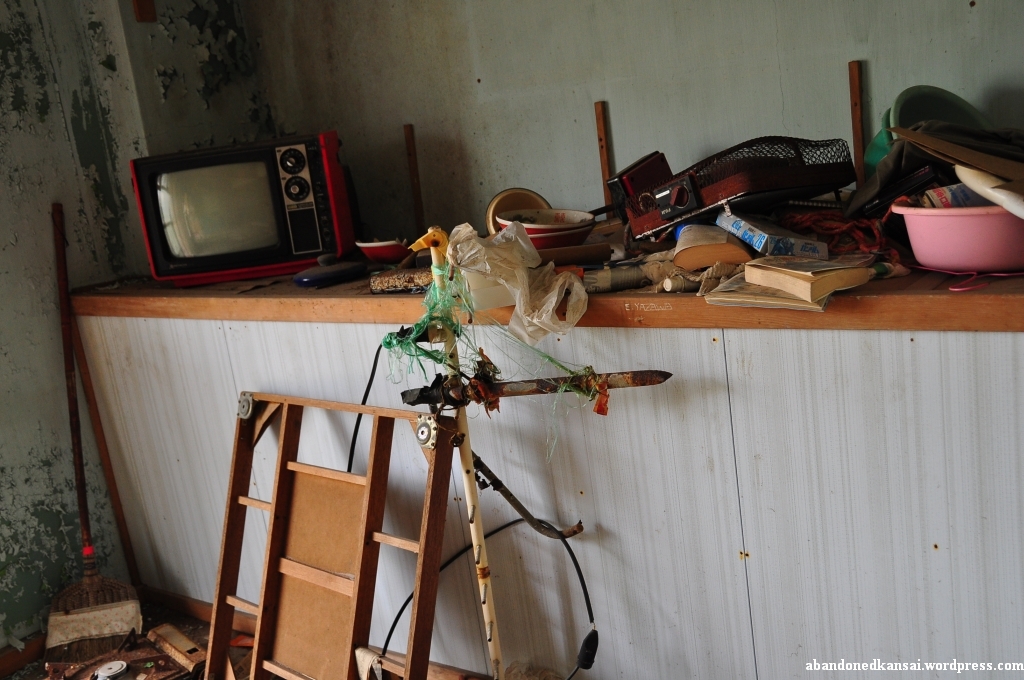
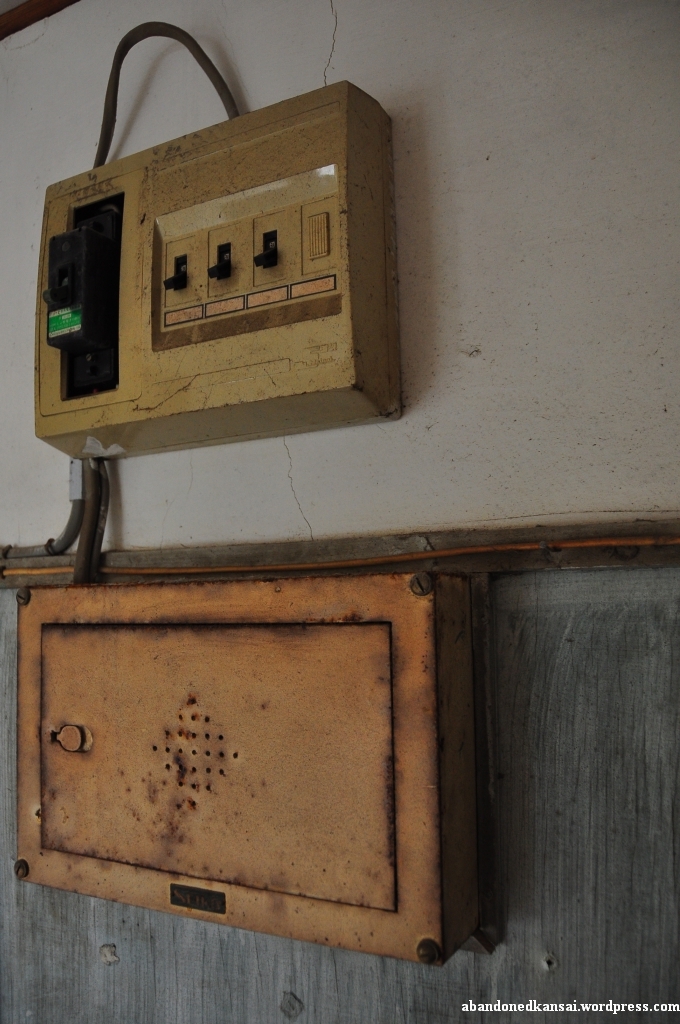
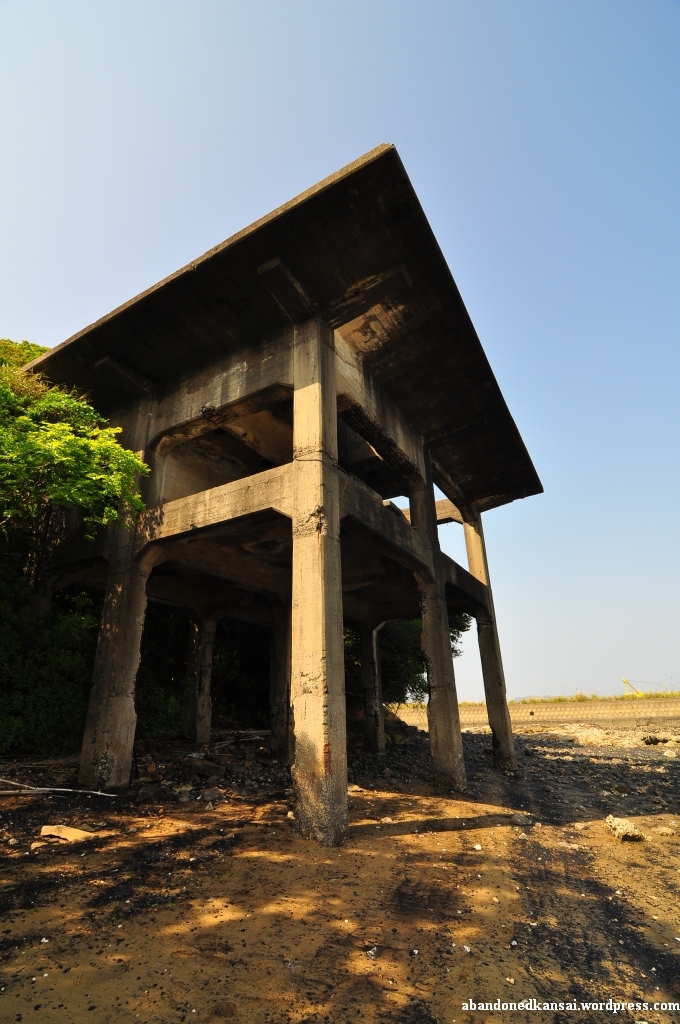
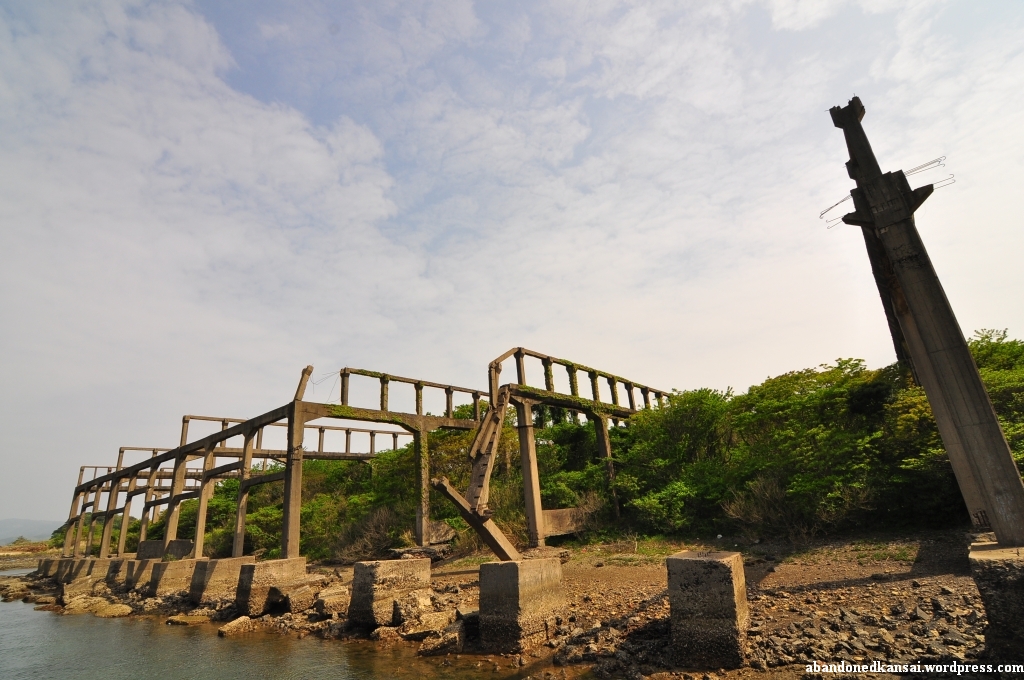
The White Stone Mine (also known as the White Limestone Mine, the Fujiwara Mine, and the Shiraishi Mine – I guess it can be read Shiroishi Mine, too…) is one of the most famous abandoned places / haikyo in Japan. For years people seemed to be quite vague about its location, but ever since GoogleMaps offers high-res satellite photos of the area pretty much everyone can confirm the whereabouts after a bit of research – when I first heard about the White Stone Mine 2 years ago all I saw was a greenish brown mush 4 hours away by train, plus another 70 to 80 minutes by foot. Not worth the hassle, especially since I had many 100% confirmed places rather close-by back then. And I was still an urbex noob after all. In autumn of 2010, almost a year after my discovery, Michael Gakuran told me that he wanted to revisit the mine with some friends of his and asked me if I wanted to tag along. Michael and I met twice before for some explorations and it was always great fun, so I didn’t hesitate a second to join the small group.
When I started me trip to the middle of nowhere the weather was great – sunny, 15 degrees Celsius, a nice autumn day. When I arrived at the train station to meet Michael and his friends, a couple of stations before the terminal stop, the weather was still nice. Then we drove towards the mountains and all of a sudden the weather turned. Cloudy… grey clouds… When we finally reached the mine at around 12.30 (traffic can be a trial of patience in Japan…) it started to drizzle – of course I didn’t bring an umbrella. But well, after almost 6 hours I was standing in front of the biggest mine I’ve ever been to and I was looking forward to finally take some photos.
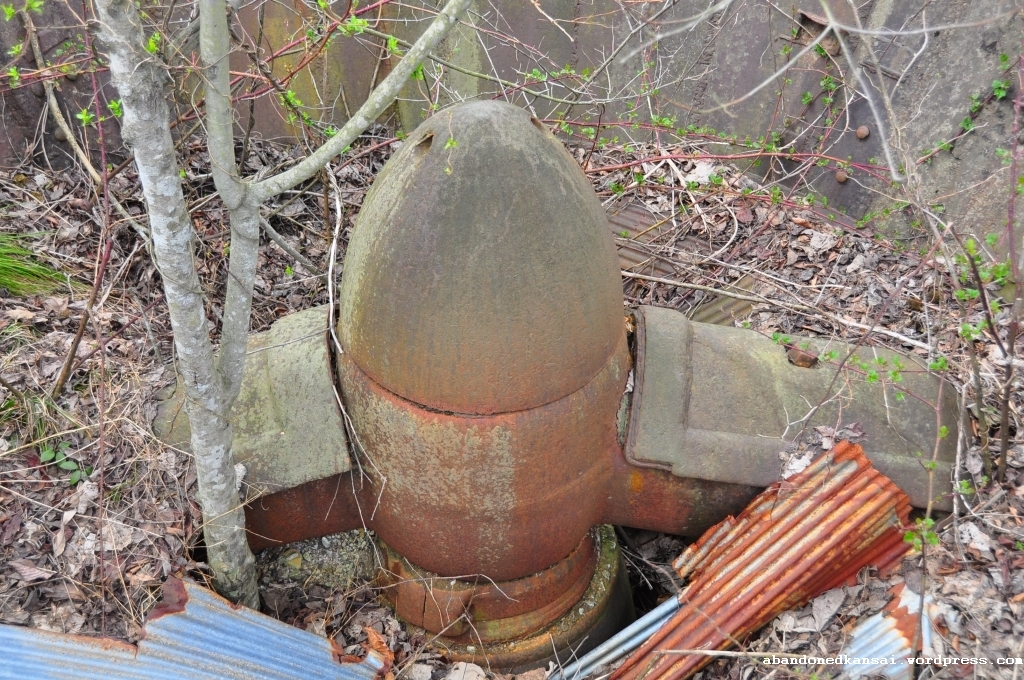
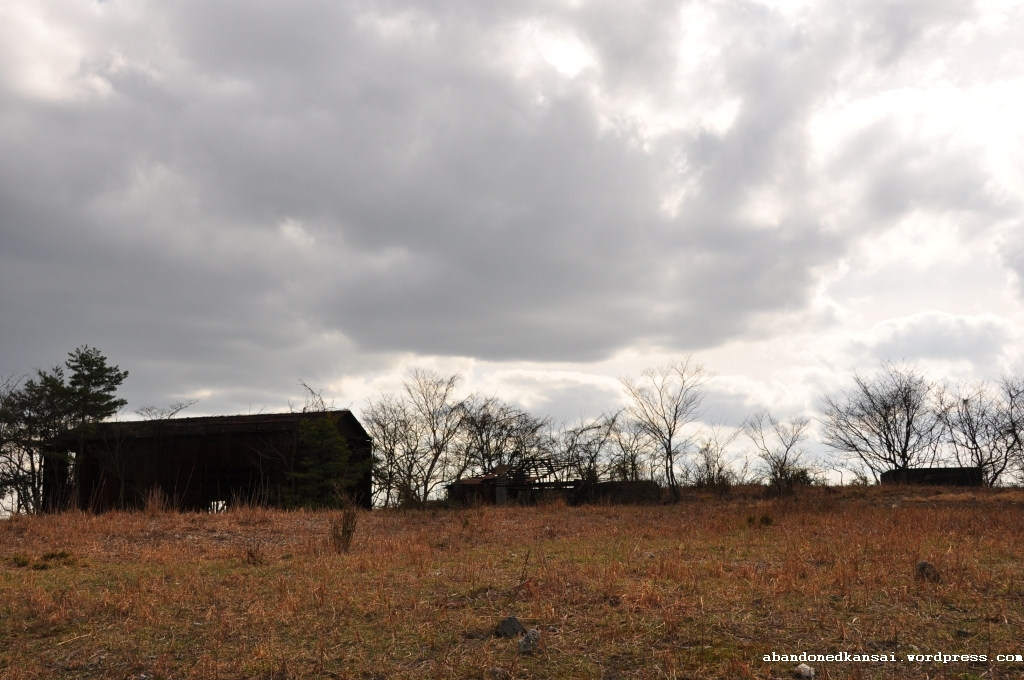
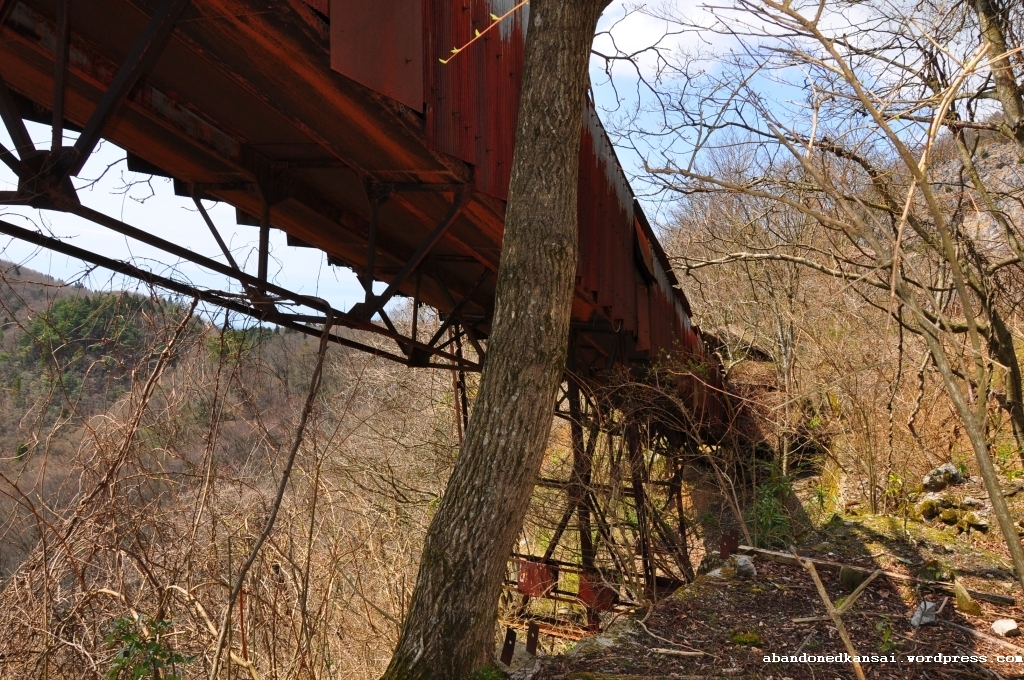
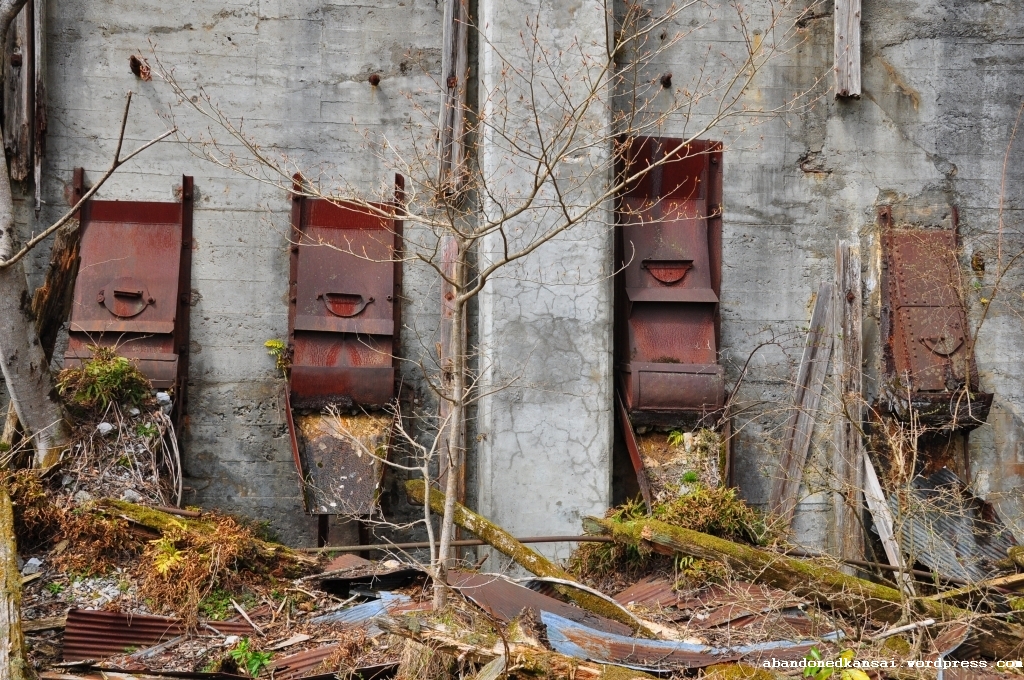
The White Stone Mine is gigantic! Close to three dozen buildings spread across an area of about 500 x 100 meters. Despite its size there is not much known about the Shiraishi Mine. It was founded by two brothers in 1921 and mining ended in 1969, supposedly after severe damage from a typhoon; the last office on the premises shut down in 1974. But the White Stone Mine was not only a limestone mine, it was also a huge chemical plant with facilities to extract calcium carbonate – a very important base substance for the paper industry. I guess in Japan calcium carbonate is mostly used for construction materials (especially cement), but also for the purification of iron in a blast furnace (at least when the White Stone Mine was still in business). Japan’s cement industry is actually huge – Japan still is the #5 consumer, #4 producer and #3 exporter of cement in the world. Japan’s coast line is famous for its sheer endless amount of concrete tripods and when you go hiking you can see surprisingly many concrete roads in the middle of nowhere – it seems like politics and the cement industry are heavily intertwined…
Exploring the White Stone Mine was exciting, sadly we were running out of time quickly. The sun goes down early in Japan, especially on a late October day in the mountains, even more so when it’s raining. Michael was a great experienced guide who was able to point out some of the best and the worst spots of the gigantic area quickly. An area I saw maybe 30% of. Although the mine was abandoned about 40 years ago it seems like there’s still somebody taking care of the premises: Michael pointed out differences to what he saw half a year prior (tarps covering wooden buildings here, new “Keep out!” signs there…) Although we kind of rushed through the lower area of the mine it already got dark by the time we reached the big silos up the slope. When we got back to the car it was already pitch-black outside and raining heavily. Nevertheless it was a great trip and totally worth the long train ride. A train ride I have to do again one day to explore the other 70% of that gorgeous mine… To be honest, I think it will take at least a full day to explore the whole area, maybe two or three days to shoot the whole mine properly. I doubt I’ll have time for that, but the White Stone Mine is definitely one of the few places I would really like to revisit! Even for (half) a day…
(If you don’t want to miss the latest article you can *follow Abandoned Kansai on Twitter* and *like this blog on Facebook* – and of course there is the*video channel on Youtube*…)
Archive for the ‘Mine’ Category
The White Stone Mine
Posted in Abandoned, Asia, Depot, Factory, Haikyo, Hiking, Japan, Kansai, Mie, Mine, Urbex, Video, Visited in 2010 on 2011/12/07| 2 Comments »
Haikyo HDR Photos
Posted in Abandoned, Amusement Park, Asia, Haikyo, HDR, House, Japan, Kansai, Kyushu, Mine, Nagasaki, Nara, Urbex, Visited in 2010, Visited in 2011 on 2011/12/03| 2 Comments »
Haikyo HDR photos or not… that was a big questions two years ago.
From the start I wanted to keep Abandoned Kansai simple. A blog instead of a homepage, photos directly out of the camera instead of massive post production – resize to 1024*680, URL in the lower right corner. That’s it. No cropping, not filters, no nothing. I actually shoot in JPG, for almost two years not even in the highest resolution. All the photos published on Abandoned Kansai are done that way. After some positive comments I started to take a few photos in NEF, just in case; maybe 2 or 3%, not one of them I ever opened. When I got a tripod, I started to use the bracket function of my D90 at maybe every fifth location – again just in case. After a while I played around with a freeware HDR program, just for fun. While I like the aesthetics of tone-mapped HDR photos I still consider them mostly a gimmick. Nevertheless I decided to publish some of my experiments – below are two samples, *for more haikyo HDR photos please click here*.
(Updates will be announced on *Twitter* and *Facebook*, not on the main page.)
Sakito Mine
Posted in Abandoned, Asia, Demolished, Factory, Haikyo, Japan, Kyushu, Map, Mine, Nagasaki, Urbex, Visited in 2011 on 2011/08/11| 4 Comments »
Sometimes I wish urban exploration was as simple as googling “awesome abandoned location nearby”, hopping on the train for ten minutes, taking two dozen nice photos and then spending the rest of the day at the beach sipping icecold beverages. Sadly it’s not. It’s never that simple and sometimes things go completely wrong.
Like me visiting the Sakito Mine in northern Kyushu. I was a bit nervous about the place right from the beginning since it’s in the highly unreliable “Nippon No Haikyo” book (by now at least half of the places in the damn thing must be gone…) and GoogleMaps, my trustworthy friend to confirm locations with high resolution satellite images, delivered rather blurry results until a couple of weeks ago. I found some homepages about the place on the internet, but most of the photos were rather old, like 2003-ish. The Sakito Mine was actually the location I skipped on *my first trip to Kyushu* to give *Gunkanjima* another try, so it was kind of a given thing I had to include it to my itinerary; the mine being rather close to Sasebo didn’t hurt either…
After my long and exhausting trip to *Ikeshima* I was eager to finally see the remains of the Sakito Mine, but things went from bad to worse by the hour. When I started my trip on a nice Thursday morning the weather forecast promised four days of hot and scorching Japanese sun, but Friday was already overcast. When I woke up early again the next morning the situation didn’t change, but I wasn’t worried a lot. Ikeshima was way too exciting to be worried again so soon!
I got to the ferry terminal on time only to find out that the boat to the island the Sakito Mine was on would leave with a delay of ten minutes. Usually that doesn’t really matter, but of course it made me miss my bus to the mine, so I had the choice of either waiting 80 minutes for the next bus or walking the eight kilometers. I kind of remembered the bus route, so I decided to walk – still not worried about the overcast weather. Big mistake. About halfways down the road, not a single person (or shop) in sight, it started to drizzle. Not very strongly, but in combination with the high humidity and a rather cold breeze not exactly comfortable. After a while it stopped and when I was finally dry it started again. Not real rain (which would have made me look for shelter), but drizzle. So I continued to walk along the coast, following the road up and down – getting wet and drying.
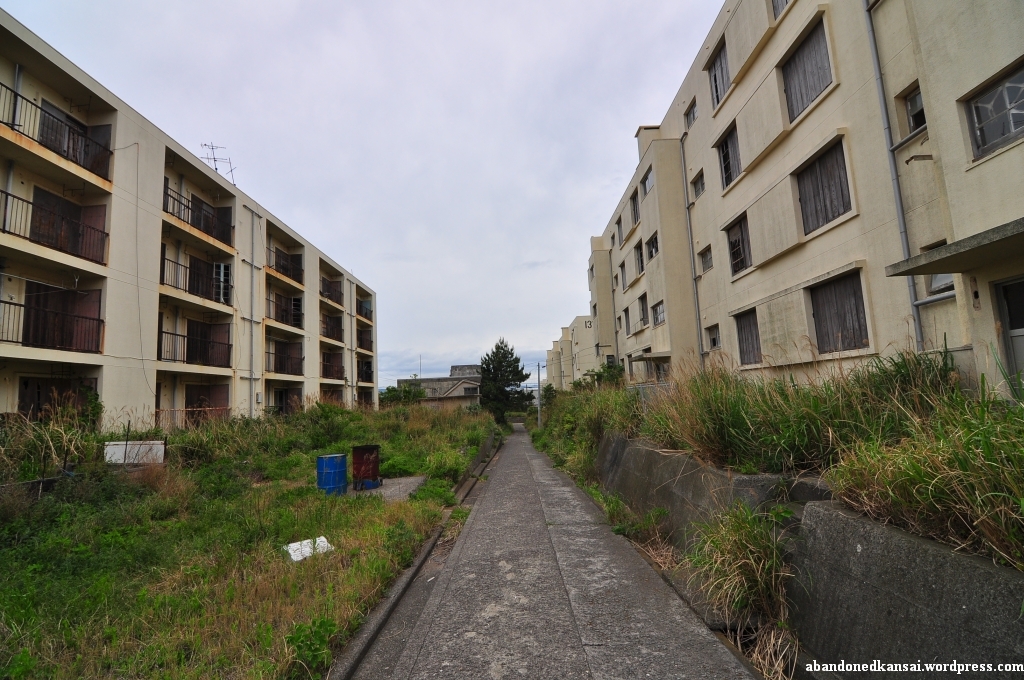
After about two hours I finally reached the area where I expected to find the leftovers of the Sakito Mine. I saw some of the remnants in the distance, overgrown and clearly blocked by (active) private property – so I looked for other remains, especially the apartment buildings I saw on Japanese photos and maps. When I found a chimney I remembered seeing on photos my spirits were finally lifted again. I saw more overgrown, out of reach concrete stuff (I wasn’t even able to identify it…), and then some apartment buildings appeared, reminding me of the ones I saw the day before on Ikeshima. I got closer and realized that they were once part of the mine, but that they have been fully renovated a couple of years ago – nevertheless they were almost completely abandoned, but still in good shape. Maybe one out of ten apartments still housed residents and the nearby playground wasn’t in good shape either – it wasn’t overgrown yet, but it didn’t look like a lot of children played there recently.
I knew that I was in the right area, and I also knew that most of the mine had been demolished right after it was shut down – but I was looking for some apartment buildings close to a huge park and restaurant. North of it actually, just down the road. When I reached the park the drizzle became rain and the light breeze became wind – it was raining almost horizontally. I fould shelter under some kind of resting stop, but I felt miserable: wet, tired, frustrated, unsure if there even were some remains left. The rain turned into drizzle again and I continued to follow the road. I found the fork to the north and of course it started to rain strongly again. This time I found shelter under a tree and after ten minutes I continued to follow the road down the mountain, only to find out that the blurry shadows on GoogleMaps were… blurry shadows – they surely weren’t the apartment buildings I was hoping for. Okay, wrong crossing… I followed the road to a different direction and to a street blocked by a massive metal blockade. That must have been it! I broke through the thick bushes next to it and followed the road for some dozen meters – only to find a flat area, big enough for some apartment blocks, but completely flattened; a wonderland for weeds. So I got back to the side road, saw another “Don’t trespass” sign and went down a rather steep road to a bay – again no signs of apartment buildings, although there should have been some of them visible according to the layout map I saw of the mine. I returned to the main road and followed it a bit more, not willing to give up. When I spotted the tip of another chimney I disappeared through the bushes again, this time to the south. I was able to take photos of some overgrown chimneys, but I couldn’t get closer as I didn’t trust the ground there – and the photos didn’t turn out well in front of the greyish sky. By now the weather was a draining mix of rain and… non-rain, leaving me contantly wet to some degree. Back to the main street I saw another possible location to the north, so I added some more scratches to my arms – again without getting the chance to take some photos.
At this point I gave up. I was tired, I was wet, I was dirty – and I’m sure I smelled pretty badly. At least the street I was walking along had some bus stops, so I didn’t have to walk all the way back to the harbor – but the next bus was coming in 30 minutes and the rain was getting worse again. I decided to go back to the shelter near the park down the road when a car passed me by, turned around and then again behind me. A few seconds later it stopped right next to me and an elderly couple asked me (in English!) where I wanted to go and if I needed a lift. Not that it happens very often, but usually I decline offers like that – not out of fear (it’s Japan…), but because I don’t wanna be a hassle for anybody. This time I gladly accepted. I was too tired and too disencouraged to worry about being a hassle. I just wanted to get out of the rain.
Being a foreigner in Japan you surprisingly often come across xenophobic people. Not at the typical tourist spots, but at shopping malls, off the beaten track roads and way too often in subway trains when they think you don’t understand Japanese at all. But the senior citizen couple I met in Kyushu were by far the nicest people I ever met in Japan, topping even the guy who helped Jordy and me at the *F# Elementary School* a couple of months earlier. They were from Beppu, but on vacation for Golden Week. Super nice people, and it was lovely to see them interact – they were exactly how you imagine kind older Japanese people to be; including the man talking (he did business internationally and therefore was used to speak English a bit) while his wife clearly understood more of what I said and translated for him what I said. They drove me all the way back to the harbor, a fact I’m still amazed about. I wasn’t trying to hitchhike and I must have looked miserably after walking in drizzle and rain without an umbrella for hours – but they turned around to offer me a ride, a male foreigner of all people. Not a lot of people would do that in Japan. Or anywhere else in the world. I doubt the two will ever read this article, but just in case: Thank you very much again, you lifted my spirits a lot and made my day a lot less miserable!
Back in Sasebo I was ready to go home one day earlier, but the staff at the little inn I stayed told me that the weather would be fine the next day. No more rain, so I stuck with my original plan. I took a shower and went to Base Street for a third time – and finally I got my “Special Size” burger, 15 cm in diameter, the best burger I ever had. Still as good as it was 14 months earlier and the perfect ending of a day full of ups and downs… (Well, lots of downs, but two insanely huge ups!)
Ikeshima – In The Afternoon
Posted in Abandoned, Animals, Asia, Haikyo, House, Japan, Kyushu, Map, Mine, Nagasaki, School, Transportation, Urbex, Video, Visited in 2011 on 2011/08/01| 2 Comments »
The best way of getting in contact with the locals on Ikeshima seems to be leaving camera equipment on the side of a street. It worked in front of the apartment complex and it worked again about an hour later just down the road next to the school. I left my belongings behind to take a video of the apartment buildings next to the abandoned baseball field. When I came back I saw a guy in his mid-30s and of course I said “Hi!”. His English was actually pretty good, so we started talking about the school and he told me that it still has 9 students – and as many teachers (although this number might include other staff like secretaries). I asked him if he was born on Ikeshima, but he wasn’t. A Kyushu native he studied in Nagasaki and then was sent to Ikeshima by his company – and he didn’t seem to be very happy about it.
For all of you not familiar with big Japanese corporations: In Japan you usually don’t apply for a specific position within a company after graduation (from senior high school or college), you apply at a company in general and then the company decides what to do with you. Commonly this includes intense training from several months to several years, depending on the company you got into. Of course your classes at university kind of give that education a direction, but it’s not unusual that somebody with a degree in mathematics or French literature ends up in marketing or HR – getting into a university in Japan tends to be a lot tougher than actually graduating, so companies tend to start from scratch after 3 years of drinking, sports and art clubs. And just because you are fluent in a second (or third!) language doesn’t mean the company makes proper use of that. (But if you are female and good looking chances are great you won’t have to clean ashtrays for two years – instead you most likely will become some supremo’s secretary.) The same applies for your place of work. Just because your company has its HQ in Tokyo doesn’t mean you won’t end up in a subsidiary somewhere remote. Like on an island off the coast of Nagasaki prefecture…
After the guy told me that he worked for a recycling company on Ikeshima we split since he had to get back to work – and I was eager to continue my exploration.
I was actually starting to run out of time, so I went back to the apartment building area I shot in the morning, this time more to the east. Some of the buildings had new plumbing outside and people were actually living there. At this point everybody I saw gave me a short nod, which I interpreted as a sign of “Yeah, you are welcome here.” – it felt really good. At an abandoned house the window next to the entrance door was broken, so I took a few pictures of the bike, cleaning tools and mailboxes that were still there. When I got back to the main street, route 216, I actually found a house that was open for visitors (I guess… it was unlocked, clean and had a sign in Japanese outside saying something about a room on the 4th floor). All the doors were locked and the staircase kinda smelled funny, but on the 4th floor I was indeed able to look inside an apartment that was arranged like a museum room.
Outside again I followed route 216 to finish my circumnavigation of Ikeshima. I passed by the noisy Ikeshima Urban Mine Co., Ltd. and several apartment buildings before reaching the old loading plant. On the southern side of the harbor entrance was a scrapyard where a single worker was moving rusty stuff around. In continued following route 216, taking some pictures here and there, before I reached the apartments at the harbor again, where my explorations started about seven and a half hours earlier, making my visit to Ikeshima one of the longest photo shoots I ever did. But it wasn’t over yet…
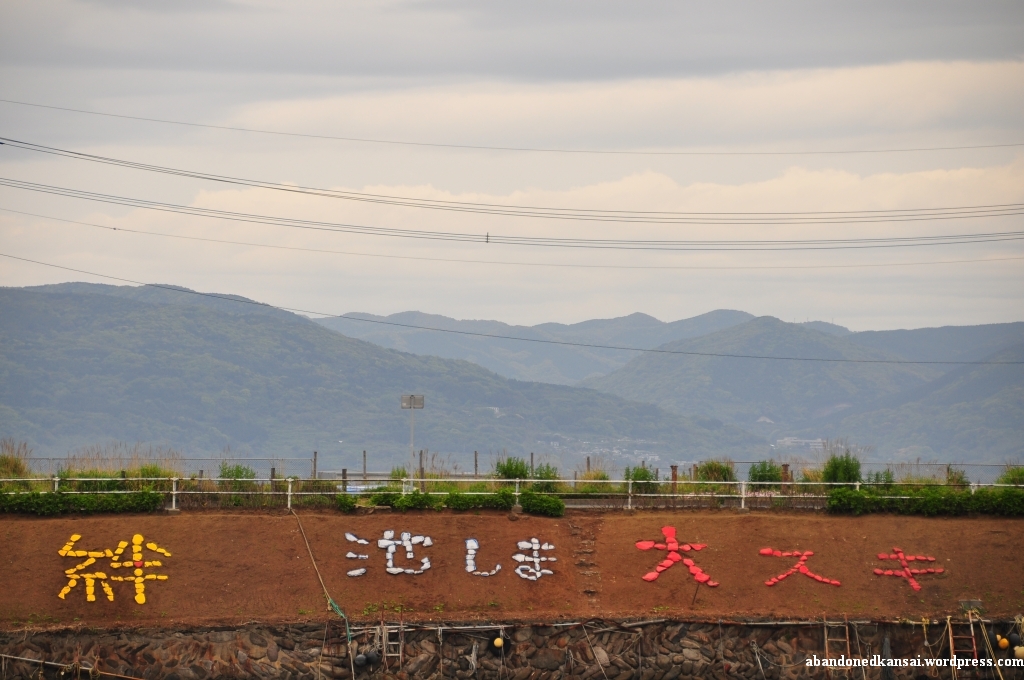
Figuring out the ferry / boat schedule when planning the trip wasn’t exactly easy since all the information was in Japanese and not really clear. I got some help from friends who are Japanese natives and confirmed the schedule with the hotel staff in Sasebo – everybody told me the boat (it actually was a boat, not a ferry, also in the morning – sorry for that!) would leave at 4.09 p.m., so when my ride entered the harbor at around 3.55 p.m. I continued to take some photos and videos. But something felt wrong watching the activities on the boat, so I decided to hurry to the terminal – and of course the boat left right when I arrived, shortly after 4 p.m.; thank you very much, guys! The people arriving on Ikeshima of course saw what happened and told me that there was another boat leaving for Sasebo today, but they couldn’t tell me when. So I waited and thought about the day – my rocky start and how I didn’t even enter any of the huge industrial ruins at the harbor. 10 minutes passed, 20 minutes… Then some senior citizens arrived at the terminal and I felt a bit of relief – I wasn’t the only one wanting to leave Ikeshima. At around 4.35 p.m. the boat to Sasebo arrived. As I took a seat while the ship left the harbor I had a last look at the huge characters in the sand of the breakwater and I couldn’t have agreed more: „絆 池しま 大スキ“ – „Kizuna Ikeshima daisuki“ – „I / We like Ikeshima a lot“
(Since the inhabitants of Ikeshima consider their island a tourist attraction I added it to the *Map Of Demolished Places And Tourist Spots* and created *a new map just for Ikeshima*. If you don’t want to miss the latest postings you can *follow Abandoned Kansai on Twitter* and *like this blog on Facebook* – and of course there is the *video channel on Youtube*…)
Ikeshima – At Noon
Posted in Abandoned, Asia, Demolished, Factory, Haikyo, House, Japan, Kyushu, Map, Mine, Nagasaki, Urbex, Video, Visited in 2011 on 2011/07/21| 2 Comments »
After I left the apartment building and shot the first video I was looking for a new approach to Ikeshima. So I left the area with three-storey buildings and headed towards a bunch of row bungalows with little garden. Some of them were still inhabited and it seemed like the people living there took care of their former neighbors’ gardens. I continued to walk uphill and reached a small park with an observation platform – the highest point of the island. Although the stairs leading up were really rusty and maybe should have been off-limits I went up and had a look around. What a nice view!
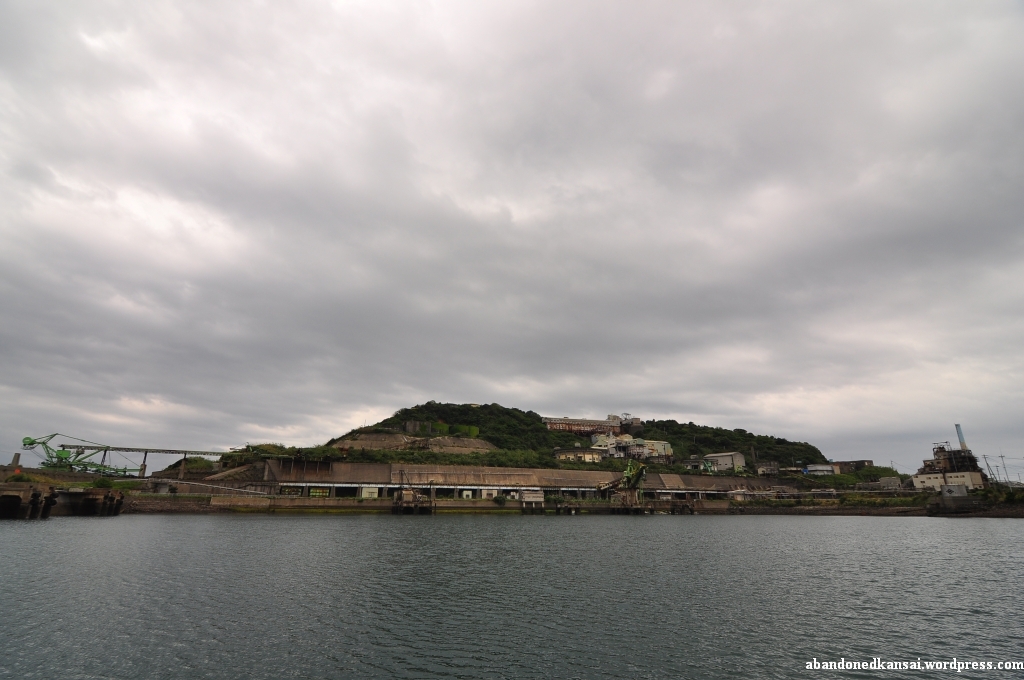
A building with a headframe caught my eye, so I carefully went down again and walked toward the coop – which is sometimes mistaken for a hospital due to some “Safety first” signs. On my way I came across what turned out to be one of the most fascinating building complex I’ve ever seen, totally reminding me of my trip to *Chernobyl and Pripyat*. Its foundation was on the lower end of a slope, with bridges connecting the upper floors with the street I was walking along. A really fascinating construction, even more beautiful from its base as I found out later. But for now the headframe was more important, so I walked down some concrete steps with a severely damaged handrail to the backside of the coop. The rear entrance was actually open, but I refrained from entering. A sign displayed some kind of opening hours of the Mitsui Matsushima Resources Company (三井松島リソーシス株式会社), the subsidiary of Mitsui Matsushima responsible for taking care of the trainee program that ended in 2007. The front entrance had the same or a similar sign. So I took some photos from the outside of the building and walked up the street towards the apartment complex.
To get a better grasp of the whole complex I put down my tripod (including the camera) and my backpack on the side of the road and headed for the bus stop right in front of it. There was some kind of roundabout and the moment I wasn’t visible from the street a small pickup truck (actually a kei truck or Japanese mini truck) passed by and stopped next to my belongings. “Great… trouble!”, I thought and made myself visible. Two guys in their 50s or 60s got out of the truck and when I came closer they addressed me in a mix of Japanese and English – and I answered the same way.
What I was doing here?
Just taking some photos…
Interested in history?
Yep, a lot!
From America?
No, Germany.
At this point their faces lit up a bit and we switched from 75% Japanese to 75% English. Then they asked me if I wanted to see their offices. Wait, what? Yeah, they were working at the coop building with the headframe, they told me. So I picked up my belongings and jumped on the truck bed. Knowing that there wouldn’t be any oncoming traffic the driver sped up quite a bit and hurried down the mountain, but somehow I managed to take some slightly blurry photos without falling off the truck.
The front door of the building was also unlocked and the guys guided me to the second floor. There were several offices and the entrance to the mine shaft. Lighting was horrible and the guided tour was so quick that most pictures turned out to be blurry. I snatched some shots of the room where the mobile radios as well as other equipment were stored (and charged), then we went through some more offices and by the time I realized what I was doing I was outside again and said goodbye to my guide – I barely spent ten minutes inside the coop, but I was able to take some rare photos. What a great opportunity!
Since the guys gave me a one way ride I walked up the street again and back to the apartment complex. This time I put down my belongings where they weren’t visible from the street and started to take pictures and videos. The weather seemed to brighten up a bit and just looking at the amazing apartment complex put a smile on my face. Such a great building, such a nice atmosphere… I felt at ease and my worries about living up to the uniqueness of Ikeshima were gone. Now that I’m writing these lines I’m again not sure if the pictures and videos can really put you there, but looking at the material for the first time in a couple weeks makes me daydream a bit. As far as I could see all entrances were boarded up or even bricked up, there was quite a bit of barbed wire and the previously mentioned bridges looked very dilapidated from below – but I didn’t even have the urge to enter the complex. It was just nice being there. With the apartment complex, more apartment buildings further down the slope, and an overgrown children’s playground on an additional level between the two housing sections. A couple of minutes before I continued my exploration of Ikeshima the van parked in front of the bus stop continued its tour after quite a long break (the driver must have taken a rest in the little hut next to it) and I felt good. Really good.
Half of my time on Ikeshima was over and I was curious *what the afternoon would bring* – it didn’t disappoint…
(Since the inhabitants of Ikeshima consider their island a tourist attraction I added it to the *Map Of Demolished Places And Tourist Spots* and created *a new map just for Ikeshima*. If you don’t want to miss the latest postings you can *follow Abandoned Kansai on Twitter* and *like this blog on Facebook* – and of course there is the *video channel on Youtube*…)
Ikeshima – In The Morning
Posted in Abandoned, Asia, Demolished, Factory, Haikyo, House, Japan, Kyushu, Map, Mine, Nagasaki, Power Station, Transportation, Urbex, Video, Visited in 2011 on 2011/07/13| 5 Comments »
„絆 池しま 大スキ“ – „Kizuna Ikeshima daisuki“ – „I / We like Ikeshima a lot“
That’s what’s written with huge, colorful characters in the sand of the breakwater at the Ikeshima harbor. A last pledge of allegiance from about 300 remaining inhabitants of an island once the home to several thousand people – miners and their families, shop owners, restaurateurs, …
When I arrived on Ikeshima I can’t say I agreed with the bold statement at the harbor. The weather changed from sunny to overcast with a serious risk of rain and the humidity rose to levels you usually experience during the long, excruciating Japanese summers. Though the previous day was pretty long, exploring the *Imari Kawaminami Shipyard* and the *Mukaiyama Mine*, I had to get up again before 6 a.m. to make it to the ferry on time and my landlubber slugabed stomach wasn’t a big fan of the early morning breakfast, although the ferry ride itself was really enjoyable.
In addition to that I felt a pressure right from the beginning I hadn’t felt in years. Back in my days as a journalist in Germany (10+ years ago) I was writing about all kinds of topics. Most of the stuff was trivial and routine, but once in a while I dealt with a project close to my heart – and in those cases of course I wanted to rise to the occasion and write an article that did justice to the topic.
So while I tried to calm down my slightly upset stomach I was worried if I would be able to take pictures that represent Ikeshima properly, if I could come up with interesting stories to write about – if I was able to experience this island that is on its way to become an urbex legend; some people already call it Gunkanjima’s little brother (although Ikeshima is way bigger…). And since Ikeshima is in way better shape and way easier to access than *Gunkanjima* it is actually on its way to become more popular amongst urban explorers – a trend that seems to be appreciated and supported by the remaining inhabitants of the island, at least to some degree.
The first thing I saw getting off the ferry were two maps of the Ikeshima right at the pier – one being an aerial shot of the island from 1982, highlighting 9 points of interest; the other being a typically Japanese manga tourist map with a hiking guide, pointing out restrooms, bus stops, areas off-limit and buildings you shouldn’t miss. Sadly (for for the locals) Ikeshima wasn’t a tourist attraction (yet), at least not during Golden Week 2011: I was not only the sole foreigner on board, I was also the only person carrying photography equipment. The other half a dozen passengers were elderly Japanese guys looking for a relaxing day of fishing.
I took a few quick photos at the harbor to calm my stomach, get used to the humidity and make sure that the settings of my camera were how they should be – and somehow I got the feeling that the few locals I met weren’t really happy about it. As a rather big, tall non-Asian foreigner in Japan I’m used to being stared at, but maybe I was overly sensitive because of the uncomfortable situation I felt I was in, so I didn’t like Ikeshima a lot at that point…
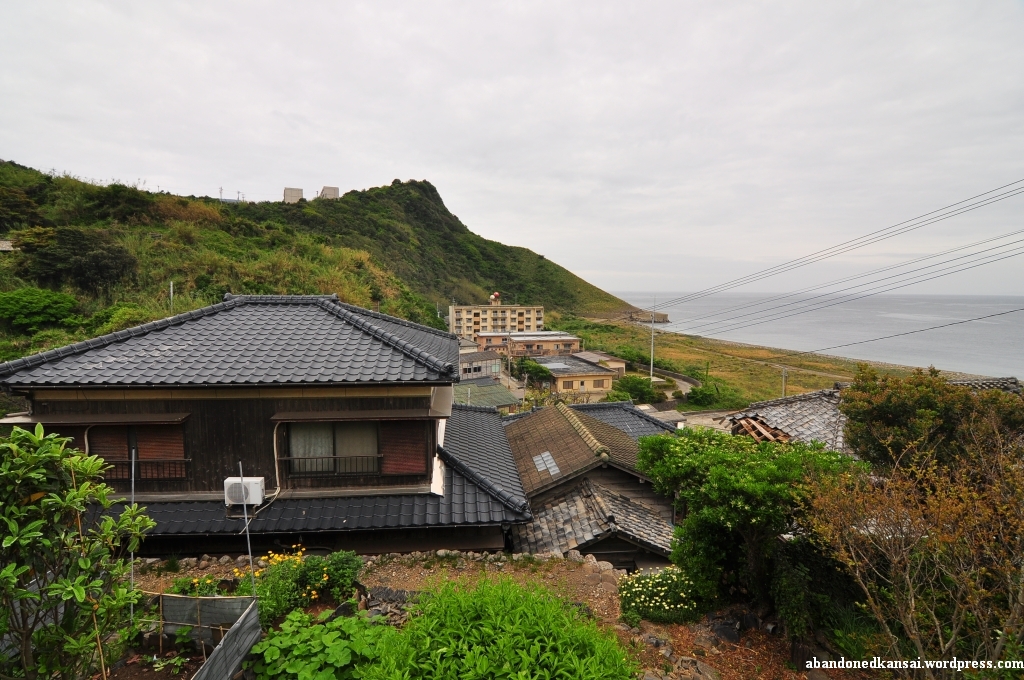
I passed by four of five people trying to get one of the omnipresent cats from an electricity pole and left the harbor area to follow the street uphill. Down to the right was a little settlement, several dozen houses, once the homes of the non-mining population on Ikeshima. I saw some big apartment buildings on the top of the hill, so I decided to follow the street and maybe have a look down there later.
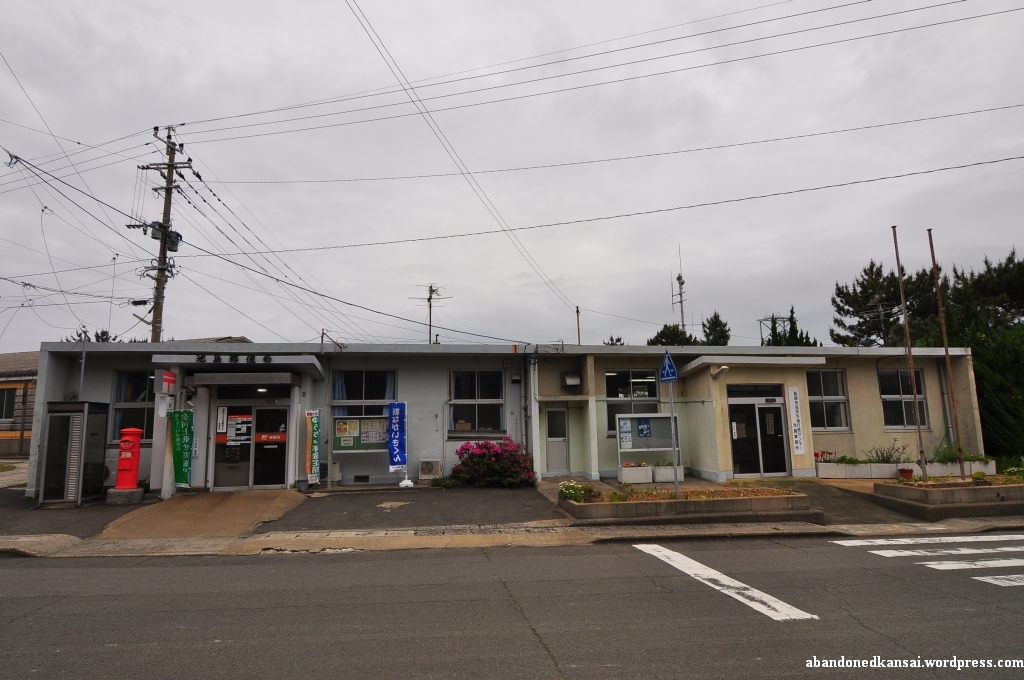
Reaching the top I passed by the post office which, to my surprise, actually had one or two customers while I was looking around that area. Although nowadays most people seemed to live down by the harbor the uphill apartment section was surprisingly busy. Within the first hour I spent there I saw maybe two dozen pedestrians and at least half a dozen cars, including the local shuttle bus which seemed to pass by me every 5 minutes – and in the background a recycling company caused quite some noise.
At that point I felt like a kid in a candy store – extremely excited, looking at dozens of opportunities, each one of them usually worth a day-trip on its own, and no idea where to start. But this was Ikeshima, Little Gunkanjima, so I had to take some spectacular shots! Just how? Especially since all buildings seemed to be boarded up, the doors bolted or welded. And the industrial areas were all off-limits, “No Trespassing!” signs everywhere in Japanese (kanji) and Bahasa Indonesia (Latin alphabet and katakana). Still under irrational pressure I felt like I had to make a move – and when I saw an open balcony door I jumped the railing and got inside. Finally what I was looking for? Not at all! I felt more uncomfortable than ever. I’m into urban exploration for the unique esthetics, for the quiet time in the middle of nowhere, for interesting angles and the amazing atmosphere really spectacular places provide. I’m not doing it for the thrill of being in buildings I’m not supposed to be. Quite the opposite in fact, I really dislike that aspect. So I took a few quick shots while hearing cars and voices everywhere outside – I could have gotten to the staircase and maybe to other apartments from there, but instead I decided to leave the building. Seconds later another car passed by, followed by two senior citizens, greeting me with a smile. Maybe it was about time to change my approach. So I put down my tripod and my backpack at one of the crossroads, grabbed my video camera and started to tape a walking tour of the housing area, wondering what the people I met were still doing on Ikeshima.
It was not until World War II that coal was discovered under Ikeshima. At that time about 300 people lived on the island while the huge corporate conglomerate (keiretsu, 系列) Mitsui Matsushima (三井松島) started to buy large parts. The development of the coal deposits started in 1952 and in 1959 mining finally began – the last colliery to open in Japan. In 1970 about 8,000 people lived on the island (although one source throws out a number as high as 20,000…), but like in all Western industrialized countries coal became less and less important; oil was the new coal. In summer of 1999, long after most Japanese coal mines were closed for good, a technology transfer program was proposed and as if it was a sign that the days of the Ikeshima Coal Mine (池島炭鉱) were numbered a fire broke out in the mine in February of 2000. On November 28th of 2001 the last shift left the Ikeshima Coal Mine, about 3000 people living on the island at that time – making Ikeshima the second to last Japanese coal mine to be closed. On April 18th of 2002 the technology transfer program started, training students from Indonesia about mining – hence the multi-language warning signs all over the island. The trainee program ran out by the end of March 2007, a year after 77 miners won a lawsuit against Mitsui Matsushima; suing them for negligence, related to coal worker’s pneumoconiosis. Around that time the number of people living on Ikeshima dropped to about 300 – as it was before coal was discovered. (The name Ikeshima means “pond island”, because until the 1950s a large pond was the main feature of the island – it was turned into the harbor by Mitsui Matsushima… Please *click here* to be taken to a Japanese homepage with before and after shots next to each other.)
Did the two old ladies know any of those 77 miners? Were they maybe even sons or husbands? And why were they still living on Ikeshima? I never found out. But I talked to several other people on the island later that day – so don’t miss *part 2* and *part 3* of my Ikeshima exploration…
(Since the inhabitants of Ikeshima consider their island a tourist attraction I added it to the *Map Of Demolished Places And Tourist Spots* and created *a new map just for Ikeshima*. If you don’t want to miss the latest postings you can *follow Abandoned Kansai on Twitter* and *like this blog on Facebook* – and of course there is the *video channel on Youtube*…)
Mukaiyama Mine (向山炭鉱)
Posted in Abandoned, Asia, Demolished, Haikyo, Japan, Kyushu, Mine, Nagasaki, Transportation, Urbex, Video, Visited in 2011 on 2011/06/30| 2 Comments »
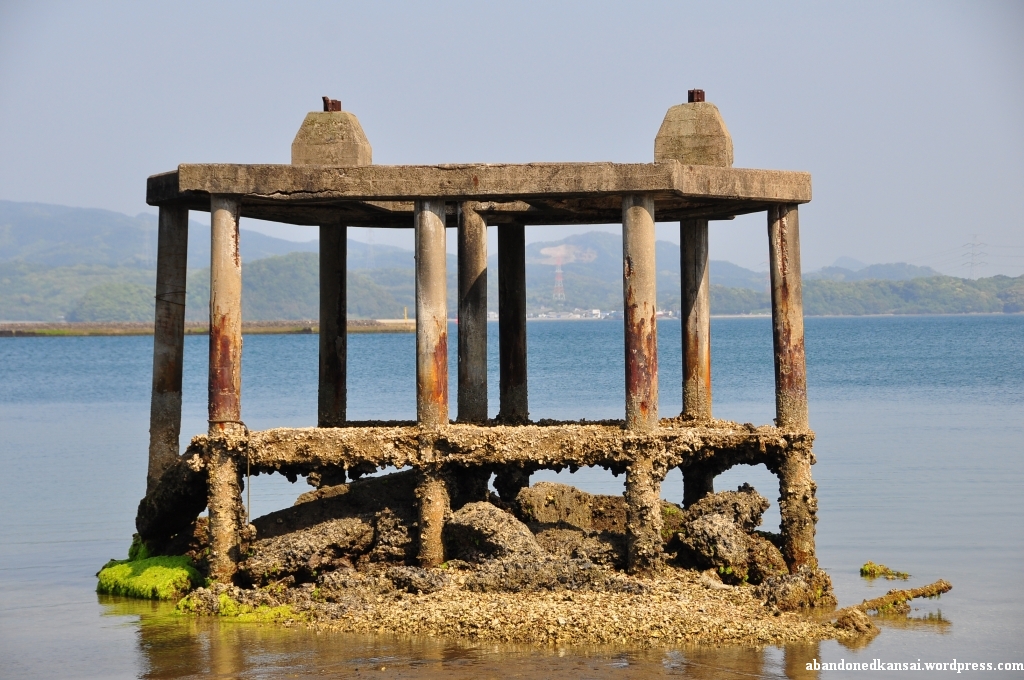
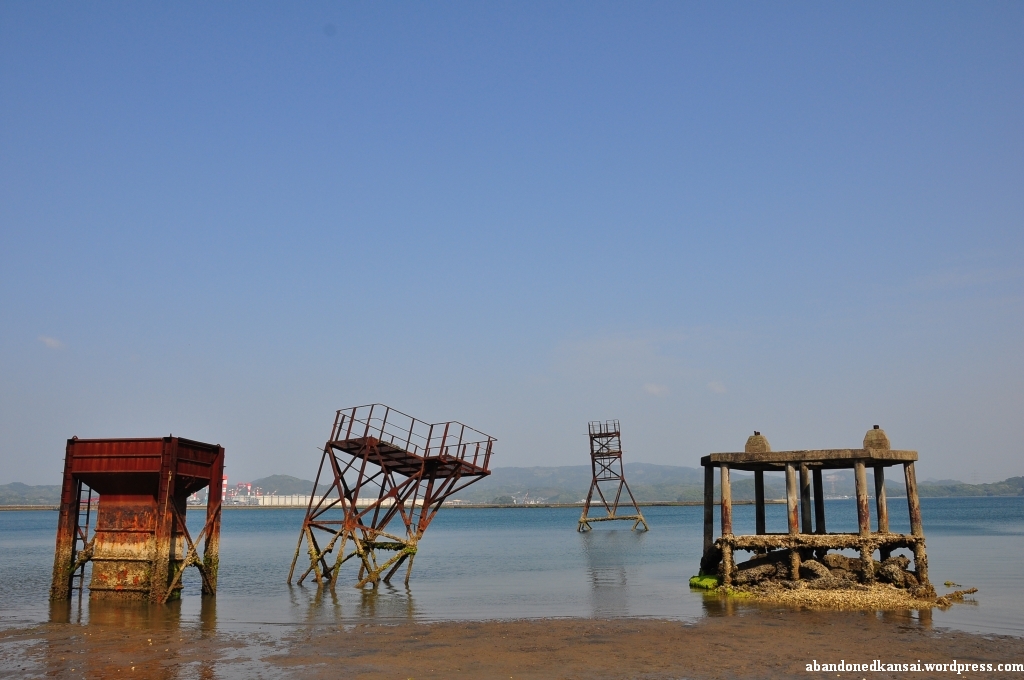
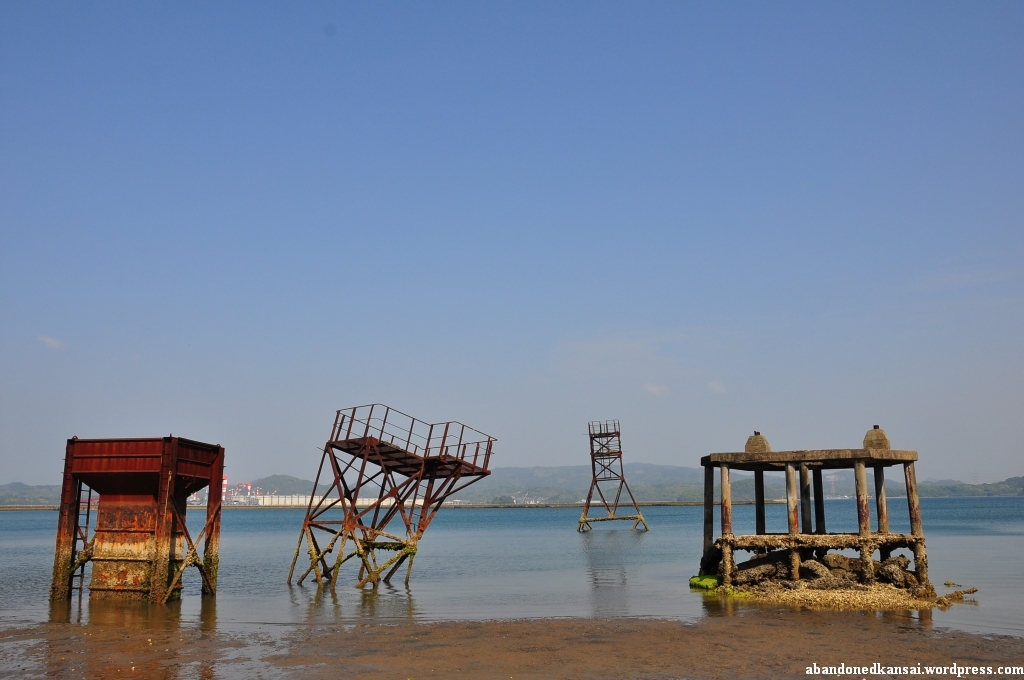
Just a couple of hundred meters down the road from the *Imari Kawaminami Shipyard* is another haikyo – visible from both the street and the train tracks the place is nevertheless often overlooked. After we finished shooting the seaside part of the shipyard Yasu was heading back to the main building while Ben and I headed to the remains I saw a couple of times on Japanese blogs without even exactly knowing what to expect – the pictures I saw were labeled “向山炭鉱“ (Mukaiyama Tankou, tankou being the Japanese word for mine), but a mine so close to the sea? Could that be?
When Ben and I arrived on the other waterfront we saw three elderly Japanese people skimming through the part of the beach that was now accessible thanks to the low tide. Since Ben’s Japanese was way better than mine he talked to them and found out that they were looking for Asari (also known as Manila clam or Venerupis philippinarum), a popular ingredient in miso soup. Like the fisherman from the dam the clam searchers were quite chatty and told us a bit about the abandoned place we were visiting. As I assumed the concrete and rusty steel remains weren’t part of a mine, but part of the sea terminal of the mine – the mine itself was somewhere in the nearby mountains and demolished centuries ago. Speaking of mountains: I didn’t realize it until Ben told me what he heard from our new Japanese friends, but the surrounding hills near the beach weren’t natural. They were also remains of the sea terminal, in this case the parts of the deliveries from the mine that didn’t get onto the ships as there weren’t coal, but worthless rocks not even good enough to be used for construction. Like everywhere else in the world that stuff was piled to create spoil-tips (or botayama, ボタ山, in Japanese).
There is actually not a lot of general information I found about the Mukaiyama Mine. Coal extraction at the place started during the Meiji era under different names and different owners. Until 1909 23 miners mined about 750 tons of coal, in 1910 15 miners brought 298 tons to daylight. 1911 brought a new owner with headquarters in Matsuura and new deposits were found. In 1912 the mine was renamed once more to now known “Mukaiyama Mine” and 100 miners were employed to mine about 800 tons of coal a year. At the same time 15 houses were constructed for the miners – if you want to see pictures from that era please have a *look here*, but please be aware that the site is in Japanese; nevertheless I didn’t want to steal their photos to put them up here… In 1937 the mine was taken over by Kawaminami Industries Ltd. who increased production again in 1939 – probably to support their *soon to be demolished shipyard*. In 1946 the Mukaiyama Colliery Labor Union was formed, raising the daily wage from 35 to 50 Yen and prohibiting underground work of women and minors. (Minors, not miners!)
In 1951, when the *Kawaminami Shipyard* was struggling, a railroad connection to the sea was built. Although new coal deposits were developed in 1957 and 1960 the Mukaiyama Mine was shut down in 1963 – and with it the sea terminal. Okay, so much for the history lesson…
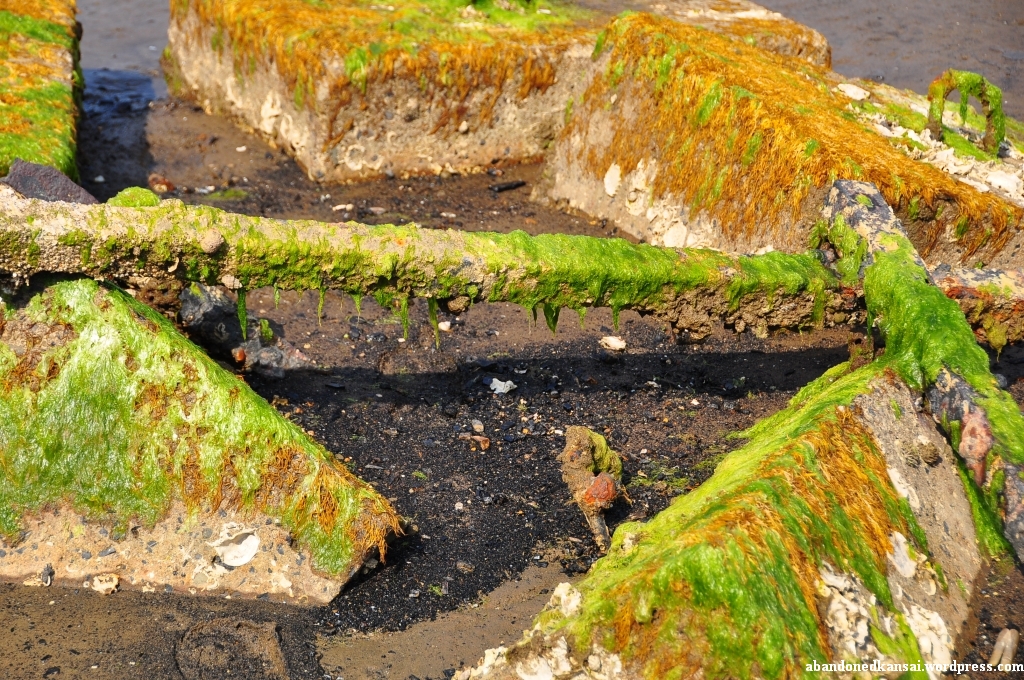
As I mentioned several times before: I was extremely lucky that the tide was low during my visit. On most pictures I saw on the internet the beach was covered with water, the remains of the sea terminal barely sticking out of the sea. Not during my visit. Thanks to that the remnants were almost completely visible, exposing their more decayed parts with vibrant colors.
(*Like Abandoned Kansai on Facebook* if you don’t want to miss the latest articles and exclusive content – and subscribe to the *video channel on Youtube* to receive a message right after a new video is online…)
Back From The Island(s) – Again…
Posted in Abandoned, Amusement Park, Demolished, Factory, Haikyo, House, Japan, Kyushu, Mine, Nagasaki, Shipyard, Transportation, Urbex, Visited in 2011 on 2011/06/02| 4 Comments »
About 15 months ago I went on my first multi-day urban exploration trip: 3 days to Kyushu with my buddy Enric. A trip with lots of up and downs, visiting some amazing locations – Gunkanjima, the Katashima Suicide Training School and the winding tower of the Shime Coal Mine, now known to some people as the Anti-Zombie Fortress. But March was kinda cold, last year as well as this year. So when Golden Week came up (late April / early May) and my company forced me to take two of my paid vacation days to install a new AC I took the lemon and made lemonade – it was time to go back to Kyushu!
Since Enric left Japan and returned to Spain a couple of months ago, I went on my own this time. Remembering the best burger I’ve ever had I set up my base in Sasebo after a long day of exploring an abandoned shipyard and the abandoned leftovers of the dock of a mine close to it. The next day I explored one of the most amazing places I’ve ever been to: an almost abandoned island, once the home of several thousand people – and as exciting as that day was as disappointing was the next one when I walked through drizzle for hours without an umbrella to look for remains of a mine and its workers’ housing-estate; but they were gone forever – as research after my return confirmed… Luckily the weather turned around on my last day, so I was able to visit an abandoned amusement park on my way back home. Thank heavens for sunscreen, because without it the harsh Kyushu sun would have burned me crisp within half an hour…
Exploring all day I spent my three evenings in Sasebo at Base Street to enjoy some burgers. While the regular sized ones are good I’ll definitely recommend the so-called “Special Size” – this 15 centimeters in diameter monster is a classic Sasebo style burger that will fill you up with pure deliciousness; if you ever wanna spend 1100 Yen (yep, that’s 9.50 Euros or 13.60 Dollars!) on a single burger without even considering regretting it then this is the place to go! I just hope I’ll find more abandoned places close to Sasebo so I can have a good reason to go back there once more…
(Oh, and greetings to the tourist office in the Sasebo! It sells a variety of souvenirs, but not the awesome huge plush hamburgers that fill half of their display window. To get one of those you have to ride a bus for about half an hour to get to a small store at a shopping mall in the middle of nowhere. And since I had to wait 45 minutes for the next bus they lost a customer who would have happily paid 200 Yen more to avoid the hassle of a 2.5 hour long round trip to get a cute present for his even cuter niece. A no-win situation… and pretty much the worst sales strategy ever!)
Taga Mine
Posted in Abandoned, Asia, Haikyo, Japan, Kansai, Mine, Shiga, Urbex, Visited in 2010 on 2010/07/07| 6 Comments »
I felt a bit like John Rambo at the beginning of First Blood when I was walking through the mountainous countryside of Shiga prefecture, kilometers away from the next train station or bus stop. But only in that way that I was completely out of place, expecting some xenophobic misanthropic cop to pick me up and drive me to the city limits (where another xenophobic misanthropic cop would pick me up to bring me to the other end of the city limits, where… this repeats until I would have been back to Osaka) – luckily the only police car I saw ignored me…
This April day started with an uncomfortable decision: Being halfway through a cold with general weariness and a serious cough I felt a little bit under the weather, I had no plans for weekend and my haikyo buddy was busy – on the other hand I just spent 5 days in an artifically lit office and this was the last sunny day before another period of rain. The choice was between staying at home and watching a sunny day passing by or going for a haikyo all by myself (which I enjoy less and less since I’m more and more aware of the dangers involved) or going on a hike – which I did the weekend before.
I decided to do a hybrid of the last two options. A while ago I marked a spot on my very personal haikyo map that I labeled “Taga Mine”. The problem with that was, that the name given by the (online) map creators was completely different and that there was another Taga Mine that is still active till this very day (and usually only active mines are marked on online maps like GoogleMaps and Mapfan anyways). So in the end I was hoping for a nice hike to find out if the marked spot is the active or the abandoned Taga Mine; or if there was anything at all. The only hint I had about the abandoned Taga Mine was a Japanese video on Youtube, which could have been mislabelled – so my trip was a long shot.
A few minutes after I left the country road to walk up the mountain I found the T crossing where I should walk to the right. Sadly it turned out to be a dead end with heavy machinery. So I gave up hope finding the abandoned Taga Mine and continued to the left, expecting either to find an active mine or nothing at all, switching into hiking mode. After a while I found another T crossing and I continued to the right. I kept walking and I reached an unimposing forest road to the right again. I don’t know why, but I left the paved road and followed it for a while, dragging my coughing self up that mountain – you can’t imagine the joy I felt when I reached an open rusty gate in front of a stone pit!
The excitement calmed down quickly when all I found was a rusty shack and a concrete room at one side of the slope – was this really the Taga Mine or just something else? Getting closer I saw that there was a machine in the ground that was obviously used to crush the rocks from the stone pit. At that moment I heard some twigs cracking. Would there be security at a remote and long abandoned place like that? I coughed a bit louder than usual, but I got no response. Maybe a fellow haikyoist? Well, I minded my own business taking pictures and after I was finished I heard the cracking twigs again, so I went towards the direction where I assumed the sound was coming from – that’s when I found the main remains of the mine with a huge conveyor belt and several other buildings, built very closely to the steep slope. I heard some noises as if somebody was walking across corrugated iron and when I got closer and looked down I saw lots of it lying on the ground in front of the mine – by nobody was there.
Not really feeling well thanks to the mix of fatigue and adrenaline rush I slid down the mountain a little bit to reach the main part of the mine. The ground was covered with metal, concrete and tons of leaves from many, many autumns. It was hard to tell if the next step would be solid earth or something else. I got closer to the buildings and then something happened that really, really scared me: I heard two animals fighting on the ground behind me, must have been pretty close to where I stood, maybe 100 meters away. At that point I looked at the ground and realized that there was wild boar feces everywhere all across the mine. I’m not a wildlife expert, but I know what a boar sounds like – and I know that you don’t want to run into one in spring, especially when exploring a seriously rotten mine at a steep slope all by yourself.
I continued my explorations, but I could feel how both my fatigue and the adrenaline rush got stronger by the minute, trying to make my way through the concrete and metal structure while taking pictures, expecting a wild angry animal at any second. To be honest, at that point I didn’t enjoy the haikyo at all and I only realized when I was looking at the pictures from the safety of my home how great of a location the Taga Mine was (and still is until it collapses – which I guess will be relatively soon…). That’s when I also found out that it took me a whopping 2 hours to take pictures, although the place wasn’t that big and I felt like I was hurrying; man, was I in a hurry…
Looking back at the adventure I consider it one of the dumbest and at the same time most exciting things I’ve ever done. Yes, I worked hard all week, I wanted to take some haikyo pictures (for the first time in three weeks) and I wanted to be in nature enjoying this beautiful spring day – but being sick and exploring a hillside rotten mine in the middle of nowhere on your own is pretty much the urban exploration definition of stupidity. If you are ever happy enough to find the abandoned Taga Mine and not the active one make sure that the weather conditions are perfect, that your gear is top notch and that you have at least one person at your side. As much as I like my pictures of the Taga Mine… this is the first place I’ve been to that I consider a deathtrap and I highly recommend to stay away from it if you don’t know exactly what you are doing. I definitely learned my lesson from that trip!
Gunkanjima
Posted in Abandoned, Asia, Factory, Haikyo, Japan, Kyushu, Mine, Nagasaki, Urbex, Video, Visited in 2010 on 2010/05/07| 15 Comments »
To be honest: I’m still a bit starstruck and have no idea how to begin this little blog entry. So many things have been written about Gunkanjima’s history – some short, some long, so it would be kind of foolish to be Captain Obvious and write another lengthy article about Gunkanjima’s past, although the ex-student of Japanese History in me is very tempted…
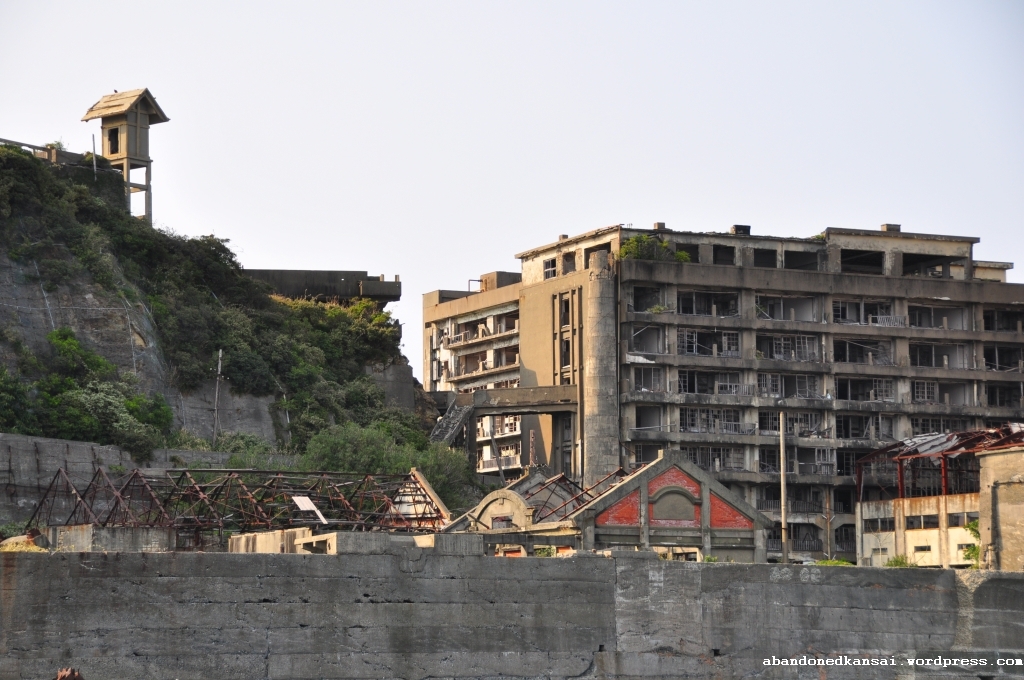
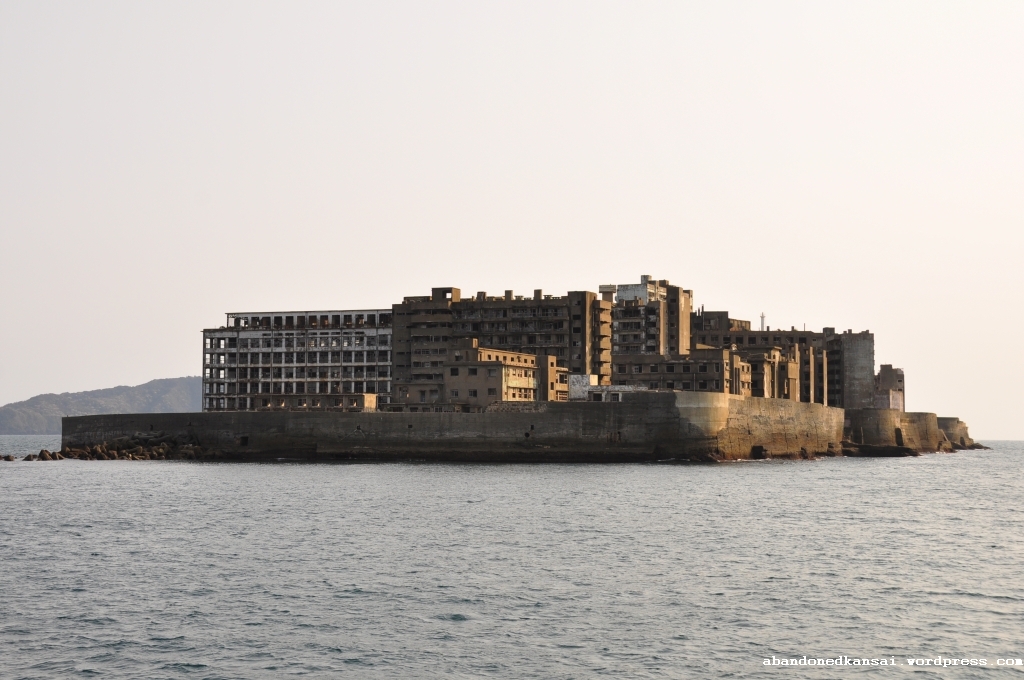
Gunkanjima (“Battleship Island”, thanks to it’s unique silhouette), also known under its original name Hashima and the not so flattering nickname “Ghost Island”, is without a doubt one of the most famous abandoned places in the world (almost on par with locations like Pripyat/Chernobyl) and by far the most well-known haikyo. Although landing on the island was strictly forbidden between 1974 and early 2009 (internet rumors claim that fishermen hired by adventurous people lost their license and foreigners were deported after being sent to jail for 30 days if they were caught – though I didn’t find any proof for those stories) there were exceptions made for film crews (documentary and fiction), professional photographers and scientists. Everybody else had to take a look from the nearby Nagasaki Peninsula or ships passing by Gunkanjima.
On April 22nd 2009 this situation changed – the island was (partly) opened to the public again.
A few years earlier, Mitsubishi (who used Hashima as a coal mine for almost 90 years and constructed all the buildings on the island) donated Gunkanjima to the Japanese state and from 2005 on the city of Nagasaki administered the abandoned island. In the same year the new owner invited journalists to Gunkanjima, bringing it back to the awareness of the public, and announced the reconstruction of a pier and the construction of a visiting zone in the southern part of the island, so tourists can land and have a safe look at the dangerously rotten buildings – entering those is strictly forbidden until this very day.
Although nowadays it is legal and relatively easy to go to Gunkanjima it still isn’t a foolproof thing to do. When Enric and I went to Kyushu in late March of 2010 we made a reservation with the only operator that has permission to land on Hashima, Yamasa Kaiun. For most foreign tourists this is the first hurdle as the homepage is in Japanese only. (The tour itself and the pamphlets they hand out are in Japanese only, too.) When we arrived at the harbor terminal to pick up our tickets we learned that the tour was cancelled. It was a beautiful, sunny day – but they cancelled anyways; the trips surrounding the island (and not landing on it) were also cancelled. You can’t imagine my disappointment as this was the center piece of the whole trip, a boat ride I was looking forward to ever since I’ve heard about Gunkanjima for the first time several years ago. But there was nothing we could do, so we moved on to Sasebo, making a stop at what turned out to be the fascinating Katashima Training School – a blessing in disguise.
The next morning we originally wanted to go to an abandoned coal mine near Sasebo, but Enric convinced me to take a train back to Nagasaki to give it another try; although we didn’t have a reservation and although I knew the tours were completely booked out. We arrived at the harbor terminal just after the first of two boats to Gunkanjima left on a day equally sunny and calm as the one before – and of course they turned us down and tried to send us away. But this time we saw a glimmer of hope and Enric convinced the ticket sales person to give us two spots on the next boat – he claimed (in Japanese) that we had tickets for the day before (which was true) and that I came all the way from Europe to Nagasaki just to see Gunkanjima (which was partly true…) while I put up the saddest face I possibly could – which was never easier although I’m a horrible, horrible actor. They told us to come back two hours later and then indeed gave us tickets: 4000 Yen for the boat ride plus 300 Yen for landing on Gunkanjima. (I followed the updates on the homepage of Yamasa Kaiun: All the tours on the next few days were cancelled. So in the end we were really, really lucky…)
Getting to Gunkanjima takes about 50 minutes by boat and the stay there is strictly organized and supervised. The pier is on the southeast part of the island and from there you pass through a tunnel in the island wall to a long concrete path that includes three gathering areas (the last one on the southwest end of Gunkanjima) where guides tell a bit about the island’s history and you have time to take some pictures. You are not allowed to move freely between the zones (several guards were blocking the path, having an eye on everybody) and of course the path is limited by chest high handrails to prohibit you from leaving the predetermined visiting zone. (Chest high by Japanese standards…) We were lucky to be in the group that started in the gathering area closest to the boat, so on the way back from area No. 3 I was actually able to shoot a video of the whole visiting zone in one shot. (I didn’t include videos so far to this blog, but maybe I’ll put it up in the future…)
If you know Gunkanjima from internet pictures made by illegal or professional photographers be prepared that you won’t be able to take similar shots as you don’t get even near the interesting buildings like housing, school or hospital – so I highly recommend bringing a good zoom for your camera to catch at least some details. The 200mm end of my lens was okay, but sometimes I wished I could get just a tiny bit closer.
The stay on the island takes about an hour and after the boat leaves, it continues to surround Gunkanjima clockwise, offering good views from pretty much every angle before returning back to Nagasaki.
Visiting Gunkanjima was an emotional rollercoaster, but in the end it was totally worth it! If you wanna go there you better be prepared that the tour you have a reservation for might be cancelled; it happens all the time…
Sure, you are limited to a predetermined path far away from the really interesting parts of Gunkanjima – and other haikyo offer similar views, some might even have more spectacular buildings. But not that many on such a small area, not with that kind of historical background. Therefore the atmosphere on Gunkanjima is absolutely unique, you can almost feel how it must have been to live on that crammed rock off the coast of Nagasaki. Unless you have some people doing wacky poses and spazzing around, having no appreciation for the island and its history. But I guess that’s a side effect we all have to live with when you make a tourist attraction out of a place like that, where 1300 laborers died during World War 2 alone – not a few of them forced workers from Korea and China.
- Gunkanjima