Feeds:
Posts
Comments

Archive for the ‘Museum’ Category

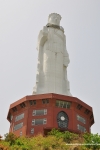
Ruins in Japan are often in such good condition that they are not recognizable as ruins at first sight. One example would be the World Peace Giant Kannon on Awaji Island, Hyogo prefecture – Kannon not being a spelling mistake, but the Japanese name for the bodhisattva associated with compassion, Guanyin. Other spellings include Kan’on, Kanzeon and Kwannon with the latter being the name giver for Canon, which was founded as Kwanon in 1934 and had the bodhisattva in its logo. I guess a World Peace Giant Cannon only exists in the minds of some really crazy people…

In 2010 I actually drove past the 80 meters tall World Peace Giant Kannon on its 20 meters tall socket building. Sure, it looked interesting, but the bright white statue seemed to be rather new in the warm sunlight of that day, so I didn’t even consider stopping. When I got back home and looked up what the statue really was I found out that most important of all it was abandoned… (It’s the 4th tallest statue in Japan and the 13th tallest in the world. Including the socket it ranks 3 and 10.)

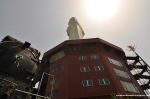
The World Peace Giant Kannon is actually part of the Heiwa Kannon Temple (heiwa meaning peace…), which was founded and funded by Toyokichi Okunai, a realtor who became rich dealing with office buildings, private apartments and business hotels in Osaka. The basis is a 5 storey building, 20 meters tall. The first floor was home to all kinds of religious exhibits as well as well as information about the famous Shikoku Pilgrimage (consisting of 88 temples along a 1200 kilometers long hiking course which usually takes between 30 and 60 days to complete). The other floors were stuffed with Mr. Okunai’s private collections – transportation, watches, china, art, armors. The fourth floor was home to a sightseeing restaurant, a banquet hall and a souvenir shop. If you look up the 80 meters tall statue on top of the building you can see some kind of a “collar” right below the statue’s head – that turned out to be an observation platform.

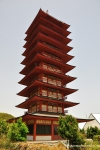
Although attracting up to 2000 visitors per day it seems like a lot of people were appalled by this mix of religion and commerce, some even accused Mr. Okunai of heresy. When Mr. Okunai died in 1988 his wife took over the management of the World Peace Giant Kannon until her death in February of 2006. After her death the Okunais’ real estate company closed the place right away and the Heiwa Kannon Temple started to fall in disrepair quickly, probably due to the lack of management of Mrs. Okunai during her final years. The Lehman Brothers took over, but they failed badly themselves at the time. Put to auction several times in 2007 and 2008 by the Kobe District Court nobody bid any money (which reminds me of the *Former Iranian Consulate* in Kobe…), so the temple was shifted to a separate company in September 2008. Since the World Peace Giant Kannon was liable to collapse (its exterior is molded of gypsum and resulted in the statue’s nickname Whiplash Kannon”) a committee was established in May 2009 by the local government, which took measures against the further deterioration of both the World Peace Giant Kannon and the nearby 10-storey pagoda in September of 2011. Just a couple of months after my buddy Gianluigi and I explored the place…

Walking up to the Heiwa Kannon Temple is actually quite impressive. The huge pagoda is right next to a parking lot and a closed restaurant. From there we had to walk up a hill to the back of the socket building. There we found all kinds of statues and items that didn’t go together very well, including a miniature version of the Statue of Liberty and an original Class D51 steam locomotive, the D51 828. We circled the socket building quickly and found an easy entry. The first floor was almost empty as most religious exhibits were gone. A quick look at the office on that floor didn’t give us much insight, so we headed up one of two staircases (one in the north, one in the south) that connected the floors. Some of them were locked, but we gained access to the restaurant on the fourth floor and the tatami room on the fifth floor. Approaching the fifth floor we heard voices, so we talked loudly to make ourselves heard. A minute or two later a young couple in their early 20s rushed past us, the guy holding a photo camera and the girl’s clothes not really being in order – your guess here is as good as mine…

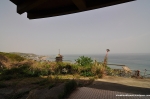
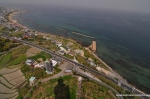
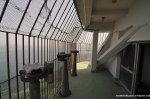
The tatami room once held the Mr. Okunai’s armor, but nowadays well armored soldiers of another kind were all over the floor: suzumebachi, Japanese Giant Hornets, 5 centimeters long killer machines. Luckily they were dead and it wasn’t summer yet, so Gian and I concentrated on the task at hand. In one of the hallways leading to the staircases we found an elevator – and nearby a mysterious claustrophobically narrow und pitch-black staircase that began to wind upwards. After spending a couple of minutes on the rooftop of the socket building admiring the beautiful gigantic Kannon statue we headed back inside and up the staircase. It was dark, the air was bad and some door-like openings revealed unpleasant views at the inside of the statue – even without knowing that people were discussing repairing the Kannon it was pretty clear that investments were necessary. After climbing stairs for about 10 minutes (it felt much longer…) we finally reached the observation platform, which offered both stunning and scary views. The location of the World Peace Giant Kannon between the coast of Awaji Island and the gentle hills was breathtaking – and so were the cracks in the gypsum everywhere. Buildings in Japan are barely constructed for eternity, but this one definitely has seen better days!

And so Gian and I walked down stairs for about 85 meters and left after spending surprisingly much time at this obviously quite popular abandoned statue – passing the also abandoned pagoda a group of about half a dozen Japanese twens was walking up the hill to have a look themselves. And I am sure they weren’t the last visitors as the maintenance work at the Heiwa Kannon Temple started not earlier than four months later…

(If you don’t want to miss the latest article you can *follow Abandoned Kansai on Twitter* and *like this blog on Facebook* – and of course there is the *video channel on Youtube*…)
Read Full Post »

When you think of Japan which other country comes to mind?
Probably Korea since it’s a neighboring country and both countries share an inglorious common history. China, of course, a major influence for centuries – from city planning to food. Most likely the United States as no other country had more impact on Japan in the past 70 years. Maybe Germany due to 150 years of more or less intense friendship and a similar post-war history.
Japan and New Zealand? A rather odd combination. Surprisingly *Michael* and I visited not only one, but two New Zealand themed amusement parks while on a *road trip in southern Honshu*. A couple of weeks ago I wrote about the *Hiroshima New Zealand Farm*, a closed but not abandoned theme park in Hiroshima prefecture. This time I’ll present you the clearly abandoned Yamaguchi New Zealand Village – same concept, same company, but without the shadow of a doubt a “lost place”; BTW: I really dislike the term Lost Place, which is used for urban exploration locations in Germany – not as bad “Handy”, which is used for mobile phones (!), but nevertheless a term that makes me cringe.

Arriving at the huge deserted parking lot of the New Zealand Village, it was pretty clear that we wouldn’t run into gardeners or other caretakers. The wooden handrail leading up to the entrance area was getting brittle and all kinds of plants grew without any attempt to tame them. Opened in July of 1990 after spending 1.8 billion Yen (currently about 16.5 million Euros or 21.7 million Dollars) the park’s attendance figures peaked in 1991 at 428.000 – in the following years the numbers dropped to about one third of that per annum before Farm Co. Ltd. put an end to it in 2005 by closing the park. Initially the 30 ha (300,000 m2) large New Zealand Village was put on hiatus for up to three years with the intent of re-opening it again one day, but that never happened. I don’t know if somebody took care of it for a while like they do at the New Zealand Farm (which is in its fourth year of closing), but nowadays the New Zealand Village is clearly abandoned…
(Just for comparison: *Nara Dreamland* peaked at 1.6 million visitors a year and closed when the number was as low as 400.000 – Universal Studios Japan in Osaka welcomes about 8 million guests a year.)

Exploring the New Zealand Village couldn’t have been more relaxed. Located in the middle of nowhere Michael and I enjoyed a wonderful sunny day on the copious premises.
The entrance area was dominated by a gift shop called カンタベリー (Canterbury), vandalized, but still stocked with quite a few examples of fake food Japan is so famous for – in this case all kinds of sweets. We found replicas of mini cakes, both Western and Japanese (mochi), all made of plastic and therefore still nice to look at.
In close proximity was the Jersey Factory that produced and sold homemade bronzer… sorry… handmade butter! And pretty much next to this place with a name that has no connection to New Zealand was a huge building that had New Zealand all over the place: Restaurant Rotorua, Newzealand Farm, Kiwi Country. Why give it one name when you can give it three? Or four, since all to the left it said “Main Bazaar”.

This food dominated commercial zone of the New Zealand Village, which overall had way less of a village feeling than the New Zealand Farm, was followed by the wide, open landscape I knew from other versions of the nature themed parks. And I loved it! I usually don’t feel very comfortable in abandoned buildings, but open areas like mining towns and amusement parks I really enjoy (if they are really abandoned), especially on sunny spring days!

What made the New Zealand Village in Yamaguchi different from those in Hiroshima and Shikoku was the variety of strange pedal-powered vehicles. Cars, bikes and really unique constructions – they were scattered all over the park, a plethora of rental… thingies. I took photos of many of them and maybe one day in the future I will publish a special picture set about them.
Another thing that made this installment of the New Zealand parks special (but not in a good way!) was the already mentioned presence of vandalism. It wasn’t “ZOMGWTFBBQ!?” bad, but since vandalism is always uncalled for it was nevertheless sad to see. Call me old-fashioned and naïve, but I like my abandoned places easy to access and naturally decayed. Luckily the amount of vandalism decreased the further we got away from the entrance, so by the time we reached the stables and Sheep House with its museum of 19th century farm equipment and a couple of taxidermy items in the making, vandalism was nothing but a bad memory.

What really bugged me about exploring the Yamaguchi New Zealand Village was the time pressure. Like I already mentioned, this was part of a road trip to the south of Honshu and the schedule was kind of tight. A place like this deserves a whole day of exploring and taking pictures, probably with some hours after sunset for some special photos – a luxury not available to us. So when Michael and I left after 3 hours (which is generous for most places – *Sekigahara Menard Land* I left after about 20 minutes…) it was with a bittersweet aftertaste, amplified by a bunch of beatniks who entered the parking lots just before we left. Us driving away was accompanied by the sound of burnouts in the distance…

(If you don’t want to miss the latest article you can *like Abandoned Kansai on Facebook* – and of course there is the *video channel on Youtube*…)
Addendum 2014-07-11: According to a friend of mine all the buildings have been demolished – R.I.P.!

Read Full Post »

The abandoned Japanese Sex Museum (a.k.a. the Mansion of the Hidden Treasure) first caught my attention in 2009 when I first started doing some research about haikyo on Japanese blogs. Three years ago the museum showed up on two or three homepages; both urbex and more general pop culture blogs. After that it basically disappeared, I haven’t seen pictures of the place ever since. So what happened? Boarded up? Security? Maybe demolition? Since *Michael* and I *were in the area anyways* we decided to find out, especially since the museum was pretty much on top of both of our “Places I Want To Explore” lists.
I guess the abandoned Japanese Sex Museum, along with the *Maya Hotel* and *Nara Dreamland*, was actually one of the locations that convinced me that Japan not only has abandoned places, but that it has some great ones. There are not that many sex museums in the world overall – so an abandoned sex museum is pretty unique! (Although “Abandoned erotic art museum” would be a slightly more correct name for the place now that I know what’s to find there.)

Opened on October 1st 1978 the Mansion of the Hidden Treasure was in business for almost 20 years before it was closed in the second half of 1997. Mansion of the Hidden Treasure is actually a great name since the exterior looks like a massive, old-style Japanese mansion, like a fortress almost. The entrance was guarded by a statue of Daikoku, the God of Great Darkness and one of the Seven Gods of Fortune. Opening hours were from 9 a.m. till 11 p.m. and the entrance fee was 1000 Yen according to a pamphlet that was lying around in an office room. Exploring the place further we found actual tickets with a printed price of 1300 Yen, so I guess the entrance fee was raised at least once during the 19 years of business. Several vending machines near the entrance and the exit offered all kinds of items, for example erotic playing cards and saucy postcards at the price of 300 Yen. One of the trashed rooms had a small stage and nearby we found a sign that said “Nude Show 2500 Yen”, so I guess it’s safe to say that there were live performances at the museum, too.

(If you are easily offended by sexual contents and you nevertheless read this far I strongly recommend to move on to another posting as from now the article will become a little bit more specific – while at no point pornographic I might mention the p-word once in a while and the photos at the end… or dear… well, it’s an abandoned sex museum, of course the exhibits are 99% erotica!)

As you may or may not know pornography in Japan is usually censored due to article 175 of the Criminal Code of Japan which says that people who sell or distribute obscene materials can be punished by fines or imprisonment – meaning that genitalia are usually blacked out, white out or pixelated with mosaic. Article 175 was part of the original Criminal Code passed in 1907 and remains pretty much unchanged till this very day. It was the written manifestation of the Meiji Era efforts to reduce the publication of pornographic materials. Before the second half of the 19th century the shunga, erotic woodblock prints and therefore a type of ukiyo-e, were quite popular – and as explicit as modern western pornography; probably even more imaginative since the shunga not only showed traditional sexual acts, but also sex with animals, demons and deities. Some of them even showed sex with foreigners… And I guess that’s where the worldwide image of weird Japanese porn comes from. Well, that… the used panties vending machines and of course the anime series Urotsukidoji, famous for inventing tentacle rape, creating a whole genre with just one extremely disturbing scene…

With that being said there was no pornography found in the abandoned Japanese Sex Museum – only a couple of paintings (some of them in a special room with black light lamps), softcore photos (e.g. Playboy Centerfolds), a couple of mannequins as well as lots and lots of wooden and stone sculptures; dozens of them, to be accurate. Sculptures of penises, vaginas, combinations of both, couples in the act, buttocks, masturbating animals, priests, deities, demons and whatever you can imagine. In one room there was a forest scene with penis shaped mushrooms. Or mushroom shaped penises. Your guess is as good as mine. It was almost impossible to open your eyes without looking at a phallic symbol.

While two or three rooms were completely trashed (basically the entrance and the exit areas as well as the offices upstairs) some of the exhibition area’s ceiling was quite moldy, but still in good shape. Those huge statues must have been insanely heavy, especially sculptures like the stone penis with a length of almost two meters, and let’s be honest: Who would actually hit a giant stone vajayjay with a sledgehammer or tip over a couple of marble dicks? Even the most ruthless vandal respects those symbols!

Sadly that didn’t apply for the female models. The main exhibits in the last room were stolen (or “taken to security” by some previous explorers…) a year or two ago. One was a wax model of the famous European softcore erotic character Emmanuelle, the other one was a replica of Marilyn Monroe – both presented in slinky poses behind now broken glass. The already mentioned pamphlet / flyer featured photos of both wax figures and they looked pretty amazing. Even more so on the already mentioned Japanese blogs I saw a couple of years ago. When the museum was still open to the public the wax figures were scantily dressed and well-lit behind glass, but once it was abandoned the new visitors had less respect and undressed both Marilyn and Emmanuelle to show lower body parts that were out of sight before – and surprisingly both models were not as anatomically impaired as a Ken doll.
The left behind mannequins on the other hand were exactly that: Rather gender neutral below that waist and more or less what you can see at every clothing store when the clerks redress the shop window dummies. Of course they were all (partly) dismembered and slightly damaged, but they were basically normal mannequins… except for the really disturbing “Sleeping Beauty” one, which had vibrators mutating out of her nipples.

The main challenge from a photography point of view was the fact that 80% of the museum was pitch black, which meant that I had to take every shot with a tripod and illuminate every photo individually with my flashlight; similar to what I did at the *Lost Subterranean Shrine*.

With a sheer endless amount of statues and the time consuming process of taking photos Michael and I spent a whopping four hours at this fascinating location. Like I mentioned at the beginning, we both had high expectations about the abandoned Japanese Sex Museum and they were not only met, but exceeded. This haikyo is without the shadow of a doubt one of the best abandoned places in Japan and it would be a place worth visiting anywhere in the world. I just hope that future visitors will treat the location with the same respect Michael and I did so it will put a smile on the faces of urban explorers for decades to come…

(If you don’t want to miss the latest article you can *like Abandoned Kansai on Facebook* and *follow this blog on Twitter* – and of course there is the *video channel on Youtube*…)

Addendum 2012-09-10: If you liked this article you might enjoy the abandoned *Japanese Strip Club*, too…

Addendum 2012-11-27: I just posted an article about another abandoned Japanese sex museum: *Hokkaido House Of Hidden Treasures*

Addendum 2013-05-09: Two months later I revisited the museum – *click here for more photos and videos*!

Addendum 2014-07-11: According to a friend of mine the museum has been demolished a while ago – R.I.P.!

Read Full Post »

Spring time is long weekend trip time! While Kansai doesn’t have much of a winter it nevertheless can be quite cold, especially when having a hobby involving taking pictures in abandoned places, other places of Japan can be snowed in for months with meters of snow… So when the sun finally warms the hearts of Japan and causes the first sunburn of the young year it’s time to explore places beyond my beloved Kansai – whether it be *Kyushu with Enric* two years ago or Shikoku with Gianluigi last year (a series of articles yet to come…), it became kind of a tradition for me to go on an urbex spring trip with a friend of mine. This time *Michael Gakuran* and I teamed up for a road trip to the southern end of Honshu, Japan’s main island – Chugoku, to be exact, the area west of Kansai. A trip with such exciting places that I decided to start writing about it right away – the last pictures are barely 50 hours old…

At this point I don’t want to give away too much about the locations we visited or which order we visited them in. But there were 8 of them in 3 days. 3 long days I might add, with me getting up at 6.30 a.m. on a Sunday, at 6 a.m. on a vacation day and at 5 a.m. on a national holiday. As I mentioned before: I’m a morning grouch; and by “morning” I mean any point in time which is followed by “a.m.”…

But the trip wasn’t just exhausting, it was also exiting, fun, frustrating, satisfying, rich in variety, surprising, delicious (I finally ate Hiroshima Okonomiyaki in Hiroshima prefecture and bought the best local sweets outside of Kyoto – mikan dango) and insanely expensive.

Why insanely expensive? It’s because at the end of the first day a serious mishap happened to me. We were on our way to a hotel to stay for a night when we saw this huge, blue and white flame at a gigantic industrial plant – probably coke oven gas burning at a cokery. (Addendum 2012-06-11: I guess I was wrong about the gas – Gert from South Africa wrote me: “This couldn’t be coke oven gas burning, because coke gas got a very very hot orange (impurities) or yellow (cleaner) flame. But the flame in the video is actually blast-furnace or corex, midrex, finex gas flame (more methane content in gas).” Thanks a lot for pointing that out! I really appreciate it and changed the title of the video below, too.)
We decided to make a stop to take picture or two and when I got out of the car to marshal Michael I grabbed my bag and I don’t know how or why, but my beloved D90 camera flew through the air and crashed hard to the concrete ground. The body cracked open a couple of millimetres so I could see the insides. Parts of the electronics were still working (e.g. I could use the screen to look at the photos on the memory card), but since the lens mount was part of what cracked it was impossible to take pictures anymore. Mad props to Tokina BTW! The mounted 11-16mm lens survived without a scratch or any other damages as I found out with relief the next day.
Sunday evening past 7 p.m. – of course I was in shock at first, because going on a photo trip without a camera is pretty pointless. So we headed towards the flame to take some picture which I couldn’t do since my photo camera broke and Mike couldn’t do because of the lighting, lenses and passing traffic. So I took the video you can find below the article – it doesn’t fully capture the beauty of the flame, but it will always remind me of the death of my favourite camera so far (I also included the last JPG I ever took with it, even though it wasn’t related to urbex). Back at the car we decided to look for an electronics store, although it was almost 8 p.m. on a Sunday evening. After a couple of minutes we found a shopping mall, but it didn’t have a camera store. The staff at the mall was very nice, telling us where to find an electronics store – but it closed at 8. Michael, who did all the talking since his Japanese is WAY better than mine, wasn’t discouraged by that and asked for the phone number of the store. Although the store was closed Michael called and somebody picked up. He told them my tricky situation and they agreed to let us into the store if we hurry – so I got into a taxi and went straight to the store. There a guy with pretty decent English helped me at the camera department. I was hoping to replace the D90 with another one, but they didn’t have them in stock. A lower model was out of the question, so the only option was a D7000. Which they didn’t have in stock either. Just the display model – which they couldn’t sell me without the kit lens since it was a display model. After some deliberation and the certainty that not buying that display model would mean losing at least 5 hours the next morning looking for another camera (electronic stores in Japan usually open at 10 a.m.) I half voluntarily upgraded from a Nikon D90 to a Nikon D7000. With a bad feeling since I not only spent a huge chunk of money, but I also had to learn by doing how to handle a new camera. While I’m very pleased with how the photos of all locations turned out it was quite unnerving at times to get the shots I wanted to take.

Now just a few quick words about the locations we visited. The undisputed highlight of the tour was the abandoned Japanese Sex Museum. Both Michael and I had high expectations and we were not the slightest disappointed, shooting in almost complete darkness for the majority of the 4 hours we spent there. Another glorious highlight to me was the Kart Pista Hiroshima race track – why it was a highlight you’ll find out soon. Since theme parks are one of my favourite types of abandoned place we visited two of them and I loved them both. 4 world class haikyo in 3 days – plus 2 good ones (a Meiji Era army fortress and a quite tricky hotel) as well as 2 more we took pictures of because we went there and it would have been a waste not to cover them… a strip bar in an onsen town (euphemistically called “theater”) and a car camp site. To my knowledge all of these places never appeared on English speaking blogs, some of them are even unknown to the Japanese urbex crowd. So please enjoy the preview pictures and come back for much more information, photos and about one hour of video material!

Here’s an alphabetical list of the upcoming locations:
Ganne Fortress
Hiroshima New Zealand Farm
Japanese Sex Museum
Kart Pista Hiroshima
Moriyama Auto Camp
Noga Hotel
Onsen Town Theater
Yamaguchi New Zealand Village

(If you don’t want to miss the latest article you can *follow Abandoned Kansai on Twitter* and *like this blog on Facebook* – and of course there is the*video channel on Youtube*…)

Read Full Post »

The Tohoku Earthquake of March 11th 2011 was a horrible, horrible event. I was on the 16th floor of an office building in Osaka at the time, almost 1,000 km away from the epicenter – but looking at the faces of my Japanese colleagues I could see that most of them remembered another horrible earthquake: the Great Hanshin Earthquake (a.k.a. Kobe Earthquake), January 17th 1995; the second worst earthquake in Japan of the 20th century with about 6,500 casualties. 200,000 buildings collapsed, the total damage was more than 100 billion US-dollars – with massive consequences for all of Kansai as many companies moved to Tokyo and other parts of Japan, closing subsidiaries in Kobe, Osaka and Kyoto out of fear of another earthquake; which is kind of strange since a major earthquake is overdue in Tokyo for quite a while now…

One of the buildings that were severely damaged in Kobe was the former Iranian general consulate or Persia House, as it was known in its later days. In the 19th century Kobe opened its ports quickly for oversea trade and became host of one of the biggest foreign communities in all of Japan. Especially an area now known as Kitano was the home of many, many merchants from all over the world. Nowadays a major tourist attraction Kitano is the home of small antique shops, fancy bakeries, lots of wedding halls and bridal gown boutiques as well as countless French bistros – or whatever Japanese people think French bistros should be like… And of course there are the old merchant houses. The Weathercock House (German style…), the Denmark House, the Original Holland House – and before the Great Hanshin Earthquake happened there was the already mentioned Persia House.

The Persia House was a 2 storey wooden building with a kiritsuma style roof. Until 1981 it was the home of the Iranian general consulate in Kobe, afterwards it was opened to the public as a tourist attraction, housing the Persian Art Museum which showcased pottery of the Persian Empire. In 1983 the Persia House received three sets of leaded glass windows from Roger Nachman Glassworks, making it even more beautiful than before.

Unlike the neighboring foreign residences the Persia House wasn’t rebuilt after the Great Hanshin Earthquake hit Kobe – nor was it demolished. It seems like the ruin was left alone for almost a decade until in 2004 city of Kobe seized the premises since the owner didn’t pay taxes for quite a while. Since from that point on the ruin was a problem of the city a green stockade was erected to keep people from hurting themselves; and to make it harder for the ruin to catch the innocent tourists’ attention. Hardly anybody likes an “eyesore” like that in a preppy area like Kitano, but it seems like nobody had the will or authority to get rid of it completely – and that assumption would have been dead wrong as the city in fact tries hard to get rid of the whole problem. So far the premises were up for public auction nine times, but there was never a taker, although the minimum bid was lowered in six steps from 159 million Yen to 95,4 million Yen. (1.5 million Euro / 1.9 million US$ to 0.88 million Euro / 1.56 million US$)

When I was visiting the Persia House it was kind of funny to watch dozens of tourists pass through the narrow street the former art museum is located at without even realizing that there was a ruin. But as soon as I took my camera to take some photos over the picket fence 80% of the people passing by did the same. After a while I left trying to take pictures from another angle – when I came back to the front again none of the passing tourists seemed to see the ruins…

I guess those tourists are basically the main reason why the location is one of the least photographed haikyo considering its exposed location in the heart of Kobe. Hopping the fence wouldn’t have been a problem, although a cable and a connected electronic device might have been some kind of alarm system. But even if you made it past the fence you could always be seen by people passing by. On the adjacent estate to the north is actually the Original Holland House (and with that I can as well mark the *location on the map*…) – looking down from its back porch you probably have a pretty good view at the side of the ruins of the Persia House. Sadly the teenager at the entrance wouldn’t let me take a couple of photos and I wasn’t willing to pay the 700 Yen entrance fee for 2 minutes of not entering the friggin house. I recently spent 15.000 Yen on a roundtrip train ticket expecting to see a demolished amusement park, so I don’t consider myself cheap, but come on! The Dutch being of German blood I would have expected a little bit more solidarity…

Anyway: board fence + uncontrolled plant growth + tourists + shooting in west direction in the afternoon = a picture set I’m not very proud of.

To end this article on a funny note, please have a look at the last photo of the set. I took this nearby at one of Kobe’s major tourist spots. It’s the map of a public restroom. Not a map showing public restrooms in the area – a map of ONE public restroom. If your sense of direction is below par you better study the map before you enter to avoid getting lost… unless you are a man. The gentlemen’s section is so small it really is your own fault if you get lost!

(Update 2013-01-05: The Persia House was demolished since I took the photos – I’ll write a RIP article as soon as possible…)

Read Full Post »

Today I had a look at some rather old videos shot at locations I already wrote articles about. None of them were intended to be published, so the camera work might be a bit rushed occasionally, but I decided to upload them anyways as I think there might be some interest in them out there in the world wide web. While some of my videos only get a couple of dozen views quite a few of them were watched by thousands of people – *this one* will actually reach 30.000 views soon. Please enjoy!
*Nara Dreamland – Aska Rollercoaster*

*Koga Family Land*

*Jumbo Club Awaji Island*

*Ohmi Lodge*

*Young People’s Plaza & Museum*

*Takada Ranch Ruin*

Read Full Post »

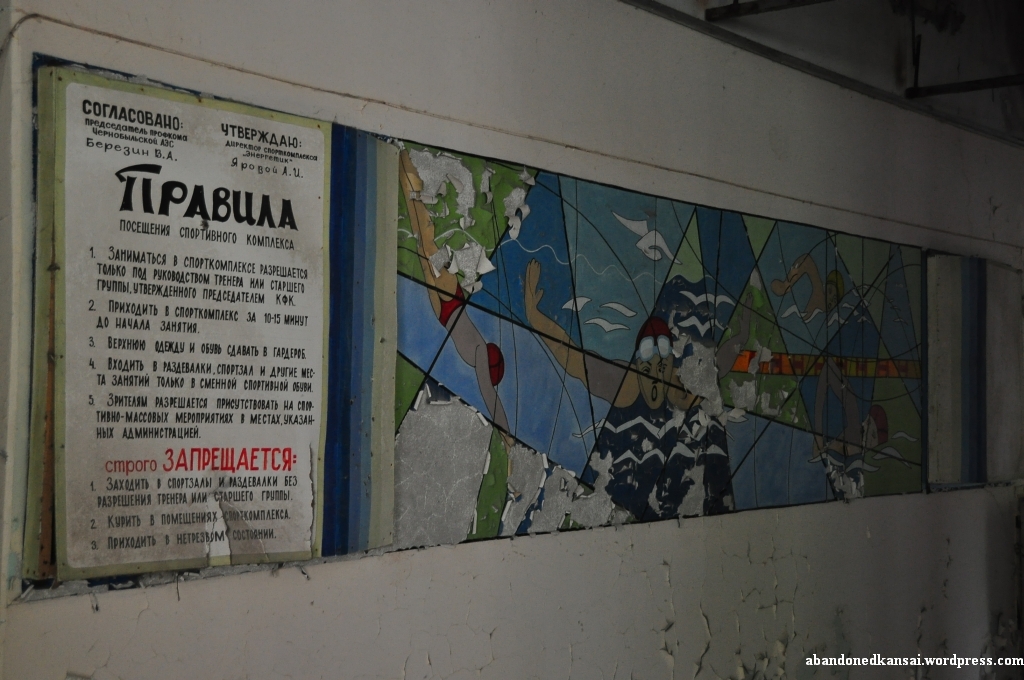
The Palace of Culture was a typical institution of the Eastern bloc. The huge buildings were the meeting point for people to enjoy all kinds of recreational activities like sports and arts – and of course they were used for political indoctrination. The PoC usually included a cinema (some of them with several screens), a concert hall, dance studios, a swimming pool, study halls, a boxing ring, rooms with a variety of instruments, an area with tools for all kinds of do-it-yourself stuff and many, many more things – and of course Pripyat had a Palace of Culture, too, being one of more than 137,000 in the Soviet Union in 1988…
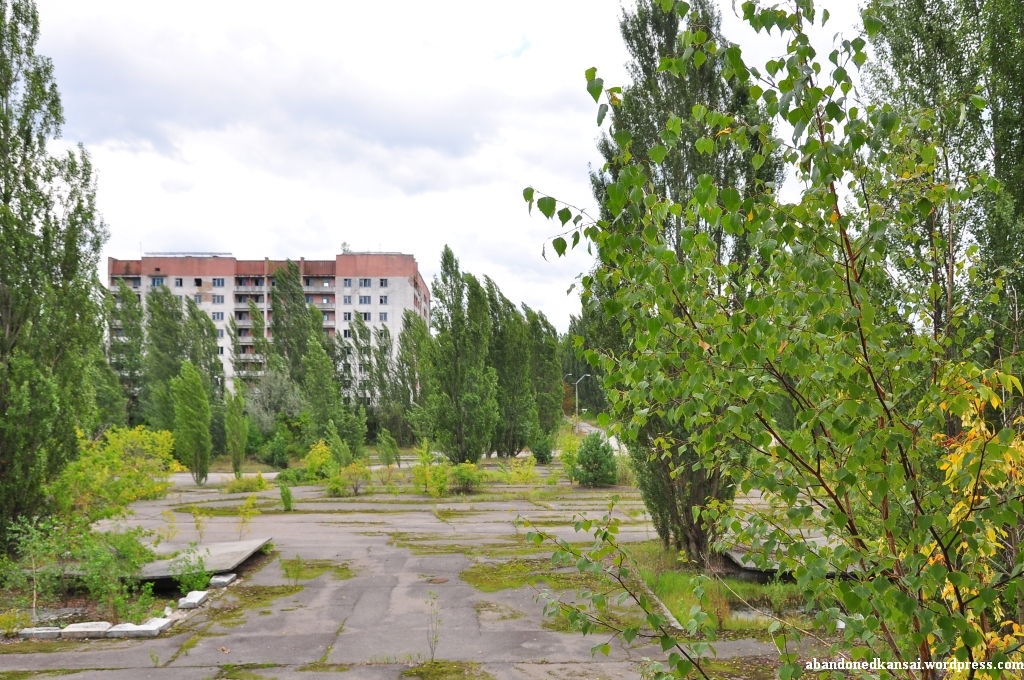
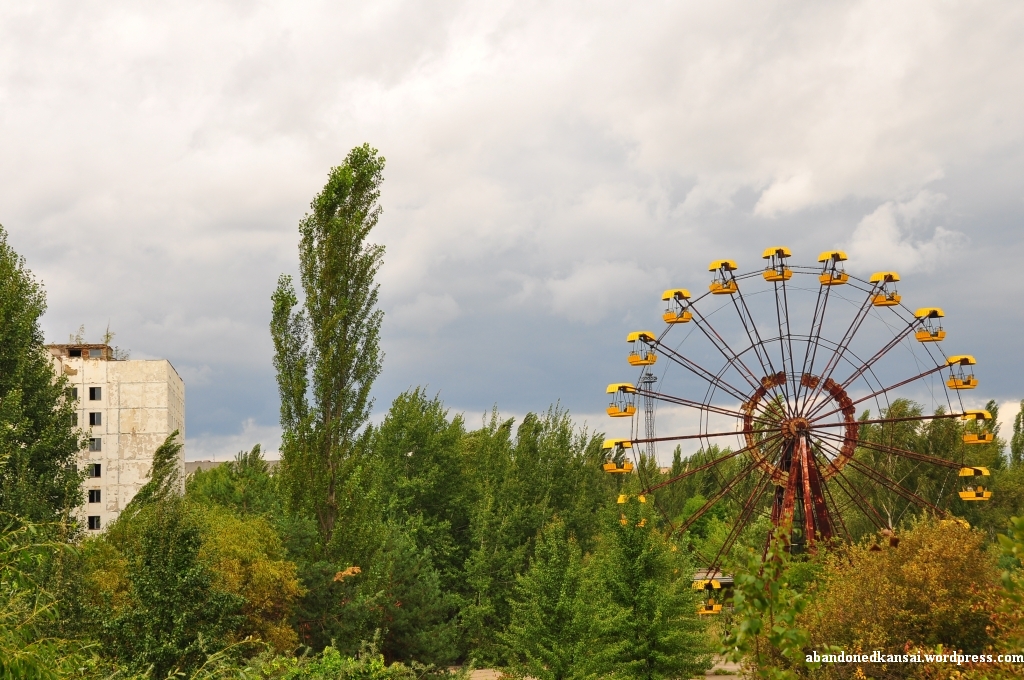
Energetik, the local Palace of Culture, was located directly at Pripyat’s center square, Lenin Square, and nowadays is one of the most visited locations in the world’s most famous abandoned city. One reason is that Energetik is on the way to everybody’s favorite Pripyat motive, the amusement park’s ferris wheel – the other is that the building offers a lot of variety on a relatively small space. Crossing Lenin Square Maxim was raving about how beautiful the place must have been 30 ago, given that the huge open space once was the home of a good part of the previously mentioned 33,000 rose plants.
I, on the other hand, was just fascinated by the unique, sad beauty that makes Pripyat what it is today. Struck by awe I entered the Palace of Culture and didn’t even know where to start taking pictures. Anywhere else in the world exploring this building would have taken at least half a day, but I somehow had the feeling that I would have that much time – in the end I had about 50 minutes…
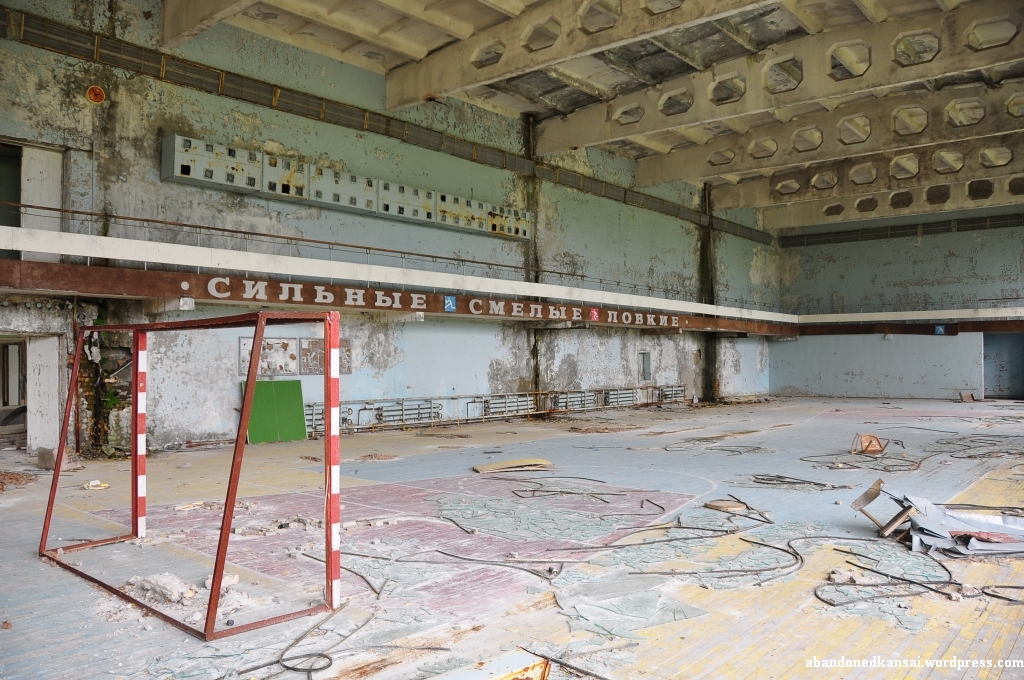
Pripyat’s Palace of Culture is actually in pretty bad shape. Like most other buildings in the zone there isn’t a single window still intact, so the forces of nature – up to 40 degrees Celsius in summer, down to minus 20 in winter – did quite some damage in the past; and having tourists visiting the place every other day doesn’t help much either I guess. Most of the rooms were severely vandalized (a long time ago though!), the cinema barely recognizable. Bushes and little trees were growing inside of some rooms and many of the mural paintings were crumbling away…
Exploring the different kinds of rooms was an amazing experience, but one moment stuck with me in a special way. It happened when I walked through a hallway towards what I assumed was the main gymnasium in the building. As I entered the huge room I looked outside the gigantic front of window frames and saw the famous ferris wheel 100 meters away in the background. Unexpected and absolutely mind-blowing… still gives me goose-bumps when I think back now.
Sadly only a couple of minutes later Maxim made us hurry-up for the first time – the amusement park was waiting just for us…
(If you would like to know more about my trip to the Zone Of Alienation please *click here* to get to the “Chernobyl & Pripyat” special. For a map of the area please *click here*.)

Read Full Post »

Growing up in Germany education about history is almost omnipresent, both in school and on TV. Most people know about the proud events and people of the past – Arminius defeating the Romans, Charlemagne unifying Europe, Ludwig van Beethoven becoming one of the greatest composers of all time, the German Revolution of 1848, … there are too many to name. But people also learn about the darkest time of German history – the years 1933 to 1945; those 12 and a half years out of thousands of years of German history actually make up for about a third of the school’s history classes, most of the rest being used to educate students to be good democrats: the ancient Greeks, the Age of Enlightenment, the French Revolution and similar events are all taught with a purpose.
After studying Japanese history and living in Japan for a couple of years it strikes me that Japanese schools handle history a bit differently. It’s all about the proud samurai past, World War II takes up only a couple of pages in history school books, downplaying events like those in Nanking 1937 by calling them incidents – while the rest of the world uses terms like “massacre” or “rape”. Popular places to remember World War II in Japan nowadays are Hiroshima and the Yasukuni Shrine… remembering losses Japan had to suffer, not so much remembering the misery Japan spread all over Asia from 1931 to 1945.
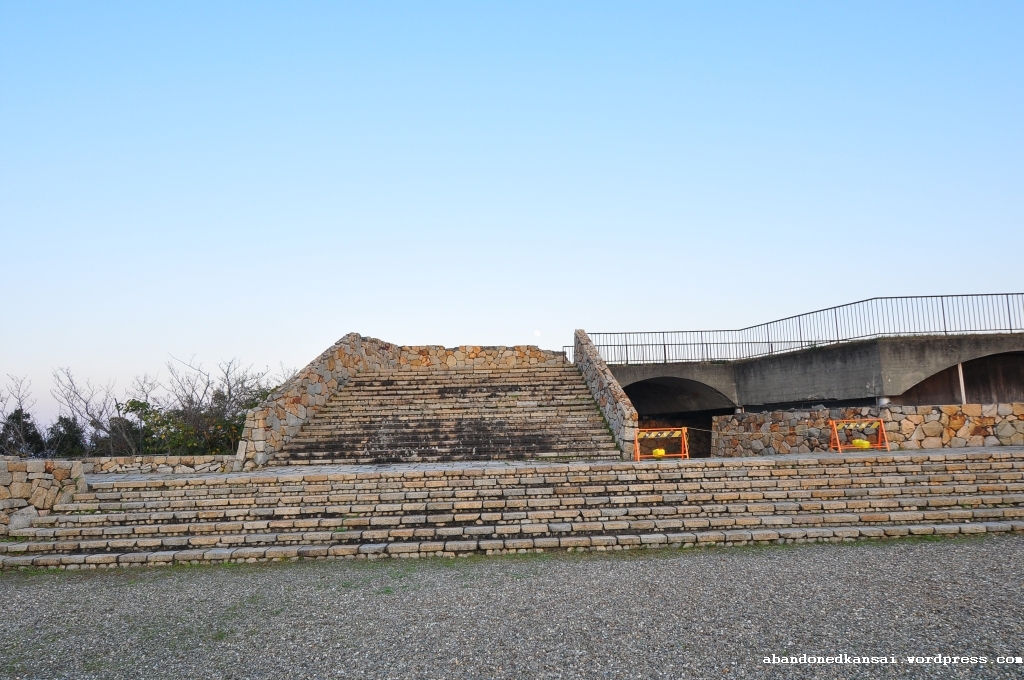
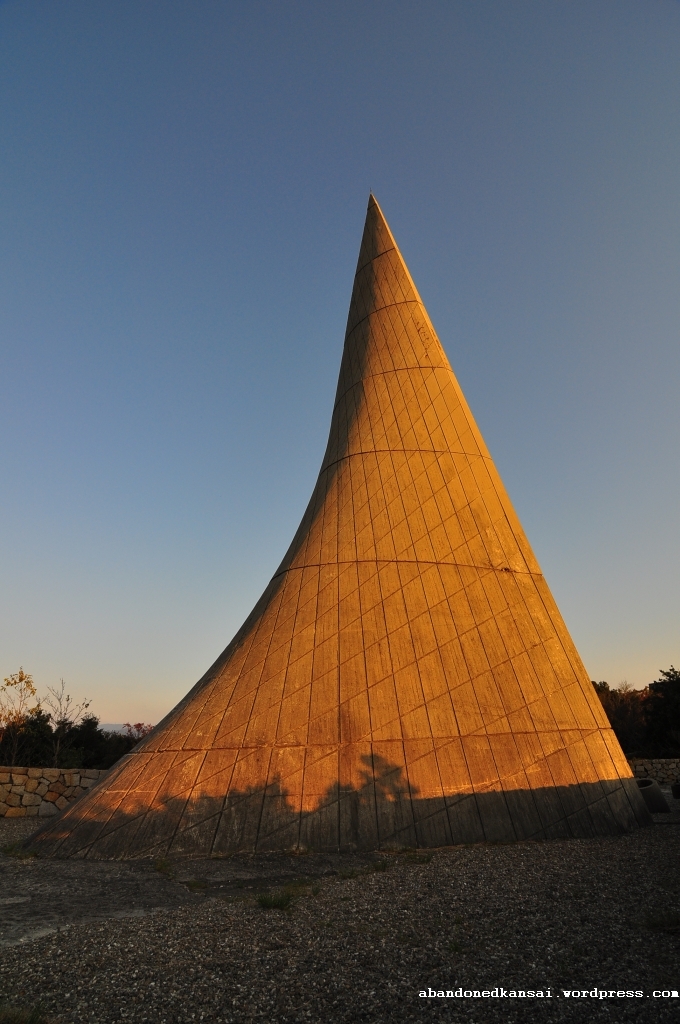
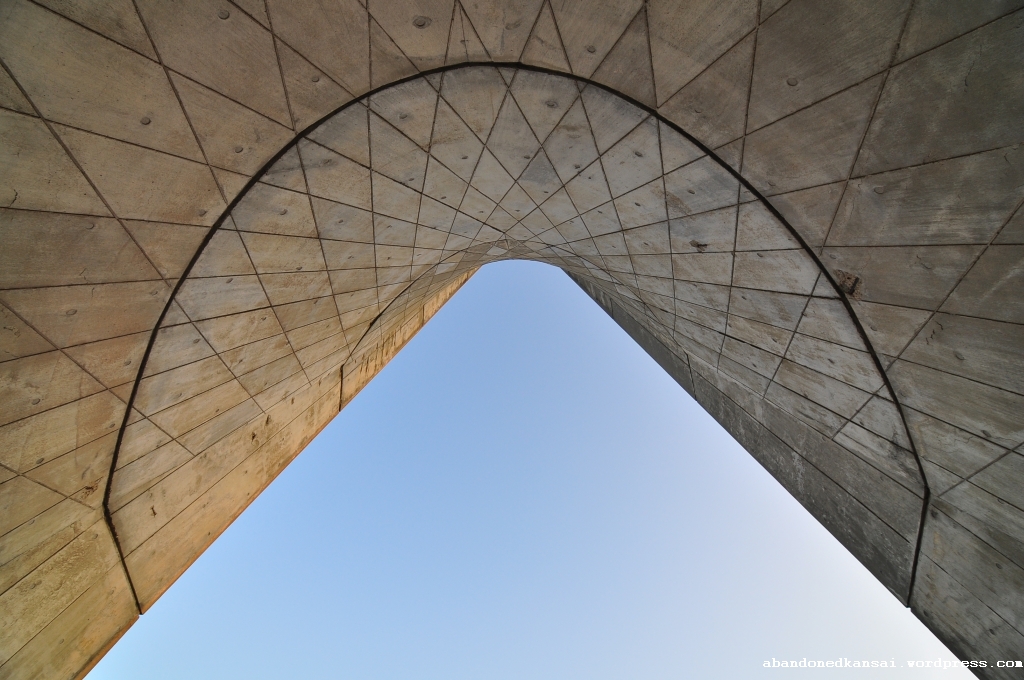
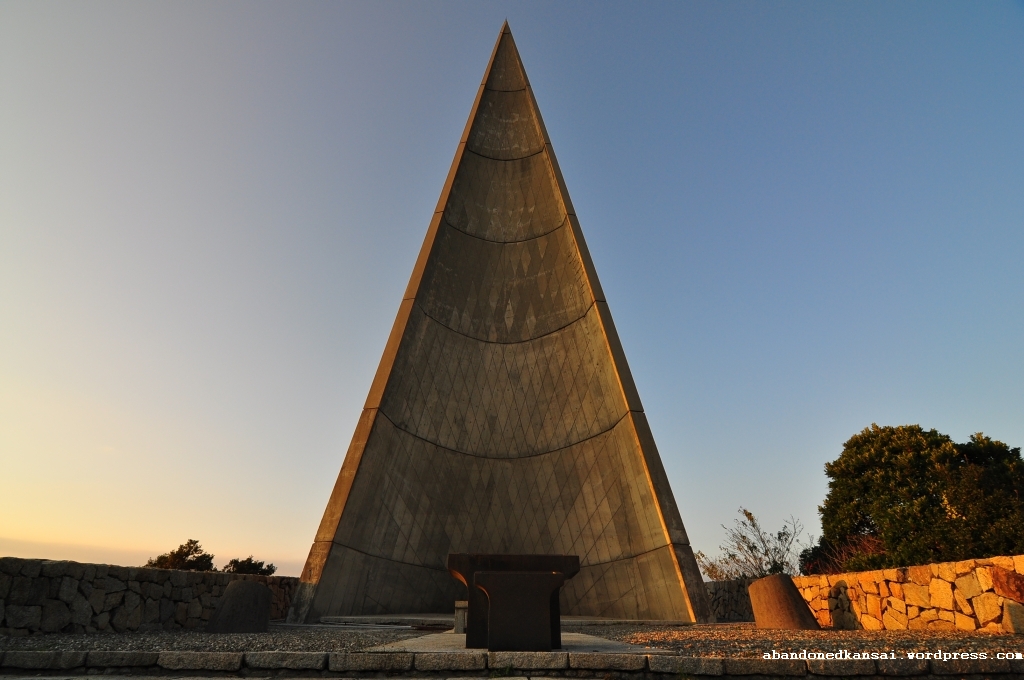
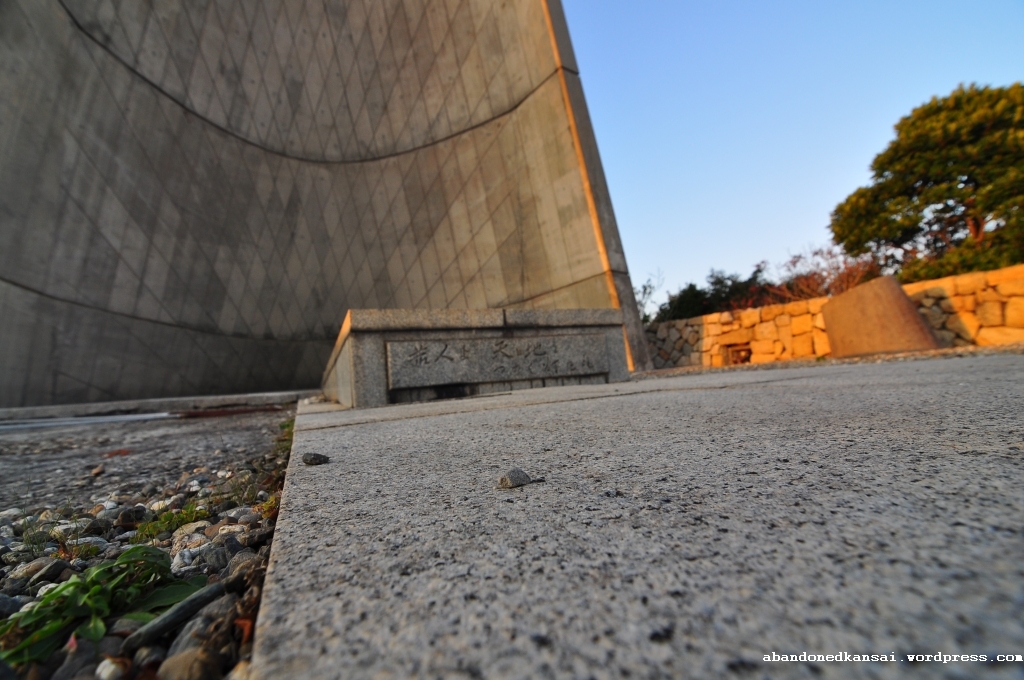
Until a couple of years ago there was another rather huge memorial accessible to the public: The Young People’s Plaza (若人の広場), dedicated to the young people who lost their lives in World War II. Designed by the famous architect Kenzo Tange in 1966 and opened in 1967 this impressive monument with an appendant museum is towering 25 meters high over the once so strategically important straight between Shikoku and Awaji Island. In 1995 the Young People’s Plaza was closed down due to dwindling visitor numbers and irreparable damage caused by the Great Hanshin Earthquake earlier that year. An important part of the centerpiece, an eternal flame placed right at the concrete sculpture once protecting it, was removed since then.
The museum, beautifully embedded into the breathtaking landscape and located on the way to the monument, was once filled with items left behind by the students who went to war, countless pictures and information boards telling their stories. It seems like the museum was boarded up in 1995, but as with all locations like that you will always have people trying to make their way in. Worried about the exhibits all 2000 items of historical value were donated to the Kyoto Museum for World Peace, which is part of the Ritsumeikan University, in 2004. Nowadays the museum is almost completely empty and a rather spooky place…


Read Full Post »

« Newer Posts