Feeds:
Posts
Comments

Archive for the ‘Sacred Site’ Category

The Kumsusan Memorial Palace of the Sun (also known as Kumsusan Memorial Palace or Kumsusan Palace of the Sun) was built in 1976 and originally named Kumsusan Assembly Hall, serving as Kim Il-sung’s official residence. Upon his father’s death Kim Jong-il had the gigantic neoclassical building renovated (cost estimates range from 100 million dollars to 900 million dollars!) and turned it into a mausoleum – in 1994, when hundreds of thousands of people were starving the country. After Kim Jong-il’s death in December 2011 the palace was closed for renovations and re-opened exactly one year after on December 17th 2012. (Hence the names Memorial Palace and Palace of the Sun – one of Kim Il-sung’s nicknames was “Sun of the Nation”…)

One great challenge when visiting the DPRK is stepping back from your own social and political views to see and experience places not only from your own perspective, but also from a North Korean one; and there is hardly any place in the country where it is more challenging and rewarding at the same time than at the Kumsusan Memorial Palace. Remember that I wrote in the first article that I most likely will piss off some people over the span of this series? Well, there is a whopping one in three chance that it will be you this time…

But let’s start at the beginning!
The security precautions at the Kumsusan Memorial Palace are putting those at airports to shame. First you have to leave all your belongings either in the bus or at the checkroom within the building – everything but your wallet and tissues; so yes, that includes cameras and even keys! Then you’ll have to go through a metal detector and pass a body check to make sure that you don’t bring in anything else, like pens or chewing gum.
Visitors enter the complex via an underpass and reach the main building using a series of moving walkways and escalators, most walls being decorated with photos and pictures showing the Great Leader and the Dear Leader. Finally you reach a series of rooms that are filled with personal items of Kim Il-sung as well as honors and awards he received from institutions and universities all over the world. Well, communist institutions and universities, which is really interesting in the case of Germany (note: Germany, not East Germany!) as those honors stopped in 1989 – guess why…
In a rather big room you can see Kim Il-sung’s train compartment he used to travel in – not only within Korea, but also to foreign countries. The exact routes and dates are displayed on one of the room’s walls. So the Kumsusan Palace is not only about bling, it’s also about education – and grief.
Centerpiece of the tour is the big man himself, Kim Il-sung – and he really is the centerpiece, like literally! After passing through a dust blowing machine you enter a rather dark room aflame in reddish light. You line up, step forward and turn left – now being at the foot-end of the preserved remains of the Great Leader. 4 to 6 people at the same time step forward again, bow for a couple of seconds and then turn left to go clockwise to the right side of the embalmed body. There you bow again before you continue clockwise 180° to the left side of Kim Il-sung where you bow a third and last time before leaving the room – all under the eyes of four (e)motionless soldiers guarding the remains.
Contrary to Wikipedia you are actually allowed to talk within the palace, but with a soft voice – though the only person talking in the mausoleum room is the guide who hints when it is appropriate to bow and when it is time to move on. Speaking of appropriate: While wearing decent clothing is expected at all time when being in the DPRK it is no problem to wear jeans and T-shirts, even with prints as long as they don’t include flags of or political slogans about certain countries (including the States and South Korea, of course…). At the Kumsusan Palace though people really dress up. (Except for that one group of Russian tourists entering right in front of us…) Korean visitors wear suits, their best uniform or colorful dresses – foreign visitors are expected to at least wear button shirts and ties, if possible a suit jacket and cloth trousers. To meet those requirements I even had to buy a tie in China, as it was the first time in almost 7 years that I was wearing one – and somebody from the group had to tie it for me as I had no idea how to. Since we were visiting the Kumsusan Palace on the first morning of our trip to the DPRK our relationship with the guides was still shaky, luckily everybody played along and afterwards it was overheard that the Korean guides told our Western guide that this was a good group. So if you ever visit the Kumsusan Palace: Dress up, shut up and bow, no matter what you think about the two Kims and their regime!

You can talk about it afterwards as much as you want. And people did, as many felt it was the most surreal situation they’ve ever been in – a statement I wouldn’t sign.
I grew up Catholic and my grandma dragged me to church every Sunday for about four years after First Communion, going irregularly for a while before that event. In middle school I finally had enough of it and went to a friend’s house playing video games before my family even woke up – when you spend an hour at an event you can’t relate to you have plenty of time to question it even more. My grandma didn’t like my “lack of enthusiasm” for Christianity, but accepted it after a while. When one of my sisters married 10 years later it was the first time for me to attend divine service in about 8 years since I even stopped going to church on Christmas and Easter. And boy, THAT was strange. During my church going days I was just bored by the long sermons (German Catholic Masses are nothing like the gospel stuff you see in American movies…) and terribly annoyed by all the contradictions, but I grew up with it, so at least it felt familiar. But after a decade I forgot most of the procedure and if you step back and don’t have a personal connection to a religious service it is really, really strange. No disrespect, but I remember sitting in the cathedral thinking “This is so surreal – it must be how Christians feel like when they see ceremonies of some previously undiscovered tribe!” – I just couldn’t relate at all!
So when we were asked to bow in front of Kim Il-sung’s embalmed body I just though “Whatever, if it makes you happy…” – and that’s it. At least they didn’t give me long boring speeches or expected me to sing! Or said “The Body of Kim” and gave me a consecrated host to eat – now that would have been friggin weird behavior! Bowing in front of a corpse? Pff, I can deal with that…
So dear religious people (in general), I didn’t write the previous paragraphs to offend you – I wrote them to stress how important it is to disconnect yourself and see situations from a different perspective. People visiting the DPRK have to understand that the personality cult about Kim Il-sung, Kim Jong-il and Kim Jong-un in North Korea isn’t that much different from radical religions all over the world (heck, when the Kims punish whole families for three generations they actually act as written in Exodus 20:5!). North Koreans in general aren’t very religious, but to them the Kims have a godlike status – and not respecting any of the three the way they do is borderline blasphemy. Luckily most Christians outgrew the whole blasphemy thing, but for centuries you were basically a dead (wo)man if you said something against the church, thanks to the Old Testament. (“Anyone arrogant enough to reject the verdict of the judge or of the priest who represents the LORD your God must be put to death.” (Deuteronomy 17:12 NLT)). And don’t get me started about the whole Muhammad drawings thing…

Anyway, now that I most likely lost some of my readers by ranting about religions and outing myself as an agnostic atheist let’s wrap up this article. (I am really curious though to find out if and how many people will unsubscribe over that little personal story…)
After leaving Kim Il-sung’s final resting place we basically did the same procedure with a Kim Jong-il setting. Awards and honors, personal items (including a boat and several cars – very interesting: his travel map was a lot more limited due to the fact that there were a lot less communist states from the mid 1990s on when he came to power…), embalmed body; though I am not sure about the order. Embalmed body might have been the second stop on both tours. But does it really matter?
Having seen both Kim Il-sung and Kim Jong-il (which is rare – it seems like most visitors only get to see one of them each visit) we went back to the checkroom by the opposite set of escalators and travelators to grab our cameras and take some pictures outside. The Kumsusan Palace is surrounded by a nice park and in front of the building is a huge square where soldiers put up hundreds of chairs for some kind of festivity nobody knew what it was about. (Oh, and if you plan a trip to the DPRK avoid the months of May and June as the Kumsusan Palace will be closed – every year.)

Overall the Palace of the Sun was a very impressive place to visit and definitely one of the highlights of the trip, even though it wasn’t the most surreal experience of my life. But since I told you about mine nonetheless, let me ask you – what was the most bizarre situation in your life?

(Please *click here to get to Abandoned Kansai’s North Korea Special* and *here for a map about the tour at GoogleMaps*. If you don’t want to miss the latest article you can *follow Abandoned Kansai on Twitter* and *like this blog on Facebook* – and of course there is the *video channel on Youtube*…)

Read Full Post »

One of my favorite things about urban exploration is travelling. Most of the time I do day trips within Kansai, but every couple of months I go on mini vacations to other regions. *Okinawa*, *Kyushu*, *Hokkaido*, *Shikoku* … and a couple of more that will be revealed in the future.
I lived in Japan for several years before I started to visit abandoned places – and in those first years I barely travelled within Japan. Kansai has plenty of castles, temples and shrines, some of the most famous in all of Japan. More than enough to get templed out, shrined out and castled out, so I didn’t feel the urge to spend hundreds of bucks on train tickets – and then a similar amount on hotels. Only to see more castles, temples and shrines that look similar to what I can see down the street. Abandoned places on the other hand are unique – and some of them are actually worth spending a couple of hundred bucks, at least to me.
The spring of 2011 saw my second overnight trip to Shikoku. *During the first one* my favorite location on Japan’s least populated main island was the spectacular *Tokushima Countryside Clinic*, a small town doctor’s house, barely harmed by vandals and the ravages of time. My friend Gianluigi, an avid photographer for almost two decades, loved the photos I took at the clinic, so I convinced him to go on a road trip – I would show him that wonderfully spooky gem if we would stop on other abandoned places along the way…
If you are a regular reader of Abandoned Kansai you might remember two articles I wrote about really unique haikyo about half a year ago – the abandoned Japanese spa *Shimizu Onsen Center* and the giant Buddha statue / viewing platform *World Peace Giant Kannon*; both of them were actually part of this second trip to Shikoku.
So here is a complete list of all the locations:
Amano Hospital
Daiwa Pottery
Kuroshio Lodge
Shimizu Onsen Center
Tokushima Countryside Clinic Revisited
World Peace Giant Kannon

One of these places has been demolished since I visited it two years ago – you’ll find out soon which one… and then I’ll add it to my *GoogleMap of Demolished Haikyo*.

(If you don’t want to miss the latest article you can *follow Abandoned Kansai on Twitter* and *like this blog on Facebook* – and of course there is the *video channel on Youtube*…)

Read Full Post »

I love the Toyoko Inn hotel chain in Japan. Their prices are fair, they are located right next to bigger train and subway stations, they offer free breakfast from 7 till 9.30 and free WiFi / internet 24/7, their staff usually speaks at least a little bit of English, they have a discount and point system for members – and you can make online reservations via their English homepage.

One reason I was hesitating to go on a trip *as mention in the previous blog post* was the fact that I was in-between credit cards for a couple of weeks. (In my experience it’s close to impossible for foreigners to get a credit card in Japan – but I am looking forward to the comments of every expat who got one… I know people who were rejected more than half a dozen times, I tried it once or twice and then got one in Germany…) But you need a credit card to make an online reservation at a Toyoko Inn – or so I thought.
When it was clear that I would spend the first night of my trip in Nagoya I stopped worrying. Last weekend wasn’t a typical time to travel in Japan (unlike *Golden Week*) and Toyoko Inn has six hotels in Nagoya, eight if you count the ones close to the airport – I was sure I would get a room somewhere. So the plan was to show up at one of them and ask the staff to make a reservation for me for the second night, which I planned to spend in Matsusaka – a town famous for its high quality beef, which turned out to be more dead then the cows it is famous for.

Luckily my plan was a good one, so I checked in at the hotel of my choice in Nagoya and asked the staff to call their sister hotel in Matsusaka to get me a reservation for the following night since I didn’t have a credit card. The friendly lady at the counter pointed to the opposite wall across the lobby and asked me to use the internet to make the reservation myself. I repeated that I didn’t have a credit card and therefore couldn’t make the online reservation. The answer was “You don’t need a credit card to make an online reservation.” – so I told her that I needed one when I tried to make one the night before. Since the hotel receptionist insisted that I wouldn’t need a card and was eager to show me that she was right we started the procedure on their English homepage – as usual. Another guest arrived so I filled out the form, scrolled down and… there it was, the section for the credit card information. I left it blank, tried to continue and of course it didn’t work and I got an error message. When the receptionist showed up again she seemed to be very surprised, switched the language settings of the homepage to Japanese and… finished the reservation without having to enter credit card information! She didn’t even have to log out / start the procedure from the beginning, she just switched the language settings and pressed a button to finalize the reservation.

I totally understand that hotels need some kind of security when people make online reservations and that’s the reason I never had a problem entering my credit card information when making an online reservation at a Toyoko Inn, 15 times for trips in 2012 alone. In fact they don’t charge your credit card and you can pay cash upon arrival, it’s just a security measure for no-shows, which I completely understand. Nevertheless I am kind of irritated by the fact that you have to put in your credit card information when you make the reservation in English, but not when you make it in Japanese – to me it implies that Toyoko Inn considers people who prefer to make reservations in Japanese more reliable than people who make reservations in English; which could be considered borderline racist. Again, I understand that (most) online hotel reservations require credit card information. But either it’s a general requirement for Toyoko Inn or not – doing it on the basis of the language chosen on the homepage feels wrong to me, as it means that not all customers are treated equally.

What do you think? „WTF?“ or “WTF!”?

(To end this posting on a lighter note I’ll add some non-urbex photos and videos I took during my three day trip. Inuyama Castle, Tagata Shrine Festival, Mount Gozaisho, Yunoyama Onsen, Toba, Iruka Island, Ise Shrine, … If anybody is familiar with dolphins please have a look at the video and let me know what you think – to me it looks like the poor creature was desperate to get away as it repeated the same motion at the “prison gates” to the ocean over and over again; I didn’t watch any shows on the island and didn’t spend any money there – Iruka Island (iruka = dolphin) was an optional stop on a harbor cruise I took in Toba.)

Read Full Post »

More often than not I barely have any information about the places I visit in advance. Sometimes I only saw a photo and have a general idea where to look for the location. It was like that when visiting the *Bibai Bio Center* – and the Horonai Substation was not much different. A red brick building somewhere in the middle of nowhere – and a road leading there. That was it. I didn’t expect a spectacular location… and I didn’t find one. Nevertheless it was a good exploration with an interesting history, the first one on my *haikyo trip to Hokkaido*. *Michael* thought so, too – although he almost paid a steep price for making a snow angel…

History

The Horonai Mine has an incredibly and unusually long history, dating back to the early years of the Meiji Era (1868-1912). Back then it was a time of new departures and Hokkaido still was kind of unknown territory. Japan recently opened itself to the world after more than two and a half centuries of information and immigration control, relying heavily on foreign experts to accomplish in a couple of decades what Europe and the States took about a century – industrialization. Just a decade prior Hokkaido was still known as Ezochi and for its renitent inhabitants, but the new government in the newly appointed capital Tokyo pushed for the development of Japan’s most northern prefecture… and population rose from 58.000 to 240.000 in the mere ten years of the 1870s. Agriculture and mining became the prefecture’s most important industries – and while agriculture is still important (especially wheat, potatoes, pumpkins, corn, raw milk, and beef), mining isn’t. The amount of abandoned mines in Hokkaido is incredible, but since most of them are in extremely rural areas, often hours away from bigger cities, we decided to visit the Horonai Coal Mine as an example – because it wasn’t completely out of the way, came with an electrical substation and, to our surprise, with the Horonai Shrine.
It wasn’t until writing this article though that I found out that the Horonai Mine was actually Hokkaido’s oldest modern mine and that Hokkaido’s first railroad, the Horonai Railway, was built to establish and operate the Horonai Mine. It’s said that in 1868 a local resident discovered coal in Horonai, but it wasn’t until 1872 that the village received any attention, leading to a survey in 1873. Expecting massive amounts of high quality coal in Horonai plans were made concrete in 1877 and money was raised through industrial bonds in 1878 after important statesmen like Ito Hirobumi and Yamagata Aritomo visited the area in previous years and campaigned to establish a mine. Further surveys were conducted in May of 1878 and the mine was opened on December 18th 1878, reaching full production almost four years later in June of 1882.
Plans for the Horonai Railway, necessary to transport the coal mined in Horonai to places where it could be used, were finalized in December of 1879, so construction of the railway began in January of 1880, installation began in July of the same year – technology and knowledge was imported from the United States by J.U. Crawford, who oversaw the railway construction project for the Japanese government; the line was officially opened on September 13th 1883 and was used for the transportation of passengers as well as coal.
In 1889 both the mine and the railroad were privatized, probably for little money, as both of them were not profitable at all. This happened a lot in the late 19th century in Japan, strengthening the so-called zaibatsu (gigantic family controlled holding companies, amongst them still famous corporations like Mitsubishi, Mitsui, Sumitomo and Kawasaki), but also countless mid-sized companies (although sometimes even profitable companies were given away for a fraction of what they were worth…). Business continued for another 100 years and ended in 1989, when most of the buildings were demolished for security reasons – and because back then industrial heritage wasn’t considered worthy of preservation. (The Völklingen Ironworks in Völklingen, Germany, and the Zollverein Coal Mine Industrial Complex in Essen, Germany, were actually spearheading the idea of maintaining old industrial buildings, becoming UNESCO World Heritage Sites in 1994 and 2001 respectively.)
A not so fun “fun fact”: Like many other mines in Hokkaido, Horonai was taking advantage of prison labor. Not only during times of war, but in the early years, both before and after privatization. In 1883 250 prisoners worked next to 228 general laborers. In 1890 there were 1.043 prisoners and 183 normal workers “employed”, the forced labor accounting for more than 80% of the work force, extraction and transportation almost exclusively relying on prison labor! (It was actually thanks to the prison laborers that the Horonai Mine survived the first couple of years. From 1882 to 1888 the mine was deep in the red with only one profitable year and couldn’t even afford to implement mechanized coal transport – that actually happened only after it was privatized and exploited prisoners as cheap labor for years. And after the extraction costs per ton of coal were cut down to one sixth over the course of six years till privatization in 1889.)
The Horonai Mine also gathered some local fame in Japan when it was used as the setting of the second Season of Survivor (サバイバー) in 2002 – after Palau, but before the Philippines and North Mariana. Probably the most original setting ever and by now much more exotic than all those islands in the Pacific Ocean; they look all the same to me anyway! (I usually don’t link to other people’s Youtube videos, but *here is the intro to that season* in 240p. Don’t miss the *video I took at mine in late November* in 720p!)

Exploration

When we arrived on location the initial situation wasn’t promising. Several hundred meters before we reached the substation we had to park the car as the road was completely snowed in. Luckily there were tire tracks (we were able to walk in) from a more suitable vehicle, but the road itself wasn’t accessible with the small car we rented. As we got ready to walk up the hill we saw a guy and his dog coming back to their car. Nothing unusual, until we saw that the guy was carrying a rifle. Not the usual BB guns you have everywhere in Japan. A real friggin rifle! Even if he wasn’t shooting trespassers we were wondering what he was hunting in the forest ahead of us… and if his prey might want to get a shot at hunting us…
Nevertheless we followed the previously mentioned tire tracks deeper into the valley. To the right we saw several concrete ruins of the Horonai Mine, abandoned in 1989, when the mine was closed after 110 years. Everywhere along the road we found information signs (Japanese only…) and it seems like the area was converted into a “coal mine scene park” in 2005. It turned out that the first abandoned place on our trip wasn’t actually that abandoned, more like a tourist attraction – like the *Shime Coal Mine*, a.k.a. the *Anti-Zombie Fortress*. Of course there were no tourists seen anywhere, so I guess the place is only of interest in the snow-free summer months… and basically inaccessible the rest of the year. Michael of course was eager to head over to concrete remains, but given the deep snow and the unknown terrain I was able to convince him to look for the substation first – especially since the grey leftovers didn’t look like they contained anything interesting.

It took us about half an hour to walk from the parking lot to the substation and the tire tracks ended a couple of dozen meters before reaching our destination thanks to a collapsed tree on the road – from that point on we had to walk through the snow which was about 30 centimeters deep.
The Horonai Substation, a two-storey brick-clad concrete building, was built in the 1920s, more than 40 years after the mine was opened, and received its electricity from a coal fired power plant in Shimizusawa. That plant, which was fuelled by coal from the Yubari Mine, not the Horonai Mine, is still in existence and closed in 1991, but was not visited by yours truly as the roads leading there would have required a separate day trip.
Sadly there wasn’t that much to see: The metal constructions of the transformers and the brick covered building – locked by a solid chain, but luckily Michael found another way in. The building clearly was in use during summer months, featuring some kind of exhibition with lots of exhibits and huge control panels from the good old days.
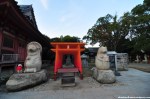
More interesting was the Horonai Shrine, which obviously was completely covered by snow, too, and probably as half-abandoned as the Horonai Substation. Located right next to the substation on a small plateau up a slope, the shrine offered a nice view at the remains below. At that point it started to snow and I don’t know why, but there is an amazing peacefulness about deserted snow-covered shrines. Michael was still down at the substation, so all I heard was snow falling – perfect tranquility.
Overall the Horonai location wasn’t spectacular, but at that point I hadn’t explored many snow covered (more or less) abandoned places, so it was a good start into the trip!

Snow Angel

Oh, after all those paragraphs about the mine’s history I almost forgot about the snow angel! It seems like either Michael or I have a serious amount of bad luck when exploring together. In spring I broke my D90 on our *haikyo trip to southern Honshu* – and I already mentioned Michael’s misstep at the *Hokkaido Sex Museum*. His bad luck started earlier though, when he insisted on making a snow angel on the way back to the car. I thought it was a bad idea in the first place as it was cold and he was jumping spine first onto unknown ground (concrete, rocks, metal, …), but everything went fine until the point when Michael first took off his glasses and then stood up shortly after, realizing that his glasses were gone. In a comedy movie kind of situation he asked me to watch my steps – the last words barely left his mouth when he moved one of his legs and we both heard a crushing sound. The spectacle frame under his boot wasn’t only bent, but broken. Well, bent and broken. Michael, the designated driver on this tour since my license isn’t valid in Japan, had some contact lenses with him, but they would have only last for two or three days – shorter than the trip. So on the way to our second hotel we were looking for a glasses store. 5 minutes to 8 p.m. (i.e. closing time) on a national holiday (!) I spotted one. Not only were they able to fix Michael’s glasses in a miracle operation taking almost half an hour, they did it for free and also give mine a new polish. Quite a few people complain about the (lack of post-buy) service in Japan (and I admit that sometimes it can drive you nuts!), but the glasses shops here are amazing and saved not only the day, but kind of the whole trip…

(If you don’t want to miss the latest article you can *follow Abandoned Kansai on Twitter* and *like this blog on Facebook* – and of course there is the *video channel on Youtube*…)

Read Full Post »

The Tenkaen, literally Flower Garden of Heaven (but also known as China Park of Heaven), was probably the biggest location *Michael* and I visited on our *haikyo trip to Hokkaido*. Opened in 1992 and closed in 1999 this deserted China themed park now is longer abandoned than it was in business – and it showed…

Japan and China have a long common history full of complications – and the recent election of the Japanese House of Representatives most likely won’t change the situation, especially regarding the Senkaku Islands. Nevertheless Japanese people seem to love themed parks that are not necessarily theme parks. Unlike famous theme parks like Disneyland or Universal Studios the dozens of themed parks all over Japan don’t have fast and expensive rides. They really are just themed parks that offer a more or less authentic look at the theme they chose – usually other countries like Germany (Doitsu no Mura Kronenberg), Spain (Spain Mura / Parque Espana), the Netherlands (Huis Ten Bosch) or New Zealand (Tohoku New Zealand Mura). Most of them were build during the real estate bubble in the late 1980s/90s and a lot of them were already closed (like the *Hiroshima New Zealand Farm* and the *Yamaguchi New Zealand Village*) or even leveled.

The Tenkaen is not much different in that regard. Opened in 1992 as one of four big theme(d) parks in Noboribetsu (the other being the Noboribetsu Bear Park (opened in 1958), the Noboribetsu Marine Park Nixe (opened in 1990), and the Noboribetsu Date Jidaimura – a Edo era themed park opened in 1992), the Tenkaen was modeled after a garden court from the Qing Dynasty (1644 to 1912) and in addition included a 5-storey pagoda with a height of 40 meters and a bell donated by China to commemorate 20 years of rather friendly diplomatic relations. Sadly the Tenkaen didn’t last nearly as long, probably due the steep entrance fee of 1,900 Yen (1,100 Yen for senior citizens and elementary school students). In the first business year (1992/1993) only 270,000 people visited the 40,000 square meter site – and it went only downhill from there. In 1995 the attendance numbers were down to half in comparison to the first record year and in 1998 the opening days were reduced and a winter closing was introduced – on October 31st 1999, only seven and a half years after the grand opening, the Tenkaen was closed for good and now is one of the most famous abandoned places in Hokkaido.

Michael and I arrived at a reasonable time in the morning at the Tenkaen, expecting a rather long day of shooting there, but we had no idea what the layout of the location would really be since this China themed park is located in a rural area where even GoogleMaps isn’t much of a help. The weather was sunny, but nevertheless strangely gloomy, offering lighting conditions I have never seen before at an abandoned place. The whole area was dusted with a thin layer of snow, so we chose our ways carefully not to leave to many visible footprints. After we spent about half an hour at the garden palace area the sun began hiding behind some clouds and we were hit by a snowstorm. The atmosphere changed completely and the photos we took looked like they were taken at a different day. The storm lasted for about half an hour and ended abruptly when the sun came back with a vengeance, melting the freshly fallen snow along with the one we found at our arrival – so much for walking carefully not to leave footprint.

But that wasn’t the last time the weather would change. It seemed like the Tenkaen wanted to live up to its name – there weren’t a lot of flowers, but heaven changed about every 30 minutes, switching between gorgeous sunlight and almost blizzard like snowstorms. Which was great for us *haikyoists*, because whatever part of the Tenkaen we explored, we always had a variety of weather conditions to take pictures of. Altogether we spent 4.5 hours at the Tenkaen, and if it wouldn’t have been for a long list of other locations to be visited on the same day (and the ice cold wind, especially on the higher floors of the pagoda!) we probably would have stayed much longer…

Personally I loved the Tenkaen – it was my kind of abandoned place: in the middle of nowhere, open space, nice weather, interesting location, not that much vandalism, lots of natural decay, unique theme. The two major streets with dozens of cars passing by were a little bit annoying at times, especially when exploring the floors of the pagoda, but overall it was a great experience, not least because of the constantly changing weather conditions. I would love to come back one day in a warmer season of the year, to see some more green and maybe to take some night shots!

(If you don’t want to miss the latest article you can *follow Abandoned Kansai on Twitter* and *like this blog on Facebook* – and of course there is the *video channel on Youtube*…)

Read Full Post »

Momijigari (紅葉狩, red leaves / maple leaves hunting) is almost as popular in Japan as the worldwide way more famous hanami (花見, flower viewing). In spring even the biggest couch potato leaves the house to view first the plum and then the cherry blossoms, in autumn they go to different spots to have a look at the autumn leaves. Of course every bigger city has special spots for both, but some countryside towns are pretty much dead for 50 weeks a year and completely swamped on two or three weekends. In Kansai prime examples would be Yoshino (hanami) and Minoh (momijigari). Why? Because those two spots are considered the best – or at least amongst the best. Surprisingly many Japanese people pursue the best of everything – the best food, the best company as an employer, the best spots to view nature. Or at least they pursue what the majority considers the best. With the result that some food is insanely expensive, employers with famous names exploit their employees (because they can!) and the best spots to view nature are so overrun that it’s not really fun anymore going there – you stand in crowded trains for hours just to be pushed past gorgeous trees and through crowded streets with souvenir shops.
So while half of Kansai “enjoyed” autumn leaves in Minoh and Kyoto (just to put up photos on Mixi and Facebook to let everybody know where they went for momijigari…) I made my way to the Hyogo countryside in late November of 2011. My goal was to climb a small mountain with an abandoned temple on top. 15 months prior I was able to explore an abandoned shrine (*you can your all about it here*), so I guess it was only natural to follow an abandoned Shinto site with an abandoned Buddhist site. (I know that there are plenty of abandoned churches – but how about mosques? Has anybody ever heard of an abandoned mosque?)

The Shuuhen Temple popped up on two or three Japanese haikyo blogs before, but it was surprisingly hard to locate. Even more surprisingly since the place is still marked on GoogleMaps, and when you are rather close you can find guide signs – which left me rather puzzled for a couple of minutes about how abandoned the place really was. I guess now it’s more abandoned than ever, because in September of 2011 the street up the mountain was closed. Halfway up the mountain a landslide flushed away the small asphalt road on a length of about 5 or 6 meters – even tiny cars could barely pass here anymore safely.
When I reached the mountain top I must have been one of the happiest people in all of Kansai: A stunning view, gorgeous autumn leaves and a temple all for myself. Sure, I couldn’t tweet “I’m in Arashiyama! (Be jealous!)”, but I wasn’t bothered by souvenir shops and crowded locations. Quite the opposite. When I was walking around I had to be careful not to run into one of many one square-meter large spider webs with a nasty middle finger long black and yellow spider in it. The abandoned temple itself was rather unspectacular. All buildings were closed, in rather good condition, and I didn’t even have a closer look if there was a way to open them. I’m not very religious myself, but I respect the beliefs of others and try to be respectful. (Which doesn’t keep me from making fun of them if it’s getting too ridiculous – you know, thetans, magic underwear and stuff like that…)

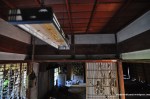
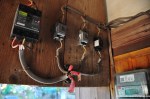
Open and rather interesting was the house of the monk that lived near the Shuuhen Temple. It’s hard to tell when it was abandoned. Some buildings in Japan fade away in no time, others withstand the ravages of time as if they couldn’t care less. It looked like it was built in the 60s or 70s, given the black and white photos of the bell and the belle; judging by the wiring maybe even earlier. The decay there was clearly natural, because thanks to the temple’s location the average bored youth vandal spares the place. Strangely enough the digital display of the power meter still worked…

The temple itself seems to have quite a long history. According to the homepage of the city it is located in, the Shuuhen Temple dated back to Emperor Kotoku’s days (596 – 654) and was first built in 651. In 1578 it was burnt to the ground and stayed a ruin for more than a century until 1682, when it was revived again. Not much information, but way more than one could get for most other temples and shrines in Japan… Now it is famous not so much amongst urban explorers, but more amongst Japanese fans of ghost spots (心霊スポット). I guess it makes sense to look for paranormal activity where people traditionally believe(d) in spirits.

Exploring the Shuuhen Temple was one of those nice, mellow urbex experiences. Sleeping in, taking some local trains, a nice and sunny autumn day, some hiking, some solitude, cold temperatures, but warm sun, beautiful countryside. A relaxed Japanese Indian Summer day…

(*Like Abandoned Kansai on Facebook* if you don’t want to miss the latest articles and exclusive content – and subscribe to the *video channel on Youtube* to receive a message right after a new video is online…)

Read Full Post »

Ruins in Japan are often in such good condition that they are not recognizable as ruins at first sight. One example would be the World Peace Giant Kannon on Awaji Island, Hyogo prefecture – Kannon not being a spelling mistake, but the Japanese name for the bodhisattva associated with compassion, Guanyin. Other spellings include Kan’on, Kanzeon and Kwannon with the latter being the name giver for Canon, which was founded as Kwanon in 1934 and had the bodhisattva in its logo. I guess a World Peace Giant Cannon only exists in the minds of some really crazy people…

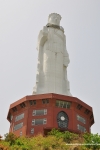
In 2010 I actually drove past the 80 meters tall World Peace Giant Kannon on its 20 meters tall socket building. Sure, it looked interesting, but the bright white statue seemed to be rather new in the warm sunlight of that day, so I didn’t even consider stopping. When I got back home and looked up what the statue really was I found out that most important of all it was abandoned… (It’s the 4th tallest statue in Japan and the 13th tallest in the world. Including the socket it ranks 3 and 10.)

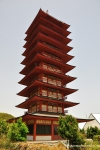
The World Peace Giant Kannon is actually part of the Heiwa Kannon Temple (heiwa meaning peace…), which was founded and funded by Toyokichi Okunai, a realtor who became rich dealing with office buildings, private apartments and business hotels in Osaka. The basis is a 5 storey building, 20 meters tall. The first floor was home to all kinds of religious exhibits as well as well as information about the famous Shikoku Pilgrimage (consisting of 88 temples along a 1200 kilometers long hiking course which usually takes between 30 and 60 days to complete). The other floors were stuffed with Mr. Okunai’s private collections – transportation, watches, china, art, armors. The fourth floor was home to a sightseeing restaurant, a banquet hall and a souvenir shop. If you look up the 80 meters tall statue on top of the building you can see some kind of a “collar” right below the statue’s head – that turned out to be an observation platform.

Although attracting up to 2000 visitors per day it seems like a lot of people were appalled by this mix of religion and commerce, some even accused Mr. Okunai of heresy. When Mr. Okunai died in 1988 his wife took over the management of the World Peace Giant Kannon until her death in February of 2006. After her death the Okunais’ real estate company closed the place right away and the Heiwa Kannon Temple started to fall in disrepair quickly, probably due to the lack of management of Mrs. Okunai during her final years. The Lehman Brothers took over, but they failed badly themselves at the time. Put to auction several times in 2007 and 2008 by the Kobe District Court nobody bid any money (which reminds me of the *Former Iranian Consulate* in Kobe…), so the temple was shifted to a separate company in September 2008. Since the World Peace Giant Kannon was liable to collapse (its exterior is molded of gypsum and resulted in the statue’s nickname Whiplash Kannon”) a committee was established in May 2009 by the local government, which took measures against the further deterioration of both the World Peace Giant Kannon and the nearby 10-storey pagoda in September of 2011. Just a couple of months after my buddy Gianluigi and I explored the place…

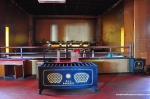
Walking up to the Heiwa Kannon Temple is actually quite impressive. The huge pagoda is right next to a parking lot and a closed restaurant. From there we had to walk up a hill to the back of the socket building. There we found all kinds of statues and items that didn’t go together very well, including a miniature version of the Statue of Liberty and an original Class D51 steam locomotive, the D51 828. We circled the socket building quickly and found an easy entry. The first floor was almost empty as most religious exhibits were gone. A quick look at the office on that floor didn’t give us much insight, so we headed up one of two staircases (one in the north, one in the south) that connected the floors. Some of them were locked, but we gained access to the restaurant on the fourth floor and the tatami room on the fifth floor. Approaching the fifth floor we heard voices, so we talked loudly to make ourselves heard. A minute or two later a young couple in their early 20s rushed past us, the guy holding a photo camera and the girl’s clothes not really being in order – your guess here is as good as mine…

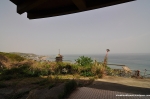
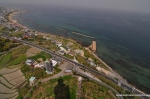
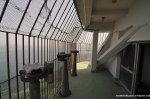
The tatami room once held the Mr. Okunai’s armor, but nowadays well armored soldiers of another kind were all over the floor: suzumebachi, Japanese Giant Hornets, 5 centimeters long killer machines. Luckily they were dead and it wasn’t summer yet, so Gian and I concentrated on the task at hand. In one of the hallways leading to the staircases we found an elevator – and nearby a mysterious claustrophobically narrow und pitch-black staircase that began to wind upwards. After spending a couple of minutes on the rooftop of the socket building admiring the beautiful gigantic Kannon statue we headed back inside and up the staircase. It was dark, the air was bad and some door-like openings revealed unpleasant views at the inside of the statue – even without knowing that people were discussing repairing the Kannon it was pretty clear that investments were necessary. After climbing stairs for about 10 minutes (it felt much longer…) we finally reached the observation platform, which offered both stunning and scary views. The location of the World Peace Giant Kannon between the coast of Awaji Island and the gentle hills was breathtaking – and so were the cracks in the gypsum everywhere. Buildings in Japan are barely constructed for eternity, but this one definitely has seen better days!

And so Gian and I walked down stairs for about 85 meters and left after spending surprisingly much time at this obviously quite popular abandoned statue – passing the also abandoned pagoda a group of about half a dozen Japanese twens was walking up the hill to have a look themselves. And I am sure they weren’t the last visitors as the maintenance work at the Heiwa Kannon Temple started not earlier than four months later…

(If you don’t want to miss the latest article you can *follow Abandoned Kansai on Twitter* and *like this blog on Facebook* – and of course there is the *video channel on Youtube*…)

Read Full Post »

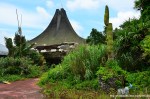
A place known to the net simply as Okinawa Cactus Park was one of the haikyo I really wanted to see when *Michael Gakuran* and I went to Okinawa earlier this year. The official name of the park was Mexico Cactus Park Sarabanda. It was opened in 1993 and closed in September of 1999, its big Mayan style head becoming an Okinawa urbex icon. The park wasn’t a super spectacular place (although there were 150.000 plants of more than 800 kinds) or a very popular one, but it was unique. I’ve never been to a cactus park before and for sure not to an abandoned one.

When Michael and I drove up to the place I had a very bad feeling – the road and the parking lot were in way too good condition and not blocked at all. As soon as we saw the main building it was pretty clear that we were either at the wrong location or the place had been refurbished / converted. Luckily Michael is a chatty guy fluent in Japanese, so he walked up to the next best person and found out that we were at the right spot at the wrong time. The cactus park, abandoned for more than 10 years, had been reconverted about 1.5 years prior to our visit, unnoticed by the Japanese urbex scene (where I borrowed the term haikyo (ruin) from, just in case you are a rather new reader).

“Cactus Park – Rest in Peace” would have been a more appropriate headline for this article than you might have expected, because the former theme park was actually converted into a graveyard. A gorgeous graveyard I might add. Located at the southern coast of Okinawa the whole area is just beautiful (I marked it on my *Map of Demolished Places in Japan*). And instead of leveling the whole cactus park the architectural office responsible for the new design did a great job using existing structures. All the old roads and paths of the former cactus park were still there, so was the main building at the entrance and a smaller building close to the cliffs, offering a stunning view and a place to rest. The cacti were all removed, except for maybe a dozen on a big rock close to the entrance – traces of the former theme park were there, but we had to look closely to find them.

The new name of the huge area is Okinawa Seimeinooka Park (沖縄清明の丘公園) and it’s a non-profit cemetery not only for all confessions, but for all religions. The barrier-free area has the size of 68830 square meters and offers space for a total of 1.740 graves which strangely correlates to the parking lot with 174 spaces (I assume those 1.740 graves include the spaces of the “joint enshrinement grave”). Each grave has a size between 2 and 15 square meters and costs 140.000 Yen per square meter (one-off) plus 10.000 Yen per year.

Michael and I were both a bit disappointed not to be able to explore an abandoned cactus park, but we agreed that they did a wonderful job converting it. We didn’t spend too much time on the premises, but before we left Michael talked to one of the employees at the beautiful Roman style main building. To my total surprise he found out that there were two cactus parks in the area in the late 90s. This one, the Mexiko Cactus Park Sarabanda, and another one called Himeyuri Park – not to be confused with the Peace Memorial Park and the Himeyuri no To monument. The Himeyuri Park was also closed and abandoned, but not destroyed and reconverted. So off we went to our next adventure on our *trip to Okinawa*

(If you don’t want to miss the latest article you can *follow Abandoned Kansai on Twitter* and *like this blog on Facebook* – and of course there is the *video channel on Youtube*…)

Read Full Post »

Urban exploration in Okinawa? Not exactly my first association when I think of the former kingdom of Ryukyu. For me it would be more like sun, beaches and… Karate Kid 2 – a movie I’ve never seen, or at least I can’t remember seeing it, but in Germany it had the tagline “Entscheidung in Okinawa” (something like “Decision in Okinawa”) and I guess that stuck with me ever since. Okinawa = Karate Kid – but I always thought it was the third one, not the second one…

When my haikyo buddy *Michael Gakuranman* and I went on a *road trip to southern Honshu* earlier this year we were talking about future expeditions. Michael mentioned that he went to Okinawa just a couple of months prior and that he explored a huge hotel he really wanted to re-visit. So he suggested a haikyo trip to Okinawa. And I was skeptical. Going to Okinawa to revisit a hotel? I knew right away which hotel Michael was talking about since it is one of the few famous abandoned places in Okinawa (Okinawa really isn’t famous for urban decay, not even amongst urban explorers), but him saying that he wants to stay a whole day there didn’t exactly seal the deal. But I am currently re-discovering Japan as a tourist (I travelled a lot in spring!) and the chances to go to Okinawa are limited, so what the heck. Let’s go to Okinawa and do some urbex! It would surely beat the beaten tracks of urbex in Kanto!

A couple of years ago the concept of budget airlines finally reached Japan and if you book early you can get really good deals. To make sure that we both arrive and departure at around the same time and we both would get reasonable rates Michael was kind enough to take care of the booking – 10.800 Yen for the roundtrip Osaka-Naha-Osaka; booyah! A Shinkansen train ticket Osaka to Hiroshima costs about the same – one way…

Late May isn’t exactly the best time to go to Okinawa since May and June are two out of three most rainy months down there, but again… why not? It’s Okinawa and I’ve never been there. The places we planned to explore sounded kind of okayish on paper, but I was more interested in Okinawa itself. The local atmosphere, the local architecture, the local food. Biggest surprise: shikuwasa (pronounced something like sheek-wasa), a Okinawan citrus fruit and the basis for all kinds of food and drinks – juice, cake, wine, mochi, sodas, chiffon cake, syrup (for kakigori), fruits chews, … In the humid pre-summer heat the most refreshing taste I ever had the pleasure to enjoy. Another popular local fruit is the pineapple. Close to the city of Nago are actually two pineapple theme parks close to each other – separated by the Okinawa Fruits Land. Michael and I visited the Nago Pineapple Park on one of the three days we spent in Okinawa. Not much of a park it features one of the tackiest rides possible – automatically driven carts through a pineapple field, telling you everything you (never) wanted to know about pineapples in horrendously pronounced English. And that was it for the park part – we basically paid 600 Yen to enter a gift shop. One of the most awesome gift shops ever though. Here you could buy (and sample!) all kinds of pineapple and (some) shikuwasa related products. Wine, cookies, chocolates, prize-winning cakes, dried fruits, different kinds of fresh pineapples, pineapple charcoal soap (!) and of course the usual gift shop stuff like plush dolls, key chains and whatnot. Awesome place, expensive though – I nevertheless loved it.

Over the course of our visit Michael and I managed to enjoy a good mix of urban exploration and tourist stuff, although Okinawa isn’t exactly famous for urban exploration. Luckily the urbex locations turned out to be way more interesting than they looked on paper, including an original find – one location freaked me out so much that I got fed up and left, one of the worst urbex experiences I ever had. So in the end we saw three abandoned hotels, two abandoned cactus parks and one abandoned restaurant island on the course of three days. As for touristy locations we visited the already mentioned Nago Pineapple Park, Shuri Castle (awesome!), Nakagusku Castle, the Underground Naval Headquarters of WW2 (overrated – it almost always makes me cringe a little seeing Japan presenting WW2…) and of course Kokusai Dori, the main tourist / night life street in Naha, Okinawa’s capital.

I didn’t plan to write about this trip so quickly, but last weekend opened up out of nothing and the East Asian rainy season (tsuyu) hitting Japan basically rendered it useless for outdoor activities – and overall I loved the trip, so it was the next best thing to get this series of articles started. The weather was constantly changing, but sunny most of the time. The food was awesome (I’m still not a fan of goya though…) and the places we visited were interesting. Life in Okinawa seems to be much more relaxed that in mainland Japan. For example: Taxi drivers in Osaka wear suits and white gloves, taxi drivers in Okinawa wear kariyushi – basically the Okinawan version of the Hawaiian shirt. And what’s not to love about an island that has strong reservations about Americans and Japanese alike? 😉

And finally here’s an alphabetical list of the upcoming articles about this haikyo trip to Okinawa:
Dolphin Restaurant Island
Himeyuri Park
Lequio Resort Hotel
Nakagusku Hotel Ruin – The Background Story
Nakagusku Hotel Ruin – The Exploration
Okinawa Cactus Park / Okinawa Seimeinooka Park
Sunset View Inn Shah Bay

(If you don’t want to miss the latest article you can *follow Abandoned Kansai on Twitter* and *like this blog on Facebook* – and of course there is the *video channel on Youtube*…)

Read Full Post »

Nippon No Haikyo, probably the most famous Japanese book about urban exploration / haikyo since it was recommended plenty of times by both Japanese and foreign blogs because of its huge amount of maps, recommended Yashima as one of the top abandoned places in West Japan. In my opinion Nippon No Haikyo is vastly overrated – while some maps are quite detailed others are completely useless. Even more so since an estimated 50% of the places (at least on the West Japan list) are either demolished or completely trashed by now. At the same time some of the best haikyo locations, like *Nara Dreamland*, are missing completely. But I guess you’ll get what you pay for: a 4 year old book about a topic that can change within a week or two. Especially in Japan, where old buildings are replaced by parking lots while you are on vacation. (It actually happened in my neighborhood…)
So whenever I visit a location described in Nippon No Haikyo I’m prepared for the worst, just in case. Which was a good thing in the case of Yashima – more than half of the buildings that were responsible for the praisal are gone now; four, to be specific. All that was left of them: 3 leveled building grounds, ready for new construction to begin. Construction that most likely won’t happen.
Yashima (屋島, roof island) has attracted people for centuries. The famous temple Yashima-ji on top of the mountain, founded as a Ritsu school temple in 754 by Ganjin (a.k.a. Jianzhen, 688–763), is the 84th stop of the Shikoku 88 temple pilgrimage. On March 22nd 1185 the Battle of Yashima took place in the waters around Yashima, resulting in one more defeat for the Taira, who owned a castle on top of the mountain. (Which is being reconstructed as I write these lines…) The whole story was later made popular in an epic poem called “The Tale of the Heike” (平家物語, Heike Monogatari).
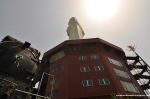
A famous temple, stunning views of the Seto Inland Sea, a historical battle. What else do you need to attract tourists? Right, an aquarium! The Yashima Mountaintop Aquarium (屋島山上水族館, Yashima Sanjo Suizokukan) was opened in 1969 and reopened as the New Yashima Aquarium (新屋島水族館, Shin Yashima Suizokukan) in 2006. In-between some (not so) smart businessmen took advantage of the Japanese asset price bubble (1986 to 1991) to build some rather big hotels on Yashima, creating way more beds on the 300 meter high mountain than necessary. Because let’s be honest: Yashima is a daytrip location, not a place to stay overnight. (Heck, I made it a daytrip although I live in Osaka!) Around the turn of the millennium most of those new hotels were already forced to close, only a few smaller ryokan north of Yashima Temple survived. It seems like the closed hotels were still standing there when Nippon No Haikyo was written in 2007, maybe for two or three more years – when I visited in late 2011 most of them were gone… The Lost Ruins of Mount Yashima.
(I used this posting for a big update of my *Map of Demolished Places in Japan* – it’s really worth a look!)

Read Full Post »

« Newer Posts - Older Posts »