All abandoned: Chernobyl / Pripyat, Nara Dreamland, Anti-Zombie Fortress, Japanese Sex Museum – and many, many more! Plus: North Korea Special – 2 trips, 16 days / 14 nights! As seen on CNN…
I fell in love with this abandoned restaurant (and onsen) instantly when I first saw a photo of the building about two years ago. Sadly the interior didn’t live up to the expectations when I finally got there…
There is always a lot of construction going on in Japan. Most buildings are having a life expectancy of just 30 years, a lot of river beds are embattled with concrete, and mountain roads once following the natural formations of small streams and hills are rectified by tunnel shortcuts. The Japanese Restaurant & Onsen, apparently a luxury product of the 1980s bubble economy, was located on one of those river bends that were cut off by a new road with a tunnel. It looks like once all the traffic from and to the mountains had to pass by the gorgeous little complex – and then all of a sudden people were able to speed by a sign on a much bigger road; most likely the kiss of death for this beautiful relaxation oasis.
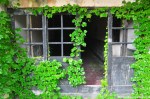
Sadly I wasn’t able to find much reliable information on this location – when it was built exactly, when it was abandoned, if it was just a rest house or if they had rooms to rent. The main complex with the restaurant was actually so overgrown that we were lucky to get there in winter; in summer it’s probably inaccessible without a machete. While the small complex looked amazing from the outside, the inside wasn’t able to match. A lot of rooms were empty or just had a few objects lying around – and it was moldy like hardly any place I’ve been to before. I’m sure the area gets quite a bit a snow in February / March, and being located directly next to a mountain river probably didn’t help either. The onsen building across the street was in much better condition, but neither a place I would want to stay for a whole. The interior was rather simplistic, but not without beauty – stone, bright wood, nice carpets. I definitely can imagine people having a luxury meal and then enjoying a good soak there, probably the best way to break up a long drive for one or one and a half hours!
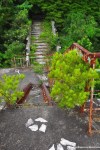
Years of abandonment obviously didn’t do any good to this interesting, somewhat contorted complex – while it was a bit disappointing to explore, it still offered some great angles and objects, for example the huge stone lantern outside at the dried-out pond.
The Fuji 5 Lakes area consists of Lake Yamanaka, Lake Kawaguchi, Lake Sai, Lake Shoji, and Lake Motosu – forming an arch around the northern part of Mount Fuji in Yamanashi prefecture. Famous for hiking, mountain climbing, sailing, fishing, the Aokigahara Suicide Forest, Fujikyu Highland and local udon noodles, this recreational area two hours outside of Tokyo attracts about nine million visitors per year… and many of them enjoy a soak at an onsen in the evening. Of course not all of those public baths can be successful – bad for the owners, good for explorers like me and readers like you…
The Fuji Five Lakes Onsen is a surprisingly rare location and apparently virtually unknown to the Japanese urbex scene. It’s actually easier to find information about the time when it was open for business than about its current abandoned state; hence the rather vague fake name for it. The place was actually not just a day trip spa (charging 300 Yen for the time between 9 a.m. and 4 p.m.), it was also a ryokan, a Japanese inn for overnight guests. Located next to a river in a tiny mountain town, the Fuji Five Lakes Onsen turned out to be a hidden wooden gem, a glimpse at Japan’s simple past that is disappearing quickly.
At 7,000 to 10,000 Yen per person and night the FFLO wasn’t exactly a cheap place to stay at, especially considering that it closed about 10 years ago. I am sure back then it was easily possible to get a more luxurious accommodation for a lower price – but probably with a lot less character. The main building of the Fuji Five Lakes Onsen was a narrow, but rather long wooden construction – followed by small apartments in the backyard along the river. After ten years of abandonment rather wobbly and squeaky, the main hallway wasn’t for the faint of heart, especially with road construction going on right outside. If we were able to hear them scavenge the street, they were able to hear almost any noise we made. Luckily they weren’t aware of *Hamish* and I being there, so they didn’t pay attention; a huge advantage on our side and a late reward for us approaching the Fuji Five Lakes Onsen carefully, avoiding any noises getting in.
The tricky part was the upper floor with its tatami party room. Regular readers know what kind of place I mean – the big one with the stage and the karaoke machine and stuff like that. What was so tricky about it? Well, the upper part was actually on road level, so the construction workers were able to look inside through some of the windows… if they would have paid attention, which they didn’t. Good for me, as the party room held some interesting items to take pictures of, including some 60s or 70s music devices and a Konami Hyper Shot controller for use with the smash hit Hyper Sports.
Down on the main floor again I took some photos of the pretty run down onsen part, the gender-separated shared bath. Surprisingly small, it must have offered a nice view on the river a few decades prior. Now the huge windows were mostly overgrown from the outside and vandalized by penis graffiti from the inside – the whole room felt rather cold and inhospitable on this beautiful autumn day.
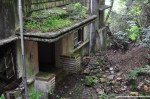
The half a dozen guest “houses” in the back looked a bit like an afterthought and some were already in quite questionable condition. The eclectic conglomerate was big enough for about 30 people, with each hut hosting a family or a carload full of friends. Been there, done that… and the light was disappearing quickly.
What made the Fuji Five Lakes Onsen such a memorable exploration was the simplicity of the place. No shiny modern kitchen, no ten-storey concrete building, no spa area the size of a football field, no arcade, no elevators – just plain wooden buildings, a handful of guest apartments and an almost underwhelming shared bath. The most modern item probably was that controller for said Konami game, every other item there most likely was from the 70s, 60s or even 50s.
The last couple of places I presented on *Abandoned Kansai* were not very Japanese at first sight, especially locations like the *Western Village* or the *Hachijo Royal Hotel*… but the Fuji Five Lakes Onsen is as Japanese as it gets!
You would think that after eight years in Japan surprises and weird situations should become rather rare, yet Hachijojima was full of them – good and bad…
In early 2014 a bunch of interesting looking abandoned hotels popped up on Japanese urbex blogs, with one thing in common: they all were located on an island I hadn’t even heard of before, Hachijojima. Turns out that it is right next to Aogashima, a hard to reach volcanic island that is often part of those “the most remote places in the world” lists that are so popular on Facebook and other social media sites. When you are living in Kansai, basically one big city of 22 million people (plus 0.7 million spread across the countryside), “the most remote place in the world” sounds wonderful, at least to me – so I decided to do a combined Hachijojima / Aogashima trip during the first half of Golden Week. Long story short: I was able to locate three gigantic abandoned hotels on Hachijojima, but I failed to organize the side trip to Aogashima due to unpredictable weather, high risk of boats getting cancelled and the season I was travelling in; *Golden Week can be a real pain* as even the biggest Japanese couch potatoes think that they should travel, because everybody else is. So I stayed on Hachijojima for 3.5 days – part relaxing vacation, part urbex trip.
For the first night I booked a small minshuku on the east coast, just five minutes away from one of the abandoned hotels. Sadly the place turned out to be in a very remote area with hardly anything around… and even worse, it was terribly overpriced due to Golden Week. So instead of extending my stay, I took a taxi to the local tourist information the next morning – and the super friendly staff managed to get me a cute little hut at a local lodge with breakfast, bathroom and internet for the same price as the basic tatami room with shared bath / toilet and without food or internet, a.k.a. the night before. They even drove to my new accommodation to introduce me to the owners of the family business as they barely spoke any English – a pleasant surprise after the cold reception at a local sushi restaurant the previous night; upon entering the chef, smoking outside, was asking his wife who just came in… and she answered “a foreigner”, using the slightly derogative term “gaijin”. Thanks a lot for the warm welcome! Luckily my new hosts were the exact opposite, some of the friendliest and nicest people I ever had the pleasure to meet. Should you ever go to Hachijojima and don’t mind a little bit of a language barrier, try the *pension Daikichimaru*!
I continued Day 2 by exploring the second big hotel on the island before climbing the most famous local mountain, Mount Nishi (literally “West Mountain” – guess where it is located…), better known as Hachijo-Fuji, thanks to its resemblance to Japan’s most famous mountain. 854 meters tall and of volcanic origin, Hachijo-Fuji turned out to be quite an exhausting and steep climb, especially on the last few hundred meters – but the view up there was amazing; one of the most rewarding hikes I ever did. (You can actually see the hiking trail on the first photo I took from the plane during landing approach.) If you are free from giddiness you can even walk along a sometimes just foot-wide path along the crater, but from where I started it looked like a rather risky walk, so I opted to descent to the green hell of Mount Nishi’s caldera; 400 meters wide and 50 meters deep it is home to lavish vegetation and even a shrine!
On the way down from Hachijo-Fuji I made a quick stop at the Hachijo-Fuji Fureai-Farm, a dairy products selling petting farm, which offers a great view at the plain between Hachijojima’s two mountain ranges. Upon arrival at the base of the mountain, near the airport, I came across a local guy and his dog. Despite being on a leash, the pooch ran towards me at full speed, barking like a mad dog (not a spaniel!) without any Englishmen; stopped by the slightly mental grinning owner maybe 20 centimeters from my ankles. Luckily it was one of those field goal dogs and not a German Shepherd or a British Bulldog, so I wasn’t too worried, but still… what a weirdo!
Almost as weird as my visit to a local supermarket the night before. After the sushi snack I had (made from local varieties like flying fish), I thought it would be nice to get some local products, so I entered a mom-and-pop store, the owner at the cash register talking to a customer. I grabbed a couple of things and when I was about to pay I saw the other customer leaving – and the owner told me that the shop was closed. So I asked if I could pay for the items I already grabbed. No! So I put the stuff back, which probably took longer than paying for it, and left empty handed… literally. Really strange 24 hours!
Day 3 was a lot more unspectacular. I took a bus to the southern part of Hachijojima and explored the third gigantic abandoned hotel after passing a police car basically in sight of it. Then I continued by bus to the Nankoku Onsen Hotel – which turned out to be a vandalized, boarded up piece of garbage with a neighboring house just 10 meters across the street. So instead of wasting any time I enjoyed a soak at a really, really nice onsen (without a hotel).
My last day on the island I spent mostly walking – to the Kurosuna sand hill and then along the coast back to the second abandoned hotel and then to the pension, from where I got a free ride to the airport.
Spending a couple of days on Hachijojima was one of the best things I did in all of 2014 – it’s just such a surreal and yet neat place! The main roads on the island for example look brand-new and very expensive. Given the massive drop in tourist numbers one wonders how a place like that can survive financially. Sure, three planes and a ferry per day bring quite a few tourists, but at the same time the three biggest hotels on the island and a few smaller ones are abandoned. Back in the 1950s and 60s Hachijojima was known as “Japan’s Hawaii” as it is much closer to Tokyo, Yokohama, Nagoya and Osaka than Okinawa, but those days are long gone and I doubt that fishing and some local farm products can pay to keep the island as neat as it is today.
Some of the islanders were just plain weird… and others were quite the opposite, the most helpful and welcoming people you could dream up. While mainland Japan became somewhat predictable to me over the years, Hachijojima gave me that “first visit feeling” back, where you just roll with the punches and expect the unexpected at all times. The nature on Hachijojima was absolutely stunning, the food was amazing (especially at the *izakaya Daikichimaru*, same owners as the pension; the best sushi I ever had!) and I even enjoyed the onsen visit… though usually I don’t like onsen at all – but the entrance fee was part of the bus ticket, so I gave it another try and liked it tremendously. *Facebook followers of Abandoned Kansai* might remember two photos I posted to the “Brand-new and Facebook exclusive!” album in late April this year – those will show up in future articles as I will start the Hachijojima series with the most unspectacular of the three hotels on Thursday, two days from now; though unspectacular is relative, especially if you are into abandoned arcade machines…
Alone at that beach on a rough coast, the sun rising, an ice-cold wind blowing – Day 4 of the Northeastern Adventure was off to a perfect start!
At first it didn’t look like it though. I am not an early riser, yet my third night in North Korea ended 10 minutes prior, when our host brought hot water to our room at around 6.20 in the morning. At the same time a dog started to bark and all of a sudden I knew that I wouldn’t go back to sleep, so I jumped into my clothes instead. Still a little bit sleepy and not yet used to the cold (in Osaka it was still around 30°C!) I stumbled down the dirt road for a few dozen meters until I reached the beach, slightly irritated by the patches of frost on the grass ground – you see that about two days a year in Osaka… which means that Osakans start to wear North Face jackets when the temperature falls below 10°C; at night! I was looking up then, the sun still scratching the horizon, when happiness about my decision not to stay at the room and to head outside instead rose within me. There is something about the combination of nipping air, solitary and beautiful raw nature that puts a smile on my face.
It turned out that Day 4 was actually all about the stunning nature of Mount Chilbo, so we headed out to the Hadok Falls and several viewing points within the Inner Chilbo area. Some we drove up to, but sometimes we hiked for a while (up to a kilometer or two) to reach our destinations. Again a beautiful autumn day at gorgeous locations! Irritating and amusing at the same time were the explanations of our guideguards, when they continued to telling us stories about pretty much every rock in sight. “This we call XYZ, because it looks as if ABC is doing DEF with GHI!” – and of course in most cases there were just rocks with no resemblance or relation to whatever we were told happened there. But Mr. Li came up with one mythological story after another. Stories he really seemed to believe in…
Quite a rare sight was the Kaesim Temple! North Korea isn’t exactly a religious country, so most “sacred” buildings surviving the Japanese occupation and the Korean War were destroyed afterwards. Not so this temple, founded in 826. Restored in 1377 and equipped with a bronze bell from 1764, the temple is an important depository for scriptures, sculptures and paintings.
An unexpected sight was a huge portrait of Kim Jong-il and three other guys halfway up a hill, depicting the group in the Mount Chilbo area. It seemed terribly out of place, but I guess with an increased amount of tourists in the future you have to remind people who was the boss and who started to develop the area for comrades on vacation. It was never mentioned specifically during the tour, but it seems like Kim Il-sung never visited Mount Chilbo as it was too rural and undeveloped during his days.
After a rather late lunch at the Outer Chilbo Hotel (with a group of exile North Koreans living in Japan on the next table – probably pachinko people…) we spent almost two hours on the bus on our way to Kyongsong. We arrived at the Yombun Revolutionary Site during dusk, with just enough light left to take a couple of photos before heading to the Kyongsong Local Hot Spa House (part of the Kim Jong-suk Sanatorium), where some of us took a hot bath. After seven years in Japan still not a fan of the onsen culture there, two other guys and I headed for the Kyongsong Guest House, the local and really basic accommodation – no blackouts, but again neither hot nor running water.
(Funny story: At least one of my fellow travelers took their camera with them into the spa house, but for obvious reasons not into the bath. Later that evening they were told by our western guide that the Korean guides recommended to delete some of their photos! Nothing like privacy, eh?)
The night at the Kyongsong Guest House was not only our last evening with our first set of guides, it was also the 40th birthday of Mr. So, who did a good job keeping us on schedule and ironing out any problems in the background, while Mr. Li kept us entertained and within limits. Dinner was even bigger than usual and after a rather melodramatic speech by Mr. So the celebrations began – including lots of alcohol and songs. Even our third guide, Mr. Sin, loosened up and wouldn’t stop singing, dancing and drinking…
(Speaking of third guides: A third guide is only present if Americans are part of the group! The western tour guides were always vague about it and kind of made it sound as if it was coincidence whether or not a third guide would be with a group, but according to more experienced fellow travelers it really depends on the presence of Americans…)
My twelfth day in North Korea across both trips was probably my favorite one overall. I love spending time in the countryside and this day had it all. A wonderful sunrise at a gorgeous beach, light hiking at a stunning mountain range and a beautiful sunset at the wild cliffs of a revolutionary site – in addition to that good food and interesting conversations. An almost perfect day…
Nampo / Nampho is the center of the North Korean shipbuilding industry and has a population of about 370,000, making it the fourth biggest city in the DPRK; other important employers are the Nampo Fishery Complex, the Nampo Smelter Complex and the Nampo Glass Corporation as well as several sea salt producing companies.
My trip to Nampo began, like most trips there, on the Youth Hero Motorway, a 46 kilometer long expressway between Pyongyang and the industrial city on the north bank of the river Taedong. Construction started in November 1998 with the massive support of young Korean volunteer workers; hence the name Youth Hero Motorway. While on the highway Mr. Yu told us that he was one of the volunteers when he was a university student – you could read between the lines that it must have been an excruciating project for everybody involved… Opened in October 2000 the widest motorway in North Korea (5 lanes in each direction!) already is in really bad condition. At least half of it is full of potholes, so we were able to drive faster on most countryside roads. (A video taken on the Youth Hero Highway came with *the first article of this series*.) I didn’t have a look at the watch how long it took us to get from Pyongyang to Nampo, but I guess it was about 2 hours, probably longer…
Nampo itself looked a lot more like how most people imagine North Korea to be – a bleak industrial city full of decay, with a lot less of those colorful apartment blocks and post-futuristic buildings I loved in Pyongyang; the streets being in a lot worse condition, too. We never stopped anywhere within the city limits, but parts of Nampo would be a perfect location to shoot a remake of Michael Radford’s 1984. When we drove past the Nampo soccer stadium I thought that most of the abandoned buildings I visit were in better condition – the FIFA would never approve of that one! (A *look at GoogleMaps* confirmed that the stadium basically is a ruin…)
The sun was setting and it was a beautiful evening, but quite a bit of Nampo looked rundown and rather depressing. Some government buildings and the huge paintings of Kim Il-sung and Kim Jong-il looked nice, but overall it was pretty clear that Pyongyang had priority over Nampo in many ways. I am actually a bit surprised that we drove through Nampo as there is a bypass north of the city center – so they could have avoided showing us stuff like the soccer stadium if they really wanted to… (I took some photos and both videos published with this article the next morning on the way to the West Sea Barrage, just in case you wonder about the different lighting conditions.)
The Ryonggang Hot Spring House (in most itineraries referred to as the “Dragon River Hot Spa Hotel” is not in Nampo city, but 20 kilometers northwest in a small town called Onchon – and like so many rather modern things in Korea it dates back to when the country was under Japanese occupation; which also might explain why you take off your shoes at the entrance and switch between house slippers, apartment slippers and bathroom slippers… The House actually is a resort, consisting of seven small villas with four apartment units each, and a so-called service center with a restaurant, a karaoke room, a pool room, and all the other usual stuff. Each apartment has its own private hot spring tub; the water is said to treat “hyperpiesia, non-tubercular arthritis, neuralgia, neuritis, lumbago, varieties of wound (sic!), sequelae of operations, chronic gynecologic inflammation, functional disorder of nidamental gland, sterility, chronic gastritis, chronic colitis, skin diseases including eczema and prurigo” according to the spa’s brochure. Speaking of the brochure – it was too large to scan as a whole since it was three big pages each side wide. So I scanned the more interesting two connecting pages on each side, leaving out the pages that mainly consist of water analysis data and tourist spots nearby.
Upon arrival Mr. Yu, Mr. Kim and Sarah started to set up the famous petrol clam BBQ *I wrote about in the food article*. By then it was pitch-black and rather cold outside, but the soju and vodka warmed everybody from the inside. Half an hour later the whole group went to the main building to enjoy dinner – a pitch-black dinner at times as Nampo, unlike Pyongyang, suffers from regular blackouts. But the food was good and the company was nice, so it was a really successful evening again…
Oh, one last thing about the Ryonggang Hot Spring House: The tree covered resort is surrounded by a barbed-wire fence and the main entrance (facing open fields, not the town’s center) is guarded by an armed soldier – your guess whether he is there to protect guests from locals or locals from guests is as good as mine!
Urban exploration is a dangerous hobby. How dangerous it really is I found out at the Daieikaku, a rather big abandoned ryokan south of Osaka. I was literally and figuratively one step away from my demise…
The Daieigaku was the first location Damon and I went to together back in 2010. Later we continued to explore the *Gion Love Hotel*, the Ferris wheel *Igosu 108*, the *K-1 Pachinko Parlor*, the *Tsuchikura Mine* as well as the *Kasuga Mine A* and *Kasuga Mine B* – but first the Daieikaku, a hotel that turned out to be quite hard to get to.
Back then I had done all my explorations using trains, but the Daieikaku was too far away from the closest station to walk to, so we had to take a bus. Which is a hassle in pretty much every country, especially if your command of the local language is… sub-par. Sometimes it’s close to impossible to figure out schedules and stops. When I wanted to get to a place near a university campus in Hokkaido last year it took the local tourist information at JR Sapporo Station 15 minutes to figure out which bus to take – and I knew the name of the bus stop I wanted to go to! Figuring out which bus to take to the Daieikaku wasn’t easy, but it wasn’t the only problem: The Daieikaku was located at a slope on the other side of a river, but the bridge leading to the ryokan was completely overgrown. Even in autumn with weakened flora we weren’t able to get to the other side, especially without being seen by locals and day visitors. So we crossed the river via another bridge, climbed up the slope and got to the back of the Daieikaku at the level of the third floor. Instead of taking some steps down to the ground floor we entered through a smashed in window right where we were. Starting up there was as good as anywhere else we thought…
Big mistake! The first room was one of those tatami party rooms you have in pretty much every hotel in Japan. Thanks to open doors and windows everywhere in the Daieigaku the place was in rather bad condition with leaves all over the place. I went to the side of the building, looking for a staircase. Found it, passed it and opened a door… a restroom. I went inside to have a closer look, but although the floor looked a lot more solid than the one in the tatami room it didn’t feel like it. Halfway into the room I had a very, very bad feeling, so I went back to the hallway, down one floor via the staircase, opened the door to the restroom below the one I just entered and… it was gone! There was no friggin restroom! Only one wall with some urinals hanging mid-air! And the bathroom I was in basically was attached to the rest of the building by its walls. I guess I don’t have to mention that the floors below were gone, too, so if I would have walked further into the restroom two minutes earlier (or probably just would have stayed where I was) there would have been a good chance that I would have crashed through a thin layer of tiles and wood three floors down to my death. After I recovered from that realization I went straight to Damon to warn him about the death trap on the third floor. Luckily he didn’t put himself in danger, so we continued our exploration without further incidents, although we continued to take risks every once in a while – especially Damon, who was exploring the hotel like a honey badger. Through tiny broken windows with shards left, up and down rotting wooden stairs, … Which lead us down to the onsen part of the ryokan, a part of the hotel I probably wouldn’t have gotten to if I would have gone there on my own, especially after that little shock right at the beginning. There we saw some major cracks in the ceiling and the wall, which didn’t exactly help to ease my mind – parts of the Daieigaku already collapsed, so being in the middle of the building with unstable floors above and below wasn’t exactly the place I wanted to be in. But the former lobby didn’t look any better. We first saw it from 2F and looked down – staircases gone, walls caved in… The whole building was in worse than dilapidated condition and I guess every single step could have been our last!
Looking back at the exploration of the Daieikaku I have to say that we were terribly naïve and really lucky. The term “Daieikaku” means big glorious building and it is often used for restaurants serving a charcoal grilled meat dish called yakiniku – and while the ryokan Daieikaku was indeed a big building it was everything but glorious. It was a deathtrap and by far the most dangerous location I have ever explored. It also was rather unspectacular overall, that’s probably the reason why I never wrote about it, almost forgot about. Back then I just did a pre-selection of my photos, deleting only the worst, so I had to go through almost 150 of them to make a final selection for this article – and it actually makes me wanna go back there. Three years ago I shot without a tripod and the Daieikaku was pretty dark in some places, though it was a bright and sunny autumn day. Furthermore several earthquakes hit Kansai since then, including the Tohoku Earthquake that caused the Fukushima Incident and a recent one that struck Awaji Island. Plus Mother Nature had 30 months to do additional damage… Well, we’ll see – if time allows I’ll stop by there again to give you an update on what happened to the Daieikaku. For now I hope you’ll enjoy the photos I took during my visit. I’m sure you are eager to see what the collapsed bathroom looked like… 🙂
One of my favorite things about urban exploration is travelling. Most of the time I do day trips within Kansai, but every couple of months I go on mini vacations to other regions. *Okinawa*, *Kyushu*, *Hokkaido*, *Shikoku* … and a couple of more that will be revealed in the future.
I lived in Japan for several years before I started to visit abandoned places – and in those first years I barely travelled within Japan. Kansai has plenty of castles, temples and shrines, some of the most famous in all of Japan. More than enough to get templed out, shrined out and castled out, so I didn’t feel the urge to spend hundreds of bucks on train tickets – and then a similar amount on hotels. Only to see more castles, temples and shrines that look similar to what I can see down the street. Abandoned places on the other hand are unique – and some of them are actually worth spending a couple of hundred bucks, at least to me.
The spring of 2011 saw my second overnight trip to Shikoku. *During the first one* my favorite location on Japan’s least populated main island was the spectacular *Tokushima Countryside Clinic*, a small town doctor’s house, barely harmed by vandals and the ravages of time. My friend Gianluigi, an avid photographer for almost two decades, loved the photos I took at the clinic, so I convinced him to go on a road trip – I would show him that wonderfully spooky gem if we would stop on other abandoned places along the way…
If you are a regular reader of Abandoned Kansai you might remember two articles I wrote about really unique haikyo about half a year ago – the abandoned Japanese spa *Shimizu Onsen Center* and the giant Buddha statue / viewing platform *World Peace Giant Kannon*; both of them were actually part of this second trip to Shikoku.
So here is a complete list of all the locations: Amano Hospital Daiwa Pottery Kuroshio Lodge Shimizu Onsen Center Tokushima Countryside Clinic Revisited World Peace Giant Kannon
One of these places has been demolished since I visited it two years ago – you’ll find out soon which one… and then I’ll add it to my *GoogleMap of Demolished Haikyo*.
One thing Japan is famous for all over the world is its bathing culture – which is hard to believe if you ever had to spend some time on a rush hour train…
While surprisingly little of Japan’s vast coastline is used for swimming (due to pollution, rocky shores or cement tetrapods) there are three different main terms to describe Japanese baths:
furo (風呂): usually the polite form “ofuro” is used for this traditional wooden bathtub
onsen (温泉): hot spring, sometimes translated as spa, especially when part of a hotel, ryokan (Japanese inn) or minshuku (Japanese bed and breakfast)
sento (銭湯): communal bath house – onsen and ofuro can be part of a sento
The use of those three terms can be confusing at times. While (o)furo technically describes a bathtub (traditional ones made of wood, modern ones made of plastic) with steep sides of about 60 cm height used for a relaxing soak at 38°C to 42°C after (!) you cleaned yourself, it can also be used for the public bath at a gym – although those baths fit more what is describes by the term sento.
A sento is a communal bath with a locker room and a bathing area – gender separated! You get undressed and lock your clothes before you enter the tiles bathing area with a hand towel. Near the entrance you usually find small stools, buckets and faucets. There you sit down and clean yourself before you enter the bathtub, which can be tiled or wooden – and therefore resemble ofuro. (To see what not to do, watch the movie Mr. Baseball…) Modern sento also include small saunas similar to the ones you know from your home country.
Onsen are hot springs and the most famous part of the Japanese bathing culture. Indoor onsen look much like sento and their number is quite low – the vast majority and well-known to everybody even slightly interested in Japan are outdoor onsen, also known as roten-buro (露天風呂). The behavioral code at an onsen is pretty identical to the one at a sento – the main difference is that onsen are fed by natural hot springs, not by heated tap water; and that they are usually more luxurious and beautiful – dozens of countryside towns all over Japan are famous for their onsen resorts and a lot of places to stay charge several hundred bucks per person and night (including breakfast and dinner).
Personally I am not a big fan of ofuro, sento and onsen – mainly because the water is just way too hot for my taste. I’m sweating enough as it is in Japan thanks to the rather high humidity here. I really don’t need to soak myself in water that is higher than my body temperature. The other reason, to be honest with you, is the fact that you stick out there as a foreigner – and I am really tired of being stared at. It’s bad enough at the subway sometimes, even in a city like Osaka. Imagine you being the only foreigner in a countryside bath then… If I’d be the last man on earth and would show up in my birthday suit at the “World Congress of Nudist Nymphomaniacs” near a naturist beach of your choice – I couldn’t earn more stares that way! I get it, most Japanese men don’t have the opportunity to see a naked foreigner and they have an urge to find out if the cliché is true and everything is smaller in Japan, but come on! It’s really impolite…
(Fun fact: Most Japanese people don’t know that public bathes in Japan were mixed until the Meiji era (1868-1912) when the nation started to open to the west. Germany, especially the eastern part, has a long naturist tradition and when I tell Japanese friends that we have mixed nudist beaches and bathes in Germany they are totally shocked and claim that they would never go there since people must stare at each other all the time, which isn’t the case at all. Fact of the matter is that I get way more stares fully clothed on a train in Japan than naked at a beach in Germany…)
Exploration
The Meihan Health Land technically was an onsen since it was fed by a natural hot spring, but it lacked most of the idyllic countryside aesthetics that come to mind when hearing the term – it looked more like a western spa trying to copy some Japanese flair. Located right next to one of the few free of charge highways in Japan and at least 30 minutes away by foot from the next train station it was clearly targeting the masses – families and busses full of tourists; a gigantic parking lot of more than 20.000 square meters supports that claim. The building itself, constructed in 1987 during the Japanese asset price bubble, was about 5.700 square meters big – it seems like it was the first “super sento” in Japan (or at least one of the first) and quite a lot followed. The Health Land closed 2 decades later with a renewal open planned for July of 2008 or 2009, but now it is on sale for 430 million Yen (currently about 3.5 million Euros / 4.6 million Dollars) – a sum it might have been worth right after it was closed, but a mere 2 years later, during my visit in November of 2011, it was already in abysmal condition.
The regular entrance fee for adults was 1300 Yen with an additional surcharge of 1050 Yen for guests staying overnight – yes, the Health Land was a 24/7 facility, offering loungers for tired guests. And of course the usual services like restaurants, shops, karaoke, …
Located in the mountains of Mie prefecture the running expenses must have been insanely high (considering that there is much isolation, but hardly any insulation in Japan…) and I am not surprised at all that the Health Land went bankrupt. I am surprised though how fast it fell into disrepair. The few photos I saw before exploring the place myself made me expect a super sento in good condition. What I found when I arrived with my buddy Hamish was a shock. From the outside the building still looked amazing, easy to see from far away thanks to two gigantic Chinese dragons on the top of the roof. The huge red lantern in front of the Health Land had seen better days, but the full amount of damage the place had suffered was only visible after entering.
The yakiniku (grilled meat) restaurant in the same building was smashed to pieces and so was the lobby of the former spa. There the ceiling was high, maybe 5 or 6 meters – nevertheless it looked like it saw an outburst of violence with damage far beyond anything natural decay could do within a year or two. I have no idea what happened there. Some of the damage, especially the water on both 1F and 2F, could have been explained by the holes in the roof – but how did those holes get into the roof in the first place? The place really looked like as if a supernatural force ripped it apart…
Next to the lobby we found a snack bar and deeper into the darkness of the building was a staircase to 2F as well as the separated bathing areas for men and women, both severely vandalized. The steam room of the men’s area featured some neat female nude drawings – drawings that attracted some homeless people, or at least one person. We found some belongings there, including a newspaper barely 2 weeks old..
Sadly the whole area, for both men and women, was smashed beyond recognition. Windows were kicked in, mirrors were broken, metal installations were ripped apart. Carpets and wallpapers were moldy and water was dripping everywhere.
The upper floor was in even worse condition. The restaurant area was only recognizable due to some signs, the former party room with a stage looked like it was vandalized and abandoned a decade ago. Pretty much all interior was either gone or smashed. Water and mold everywhere. Not really a pleasant exploration, but you never know in advance what you’ll find…
Like that taxidermy bull in some kind of concrete storage underneath the Health Land. We were already ready to leave when we found that half-overgrown door that lead into the building again… and there it was, a stuffed bull, covered by what looked from the distance like an Ostfriesennerz (“East Frisian Mink”, a yellow hooded heavy-duty medium-length PVC rain coat – and you thought German terms were long!). Of course it wasn’t the famous German clothing item, just a simple tarp. Nevertheless a neat find that put smiles on our faces, before we walked to the next train station; wondering how the Health Land could get into that kind of state so quickly.
The Shimizu Onsen Center was the last stop on a road trip to Shikoku my buddy Gianluigi and I did in the spring of 2011. Usually I write a short road trip summary in advance, but these days I’m a bit busy, so maybe I’ll make up leeway some day in the future – after all it was quite a busy road trip with six locations in two days.
Onsen is the Japanese term for hot spring, but usually it is more about the hotel / restaurant that is making use of the water. The Shimizu Onsen Center is one of those hidden gems of the beaten tracks deep in the mountains of Shikoku – and the name is just perfect, because shimizu actually means “pure water”. Pure water that won’t be soiled by many visitors, because the Shimizu Onsen Center closed a couple of years ago. If you try to find some information about it yourself, make sure to not confuse it with several other towns named Shimizu all over Japan (like in Fukui, Hokkaido, Kochi, Shizuoka, and Wakayama). You can imagine that the name is quite popular…
When Gian and I drove onto the already slightly overgrown parking lot we had no idea at all what expect – I had never seen photos of the Shimizu Onsen Center and I’ve never seen any since I’ve been there, so please consider it an original find that hasn’t appeared on any blog about Japanese ruins, neither in English nor in Japanese. As we got out of the car it just started to rain and we were pretty tired after a series of exciting but energy-sapping explorations. Nevertheless we closed in quickly, but carefully, just in case the low buildings nearby were home to some curious spectators. But we were lucky and able to enter the Shimizu Onsen Center without trouble of any kind. Not only that, but there was a note taped to the entry glass door of the spa, explaining a little bit about the place’s history. According to this it was opened in 1981 and operated for 14 years before it was sold to a new owner. Financial trouble began in 2003 and in late November of 2007 the place closed with 160 million Yen of debt – just three and a half years before Gian and I visited.
The Shimizu Onsen Center was fed by a sodium hydrogen carbonate spring with a temperature of 17 degrees Celsius, helpful to treat rheumatism, neuralgia, diabetes, and skin diseases. It targeted mainly day-trippers and tourists who booked accommodations nearby. Opening hours were from 9 a.m. till 9 p.m. (closed every 1st and 3rd Thursday of each month) and the entrance fee was 600 Yen. In the northern part I found a couple of Japanese style guest rooms with tatami mats and small TVs, but I’m not sure if they were used for overnight stays or just to relax between two baths.
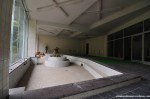
Gian and I entered through the normal entrance on the second floor and went straight downstairs to the first floor, where the baths were. Both the one for males as well as the ones for females were equipped with a sauna and featured several frog statues. The Japanese word for frog is “kaeru”, which can also mean “to return”, and that made them good luck charms / symbols for money and coming back safely. This floor also featured the already mentioned guest rooms, which could be reached through a very, very dark hallway. The whole floor and all the items there looked a bit old and run down (like the massage chairs in the hallway and vending machine for razors), but there were no signs of vandalism or theft.
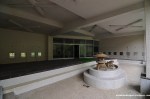
That also applied for the second floor with the front desk and a huge tatami room with a stage – a typical Japanese party room for long karaoke sessions with dozens of attendees. The tiny coop next to the stage even still had all the music equipment including countless tapes. No vandalism, no theft. In the entrance area we found a bin stuffed with umbrellas, slippers were still lined up and the front desk was neat and tidy.
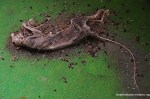
The rather small third floor was exciting and disappointing at the same time. On the one hand the former bar was removed and so were the arcade machines that one day must have been there. On the other hand I finally found some dead animals, in amazingly good condition actually. Two skeletonized birds and a rat with some of the skin left, surrounded and partly covered by dead maggots. One of the bird skeletons was on the stairs on the way up, but the other one was just a couple of centimeters away from the rat – it looked like hunter and prey died at the same time at the same place. And that rat was huge! Maybe 30 centimeters long, and by that I mean the body alone. Since it was grey outside and I had to bring my tripod for the interior shots anyway I set up my little equipment to a comfortable height and zoomed to get a decent picture, being the lazy photographer I am sometimes. I was aware that the exposure time was rather long (a quarter of a second), but I didn’t realize that I zoomed to a point where gravity took over and the lens continued to zoom on its own – and so I accidentally created one of my favorite photos ever, one that still makes me a bit dizzy to this very day. Excited by this new discovery (commonly known as radial blur) I took some additional similar shots with both the rat skeleton and the bird skeleton next to it before we finally ran out of time – we were in the middle of nowhere in Shikoku on a rainy day and had less than 3.5 hours to get the car back to the rental company. Which really reminded me of my *first trip to Shikoku*, but this time the car rental was in Osaka, not in Kobe – and due to Golden Week the roads were a lot busier…
*Nara Dreamland* is the current haikyo hot spot in Kansai, maybe in all of Japan. But the area including Osaka, Nara, Kyoto and Kobe is also the home of a classic urbex location: the Maya Tourist Hotel. (A.k.a. Maya Kanko Hotel, Mayakan, Mount Maya Hotel, Mount Maya Onsen Hotel, and Gunkan Hotel – Battleship Hotel / Warship Hotel; similar to *Gunkanjima*, the now also abandoned Battleship Island off the coast of Nagasaki.)
Mount Maya is one of the highest peaks of the Rokko Mountain Range that spreads from the west end of Kobe to Takarazuka (near Osaka) and is one of the most popular recreational areas in Kansai. In 646 the Tenjo-ji (忉利天上寺), a Buddhist temple, was founded near the top of the mountain at the behest of Emperor Kotoku. During the 8th century a monk named Kobo brought a statue from China to the temple – a depiction of Maya, Buddha’s mother; and that’s how the Mount Maya got its name. (The original temple was burned to the ground by a pyromaniac in 1975. The remains are still a popular destination for hikers, although the temple was reestablished further north and at a higher place.)
The Maya Tourist Hotel is located halfway up the mountain and in walking distance of the original Tenjo-ji. It should be obvious how the place got its name… Something I still haven’t figured out is why it took me almost a year to go to the Maya Hotel and another 17 months to write about it, although the hotel is basically in my backyard, just a couple of minutes down the rail on a single line (yes, no need to switch trains!).
Going to the Maya Hotel was actually my first exploration I haven’t done by myself or with a friend, but with a fellow urban explorer: Michael Gakuran. Mike was passing through the area on his way back home from a summer trip to the Seto Inland Sea and asked if I was interested in a joint adventure – and since he runs one of few blogs I actually read it was a pleasure to say yes. Michael likes his abandoned places rather high profile (who can blame him for that?) and so we pretty quickly narrowed it down to the Maya Hotel. The downside of that location: It’s right next to an active cable car station whose employees have a reputation for calling the police if they see trespassers on their way to or on the premises of the Maya Hotel (you have a beautiful view at the roof of the hotel from the cable car station). Since Mike and I are both rather dedicated explorers we decided to tackle the place hardcore style: During my research about the place I found out that there was a steep closed hiking trail up the mountain that leads there without getting close to the cable car station. To be able to take some photos on the rooftop we met at a Hankyu line station before 5.30 in the morning, hiked about 400 meters up the insanely steep, spider web covered abandoned hiking trail to finally reach the hotel; drenched in sweat and out of breath. Osaka / Kobe summers are everything but nice, the temperature barely ever falls below 30 degrees Celsius (even at night!) and the humidity is breathtaking. Especially in the morning, especially hiking up a forest trail, especially close to an abandoned and rotting hotel. Getting up Mount Maya that morning was my worst hiking experience without getting in physical danger and the third worst overall. Oh, and did I mention that I’m not a fan of alarm clocks at 4.30 in the morning? They tend to make me grumpy…
Luckily the anticipation of exploring a legendary abandoned building dominated over my morning grouchiness and so Michael and I reached the Maya Hotel in good spirits. Until we reached the entrance. Which was recently boarded up and ripped apart again. Carefully we got closer, gigantic flying insects the size of table tennis balls buzzing around and landing on us. Footsteps inside. 100%! What should we do? Getting inside? Waiting to be eaten alive by the insects? After a short deliberation we decided it would be better to take our chances with whoever was inside than with the nasty beasts outside, so we passed through the cracked open plywood and entered undaunted by death – only to find out that the footstep noises were created by dripping water. Of course we weren’t convinced right away, but after 5 minutes… well, 10 – okay, after 15 minutes we were confident that we were alone in the big hotel.
The history of the Maya Hotel started in 1929. Four years after the Maya Cable Car (officially Maya Cable Line (摩耶ケーブル線, Maya Kēburu-sen) began to transport tourists to the foot of Tenjo-ji the same company decided it would be a good idea to have a hotel up there – so they built it right next to the upper terminus. Construction began on May 15th 1929 and the Maya Tourist Hotel opened after a record time of just 6 months on November 16th. 15 years later, late in World War 2 on February 11th 1944, the Maya Cable Car was shut down as a non-essential line and the next year the hotel was forced to close, too. I’m not sure though if it was before or after the damages through air raids occurred – on top of Mount Maya were anti-aircraft guns installed and I guess taking them out damaged the hotel. Shortly after the war plans to turn the hotel into an officer’s club for the U.S. Forces fell through. In 1960 the cable car company decided to sell the severely damaged hotel and the new owner began renovations on September 1st. On August 28th 1961 the once so luxurious lodging was renovated to shine in new splendor – with parts from the French luxury ocean liner “SS Île de France” which was disassembled in the spring of 1959 in Osaka. But the grand re-opening wasn’t followed by a streak of good luck and so the Maya Tourist Hotel was forced to close its doors again in 1967, this time after suffering severe damages from a typhoon and a resulting mudslide. A final and finally rather long-term future began in 1974 when the place was re-opened again as the “Maya Student Center”. But the student center was closed in 1994 and the destiny of the Maya Hotel was sealed on January 17th 1995 when it suffered severe damage from the Great Hanshin Earthquake that killed almost 6.500 people – in the aftermath the construction was boarded up and fenced off, and its rise to become one of the most famous abandoned places (haikyo) in Japan began.
Since time was of the essence when Michael and I arrived at the more than 80 years old Maya Hotel we went right to the rooftop to take some photos outside before the crew of the cable car station would appear for work. The atmosphere was utterly eerie. Half of the mountain was covered by low hanging clouds, so at first our sight was quite limited while the sun tried to break through. I felt like in the middle of a horror film, but at the same time I knew there was an active cable car station just a stone’s throw away. A weird, slightly surreal situation. The chimney on the top of the roof collapsed a couple of years ago and was lying there like a gigantic crumbling grey cigar. Crushed through a lower roof on the southern side I saw the famous plane tire that once actually stuck in the roof. (Nobody seems to know where the tire is from and when it got onto, or better: into, the roof. It’s the tire of a B-29 Superfortress though – used in WW2 and retired in 1960.) The tranquility of the place was amazing, totally worth getting up at a time people should rather go to bed and climbing up a mountain at the worst time of the year. Sadly we had to hurry since 8 a.m., our personal roof deadline, came closer – the cable car started at 8.30 a.m. and we wanted to be out of sight with a little bit of a buffer. Only minutes after we got back inside of the Maya Tourist Hotel we heard a sound signal from the cable car station.
Exploring the inside of the Maya Hotel was almost as exciting as exploring the outside. Since the place was abandoned almost two decades ago with little renovation in the years before, there were only a few pieces of furniture left, the most striking one a red leather couch clearly not part of the original inventory As far as I know it was part of a video shooting – at least three Japanese bands used the abandoned hotel as a location for their music videos. Not to mention the countless photo shoots. Urbex, fashion, nudes – its stunning architecture made the Maya Hotel one of the most photographed modern ruins in Japan, probably in the world. Luckily most visitors carry a tremendous amount of respect for the place, so vandalism is a surprisingly minor factor. I guess when you deal with the hassle of getting to the Maya Tourist Hotel without being discovered you rather enjoy the breathtaking theater hall, the beautiful dining room and all the big and little surprises waiting for curious and careful explorers. And you have to be careful visiting the Maya Hotel! Water is running down the walls and dripping from the ceilings, broken stuff is lying around everywhere and the floors are severely damaged. Nevertheless the Maya Hotel as a whole is stunningly beautiful, magical, just fascinating. Nowadays most abandoned hotels get trashed before they get the chance to age properly – the Maya Hotel was abandoned several times and the 1920s architecture offers a completely different basis than the usual concrete blocks that look like they were designed by the same architect and interior designer.
Now I have to bring this pretty long article to an end somehow; maybe by linking to nk8513’s blog, you can find his collection of old photos and leaflets *here* (it’s in Japanese, but even if you go there just for the picture material you won’t regret it). Well, other than that let me say that this was my last exploration before I got a wide angle lens and a tripod, so the photos are not nearly as spectacular as I hoped they would turn out to be – considering the age of this blog it’s actually quite old material. I hope the three videos will make up for it a little bit… Oh, and thanks for reading till the very end!
(If you don’t want to miss the latest article you can *follow Abandoned Kansai on Twitter* and *like this blog on Facebook* – and of course there is the*video channel on Youtube*…)















 Abandoned Kansai