All abandoned: Chernobyl / Pripyat, Nara Dreamland, Anti-Zombie Fortress, Japanese Sex Museum – and many, many more! Plus: North Korea Special – 2 trips, 16 days / 14 nights! As seen on CNN…
The White Stone Mine (also known as the White Limestone Mine, the Fujiwara Mine, and the Shiraishi Mine – I guess it can be read Shiroishi Mine, too…) is one of the most famous abandoned places / haikyo in Japan. For years people seemed to be quite vague about its location, but ever since GoogleMaps offers high-res satellite photos of the area pretty much everyone can confirm the whereabouts after a bit of research – when I first heard about the White Stone Mine 2 years ago all I saw was a greenish brown mush 4 hours away by train, plus another 70 to 80 minutes by foot. Not worth the hassle, especially since I had many 100% confirmed places rather close-by back then. And I was still an urbex noob after all. In autumn of 2010, almost a year after my discovery, Michael Gakuran told me that he wanted to revisit the mine with some friends of his and asked me if I wanted to tag along. Michael and I met twice before for some explorations and it was always great fun, so I didn’t hesitate a second to join the small group.
When I started me trip to the middle of nowhere the weather was great – sunny, 15 degrees Celsius, a nice autumn day. When I arrived at the train station to meet Michael and his friends, a couple of stations before the terminal stop, the weather was still nice. Then we drove towards the mountains and all of a sudden the weather turned. Cloudy… grey clouds… When we finally reached the mine at around 12.30 (traffic can be a trial of patience in Japan…) it started to drizzle – of course I didn’t bring an umbrella. But well, after almost 6 hours I was standing in front of the biggest mine I’ve ever been to and I was looking forward to finally take some photos.
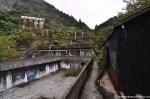
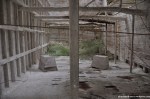
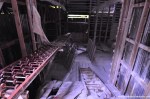
The White Stone Mine is gigantic! Close to three dozen buildings spread across an area of about 500 x 100 meters. Despite its size there is not much known about the Shiraishi Mine. It was founded by two brothers in 1921 and mining ended in 1969, supposedly after severe damage from a typhoon; the last office on the premises shut down in 1974. But the White Stone Mine was not only a limestone mine, it was also a huge chemical plant with facilities to extract calcium carbonate – a very important base substance for the paper industry. I guess in Japan calcium carbonate is mostly used for construction materials (especially cement), but also for the purification of iron in a blast furnace (at least when the White Stone Mine was still in business). Japan’s cement industry is actually huge – Japan still is the #5 consumer, #4 producer and #3 exporter of cement in the world. Japan’s coast line is famous for its sheer endless amount of concrete tripods and when you go hiking you can see surprisingly many concrete roads in the middle of nowhere – it seems like politics and the cement industry are heavily intertwined…
Exploring the White Stone Mine was exciting, sadly we were running out of time quickly. The sun goes down early in Japan, especially on a late October day in the mountains, even more so when it’s raining. Michael was a great experienced guide who was able to point out some of the best and the worst spots of the gigantic area quickly. An area I saw maybe 30% of. Although the mine was abandoned about 40 years ago it seems like there’s still somebody taking care of the premises: Michael pointed out differences to what he saw half a year prior (tarps covering wooden buildings here, new “Keep out!” signs there…) Although we kind of rushed through the lower area of the mine it already got dark by the time we reached the big silos up the slope. When we got back to the car it was already pitch-black outside and raining heavily. Nevertheless it was a great trip and totally worth the long train ride. A train ride I have to do again one day to explore the other 70% of that gorgeous mine… To be honest, I think it will take at least a full day to explore the whole area, maybe two or three days to shoot the whole mine properly. I doubt I’ll have time for that, but the White Stone Mine is definitely one of the few places I would really like to revisit! Even for (half) a day…
(If you don’t want to miss the latest article you can *follow Abandoned Kansai on Twitter* and *like this blog on Facebook* – and of course there is the*video channel on Youtube*…)
Haikyo HDR photos or not… that was a big questions two years ago.
From the start I wanted to keep Abandoned Kansai simple. A blog instead of a homepage, photos directly out of the camera instead of massive post production – resize to 1024*680, URL in the lower right corner. That’s it. No cropping, not filters, no nothing. I actually shoot in JPG, for almost two years not even in the highest resolution. All the photos published on Abandoned Kansai are done that way. After some positive comments I started to take a few photos in NEF, just in case; maybe 2 or 3%, not one of them I ever opened. When I got a tripod, I started to use the bracket function of my D90 at maybe every fifth location – again just in case. After a while I played around with a freeware HDR program, just for fun. While I like the aesthetics of tone-mapped HDR photos I still consider them mostly a gimmick. Nevertheless I decided to publish some of my experiments – below are two samples, *for more haikyo HDR photos please click here*.
(Updates will be announced on *Twitter* and *Facebook*, not on the main page.)
# What is Nara Dreamland?
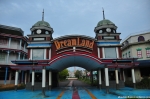
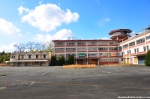
– Nara Dreamland is an abandoned amusement park in Nara, Japan. It was closed in 2006 and abandoned without getting demolished – which makes it quite a unique urbex location since all the roller coasters, merry-go-rounds, souvenir shops, arcades and other attractions are still there. (Although it’s up for discussion if the place is really abandoned. It’s closed, that’s for sure, but the owner of the park obviously still cares about it to some degree…)
# Where is Nara Dreamland?
– That’s the kind of questions I usually don’t answer. But since NDL has entries in four language versions of Wikipedia, three of them giving away the exact location of Nara Dreamland, I can as well link to *my own map at GoogleMaps*. The address was / is:
Nara Dreamland
1900 Horen-cho
630-8113 Nara
But just because you know where it is I wouldn’t recommend going there. You might wanna read the next question(s) before rushing out…
# Does Nara Dreamland have security?
– YES! Some people got lucky and didn’t run into security at Nara Dreamland, I got away with plugged feathers – others got roasted and served to the police. The whole park is surrounded by fences, most parts with spikes and / or barbed wire. Warning signs once asked people to call the police if they see somebody suspicious, now the latest signs I saw announced a fine of 100.000 Yen, about 950 Euros / 1300 Dollars! Furthermore there were reports that the guy patrolling there tries to blame caught trespassers for vandalism to get more money out of them. And vandalism becomes more and more of a problem…
# Is there any vandalism at Nara Dreamland?
– Sadly yes. Lots of it. When I explored Nara Dreamland for the first time in December of 2009 there were barely any signs of vandalism. Almost two years later there are graffiti at the former pachinko parlor at the Eastern Parking Lot. The Parking Garage’s staircase is completely sealed now and the Hotel is boarded up again. Inside the park you can see how people smashed the control station of a merry-go-round – the fire extinguisher still on top of broken glass. The Main Street USA clone with all the souvenir shops has barely any undamaged windows and several doors were kicked in, even of buildings that were clearly just a false front. It’s actually pretty sad how fast the place goes down the drain – especially since the graffiti people took over; and not the good ones…
# I’ve heard Nara Dreamland is a rip-off of Disneyland in Anaheim. Is that true?
– Definitely. Disneyland was opened in 1955, Nara Dreamland followed in 1961. You have copies of the Sleeping Beauty Castle, Adventureland, Main Street USA, Autopia, Skyway, Tea Party Cup Ride, Submarine Voyage, Flying Saucers, the monorail, the fire station, a pirate ship, double decker omnibusses, vintage cars, and a train station (called DreamStation). Even the entrance looked the same! Of course the layout of the park was very similar – aerial shots make them look like twins. And of course there is the story of Kunizo Matsuo, the man behind Nara Dreamland.
# Can you tell me more about the history of Nara Dreamland?
– Sure. After World War II Japan’s industry was booming. People worked hard and needed some places to relax. The United States were not only occupiers, but also the helping hands for the reconstruction of the country – and the new role models. In the second half of the 1950s a Japanese businessman called Kunizu Matsuo, president of the Matsuo Entertainment Company, visited the States and the brand-new amusement park Disneyland in Anaheim near Los Angeles – and was quite impressed. Something like that would be perfect for Japan, he decided. He became a mediator for the Japanese Dream Sightseeing Company (JDSC) and had direct contact with Walt Disney. The plan was to bring Disneyland to Japan – not to Tokyo, but to the old capital Nara (710 – 794), the cradle of Japanese culture. Matsuo also was in direct contact with Disney’s engineers to create the Japanese version of Disneyland. But Nara Disneyland never came true. Towards the end of the construction phase JDSC and Disney couldn’t agree on license fees for all the famous Disney characters like Mickey Mouse, Pluto, Donald Duck and Goofy – so the Japanese side created their own mascots and abandoned the idea of Nara Disneyland. I have no idea how JDSC and Disney settled in the end (I’m sure JDSC had to pay quite a bit of money for Disney’s “help” even without getting the permission to use Cinderella & Co.), but while Nara Dreamland opened in 1961 it took Disney another 20 years to finally open Tokyo Disneyland on April 15th of 1983. Coincidentally (?) this year marked the beginning of the downfall for Nara Dreamland – the number of visitors began to decrease and JDSC including Nara Dreamland was bought by the supermarket chain Daiei in 1993. Eight years later, in 2001, Universal Studios Japan (USJ) opened in Osaka, just about 40 kilometers away. USJ annihilated Nara Dreamland and the once so glamorous place was forced to shut its doors on August 31st of 2006.
# What were the names of the mascots at Nara Dreamland? And are there famous non-Disney characters present at Nara Dreamland?
I’m sorry, but I have no idea about the mascots. All I know is that there are two of them, a male one and a female one. I don’t even know if they had names…
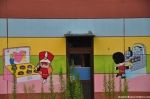
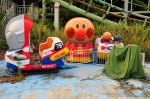
As for other characters: There are no specially themed rides, but Anpanman is pretty visible at Nara Dreamland. (In case you don’t know Anpanman: He’s the most popular fictional character amongst Japanese age 0 – 12 for 10 consecutive years. Anpanman was created by Takashi Yanase in 1968 as a manga character, but spread to other media quickly (including movies, animated shorts, a TV show and dozens of video games). Nowadays Anpanman is everywhere – imagine Hello Kitty, but popular with girls and boys…)
# Why was Nara Dreamland closed?
– A declining amount of visitors for many, many years – and most of all Universal Studios Japan. By the time USJ opened in 2001 Nara Dreamland already was a rundown theme park decades after its prime. Universal Studios Japan on the other hand was brand-new and high-tech, probably the most modern amusement park of its time. Tokyo Disneyland started the struggle (yes, even though 400km away TDL was direct competition for NDL!) and Universal Studios knocked it down – Nara Dreamland didn’t have a snowball’s chance in hell… (Surprisingly enough *Expoland* in Osaka wasn’t affected that much by USJ and closed mainly because of bad press after a 19 year old university student from Shiga prefecture died on a roller coaster in 2007 – and Hirakata Park (also known as HiraPa – ひらかたパーク / ひらパー) between Osaka and Kyoto still doesn’t show any signs of giving up…)
At the height of its success Nara Dreamland welcomed 1.6 million visitors per year, when it closed the number was as low as 400k. Universal Studios Japan on the other hand had 11 million visitors (!) in its first year of operation…
# What was Nara Dreamland’s main attraction?
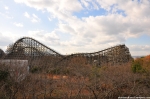
– Nara Dreamland’s main attraction was (and still is!) the Aska roller coaster (木製コースターASKA, Mokusei kōsutā ASKA), a wooden coaster built by Intamin and opened in 1998. The track was 1081 meters long and reached a height of 30 meters. The trains consisted of seven waggons for four guests each (two rows with two seats). They reached a speed of 80 km/h (almost 50 mp/h) and accelerated with up to 2.8g. Aska is named after Asuka, a city close to Nara – from 538 to 710 it was the capital of Yamato, one of the earliest states on Japanese ground, and the location of many imperial palaces as well as important temples and shrines, some of them still in existence today.
I took a video walking along parts of the abandoned Aska roller coaster – you can check it out on *Youtube*.
# Was it expensive to visit Nara Dreamland?
– The signs at the abandoned Nara Dreamland indicate that it was a pay-as-you-go amusement park (as was Disneyland when it opened in 1955!) – which means that you had to pay a low entrance fee, but then additionally for every single ride. So basically it was up to you how much you spent there. Sadly I never paid much attention to the prices, so let me have a look at some photos and see what I can come up with… Parking was 200 Yen for bikes, 1.200 Yen for cars and 2.000 Yen for busses. Bobsleigh (ボブスレー), the steel roller coaster modeled after Disney’s Matterhorn Bobsleds, was 600 Yen and a haunted witch cave put a hole of 300 Yen in your pocket. As for food: A beer was 500 Yen, chuhai was 400 Yen, takoyaki were 300 Yen, yakisoba was 400 Yen and the Family BBQ Set was 3.200 Yen. I don’t know how much the entrance fee was, but if you get caught by security now it costs you a whopping 100.000 Yen!
# I’ve heard there is a Yokohama Dreamland. Is it related?
– Well, there was a Yokohama Dreamland – it operated from October 1st 1964 to February 17th 2002 and closed, not really surprisingly, because of financial issues. It was located in the Totsuka ward of Yokohama. Unlike Nara Dreamland it was completely demolished – and replaced by a prison. And to finally answer the question: Yes, it was the sister park of Nara Dreamland with a similar layout, similar attractions and the same branding.
# Is there an official homepage?
– There was: http://www.nara-dreamland.co.jp/ (I didn’t make it clickable as it doesn’t work anymore anyways – save your time…)
You can find a copy *here*. (2003, Japanese only)
# How often have you been to Nara Dreamland?
– Never when it was still open and 5 times since it was closed.
# Do you have any plans to go back?
– Concrete, solid plans? No. Security there is the main reason for me not to go anymore. I know people visited the place without getting caught, but I made my own experiences and they were not all pleasant…
If you are less into facts about Nara Dreamland and you rather want to more about what it’s like to explore this abandoned theme park I recommend reading the articles I’ve just mentioned.
# Do you have material for more articles about Nara Dreamland?
– Yes! As of August 2014 I have material for about half a dozen articles, including some very unique photos…
# Is there a place even creepier than Nara Dreamland?
– Yes! It’s a half-abandoned amusement park called *People’s Park* – thanks to the constant music in the background and its nude statues it’s creepy as heck!
# What about that killer robot called Mascot 6-22? Is it really roaming Nara Dreamland?
– Killer robots at Nara Dreamland?! No, this is not another *April Fool’s joke*, this is the internet!
Nara Dreamland has been kind of my backyard for the past five years and I thought I’ve heard pretty much all stories about it… until one of Abandoned Kansai’s regular readers, Justin, asked me about the fully animatronic Mascot 6-22 in a private message via *Facebook* – and I had no idea what he was talking about. I did some research and there seems to be a theory out there in the depth of the internet, that Disney created Nara Dreamland to find out whether the fake park would be popular enough to justify the construction of an official Disneyland; which happened more than 20 years later. As if that wouldn’t be ridiculous enough, somebody claimed that the official new mascots were not poor students in poorly tailored costumes, but in fact robots – and that series 6, unit 22 was so special, that they didn’t turn it off, but let it roam freely in the park after it closed in 2006, defending a solar power station and giving everybody who tries to deactivate him an electric shock. But that’s not all! Some people actually seem to believe that the Japanese military asked Disney if they should take out “Mascot 6-22”, but they declined as the thing was showing interesting program adaptations.
Seriously, what the heck? The whole story is so ridiculous I won’t even spend the time to point out all the things that are wrong with it! Yes, I know, both the origin and the end of Nara Dreamland are somewhat in the dark, but come on, people… that’s a bit much, don’t ya think?
# I’ve heard that Nara Dreamland has been sold in late 2015. Is that true?
– Yes, that’s true. It seems like the previous owner owed the city of Nara 650 million Yen in ground tax, so the city foreclosed Dreamland and sold it to the only bidder for 730 million Yen – a real estate company called SK Housing. What plans they have is unclear though, because there are strict limitations on how the land Nara Dreamland is on can be used in the future…
# What are those strange noises I can hear at Nara Dreamland?
– If the noises are not coming from one of the nearby sports arenas, they are most likely caused by ushigaeru (ウシガエル) a.k.a. American bullfrogs. They freaked me out the first time I heard them in 2010, because they sounded like somebody opening a heavy metal door / gate…
If you have any unanswered questions about Nara Dreamland please let me know – I might update this posting every once in while. A lot of the information given here was only available in Japanese so far, some stuff I came up with by actually going to NDL – so if you use material for your own articles please be so kind and mention / link to this FAQ. Thanks a lot!
All of the following photos were taken in 2009 and 2010, most of them previously unpublished. The photos I took later will be published in two separate articles at some point in the future.
(If you don’t want to miss the latest article you can *like Abandoned Kansai on Facebook* and *follow this blog on Twitter* – and of course there is the *video channel on Youtube*…)
Ever since I visited the abandoned Ishikiri Shrine in Himeji I am asking myself which kind of places are really worth writing about. I’ve been to demolished places places before and after – but are they really worth writing about? How about historical places like castles or forts – especially when used as tourist spots? I wish all places could be as exciting and stunning as *Nara Dreamland*, *Gunkanjima* and *Pripyat*, but let’s be honest: most of them are not. (And Gunkanjima and Pripyat actually became tourist spots…) Interestingly enough the Ishikiri Shrine wasn’t the worst place I’ve visited; not even close. I guess it just sparked those thoughts as I grew up in Germany in an area where you have abandoned castles and really old churches every couple of kilometers. Heck, I once went kayaking on the river Neckar (near Heidelberg) and at one point I was able to see three abandoned castle ruins at the same time!
And what castles are for Germany shrines are for Japan – times 10. Or 100. Maybe 1000. They are everywhere. You can barely throw a stone without hitting one (not that I’ve tried… I guess nobody would appreciate that kind of behavior!). At first visitors to Japan are all excited. “How beautiful – and look, there’s another one!” – but after a while this wears off, even for the tourists. Living in Japan for five years I barely notice shrines and temples anymore, unless they are famous tourist attractions – or abandoned. The Ishikiri Shrine in Himeji (not to be confused with the rather famous Ishikiri Shrine in Osaka!) is one of the few abandoned ones. About a third up a small mountain with the former priest’s house right at the bottom the shrine entrance is beautiful – a stone torii at the edge of a bamboo forest, offering much welcomes shade in the summer hear. The main part of the Ishikiri Shrine consists of a now empty building, probably once used for storage, and the shrine itself as well as another small building. Sadly I have no idea about the history of the Ishikiri Shrine – even the few Japanese blogs that write about it only speculate, for example that it was built about 60 years ago and might have been an offshoot of the Osaka shrine of the same name. The place actually got so popular that somebody screwed tight the door of the shrine building with two wooden beams and put up a sign asking people not to break in. The priest’s house at the foot of the mountain was in such bad shape and in July of 2010 already so much overgrown that I only took some outside shots and didn’t even enter – I guess I’m not that much into private houses… especially when people are always near praying at / taking care of another shrine that is not abandoned.
The Ishikiri Shrine is far from being a haikyo highlight, but it was nevertheless a nice little summer hike in the outskirts of Himeji. Furthermore abandoned shrines are rather rare since there are (almost) always some locals taking care of even the smallest places of prayers. Too bad I wasn’t able to find out more about the shrine’s past…
I can’t even remember how I found out about the Karadate Golf Center in Himeji. In late 2009 / early 2010 I did quite a bit of research about abandoned places in Japan and I guess one of the leads I had was that one. I just remember that I didn’t even found pictures, just a Japanese list of (operating) driving ranges – and that one of them had a footnote that it was closed / demolished. When I went to an abandoned shrine in Himeji in July of 2010 I went to the Karadate Golf Center, too, since it was only a few kilometers away from the shrine.
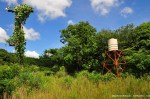
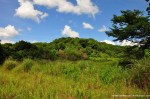
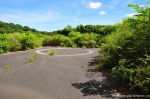
Located on top of a small mountain close to Mount Shosha (a filming location of “The Last Samurai” with Tom Cruise and Ken Watanabe) the Karadate Golf Center offered a stunning view on Himeji and the Seto Inland Sea, but due to its rather remote location (a couple of hundred meters away from the next houses at the end of a now too abandoned winding road) I guess it wasn’t a financial success – and the competition for driving ranges is tough in Japan! At the time I went there GoogleMaps still showed the driving range and a small building in satellite mode, but now these remains are only visible when switching to map mode. When I went there I found the golf center gone, with only a few signs left that it has ever been there: A fence, some bricks on the ground, a water tower, a lamp post… The driving range itself was almost completely overgrown, only two baskets sitting on the ground in the northern part. Unless you have a faible for old lamps the Karadate Golf Center is a demolished and hence uninteresting haikyo. But of course I had to see it for myself… And the view there was really nice!
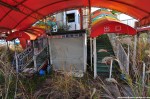
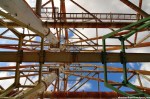
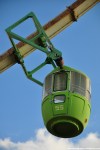
Abandoned ferris wheels usually come with abandoned theme parks. But when I visited *Expoland* in Osaka the ferris wheel was just demolished. And so were the giant wheels in all the other *abandoned amusement parks* I visited – except for the *big wheel in Pripyat* – which was actually pretty small… So usually the ferris wheel is one of the first things to be demolished when an amusement park closes – to be re-built at another park or to be sold for scrap metal. Not in the case of Igosu 108…
You might have seen photos of this abandoned ferris wheel at other blogs and you might ask yourself “Why is Florian calling the ferris wheel ‘Igosu 108’ – it says びわ湖タワー (Biwako Tower) in huge letters right in the middle of the thing and everybody calls it that way when writing about it?!”. Well, my Japanese might not be the best, but just because something is written somewhere doesn’t mean it’s the name of the place. And in this case it isn’t. The name of the ferris wheel is Igosu 108 – the name of the surrounding amusement park, now mostly gone, was Biwako Tower. To be more precise: The name of an observation tower, now gone, was Biwako Tower. This tower was 63.5 meters high and had a rotating observation platform that went up and down to give visitors a spectacular view across Lake Biwa, the largest freshwater lake in Japan. Biwako Tower was built in 1965 and extended to an amusement park in 1967. In addition to the observation platform there was a small ferris wheel, a rollercoaster, a pachinko parlor, water bumper car and several other small rides. But that’s not all! Biwako Tower also included an onsen (hot spring / spa) and a wedding hall – plus the usual array of restaurants, shops and stuff like that. Thanks to free parking and no entrance fee Biwako Tower was hugely successful and attracted up to 50.000 people a day!
In 1992 the last attraction was built – now the last one standing: Igosu 108 (イーゴス108). I can’t say for sure, but I guess the name is a combination of sugoi (すごい, meaning “great”) backward and 108 – the height of the ferris wheel, at the time the largest ferris wheel in the world. It was soon considered a landmark of Shiga prefecture and Lake Biwa, but couldn’t stop the downfall of Biwako Tower. Speaking of which: Since the ferris wheel was higher than the name-giving attraction Biwako Tower was transformer into a bungee jumping platform.
On August 31st of 2001 Biwako Tower finally closed its doors – just half a year after Universal Studios Japan opened in Osaka. Most of Biwako Tower was demolished in late 2003 / early 2004 with the exception of Igosu 108. Some small attractions survived partly (like a fortune teller booth, Fantasy Land and Bumper Boat), but the rest was transformed into big supermarkets and other stores, their parking lot replacing the pachinko parlor. Two sources claim that Igosu 108 still has an owner who announced in 2007 that the ferris wheel will re-open in 2008, but that never happened. According to them an operator puts Igosu 108 into motion once a month to make sure that everything is still working.
Having visited what’s left of Biwako Tower in December of 2010 (together with Damon and Andrew right after leaving the *Love Hotel Gion*) I kinda doubt that claim. While the outer part is easy to access Igosu 108 is protected by a typical Japanese orange site fence. The noisy kind that doesn’t have a door to let people in and out easily. I didn’t have a closer look at the controls of the ferris wheel, but the whole place looked quite rusty and run-down. To reactivate Igosu 108 you would need way more than just a bucket of paint and a “Reopened!” sign…
(If you don’t want to miss the latest postings you can *follow Abandoned Kansai on Twitter* and *like this blog on Facebook* – and of course there is the*video channel on Youtube*…)
Addendum 2013-11-28: Igosu 108 was dismantled in autumn of 2013…
Love hotels always fascinated me. From the first time I heard about them and even more so after the first time I visited one. So of course an abandoned love hotel was always quite high on my “Places I want to go to” list, but while Kanto is swamped with that type of haikyo there seem to be barely any in Kansai. It took me more than a year to find the love hotel Gion, and technically I guess it’s more like a love motel…
Since I guess not everybody reading this blog is familiar with that kind of “popular Japanese subculture”. So, what is a love hotel? First of all – the love hotel industry is not a subculture at all, it’s one of the biggest money makers in Japan! A love hotel (also known as fashion hotel, amusement hotel, boutique hotel, couples hotel, romance hotel or leisure hotel) is a hotel where you can get rooms not only for a whole night, but also by the hour. They originated in the Edo period in Edo (nowadays Tokyo) and Kyoto, the then-capital – appearing to be tea rooms or normal inns, used by both prostitutes and normal couples. When prostitution was abolished in 1958 love hotels (then known as “bring-along inns”) started to boom – litte known fact: Even Nintendo ran a love hotel in 1963, just about 10 years before they started entering and revolutionizing the video games industry. The modern term “love hotel” derives from the “Hotel Love”, which was built in 1968 and attracted customers with a rotating sign. While some love hotels are basically more or less normal hotels without windows (if you see a hotel without windows in Japan you can be sure it’s a love hotel…) and an extremely discrete front desk other love hotels have very creative theme rooms for almost every taste – from princess bedrooms to BDSM stuff, from train compartments to whatever cliché fantasy you can imagine. The furnishing and equipment of those rooms vary heavily on the price – in addition to the standard stuff you have in a normal hotel room (TV, free tea, hairdryer, …) you usually get a games console, a karaoke machine and some condoms; some hotels have vending machines with sex toys in the hallway or the lobby. If you are willing to pay more there are basically no limits – insanely huge HDTVs, jacuzzis, massage chairs, private balconies on the top floor to enjoy the night sky and in some cases even a private swimming pool. While “rests” are about 2000 to 4000 Yen an hour “stays” cost about 8000 to 16000 Yen per room per night (usually from 10 or 11 p.m. on for 10 or 12 hours, depending on the hotel) – super luxurious rooms can cost up to 60.000 Yen per night in cities like Kyoto or Tokyo. (1000 Yen = 9 Euros / 13 US-$)
Nowadays the turnover of the love hotel industry in Japan is a whopping 4 trillion Yen per year, equivalent to about 36,000,000,000 Euros or 52,000,000,000 US-$ as of September 2011 – generated by 500 million visits to 37,000 love hotels all over the country. Love hotels are considered a whacky underground thing by many foreigners, while in fact they are part of daily life, turning over double of what the anime industry does.
Why are love hotels so successful in Japan? Because Japanese walls are thin and a lot of even not so young Japanese people are still living with their parents; the so-called parasite singles (パラサイトシングル, parasaito shinguru) enjoy the carefree and comfortable life of living at home up till their early 30s when even the late bloomers are getting married. If they want to have some passionate hours with their girlfriends, boyfriends or club acquaintances they go to a love hotel (and so do most adulterers…). It’s clean, it’s anonymous (most lovel hotel visitors don’t see any staff person!) and it’s affordable, especially if you have a job and still live with your parents. And the novelty factor of the rooms is a big plus, too!
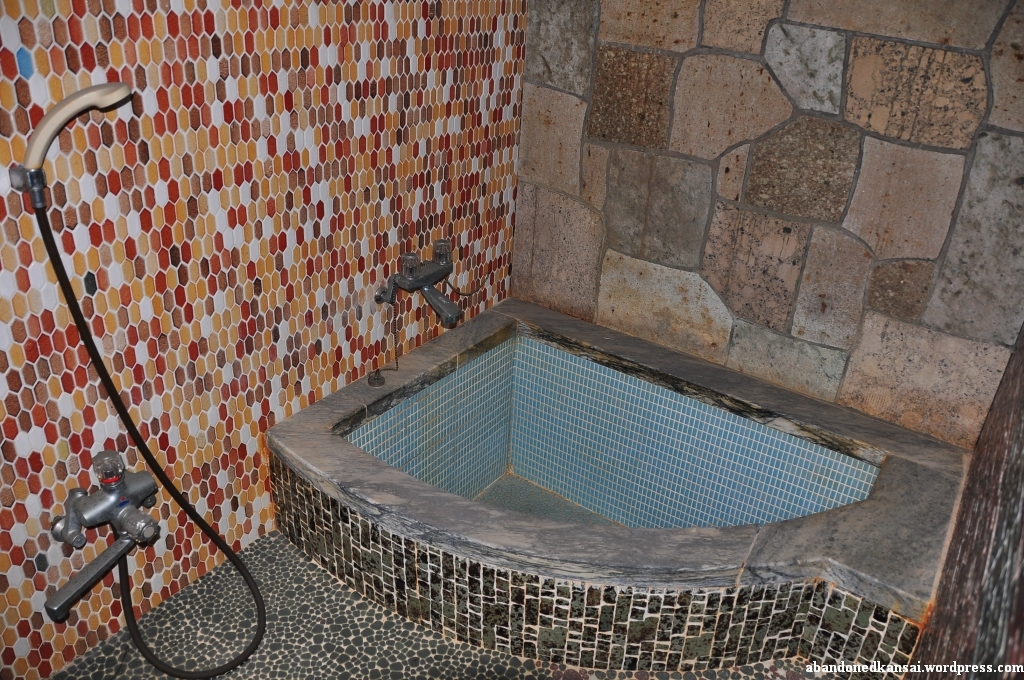
So one day in November I met up with Damon and Andrew at a small train station somewhere in Shiga – all three of us were eager to finally explore an abandoned love hotel; especially Damon, who seems to find secret porn stashes at pretty much every location he goes to. Sadly the haikyo Love Hotel Gion didn’t have any of the (fake) glamour and sexiness you experience at a fashion hotel that’s still in business. It wasn’t even a real hotel, more like a motel – 8 row bungalows with rather deep open garages in front of them to prohibit people from getting an easy look at the license plates of the parked cars. The lot in front was quite big, so I guess another row bungalow or two were already demolished. And the one still standing was in pretty bad shape overall. Some of the “rooms” I didn’t fully explore, because the floors and roofs were falling apart, but one or two were barely touched. The downside of that was that it was pitch-black in there – luckily I brought my tripod. The layout of the bungalow sections was pretty much the same for all of them. A little lobby at the entrance, a windowless bath including a tiled tub to the left and then a bedroom straight ahead. Most of the bedrooms were covered by landscape wallpapers while the rest of the rooms had crimson wallpapers. Very, very 70s porn! (Or how an innocent young man like myself imagines something filthy like that!) Sadly most of the rooms were empty except for fixtures and solid bed frames. In one of the mini apartments we found a jukebox in questionable condition, but the most interesting detail was the wall mosaic in one of the bathrooms – it depicted two nude women in front of a horse, of one of them you could see the pubic area. Shaved, with just a little bit of hair left; except for the final stone – that one was red…
(If you don’t want to miss the latest postings you can *follow Abandoned Kansai on Twitter* and *like this blog on Facebook* – and of course there is the *video channel on Youtube*…)
Today I had a look at some rather old videos shot at locations I already wrote articles about. None of them were intended to be published, so the camera work might be a bit rushed occasionally, but I decided to upload them anyways as I think there might be some interest in them out there in the world wide web. While some of my videos only get a couple of dozen views quite a few of them were watched by thousands of people – *this one* will actually reach 30.000 views soon. Please enjoy! *Nara Dreamland – Aska Rollercoaster*
I have to admit: After almost five years working for a big company in Japan my view on the country and its people changed quite a bit. Foreigners visiting Japan as tourists and exchange students tend to have a very romanticized image of Japan, even more extreme in the case of people longing to visit Japan for the first time. Actually working in Japan is a totally different thing as the usual struggles at work get multiplied by cultural differences and, yes, sometimes xenophobia – and if you work in an industry that locks you up in rooms without daylight with a lot of “characters” for the major part of the week you tend to generalize certain things. Which is really bad – and the main reason I like to get outside on the weekends and travel to other parts of the Japan to get in contact with people that have nothing to do with my line of work…
After finding the shangri-la and the Big Mountain Pachinko Parlor on our way from the Sky Rest New Muroto to our next haikyo we finally entered the mountainous part of Shikoku. The roads were getting smaller and the weather got worse. When we reached the area we suspected the F# Elementary School was (we only had vague hints…) it was pouring and the road was so narrow it was only wide enough for one car, villages so small they were not more but an accumulation of a few buildings. And none of them looked like a school. We were driving up and down a road and its backstreets while the time was ticking away – in only a few hours we had to return the car…
Doing urban exploration you don’t want to attract a lot of attention as you never know what people might think of you and your undertaking. After about half an hour we decided we had nothing to lose and when we saw a guy from a well-known telecommunications company having a break in his car Jordy insisted asking him about the school. The guy knew where the school was and told us that it was abandoned in the 1960s, but that it was under construction now. Just down the road, we couldn’t miss it (well, we did before…). Very nice guy – and we were so happy that we finally got some directions. We followed the road for about five minutes, parked our car and then something happened I never thought would happen, especially after being surrounded by dopey and to some extent ignorant people for the bigger part of the year: The guy showed up, not only making sure that we found the school, but also talking to the construction workers, telling them the same story we told him (that we were photographers from France and Germany taking pictures of abandoned places), allowing us to enter the school and taking pictures for as long as we wanted. There it was, the personification of the positive image most people have of Japan – and it blew me away. To all the expats in Japan getting frustrated, and I know there are a lot: Go on weekend trips, re-connect with the Japan you once loved so much. Working crazy hours and having only a few paid days off a year it’s easy and dangerous to generalize, especially when gathering with other foreigners who are frustrated, too…
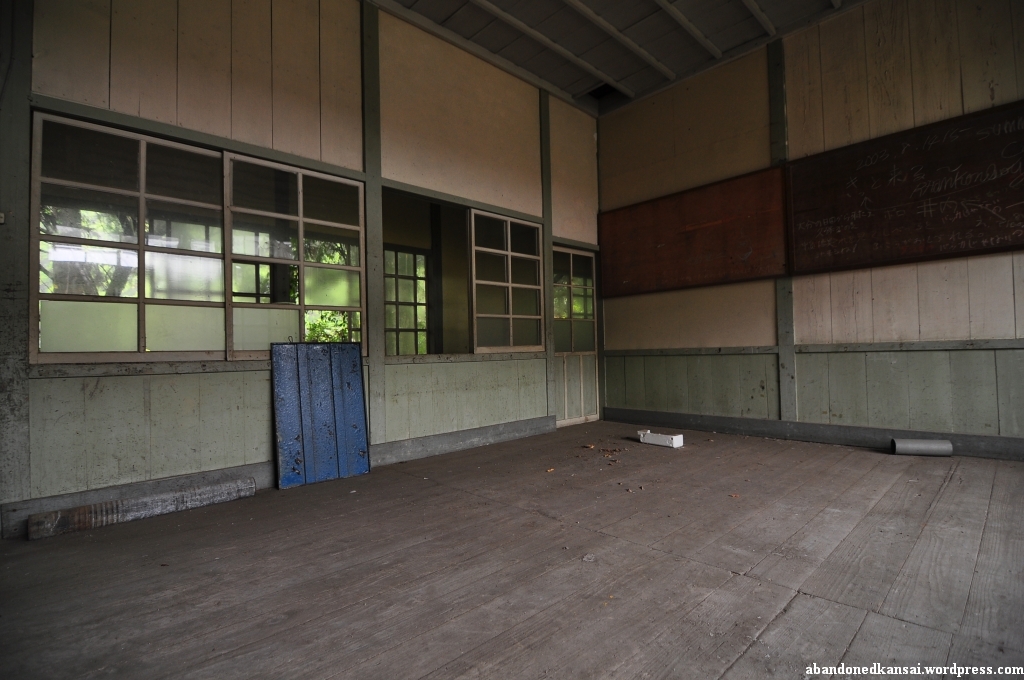
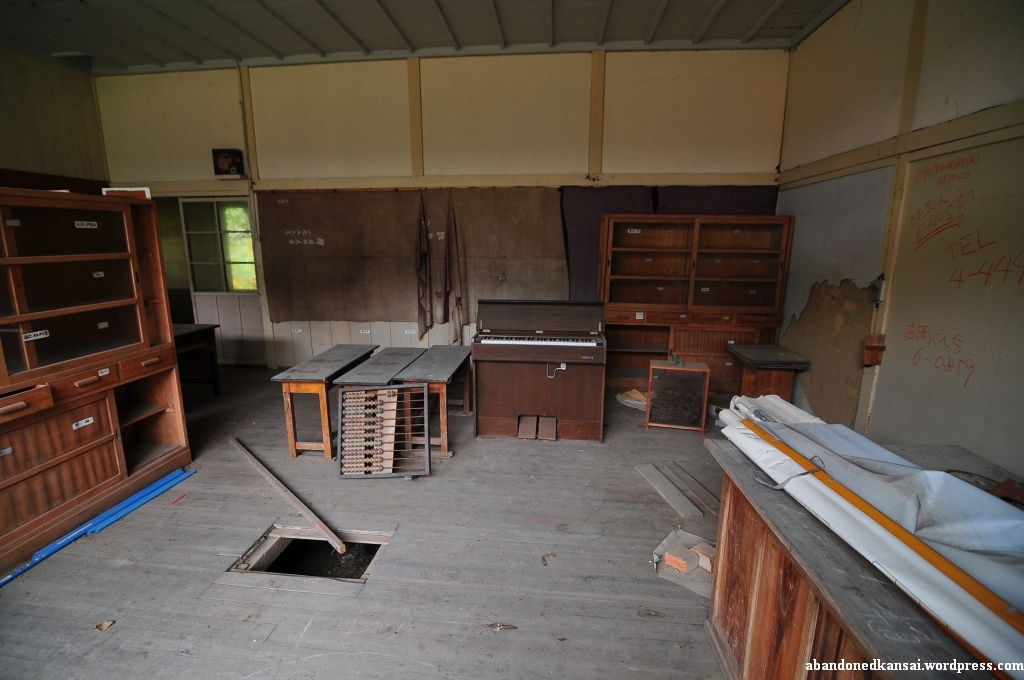
That being said I can finally write a few words about the school itself, although I know barely anything about it. Closed in the 1960s this wooden construction was withstanding decay for several decades until somebody decided not to tear it down, but to renovate it. Construction started about a month prior to our visit (= end of October 2010) and was supposed to finish March 10th 2011. Luckily they spent most of the time building ramps for trucks and machinery as well as taking care of a side building, so the main building of the school was barely touched – giving us the opportunity to take unique pictures as I’m sure the building looks completely different now…
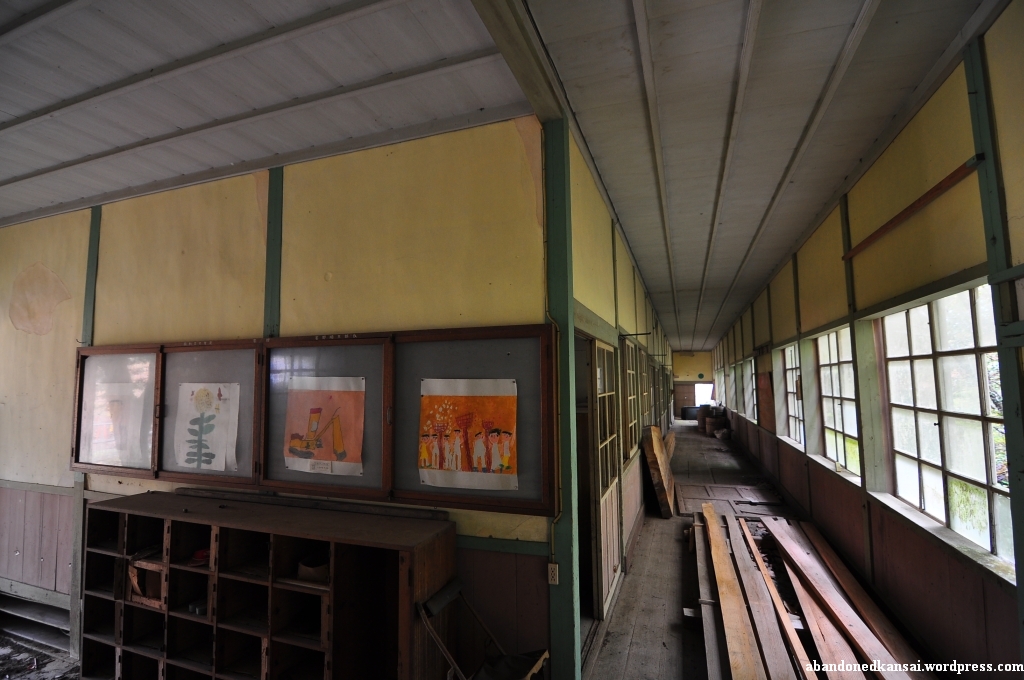
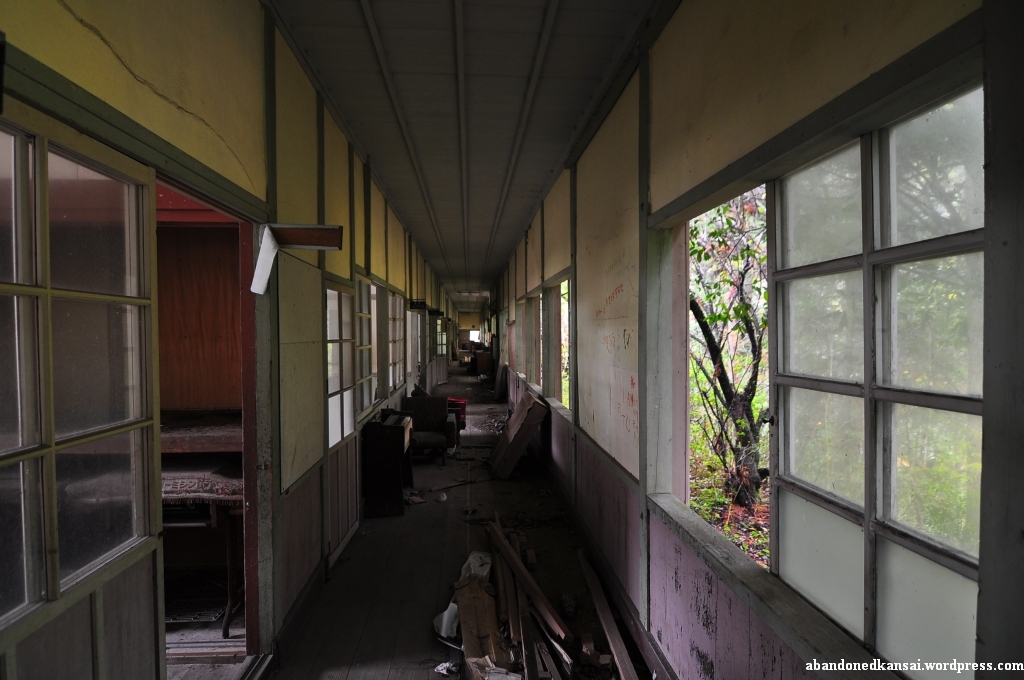
The F# Elementary School was a typical Japanese school of its time: A rather narrow wooden building with a long hallway, classrooms (and other rooms) only to one side. While we entered through a side entrance the main entrance with some lockers and paintings created by students was located in the middle of the building – restrooms being outside on the back side of the school. Most of the rooms were empty, but others were full of all kinds of items: furniture, educational materials, pianos. Yes, pianos. Like the Middle School #3 in Pripyat this school was also stuffed with pianos – I saw at least half a dozen. Another kind of item I didn’t expect were a couple of sewing machines made by Brother, nowadays more famous for printers than for their original core business.
Since this was my first (and so far only) abandoned Japanese school it was an amazing experience to explore it – especially since it was about to be reconstructed and even more so given the story leading to the exploration. The perfect final location of my (first) Haikyo Trip To Shikoku!
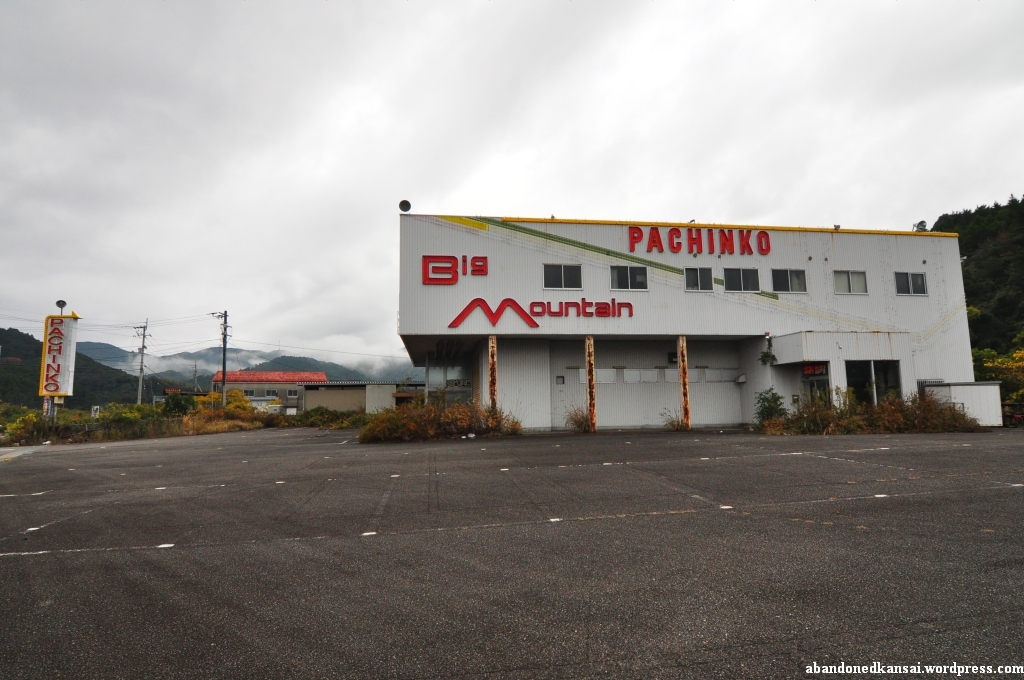
While I am happily taking credit for finding the hotel shangri-la it was thanks to my fellow explorer that we entered the Big Mountain (or Big Mountein… as they misspelled their own name occasionally) pachinko parlor. We were on the road again to finally get to that abandoned school in the middle of the mountains when we saw said abandoned place of amusement. We turned around, parked the car and actually found an easy way in.
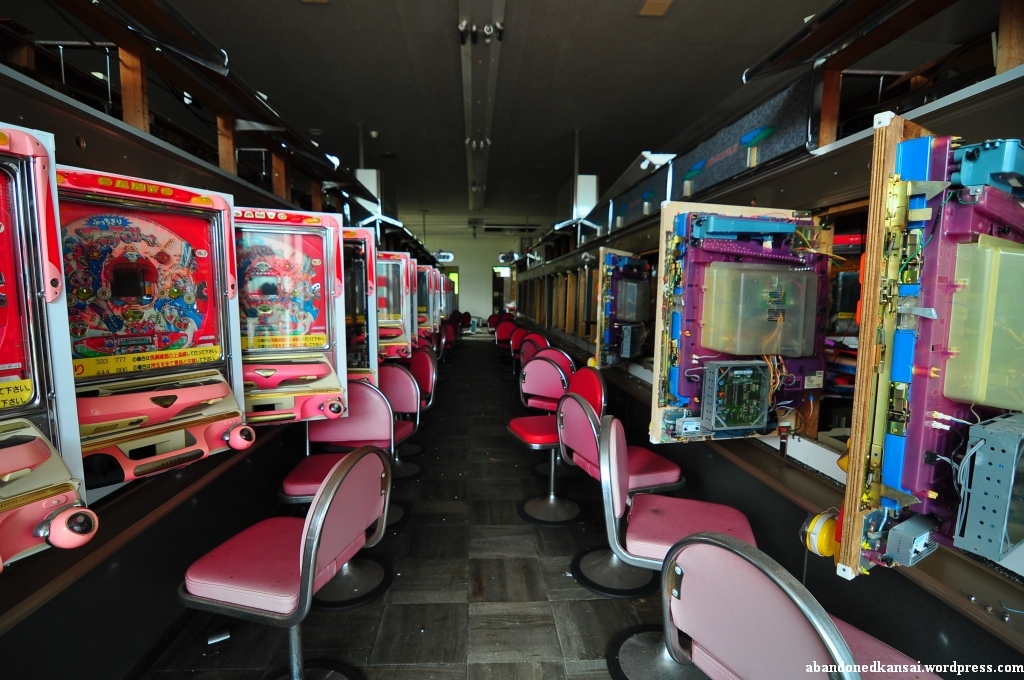
There are plenty of abandoned pachinko parlors in Japan, it’s maybe the most common kind of haikyo overall. But usually they are either boarded up or completely gutted. The Big Mountain on the other hand was in pretty decent shape. Most of the machines were opened, but only a few were missing. Since new pachinko parlors are opened all the time a lot of the equipment gets recycled, but in this case most of it was still there (machines, stools, balls, containers for the balls, signs, …) and in decent condition – especially considering that the most recent calendar sheets we found were from 1996.
Since gambling is strictly controlled by the Japanese state there are only a few possibilities to actually win money – with lotteries and betting. Playing pachinko (パチンコ) you can only win prizes by exchanging the pachinko balls you’ve won for prizes worth less than 10.000 Yen each (82 Euros / 117 Dollars). Popular items are perfumes, expensive lighters and tiny gold bars. Conveniently most pachinko parlors have a “pawn shop” close-by where you can get rid of your prizes; of course 10 to 30% under value! 16 million Japanese play pachinko on a regular basis, about 34.000 play for a living – yes, professional pachinko players…
What most people don’t know, especially in the West, is that the majority of pachinko parlors in Japan are run by the so-called Zainichi Koreans, the biggest ethnic minority in Japan. Of the estimated 16.000 parlors about 50% are run by South Koreans, 30 to 40% by *North Koreans* and the rest by Chinese and Japanese; most of the latter ones associated with the Yakuza, the “Japanese Mafia”. The parlors run by North Koreans usually are under the control of the Chongryon (Ch’ongryŏn / 총련 / 總聯 / 朝鮮総連), the “General Association of Korean Residents in Japan” which has close ties to North Korea. According to an article in the Japan Times up to 200 billion Yen a year are flowing to North Korea that way – currently that’s about 1.7 billion Euros or 2.4 billion Dollars…
Sadly we were running out of time and we still wanted to go to that school, so we left the Big Mountain Pachinko Parlor after about 30 minutes. We even forgot to go upstairs, where you usually can find a couple of sleeping rooms, a kitchen, and a security room with surveillance monitors and a safe. Luckily I explored another pachinko parlor a few months later, this time in Shiga – but that’s *a story for another time*…


































 Abandoned Kansai