Feeds:
Posts
Comments

Archive for the ‘Visited in 2013’ Category

My *first trip to North Korea* was a great experience. I went there with a certain amount of ignorance, to “enjoy the show”. And it was a good show, a great show… a fantastic show actually. It was so elaborate, that it was easy to believe most of it. No freedom of movement? Sure, their country, their rules. Regular blackouts outside of Pyongyang? Unfortunate exceptions. Taboo topics? Well, you avoid bringing up politics and religion in most parts of the world. The radio wasn’t working? Who cares, it would have been in Korean anyway – there was barely enough time to watch TV. Not much traffic? Well, it’s a poor country with fuel shortages, but everybody is trying to make the best of the situation. And the guides telling us that walking a lot is healthy anyway? Well, probably just North Korean humor – it’s not like Japanese jokes are much funnier…

North Korea is changing, no doubt about it – opportunities to “enjoy the show” are getting sparse, and now is probably the last chance to get a glimpse at the old regime, the strict, stiff, dictatorial North Korea. If you visit Pyongyang you already get a watered down, rather easy to swallow version. While a couple of years ago visitors had to refer to Kim Il-sung as “Great Leader” and Kim Jong-il as “Dear Leader”, nobody seems to care about the use of honorary titles like that anymore, as it alienates foreign visitors. The guides in Pyongyang speak English quite well and most of them have enough experience with foreigners to know how to handle them and follow the rather strict limitations (forced on them by their bosses) at the same time. It’s easy to get lost in that charade and blame all the evil things happening on America or the people themselves – if they would have followed the rules, they would not have been put in jail. (Which is bullshit, as we all know. In the Early Modern Age countless women were tortured and killed as witches, because their resentful neighbors made a claim and the victim had to proof their innocence. And that’s pretty much how North Korea works today.)

After my return to Japan and the series of articles I wrote about my trip to North Korea, I wanted to see more. I wanted to see a different side. I wanted a rougher version, to see myself whether Pyongyang was just a sample of an aspiring country striving for success – or if it was the exception, a Potemkin village to fool visitors.
In July 2013, while still writing articles for the first series, I decided to go back to North Korea. This time I chose a tour with a completely different itinerary with a route that wouldn’t even get close to any destination I saw on the first tour. The Northeastern Adventure was introduced in spring 2013 and opened the border crossing in Tumen for western tourists. Up till then the few visitors to North Hamgyong province used to fly in from Pyongyang or entered via Rason to visit the famous Mount Chilbo area. With the Northeastern Adventure I had the rare opportunity to see the Wangjaesan Grand Monument and to spend a night in Hoeryong. Next stops were Chonjing, the homestay village near Mount Chilbo and Kyongsong before spending three nights in the Special Economic Zone Rason. (*Click here for a GoogleMap to give you a better idea.*)
Believe it or not – I got what I bargained for. North Hamgyong and Rason were a lot rougher than Pyongyang and the places in the south of North Korea. The guides were rougher (“It’s comrade Kim Il-sung! / “No take photos!”), the conditions were rougher (no running water and no hot water for three consecutive days – which is not unusual in a poor country, but irritating when that poor country always pretends to be on par with the rich ones…), the locals were rougher. The cities were smaller and less colorful, the anti-American propaganda was less subtle, the infrastructure was less developed. While the southern parts were all about the Korean war, the northern parts were all about the Japanese occupation – down to the guide’s countless stories about Japanese atrocities, some of which started with “Sorry Mr. XYZ, but it’s historical fact!” as the Northeastern Adventure was accompanied by two Japanese citizens. (To everybody’s surprise as most Japanese people don’t want to have anything to do with North Korea.)
Speaking of my fellow travelers: This was an extraordinary group to travel with! When signing up for a group tour you never know what you get. While I enjoyed the Pyongyang group for several reasons (hey Jeff!), the Northeastern Adventure group overall was much more relaxed and less stressful – probably because it wasn’t the first trip to North Korea for anybody, with one exception. Everybody knew what to expect, everybody knew how to behave (at least most of the time), there were no “I am so cool because I am traveling to North Korea!” characters, it was just a great group!
Which brings me to related topic: You won’t find a picture of myself on Abandoned Kansai and, like last time, I tried to extent this courtesy to the rest of the group for this article series – which worked with two or three exceptions. If you see yourself on a photo and don’t like it, please drop me a line and I’ll remove the picture right away! As for you, dear reader: This time the group consisted of thirteen people plus one British guide (Amanda) plus three Korean guides during the first leg in Hamgyong province and three different Korean guides during the second leg in Rason, where the group shrunk to twelve people as one of our Japanese group members had been to the Special Economic Zone before and decided to leave early. (A “Special Thanks” goes out to my friend Mayu, who didn’t join me on the trip, but provided valuable translations afterwards. Whenever you see captions to Korean text on photos – those I owe to her.)

For the first trip I decided to write separate articles for each major stop on the tour, which resulted in more than 30 posting over 10 weeks – way too long for a blog that usually is all about urban exploration. So this time it’ll be more like a classic travel report: eight articles, one for each day; plus this introduction and an epilogue with some final thoughts. Some of the articles will be freakishly long (up to 2.500 words…), some of them will contain rants as I won’t stay away from hot topics this time. Nevertheless I hope you’ll enjoy reading what I have to say – my mind was blown several times during the trip and if everything goes according to plan you’ll make a “WTF?” face at least once per article… 🙂

Oh, and for all you hardcore urbex fans out there: The next abandoned place will be posted on February 25th – an amazing original find I explored almost two years ago!

(Please *click here to get to Abandoned Kansai’s North Korea Special* and *here for a map about the tour at GoogleMaps**Like Abandoned Kansai on Facebook* if you don’t want to miss the latest articles and exclusive content – and subscribe to the *video channel on Youtube* to receive a message right after a new video is online…)

P.S.: I almost forgot – welcome, dear readers from North Korea! I know you don’t stop by often and I doubt that you are regular people who surf the internet after a hard day of work in the fields. But, according to the basic statistics WordPress shares with me, I had 12 page views from the DPRK between my first and second trip to North Korea, much to my own surprise. So again – welcome, comrades!

Read Full Post »

An abandoned combat theater, double fence with watchtowers, a dozen covered bunkers and a really creepy dead animal – the Aschaffenburg Local Training Area (ALTA / Truppenübungsplatz Aschaffenburg) delivered much more than I was hoping for…
Whenever I am on vacation in Germany, I throw in a couple of urbex days. And since those days usually involve several hours of driving and walking, it’s a good way to reconnect with people I haven’t seen all year, to get some alone time and adventure without too many distractions. One of my favorite urbex partners back home is my sister Sabine, especially when exploring abandoned military bases as she is ex-Luftwaffe (German Air Force) herself.

The Aschaffenburg Local Training Area dates back to the Kingdom of Bavaria, which bought 32 ha of land in the south of Aschaffenburg in 1912/13. After being used as a parade ground and farm land, the Wehrmacht took over in 1936 to supply training ground for some newly constructed barracks in Aschaffenburg. In the last weeks of WW2 the US Army made use of the area as an encampment with a field hospital.
From 1946 on part of the area was used by locals as farm land, while the US Army expanded and modernized the training ground by building new facilities like shooting ranges for pistols, machine guns and bazookas, a tank training area (including new roads for heavy Abrams tanks!), a helicopter pad, several bivouac areas, and many more. “Highlight” till this very day was a Special Ammunition Site for MGM-52 Lance missiles – including nuclear warheads, which explains the double fence and the watch towers we found in the center of the area in the middle of the woods. (Greetings to the 1st Bn 80th Field Artillery Regiment (1974-1987) and the 3rd Bn 12th Field Artillery Regiment (1987-1991), who took care of those deadly and always controversial babies…) In addition to the 2 FAMs all kinds of units stationed in Babenhausen, *Darmstadt*, *Hanau* and Würzburg used the ALTA for their training purposes.
The deactivation of the MGM-52s marked the beginning of the end of the Aschaffenburg Local Training Area. In 2007, after several years of indecisiveness on the part of the US Army, the whole area was given back to the original owners, resulting in 337 ha for the city of Aschaffenburg and 240 ha for the Federal Republic of Germany. Since an ornithological mapping was executed in 1992, it was pretty clear from the beginning what should become of the former military area – a nature sanctuary. Now, half a decade later, 237 ha are designated as a preserve area and open to the public, despite the fact that a lot of the former military installations haven’t been demolished yet.
Sabine and I parked our car at the edge of the wood and the first thing we saw was a huge old sign with the general layout of the former training area. We followed a road and quickly found an abandoned yet unspectacular building with metal-grilled windows to the left… and a combat theater to the right, just across the street. Despite mostly gutted too, the combat theater was quite an interesting place to explore. Since I’ve never done even basic military training myself, I’ve never been to a place like that, but judging by the layout and the things left behind, Sabine was convinced that it was a AGSHP (Ausbildungsgerät Schießsimulator Handwaffen/Panzerabwehrhandwaffen – something like “Training Unit Shooting Simulator Small Arms/Antitank Small Arms”), built by Thales Defence Deutschland GmbH. I uploaded a walking tour of the whole building to Youtube and you can watch it at the end of the article after the photos.
Definitely the highlight of the ALTA was the storage area of the MGM-52 missiles and warheads. When I wrote about the *Hochspeyer Munitions Storage* (where also nuclear warheads were stored at one point in time), a commenter mentioned that the typical structure of two fences and watchtowers were already gone – well, that structure was clearly intact in Aschaffenburg. More or less. The gates of the fences looked like Bender Rodriguez had a go with them… and the watchtower wasn’t in good shape either, but even amateurs could see that they hadn’t been storing vegetables behind those barb-wired fortifications! Most of the ammunition bunkers were open at the time of our visit, but they were also smaller and in worse condition than their counterparts in Hochspeyer. While the Hochspeyer ones were all cleaned out, a surprised was waiting for me in the unmaintained forest depths of Aschaffenburg. Over the years I’ve encountered my share of living and dead animals while exploring abandoned place, but the creature I found in one of the dim bunkers looked really creepy – most likely a mummified cat, judging by the size of it. Not exactly a pleasant sight!

Despite being easily accessible and extremely popular amongst runners, Nordic Walkers, bikers as well as dogs and their owners, the Aschaffenburg Local Training Area doesn’t seem to have many friends amongst the German urbex community. Maybe it’s because Bavaria has a reputation of being difficult for urban explorers (fewer locations, stricter police), maybe it’s because Aschaffenburg is a little bit off the beaten tracks. Whatever it is, I enjoyed the little trip to Franconia as I was finally able to see a few things with my own eyes I only knew from pictures in books before – like a combat theater and the double fence with watchtowers structure…

(*Like Abandoned Kansai on Facebook* if you don’t want to miss the latest articles and exclusive content – or subscribe to the *video channel on Youtube* to receive a message right after a new video is online…)

Read Full Post »

Usually I stay away from exploring regular Japanese houses. It happened way too often that I thought “Oh, this house / apartment building looks abandoned!” and upon closer look it actually was not. Japan has an unbelievable amount of rundown yet inhabited buildings, especially in the countryside and the outskirts of bigger cities – and I don’t want to get in trouble!

When *Rory* and I drove through the countryside on one of our exploration trips, my fellow explorer tried to point my attention to a slightly dilapidated concrete building to the left – and even without looking at it I dismissed the idea, because “there are cars parked”. Well, last time I saw the building half a year prior there were cars parked, but this time I jumped the gun. Rory was indeed right: the cars were gone, leaving behind a building that looked abandoned… and so we stopped.
Still not 100% convinced that the building was really abandoned I left the lead to Rory and had a look at the surroundings – a couple of storage shacks inhabited by half a dozen cats, some garden plots with Napa cabbage (the key ingredient of kimchi…), a few open windows; no real proof that this simple, ugly building was really abandoned. Access of course was easy – two staircases in the back lead to four floors with two apartments each. (The video shows one staircase, the photos I selected are from apartments on both staircases.)
While all apartments basically had the same layout, their interior was like a box of chocolates – we never knew what we were gonna get! Some apartments looked like you could move it in right away if you had low standards, others were completely moldy and a serious health hazard, while the third kind was covered by spider webs. Some were packed with brand-new boxed items, the strangest being the ones labelled “Glycerin Enema Mune 60”, others were filled with all kinds of trashed. Some showed signs of families with children, others most likely were bachelor pads. In one apartment was a calendar – showing last month’s date; which would explain why there were cars parks at the building half a year prior to our visit.
Since the apartment building was just outside of a small town, Rory and I went for a walk after we were done exploring. It was getting dark anyway, so we thought it would be nice to enjoy a countryside sunset. Countryside people in Japan tend to be much friendlier than city folks according to my experience, so it didn’t surprise me at all when a local woman started a conversation with Rory when he took a picture of a cat with an improvised Elizabethan collar – and she confirmed that the apartment building was abandoned just two months prior to our visit after it fell into disrepair.

When approaching and exploring the apartment building I didn’t think it was a good idea being there, but in retrospect it was quite an interesting experience. I still wouldn’t drive hours to get there, but it wasn’t a bad location as far as original finds go!

(If you don’t want to miss the latest articles and exclusive content you can *like Abandoned Kansai on Facebook* – or subscribe to the *video channel on Youtube* to receive a message right after a new video is online…)

Read Full Post »

Abandoned Japanese towns must be the most common type of *haikyo*. For decades people have been moving from the countryside to the cities… and the trend continues: Almost 70% of Japan’s population live on 3.3% of the land – it’s a mountainous country, and the further you drive into the valleys, the more half-abandoned villages you’ll see; some are deserted completely, especially those so remote that they are almost completely cut off from the outside world in winter. (And that’s the main reason why ghost towns don’t show up at urbex blogs so much – only a few, like *Mukainokura*, are easily accessible; for most of them you need to have a car or a motorcycle…)

Across one of those hamlets my buddy Rory and I stumbled on our way to an off the beaten tracks location somewhere in the mountains of the Shiga / Mie / Gifu triangle. We thought it would be a good idea taking a direct way along a narrow one lane road stretching up and down several mountains instead of using the ridiculously expensive highways in Japan. It was a sunny day in March not only in Osaka (where there is no winter…), but also in Shiga. So we drove up one mountain in beautiful weather and started to descent on the other side… when all of a sudden we saw snow on the side of the road. We descended further and further, snow slowly creeping closer until we started driving on it. When we saw said hamlet, we made a quick stop to take a picture or two and continued driving… until we hit a dead end. The snow was getting too high and there was no way we were able to continue. So we turned around – and got stuck in the snow right in the middle of the hamlet (GoggleMaps doesn’t have a name for it, so I just simply call it Japanese Ghost Town). So I got out of the car and started pushing, successfully. Until we got stuck again a couple of hundred meters down the road, up the mountain. This time I needed the help of some boards that were conveniently placed right next to the road (coincidence?), but to both of our great relief we got grip right away and returned to the weather divide, this time without further incidents. Down the mountain on the Shiga side we found out that the only regular road nearby was still closed for winter, so we made our way back to Osaka as we were running out of time anyway.
Half a year later, November 2013, on our way to the remote haikyo Rory and I wanted to explore in spring – this time the first location of the day, not the third. Beaten by that darn valley six months prior and dangerously close to winter we decided to give the narrow mountain road another try. When we reached the hamlet this time there was no snow in sight, so we got out of the car and considered the place an original find. What started as “a quick look” turned into an hour long full exploration of about a dozen houses, most of them partly collapsed. All the buildings were Japanese style, which means mostly wood, so even the rather undamaged buildings were quite brittle once we found a way inside (without using force, of course) – half a dozen more winters with heavy snow and they will be flattened, too. To make the houses more stable and more durable, some outside walls were clad with thin metal plates. One of the houses still had an active digital (!) wattmeter above the entrance door and where we parked the car we found a laminated sheet of paper with information about an on demand taxi as a replacement for a regular bus service. My favorite item though was an abandoned bike, clearly an older model, maybe from the 50s or 60s. A really lovely piece of rust!

After we left the hamlet, we continued beyond the point where were forced to turn around half a year prior – and then we got lost in the mountains and reached dead ends… several times… losing massive amounts of time. The car’s navi more or less useless, we finally found a real road that lead us back to civilization, so we headed for the main road that was closed in March because of snow. This time we passed this point, too, only to get stopped in front of a tunnel – mudslides had severely damaged the road on the other side more than a year prior, so the tunnel was closed indefinitely, yet the road was open for hikers to reach a popular trailhead in spring, summer and autumn.
Running out of time again, Rory and I made our way back to Osaka, hoping to reach Location X on a third attempt. Or by finally trying a different route…

(If you don’t want to miss the latest article you can *like Abandoned Kansai on Facebook* or subscribe to the *video channel on Youtube*…)

Read Full Post »

After I finished exploring the modern parts of the *Japanese Countryside University* I remembered some roped-off areas that I didn’t dare to step in out of respect for an elderly artist who was nothing but kind to me when I first entered the premises – but when he left, my urbex instincts kicked in and I just had to have a look. All those buildings I had already seen, they looked way too new for a university founded in 1964, so there must have been more… and there were!
The Japanese Countryside University definitely consisted of two parts; an older one from the 1960s and a newer one from the 1980s. The older part originally was a six floor main building across the street from the train station. On the third floor was a back exit / entrance leading to a book store and the old dormitory via a strange dark tunnel contruction that had written “Rape!” all over it. (Well, not really, but I felt like I could have been assaulted at any time and I was pretty sure that I was alone…) Down from the street a road was leading up, too, to what originally probably was a parking lot and now is the 1980s building complex.
Since I was coming from that elevated area I made my way through the pretty vandalized old dormitory, quite a mindblowing contrast to the immaculate modern building right next to it. It seems like the Japanese Countryside University was a women’s college with a 10 p.m. curfew, but all that was living in those original buildings now were a couple of gigantic and pretty fast spiders. Not like the colorful ones sitting in their webs everywhere, no, more like thin tarantula looking ones, the size of saucers…
From the dormitory I went straight to the old university building at the street and I understood immediately why the new buildings were constructed on elevated ground – even on a Sunday the noise was pretty annoying. Sadly most of the building was empty, so there wasn’t that much to see, nevertheless it was an interesting exploration. On the way out I took a couple of photos of the former sports ground. The soccer / track area was gone completely, but the tennis courts were still intact; somewhat overgrown though, reminding me of the *Asahi Sports Center*.
The Japanese Countryside University is still virtually unknown to the internet and I might have been the first foreigner to ever lay eyes on it, so this was a true exploration with new sights around every corner – not necessarily a spectacular one, but a new one! When I was planning this exploration I put together two train schedules for that day. One giving me 40 minutes to explore the Japanese Countryside University, in case the place was inaccessible, demolished or just uninteresting. The alternative plan gave me 1 hour and 40 minutes to explore, which is probably about the average time I spend at an abandoned place. More than 3 hours and 250 photos after my arrival I finally left this spectacularly unspectacular location I was longing to explore for more than a year – luckily it totally lived up to the high expectations I had.

(If you don’t want to miss the latest article you can *like Abandoned Kansai on Facebook* or subscribe to the *video channel on Youtube*…)

Read Full Post »

I am a bit in a pickle here…

Do I write and publish the article I have been thinking about for several weeks now – or do I keep my mouth shut? In October I went back to the DPRK for a second time, an experience even more intense than *the first trip in spring*, way more disturbing, way more conflicting. On the one hand I enjoyed both trips tremendously, on the other hand I saw and experienced things I would like to share with all of you. But if I do it in an honest way, I probably shouldn’t show my face again in North Korea for a third time…

When I first visited the “Hermit Kingdom” in spring of 2013 I did it with a slightly ignorant attitude, willing to enjoy the experience, knowingly accepting that I will be fooled and restricted. And I actually enjoyed the tour. A lot! So much that I visited the DPRK again in October of 2013, this time the northern parts; North Hamgyong province and Rason.
The guides in Pyongyang were nice and surprisingly open-minded, the food was fantastic, Pyongyang with its high-rise buildings and solar-powered streetlights was a lot more modern than expected, the photography and video limitations were a lot more loose than (almost) everybody claims… and the bowing in front of statues, the bumpy countryside roads, the regular power-cuts outside of Pyongyang, the restrictions of free movement – all of that was commonly accepted as North Korean quirkiness in a combination of group effort and voluntary Stockholm Syndrome; it became natural within hours, everybody always gave the home team the benefit of the doubt. And I was intrigued, I wanted to see and experience more… despite my friends and family universally thought that it wasn’t a good idea, some of them being worried about the articles I wrote about my first trip, about remarks I made in the comments.
Of course I went anyway, fueled by what appeared to be authentic moments – and I still think that some of them actually were honest and unstaged, like the *picnic at the Taesongsan Park & Fun Fair*. I also believe that life in Pyongyang is decent, but I had to come back with a clear mind and travel to the countryside to get a look at the costs of it, because Pyongyang isn’t a typical example of North Korean progress – it’s an exception, a severely subsidized prestige project that only exists because the almighty political elite doesn’t care much about, and in some regards even sucks dry, the rest of the country. The power-cuts in Nampo and Kaesong weren’t the exceptions, they were just small glimpses at reality in the DPRK outside of Pyongyang – and the southern parts of North Korea are quite blessed. The temperatures are rather mild in comparison to North Hamgyong, the economy is comparatively successful thanks to the train and ship connections to China, and the much larger amount of Western tourists doesn’t hurt either…

Group Photo With North Koreans

Fool me once…

I really enjoyed my first trip to the DPRK, but after going there a second time, I have to admit that I’ve been fooled a lot more than I thought while writing about my experiences. The strange thing is: I liked my second trip to North Korea even more than the first one! Despite (or maybe because?) it dawned on me that this trip was a lot more real – a much better look at the current state of the DPRK, yet still just a scratch on the surface. On the first trip pretty much everybody ate up what the guides / guards / guardguides / guideguards had to say, but this time the vibe was different. People behaved even better, but for different reasons. Some were hardcore North Korea fans, others just wanted to allay all the worries our constant companions might have had about us to get a little bit more freedom and insight than previous visitors. I don’t think the minders were blatantly lying to us, but they were controlling all information – what we heard, what we saw, what we smelled, what we tasted. And when you are in almost total control and nobody questions that power, it is actually quite easy to shape impressions just by leaving things out. Some of it became very apparent during this second tour, some of it only while I was reconstructing the experience with the help of my photos, the adjusted itinerary, GoogleMaps and Wikimapia. (I added lots of new locations to my original GoogleMap about North Korea. *Please click here to have a look.*)

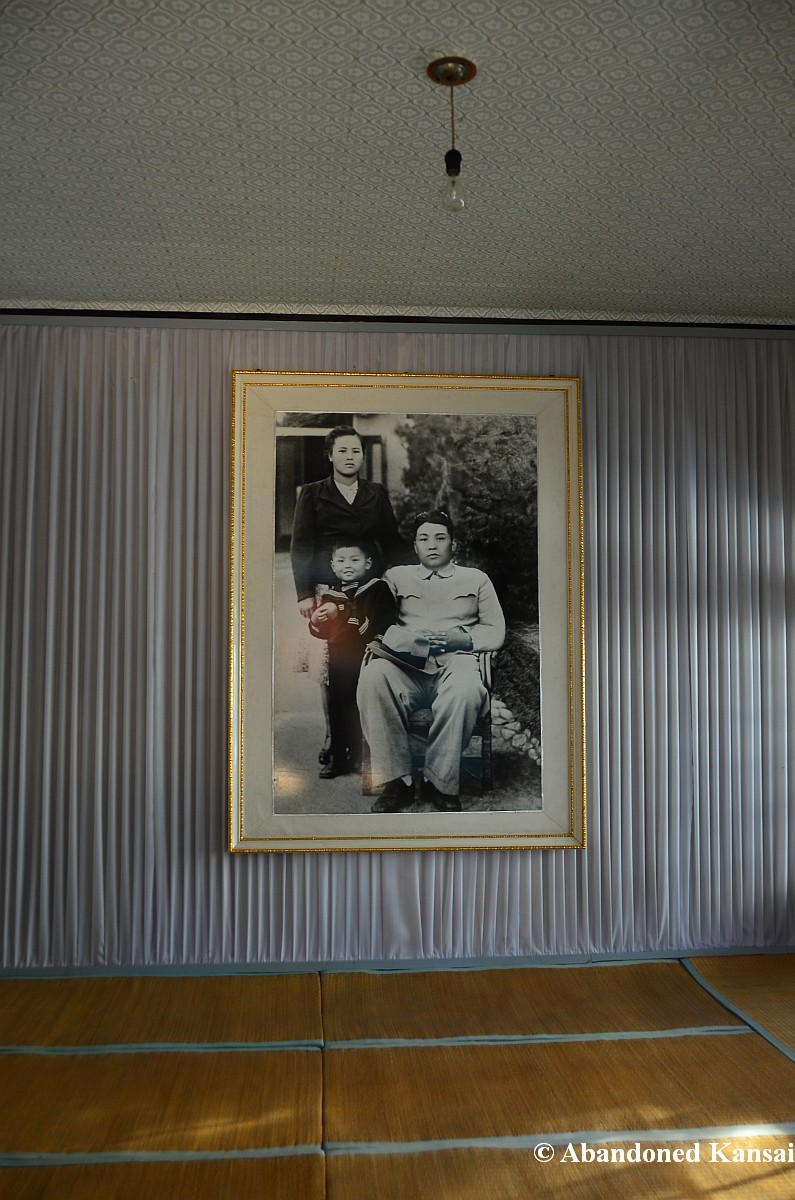
The fact that shocked me the most after my return was that we passed three of the biggest concentration camps in North Korea by less than 10 km! When we visited the city Hoeryong right at the beginning of the tour, our guide kept repeating that the city is famous for its three beauties: Beautiful women, beautiful white peaches and beautiful earthenware. I knew that he was bullshitting us just by looking at photos of Hoeryong’s most famous daughter, Kim Jong-suk, the wife of Kim Il-sung and mother of Kim Jong-il – no offense, but when I talk about the beauty of German women I don’t get Angela Merkel associated! (And after this comment I guess I better not return to North Korea…) Luckily Germans are more forgiving and Mrs. Merkel won’t throw me and my family into jail for the rest of our lives. Speaking of which: Hoeryong is famous for another thing, though it’s everything but beautiful – Kwan-li-so 22, Labor Camp 22; one of North Korea’s biggest and harshest concentration camps, where (according to two defected eyewitnesses) 1500 to 2000 people per year get worked or tortured to death, up to 4% of its total population. Maybe got, as the camp might have been closed in 2012 – which means that those prisoners were either killed or continue their sufferings in other camps. All of that I didn’t know at the time when I was spending a night at a hotel in Hoeryong, just about 5 kilometers away from the camp’s gate… (BTW: Prisoners only receive(d) a small amount of the food per day, despite a food factory in the camp’s labor colony Haengyong-ri. Like everywhere else in the country most of it was delivered to the capital Pyongyang, even if the locals and prisoners were starving, like during the Arduous March between 1994 and 1998.)

Kim Jong-suk With Husband And Son Food Factory In North Korea

Get them while they are young!

Other examples for leaving out information we experienced at two kindergartens, where we were about to watch typical performances by local children; singing, dancing and playing musical instruments. At the first kindergarten we walked through long hallways on the first floor with Hello Kitty and other colorful child-oriented images painted to the walls, then we were rushed through a staircase directly to the third floor, where the children were waiting to perform for us. I was able to sneak five meters down a hallway on the second floor and took quick photos of a painting depicting two snowmen being attacked by armed children, a subject that didn’t go along well with the stuff I saw on the first floor. Back home I asked friends what was written on the snowmen: American Bastard and a derogatory play on words about a former president of South Korea…
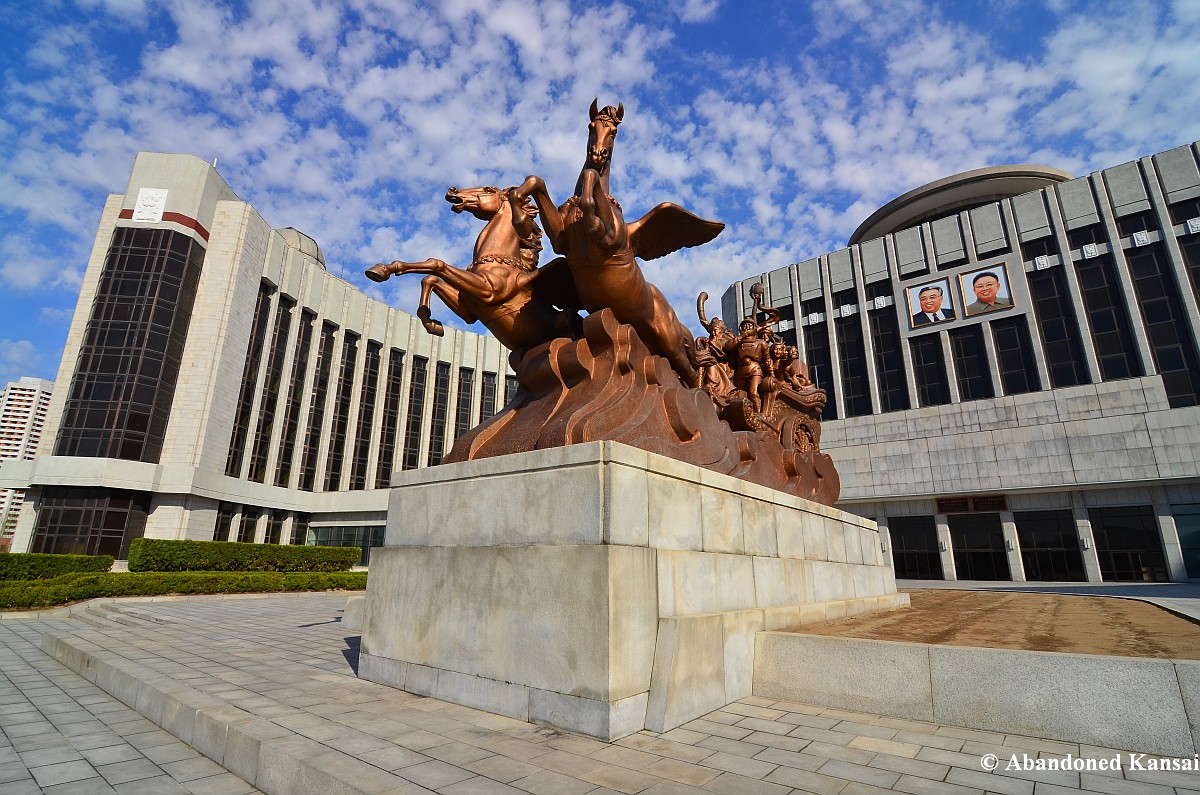
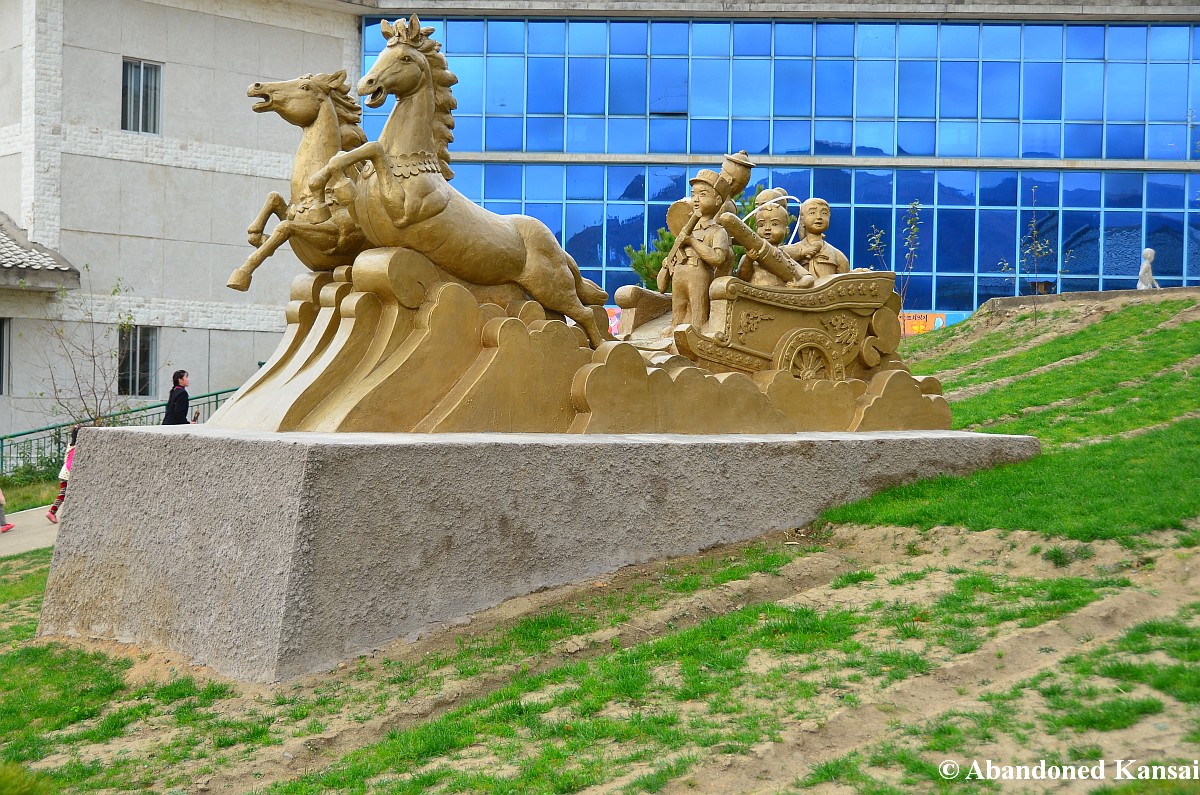
At the other kindergarten (with a different layout) we weren’t shown much of the second floor neither – and this time it was a fellow traveler who found a room she later described as “a war museum”. Sadly I wasn’t able to see it myself, but it goes without saying that our Korean guides didn’t mention it. They also didn’t mention the huge chariot sculpture in front of the kindergarten. At first sight it looked a lot like a simplified version of the one in front of the *Mangyongdae Schoolchildren’s Palace* in Pyongyang, which is all about the future and having fun. The one in Rason? Well, the first child is holding an automatic rifle in his hand, the second one a missile. Nobody pointed out those details…
Chariot of Joy Chariot Of Destruction
Instead we went through yet another musical performance, because North Koreans like to sing and dance – I don’t. Malicious gossip has it that it’s because they don’t have anything else, but hey, they love it, so if it helps the understanding among nations I suffer through 20 minutes of creepily smiling kids at a kindergarten… or a guide singing the national anthem / their favorite NK pop song. Usually both the kids and the adults (guides, waitresses…) are pretty good at what they are doing, which eases the suffering. What really started to irritate me is that you never know when you get dragged into the whole thing. You are never safe… not at kindergartens, not at schools, not at restaurants, not at BBQs, not even on the bus. What is announced and starts as a more or less harmless performance can end with you starring it – and I HATE that kind of attention. At the same time you don’t want to be impolite, so you basically have to choose between the devil and the deep blue sea. One time on the first trip all the guides, one after another, were singing the national anthem of North Korea on the bus – and then kept nagging all tourists into singing theirs. My only way out was to claim that Germany is so anti-nationalistic now, that it is actually punishable to sing the national anthem without written permission by the government; interestingly enough not only the Korean guides but also some of my fellow travelers from all over the world believed that story… (And yes, the singing and dancing was even more intense on the second trip!)

Hunger Games, The Musical

While I visited North Korea for a second time in October I felt like being part of “Hunger Games – The Musical”: A totalitarian system concentrating all the power and wealth in the capital… and everybody was singing and dancing all the time! This wasn’t the rather cozy Pyongyang bubble anymore, this was a glimpse at a system that is plain and simple batshit crazy. Back in spring I actually thought that the DPRK was a little bit misunderstood and just needs some good PR, that Pyongyang was just a sample of what’s going on in all of North Korea, but obviously I was wrong. North Korea needs massive change from the inside, the mindset of the population has to change drastically. And I don’t blame individual average people, most of them are just doing what they are told to do (look at the communism loving Russians that now hump capitalism like a pet bunny does its favorite plush toy…), they are simply trying to survive without getting into trouble themselves, probably being traumatized by decades of subjugation from psychotic despots! I’m sure it’s not all bad in North Korea, but it definitely isn’t as good as tourists are made believe when visiting Pyongyang…

It will take me a couple of months to write about my second trip, especially since this time I want to have the whole set written before I start publishing it. Like last time I have no political or financial agenda, and I will write about my vacation as I experienced it. I just wanted to give all of you a heads up that this time it won’t be as positive and naïve – it will be full of love for the coast and the mountains, for fearless toddlers and curious language students. But you will also read some completely messed-up stories about extreme poverty and regular power-outs, about electric fences along the coastline and despicable acts towards children, about denunciation, double standards and deception – and about how I will rather never go back to North Korea again than deliberately ignoring or even sugar-coating the things that I’ve experienced…

(Please *click here to get to Abandoned Kansai’s North Korea Special* and *here for a map about both tours at GoogleMaps*.
If you don’t want to miss the latest article you can *like Abandoned Kansai on Facebook* or subscribe to the *video channel on Youtube*…)

Border guards don’t like to be filmed, yet I managed to tape me walking from China into North Korea. (As far as I know we were the second Western tourist group ever to enter North Korea on foot from Tumen, China!)

At the end of the video you can hear a guideguard approaching me after he caught me taking this video, despite him announcing that it’s okay to take pictures from the bus just 5 minutes earlier…

One of the most beautiful hours I had in North Korea – sunrise at the beach of the homestay village while most of my fellow travelers were still sleeping.

Read Full Post »

Urban exploration in China is something I thought I would never do – and actually only did by chance. In October of 2013 I was on my way to a second trip to North Korea; not *Pyongyang and the southern parts* again, but North Hamgyong province and the Special City Rason in the north of the DPRK. To reach those areas you don’t fly into Pyongyang via Beijing, but you enter and exit by land. Meeting point for those trips is the Chinese city Yanji, an up and coming 400.000 people town quite close to Russia and less than an hour away from the North Korean border. The tour to Korea ended on a Monday evening… and since Korean Air doesn’t offer any flights on Tuesdays I was stuck in Yanji for a whole day. My buddy Nikolai, who spent a couple of months learning Korean in this town without any tourist attractions at all, told me about a half-abandoned amusement park in the city center. “Half-abandoned” sounded like a dying amusement park to me, one with fewer visitors than necessary, one that is supposed to close soon. Little did I know that he meant an amusement park where literally half of the attractions were abandoned. And that’s not even the weirdest thing about it!

The People’s Park (人民公園) in Yanji looks like a normal public park when entering from the south – a big pond full of water plants, a couple of peddlers selling food and plastic toys, some sculptures (including tasteful nudes), a few benches, and senior citizens playing games at tables. After a couple of minutes you’ll reach animal cages and stalls filled with all kind of more or less exotic animals… as the People’s Park features a free public zoo. But that’s not all! Right where the zoo ends is a small dump area with a couple of abandoned seats, small stands and parts of carnival rides – and at first I thought that was what Nikolai meant when talking about the half-abandoned park. Boy, was I wrong!
Within earshot of the rusty remains I spotted small Ferris wheel, blasting some music into the silence of this sunny Tuesday noon. Customers? None. Potential customers? Only a few more.
The (not so) big wheel was surrounded by 15 to 20 other carnival rides. Two or three of them were also open and running, half a dozen others looked more or less well maintained – and the rest of them were actually abandoned, except for the single demolished one; paint flaking off, weeds growing through a mini roller coaster, seats weathering, concrete crumbling.
This place was so friggin weird! It looked like an abandoned pay-as-you-go amusement park, but it wasn’t, because every other minute you would run into some sweethearts looking for entertainment, and there was music playing in the background all the time; some of it being karaoke sung by a few senior citizens further up the hill. It was so creepy and bizarre – and calming yet very exciting at the same time! Usually I have to sneak around and jump some fences, especially when exploring abandoned theme parks… but not this time! Relaxed I made my way from attraction to attraction and took pictures of whatever I wanted at my own speed, not worrying about anything. When I thought it couldn’t get any better (except for being there on a misty day!) I hit the weirdo jackpot!
I’ve seen a haunted house or two in my lifetime, but none with a naked female torso breaking through the wall on the upper floor, a big hand trying to hold her back, partly covering one boob – next to a monstrous mutant face. But that’s not all! To the left and mid-air was a nude couple (male and female) in a grotesque pose, attacked by two gigantic green snakes – the guy’s face full of panic, the girl’s face barely visible, but clearly in agony, one of the snakes biting into her left shoulder and half of the exposed torso.
The back of the abandoned haunted house wasn’t a tiny bit less bizarre and probably my favorite area in the whole park. There I found a couple of concrete or gypsum animals lying on the ground and standing around, the greyish material spalling off in huge chunks, revealing steel wires underneath. Next to a path nearby was a huge Buddha statue rotting away, made of a Styrofoam looking material – accompanied by the concrete statue of a naked Chinese fairy, right in front of a white rabbit with red eyes carrying a gigantic mushroom… which at this point I felt I must have smoked earlier!

The *second abandoned Japanese sex museum* meets *Nara Dreamland*… with no security standards whatsoever. One of the remaining running rides was a monorail through half of the park. It’s height? About two meters – and no protection at all. I was able to touch the rail at any time and even smaller people carelessly stretching could get hurt seriously by one of the monowheel looking cars. Trash, broken glass and mirrors, rusty metal, brittle animal figures – everything was scattered in the woods around the park and nobody seemed to care about it.
The carnival section of the People’s Park in Yanji was one long bizarre exploration and one of my favorite abandoned amusement parks overall. Deserted theme parks are generally creepy, but the fact that this one was only half-abandoned took it to a whole new level!

(If you don’t want to miss the latest article you can *like Abandoned Kansai on Facebook* or subscribe to the *video channel on Youtube*…)

Read Full Post »

Abandoned furniture stores are quite rare, I’ve actually never heard of one before. Most of the times they are located near shopping malls and either the direct competition takes over and slams their name on it – or some other giant store is happy about aquiring cheap real estate with lots of selling space. Möbel Erbe was different though – and it ended in a fascinating but sad story about greed and incompetence…

First of all, just in case your German is rusty: Möbel means furniture. So Möbel Walther is a furniture store named after the Walther family, Möbel Kraft was named after the Kraft family and Möbel Erbe… right, after the Erbe family.

Until the mid-2000s the Erbe family owned two huge furniture stores, one in Hanau near Frankfurt (more than 50000 square meters, which equals about 538200 square feet) and one in Schkeuditz near Leipzig (about 25k sqm). There might have been a third store, but more likely is that some authors were confused by stores of the same name or by not knowing much about geography.  (E.g. Dölzig is near Schkeuditz, but it’s highly unlikely that Möbel Erbe would have run two stores of that size within five Kilometers of each other.) It was generally tough to find information about the company’s history, specifics about furniture stores are not exactly popular a topic on the internet…
What I was able to find out was that in 2000 Möbel Erbe expanded their original company home with a 5-storey, 30000 sqm building right across the street and connected it with a glass bridge. The so-called “Eurostore” aimed at a younger audience, kind of an IKEA clone. Successfully, according to news reports from 2002, when owner Thomas Erbe was awarded the “OSKAR für den Mittelstand” (OSKAR for Small and Medium Sized-Businesses”) by the Oskar Patzelt Foundation; kind of the Academy Award of enterprises in Germany – which is why the Academy of Motion Picture Arts and Sciences sued… and settled out of court after seven years in 2005, with the prize being renamed to “Großer Preis des Mittelstandes” (Grand Prize of Small and Medium Sized-Businesses). Erbe reportedly was chosen from almost 1000 companies after being nominated four times in previous years. Basically a rock-solid company from all I know, with more than 100 Million Euros revenue per year…

In 2005 strange things happened… In February media reported that the furniture store chain “Sconto” was trying to get permission to build another store in Großaurach near Hanau, but residents and politicians there voiced opposition. Sconto belongs to Kurt Krieger, who also owns Möbel Kraft, Möbel Walther as well as Höffner – plus probably some more, but the company structure is complicated and at least one of his daughters, Sonja Krieger, is in the business, too; acting indepedently, of course. Anyway, Sconto in Großaurach near Hanau wasn’t going to happen and so on July 1st Höffner announced the acquisition of Möbel Erbe out of nowhere; Kurt Krieger in control of Hanau, Sonja Krieger in control of Schkeuditz; and Thomas Erbe told a newspaper that he considered himself responsible personally that nobody gets fired.
Three weeks later Sonja Krieger announced that Möbel Erbe in Schkeuditz would be closed due to the store’s catastrophic economical situation she said she wasn’t aware of before… Yeah, right. Daddy’s in the furniture business since 1967 and is #2 right behind IKEA in Germany and they had no clue what they were buying… so they had to close… by the end of August! Right. But it gets worse!
Four weeks after the aquisition of Möbel Erbe in Hanau and just one week after his daughter fired 120 people in Schkeuditz (the Krieger family conglomerate owned two gigantic stores nearby and didn’t offer any of the former Erbe employees jobs there…) Kurt Krieger announced that Möbel Erbe in Hanau would be closed. But he wasn’t in a rush. While his daughter gave her employees only five weeks notice, “Karate Kurti” was nicer and gave them seven weeks… The reasons given? Same as is in Schkeuditz, the catastrophic economical situation of the store. This time 230 employees were fired, despite (or because of…) the fact that the Krieger family owned two other mega stores less than a dozen kilometers away from Möbel Erbe in Hanau, which was closed in mid-September. But it gets worse!
On December 27th a Sconto furniture store opened in Hanau… in the building formerly occupied by the Eurostore. Yes, in the exact same Möbel Erbe extension Kurt Krieger bought along with the main building… and whose employees he fired just four months prior! Oh, BTW, according to media reports Kurt Krieger’s personal fortune is about 600 million Euros…
(This is the story how I pieced it together from about two dozen news reports I found online. If any former employee or other insiders know more about the story please feel free to correct me or add bits and pieces!)

Eight years after the main store was closed, it is still empty and in worse shape than ever. The latest media reports about the completely vandalized building are from 2011, stating that Kurt Krieger suggested several business plans about food retail and electronic stores, all of which were declined by the Hanau city council, which decided in 2005 that they won’t allow any other retail stores on the premises in an attempt to proctect retailers in downtown Hanau from mega stores in the outskirts. So the inevitable happened and airsoft players, graffiti sprayers and vandals took over.

Interestingly enough I had never heard of the abandoned Möbel Erbe Furniture Store before, despite its quite exposed location – it was actually my sister who spotted it from the car when we were on our way to some closed / abandoned military bases in Hanau, including the *Pioneer Kaserne* I wrote about a couple of weeks ago. For some reason the place doesn’t seem to be very popular with German urban explorers… but I actually enjoyed it. Sure, there was not much to see and the huge storage in the back was partly demolished already, but if you had a closer look you could find some interesting things, like the almost completely broken window front or a couple of items like old order forms and left-behind 5.25” floppy disks. Möbel Erbe probably would have been a disappointment if it was supposed to be the exploration highlight of the day, but as an original find it was a perfect snack on the way to other locations…

(If you don’t want to miss the latest article you can *like Abandoned Kansai on Facebook* or subscribe to the *video channel on Youtube*…)


Read Full Post »

Festivalgate was a post real estate bubble amusement park in the city center of Osaka, just down the street of the famous Tennoji Zoo and right next to a transportation hub combining two railway lines at Shin-Imamiya Station with the tramway stop Minamikasumicho and the subway station Dobutsuen-mae (literally “in front of the animal park”) on the city’s main line Midosuji – although “amusement park” doesn’t really nail it, since the park part was missing. Festival Gate was more like an amusement building with all kinds of arcades, shops, a cinema, restaurants and a rollercoaster on eight floors with a total floor space of more than 5700 m². Though located in a densely populated area with perfect connection to public transportation Festivalgate offered parking space for 380 cars and 120 bikes. Nevertheless it failed twice within 10 years…

I guess the planning of Festivalgate started during the bubble (1986-1991), when the Osaka Municipal Transportation Bureau got rid of the Tennoji Streetcar Garage (大阪市電天王寺車庫). The then leveled lot was split into two parts, A and B – A was the location of the now demolished Festivalgate, on lot B the still operative Spa World was built (a spa wonderland with saunas, waterslides, a gym and themed areas from all around the world). For that the city founded a joint venture with the Mitsubishi UFJ Trust and Banking Corporation and the Chuo Mitsui Trust and Banking Co. (two of Japan’s biggest companies) to raise 50 billion Yen, back then about 290 million Euro / 350 million US$, nowadays 400 million Euro / 532 million US$ (not adjusted for inflation).

Festivalgate opened together with Spa World on July 18th 1997 with an underwater / Atlantis theme – little did they know that they would drown in debt soon…

The opening hours were rather long – 10:00 to 20:00 for stores, 10:00 to 22:00 for amusement facilities, 10:00 to 23:00 for eateries. To give Festivalgate a financial identity you were able to buy discount tickets at vending machines; for 1000 Yen you received a 1100 Yen card, for 3000 Yen you got a 3400 Yen card and for 5000 Yen you were able to enjoy 5800 Yen worth of fun. This was what the floor plan looked liked:
B1 – Underground walkway to Shin-Imamiya Station and Dobutsuen-mae Station.
1F – Miracle Gate: Entrance and main floor.
2F – Plaza Festa: Eateries and shopping.
3F – Festival Pier: Eateries and shopping with a West Coast theme.
4F – Oriental Festa: Eateries and shopping with a Marco Polo theme.
5F – Festa Mosque: Eateries and shopping with a Bazaar theme.
6F – Festa Lab: Arcade game zone (Sega World) with a Jules Verne theme.
7F – Cine Festival: Cinema complex with 4 screens for up to 600 guests total.
8F – View Festa: Restaurant area with a stunning view.

Since Festival was considered an amusement park (no entrance fee though!), of course there were pay as you go attractions scattered all over the floors 2 to 6 – for example 2F had the Mermaid Carousel, 3F had the entrance the parachute tower “Tower of Teos”, 4F had a cat petting zoo and a Chinese Ghost house, 5F had a kid’s land, an airgun museum and the entrance for the iconic rollercoaster and 6F was full of arcade machines run by Sega.

At the beginning Festivalgate was a huge success – in the first year (1997/98) 8.31 million visitors had a look, but in the following year the Asian Financial Crisis hit Japan and numbers dropped significantly. Four years later, which is one year after Universal Studios Japan opened in the south of Osaka, Festivalgate had only 3 million visitors – none of which paid an entrance fee… Shops and restaurants started to drop out and the downwards spiral could not be stopped – in January of 2004 the banks withdrew from the project, driving the Festival Gate Corporation into bankruptcy and leaving the city of Osaka with 20 billion Yen of debt. Orix, a financial service provider most famous for owning and sponsoring the baseball team Orix Buffaloes, stepped up in 2005, but dropped out when it became clear that Festivalgate was a bottomless pit. In January of 2007 the city of Osaka concluded that Festivalgate would cost 200 million Yen per year for maintenance and decided to get over with this unfortunate and highly unprofitable project – the remaining businesses were given notice and Festivalgate closed officially July 31st of the same year. After some back and forth with potential Korean investors the Japanese entertainment giant Maruhan (bets, pachinko parlors) bought Festivalgate in a third auction on January 30th 2009 with a winning bid of 1.4 billion Yen, announcing reconstruction plans soon after. The demolition of Festivalgate began in 2010 and it turned out to be a surprisingly time-consuming process given that Japanese wrecking crews usually are faster than a bunch of piranhas dealing with a chicken…
When I first went to Festivalgate on November 3rd 2010 there was little to nothing to explore, although it seems like the building was still accessible from 2007 till 2009, despite all shops and restaurants being closed. Demolition had already begun, but at least the underground passage and the entrance area on 1F was still accessible with signs announcing that this would change December 17th. Active Japanese construction sites usually are fortified – solid high fences all around, guards in front of every exit, sometimes with small lightsabers to stop pedestrians when vehicles are getting in or out. The Festivalgate deconstruction site was no exception. All potential entrances (including windows) were locked solidly, security was patrolling (probably to keep homeless people away since Festivalgate was in an area that has a rather bad reputation… by Japanese standards), fences were even higher than usual – 3.5 to 4 meters, not the normal 2.5 meters high ones. But not high enough to block the view from the elevated Osaka Loop Line! So I took a couple of photos… and again when I was visiting a friend for a Christmas party later that year. And again whenever I passed by – which wasn’t that often, but still enough to give you a general idea how things progressed. To my surprise it took more than two years to get rid of the ill-fortuned Festivalgate. Good for me (and you) as this article was only possible thanks to that… BTW: Sorry for the quality of the photos – they are not artistic at all, shot from crowded, moving trains, but I think they nevertheless are interesting.

(If you don’t want to miss the latest article you can *like Abandoned Kansai on Facebook* or subscribe to the *video channel on Youtube*…)

Read Full Post »

“How do you find all those abandoned places?”

Hardly any other question I hear more often than the above one, maybe with the exception of “Which is your favorite abandoned place?”. Finding abandoned places… it’s easier than you might think – and harder at the same time. Of all the 300 explorations I did (more or less), about half a dozen locations were shown to me; voluntarily, I don’t recall ever asking anybody any specifics. Which also means that I found 98% of the places I explored either by chance (driving around in a car or spotting them from a train) or by doing research – reading other people’s blogs, looking for hints like location names, parts of location names, city names, prefecture names… or paying close attention to photos. Yes, I actually identified abandoned places by looking at mountains, coastal lines or other buildings in the background. Once I thought I found the location of an abandoned cable car, but I was wrong… instead I found an abandoned ropeway virtually unknown to the internet – the cable car I identified half a year later, about 300 kilometers away from where I first thought it would be. If you are lucky you can find urbex maps by less caring explorers, but they tend to be unreliable… and most of the locations revealed on those maps are rather well-known anyway. The real gems are hidden – and it’s even more satisfying finding them than just choosing one from a catalogue!
The Japanese Countryside University is one of those places, a mesmerizing complex of rather new yet partly overgrown buildings; at least according to my internet source. I saw it once on a Japanese blog and never again since. The J-blog dropped a couple of hints, like an abbreviated version of the university’s name, a road number and the fact that there was a train station next to the road – nevertheless it took me several hours to find the exact location, because it turned out that the university still exists and that the abandoned campus was a couple of dozen kilometers out of town… but with a train station along the same road as the main campus. No word about that fact in the article, of course! In the end it took me half a day of research in Japanese and the help of a friend (thanks again, Mayu!) to finally pin down the exact location. I felt like Sherlock Holmes himself when I confirmed the overgrown campus on GoogleMaps… and even better when I finally went there more than a year later. I found that place – and I was about to explore it…

Over the course of the past four years I learned two important things about urbex:
1.) Never enter right away, you might find an easier back entrance!
2.) Don’t sneak around like a thief in the night – approach people unless they wear a uniform!

Arriving at the Japanese Countryside University my heart sank a little bit. The entrance gate had nasty spikes and the road was surprisingly busy, even on a weekend day. So I followed guideline #1 and started to circle the place, only to find an entrance to a big parking lot in the back, where I could not have been seen or heard; or so I thought. Some of the buildings were in amazing condition, despite the fact that the university was closed in 2006. While I was still wondering about that fact I saw two cars parked near the entrance of what appeared to be the main building. Darn! So I got closer and while I was walking between two buildings I saw an older dude kneeling on the ground of floor 1.5 – instincts kicked in and I made my way back to where I entered, without being seen. Then I remembered guideline #2, so I went back, waved (this time the guy saw me…) and entered the building. Living in an English speaking bubble my Japanese is rather basic, so I scraped together a couple of long forgotten phrases and approached the guy – who’s English was about as good as my Japanese. I asked him what this building was and he told me what I already knew. Then I told him that I like old buildings and asked him if it was okay to take some photos. At first I thought he was strictly against it, but then he took me up to the sixth floor of this brand-new looking building from the year 1986 where I was presented with a gorgeous view over the whole campus – sadly I wasn’t able to take some good photos through the windows, but my new friend left me alone and walked down the stairs, so I could take some photos and videos of the building, a former library, at my own speed.
Back at the 1.5th floor we had another quick chat. It turned out that my new friend was a 75-year-old former art teacher and some of the university buildings were in the process of being converted into… some kind of art project; the exact details were lost in translation.
I went on to take some photos outside – and having been been treated with such generosity and kindness I didn’t even consider entering the areas that were roped-off. So I took some more photos and shot a walkthrough from now almost completely overgrown dormitory to the main area.
That’s when I realized that my artist friend was gone… and my urbex instincts kicked in. The ropes. *What was behind those ropes? Well, that’s a story for another time…*

(If you don’t want to miss the latest article you can *like Abandoned Kansai on Facebook* or subscribe to the *video channel on Youtube*…)

Read Full Post »

« Newer Posts - Older Posts »