Feeds:
Posts
Comments

Archive for the ‘Animals’ Category

If you are a regular reader of this blog you might remember my *rant about Golden Week* a while ago. To refresh your memory: I went to Kyushu for some urban exploration – my plan was to stay for four days, but I had to return to Kansai the same day, because I couldn’t find a hotel room; partly because I’m Caucasian, probably because my Japanese skills are limited.

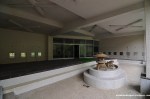
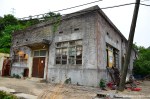
Between the devastating news from the Sasebo Tourist Information Center (their staff was great though!) and me returning home I visited the abandoned Saikaibashi Public Aquarium, a location that gained quite a bit of popularity on Japanese *haikyo* blogs recently.
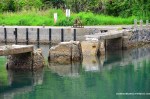
Sadly only a couple of urban exploration blogs, Western as well as Japanese, really care about the history of the places they present – a fact that sometimes makes it tough for yours truly to give you proper facts about the places I showcase on Abandoned Kansai. I’ve seen a really old photo of the aquarium taken in summer of 1965, so it’s pretty safe to say that it was in business already back then. The oldest photos of the abandoned aquarium dated as far back as 1996 – and on those photos the place already looked like nobody took care of it for a decade or two. The small floating platform in front of the aquarium did not have the wood and barbed wire installation yet, and the handrail on the waterfront was still there, but the concrete holding it up was already severely damaged.

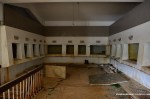
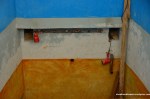
I can’t remember the last time I’ve been to a public aquarium still in business, but passing by the ones on *Mount Yashima* and the Kaiyukan in Osaka (which is one of the biggest aquariums in the world) I was under the impression that those installations are pretty big. The Saikaibashi Public Aquarium wasn’t big at all. Probably 6 or 7 meters by 35 meters, 2 floors (steps, no elevator). There was one huge tank combining both floors and several smaller ones on each floor. None of them were filled with water, hardly any had intact windows. The amount of vandalism was severe – no graffiti, but most of the smashable items were destroyed. The building being exposed to the elements didn’t help either – even on the upper level the massive concrete floor felt kind of unsteady due to the damages done in the past decades. And outside it was more than clearly visible how fragile concrete can be: the bridge leading to the aquarium collapsed at two different segments and I really hope nobody was walking there when it happened. Which is rather likely since I’ve seen photos of the intact bridge that weren’t that old – maybe 1.5 or 2 years. The chance that a fellow explorer took an involuntary bath is rather high…

What really surprised me, not to say shock me, was a fact I found out about only after I visited the Saikaibashi Public Aquarium. As small as the aquarium was, it seems like the main attraction of the place was a dolphin show! The now broken bridge, fitted with metal grids, limited an area known as the “Dolphin’s Cove” (イルカの池), show time was at 10:00, 12:00, 14:00 as well as at 16:00 on normal weekdays and at 10:30, 12:00, 13:30, 15:00 and at 16:30 on weekends, public holidays and during the six week long school summer break that to the best of my knowledge usually starts in July when the weather becomes too hot and humid to spend time in a building without AC, which applies for most Japanese schools.

Though small and vandalized, the one hour I had to explore and document the Saikaibashi Public Aquarium felt a bit short. How often do you have the chance to visit an abandoned aquarium? But at that point I was still hoping to get a hotel room in Fukuoka, so I had to leave prematurely and hurry to save my third Kyushu trip…

(If you don’t want to miss the latest article you can *follow Abandoned Kansai on Twitter* and *like this blog on Facebook* – and of course there is the *video channel on Youtube*…)

Read Full Post »

The Shimizu Onsen Center was the last stop on a road trip to Shikoku my buddy Gianluigi and I did in the spring of 2011. Usually I write a short road trip summary in advance, but these days I’m a bit busy, so maybe I’ll make up leeway some day in the future – after all it was quite a busy road trip with six locations in two days.

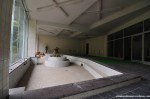
Onsen is the Japanese term for hot spring, but usually it is more about the hotel / restaurant that is making use of the water. The Shimizu Onsen Center is one of those hidden gems of the beaten tracks deep in the mountains of Shikoku – and the name is just perfect, because shimizu actually means “pure water”. Pure water that won’t be soiled by many visitors, because the Shimizu Onsen Center closed a couple of years ago. If you try to find some information about it yourself, make sure to not confuse it with several other towns named Shimizu all over Japan (like in Fukui, Hokkaido, Kochi, Shizuoka, and Wakayama). You can imagine that the name is quite popular…

When Gian and I drove onto the already slightly overgrown parking lot we had no idea at all what expect – I had never seen photos of the Shimizu Onsen Center and I’ve never seen any since I’ve been there, so please consider it an original find that hasn’t appeared on any blog about Japanese ruins, neither in English nor in Japanese. As we got out of the car it just started to rain and we were pretty tired after a series of exciting but energy-sapping explorations. Nevertheless we closed in quickly, but carefully, just in case the low buildings nearby were home to some curious spectators. But we were lucky and able to enter the Shimizu Onsen Center without trouble of any kind. Not only that, but there was a note taped to the entry glass door of the spa, explaining a little bit about the place’s history. According to this it was opened in 1981 and operated for 14 years before it was sold to a new owner. Financial trouble began in 2003 and in late November of 2007 the place closed with 160 million Yen of debt – just three and a half years before Gian and I visited.

The Shimizu Onsen Center was fed by a sodium hydrogen carbonate spring with a temperature of 17 degrees Celsius, helpful to treat rheumatism, neuralgia, diabetes, and skin diseases. It targeted mainly day-trippers and tourists who booked accommodations nearby. Opening hours were from 9 a.m. till 9 p.m. (closed every 1st and 3rd Thursday of each month) and the entrance fee was 600 Yen. In the northern part I found a couple of Japanese style guest rooms with tatami mats and small TVs, but I’m not sure if they were used for overnight stays or just to relax between two baths.

Gian and I entered through the normal entrance on the second floor and went straight downstairs to the first floor, where the baths were. Both the one for males as well as the ones for females were equipped with a sauna and featured several frog statues. The Japanese word for frog is “kaeru”, which can also mean “to return”, and that made them good luck charms / symbols for money and coming back safely. This floor also featured the already mentioned guest rooms, which could be reached through a very, very dark hallway. The whole floor and all the items there looked a bit old and run down (like the massage chairs in the hallway and vending machine for razors), but there were no signs of vandalism or theft.

That also applied for the second floor with the front desk and a huge tatami room with a stage – a typical Japanese party room for long karaoke sessions with dozens of attendees. The tiny coop next to the stage even still had all the music equipment including countless tapes. No vandalism, no theft. In the entrance area we found a bin stuffed with umbrellas, slippers were still lined up and the front desk was neat and tidy.

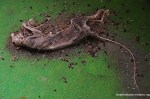
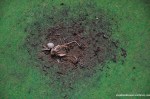
The rather small third floor was exciting and disappointing at the same time. On the one hand the former bar was removed and so were the arcade machines that one day must have been there. On the other hand I finally found some dead animals, in amazingly good condition actually. Two skeletonized birds and a rat with some of the skin left, surrounded and partly covered by dead maggots. One of the bird skeletons was on the stairs on the way up, but the other one was just a couple of centimeters away from the rat – it looked like hunter and prey died at the same time at the same place. And that rat was huge! Maybe 30 centimeters long, and by that I mean the body alone. Since it was grey outside and I had to bring my tripod for the interior shots anyway I set up my little equipment to a comfortable height and zoomed to get a decent picture, being the lazy photographer I am sometimes. I was aware that the exposure time was rather long (a quarter of a second), but I didn’t realize that I zoomed to a point where gravity took over and the lens continued to zoom on its own – and so I accidentally created one of my favorite photos ever, one that still makes me a bit dizzy to this very day. Excited by this new discovery (commonly known as radial blur) I took some additional similar shots with both the rat skeleton and the bird skeleton next to it before we finally ran out of time – we were in the middle of nowhere in Shikoku on a rainy day and had less than 3.5 hours to get the car back to the rental company. Which really reminded me of my *first trip to Shikoku*, but this time the car rental was in Osaka, not in Kobe – and due to Golden Week the roads were a lot busier…

(If you don’t want to miss the latest article you can *follow Abandoned Kansai on Twitter* and *like this blog on Facebook* – and of course there is the *video channel on Youtube*…)

Read Full Post »

Okunoshima is urban exploration for beginners. Actually it’s more like a vacation day than urbex – with an inglorious past, probably one of the darkest chapters in Japan’s history. And it’s an island with many names. In Japan Okunoshima (大久野島) is famous as usagi shima (ウサギ島), Rabbit Island. People with a more twisted look at life call it Poison Gas Island, though the Japanese term doku gas shima (毒ガス島) is way less common – but I doubt that this is the result of a more positive Japanese mindset…

Located in the Seto Inland Sea about 50 kilometers east of Hiroshima Okunoshima disappeared before if became famous. Back in the 1920s Japan signed the Geneva Protocol of 1925 that banned the use of chemical and biological weapons – but it didn’t say anything about development, production, storage or transfer. At the time being up to no good and started making trouble in the neighborhood, Japan immediately began to take advantage of that loophole. And with that Japan became the only country to use chemical weapons  in World War II, killing an estimated 80.000 Chinese soldiers and civilians according to historian Chi Hsueh-jen! (Not only with the knowledge, but with the permission of Emperor Hirohito… which probably should have lead to his prosecution as a war criminal. Sadly, hard evidence was found only decades later by Yoshiaki Yoshimi, a professor of modern Japanese history at the prestigious Chuo University and a founding member of the “Center for Research and Documentation on Japan’s War Responsibility”. My deep respect for the man, I’m sure his research made him more enemies than friends…)
The location of choice was the small and barely known island of Okunoshima, off the beaten tracks in case of a major accident, but still close enough to the important military city Hiroshima. From 1927 to 1929 an existing fish cannery on Okunoshima was “modernized” with a desalination plant, a refrigeration system and a power plant – and at the same time all foxes, martens, cats and rats were systematically eradicated. Okunoshima was erased from maps and Japan did everything to keep its existence a secret. Shipping routes were changed and trains along the coast had to close their window shutters, so did ferries passing the island. Plain-clothed members of the infamous Japanese military police kempeitai made sure everybody followed those rules and didn’t dare to sneak a peek. To avoid any activity on Okunoshima being seen from mainland Japan the old fish cannery was blown up, keeping the new installations intact – and the old pier in the west was replaced by a new one further south, closer to the research and production facilities. Huge storages for gigantic tanks were carved into the mountain and the soil was used to create ramparts as visual covers. In 1929 production began with high secrecy and under horrible conditions.

Since most of Japan’s leading scientists were under the supervision of western secret services they couldn’t be involved directly in the top secret base on Okunoshima. Production had to be executed by educated amateurs. Most of them were Korean forced laborers who worked in the production of medicine or soap before, locals looking for a good salary – and later on the military pressured more than 1000 local high school students into working on Okunoshima; at first only those with good grades in natural sciences, in the final years of WWII pretty much everybody available. The workers were given protective suits that weren’t really protective because the aggressive chemicals made the PVC brittle – thousands were injured because of that and during accidents, many died of their injuries because there were no doctors on the island and nobody was allowed to seek medical help on the Japanese mainland for the reason of secrecy. The production halls were cold in winter and smoldering in summer. Imagine wearing a plastic suit in a climate that sometimes makes it hard to breathe even when in shorts and T-shirt…

About 6.600 tons of mustard gas (Yperite), lewisite, phosgene and other poison gases were produced and stored temporarily on Okunoshima between 1929 and 1944 before being put to use by the Japanese military. While the gases were tested on rabbits on Okunoshima the scientists there worked together with the infamous *Unit 731* on at least two occasions in 1940 and 1943 – they tested mustard gas on Chinese prisoners. (In case you don’t know Unit 731: Have a look at Wikipedia and make sure you don’t wanna eat soon. Their initiator and commanding officer *Shiro Ishii* was one of the most despicable people to ever walk on this planet, the Japanese Josef Mengele, maybe even worse – but thanks to some Americans, especially from Fort Detrick, the weasel was never prosecuted, although he should have been executed for his war crimes. Ishii didn’t even have to flee Japan since he was able to negotiate immunity for himself and his closest allies. Instead he lived a peaceful life with his family until is death in 1959 at age 67.)

After World War II ended in 1945 the remaining poison gas was dumped in the ocean, buried or burned – the factories were blown up or used as housing or storage (e.g. for ammunition during the Korean War). This was done by Japanese contractors under the supervision of the Americans, but what happened to the rabbits used as laboratory animals is rather unclear. Some say they were released by workers after the Japanese military left the island – others claim that they were all killed by the American military and the current rabbits on Okunoshima are descendants of a dozen pets released by a Japanese school class in 1972. One thing is for sure: Since all natural enemies of the rodents were killed in the late 1920s they don’t have to fear any predators and so they breed like… well… rabbits.

Okunoshima stayed a forgotten island for a few decades until in 1988 something unusual happened, at least by Japanese standards: A poison gas museum opened on the Poison Gas Island. Of course emphasizing the harsh conditions for the workers in the factory, because as everybody knows, at least everybody educated by the Japanese school system: Japan was the victim of WWII. Well, sadly that is the common self-awareness, which explains South Park episodes like Whale Whores (and Chinpokomon…) – episodes that show an understanding of Japan most people, including Japanese, don’t have. And so all the photos of poison gas inflicted wounds in the 2 room museum are not from WWII, but from the Iran-Iraq War of 1980-1988. And while most ruins on Okunoshima have signs in Japanese and English (which is quite commendable since it’s unusual for any location that far off the beaten tracks!) the ones at the museum are mostly in Japanese only. (Which reminds me of the Peace Center in Osaka, where most of the surprisingly critical exhibits are labeled in Japanese only while all the others are bilingual, Japanese and English – shamed be he who thinks evil of it…)

Nowadays Okunoshima is a popular tourist spot, visited by about 100.000 people a year, many of them staying overnight at the hotel or the camping ground on the island. Not so much because of the poison gas factory ruins or the museum, but because of the rabbits. Like I said, no predators, so 100s of them are roaming freely, probably making Okunoshima the world’s largest petting zoo. Usually when I am on my way to an abandoned place and there is some noise in the bushes close-by it’s a snake. Or a boar. Or a monkey. Maybe even a bear. On Okunoshima it’s a rabbit. Or a bunch of them. Charging at any person that is passing by, hoping for some food. And they are so adorable! I came for the ruins, but I stayed for the rabbits. Seriously, I spent much more time taking photos of rabbits than taking photos of ruins – when I found out that there were remains of a Meiji era fort from the Russo-Japanese War of 1904/05 I almost considered it a burden, not another photo opportunity…

Pretty much all rabbits on Okunoshima are hand-tame. The ones near the ferry terminals and the hotel are by far the biggest ones. I’m sure they get fed 24/7! If you like your rabbits smaller and a little bit more shy I recommend going off the beaten tracks – to the tennis courts (de-facto abandoned, at least some of them), to the former gunpowder storage or any trail up the mountain. Don’t worry, even there you don’t have to look for rabbits… they will find you! (And you don’t have to worry about snakes, boars, monkeys or bears – you are not even allowed to bring cats or dogs to the island.)

As for my day on Okunoshima: I did a full circle, starting at ferry terminal 2 and ending at ferry terminal 1, since I left on the second to last boat departing from the island; you can *have a look at GoogleMaps* as Okunoshima is a tourist attraction. And I refrained from renting a bike, because I wanted to take my time and enjoy the relaxing atmosphere on the island. The weather started out sunny and ended overcast, poison for photography, but surprisingly I didn’t mind. All of a sudden I didn’t care that much for the gas factory ruins. Many of them were fenced off by ridiculously low bars, but for once I did respect those barriers that were more symbolic than effective. After learning about the place’s history all those chunks of concrete blackened with soot weren’t that important anymore. Okunoshima’s history was just overwhelming. Why disrespect a place that saw and caused so much pain and suffering? When at the same time you can spend a relaxing day at the beach and play with cute little bunnies!

Going to Okunoshima was a wonderful experience and I kind of left with a heavy heart – I visited in spring on a warm day, probably still a little bit too cold to go swimming, and I had plans for the next day. But if you ever have the chance to go to Okunoshima from late spring to early autumn make sure to bring a loved one (as well as your kids, if you have some) and stay overnight at the hotel – just make sure to make a reservation months ahead as the hotel is very busy. Unless you are afraid of ghosts and fear that hordes of Chinese war victims, Japanese workers and laboratory rabbits will haunt you…

(If you don’t want to miss the latest article you can *follow Abandoned Kansai on Twitter* and *like this blog on Facebook* – and of course there is the *video channel on Youtube*…)

Oh, before I forget: A shortened German version of this article, “Die Insel der Versuchskaninchen / Okunoshima – Zwischen Giftgas und Kaninchen” (The Island of Guinea Pigs / Okunoshima – Between Poison Gas and Rabbits), was published on Spiegel Online / einestages on Monday – you can *read it here*.

Read Full Post »

When you think of Japan which other country comes to mind?
Probably Korea since it’s a neighboring country and both countries share an inglorious common history. China, of course, a major influence for centuries – from city planning to food. Most likely the United States as no other country had more impact on Japan in the past 70 years. Maybe Germany due to 150 years of more or less intense friendship and a similar post-war history.
Japan and New Zealand? A rather odd combination. Surprisingly *Michael* and I visited not only one, but two New Zealand themed amusement parks while on a *road trip in southern Honshu*. A couple of weeks ago I wrote about the *Hiroshima New Zealand Farm*, a closed but not abandoned theme park in Hiroshima prefecture. This time I’ll present you the clearly abandoned Yamaguchi New Zealand Village – same concept, same company, but without the shadow of a doubt a “lost place”; BTW: I really dislike the term Lost Place, which is used for urban exploration locations in Germany – not as bad “Handy”, which is used for mobile phones (!), but nevertheless a term that makes me cringe.

Arriving at the huge deserted parking lot of the New Zealand Village, it was pretty clear that we wouldn’t run into gardeners or other caretakers. The wooden handrail leading up to the entrance area was getting brittle and all kinds of plants grew without any attempt to tame them. Opened in July of 1990 after spending 1.8 billion Yen (currently about 16.5 million Euros or 21.7 million Dollars) the park’s attendance figures peaked in 1991 at 428.000 – in the following years the numbers dropped to about one third of that per annum before Farm Co. Ltd. put an end to it in 2005 by closing the park. Initially the 30 ha (300,000 m2) large New Zealand Village was put on hiatus for up to three years with the intent of re-opening it again one day, but that never happened. I don’t know if somebody took care of it for a while like they do at the New Zealand Farm (which is in its fourth year of closing), but nowadays the New Zealand Village is clearly abandoned…
(Just for comparison: *Nara Dreamland* peaked at 1.6 million visitors a year and closed when the number was as low as 400.000 – Universal Studios Japan in Osaka welcomes about 8 million guests a year.)

Exploring the New Zealand Village couldn’t have been more relaxed. Located in the middle of nowhere Michael and I enjoyed a wonderful sunny day on the copious premises.
The entrance area was dominated by a gift shop called カンタベリー (Canterbury), vandalized, but still stocked with quite a few examples of fake food Japan is so famous for – in this case all kinds of sweets. We found replicas of mini cakes, both Western and Japanese (mochi), all made of plastic and therefore still nice to look at.
In close proximity was the Jersey Factory that produced and sold homemade bronzer… sorry… handmade butter! And pretty much next to this place with a name that has no connection to New Zealand was a huge building that had New Zealand all over the place: Restaurant Rotorua, Newzealand Farm, Kiwi Country. Why give it one name when you can give it three? Or four, since all to the left it said “Main Bazaar”.

This food dominated commercial zone of the New Zealand Village, which overall had way less of a village feeling than the New Zealand Farm, was followed by the wide, open landscape I knew from other versions of the nature themed parks. And I loved it! I usually don’t feel very comfortable in abandoned buildings, but open areas like mining towns and amusement parks I really enjoy (if they are really abandoned), especially on sunny spring days!

What made the New Zealand Village in Yamaguchi different from those in Hiroshima and Shikoku was the variety of strange pedal-powered vehicles. Cars, bikes and really unique constructions – they were scattered all over the park, a plethora of rental… thingies. I took photos of many of them and maybe one day in the future I will publish a special picture set about them.
Another thing that made this installment of the New Zealand parks special (but not in a good way!) was the already mentioned presence of vandalism. It wasn’t “ZOMGWTFBBQ!?” bad, but since vandalism is always uncalled for it was nevertheless sad to see. Call me old-fashioned and naïve, but I like my abandoned places easy to access and naturally decayed. Luckily the amount of vandalism decreased the further we got away from the entrance, so by the time we reached the stables and Sheep House with its museum of 19th century farm equipment and a couple of taxidermy items in the making, vandalism was nothing but a bad memory.

What really bugged me about exploring the Yamaguchi New Zealand Village was the time pressure. Like I already mentioned, this was part of a road trip to the south of Honshu and the schedule was kind of tight. A place like this deserves a whole day of exploring and taking pictures, probably with some hours after sunset for some special photos – a luxury not available to us. So when Michael and I left after 3 hours (which is generous for most places – *Sekigahara Menard Land* I left after about 20 minutes…) it was with a bittersweet aftertaste, amplified by a bunch of beatniks who entered the parking lots just before we left. Us driving away was accompanied by the sound of burnouts in the distance…

(If you don’t want to miss the latest article you can *like Abandoned Kansai on Facebook* – and of course there is the *video channel on Youtube*…)

Addendum 2014-07-11: According to a friend of mine all the buildings have been demolished – R.I.P.!

Read Full Post »

I have to admit: Finding and exploring the abandoned poultry farm in Okayama prefecture was one of the most rewarding and exciting experiences since I started urban exploration. It was unusual in many ways and I’m so eager to tell you about it, that this has become the fastest published article in Abandoned Kansai history – the events, photos and videos are just 5 days old…
Gosh, where to start? Pretty much everything about this exploration was unusual. The whole thing started when in 2011 a *red factory* / mine popped up on Japanese blogs several times. Urban exploration usually means going to places where many men (and women) have gone before, so I did some research, but didn’t get more than the information that the red mine was supposed to be in Okayama prefecture. So when I kind of randomly looked at the satellite mode of GoogleMaps I found two places with red roofs in the mountains that might have been abandoned. While I found confirmation about the smaller one that it was really a factory, the larger one I had no lead on. A still quite blurry satellite image, that’s it. No information on other blogs, no marking on a Japanese haikyo map, no Streetview – darn, not even a link to a Panoramio photo nearby. Just a bunch of buildings with red roofs standing rather close to each other, kind of similar to the satellite image when you look at the *White Stone Mine*. I didn’t know what they were or even if they were still there as the satellite photos of GoogleMaps tend to be a couple of years old. Nevertheless I grabbed my equipment and a book (The Hunger Games, which I really enjoyed!) last Saturday early in the morning and boarded a train – and another one, and another one, and…
After I finally reached a small station in the middle of nowhere I left the tiny town it was in quickly and walked along a country road for about half an hour, reaching a small settlement close to where I suspected the red roof shacks to be. I was on my own for this exploration – it’s hard to find people to get up when it’s still dark outside to go to a cold place in the middle of the mountains, especially when you can’t promise a spectacular site; or in this case: anything at all. While I was walking past gorgeous little wooden Japanese houses with the stunning roofing tiles and neat gardens a small pickup truck with two senior citizens passed me and turned left down the road – where I suspected the red roof shacks to be. My heart sank almost as quickly as when Gil and I approached the *Deportation Prison Birkhausen-Zweibrücken* back in Germany. And like half a year ago I was right: Getting passed by a truck near an abandoned place is barely ever a good sign. When I reached the small gravel road that supposed to lead to the red roof shacks I found the street and the whole area fenced off. Not with a sturdy fence that is easy to climb. No, one of those half-ass ones you basically have to trample down to get across – unless you are willing leave and get home. But at that point it wasn’t the decision to be made. Because the previously mentioned senior citizens were there, early on a Saturday morning of all days… inspecting the fence and making sure that it reached about a meter over the little river so nobody can go around it – like *Enric* and I did at the *Iimori Mine* two years ago. Since those guys looked like they came to stay I climbed a nearby small mountain with a cemetery. My hope was to get a glimpse into the valley, to at least confirm that the red roof shacks were still there. But that didn’t work out either. Slightly frustrated I came down the mountain and made my way back to the train station when I realized that I will miss the once per hour train by about five minutes even if I’d run. At that point I became rather frustrated and angry. Why the heck did I get up early on a Saturday winter morning to ride trains for hours to go all by myself to a cold mountain valley where I didn’t know what to expect just to find it fenced off and guarded by two old guys? While I was silently cursing on my way through the settlement outside the little town I heard a small pickup truck behind me. When it passed I saw the two old guys sitting in there and I stopped… I had at least half an hour to kill and even then I would make the next train. Why not getting back to that stupid fence?
So that’s what I did. I hurried back to the fence only to find that Japanese planning never disappoints. Since I couldn’t make it around the fence I just followed it for a while. Up another mountain and another cemetery. And there it was, an opening in the fence, at least a meter wide, probably to allow hikers and mourners to reach the top of the mountain. I followed the fence back (on the other side, of course!), only to find a rather steep slope along a wastewater pipe or something like that. Luckily somebody set up a rope there, so it was quite easy to get up and down, ignoring the fact that I ripped my fingers on the cutting plastic, but well, small sacrifices…
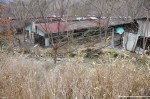
Finally on the other side of the fence at the gravel road I hurried deeper into the valley. The road here was overgrown and barely visible, but to my left I saw a couple of shacks in abysmal condition. I was relieved. A lot! Whatever I saw on the satellite pictures was still here. But the feeling of relief didn’t lower the tension at all. At this point I was still visible from the street and being alone in a fenced off area in the Japanese mountains isn’t the best situation to be in. No need to worry about poisonous snakes in January, but I ran into both wild boars and wild monkeys before… and there are wild bears in Japan, too. I tried to ignore those worries and hurried deeper into the valley on this overcast, hazy winter morning. And there it was – the big red building with the intact roof. And at first sight it was clear: This wasn’t the red mine / factory I hoped it would be… it was better!
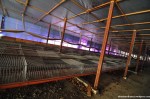
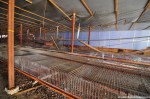
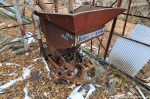
The first thing that caught my eyes was the small silo in front of the open, but rather uninviting building. When I entered I saw cages inside. Dozens, hundreds of them. With the roof still intact the building was pretty dark towards the middle, so I got outside again, circumvented the place and entered from the back. It seemed like nobody had been here in years. And there’s where I found a couple of Lyon Debeaker machines (to „stop losses from picking, cannibalism, fighting, and egg eating”). A silo, cages, debeakers… no need to be a modern Sherlock Holmes to conclude that this was an abandoned poultry farm. An abandoned poultry farm that, to my knowledge, hasn’t been mentioned on any urban exploration / haikyo blog. Ever. Not in Japanese, not in English. So this wasn’t the nth mine to visit – no, this was a unique place. An abandoned poultry farm in Japan!
Finding new places is always exciting to some degree, but in most Japanese prefectures you can’t throw a stone without hitting an abandoned private home or small business, so it isn’t actually that unusual. Finding a yet unknown gigantic abandoned animal farm in the middle of nowhere on the other hand… that’s kind of the urbex definition of “jackpot”. I was truly happy for a short moment, until I realized that I had only a little bit more than an hour to shoot the huge place – I could afford to skip a train, but I would have to catch the next one to make it on time to the second place on my agenda that day. Nevertheless I forced myself into taking my time at the mostly undamaged building. Doing some bracket shots and taking photos with long exposure time in the dark parts of the one room building.
Separating the one intact building from two dozen severely damaged shacks was a small, mostly dried out river. I followed it for a while back towards the fence to find a place where the river bank on both sides was rather low so I could make it on the other side. I had about one third of my time left to cover 80% of the area, so I decided to leave my tripod behind and take some freehand photos, which turned out fine; nevertheless I wish I had an additional hour or two, but there was this other mysterious red roofed building on my schedule. So I hurried a bit making my way through the poultry farm and took a video on my way back to the tripod. I then crossed the tiny river and walked carefully up to the fence, but nobody was in sight. Just to be sure I climbed the mountain again and ripped my fingers just a little bit more. Back down the mountain and through the settlement. This time with a big smile on my face. I had found a huge yet unknown unique abandoned place in the middle of nowhere without any help and explored it all by myself on a cold Saturday morning – the only thing making this experience even sweeter was the fact that I almost failed when the two old guys showed up at the fence at the same time as myself.
What an absolutely awesome adventure!
(If you don’t want to miss the latest article you can *follow Abandoned Kansai on Twitter* and *like this blog on Facebook* – and of course there is the*video channel on Youtube*…)

Read Full Post »

The best way of getting in contact with the locals on Ikeshima seems to be leaving camera equipment on the side of a street. It worked in front of the apartment complex and it worked again about an hour later just down the road next to the school. I left my belongings behind to take a video of the apartment buildings next to the abandoned baseball field. When I came back I saw a guy in his mid-30s and of course I said “Hi!”. His English was actually pretty good, so we started talking about the school and he told me that it still has 9 students – and as many teachers (although this number might include other staff like secretaries). I asked him if he was born on Ikeshima, but he wasn’t. A Kyushu native he studied in Nagasaki and then was sent to Ikeshima by his company – and he didn’t seem to be very happy about it.
For all of you not familiar with big Japanese corporations: In Japan you usually don’t apply for a specific position within a company after graduation (from senior high school or college), you apply at a company in general and then the company decides what to do with you. Commonly this includes intense training from several months to several years, depending on the company you got into. Of course your classes at university kind of give that education a direction, but it’s not unusual that somebody with a degree in mathematics or French literature ends up in marketing or HR – getting into a university in Japan tends to be a lot tougher than actually graduating, so companies tend to start from scratch after 3 years of drinking, sports and art clubs. And just because you are fluent in a second (or third!) language doesn’t mean the company makes proper use of that. (But if you are female and good looking chances are great you won’t have to clean ashtrays for two years – instead you most likely will become some supremo’s secretary.) The same applies for your place of work. Just because your company has its HQ in Tokyo doesn’t mean you won’t end up in a subsidiary somewhere remote. Like on an island off the coast of Nagasaki prefecture…
After the guy told me that he worked for a recycling company on Ikeshima we split since he had to get back to work – and I was eager to continue my exploration.
I was actually starting to run out of time, so I went back to the apartment building area I shot in the morning, this time more to the east. Some of the buildings had new plumbing outside and people were actually living there. At this point everybody I saw gave me a short nod, which I interpreted as a sign of “Yeah, you are welcome here.” – it felt really good. At an abandoned house the window next to the entrance door was broken, so I took a few pictures of the bike, cleaning tools and mailboxes that were still there. When I got back to the main street, route 216, I actually found a house that was open for visitors (I guess… it was unlocked, clean and had a sign in Japanese outside saying something about a room on the 4th floor). All the doors were locked and the staircase kinda smelled funny, but on the 4th floor I was indeed able to look inside an apartment that was arranged like a museum room.
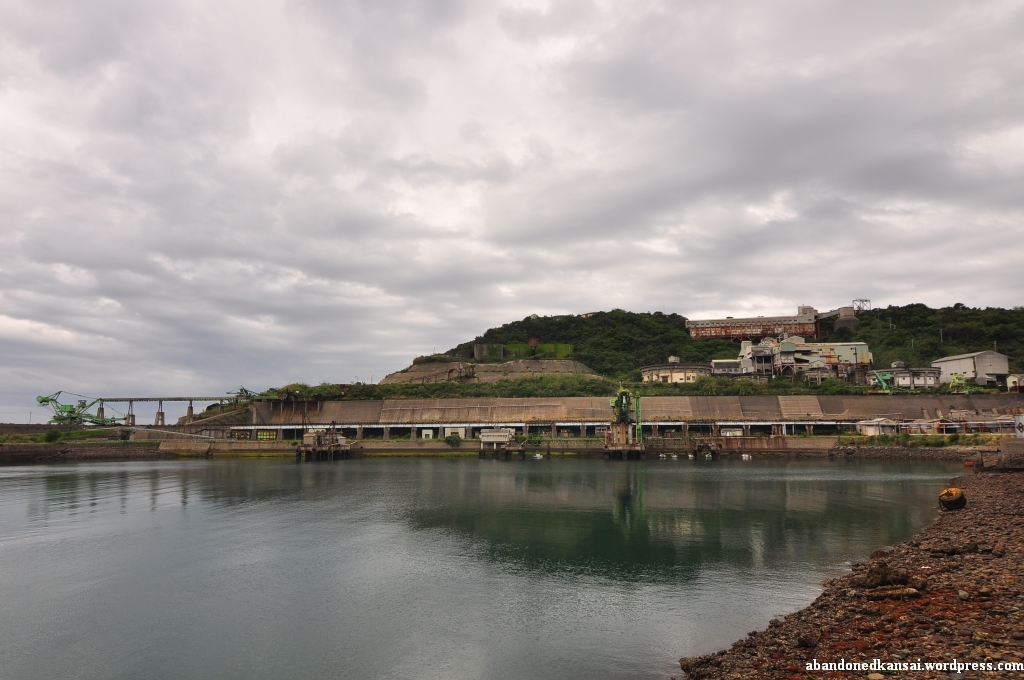
Outside again I followed route 216 to finish my circumnavigation of Ikeshima. I passed by the noisy Ikeshima Urban Mine Co., Ltd. and several apartment buildings before reaching the old loading plant. On the southern side of the harbor entrance was a scrapyard where a single worker was moving rusty stuff around. In continued following route 216, taking some pictures here and there, before I reached the apartments at the harbor again, where my explorations started about seven and a half hours earlier, making my visit to Ikeshima one of the longest photo shoots I ever did. But it wasn’t over yet…
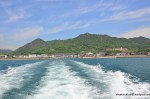
Figuring out the ferry / boat schedule when planning the trip wasn’t exactly easy since all the information was in Japanese and not really clear. I got some help from friends who are Japanese natives and confirmed the schedule with the hotel staff in Sasebo – everybody told me the boat (it actually was a boat, not a ferry, also in the morning – sorry for that!) would leave at 4.09 p.m., so when my ride entered the harbor at around 3.55 p.m. I continued to take some photos and videos. But something felt wrong watching the activities on the boat, so I decided to hurry to the terminal – and of course the boat left right when I arrived, shortly after 4 p.m.; thank you very much, guys! The people arriving on Ikeshima of course saw what happened and told me that there was another boat leaving for Sasebo today, but they couldn’t tell me when. So I waited and thought about the day – my rocky start and how I didn’t even enter any of the huge industrial ruins at the harbor. 10 minutes passed, 20 minutes… Then some senior citizens arrived at the terminal and I felt a bit of relief – I wasn’t the only one wanting to leave Ikeshima. At around 4.35 p.m. the boat to Sasebo arrived. As I took a seat while the ship left the harbor I had a last look at the huge characters in the sand of the breakwater and I couldn’t have agreed more: „絆 池しま 大スキ“ – „Kizuna Ikeshima daisuki“ – „I / We like Ikeshima a lot“
(Since the inhabitants of Ikeshima consider their island a tourist attraction I added it to the *Map Of Demolished Places And Tourist Spots* and created *a new map just for Ikeshima*. If you don’t want to miss the latest postings you can *follow Abandoned Kansai on Twitter* and *like this blog on Facebook* – and of course there is the *video channel on Youtube*…)

Read Full Post »

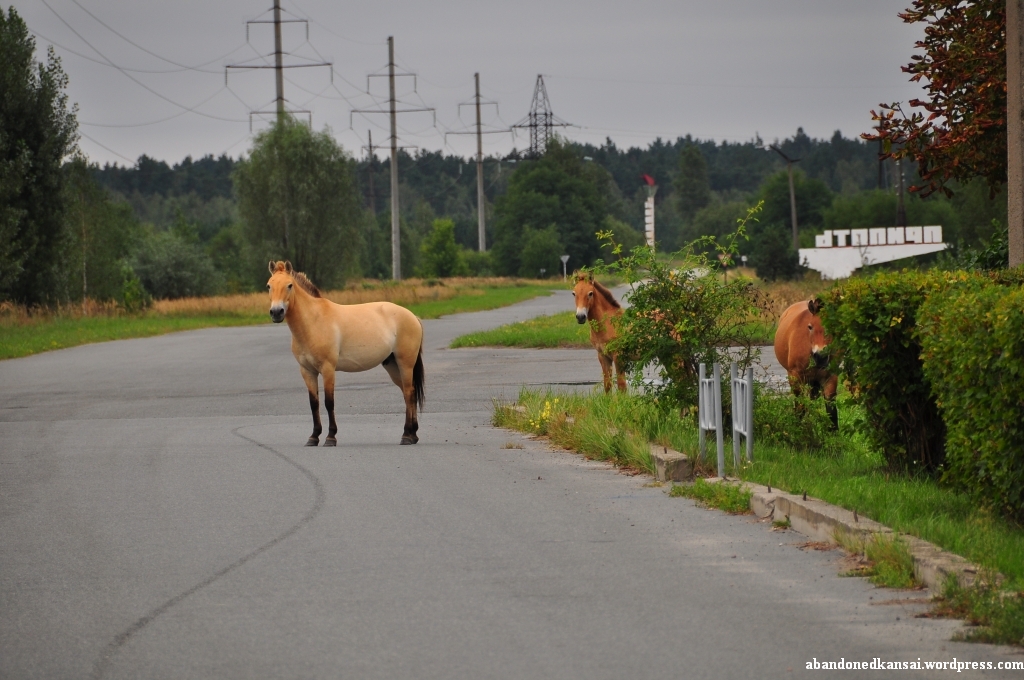
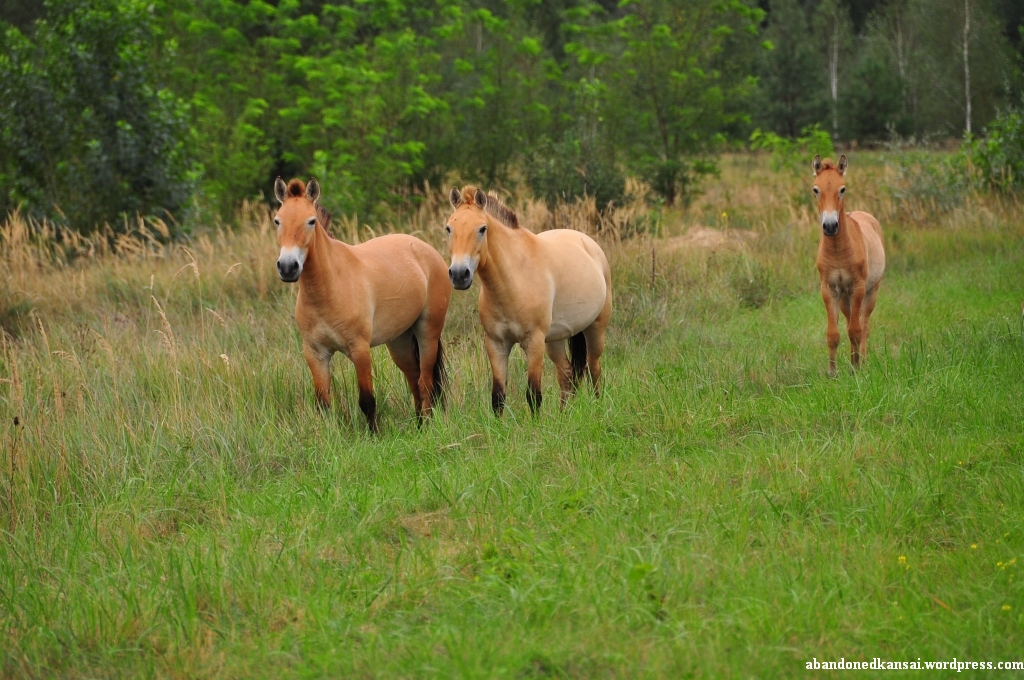
The Przewalski’s Horse (Equus ferus przewalskii, Dzungarian Horse), named after the Russian explorer and geographer Nicolai Przewalski, is a rare and endanger kind of wild horse and was first described in 1881 by L.S. Poliakov. The current world population of about 1500 animals are all descendants from nine horses kept in captivity in 1945 (total population then: 31). At one point extinct in the wild Przewalski’s Horses have been reintroduced to their former native habitat in Mongolia as well as to Hungary, China and Ukraine; the latter one offering space for the wild horses in Askania-Nova and the Zone Of Alienation.
On the first day, on our way from the 30km checkpoint of the Zone Of Alienation to Pripyat, Maxim told us how scientists returned several dozens of Przewalski’s Horses to the wild in the late 80s. The Exclusion Zone was already kind of a natural preserve, so the horses did well and their number raised to about 120. Nowadays, Maxim told us with some sadness in his voice, they are a rare sight since their number is down to about 60. Officially they migrated to the Belarus part of the Zone Of Alienation, but Maxim had a different explanation that involved bored militia and rifles…
On the second day, when we were driving from the monument at reactor #4 of the Chernobyl Nuclear Power Plant to do some more exploration in Pripyat, Maxim and our driver all of a sudden had a quick conversation in Ukrainian. Close to a building in the middle of nowhere they stopped the car, got out and pointed to the road in front of us. Przewalski’s Horses. At first I had no clue what they were talking about, but then a horse’s head appeared behind a tree about 80 meters in front of us. The horse was carefully stepping on the street, followed by about half a dozen more. Maxim and the driver (sorry dude, forgot your name!) were really excited, taking pictures with their cell phone cameras. Luckily I had my 18-200mm lens mounted, so I was able to take some quite nice shots of those shy creatures. I’ve never seen wild horses before and it was very interesting to see how they behaved – they kept us under constant surveillance. While some of the horses nibbled on some grass now and then, at least half of them always had their eyes on us, making sure that we didn’t get too close.
Having urban exploration as a hobby I ran into all kinds of rather unusual wild animals before – snakes, boars, monkeys… but the Przewalski’s Horses were by far the most impressive ones. Another experience that took me completely by surprise.
After we got back into the van to continue our way to Pripyat Maxim told us that he hasn’t seen any Przewalski’s Horses in more than three years – and he spends half his life in the Zone Of Alienation as a guide…
(If you would like to know more about my trip to the Zone Of Alienation please *click here* to get to the “Chernobyl & Pripyat” special. For a map of the area please *click here*.)

Read Full Post »

Living in Japan days off are a valuable thing. And long weekends, even if they are only three days long, are a perfect opportunity to go on vacation.
This time my buddy E and I went to Kyushu to enjoy some days of photography, food and haikyo. Fukuoka, Nagasaki, Sasebo. Not everything went according to plan, we had to cut down the haikyo locations from four to three, but in the end the trip turned out to be great. Great food, great locations, great comradeship.
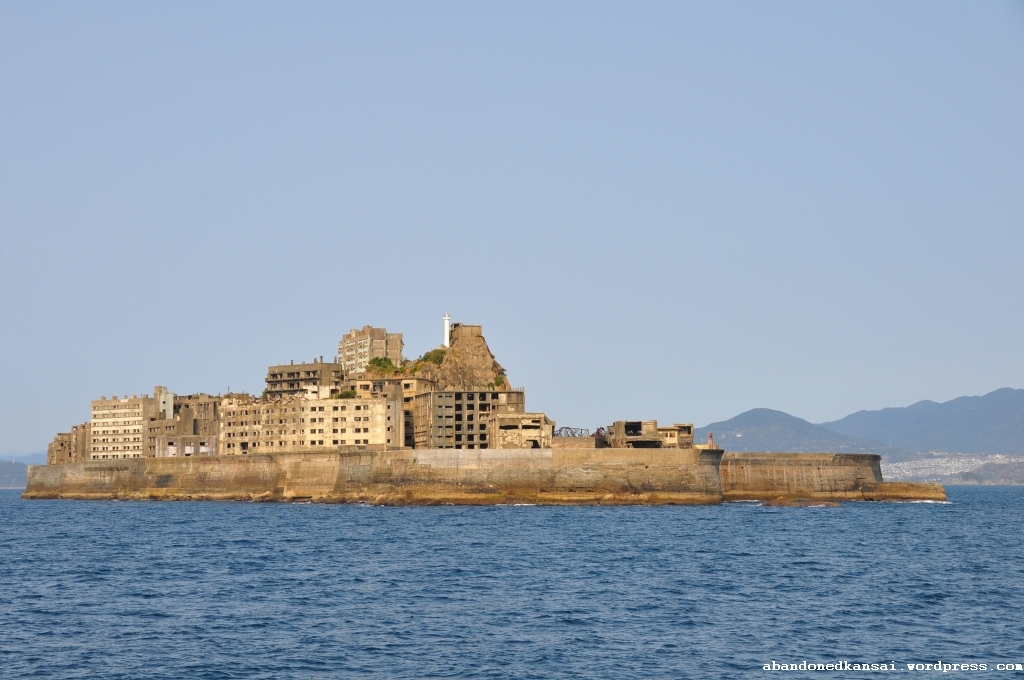
This posting is accompanied by photos that are not necessarily haikyo related – the haikyo locations deserve three postings of their own, so please keep coming back for more. One of them will be about the Shime Coal Mine, one about the Katashima Training School and the last one… well… it will be about Gunkanjima, the most awesome ruin complex in Japan.

Read Full Post »

My first visit to the “Doggy Land” in early December was abruptly ended when the police showed up to re-enact a car accident. Seven weeks later I came back to finally have a closer look at that strangely fascinating dog theme park that was opened in the summer of 2001 and closed in the summer of 2008.
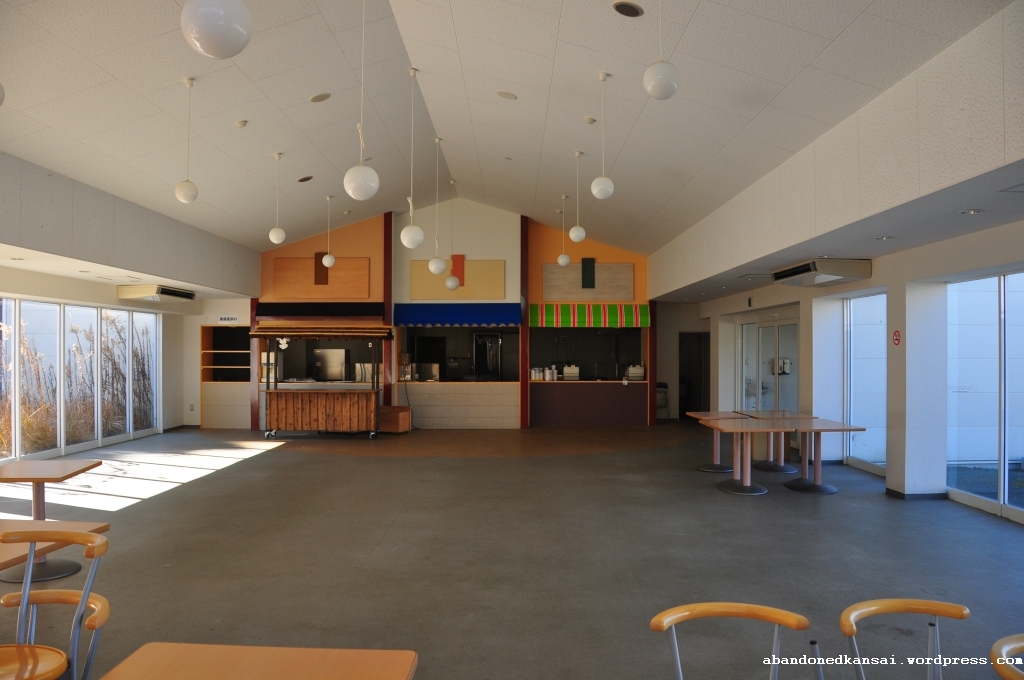
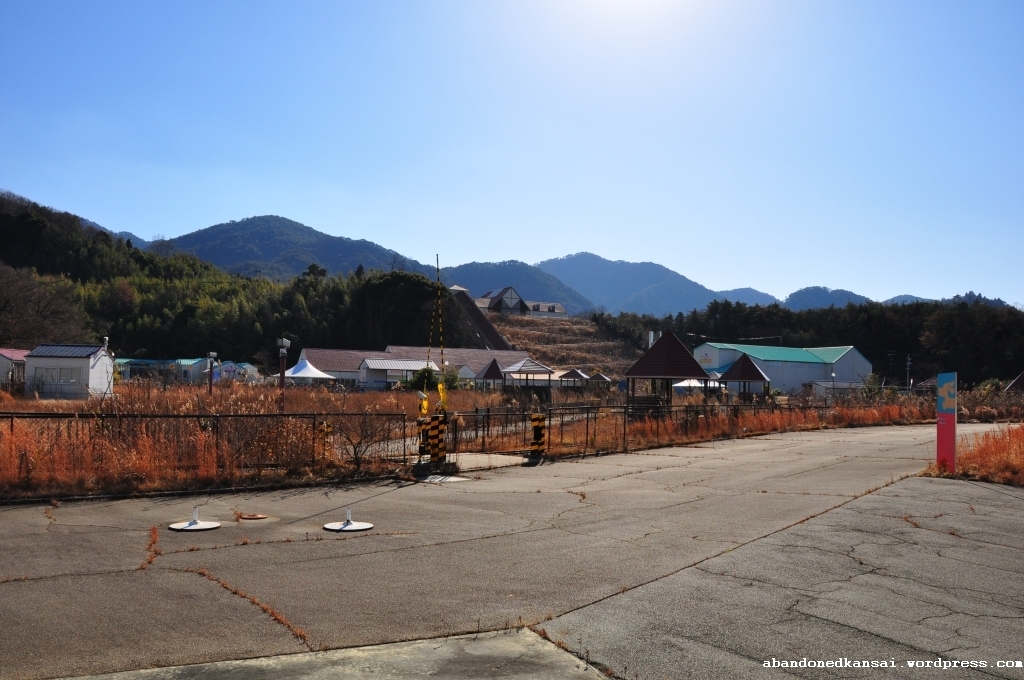
Entering “Doggy Land” is as easy as it can be, at least by theme park standards. Unlike other parks “Doggy Land”‘s fence has no spikes or barb wires, so there are several locations where you can enter easily and out of sight of the surrounding streets. Overall the park is in great condition – no vandalism and only a few rusty spots here in there. Since it’s closed for only about 1.5 years and barely known to the internet there are no graffiti, no broken windows or mirrors. 
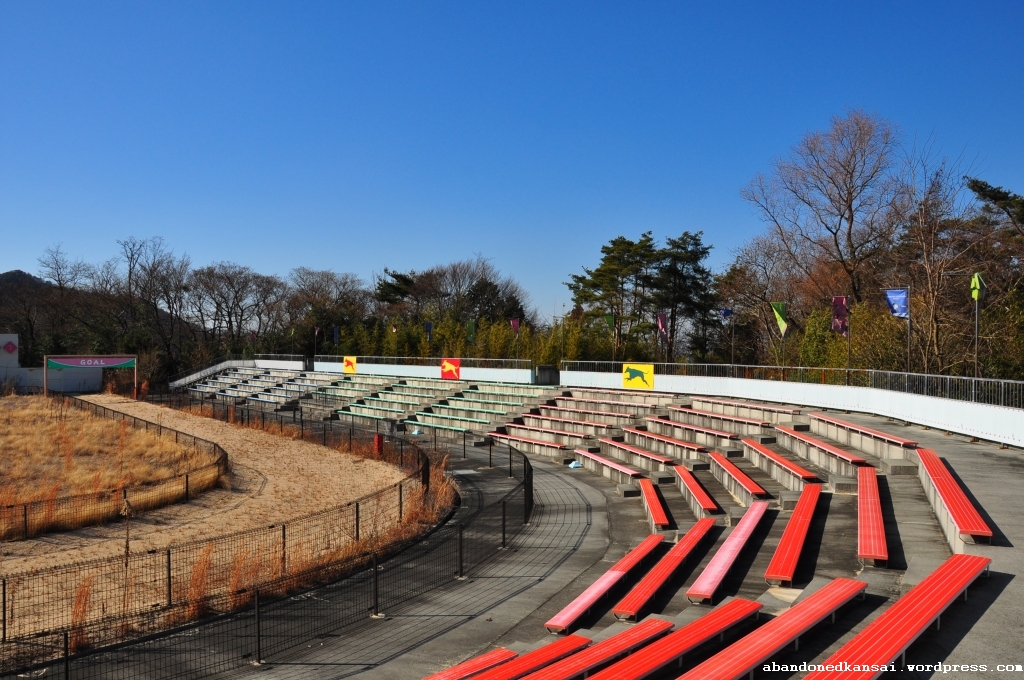
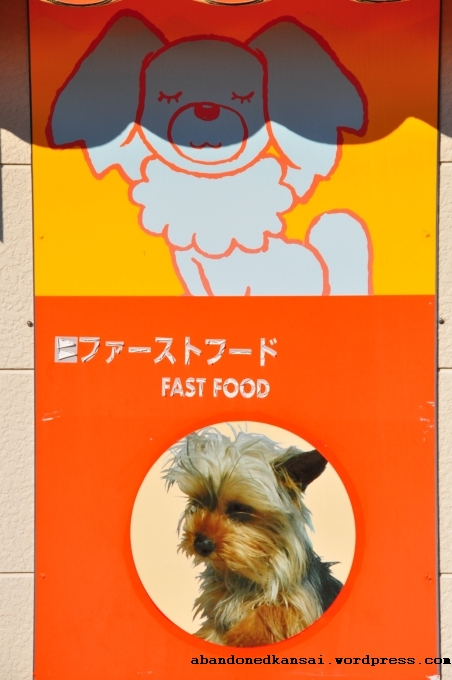
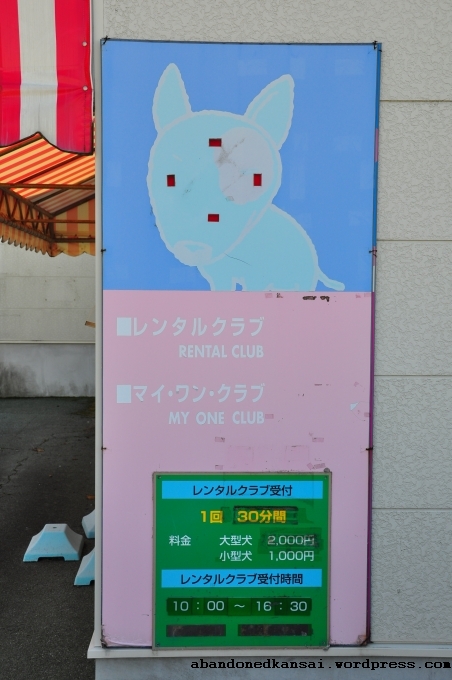
But what is “Doggy Land” exactly? Well, it seemed to be a theme park for people who love dogs. There is a dog cinema, a dog train, a dog racetrack, a restaurant and a snack bar, several educational signs – and even a place where you could rent a dog to take a walk with. I’m not sure if you were allowed to bring your own dog as information about the place is almost nonexistent. 
But I seriously wonder what people would do there. Sure, you can rent a dog for 2000 Yen / 30 minutes and go for a walk. Watch a dog race at the awfully small racing track. But what would you do for the rest of the day? If you combine the amounts of eateries and restrooms they almost outnumber the attractions “Doggy Land” had to offer! I guess people thought the same and that’s why the place closed down after only 7 years…

Read Full Post »

Urban exploration usually means visiting places that many people have been before – in most cases those ruins are off the beaten tracks and therefore hard to find. Some places are well known on the internet, some are not. But in the end most of them have pictures and maybe even a description online or in a book – and that’s the way most explorers find out about them.
When I did the bulk of my haikyo research in late 2009 I followed all kinds of hints on the internet to find places I could go to. Sometimes I found names, sometimes descriptions. Most of the time pictures, barely ever the whole package. With “Doggy Land” (not the real name) it was even harder. I had barely any information about it, not even what kind of place it was, but thanks to GoogleMaps I had a vague idea of where it was – so I went to the Hyogo countryside to find out. And I guess I was lucky as the place still existed and was nowhere covered with pictures and reports on the internet, neither the English speaking nor the Japanese speaking. Not even from the time when it was still open for business.
Although the next city is a bit away, “Doggy Land” isn’t easy to enter as there are several roads surrounding more than half of the place, all offering a good view at the whole site – and there is a toll road exit not far away, so cars are passing by almost constantly. Right when I finished checking out the surrounding area the police showed up – I literally had to get my hands off the fence I was about to climb over. Luckily they didn’t come for me, but to re-enact a car accident or something. Since there was no end in sight after 20 minutes I gave up and went home – but I’m looking forward to going back there. Until then I’ll share some pictures I took from the outside.
EDIT: For more “Doggy Land” please click here. (Yes, I went back…)

Read Full Post »

« Newer Posts