Feeds:
Posts
Comments

Archive for the ‘Demolished’ Category

Every once in a while you come across words in English that are actually German. Some of them you might know, like kindergarten or rucksack, others are not that well-known, like schadenfreude (malicious joy). Given that Great Britain is the home of modern rail transportation I didn’t expect to find a German term that doesn’t have an equivalent in English, but here we are: Ausbesserungswerk (composed of Ausbesserung = repair / correction and Werk = plant / facory). I never found a spelling with a lower case A, so I guess unlike the previous examples Ausbesserungswerk never became officially an English term, but there is an English Wikipedia entry, so that’s good enough for me…
So, what’s an Ausbesserungswerk? Well, an Ausbesserungswerk is a repair and upgrade shop for railway vehicles and their components. While the so-called Bahnbetriebswerke (train yard / depot / engine terminal – you get the idea…) take care of maintenance, small repairs and cleaning, the Ausbesserungswerke are responsible for bigger repairs, general inspections and modernization. Originally there were 84 Ausbesserungswerke all over Germany, but today there are only 18 left.

One of the closed, abandoned and partly demolished one is / was in the lovely town of Schwetzingen, famous for its palace Schloss Schwetzingen.
On October 14th 1912 the citizen’s committee of Schwetzingen unanimously decided to build an Ausbesserungswerk northeast of the train station. Construction began in 1913 and was finished in 1917 to be opened in 1918. Perfect timing, because due to World War I there was a huge demand for the repair of railroad vehicles and from its opening on the Ausbesserungswerk was the biggest employer in the Schwetzingen area for decades to come, with about 1100 people in 1920.
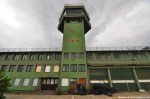
During World War II the Ausbesserungswerk was fortified with bunkers, some of them are still in existence today. Armored observation towers against air raids were installed on the top of some buildings and in late 1943 a shooting range was built on the business premises – resulting in air raids by the Royal Air Force on March 19th 1945, damaging the buildings and killing 22 employees.
From the 1960s on the Ausbesserungswerk Schwetzingen was in decline. The German post-war economic miracle was in full bloom and a lot of employees switched to more lucrative jobs. At first they were replaced by guest workers, but when there was less and less work the amount of employees was continuously reduced from 1974 with the objective to close the Ausbesserungswerk; against the will of the staff council and the works management. But resistance was futile and on October 11th 1983 the Federal Minister of Transportation signed a document to close the Ausbesserungswerk Schwetzingen. In April of 1987 some employees were relocated to the Ausbesserungswerk in Karlsruhe (closed in 1997, mostly demolished by now) and on December 31st 1989 more than 70 years of railroad history ended in Schwetzingen…
In the following years some of the buildings were used as a half-way house for ethnic German immigrants and applicants for asylum, but most of them were just left to decay and rot – kind of insane, since a couple of buildings of the Ausbesserungswerk were put under monumental protection, which means that they can’t be torn down just like that. That came into effect when in Mai of 2011 all the other buildings were demolished, to make room for a logistics center of the manufacturer of sports equipment, Decathlon, scheduled to be opened in April of 2013. The protected buildings were handed over to the city of Schwetzingen for free, shifting the responsibility (and cost…) to the general public. The federal state of Baden-Württemberg granted 1.5 million Euros in 2010 to redevelop the protected area in the southern part of the Ausbesserungswerk and the city of Schwetzingen is deciding these days what to do with the money and the buildings – most likely a mixed use for both residential and commercial purposes. Those plans might have been affected by a case of arson committed by an 18 year old homeless guy on March 21st 2012, causing damages to the amount of 100.000 Euros, but I’m not sure how or if at all.

The Ausbesserungswerk Schwetzingen was the first urbex location in Germany I ever visited. My trip back home in 2011 was rather rainy and disappointing in general, so when there finally was a sunny day I took my chance and had a look. It was a weird feeling though, since everything felt a bit “more real”. In Japan I can always pretend to not being able to read signs, that I got lost, that I don’t understand a word. In Germany those excuses are a lot harder to make, especially since I am not a good bullshitter in the first place. (On the other hand some things are a lot easier – on later explorations I was able to ask people passing by about the history of places and even ask for permission to take photos, both rather impossible for me to do in Japan…)
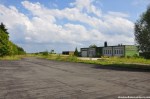
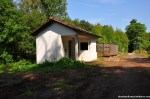
Sadly there wasn’t much to see anymore. Most buildings were either in really bad condition or completely bolted up with metal plates. There was an abandoned TV, some instructions signs on walls and a rule book regarding laundry and other aspects of daily life living in the half-way house, but that’s pretty much it. A nice stroll, 1.5 to 2 hours, the most interesting part probably the small playground for children in the back of the half-way house – nothing spectacular, but far from being a disappointment…

(If you don’t want to miss the latest article you can *follow Abandoned Kansai on Twitter* and *like this blog on Facebook* – and of course there is the *video channel on Youtube*…)

Read Full Post »

More often than not I barely have any information about the places I visit in advance. Sometimes I only saw a photo and have a general idea where to look for the location. It was like that when visiting the *Bibai Bio Center* – and the Horonai Substation was not much different. A red brick building somewhere in the middle of nowhere – and a road leading there. That was it. I didn’t expect a spectacular location… and I didn’t find one. Nevertheless it was a good exploration with an interesting history, the first one on my *haikyo trip to Hokkaido*. *Michael* thought so, too – although he almost paid a steep price for making a snow angel…

History

The Horonai Mine has an incredibly and unusually long history, dating back to the early years of the Meiji Era (1868-1912). Back then it was a time of new departures and Hokkaido still was kind of unknown territory. Japan recently opened itself to the world after more than two and a half centuries of information and immigration control, relying heavily on foreign experts to accomplish in a couple of decades what Europe and the States took about a century – industrialization. Just a decade prior Hokkaido was still known as Ezochi and for its renitent inhabitants, but the new government in the newly appointed capital Tokyo pushed for the development of Japan’s most northern prefecture… and population rose from 58.000 to 240.000 in the mere ten years of the 1870s. Agriculture and mining became the prefecture’s most important industries – and while agriculture is still important (especially wheat, potatoes, pumpkins, corn, raw milk, and beef), mining isn’t. The amount of abandoned mines in Hokkaido is incredible, but since most of them are in extremely rural areas, often hours away from bigger cities, we decided to visit the Horonai Coal Mine as an example – because it wasn’t completely out of the way, came with an electrical substation and, to our surprise, with the Horonai Shrine.
It wasn’t until writing this article though that I found out that the Horonai Mine was actually Hokkaido’s oldest modern mine and that Hokkaido’s first railroad, the Horonai Railway, was built to establish and operate the Horonai Mine. It’s said that in 1868 a local resident discovered coal in Horonai, but it wasn’t until 1872 that the village received any attention, leading to a survey in 1873. Expecting massive amounts of high quality coal in Horonai plans were made concrete in 1877 and money was raised through industrial bonds in 1878 after important statesmen like Ito Hirobumi and Yamagata Aritomo visited the area in previous years and campaigned to establish a mine. Further surveys were conducted in May of 1878 and the mine was opened on December 18th 1878, reaching full production almost four years later in June of 1882.
Plans for the Horonai Railway, necessary to transport the coal mined in Horonai to places where it could be used, were finalized in December of 1879, so construction of the railway began in January of 1880, installation began in July of the same year – technology and knowledge was imported from the United States by J.U. Crawford, who oversaw the railway construction project for the Japanese government; the line was officially opened on September 13th 1883 and was used for the transportation of passengers as well as coal.
In 1889 both the mine and the railroad were privatized, probably for little money, as both of them were not profitable at all. This happened a lot in the late 19th century in Japan, strengthening the so-called zaibatsu (gigantic family controlled holding companies, amongst them still famous corporations like Mitsubishi, Mitsui, Sumitomo and Kawasaki), but also countless mid-sized companies (although sometimes even profitable companies were given away for a fraction of what they were worth…). Business continued for another 100 years and ended in 1989, when most of the buildings were demolished for security reasons – and because back then industrial heritage wasn’t considered worthy of preservation. (The Völklingen Ironworks in Völklingen, Germany, and the Zollverein Coal Mine Industrial Complex in Essen, Germany, were actually spearheading the idea of maintaining old industrial buildings, becoming UNESCO World Heritage Sites in 1994 and 2001 respectively.)
A not so fun “fun fact”: Like many other mines in Hokkaido, Horonai was taking advantage of prison labor. Not only during times of war, but in the early years, both before and after privatization. In 1883 250 prisoners worked next to 228 general laborers. In 1890 there were 1.043 prisoners and 183 normal workers “employed”, the forced labor accounting for more than 80% of the work force, extraction and transportation almost exclusively relying on prison labor! (It was actually thanks to the prison laborers that the Horonai Mine survived the first couple of years. From 1882 to 1888 the mine was deep in the red with only one profitable year and couldn’t even afford to implement mechanized coal transport – that actually happened only after it was privatized and exploited prisoners as cheap labor for years. And after the extraction costs per ton of coal were cut down to one sixth over the course of six years till privatization in 1889.)
The Horonai Mine also gathered some local fame in Japan when it was used as the setting of the second Season of Survivor (サバイバー) in 2002 – after Palau, but before the Philippines and North Mariana. Probably the most original setting ever and by now much more exotic than all those islands in the Pacific Ocean; they look all the same to me anyway! (I usually don’t link to other people’s Youtube videos, but *here is the intro to that season* in 240p. Don’t miss the *video I took at mine in late November* in 720p!)

Exploration

When we arrived on location the initial situation wasn’t promising. Several hundred meters before we reached the substation we had to park the car as the road was completely snowed in. Luckily there were tire tracks (we were able to walk in) from a more suitable vehicle, but the road itself wasn’t accessible with the small car we rented. As we got ready to walk up the hill we saw a guy and his dog coming back to their car. Nothing unusual, until we saw that the guy was carrying a rifle. Not the usual BB guns you have everywhere in Japan. A real friggin rifle! Even if he wasn’t shooting trespassers we were wondering what he was hunting in the forest ahead of us… and if his prey might want to get a shot at hunting us…
Nevertheless we followed the previously mentioned tire tracks deeper into the valley. To the right we saw several concrete ruins of the Horonai Mine, abandoned in 1989, when the mine was closed after 110 years. Everywhere along the road we found information signs (Japanese only…) and it seems like the area was converted into a “coal mine scene park” in 2005. It turned out that the first abandoned place on our trip wasn’t actually that abandoned, more like a tourist attraction – like the *Shime Coal Mine*, a.k.a. the *Anti-Zombie Fortress*. Of course there were no tourists seen anywhere, so I guess the place is only of interest in the snow-free summer months… and basically inaccessible the rest of the year. Michael of course was eager to head over to concrete remains, but given the deep snow and the unknown terrain I was able to convince him to look for the substation first – especially since the grey leftovers didn’t look like they contained anything interesting.

It took us about half an hour to walk from the parking lot to the substation and the tire tracks ended a couple of dozen meters before reaching our destination thanks to a collapsed tree on the road – from that point on we had to walk through the snow which was about 30 centimeters deep.
The Horonai Substation, a two-storey brick-clad concrete building, was built in the 1920s, more than 40 years after the mine was opened, and received its electricity from a coal fired power plant in Shimizusawa. That plant, which was fuelled by coal from the Yubari Mine, not the Horonai Mine, is still in existence and closed in 1991, but was not visited by yours truly as the roads leading there would have required a separate day trip.
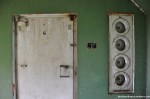
Sadly there wasn’t that much to see: The metal constructions of the transformers and the brick covered building – locked by a solid chain, but luckily Michael found another way in. The building clearly was in use during summer months, featuring some kind of exhibition with lots of exhibits and huge control panels from the good old days.
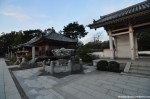
More interesting was the Horonai Shrine, which obviously was completely covered by snow, too, and probably as half-abandoned as the Horonai Substation. Located right next to the substation on a small plateau up a slope, the shrine offered a nice view at the remains below. At that point it started to snow and I don’t know why, but there is an amazing peacefulness about deserted snow-covered shrines. Michael was still down at the substation, so all I heard was snow falling – perfect tranquility.
Overall the Horonai location wasn’t spectacular, but at that point I hadn’t explored many snow covered (more or less) abandoned places, so it was a good start into the trip!

Snow Angel

Oh, after all those paragraphs about the mine’s history I almost forgot about the snow angel! It seems like either Michael or I have a serious amount of bad luck when exploring together. In spring I broke my D90 on our *haikyo trip to southern Honshu* – and I already mentioned Michael’s misstep at the *Hokkaido Sex Museum*. His bad luck started earlier though, when he insisted on making a snow angel on the way back to the car. I thought it was a bad idea in the first place as it was cold and he was jumping spine first onto unknown ground (concrete, rocks, metal, …), but everything went fine until the point when Michael first took off his glasses and then stood up shortly after, realizing that his glasses were gone. In a comedy movie kind of situation he asked me to watch my steps – the last words barely left his mouth when he moved one of his legs and we both heard a crushing sound. The spectacle frame under his boot wasn’t only bent, but broken. Well, bent and broken. Michael, the designated driver on this tour since my license isn’t valid in Japan, had some contact lenses with him, but they would have only last for two or three days – shorter than the trip. So on the way to our second hotel we were looking for a glasses store. 5 minutes to 8 p.m. (i.e. closing time) on a national holiday (!) I spotted one. Not only were they able to fix Michael’s glasses in a miracle operation taking almost half an hour, they did it for free and also give mine a new polish. Quite a few people complain about the (lack of post-buy) service in Japan (and I admit that sometimes it can drive you nuts!), but the glasses shops here are amazing and saved not only the day, but kind of the whole trip…

(If you don’t want to miss the latest article you can *follow Abandoned Kansai on Twitter* and *like this blog on Facebook* – and of course there is the *video channel on Youtube*…)

Read Full Post »

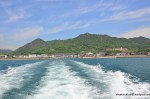
Okunoshima is urban exploration for beginners. Actually it’s more like a vacation day than urbex – with an inglorious past, probably one of the darkest chapters in Japan’s history. And it’s an island with many names. In Japan Okunoshima (大久野島) is famous as usagi shima (ウサギ島), Rabbit Island. People with a more twisted look at life call it Poison Gas Island, though the Japanese term doku gas shima (毒ガス島) is way less common – but I doubt that this is the result of a more positive Japanese mindset…

Located in the Seto Inland Sea about 50 kilometers east of Hiroshima Okunoshima disappeared before if became famous. Back in the 1920s Japan signed the Geneva Protocol of 1925 that banned the use of chemical and biological weapons – but it didn’t say anything about development, production, storage or transfer. At the time being up to no good and started making trouble in the neighborhood, Japan immediately began to take advantage of that loophole. And with that Japan became the only country to use chemical weapons  in World War II, killing an estimated 80.000 Chinese soldiers and civilians according to historian Chi Hsueh-jen! (Not only with the knowledge, but with the permission of Emperor Hirohito… which probably should have lead to his prosecution as a war criminal. Sadly, hard evidence was found only decades later by Yoshiaki Yoshimi, a professor of modern Japanese history at the prestigious Chuo University and a founding member of the “Center for Research and Documentation on Japan’s War Responsibility”. My deep respect for the man, I’m sure his research made him more enemies than friends…)
The location of choice was the small and barely known island of Okunoshima, off the beaten tracks in case of a major accident, but still close enough to the important military city Hiroshima. From 1927 to 1929 an existing fish cannery on Okunoshima was “modernized” with a desalination plant, a refrigeration system and a power plant – and at the same time all foxes, martens, cats and rats were systematically eradicated. Okunoshima was erased from maps and Japan did everything to keep its existence a secret. Shipping routes were changed and trains along the coast had to close their window shutters, so did ferries passing the island. Plain-clothed members of the infamous Japanese military police kempeitai made sure everybody followed those rules and didn’t dare to sneak a peek. To avoid any activity on Okunoshima being seen from mainland Japan the old fish cannery was blown up, keeping the new installations intact – and the old pier in the west was replaced by a new one further south, closer to the research and production facilities. Huge storages for gigantic tanks were carved into the mountain and the soil was used to create ramparts as visual covers. In 1929 production began with high secrecy and under horrible conditions.

Since most of Japan’s leading scientists were under the supervision of western secret services they couldn’t be involved directly in the top secret base on Okunoshima. Production had to be executed by educated amateurs. Most of them were Korean forced laborers who worked in the production of medicine or soap before, locals looking for a good salary – and later on the military pressured more than 1000 local high school students into working on Okunoshima; at first only those with good grades in natural sciences, in the final years of WWII pretty much everybody available. The workers were given protective suits that weren’t really protective because the aggressive chemicals made the PVC brittle – thousands were injured because of that and during accidents, many died of their injuries because there were no doctors on the island and nobody was allowed to seek medical help on the Japanese mainland for the reason of secrecy. The production halls were cold in winter and smoldering in summer. Imagine wearing a plastic suit in a climate that sometimes makes it hard to breathe even when in shorts and T-shirt…

About 6.600 tons of mustard gas (Yperite), lewisite, phosgene and other poison gases were produced and stored temporarily on Okunoshima between 1929 and 1944 before being put to use by the Japanese military. While the gases were tested on rabbits on Okunoshima the scientists there worked together with the infamous *Unit 731* on at least two occasions in 1940 and 1943 – they tested mustard gas on Chinese prisoners. (In case you don’t know Unit 731: Have a look at Wikipedia and make sure you don’t wanna eat soon. Their initiator and commanding officer *Shiro Ishii* was one of the most despicable people to ever walk on this planet, the Japanese Josef Mengele, maybe even worse – but thanks to some Americans, especially from Fort Detrick, the weasel was never prosecuted, although he should have been executed for his war crimes. Ishii didn’t even have to flee Japan since he was able to negotiate immunity for himself and his closest allies. Instead he lived a peaceful life with his family until is death in 1959 at age 67.)

After World War II ended in 1945 the remaining poison gas was dumped in the ocean, buried or burned – the factories were blown up or used as housing or storage (e.g. for ammunition during the Korean War). This was done by Japanese contractors under the supervision of the Americans, but what happened to the rabbits used as laboratory animals is rather unclear. Some say they were released by workers after the Japanese military left the island – others claim that they were all killed by the American military and the current rabbits on Okunoshima are descendants of a dozen pets released by a Japanese school class in 1972. One thing is for sure: Since all natural enemies of the rodents were killed in the late 1920s they don’t have to fear any predators and so they breed like… well… rabbits.

Okunoshima stayed a forgotten island for a few decades until in 1988 something unusual happened, at least by Japanese standards: A poison gas museum opened on the Poison Gas Island. Of course emphasizing the harsh conditions for the workers in the factory, because as everybody knows, at least everybody educated by the Japanese school system: Japan was the victim of WWII. Well, sadly that is the common self-awareness, which explains South Park episodes like Whale Whores (and Chinpokomon…) – episodes that show an understanding of Japan most people, including Japanese, don’t have. And so all the photos of poison gas inflicted wounds in the 2 room museum are not from WWII, but from the Iran-Iraq War of 1980-1988. And while most ruins on Okunoshima have signs in Japanese and English (which is quite commendable since it’s unusual for any location that far off the beaten tracks!) the ones at the museum are mostly in Japanese only. (Which reminds me of the Peace Center in Osaka, where most of the surprisingly critical exhibits are labeled in Japanese only while all the others are bilingual, Japanese and English – shamed be he who thinks evil of it…)

Nowadays Okunoshima is a popular tourist spot, visited by about 100.000 people a year, many of them staying overnight at the hotel or the camping ground on the island. Not so much because of the poison gas factory ruins or the museum, but because of the rabbits. Like I said, no predators, so 100s of them are roaming freely, probably making Okunoshima the world’s largest petting zoo. Usually when I am on my way to an abandoned place and there is some noise in the bushes close-by it’s a snake. Or a boar. Or a monkey. Maybe even a bear. On Okunoshima it’s a rabbit. Or a bunch of them. Charging at any person that is passing by, hoping for some food. And they are so adorable! I came for the ruins, but I stayed for the rabbits. Seriously, I spent much more time taking photos of rabbits than taking photos of ruins – when I found out that there were remains of a Meiji era fort from the Russo-Japanese War of 1904/05 I almost considered it a burden, not another photo opportunity…

Pretty much all rabbits on Okunoshima are hand-tame. The ones near the ferry terminals and the hotel are by far the biggest ones. I’m sure they get fed 24/7! If you like your rabbits smaller and a little bit more shy I recommend going off the beaten tracks – to the tennis courts (de-facto abandoned, at least some of them), to the former gunpowder storage or any trail up the mountain. Don’t worry, even there you don’t have to look for rabbits… they will find you! (And you don’t have to worry about snakes, boars, monkeys or bears – you are not even allowed to bring cats or dogs to the island.)

As for my day on Okunoshima: I did a full circle, starting at ferry terminal 2 and ending at ferry terminal 1, since I left on the second to last boat departing from the island; you can *have a look at GoogleMaps* as Okunoshima is a tourist attraction. And I refrained from renting a bike, because I wanted to take my time and enjoy the relaxing atmosphere on the island. The weather started out sunny and ended overcast, poison for photography, but surprisingly I didn’t mind. All of a sudden I didn’t care that much for the gas factory ruins. Many of them were fenced off by ridiculously low bars, but for once I did respect those barriers that were more symbolic than effective. After learning about the place’s history all those chunks of concrete blackened with soot weren’t that important anymore. Okunoshima’s history was just overwhelming. Why disrespect a place that saw and caused so much pain and suffering? When at the same time you can spend a relaxing day at the beach and play with cute little bunnies!

Going to Okunoshima was a wonderful experience and I kind of left with a heavy heart – I visited in spring on a warm day, probably still a little bit too cold to go swimming, and I had plans for the next day. But if you ever have the chance to go to Okunoshima from late spring to early autumn make sure to bring a loved one (as well as your kids, if you have some) and stay overnight at the hotel – just make sure to make a reservation months ahead as the hotel is very busy. Unless you are afraid of ghosts and fear that hordes of Chinese war victims, Japanese workers and laboratory rabbits will haunt you…

(If you don’t want to miss the latest article you can *follow Abandoned Kansai on Twitter* and *like this blog on Facebook* – and of course there is the *video channel on Youtube*…)

Oh, before I forget: A shortened German version of this article, “Die Insel der Versuchskaninchen / Okunoshima – Zwischen Giftgas und Kaninchen” (The Island of Guinea Pigs / Okunoshima – Between Poison Gas and Rabbits), was published on Spiegel Online / einestages on Monday – you can *read it here*.

Read Full Post »

Expectations are one of the worst things in life. Especially when they are as high as mine were driving up to the top of Mount Noro in Hiroshima prefecture. What did I expect? A speedway abandoned in 1974 and a shuttered amusement park, also left behind in 1974. I didn’t see any photos in advance, but I read a slightly cryptical Japanese description and the satellite view on GoogleMaps was very promising. Sadly the location didn’t live up to the expectations, so *Michael* and I were about to face the first disappointment of our *road trip to southern Honshu*… which wasn’t as bad in retrospect.

Mount Noro (insert stupid joke about the Noro virus in Japan here) near Hiroshima is one of the city’s most popular recreational areas for hikers, mountain climbers, campers and flower lovers. It’s said that it offers a stunning view at both sunrise and sunset. Aside from the fact that Michael and I were way to too late for the first and way too early for the second we wouldn’t have been able to see either anyways – the 839 meters high mountain was covered by low hanging clouds from about its second half. Occasionally the visibility was only a couple of meters and it looked more like rain than clearing up. When we reached the entrance of what I hoped would be the abandoned Mount Noro Speed Park (a.k.a. Mount Noro Circuit) at an elevation of 830 meters (Japanese people like their race tracks high above sea level as we know from the *Hiroshima Kart Pista*) we realized that the place was reused at least once since we were welcomed by signs telling us that we found the Moriyama Auto Camp. Close, but no cigar…

It turned out that this location has quite a history. A history I only found out about after we visited the place – like I mentioned earlier: Before our visit I had only vague information about a racetrack and an amusement park. The Mount Noro Amusement Park was a typical mid-size theme park of the 60s with a couple of merry-go-rounds and a rollercoaster, and it opened in April of 1968. In close proximity the Mount Noro Speed Park followed with an opening ceremony in October 1969. The intent was to make Mount Noro more attractive for tourists. As we all know: Those hiking eco freaks that headed for the mountain until then weren’t spending much money while amusement parks were THE cash cows of 1960s Japan, where the tired workers of the East Asian Wirtschaftswunder (economic miracle) were looking to spend their hard earned bucks. Sadly the business people behind the big tourist plans didn’t expect two things to happen: The traditional nature lovers complained about the dramatically increased noise level on Mount Noro – and in 1973 / 1974 an oil crisis hit the world. The combination of those events forced both the amusement park as well as the speedway to close their doors for good in 1974. Which was incredibly sad in the case of the 932 meters long and technically quite demanding Mount Noro Speed Park as it was quickly used for races of national fame, including the “All Japan 200km Stock Car Race” which was held annually from May 1970 on.

Sad for Michael and I was the fact that the weather was bad and that the race track was in such horrible state we weren’t even sure we found the right place – especially with those Moriyama Auto Camp signs at the entrance. We entered the place (adults 500 Yen, children 200 Yen, cars 3500 Yen…) and were quite a bit confused about the routing along the slope, which seemed rather unusual for a speedway. And the empty pond with the garbage cans also didn’t really fit in. Down the road we reached a bifurcation – left: Moriyama Auto Camp; right: Moriyama Auto Camp. Well, that didn’t help much…

We continued to the left only to find a huge abandoned trailer advertising Fukutome Ham, the inside filled with some seats (no meats…), garbage and a seriously damaged suzumebachi nest. For those not aware of this danger for all urban explorers and hikers: suzumebachi are also know as Asian Giant Hornets (Vespa mandarinia), aggressive nasty beasts with a body length of 5 cm and a sting that injects large amounts of potent poison, potentially deadly for both other animals and humans.

We continued up the mountain along the seriously damaged asphalt road only to find half demolished bath rooms at what once was the pit lane of the speedway. The surrounding building was gone, making all the faucets, toilets and showers open air installations. 300 Yen for 5 minutes was written on the shower doors, the curtains behind moldy and nasty.

Further down the pit lane, a bit above the race track, we found a two-storey building. The lower floor once housed a restaurant and I guess it dated back to the speedway days. The upper floor once was the home of somebody. Quite an unspectacular house with the usual remains of an abandoned building.

On the way back to our car we saw a camping trailer next to the former race track. It looked way more modern than anything else on the premises, so I kept a safe distance while Michael had a closer look. Through the window he saw a calendar from 2012 and a working clock, so we wondered why somebody would rather live in a trailer than in the furnished room in the building three minutes away – and decided to leave as none of us were eager to ask the person who made this choice.

Right at the entrance we had a closer look at the attendant’s hut with the charming painting. I guess the previously mentioned empty pond once was an attraction of the Moriyama Auto Camp – rainbow trout fishing. The hut also revealed that the now abandoned area had a size of 71000 m2 and once offered 40 campfire places – just not right before it closed as this information was blacked out on the flyer. Reason for the leaflet was the opening of the place on July 1st of an undisclosed year. Leaving the hut my eyes caught one final item, the flyer of a Bihoku Auto Village, announcing its grand opening on June 26th 1999. I was confused. Same place, again a different name? Luckily not as it turned out later – just the flyer of a similar place elsewhere in Hiroshima prefecture… (And still in business!)

I never went camping in Japan and obviously I was disappointed that the expected abandoned race track turned out to be a converted one, but the rainy / foggy weather was a blessing in disguise. Walking along the seriously damaged speedway with that kind of weather created quite an eerie atmosphere I actually enjoyed more in retrospect than I was aware of at the time. But it took quite some effort to find out about and get to the Mount Noro Speed Park / Moriyama Auto Camp as to my knowledge it hasn’t appeared on any other urbex / haikyo blog yet… Would I spend that much time on it again? Probably not. Do I regret having it done? Definitely not! I especially enjoy exploring new kinds of abandoned locations, especially if they are in the middle of nowhere. And in that regard this haikyo was a great success – I’d always prefer my first abandoned auto camp over the 20th abandoned hotel!

(If you don’t want to miss the latest article you can *follow Abandoned Kansai on Twitter* and *like this blog on Facebook* – and of course there is the *video channel on Youtube*…)


Read Full Post »

2012 didn’t start well for urban exploration in Japan – January has been a sad month for abandoned places in Kyushu. Two of the most famous haikyo in southern Japan were demolished:
The demolition of the *Kawaminami Shipyard* didn’t come as a surprise. It was decided on June 9th 2011 by the Yamashiro City Zoning Committee and executed in mid-January 2012 after all the greens were removed in late 2011. Nevertheless it is a big loss to the urbex community in Japan as it was one of the few locations that aged for decades without being affected much by anything but nature itself.
At the same time (late 2011 / early 2012) an up-and-coming location called *Navelland* was destroyed just 70 kilometers away from the famous deserted shipyard. The former amusement park was turned into a lot to soon become another campus of the Teikyo University. I was lucky enough to visit both places during Golden Week 2011 before they were destroyed and I have fond memories of both visits. You can find out their exact locations on my *map of touristy and demolished ruins in Japan*.
I guess it’s the normal run of things. New abandoned places show up, well-known ones get demolished. Nevertheless it makes me a bit heavy-hearted, especially since I decided a while ago to concentrate on western Japan and leave the east to all the blogs and people who live there. I already missed the famous Sports World in Izu for sure, but even if I change my mind chances are “good” that I might miss *Western Village in Tochigi*, the Russian Village amusement park near Nagano, *Kejonuma Leisure Land* in Tohoku and the Irozaki Jungle Park in Izu. Famous abandoned military installations like the Fuchu Air Base, Camp Drake Army Base or the Tachikawa Air Base. Popular deserted mines like the *Matsuo Ghost Town*, *the Taro Mine*, the Ashio Mine, the Murakashi Mine, *the Osarizawa Mine*, the Seigoshi Mine, the Kamaishi Mine or the *Nichitsu Ghost Town*. Not to forget the quirky remains of the sex industry like the Queen Chateau soapland, the Hotel Royal love hotel, the Fuu# Motel, the Yui Grand Love Hotel, the Akeno Gekijo strip club or the Pearl love hotel – and all the other places like the Royal House, the Small Pox Isolation Ward, the Japan Snake Center, the Okutama Ropeway, the *Heian Wedding Hall*, the many spas and resort hotels of the Yamanaka Lake, the Mount Asama Vulcano Museum, the Okawa Grand Stand or the Gunma Motor Lodge.
I probably forgot some famous spots as the east of Japan has plenty of wonderful abandoned places – but so has the west, and most of them are only described on Japanese urbex blogs until now. So I guess I’ll continue to focus on deserted locations east of Nagano / Nagoya, hoping that I will be able to see as many as possible before they falls victim to jackhammers, wrecking balls and other heavy machinery…


Read Full Post »

Exploring the Tsuchikura Mine (a.k.a. the Pawnbroker Mine) caused quite a bit of trouble. Unlike most of my other explorations it is not easily accessible by public transportation and therefore a challenge in general. As described last time I met with my urbex buddies Andrew and Damon to drive to the Tsuchikura Mine in the Shiga mountainside. After we were distracted by the *K-1 Pachinko Parlor* we finally made our way to the east. At Lake Biwa the weather was already rather cold and it snowed a little bit, but the streets were just wet, that’s it. The country road leading to the mountain though was soon covered with the white slippery beauty and each tunnel we went through seemed to add 5 centimeters of snow to the fields and forests we were passing. When we finally reached the old side road to the mine we had to abort our approach: The street was completely covered by snow, at least 50 cm were piling up and looking down the way ahead of us it looked like it was getting worse – we had to wait till spring.
4 months later, April. Japan’s cherry blossoms were in full bloom when Damon, Andrew and I decided to try the Tsuchikura Mine again. With the snow (mostly) gone access was as easy as it could be. No fences, no barbed wire, no secret entrances – no wonder the place is one of the haikyo favorites everybody seems to know about.
The Tsuchikura Mine was opened in 1907 (Meiji 40) by a company called Tanaka Mining and produced mainly copper and iron sulfide as well as some gold and silver and small amounts of lead. In 1934 (Showa 9) the Nitchitsu Mining Corporation bought and modernized the mine, but a series of accidents caused by heavy snowfalls in the area (no kidding, huh?) cost quite few lives:
1934: 4
1936: 6
1939: 10
1940: 10
In 1942 most of the mine was moved two kilometers to the south, to the present location, where a sifting plant with a capacity of 100 tons per month was built. In 1957 the sifting plant was expanded to 200 tons per month, but around six years later the plant stopped to be profitable due to cheap ore from overseas when trade liberations kicked in – the unexpectedly low quality of the ore at the new deposit didn’t help either and so the mine closed in 1965.
At its zenith about 1,500 people worked at the Tsuchikura Mine, sadly there is nothing left of the mining town surrounding it. All there is to see today is a couple of concrete constructions on a steep slope and a roofless house towards the top of it – probably the previously mentioned sifting plant, once wainscoted by wooden buildings. (If you are interested in some old photos please *click here* – the text there is in Japanese as this is the first time somebody writes a bit more about the Tsuchikura Mine in English on the internet.)
Exploring the abandoned leftovers of the Tsuchikura Mine was pretty easy thanks to its popularity. The place consisted of several “floors” with concrete fluid reservoirs and brackets for conveyer belts which looked a bit like Stonehenge. Since quite a lot of people seek to get up there nice explorers installed ladders and lots of ropes. People in decent shape and free from giddiness should have no problems to make it up the slope and enjoy a nice view down on the remains and the rather narrow valley. In comparison to the *White Stone Mine* and even the *Iimori Mine* the Tsuchikura Mine was rather boring, but it offered some nice angles and interesting views to take pictures of – and if you are lucky you will meet a photographer and their cosplay models… (Abandoned mines are popular amongst certain niche photographers. You know, production value!)
(If you don’t want to miss the latest article you can *follow Abandoned Kansai on Twitter* and *like this blog on Facebook* – and of course there is the*video channel on Youtube*…)


Read Full Post »

Nippon No Haikyo, probably the most famous Japanese book about urban exploration / haikyo since it was recommended plenty of times by both Japanese and foreign blogs because of its huge amount of maps, recommended Yashima as one of the top abandoned places in West Japan. In my opinion Nippon No Haikyo is vastly overrated – while some maps are quite detailed others are completely useless. Even more so since an estimated 50% of the places (at least on the West Japan list) are either demolished or completely trashed by now. At the same time some of the best haikyo locations, like *Nara Dreamland*, are missing completely. But I guess you’ll get what you pay for: a 4 year old book about a topic that can change within a week or two. Especially in Japan, where old buildings are replaced by parking lots while you are on vacation. (It actually happened in my neighborhood…)
So whenever I visit a location described in Nippon No Haikyo I’m prepared for the worst, just in case. Which was a good thing in the case of Yashima – more than half of the buildings that were responsible for the praisal are gone now; four, to be specific. All that was left of them: 3 leveled building grounds, ready for new construction to begin. Construction that most likely won’t happen.
Yashima (屋島, roof island) has attracted people for centuries. The famous temple Yashima-ji on top of the mountain, founded as a Ritsu school temple in 754 by Ganjin (a.k.a. Jianzhen, 688–763), is the 84th stop of the Shikoku 88 temple pilgrimage. On March 22nd 1185 the Battle of Yashima took place in the waters around Yashima, resulting in one more defeat for the Taira, who owned a castle on top of the mountain. (Which is being reconstructed as I write these lines…) The whole story was later made popular in an epic poem called “The Tale of the Heike” (平家物語, Heike Monogatari).
A famous temple, stunning views of the Seto Inland Sea, a historical battle. What else do you need to attract tourists? Right, an aquarium! The Yashima Mountaintop Aquarium (屋島山上水族館, Yashima Sanjo Suizokukan) was opened in 1969 and reopened as the New Yashima Aquarium (新屋島水族館, Shin Yashima Suizokukan) in 2006. In-between some (not so) smart businessmen took advantage of the Japanese asset price bubble (1986 to 1991) to build some rather big hotels on Yashima, creating way more beds on the 300 meter high mountain than necessary. Because let’s be honest: Yashima is a daytrip location, not a place to stay overnight. (Heck, I made it a daytrip although I live in Osaka!) Around the turn of the millennium most of those new hotels were already forced to close, only a few smaller ryokan north of Yashima Temple survived. It seems like the closed hotels were still standing there when Nippon No Haikyo was written in 2007, maybe for two or three more years – when I visited in late 2011 most of them were gone… The Lost Ruins of Mount Yashima.
(I used this posting for a big update of my *Map of Demolished Places in Japan* – it’s really worth a look!)

Read Full Post »

The now abandoned Sembach Air Base has quite a long history. The location was first used as an airfield after World War I by the French occupation troops in 1919 with 10 sheet-iron barracks and 26 wooden hangars. When France retreated from Germany in 1930 the air base was abandoned on June 15th and the land was returned to farmers who used it as a hay field. (The area around Sembach is very rural and agriculture is an important economic factor till this very day.)
In preparation of World War II the Nazi-German Luftwaffe deemed the area proper to build a fighter base and claimed the land in early 1940, but gave it back to the owners in June of 1940 after France was conquered in a blitzkrieg now known as the “Battle of France”.
After the defeat of Nazi-Germany in May of 1945 Sembach was part of the French occupational zone. In April of 1951 German surveyors along with French officers were looking for suitable locations for air bases. The Cold War had begun a few years prior and both the NATO and the Warsaw Pact armed themselves at a remarkable speed. The NATO’s lack of air fields suitable for modern jets made it necessary to build new military airports – so the French authorities began with the construction of a hard surface airfield in June of 1951, much to the protest of local farmers, who demonstrated in Mainz, the capital of Rhineland-Palatinate, without much success. On September 1st the United States took over the construction site, naming it Sembach Air Auxiliary Field, and pushed hard to finish the base – completing the 8500 foot concrete runway by the end of the month working round the clock using nighttime illumination. The rest of the airfield (tower, hangars, repair shops, storages and other buildings) were built during the winter. Local protests rose again when plans for the construction of barracks and office buildings surfaced in April of 1952 – this time with a little bit more success: Instead of using valuable farm land the new buildings were constructed on a sandy area with little agricultural value about 1.5 kilometers away from the airfield (Heuberg). Everybody was happy and after another year of construction the American flag was finally raised at the base now known as Sembach Air Base on July 8th 1953, when a RB-26 Invader arrived from Shaw Air Force Base in South Carolina. It was part of the 66th Tactical Reconnaissance Wing, the first of many units to be stationed in Sembach.
40 years after Sembach Air Base was opened protests rose again – this time because the Americans announced plans that the base will only be used as a substation of Ramstein Air Base; a huge economical setback for the town and nearby cities, directly (German civilian employees at the base) and indirectly (soldiers spending money in the area). The airfield was returned to German control two years later on March 30th 1995, the installations in Heuberg were renamed Sembach Annex. In summer of 1998 the demolition of the base began, the runway being the first “victim” of this process. Since then most of the buildings on the former air base have been demolished – but not all of them, at least not by the time Gil and I arrived at the location.
After the *Deportation Prison Birkhausen* and the *USAREUR Communication Facility Lohnsfeld* turned out to be quick stops we decided to tackle another big one and drove to Sembach to have a look at what was left of the air base. First we went to the western part and found some half-underground bunkers, inaccessible of course. Next was a small office building (?) that looked like it was made of corrugated cardboard. Quite interesting was the former Fire Station, part of the Fire and Emergency Service. I was rather surprised by the coloring of the toilets – white and pink. Seriously? The restrooms of the fire department on a US Air Force base were pink?
In the afternoon, when we left the fire station, the weather started to turn drastically. The sunshine was gone and dark grey clouds approached quickly. While we were making our way to the abandoned tower the wind sped up massively – to my favor as I should find out minutes later. I just finished shooting the tower building when a wall of rain came closer quickly and before I had the chance to take shelter it poured liked I was standing in the shower; a first class cloudburst. At that time I was close to the eastern wall of the tower, so I pressed myself against the high wall while the wind was blowing so hard that it actually blew the rain over my head. About 15 minutes I was standing there, hoping for the wind to continue and the rain to stop. When the heavy rain turned into light drizzling I started to look for Gil, who found shelter in a nearby building I assumed was inaccessible. That building was boarded up (almost) completely and its massive walls made me wonder right away what it was used for. Sadly it was pretty much empty, nevertheless we found some interesting items – a sleeping bag and other signs of a homeless person being there for a while, a perforated cardboard character and some documents with rather sensitive information; like special travel orders, granting individuals the permission to hand-carry a M16 rifle. I have no clue how those documents escaped the shredder, but I guess I better refrain from posting photos since each sheet of paper contained several names including ranks and addresses…
Going on an exploration trip with Gil was absolutely fantastic (thanks, man!). While the first two locations were quite disappointing from an urbex point of view Sembach Air Base made up for it big time. It was the first US military base I was able to explore (yes, I went to a second one, so stayed tuned!) and I had a blast – no pun intended. The locations in Germany differ quite a bit from the places I usually get to see in Japan, so I really enjoyed this refreshing experience!

Addendum 2013-08-27: If you liked this article, check out the one about the nearby *Hochspeyer Munitions Storage*!
(If you don’t want to miss the latest article you can *like Abandoned Kansai on Facebook* and *follow this blog on Twitter* – and of course there is the *video channel on Youtube*…)


Read Full Post »

Urbex in France? Urbex in Luxembourg? Urbex in Belgium? Or urbex in Germany? That was the big question after our visit to the *Deportation Prison Birkhausen* was a unexpectedly short one – where should we continue our urban exploration day trip? There were plenty of options, but since Kaiserslautern (a.k.a. K-Town, especially amongst American military) was rather close we decided to continue our explorations there. The next place to visit: The USAREUR Communication Facility Lohnsfeld.
Very little is know about this former US military installment. The Energy Engineering Analysis Programm (EEAP) from August 1986 prepared for the Department of the Army, European Division, Corps of Engineers described it as “Located at Lohnsfeld, the station consists of a barracks and receiver building”. The facility was open from at least 1953 and on 1998-09-03 the U.S. Department of Defense announced that the Lohnsfeld Communications Station will be returned to the host nation, in this case Germany. It seems like my home country didn’t have any use for it and left the comm fac in the middle of nowhere abandoned, until… it was demolished in October of 2007. Which I found out about after I went there with my old buddy Gil – after we drove through the middle of nowhere for maybe half an hour, including dirt roads along some fields and an airport for model aircrafts. So maybe urbex in France, urbex in Luxembourg or even urbex in Belgium would have been a better alternative. (The place I really wanted to go, Villa Viktoriastift, one of the few abandoned mansions in Germany, became inaccessible a week prior when the new owner of the place was fed up by geocachers swarming the place – so he informed the police, threatened to sue some people (including the person who put the cache there!) and hired security…) Luckily Lohnsfeld wasn’t our last stop on our trip to Palatinate – and the last location made up big time to the first two less successful ones…

Read Full Post »

The first time I heard about the abandoned deportation prison Birkhausen in the forest near Zweibrücken-Ixhausen, within a stone’s throw from The Style Outlets mall and Zweibrücken Airport, I got really excited. Abandoned prisons are rare… but an abandoned deportation prison? I’ve never heard of a place like that before! Even better: Zweibrücken was in rather close proximity of where I was staying during my yearly vacation to Germany, so I could easily get there by car in about 90 minutes – after I had to wait about 8 month to visit family and friends back home gain…
I met my old friend Gil at a high school reunion and we talked about urbex – he just failed entering an abandoned mill (the huge, early industrial kind from the late 19th century) due to lots of nosy neighbors and the place being boarded up, so I suggested to go on an urbex trip together. I guess it’s no suprise we decided to break into the prison! (And by “break in” I mean “enter through an open door or window” – I’ve never broke or even destroyed anything to access an urbex location and I never will! Vandalism isn’t my thing…)
The history of the prison in Birkhausen was short: The premises were used for decades to house a day-parole building with a market garden and a tree nursery (as a branch of the correctional facility Zweibrücken) before the buildings were converted into a deportation prison in 1996. About 900 people obliged to leave Germany passed through the facilty each year before it was closed in 2005 – from now on Ingelheim was the only deportation prison in Rhineland-Palatinate (no, dear Star Wars fans, not Palpatine…). Instead of demolishing the prison the Justice Department decided to keep it, considering plans to turn it into a prison for senior citizens.
When Gil and I walked along a forest road a truck with an empty construction waste container passed us by – and our hearts sank. A couple of minutes later we had certainty that the prison was in the process of being demolished. We approached the (de)contruction workers and they waved us through to their foremen. As always in situations like that honesty is the way to go, so I explained them what I am doing as a hobby and that I came to take pictures of the prison. The guys were really nice, but blocked right from the beginning – no photos, not without permission from the authorities; which would take way too long even if we could get it since they were about to finish they job by the end of the week. I asked them why the prison was taken down and they told us that geocachers were swarming the place ever since a cache was hidden there (later I found out the cache had almost 1400 logs on geocaching.com alone!) – all of a sudden the prison was kind of famous and irresponsible people brought their whole families, not even thinking about the dangers a place like that would hold. So the State decided to tear it down. So I explained that I have nothing to do with geocaching – urban exploration is about taking nothing but pictures and leaving nothing but footprints, about keeping places secret (unless they were demolished or turned into tourist attractions…). My reason to come here was to take some nice photos to keep the memory about the place alive. The older guy started thinking and said that he wanted to take pictures himself, but never had the chance since they were so fast tearing everything down – so he asked his younger colleague to stay with us while we took some quick shots to prove that the place was gone and to spread the word about it; but no pictures of people or equipment! Gil and I happily agreed and had about five minutes to take some quick shots. All of a sudden the foremen’s boss showed up, so the two guys gave us a sign and we took our equipment to head towards the exit – quickly greeting the boss while hurrying away…
Leaving the deportation prison I was devastated at first. Such a great location gone because it grew to popular – not even amongst urban explorers, but amongst geocachers! Such a shame… (To be fair: Another reason to demolish the place might have been the serious amount of vandalism – and on 2009-08-24 there was a case of arson that burned down half a building. Where those vandals came from? I have no idea, but the cache called Alcatraz was hidden back in 2006…) At least Gil and I were able to take some photos due to our successful conversation with the demolition squad – unique pictures I might add since altogether it took them about 3 weeks to get rid of the whole facility and I don’t think they gave permission to photographers before…

Read Full Post »

« Newer Posts - Older Posts »