All abandoned: Chernobyl / Pripyat, Nara Dreamland, Anti-Zombie Fortress, Japanese Sex Museum – and many, many more! Plus: North Korea Special – 2 trips, 16 days / 14 nights! As seen on CNN…
Usually I don’t explore military ruins that were turned into tourist attractions. I went to Tomogashima off the coast of Wakayama about two years ago and deemed it so unspectacular that I haven’t even written about it yet. In Kanto a lot of urban explorers visit Sarushima (Monkey Island, like the game) in Tokyo Bay and write about it on their blogs. To me it doesn’t feel right. Those places are 100, 150 year old tourist attractions. Gutted and polished. With gardeners. Maybe it’s because I grew up in an area of Germany where you can hardly throw a stone without hitting a castle ruin. And no Greek would call the acropolis an abandoned place. Because those places aren’t. They are old buildings attracting tourists. Historical ruins, not modern ruins.
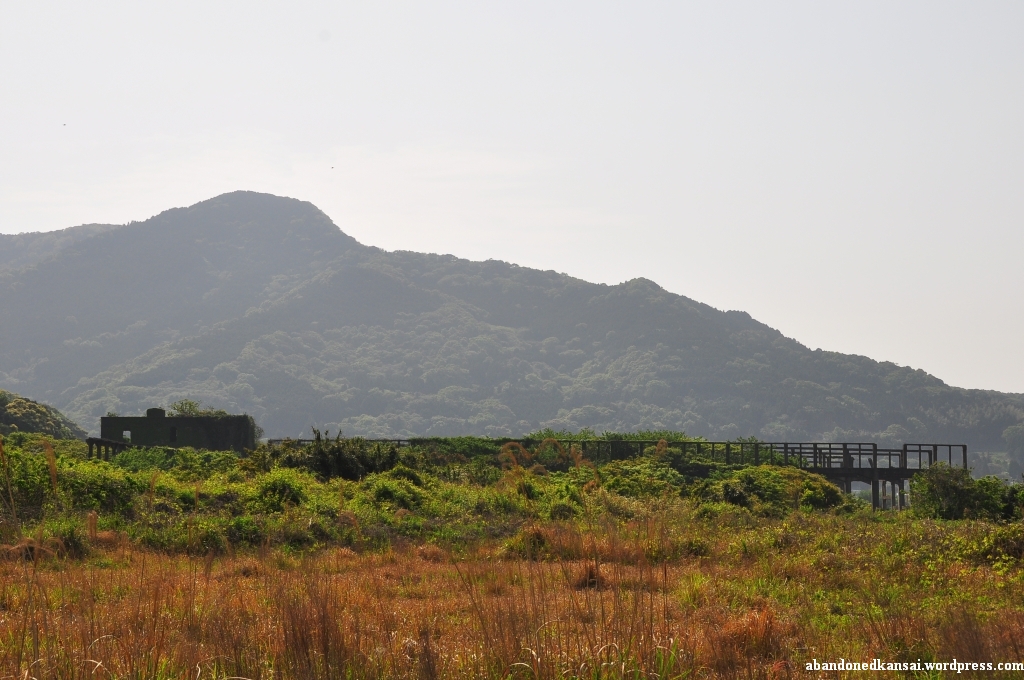
The Ganne Fortress on the other hand WAS a historical ruin that attracted tourists. After it was left behind by the Japanese military it was abandoned again as a tourist attraction and became a modern ruin. The peninsula housing the Ganne Fortress was of strategic importance for centuries to guard the sea route to Hiroshima. The current fortification was built in 1898 and retired in 1919 without having seen any action. It was equipped with four 270 millimeter canons as well as four 50 millimeter light artillery guns, supplied by four powder storages. In 1997 the Ganne Fortress was fixed up along with a couple of similar installations to create the Fortress Forest Park, teaching tourists and locals about the military history of that area. In 2004 the area experienced a major reorganization with cities merged and stuff like that, so I guess the new people in charge lost interest. Especially since they were now taking care of a real naval history museum, too. A small fortress on top of a mountain really off the beaten track with a rather steep narrow road that can become dangerously slippery leading to it? Nobody wants to be responsible for that!
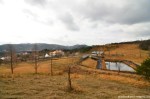
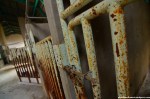
While nature generally seems to do a pretty good job reclaiming territory given up by mankind it is especially fast in Japan. Just a couple of years after the Ganne Fortress was abandoned the whole thing is pretty much overgrown. The asphalt road leading to the installations is covered by needles and broken branches, trees are starting to reach over. Concrete handrails looking like wood are losing their color and cracking up, revealing their stone and metal innards. Smaller stairs, once used as shortcuts to the top and to reach one of the already mentioned former powder storages, are pretty much completely overgrown now, making it tough even in very early spring to pass through. The stainless steel chains, a decade ago preventing tourists from falling to their deaths, lost their purpose, but they are still flashing in the sunlight. Halfway up the mountain, in anonther one of the old powder storages, was a little museum – now completely smashed to pieces and hard to reach due to two other sets of overgrown stairs. The mountain top still offers a gorgeous view, although the uncontrolled growth of nature sometimes makes it hard to get a good look. Or to take interesting photos. The two short videos I took turned out to be so dull that I won’t even publish them.
My fellow explorer *Michael* didn’t seem to be impressed either so we called it a day pretty quickly and got *back on the road* again…
Abandoned or not abandoned? That was the question when my haikyo buddy *Michael* and I arrived at the New Zealand Farm in Hiroshima (a.k.a. the Rainbow Farm). It clearly wasn’t demolished, which is always a big relief when finally reaching a location to explore, but getting close to the place it was clear that we would be in for a ride at this supposedly abandoned theme park…
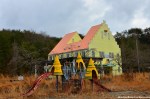
Entering the meticulously clean parking lot by getting around a knee-high road block things didn’t look very abandoned. Nevertheless a sign there confirmed what I knew from my long hours of research on the internet: The New Zealand Farm was closed more than three years ago on 2008-08-31. But to our surprise the entrance area looked very preppy. The hedges and trees were well-trimmed, with freshly cut branches waiting to be removed at some parts. Things just didn’t add up – causing a bad feeling in my stomach. Michael was all excited and ready to jump a fence or disappear into the bushes, but I was very hesitant. So we agreed on having a look from the outside first before doing something that might get us into trouble. Which was good thing in this case, because a couple of minutes later, still on the huge parking lot, we ran into a security guard and several maintenance workers. (On the other hand: Later during the *road trip* Michael’s great gallantry would get us to a place we didn’t even expect to reach.) Since Michael’s Japanese is way better than mine and since he’s the more voluble person anyway I stayed in the background while he was talking to the main guy. From where I stood I wasn’t able to hear their conversation, so I’m still not sure which language they were talking in (Japanese, English or a more universal one…), but after a couple of minutes a smiling Michael came up to me and pointed ahead – we had one hour to explore the Hiroshima New Zealand Farm! (We were probably the first people ever to do so since this location never appeared on any Japanese or any other haikyo blogs – and most likely never will given the circumstances.)
What I already knew about the Hiroshima New Zealand Farm was that it was opened in July of 1990 and closed on August 31st 2008. This agricultural theme park was run by a company called Farm Co., Ltd. that owns farm parks all over Japan. Four of them were New Zealand branded, but only the one in Tohoku (where the earthquake and the tsunami struck last year…) is still up and running – the other three were closed in the late 00s. The remaining dozen parks are served by about 700 employees and have all kinds of themes: Austrian, German, Japanese countryside, … The concept is basically always the same: Giving children and their families the opportunity to spend a day amidst tamed nature. The parks are usually pretty big and feature attractions like a petting zoo, an animal race track (sheep… yes, a sheep race track!), kid friendly rides like a hill slide, horse / pony riding, miniature golf, go-kart races or a kids train, paddleboats, exhibitions and different shops (like a bakery or a milk processing facility) where you can witness or even participate in making fresh bread, yoghurt and butter – and of course there is the usual array of restaurants, BBQ areas and snack shops. Buildings are named according to the theme, so in this case we saw the “Hamilton Restaurant” and the “Kiwi Museum”. Everything merges beautifully in hilly landscapes. High-tech attractions like at Universal Studios Japan (USJ) are nowhere to be seen – those kinds of amusement parks have a rather different target audience. Unlike USJ and its major competitors the farm themed parks are pay-as-you-go amusement parks – which means that you can enter for little money (in this case 600 Yen, children and senior citizens only 300 Yen), but then you have to pay additionally for every single attraction; usually between 400 and 600 Yen – which can add up quite a bit over the course of a whole day.
What I didn’t know about the Hiroshima New Zealand Farm was that it was just closed, but not abandoned – unlike its *sister parks in Yamaguchi* and Shikoku. About half a dozen maintenance workers make sure to keep vandals and other nosy good-for-nothings out and take care of the vast meadows and countless big and small buildings – it seems like the destiny of this New Zealand park is still uncertain and that Farm Co., Ltd. has yet to decide what to do with it. Until then some long-serving employees keep their jobs.
I’ve been to *several abandoned theme parks before (and after…)*, but never to one that was only closed. Which made this experience unique and eerie at the same time. With the slowly decaying buildings in the outskirts of the premises it felt like an abandoned theme park, but overall it was in way too good condition – it was actually kind of confusing to see no signs of vandalism whatsoever. Nothing. Not even a broken window. At the same time climbing frames were getting rusty, colors were losing their intensity and wooden panels were getting brittle. We were actually told to not cross a certain bridge as it wasn’t considered safe anymore.
Exploring the closed by not abandoned Hiroshima New Zealand Farm was an absolutely fantastic experience, though rushed in parts. There was so much to see, so many attractions to go to. So many little things to discover, like the small road between the buildings at the village square, or the bunny welcoming visitors big and small to the petting zoo halfway up the main hill – and even further up was a kart track of decent size. It was almost a little bit like Shigeru Miyamoto described his childhood neighborhood explorations in David Sheff’s book “Game Over” – you never knew what to expect behind the next corner, behind the next hummock…
The abandoned Japanese Sex Museum (a.k.a. the Mansion of the Hidden Treasure) first caught my attention in 2009 when I first started doing some research about haikyo on Japanese blogs. Three years ago the museum showed up on two or three homepages; both urbex and more general pop culture blogs. After that it basically disappeared, I haven’t seen pictures of the place ever since. So what happened? Boarded up? Security? Maybe demolition? Since *Michael* and I *were in the area anyways* we decided to find out, especially since the museum was pretty much on top of both of our “Places I Want To Explore” lists.
I guess the abandoned Japanese Sex Museum, along with the *Maya Hotel* and *Nara Dreamland*, was actually one of the locations that convinced me that Japan not only has abandoned places, but that it has some great ones. There are not that many sex museums in the world overall – so an abandoned sex museum is pretty unique! (Although “Abandoned erotic art museum” would be a slightly more correct name for the place now that I know what’s to find there.)
Opened on October 1st 1978 the Mansion of the Hidden Treasure was in business for almost 20 years before it was closed in the second half of 1997. Mansion of the Hidden Treasure is actually a great name since the exterior looks like a massive, old-style Japanese mansion, like a fortress almost. The entrance was guarded by a statue of Daikoku, the God of Great Darkness and one of the Seven Gods of Fortune. Opening hours were from 9 a.m. till 11 p.m. and the entrance fee was 1000 Yen according to a pamphlet that was lying around in an office room. Exploring the place further we found actual tickets with a printed price of 1300 Yen, so I guess the entrance fee was raised at least once during the 19 years of business. Several vending machines near the entrance and the exit offered all kinds of items, for example erotic playing cards and saucy postcards at the price of 300 Yen. One of the trashed rooms had a small stage and nearby we found a sign that said “Nude Show 2500 Yen”, so I guess it’s safe to say that there were live performances at the museum, too.
(If you are easily offended by sexual contents and you nevertheless read this far I strongly recommend to move on to another posting as from now the article will become a little bit more specific – while at no point pornographic I might mention the p-word once in a while and the photos at the end… or dear… well, it’s an abandoned sex museum, of course the exhibits are 99% erotica!)
As you may or may not know pornography in Japan is usually censored due to article 175 of the Criminal Code of Japan which says that people who sell or distribute obscene materials can be punished by fines or imprisonment – meaning that genitalia are usually blacked out, white out or pixelated with mosaic. Article 175 was part of the original Criminal Code passed in 1907 and remains pretty much unchanged till this very day. It was the written manifestation of the Meiji Era efforts to reduce the publication of pornographic materials. Before the second half of the 19th century the shunga, erotic woodblock prints and therefore a type of ukiyo-e, were quite popular – and as explicit as modern western pornography; probably even more imaginative since the shunga not only showed traditional sexual acts, but also sex with animals, demons and deities. Some of them even showed sex with foreigners… And I guess that’s where the worldwide image of weird Japanese porn comes from. Well, that… the used panties vending machines and of course the anime series Urotsukidoji, famous for inventing tentacle rape, creating a whole genre with just one extremely disturbing scene…
With that being said there was no pornography found in the abandoned Japanese Sex Museum – only a couple of paintings (some of them in a special room with black light lamps), softcore photos (e.g. Playboy Centerfolds), a couple of mannequins as well as lots and lots of wooden and stone sculptures; dozens of them, to be accurate. Sculptures of penises, vaginas, combinations of both, couples in the act, buttocks, masturbating animals, priests, deities, demons and whatever you can imagine. In one room there was a forest scene with penis shaped mushrooms. Or mushroom shaped penises. Your guess is as good as mine. It was almost impossible to open your eyes without looking at a phallic symbol.
While two or three rooms were completely trashed (basically the entrance and the exit areas as well as the offices upstairs) some of the exhibition area’s ceiling was quite moldy, but still in good shape. Those huge statues must have been insanely heavy, especially sculptures like the stone penis with a length of almost two meters, and let’s be honest: Who would actually hit a giant stone vajayjay with a sledgehammer or tip over a couple of marble dicks? Even the most ruthless vandal respects those symbols!
Sadly that didn’t apply for the female models. The main exhibits in the last room were stolen (or “taken to security” by some previous explorers…) a year or two ago. One was a wax model of the famous European softcore erotic character Emmanuelle, the other one was a replica of Marilyn Monroe – both presented in slinky poses behind now broken glass. The already mentioned pamphlet / flyer featured photos of both wax figures and they looked pretty amazing. Even more so on the already mentioned Japanese blogs I saw a couple of years ago. When the museum was still open to the public the wax figures were scantily dressed and well-lit behind glass, but once it was abandoned the new visitors had less respect and undressed both Marilyn and Emmanuelle to show lower body parts that were out of sight before – and surprisingly both models were not as anatomically impaired as a Ken doll.
The left behind mannequins on the other hand were exactly that: Rather gender neutral below that waist and more or less what you can see at every clothing store when the clerks redress the shop window dummies. Of course they were all (partly) dismembered and slightly damaged, but they were basically normal mannequins… except for the really disturbing “Sleeping Beauty” one, which had vibrators mutating out of her nipples.
The main challenge from a photography point of view was the fact that 80% of the museum was pitch black, which meant that I had to take every shot with a tripod and illuminate every photo individually with my flashlight; similar to what I did at the *Lost Subterranean Shrine*.
With a sheer endless amount of statues and the time consuming process of taking photos Michael and I spent a whopping four hours at this fascinating location. Like I mentioned at the beginning, we both had high expectations about the abandoned Japanese Sex Museum and they were not only met, but exceeded. This haikyo is without the shadow of a doubt one of the best abandoned places in Japan and it would be a place worth visiting anywhere in the world. I just hope that future visitors will treat the location with the same respect Michael and I did so it will put a smile on the faces of urban explorers for decades to come…
Spring time is long weekend trip time! While Kansai doesn’t have much of a winter it nevertheless can be quite cold, especially when having a hobby involving taking pictures in abandoned places, other places of Japan can be snowed in for months with meters of snow… So when the sun finally warms the hearts of Japan and causes the first sunburn of the young year it’s time to explore places beyond my beloved Kansai – whether it be *Kyushu with Enric* two years ago or Shikoku with Gianluigi last year (a series of articles yet to come…), it became kind of a tradition for me to go on an urbex spring trip with a friend of mine. This time *Michael Gakuran* and I teamed up for a road trip to the southern end of Honshu, Japan’s main island – Chugoku, to be exact, the area west of Kansai. A trip with such exciting places that I decided to start writing about it right away – the last pictures are barely 50 hours old…
At this point I don’t want to give away too much about the locations we visited or which order we visited them in. But there were 8 of them in 3 days. 3 long days I might add, with me getting up at 6.30 a.m. on a Sunday, at 6 a.m. on a vacation day and at 5 a.m. on a national holiday. As I mentioned before: I’m a morning grouch; and by “morning” I mean any point in time which is followed by “a.m.”…
But the trip wasn’t just exhausting, it was also exiting, fun, frustrating, satisfying, rich in variety, surprising, delicious (I finally ate Hiroshima Okonomiyaki in Hiroshima prefecture and bought the best local sweets outside of Kyoto – mikan dango) and insanely expensive.
Why insanely expensive? It’s because at the end of the first day a serious mishap happened to me. We were on our way to a hotel to stay for a night when we saw this huge, blue and white flame at a gigantic industrial plant – probably coke oven gas burning at a cokery. (Addendum 2012-06-11: I guess I was wrong about the gas – Gert from South Africa wrote me: “This couldn’t be coke oven gas burning, because coke gas got a very very hot orange (impurities) or yellow (cleaner) flame. But the flame in the video is actually blast-furnace or corex, midrex, finex gas flame (more methane content in gas).” Thanks a lot for pointing that out! I really appreciate it and changed the title of the video below, too.)
We decided to make a stop to take picture or two and when I got out of the car to marshal Michael I grabbed my bag and I don’t know how or why, but my beloved D90 camera flew through the air and crashed hard to the concrete ground. The body cracked open a couple of millimetres so I could see the insides. Parts of the electronics were still working (e.g. I could use the screen to look at the photos on the memory card), but since the lens mount was part of what cracked it was impossible to take pictures anymore. Mad props to Tokina BTW! The mounted 11-16mm lens survived without a scratch or any other damages as I found out with relief the next day.
Sunday evening past 7 p.m. – of course I was in shock at first, because going on a photo trip without a camera is pretty pointless. So we headed towards the flame to take some picture which I couldn’t do since my photo camera broke and Mike couldn’t do because of the lighting, lenses and passing traffic. So I took the video you can find below the article – it doesn’t fully capture the beauty of the flame, but it will always remind me of the death of my favourite camera so far (I also included the last JPG I ever took with it, even though it wasn’t related to urbex). Back at the car we decided to look for an electronics store, although it was almost 8 p.m. on a Sunday evening. After a couple of minutes we found a shopping mall, but it didn’t have a camera store. The staff at the mall was very nice, telling us where to find an electronics store – but it closed at 8. Michael, who did all the talking since his Japanese is WAY better than mine, wasn’t discouraged by that and asked for the phone number of the store. Although the store was closed Michael called and somebody picked up. He told them my tricky situation and they agreed to let us into the store if we hurry – so I got into a taxi and went straight to the store. There a guy with pretty decent English helped me at the camera department. I was hoping to replace the D90 with another one, but they didn’t have them in stock. A lower model was out of the question, so the only option was a D7000. Which they didn’t have in stock either. Just the display model – which they couldn’t sell me without the kit lens since it was a display model. After some deliberation and the certainty that not buying that display model would mean losing at least 5 hours the next morning looking for another camera (electronic stores in Japan usually open at 10 a.m.) I half voluntarily upgraded from a Nikon D90 to a Nikon D7000. With a bad feeling since I not only spent a huge chunk of money, but I also had to learn by doing how to handle a new camera. While I’m very pleased with how the photos of all locations turned out it was quite unnerving at times to get the shots I wanted to take.
Now just a few quick words about the locations we visited. The undisputed highlight of the tour was the abandoned Japanese Sex Museum. Both Michael and I had high expectations and we were not the slightest disappointed, shooting in almost complete darkness for the majority of the 4 hours we spent there. Another glorious highlight to me was the Kart Pista Hiroshima race track – why it was a highlight you’ll find out soon. Since theme parks are one of my favourite types of abandoned place we visited two of them and I loved them both. 4 world class haikyo in 3 days – plus 2 good ones (a Meiji Era army fortress and a quite tricky hotel) as well as 2 more we took pictures of because we went there and it would have been a waste not to cover them… a strip bar in an onsen town (euphemistically called “theater”) and a car camp site. To my knowledge all of these places never appeared on English speaking blogs, some of them are even unknown to the Japanese urbex crowd. So please enjoy the preview pictures and come back for much more information, photos and about one hour of video material!
The Tohoku Earthquake of March 11th 2011 was a horrible, horrible event. I was on the 16th floor of an office building in Osaka at the time, almost 1,000 km away from the epicenter – but looking at the faces of my Japanese colleagues I could see that most of them remembered another horrible earthquake: the Great Hanshin Earthquake (a.k.a. Kobe Earthquake), January 17th 1995; the second worst earthquake in Japan of the 20th century with about 6,500 casualties. 200,000 buildings collapsed, the total damage was more than 100 billion US-dollars – with massive consequences for all of Kansai as many companies moved to Tokyo and other parts of Japan, closing subsidiaries in Kobe, Osaka and Kyoto out of fear of another earthquake; which is kind of strange since a major earthquake is overdue in Tokyo for quite a while now…
One of the buildings that were severely damaged in Kobe was the former Iranian general consulate or Persia House, as it was known in its later days. In the 19th century Kobe opened its ports quickly for oversea trade and became host of one of the biggest foreign communities in all of Japan. Especially an area now known as Kitano was the home of many, many merchants from all over the world. Nowadays a major tourist attraction Kitano is the home of small antique shops, fancy bakeries, lots of wedding halls and bridal gown boutiques as well as countless French bistros – or whatever Japanese people think French bistros should be like… And of course there are the old merchant houses. The Weathercock House (German style…), the Denmark House, the Original Holland House – and before the Great Hanshin Earthquake happened there was the already mentioned Persia House.
The Persia House was a 2 storey wooden building with a kiritsuma style roof. Until 1981 it was the home of the Iranian general consulate in Kobe, afterwards it was opened to the public as a tourist attraction, housing the Persian Art Museum which showcased pottery of the Persian Empire. In 1983 the Persia House received three sets of leaded glass windows from Roger Nachman Glassworks, making it even more beautiful than before.
Unlike the neighboring foreign residences the Persia House wasn’t rebuilt after the Great Hanshin Earthquake hit Kobe – nor was it demolished. It seems like the ruin was left alone for almost a decade until in 2004 city of Kobe seized the premises since the owner didn’t pay taxes for quite a while. Since from that point on the ruin was a problem of the city a green stockade was erected to keep people from hurting themselves; and to make it harder for the ruin to catch the innocent tourists’ attention. Hardly anybody likes an “eyesore” like that in a preppy area like Kitano, but it seems like nobody had the will or authority to get rid of it completely – and that assumption would have been dead wrong as the city in fact tries hard to get rid of the whole problem. So far the premises were up for public auction nine times, but there was never a taker, although the minimum bid was lowered in six steps from 159 million Yen to 95,4 million Yen. (1.5 million Euro / 1.9 million US$ to 0.88 million Euro / 1.56 million US$)
When I was visiting the Persia House it was kind of funny to watch dozens of tourists pass through the narrow street the former art museum is located at without even realizing that there was a ruin. But as soon as I took my camera to take some photos over the picket fence 80% of the people passing by did the same. After a while I left trying to take pictures from another angle – when I came back to the front again none of the passing tourists seemed to see the ruins…
I guess those tourists are basically the main reason why the location is one of the least photographed haikyo considering its exposed location in the heart of Kobe. Hopping the fence wouldn’t have been a problem, although a cable and a connected electronic device might have been some kind of alarm system. But even if you made it past the fence you could always be seen by people passing by. On the adjacent estate to the north is actually the Original Holland House (and with that I can as well mark the *location on the map*…) – looking down from its back porch you probably have a pretty good view at the side of the ruins of the Persia House. Sadly the teenager at the entrance wouldn’t let me take a couple of photos and I wasn’t willing to pay the 700 Yen entrance fee for 2 minutes of not entering the friggin house. I recently spent 15.000 Yen on a roundtrip train ticket expecting to see a demolished amusement park, so I don’t consider myself cheap, but come on! The Dutch being of German blood I would have expected a little bit more solidarity…
Anyway: board fence + uncontrolled plant growth + tourists + shooting in west direction in the afternoon = a picture set I’m not very proud of.
To end this article on a funny note, please have a look at the last photo of the set. I took this nearby at one of Kobe’s major tourist spots. It’s the map of a public restroom. Not a map showing public restrooms in the area – a map of ONE public restroom. If your sense of direction is below par you better study the map before you enter to avoid getting lost… unless you are a man. The gentlemen’s section is so small it really is your own fault if you get lost!
(Update 2013-01-05: The Persia House was demolished since I took the photos – I’ll write a RIP article as soon as possible…)
Takarazuka is one of those bedroom towns at the foot of the Rokko Mountains, home to thousands of commuters working in Kobe and Osaka. Like Nishinomiya and Ashiya (both to the south) Takarazuka is a rich suburb. While Nishinomiya is famous for sake and the Hanshin Tigers in all of Japan till this very day, Takarazuka’s brightest days are in the past – although it’s still a beautiful place to live and attracts hordes of tourists every weekend. The days of Hanshinkan Modernism, which made Takarazuka one of THE places to be in the early 20th century, may be long gone, but a few parts of this cultural heyday survived for almost a century. Prime example being the Takarazuka Revue, an all-female musical theater troupe, founded in 1913 by the president of Hankyu Railways to attract more people to come to Takarazuka and its hot springs – and of course to sell train tickets… 99 years later the revue is popular as always with ticket prices up to 11.000 Yen. While the hot springs are outshined by the nearby Arima Onsen town Takarazuka gained a new attraction in 1994 when the Osamu Tezuka Manga Museum (Takarazuka’s Tezuka Osamu Memorial Hall) opened its door. This three floor museum is dedicated to Osamu Tezuka (who would have thought it?), the godfather of anime, father of manga, Japan’s Walt Disney – and creator of Astro Boy, Kimba the White Lion (still in development hell at Nintendo?) and Black Jack. Oh, and of course there are dozens of hiking trails in the mountains to Takarazuka’s west and north!
Being one modern and tidy city Takarazuka is way less famous for abandoned places. I’ve actually never seen one on any of the Japanese haikyo blogs. The more surprised I was when I spotted some rusty machinery on my way back from a hiking trip a couple of years ago, long before I started urban exploration as a hobby. So when I remembered the rusty gold a few months ago I saved it for one of those “I wanna explore an abandoned place, but I don’t wanna get up at 6 a.m. to ride several trains for 3 or 4 hours” days. In February of 2012 I finally went back to Takarazuka again – after lunch, because I could!
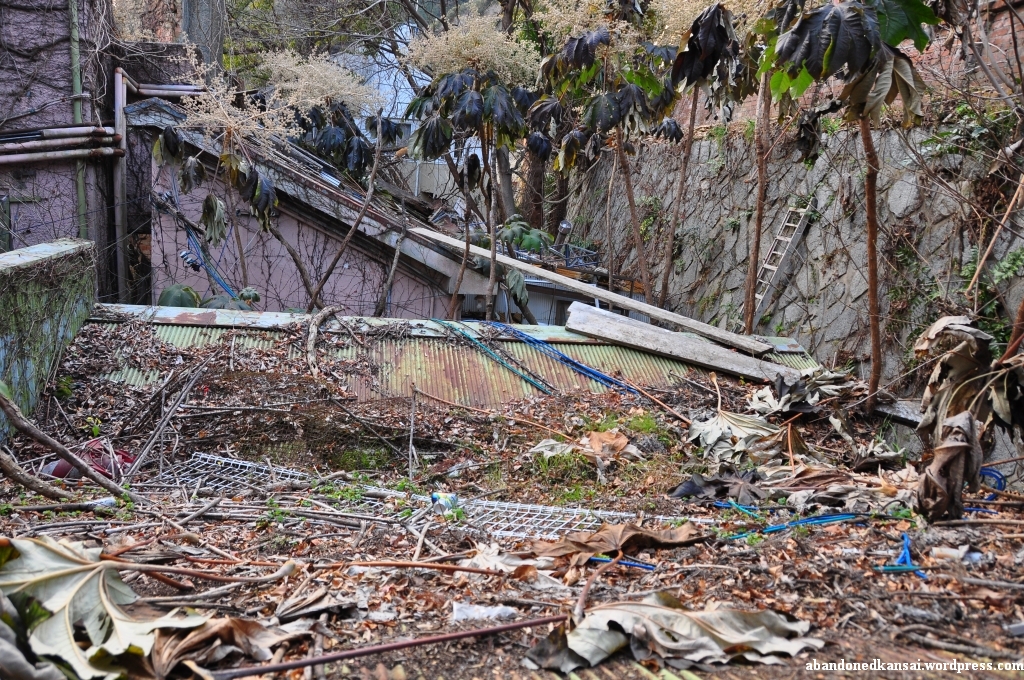
When I was exploring the Takarazuka Macadam Industrial Plant I wasn’t sure what the place was exactly. Judging by the look of the surroundings and the machinery left behind I guessed it was another limestone mine, an industry almost omnipresent in Japanese countryside – just without the chemical plant the *White Stone Mine* had. A stone crusher was also missing, which is kind of ironic in retrospect given the fact that the kanji for macadam are the same as the ones used in the Japanese term for “crushing stones”. So basically all I found were a couple of loading bays (probably with sorting devices to separate small stones from bigger ones) and conveyor belts; plus controls for the machinery. Some installed within wooden huts in dangerously desolate state, some in wooden boxes just nailed and bolted to concrete walls; I guess waterproof wasn’t invented back then…
Exploring the area was especially exciting since I’ve never seen the place anywhere on the internet before – and it was dangerous! Every step forward, every corner revealed more unsound wood and brittle metal. I guess somebody lived for a while in one of the shacks and left behind, among other things, a suitcase full of porn. Yes, not just a couple of magazines – a whole suitcase full of the censored Japanese school girl porn that seems to be so common for abandoned places in this country… I guess you could call it the Porn Shack.
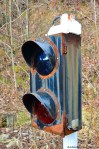
The other thing that really fascinated me was the already mentioned wooden box containing some of the controls for some of the machinery. Being located at the foot of a mountain range Takarazuka gets its share of rain, so I really wonder who thought it would be a good idea to nail a wooden control box to a concrete wall – and put a metal control panel right next to it. One can only imagine how much maintenance those things needed…
And finally a couple of words about the history of the place – stuff I found out after I explored the plant based on the information gathered there; and of course the internet was a big help… The whole rusty thing is / was owned by a company which could (should?) be translated as Osaka Macadam Industrial Place (大阪砕石工場, Osaka Saiseki), which is still a major player in the earthwork / crushed stone industry with 350 employees and several plants all over Japan. But my limestone assumption was wrong, hence the lack of a chemical plant. Osaka Saiseki was founded 1934 and the macadam plant in Takarazuka was opened in 1938. I assume the area I explored was the old separation and transportation line that was abandoned when the plant moved further into the valley to continue ripping some chunks out of the Rokko mountain range…
The Mt. Hiei Artificial Ski Slope is an abandoned ski resort near the top of Mount Hiei on the border between Kyoto prefecture and Shiga prefecture. Famous for its Enryaku Tempel and the Kokuhoden Museum this holy mountain was once thought to be the home of gods and demons in the Shinto belief system. Interestingly enough the predominantly religion on Mt. Hiei has always been Buddhism. The monk Saicho founded the Enryaku-ji in 788 as the first outpost of the Tiantai / Tendai sect and it remained the Tendai headquarters till this very day, although it was famously destroyed by Oda Nobunaga in 1571 to vanish the rising power of the local warrior monks, killing about 20,000 people (including civilians) in the area. The temple was rebuilt soon after and is one of the main tourist attractions in Shiga prefecture today, accessible via two cable car lines, several beautiful hiking trails and a toll road for cars, motorcycles and busses.
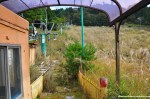
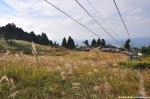
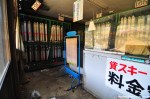
Along the “Kitayama East Course” lies the Mt. Hiei Artificial Ski Slope, probably the most visited haikyo in all of Japan. On an average day during the hiking seasons in spring and autumn you’ll never be alone in the area as people are constantly passing by – about half a dozen hiking trails meet here and a close-by cable car station, serving the longest funicular line in Japan, attracts hundreds of people a day. Most hikers barely notice the abandoned ski lift and ski slope, hardly anybody peeks through the broken windows of the gear rental store or has a look at the undamaged closed restaurant. Why wasting a thought on that ugly stain when the surrounding nature is of such beauty? Because beauty lies in the eye of the beholder and though the ski resort on Mount Hiei was rather small it nevertheless offers a few neat angles now that it is abandoned.
Wanna know some facts about the resort? Okay, this is what I was able to find out: The Mt. Hiei Artificial Ski Slope was opened in 1964 and on November 1st of 2002 the newspaper Kyoto Shimbun reported that the ski resort was closed for good after a hot summer in 2000 and a way too warm winter in 2001 – followed by a year of temporary closing; which explains why both the restaurant and the rental store are still stocked with all kinds of items. In the almost 40 years of operation the already mentioned facilities welcomed customers for both a summer and a winter season. In winter a combination of natural and artificial snow (provided by a snow gun) offered fun for the whole family, in summer grass skiing was the business of choice. A lift transported guest for a distance of 170 meters so they could enjoy the pretty short slope of up to 200 meters with a vertical drop of 38 meters.
Oh, before I forget: The nearby “Garden Musem Hiei”, a flower park, once was an amusement park with a haunted house, a small Ferris wheel and a viewing platform, but I guess it was converted quickly enough to never been considered abandoned.
And that’s it for now from Mount Hiei. For now, because the ski resort was actually my second urbex trip there and my fourth or fifth overall – I really like Mount Hiei! Next time I’ll take you there I’ll either show you an abandoned rest house on a steep slope or a mysterious construction I’ve never seen anywhere else on the internet…
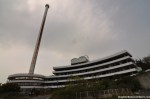
The La Rainbow Hotel & Tower (a.k.a. as the Graffiti Hotel) was one of my favorite explorations of 2011. I knew about that place for quite a while and I guess it’s one of the most popular abandoned places in west Japan for a number of reasons. First of all it’s in that ineffable “Nippon No Haikyo” book – and then of course there are the countless colorful graffiti, the unusual architecture and the observation tower with its moveable platform…
I’m always happy to introduce friends to my urban exploration hobby, so when my buddy Luis showed some interest in accompanying me I suggested a place I wanted to go for a long time; one I’ve never made it to due to the rather long train ride there. (About 3 hours plus and at least half an hour of walking – or 2 hours for double the fare taking one stop on the fastest Shinkansen.)
Usually the journey to an abandoned place isn’t exactly a fun time, but thanks to some very interesting and insightful conversations with Luis we both arrived at the La Rainbow Hotel & Tower in a very good mood – which got even better once we realized that the place was off the main street and had no security whatsoever; which came with both the good and the bad aspects (easy to access, relaxing photo and video shoots for hours / vandalism, arson, …).
One thing was perfectly clear from the first second: The La Rainbow Hotel (I never got why Japanese love to mix languages!) was a pretty big building! It was so huge the floors were not only connected by staircases and elevators, but also by escalators.
To my surprise the number of guest rooms was rather limited. There were none on the first floor. Or on the second floor. Neither on the fifth or sixth floor. So here’s a floor overview:
1F: entrance to the hotel, exit of the observation tower, ticket machines, arcade, bathes
2F: entrance to the observation tower, front desk of the hotel, party rooms, kitchen
3F: guest rooms 301-327
4F: guest rooms 401-437
5F: upper entrance to the building via a bridge, kitchen, family restaurant “La Rainbow”
6F: bar, beer garden
Having learned from previous experiences (never explore a floor when you are not sure in which condition the rooms below are in…) Luis and I made our way up. 1F, 2F, 3F, 4F, 5F, 6F. The hotel was equipped with several large Japanese style gathering / party rooms, one of them even still had a karaoke machine, but some of the guest rooms were Western style. This was rather interesting, especially since it looked like as if the rooms were designed and furnished individually – a common thing in love hotels, but not in standard tourist hotels. Another huge difference from normal hotels: the gigantic window fronts of most of the rooms. The La Rainbow Hotel had ceiling to floor windows with a rather nice view at the Seto Inland Sea and the Great Seto Bridge.
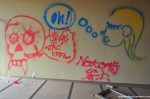
The main difference between the La Rainbow Hotel and any other abandoned hotel I’ve been to before (and after…) was the huge amount of graffiti. Like everywhere else in the world abandoned places and graffiti go hand in hand, and most of the time they are nothing more than a couple of ugly scribblings. Not in the case of the La Rainbow Hotel. The graffiti there were real pieces of art most of the time. And they were everywhere! I guess about a third of all walls received a new layer of paint, often as big as 2.5 x 4 meters. The absolute highlight in that regard was the basement of the La Rainbow Tower. Having the observation platform hovering over your head isn’t exactly a calming feeling, but the graffiti down there on a gigantic circular concrete canvas… As much as I usually despise graffiti at abandoned places, even I have to admit that they looked beautiful there! Especially since they were rather well made and offered quite a bit of variety…
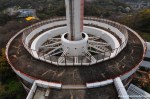
Speaking of the observation platform: It was attached to a tower 150 meters high (the highest observation platform of its kind in the world when it was built – not only in Japan!) and it was moveable not only vertically, but the platform was also able to spin around the tower. 23 meters in diameter the viewing cabin offered space for 150 guests at a time, the fare was 800 Yen for adults and 500 Yen for children. With the proper lighting (which was installed…) it must have been quite a sight after sunset. Well, it actually was. In the basement of the tower Luis and I found a box with several old photos of when both places were still welcoming customers – and especially the nighttime shots with long exposure time were stunningly beautiful!
Too bad the life of the now abandoned revolving observation tower was as short as that of the adjunct hotel. Little is known about the history of the unfortunate pair, but it seems like the place was the another product of the real estate bubble. From 1978 till 1988 the Great Seto Bridge (also known as Seto-Ohashi Bridge or the Japanese name Seto Ōhashi / 瀬戸大橋) was constructed… and some people decided that a bridge like that needs a place to welcome all the visitors who would come from all over Japan to have a look – ignoring the fact that the area already had some hotels due to the Washuzan Highland amusement park nearby.
The question is: Who were those people? A local taxi driver told Luis that the hotel was built by the Okayama prefecture and run for three years in the mid 1990s before it was privatized. The new owners gave up after only one more year as the general Japanese population wasn’t as fascinated by the bridge as the local politicians hoped it would be. The bridge is a great way to get to Shikoku, but “Hey, let’s stay for a night at a fancy hotel with rather small rooms and look at the bridge!” didn’t come to many people’s minds.
The more likely story is that a private investment group burned quite a bit of money when they opened the hotel and tower in 1988. They named the place after one of their two golf courses and were making big bucks at the time with their 400 seat seafood restaurant and two cruise ships. It was one of the companies that dreamed of making the area a “Japanese Venice”, actually buying large quantities of land on small islands like Yoshima. Since the Seto Sea boom bursted along with the Japanese asset price bubble (1986 to 1991) the La Rainbow Hotel & Tower soon faced financial issues and was closed for good in 1997 – something the internet and our taxi driver to a second location agreed on.
The latter story is more likely for two reasons: First of all I found a brochure by said real estate investment group laying out the whole La Rainbow project. And in 1990 the actress and singer Youki Kudoh (who later played alongside Ethan Hawke, Zhang Ziyi, Ken Watanabe, Jackie Chan and Max von Sydow in movies like Snow Falling On Cedars, Memoris of a Geisha and Rush Hour 3) did a commercial for the place usually referred to as Hotel La Rainbow in Japanese. (I named it slightly different here for the purpose of readability. Technically you have “La Rainbow”, the tower, and “Hotel La Rainbow”, the hotel.)
It’s said that the first round of vandalism was unleashed on the place by a motorcycle gang, but that kind of sounds like an urban legend – like the one you get with pretty much every abandoned countryside onsen hotel, where the last owner committed suicide. After the rough guys left the complex was taken over by graffiti artists and the usual vandals and arsonists…
Oh, by the way: The strange sounds you can hear in some of the videos are neither ghosts nor Imperial Stormtroopers charging at the building – initially I thought they were birds, but in fact those were the steels cables of the tower hitting each other and the tower itself due to high wind; quite irritating and spooky at first…
Sometimes you just gotta be lucky. Like I was on February 11th 2011.
Living in central Kansai you kind of forget about winter. Temperatures drop to 5° Celsius and people complain about how cold it is. There are barely ever minus degrees. Sure, if you hop on a train and go to the nearby mountains you can enjoy some snow. But in the Osaka Plain? Not so much. In the first 4.5 years of me being in Japan it happened once that it snowed strong enough for the white beauty to accumulate on the ground – but that was long before I started urban exploration.
On February 10th I met with some current and former colleagues to have a couple of drinks as the next day was a national holiday – a flip dark chill winter bastard though dry. I remember mentioning how much I missed snow and that there hasn’t been some in three years. Well… When I woke up the next morning at around 9.30 a.m., slightly hung over, I opened the curtains so see… snow! Everywhere! And it was still coming down in beautiful large flakes. I slightly panicked as it was already quite late (for a haikyo trip). Where should I go to? A new place or revisiting one? And which one of them? Would there be snow, too? I always wanted to see *Mt. Atago* covered in snow, but in addition to the train ride I’d need to take a bus… and they were most likely cancelled. My mind spun for a couple of minutes before I came to the conclusion that there was only one place to go. A place I never wanted to go back to: Nara Dreamland!
So I took a quick shower, made sure that my equipment was ready and headed to the train station. 80 minutes later I was in Nara, pleased to see that the whole city was covered by a thick layer of snow, too. Reaching the Dreamland it was still snowing heavily and I went straight for the *Eastern Parking Lot* with the parking garage, the hotel and the iconic main entrance. The DreamStation in the background was definitely a welcomed bonus, but most important of all: You can enter without jumping fences or ignoring “No trespassing!” signs; you just have to know where – definitely a plus in case security shows up with the police… About half an hour later it stopped snowing and almost instantly I heard dripping water. Yes, even before the sky turned from dark grey to light grey the snow began melting! I sped up to take some more pictures of this oh so familiar place (noticing unpleasant changes like the ugly graffiti at the former pachinko parlor) and hurried over to the western parking lot, another one of my (rather risk-free) favorites. By the time I was actually ready to enter Nara Dreamland itself half of the snow was already gone. Happy with the pictures I already took and not willing to risk them I decided to call it a day and went back to JR Nara Station – where I found barely any proof that this was a very snowy day…
But I really was lucky that day. Lucky that it snowed. Lucky that it was a national holiday and I didn’t have to work. Lucky that I didn’t oversleep completely. Lucky that I decided to go to Nara Dreamland. While a Japanese blog was quicker than I taking and posting night shots of Nara Dreamland I’m happy to present the first snow photos of Nara Dreamland, although it took me almost a year to post them. Please enjoy and tell your friends!
(For all your Nara Dreamland needs please have a look at the Nara Dreamland Special. For a look at the area around Nara Dreamland on GoogleMaps, including some fancy icons linking to articles on Abandoned Kansai and videos on YouTube, please *click here*. If you don’t want to miss the latest postings you can *follow Abandoned Kansai on Twitter* and *like this blog on Facebook* – and of course there is the*video channel on Youtube*… Oh, and don’t worry: Nara Dreamland is neither Japan’s last abandoned theme park nor is it in immediate danger of being demolished. NDL will make many more appearances on this blog, most likely all of them with unique videos…)
2012 didn’t start well for urban exploration in Japan – January has been a sad month for abandoned places in Kyushu. Two of the most famous haikyo in southern Japan were demolished:
The demolition of the *Kawaminami Shipyard* didn’t come as a surprise. It was decided on June 9th 2011 by the Yamashiro City Zoning Committee and executed in mid-January 2012 after all the greens were removed in late 2011. Nevertheless it is a big loss to the urbex community in Japan as it was one of the few locations that aged for decades without being affected much by anything but nature itself.
At the same time (late 2011 / early 2012) an up-and-coming location called *Navelland* was destroyed just 70 kilometers away from the famous deserted shipyard. The former amusement park was turned into a lot to soon become another campus of the Teikyo University. I was lucky enough to visit both places during Golden Week 2011 before they were destroyed and I have fond memories of both visits. You can find out their exact locations on my *map of touristy and demolished ruins in Japan*.
I guess it’s the normal run of things. New abandoned places show up, well-known ones get demolished. Nevertheless it makes me a bit heavy-hearted, especially since I decided a while ago to concentrate on western Japan and leave the east to all the blogs and people who live there. I already missed the famous Sports World in Izu for sure, but even if I change my mind chances are “good” that I might miss *Western Village in Tochigi*, the Russian Village amusement park near Nagano, *Kejonuma Leisure Land* in Tohoku and the Irozaki Jungle Park in Izu. Famous abandoned military installations like the Fuchu Air Base, Camp Drake Army Base or the Tachikawa Air Base. Popular deserted mines like the *Matsuo Ghost Town*, *the Taro Mine*, the Ashio Mine, the Murakashi Mine, *the Osarizawa Mine*, the Seigoshi Mine, the Kamaishi Mine or the *Nichitsu Ghost Town*. Not to forget the quirky remains of the sex industry like the Queen Chateau soapland, the Hotel Royal love hotel, the Fuu# Motel, the Yui Grand Love Hotel, the Akeno Gekijo strip club or the Pearl love hotel – and all the other places like the Royal House, the Small Pox Isolation Ward, the Japan Snake Center, the Okutama Ropeway, the *Heian Wedding Hall*, the many spas and resort hotels of the Yamanaka Lake, the Mount Asama Vulcano Museum, the Okawa Grand Stand or the Gunma Motor Lodge.
I probably forgot some famous spots as the east of Japan has plenty of wonderful abandoned places – but so has the west, and most of them are only described on Japanese urbex blogs until now. So I guess I’ll continue to focus on deserted locations east of Nagano / Nagoya, hoping that I will be able to see as many as possible before they falls victim to jackhammers, wrecking balls and other heavy machinery…



















































 Abandoned Kansai