Feeds:
Posts
Comments

Archive for the ‘Kansai’ Category

The Kuroshio Lodge is one of the oldest and most famous abandoned places in Japan – even pioneer *haikyo* blogs who haven’t been updated in years feature this almost completely trashed hotel with the iconic bar; a beautiful photo opportunity thanks to its rusty stools and bright orange and yellow lamps. Nevertheless I struggled for about a year to find out where the Kuroshio Lodge was… and then another six months to find a ride as it is close to impossible to get to the place by public transportation – luckily it was *on the way to Shikoku* for Gianluigi and I, so we made a stop to stretch our legs and to take some photos.
Kuroshio means “black tide” and is also the name of a northeast-flowing ocean current stretching from Taiwan past Japan to the North Pacific Current – hence the nicknames Black Stream and Japanese Current, deriving from the deep blue of its waters and the country it flows by.
It’s pretty safe to say that the Kuroshio Lodge was named after the current – despite the fact that the Kuroshio (current) isn’t visible from where the lodge is located. The lodge on the other hand isn’t visible from the beautiful coastline of Awaji Island. You can get as close as 100 meters (beeline) on a busy street, look up a hill and see nothing but trees. At the same time you have a gorgeous view at the mountains of Awaji Island and the stunning Seto Inland Sea from the rooftop of the lodge… It’s all a matter of location!

At first and third sight the Kuroshio Lodge is a big disappointment. After huffing and puffing up a rather steep mountain road on foot, Gianluigi and I reached the back of the mid-size grey building. After years without maintenance the outside walls looked dirty, but that was nothing in comparison to what we saw when peeking through some open windows – the exposed rooms were filled with rotting vandalized futons and other interior. Not exactly a great start.
In close proximity of the abandoned hotel we found a couple of small houses at the slope; hut-sized, most likely the former living quarters of employees. We entered one of them, but the lighting in there was horrible and neither of us brought a tripod. There was not much to see anyway – I didn’t even bother to take a video.

Back up the slope we finally entered the Kuroshio Lodge – and were positively surprised by the lobby area with its famous turquoise chairs and the bar with its even more famous lamps and stools. You could take 100 interesting photos there and still won’t be bored!
Sadly disappointment stroke again right behind the counter. The kitchen next to the lobby / bar was completely vandalized and rotten, so we made our way up to 2F (first floor in Europe, second in Japan). No wonder that you barely ever see other rooms than the lobby when people post about the Kuroshio Lodge. The whole rest of the place was either vandalized and rotten or completely boring. I took a couple of snapshots here and there (like the lamp and the bath, although they were not really exciting subjects…) and then called it a day, taking the obligatory video on the way back to the lobby.

Since I visited the Kuroshio Lodge almost two years ago I found several Japanese articles about the hotel claiming that the area is overrun by wild dogs from a former dog breeder close to the hotel. They also claim that those dogs were involved in some rituals… whatever that means. Luckily I didn’t run into any mad dogs, crazy cultists or bloodthirsty sadists – although I remember seeing some kind of triangular sign on a metal plate in the boiler room (the one at the beginning of the video below, I just missed to catch the symbol on film… sorry for that, I didn’t think it was on any significance). The whole thing sounds a little bit like an exaggerated version of the usual ghost story surrounding basically every abandoned hotel in Japan. A lot of Japanese people are surprisingly superstitious, so whenever a place is abandoned you get some variation of the “owner committed suicide” story. Stories that are virtually impossible to verify. Nevertheless I thought I better mention the wild dogs. You know, just in case you walk up to the Kuroshio Lodge one day, get surrounded by them and think “Florian never mentioned those damn dogs!”…

To me the Kuroshio Lodge was a rather disappointing location. I loved the entrance area, but the rest of the building gave me a “been there, done that” kind of vibe – which is not what I was hoping for after putting so much time and effort into finding the place. But hey, what can you do? At least the bar and the lobby didn’t fail to deliver. And sometimes one room is all you need to make a visit worthwhile…

(If you don’t want to miss the latest article you can *follow Abandoned Kansai on Twitter* and *like this blog on Facebook* – and of course there is the *video channel on Youtube*…)

Read Full Post »

Daiwa Pottery or Yamato Ceramics?
Researching abandoned Japanese places can be a pain. Even if you have a name in kanji (those complicated Japanese characters that the island-dwellers use up to 20.000 different ones of…) doesn’t mean that you know how to pronounce it or do some research with it. In this case I found the name in kanji both on a chimney as well as written across the entrance of the main building – nevertheless I couldn’t find out anything about the company behind those characters; or how to read those characters as kanji can have several readings and meanings. Sure, I found a company of the same name in Osaka, but their logo didn’t match the one on the building I explored. I also found photos by two Japanese explorers, taken around the same time my buddy Gianluigi and I explored the factory – sadly neither of those fellow explorers put some visible effort into researching the history of the place; they just used the kanji they found written to name their pictures…
It got even more confusing at the end of the exploration when I took a photo of a piece of paper taped to the locked office door. Thanks to Gianluigi I know now that the sales team of the company moved to a different location in late 2006 / early 2007 – but on that sheet the name of the company was given as Daito, in katakana (those less complicated Japanese characters mainly used for foreign terms and to make terms stand out). So I did some research on the internet… At first without success, but then I found a Japanese page selling roof tiles, presenting some made by Daito. Full of excitement I sent the link to Gianluigi – who told me that I missed the top part of the page where it says that Daito went bankrupt.
So I guess the company started out as Daiwa Pottery / Yamato Ceramics, changed their name to Daito (maybe due to pressure from the Osaka company of the same name?), moved their sales team 7 years ago and went bust since then… which leaves me with a new abandoned place nobody knows about yet. 🙂
(BTW: The standard Daiwa Pottery / Yamato Ceramics roof tiles were 345mm by 345mm, weighed 3.6kg each and came in the colors Straight Black, Matt Brown, Matt Green, Metallic Black and Caribbean Blue.)

Exploring this abandoned tile factory was ill-starred anyway; mainly because it was only a matter of time until the stars were visible as *we arrived way behind schedule* at around 6 p.m. – sunset in early May in Japan, where complete darkness hits shortly after 7. An hour of twilight was all we got left, so we rushed through the backyard and the storage area below the main building first. By the time we actually entered the unlocked parts of the factory (another factory building was locked, so was the office) it was already too dark to take photos without a tripod – so I left it on the ground, on tables, machinery and whatever seemed to offer space. Exposure times quickly reached 30 seconds, so I hurried to take a flashlight assisted video before we finally ran out of time for good.
Like most last locations of a day the tile factory definitely deserved another hour or two, preferably with better lighting conditions. But well, what can you do? If I ever come to that area again I’ll make sure to revisit the place as it was a lot better than the few decent photos indicate. And I’ll stop by the now closed “new” sales office, maybe I will be able to find out more about the company’s history – or at least its name…

(If you don’t want to miss the latest article you can *follow Abandoned Kansai on Twitter* and *like this blog on Facebook* – and of course there is the *video channel on Youtube*…)

Read Full Post »

One of my favorite things about urban exploration is travelling. Most of the time I do day trips within Kansai, but every couple of months I go on mini vacations to other regions. *Okinawa*, *Kyushu*, *Hokkaido*, *Shikoku* … and a couple of more that will be revealed in the future.
I lived in Japan for several years before I started to visit abandoned places – and in those first years I barely travelled within Japan. Kansai has plenty of castles, temples and shrines, some of the most famous in all of Japan. More than enough to get templed out, shrined out and castled out, so I didn’t feel the urge to spend hundreds of bucks on train tickets – and then a similar amount on hotels. Only to see more castles, temples and shrines that look similar to what I can see down the street. Abandoned places on the other hand are unique – and some of them are actually worth spending a couple of hundred bucks, at least to me.
The spring of 2011 saw my second overnight trip to Shikoku. *During the first one* my favorite location on Japan’s least populated main island was the spectacular *Tokushima Countryside Clinic*, a small town doctor’s house, barely harmed by vandals and the ravages of time. My friend Gianluigi, an avid photographer for almost two decades, loved the photos I took at the clinic, so I convinced him to go on a road trip – I would show him that wonderfully spooky gem if we would stop on other abandoned places along the way…
If you are a regular reader of Abandoned Kansai you might remember two articles I wrote about really unique haikyo about half a year ago – the abandoned Japanese spa *Shimizu Onsen Center* and the giant Buddha statue / viewing platform *World Peace Giant Kannon*; both of them were actually part of this second trip to Shikoku.
So here is a complete list of all the locations:
Amano Hospital
Daiwa Pottery
Kuroshio Lodge
Shimizu Onsen Center
Tokushima Countryside Clinic Revisited
World Peace Giant Kannon

One of these places has been demolished since I visited it two years ago – you’ll find out soon which one… and then I’ll add it to my *GoogleMap of Demolished Haikyo*.

(If you don’t want to miss the latest article you can *follow Abandoned Kansai on Twitter* and *like this blog on Facebook* – and of course there is the *video channel on Youtube*…)

Read Full Post »

I love the Toyoko Inn hotel chain in Japan. Their prices are fair, they are located right next to bigger train and subway stations, they offer free breakfast from 7 till 9.30 and free WiFi / internet 24/7, their staff usually speaks at least a little bit of English, they have a discount and point system for members – and you can make online reservations via their English homepage.

One reason I was hesitating to go on a trip *as mention in the previous blog post* was the fact that I was in-between credit cards for a couple of weeks. (In my experience it’s close to impossible for foreigners to get a credit card in Japan – but I am looking forward to the comments of every expat who got one… I know people who were rejected more than half a dozen times, I tried it once or twice and then got one in Germany…) But you need a credit card to make an online reservation at a Toyoko Inn – or so I thought.
When it was clear that I would spend the first night of my trip in Nagoya I stopped worrying. Last weekend wasn’t a typical time to travel in Japan (unlike *Golden Week*) and Toyoko Inn has six hotels in Nagoya, eight if you count the ones close to the airport – I was sure I would get a room somewhere. So the plan was to show up at one of them and ask the staff to make a reservation for me for the second night, which I planned to spend in Matsusaka – a town famous for its high quality beef, which turned out to be more dead then the cows it is famous for.

Luckily my plan was a good one, so I checked in at the hotel of my choice in Nagoya and asked the staff to call their sister hotel in Matsusaka to get me a reservation for the following night since I didn’t have a credit card. The friendly lady at the counter pointed to the opposite wall across the lobby and asked me to use the internet to make the reservation myself. I repeated that I didn’t have a credit card and therefore couldn’t make the online reservation. The answer was “You don’t need a credit card to make an online reservation.” – so I told her that I needed one when I tried to make one the night before. Since the hotel receptionist insisted that I wouldn’t need a card and was eager to show me that she was right we started the procedure on their English homepage – as usual. Another guest arrived so I filled out the form, scrolled down and… there it was, the section for the credit card information. I left it blank, tried to continue and of course it didn’t work and I got an error message. When the receptionist showed up again she seemed to be very surprised, switched the language settings of the homepage to Japanese and… finished the reservation without having to enter credit card information! She didn’t even have to log out / start the procedure from the beginning, she just switched the language settings and pressed a button to finalize the reservation.

I totally understand that hotels need some kind of security when people make online reservations and that’s the reason I never had a problem entering my credit card information when making an online reservation at a Toyoko Inn, 15 times for trips in 2012 alone. In fact they don’t charge your credit card and you can pay cash upon arrival, it’s just a security measure for no-shows, which I completely understand. Nevertheless I am kind of irritated by the fact that you have to put in your credit card information when you make the reservation in English, but not when you make it in Japanese – to me it implies that Toyoko Inn considers people who prefer to make reservations in Japanese more reliable than people who make reservations in English; which could be considered borderline racist. Again, I understand that (most) online hotel reservations require credit card information. But either it’s a general requirement for Toyoko Inn or not – doing it on the basis of the language chosen on the homepage feels wrong to me, as it means that not all customers are treated equally.

What do you think? „WTF?“ or “WTF!”?

(To end this posting on a lighter note I’ll add some non-urbex photos and videos I took during my three day trip. Inuyama Castle, Tagata Shrine Festival, Mount Gozaisho, Yunoyama Onsen, Toba, Iruka Island, Ise Shrine, … If anybody is familiar with dolphins please have a look at the video and let me know what you think – to me it looks like the poor creature was desperate to get away as it repeated the same motion at the “prison gates” to the ocean over and over again; I didn’t watch any shows on the island and didn’t spend any money there – Iruka Island (iruka = dolphin) was an optional stop on a harbor cruise I took in Toba.)

Read Full Post »

One of the trends during the Japanese Asset Price Bubble of 1986 to 1991 was building company retreats – on top of mountains with stunning views, in old onsen towns, along the coast. Regular trips for team building in addition to the weekly drinking nights were a given anyway, so why not go all in and build a weekend house with the company logo on it? It surely was a lot more prestigious than sending the staff off to a ryokan or a hotel. As soon as a company had a couple of hundred employees it also had a more or less big and luxurious house somewhere; and not only companies – universities and private high schools, too. Some of those buildings were small wooden huts for 6 to 8 people, others were kind of company hotels with (part-time) staff, taking care of chores like cooking, cleaning and gardening. Most of them were for class trips, department vacations and team building events – others could be booked like a hotel with internal company credit.
As we all know the real estate bubble burst and the Japanese economy began to struggle. It actually still does, probably more than ever since World War 2. Over the past 10 to 15 years a lot of those relaxation retreats became too expensive and were just abandoned; because the company went bankrupt or because it couldn’t afford the running expenses anymore and wasn’t able to sell the property.

In 2012 I visited about 100 abandoned places in Japan and Germany and I had quite a slow start into 2013 – the weather wasn’t exactly great and I felt a bit exhausted. Last Thursday I had to make a decision whether to go on a (non-urbex) trip for three days as I wanted to see a shrine festival near Nagoya, but I still felt tired and worn out by one of those colds that get you in Japan every couple of weeks in winter, since most companies don’t have sick days and therefore people drag themselves to the office instead of taking a paid day off. It was on that Thursday morning when I found two extremely motivating comments by Nikki praising the last two photo sets I published – and while I appreciate every comment (especially the positive ones! :)) it was the timing of those two that gave me the final push to see Inuyama Castle, attend the Tagata Shrine Festival, take the gondola up Mount Gozaisho, do a boat trip from Toba to Iruka Island and finally pay a visit to the famous Ise Grand Shrine. Although I knew that there were abandoned places near all of those locations I didn’t do much preparation as I wanted to experience Japan again the same way I did when I fell in love with it – as a tourist, doing touristy things.

While I was walking along a countryside road on one of those three days, minding my own business, thinking about this and that, I saw a house with an open door from the corner of my eye, MISATO.TENNIS.CLUB written in neon green letters above it. If the door would have been closed I probably would have passed by as the building was in good condition and there was nothing unusual about it. But an open door and neon green letters… who knows?
So I turned around and had a closer look. While I was entering I was trying to remember simple phrases in Japanese, like “Excuse me, do you know where can I buy something to drink?”, just in case I would run into somebody – but nobody was there. From the outside the building looked like a normal single-family house, but the entrance area and the name above the door made it pretty clear that it was one of those company vacation facilities.
Since I have never seen the Misato Tennis Club Lodge anywhere on the internet I tried to be as careful as possible. Original finds are always especially exciting to explore, but this one was in exceptional condition – no graffiti, no vandalism, barely any signs that the place was really abandoned. The saddest thing about this lodge was a dead bird I found in the hallway of the upper floor. Other than that it was a clean place with lots of stuff left behind – like the model of a boat on the counter at the entrance, lots of plates near the kitchen and plenty of furniture. With a couple of cleaning products you could make that place ready for occupancy within a day! (I guess that’s what the Misato Tennis Club is thinking, too, as I found a completely faded sign with a phone number outside…)

I had been to similar places before (although I haven’t written about them yet), so I didn’t take a lot of photos – especially since I didn’t bring my tripod and the lighting conditions inside the building weren’t always great. But it turned out that the lodge was full of lines and fascinating details. Well, at least fascinating to me. If you want to see what the place looked like in general I recommend to watch the video – the photo set mostly shows those details I was strangely attracted to; in that regard the lodge reminded me of the *Takarazuka Macadam Industrial Plant*. All of the photos I took were taken freehand within 30 minutes. And while not all of them turned out the way I hoped others still put a smile on my face. So much that I had to write about the place right away, although it really wasn’t that spectacular. But it was an original find in great condition, a rare combination nowadays, where you have more urbex blogs than abandoned places…
The downside of an original find is that it’s close to impossible to find any information about it. The Misato Tennis Club Lodge could have been abandoned a year ago, maybe five; maybe it just wasn’t used during winter and somebody forgot to close the door when he had a look at what to fix for the new season? Some places in Japan go to shit in a heartbeat, others look barely touched after 30 years. In this case one to three years kind of sound reasonable, the remote location being the reason why it was spared by vandals. (There actually is a Misato Tennis Club in driving distance of the lodge – and like I said, their phone number can be found on a sign outside. They have locations in Yokkaichi and Suzuka, and about a dozen trainers; including head coach Robert “Bobie” Angelo, a Davis Cup player from the Philippines.)

I always try to be as respectful as possible when exploring an abandoned place, but I think this time I didn’t even leave footprints… I actually wiped off my shoes on the doormat before entering! Like all exceptional original finds the Misato Tennis Club Lodge will forever have a special place in my heart and I really hope it will find a new owner before it falls victims to vandals or the forces of nature.

(If you don’t want to miss the latest article you can *follow Abandoned Kansai on Twitter* and *like this blog on Facebook* – and of course there is the *video channel on Youtube*…)

Read Full Post »

Usually I write a full-blown article when revisiting a location, sometimes weeks or years later. I did that in the past with *Sekigahara Menard Land* and *Sekigahara Menard Land Revisited*, *Exploland* and *Expoland Revisited* and of course *Doggy Land* and *Doggy Land Revisited* – and I already know that there will be more articles like that in the future. When I revisited the *Kasagi Hotel* almost two years after I fully explored it, the whole thing ended quickly; hence just a short update with a couple of photos. I wasn’t even able to take a video…

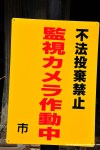
Revisiting the Kasagi Hotel was to round off a day of explorations with two friends from England, Adam and Klara. The sun was already setting when we arrived by car, so we hurried towards the entrance… only to find the barricade completely reconstructed. And that wasn’t all: The thing was plastered with warning signs! Not only did they warn you that the place was secured by cameras now (usually a hoax…), but they also announced that 16 people have been arrested by the police at the Kasagi Hotel on October 10th 2011! And that’s… unusual. You get “No trespassing!” and “Call the police when you see something suspicious!” signs everywhere, but announcements of arrests I had only seen on the internet to keep people from exploring the abandoned German themed park Glucks Kingdom (or Glücks-Königreich, kingdom of fortune, as the name really was…).

Like I said, the sun was already setting anyway, so we just had a quick look from the street along the hotel. I’m sure there would have been ways to get in, but since we were running out of time and cameras / silent alarms were a possibility, we decided not to risk getting caught and called it a day. 16 people arrested… Jeebus, that’s quite a number for such a rundown place! Cute drawing though…

Read Full Post »

“Flash? I don’t use flash! Most photos look ugly when using flash!”
In February of 2010 I had no clue what my dear friend *Enric* was talking about. I had my first DSLR for 3 months and I had no clue about photography either. But when I was using the flash of my D90 in the darker corners of the Kasagi Sightseeing Hotel my now truly missed buddy got really upset. I didn’t think much about it, to be honest. I just picked up urban exploration and photography as a hobby, and I was happy about every decent shot I was able to take. Flash or not…
Who cares? Just let the crazy Spaniard talk! — Gosh, was I ignorant. But I really had no clue what I was doing. Couldn’t have known a good photo from a bad one even if Ansel Adams would have hit me in the face with a picture book! I continued the learning by doing process and half a year later I bought an ultra-wide angle lens and a tripod – and I guess my photos improved massively since then, probably because I barely ever used flash again. But whenever I do, I remember Enric’s words at the Kasagi Tourist Hotel…

I don’t know why it took me more than 3 years to write about the Kasagi Hotel; this is actually one of the oldest unpublished locations I had on my hard-drive – and the other ones are way less interesting! It’s probably because of the name… or its rather convenient location in walking distance of a train station… Guess which one! Although I have to admit “convenient” and “walking distance” is relative. It’s convenient and in walking distance for urban explorers. If you arrived as guests with suitcases you better took a taxi!
Although one of the most popular abandoned places in Japan for many, many years there is not much information floating around about the Kasagi Hotel. It’s widely known as a ghost spot, since rumors have it that the owner committed suicide by arson – half of the Japanese blogs writing about the place admit that they didn’t dare to enter. Or care to find out more about the hotel’s history. So here’s some information I got from reading a dented sign near the entrance and that is nowhere to be found on any Japanese blog: It seems like the Kasagi Hotel was famous for its onsen. The hot spring was fed by a spring 1200 meters below the hotel, rich in sodium and alkali. Staying at the hotel for one night including two meals was 6500 Yen, onsen only was 1000 Yen, onsen and one meal 2000 Yen.
Enric and I didn’t mind those suicide stories to scare away children and walked straight in, past the barricade that once prevented nosy people from entering; but of course it was ripped apart by some vandals by the time of our arrival. We mostly ignored the smaller storage buildings to the right and headed straight for the hotel, squeezing past another barricade made of conjugated iron, a lot more solid, but nevertheless wide open even for foreigners.
The ground floor was a pitiable sight. Half destroyed by arson and littered by bent and rusted iron it offered a sample of the general condition of the Kasagi Hotel. I guess that’s the downside of the hotel’s fame and location: It was vandalized like hardly any place I’ve been to before or after – graffiti, arson and ripped apart walls, floors, ceilings… you name it. Even two staircases were completely ripped apart, although it looked like that was done professionally and with heavy machinery; especially since there was barely any rubble left. The whole floor was dark and gloomy, with holes in the wooden floor spared by the fire. The hotel kitchen also became the victim of flames, underlining the spooky first impression.
A concrete and graffiti stained staircase in the back lead to the upper floors, but the door to the second one was blocked by a huge welded metal plate. Somebody built an improvised metal ladder from 1F to 2F, but I preferred not to climb it – especially since 2F suffered as much damage from vandals as all the other floors. Except for the ground floor and the top floor all the floors looked pretty much the same with different kinds of destructions: On one floor the toilets were completely intact, on other floors you could still see parts of the wallpaper, while on another floor the intact walls gave a good impression how big the rooms really were – the whole building was one big puzzle.

The Kasagi Hotel was one of the first 20 explorations I did and therefore everything was extremely exciting. Looking back years later it was one of the more unspectacular locations I visited; except for the view. The view was fantastic, especially from the terrace on the roof top and from the corner baths, which allowed free sight on the Kizu River ten meters below the ground floor of the hotel.
One word of warning though to all the people planning trips there to have a look themselves: I wouldn’t do it! About a year ago I went there again for a quick revisit. More about that trip later this week or early next week…

(If you don’t want to miss the latest article you can *follow Abandoned Kansai on Twitter* and *like this blog on Facebook* – and of course there is the *video channel on Youtube*…)

Read Full Post »

When Conan was asked “What is best in life?” he answered “To crush your enemies, see them driven before you, and to hear the lamentation of their women.” – I’m pretty sure if the Mongol general would have asked him “What is worst in life?” Conan would have answered “To marry a Japanese woman, see her taking your paycheck, and to hear the lamentation about setting the AC to a ‘freezing’ 28° C in the middle of summer.”

Please forgive this provocative generalization of an introduction, but whenever I stumble across an abandoned love hotel I can’t help but be reminded of how different Japan is in so many ways to my home country Germany. Especially in the relationship department. What I wrote so far and will write in the lines to come is not an analysis of the Japanese society or even just its love life – I’m just describing what I see and hear as an expat living in Japan, which is quite different from the things one sees and hears as a tourist visiting Japan. After six years in Japan I tend to compare this country to a big amusement park – it’s shiny, it’s tidy, it’s expensive and everybody seems to be nice. But visiting an amusement park and working in an amusement park are two completely different things…

Last time I visited an abandoned love Hotel (*Love Hotel Gion*) I wrote about the love hotel industry in Japan in general – this time I will rant a little bit about relationships in Japan. Back home in Germany, when you talk about your girlfriend or wife, you are usually in the range of being honest to being more positive than it actually is; unless you have a beer with your best buddy, then it might turn into a bitchfest. Not so in Japan! The vast majority of people married to a Japanese woman, no matter if they are foreigners or Japanese, bitch openly about their significant others to everybody – constantly! For every happily married couple I can name two or three where the guy calls his wife “The Dictator” or at least doesn’t feel that it is a waste of time to feed his new-born kid after being pressured into having children… It’s depressing sometimes. (Maybe I should add that I never did any of the above and find Japanese women rather sweet and caring… but I was never married to one.)
While pretty much every woman’s biological clock starts to tick at a certain age that certain age is definitely lower in Japan. The big 3-0 seems to be the current number where cute, open-minded girls turn into little monsters obsessed with marriage – if you meet a woman past 35 you better look for rings right away and get prepared to father a child or two. But that actually is progress in comparison to a derogatory term popular for decades in Japan: Leftover Christmas Cake. Leftover Christmas Cake was a not so flattering way to call an unmarried Japanese woman over the age 25. In Japan Christmas is kind of an additional Valentine’s Day you spend with your significant other eating a beautiful, but extremely overpriced cake – and Leftover Christmas Cake is something nobody wants… Since the ticking deadline is now 30 instead of 25 the term isn’t as popular anymore and you can always see the surprise or even shock on a Japanese person’s face when you mention it.

But even if you get married before the age of 30 it seems like people just follow set behaviors, no matter if they make sense or not; like hardly anybody goes swimming in the ocean after September 1st because according to Japanese definition it’s autumn now – it doesn’t matter that it’s still 32° C outside, you don’t go swimming in autumn since it’s a summer thing to do. And it’s the same with married Japanese women. They quit their jobs, they dress differently, they behave differently. Again: Not all of them, but a lot. A couple of years ago a Japanese friend of mine, a cute girl in her mid 20s, wrote me something along these lines: “I know it’s a horrible thing to say, but I don’t want to work anymore. Maybe I should get married…” – I’m not making this up! In Japan the women have control over the money. No matter how much the husband makes or how high he is on the career ladder: The woman gets the paycheck and the husband gets some pocket money. And if he needs more he has to ask his wife – if he’s lucky enough to have access to a bank account he better remembers when and why he used the ATM, because it’s highly likely that he will have the justify the use of that card. One of the reasons guys married to Japanese women tend to bitch about their wives…

Wives that they sometimes barely know. While arranged marriages are not common in Japan it is not exactly unusual that parents introduce their daughters to suitable candidates – especially when their daughters have passed the devilish age of 30. Traditionally men and women are not platonic friends with each other – and if a couple isn’t working at the same company it’s not really rare that they see each other only once or twice a week, because they are both super busy at work; especially the guys. And that’s another big difference to what I’m used to – unless you are having a long distance relationship you see (and get to know) your significant other on 5, 6, 7 days a week where I come from; way more often than in Japan. With the result that a lot of men (including foreigners) are marrying Japanese women they don’t know nearly as much about as if they would have been in a relationship with a woman in a western country for the same amount of time. On the other hand that fact makes it easier to stay at work till 9, 10 or 11 p.m. every night… Who wants to go home to a wife and kids they barely know…?
For a lot of Japanese men it almost seems to be a hassle to have a relationship after all – the so-called Herbivore Men (草食(系)男子, sōshoku(-kei) danshi) are described as having an “indifferent attitude towards desire of flesh”. Whenever you think you’ve heard it all…

Don’t get me wrong, I’m sure there are many, many, many happy (happy!) marriages in Japan, but when I listen to co-workers and friends hardly anybody seems to be really happy in their marriage – and a lot of them cheat on their wives.

And that finally brings us to the exploration of the Furuichi Love Hotel in Hyogo prefecture – an original find I’ve never seen anywhere else before, including Japanese haikyo blogs! Like the *Love Hotel Gion* the Furuichi Love Hotel was more like a motel. You drove into a garage (this one even had closable doors!) and entered a small apartment from there – on the right side was a Japanese style toilet, on the left side a bathroom, straight ahead the fun room with the king size bed and all the other extras. Like the Love Hotel Gion the Furuichi Love Hotel was in pretty bad shape. Most garages were locked and the dozen rooms were accessible via a two small hallways in abysmal state – some vandals used a pickaxe for some remodeling. They did surprisingly little damage to most of the rooms, so I was able to take photos in three of them. Sadly the light from the hallway wasn’t enough to see anything there, so I had to use my flashlight again to bring some light to those abandoned love caves.

The rest of the area was in a state of destruction, too. Right at the entrance was a small house for the manager of the hotel, the interior covered by some smelly pink powder – most likely somebody emptied a fire extinguisher there. The backyard was turned into a junkyard, but if you are looking for a Japanese style toilet you might find an undamaged one there. Glass shards and pieces of porcelain were all over the place, but what really caught my eyes was a sex toy with a cable remote hanging in one of the trees – Merry XXX-Mas everybody!

(If you don’t want to miss the latest article you can *follow Abandoned Kansai on Twitter* and *like this blog on Facebook* – and of course there is the *video channel on Youtube*…)

Read Full Post »

The Restaurant Kent, on Japanese haikyo blogs mostly known as the Good Omen Garden, is one of the staples of urban exploration in Japan. Located on quite a long country road connecting Osaka with Miyazu (home of the famous sandbar Amanohashidate, one of Japan’s three scenic views) the Restaurant Kent was one of the most popular local haikyo when I started doing urban exploration three years ago. Nowadays it lost quite a bit of its popularity, probably because it was photographed to death over the years – or maybe because there are a couple of signs announcing camera surveillance… which I totally respect if it’s true.
In this case the claim was complete bullshit, which annoys the heck out of me as it just cost me time and nerves. The signs looked rather new, so maybe they were put up before the local city administration set up the cameras (government involvement, even on the lowest level, is always a bad thing since it usually means serious business – private companies might hire some slackers, but you don’t want to mess with bureaucrats, especially in a country like Japan…), but when I visited the Restaurant Kent in March of 2011 there were no cameras or other forms of security; a topic I usually leave out, but if somebody lies to me blatantly I have to set the record straight!

Sadly there is not much else to report about the Restaurant Kent, since nobody seems to know a lot of facts about the place. I don’t even know if it was named after the county of Kent in South East England – or after the hugely popular cigarette brand “Kent”, which famously used carcinogenic blue asbestos in their filters from 1952 till 1956 (I guess at least British American Tobacco made cigarettes healthier after all…). The restaurant area itself seemed to be quite small, but neat. Previous explorers set up some tableware in front of a chair with armrests, but other than that there was not much to see.
The Good Omen Garden seemed to be much bigger – one of those festivity locations Japan so desperately needs when you want to be loud and / or with some friends. My buddy Dan and I found several party rooms of various sizes (Western Style and Japanese style, i.e. either carpet floor and tables or tatami floor and furniture that is long gone now…) equipped with all kinds of electronics including laser disc karaoke machines, beamers, microphones (not for karaoke as they were installed to the ceiling…) and mountings for camera and / or additional lighting. One room even featured a disco ball, although it was quite severely damaged – and so was the fake wedding cake one floor down outside. At the first look the Good Omen Garden didn’t seem that big, but then it turned out that there was a second building behind the first one, connected by a kitchen on the upper floor. There were more rooms, including some guest rooms for overnight stays and the usual array of baths for men and women.
My favorite item though wasn’t in the building, it was outside in the backyard – a wooden electronic organ, beyond repair thanks to years of abuse from vandals and weather; nevertheless an unusual and strangely beautiful sight.

Since the Kent Restaurant / Good Omen Garden was along a busy road, but not within a city, town or even village, there were almost always cars parked outside. But nobody had the intention to bother us, I guess the camera warning signs outside worked. When Dan and I were about to leave though, a pickup-truck with a small crane parked next to the building. We “escaped” through the front entrance while two or three men entered the building through the restaurant. On official order or to loot? We’ll never find out. Dan and I were kind of in a hurry anyway, since on the way to the Kent Restaurant we spotted a location I’ve never seen anywhere else before. But that’s a story for another time. Probably Christmas time…

(If you don’t want to miss the latest article you can *follow Abandoned Kansai on Twitter* and *like this blog on Facebook* – and of course there is the *video channel on Youtube*…)

Read Full Post »

Momijigari (紅葉狩, red leaves / maple leaves hunting) is almost as popular in Japan as the worldwide way more famous hanami (花見, flower viewing). In spring even the biggest couch potato leaves the house to view first the plum and then the cherry blossoms, in autumn they go to different spots to have a look at the autumn leaves. Of course every bigger city has special spots for both, but some countryside towns are pretty much dead for 50 weeks a year and completely swamped on two or three weekends. In Kansai prime examples would be Yoshino (hanami) and Minoh (momijigari). Why? Because those two spots are considered the best – or at least amongst the best. Surprisingly many Japanese people pursue the best of everything – the best food, the best company as an employer, the best spots to view nature. Or at least they pursue what the majority considers the best. With the result that some food is insanely expensive, employers with famous names exploit their employees (because they can!) and the best spots to view nature are so overrun that it’s not really fun anymore going there – you stand in crowded trains for hours just to be pushed past gorgeous trees and through crowded streets with souvenir shops.
So while half of Kansai “enjoyed” autumn leaves in Minoh and Kyoto (just to put up photos on Mixi and Facebook to let everybody know where they went for momijigari…) I made my way to the Hyogo countryside in late November of 2011. My goal was to climb a small mountain with an abandoned temple on top. 15 months prior I was able to explore an abandoned shrine (*you can your all about it here*), so I guess it was only natural to follow an abandoned Shinto site with an abandoned Buddhist site. (I know that there are plenty of abandoned churches – but how about mosques? Has anybody ever heard of an abandoned mosque?)

The Shuuhen Temple popped up on two or three Japanese haikyo blogs before, but it was surprisingly hard to locate. Even more surprisingly since the place is still marked on GoogleMaps, and when you are rather close you can find guide signs – which left me rather puzzled for a couple of minutes about how abandoned the place really was. I guess now it’s more abandoned than ever, because in September of 2011 the street up the mountain was closed. Halfway up the mountain a landslide flushed away the small asphalt road on a length of about 5 or 6 meters – even tiny cars could barely pass here anymore safely.
When I reached the mountain top I must have been one of the happiest people in all of Kansai: A stunning view, gorgeous autumn leaves and a temple all for myself. Sure, I couldn’t tweet “I’m in Arashiyama! (Be jealous!)”, but I wasn’t bothered by souvenir shops and crowded locations. Quite the opposite. When I was walking around I had to be careful not to run into one of many one square-meter large spider webs with a nasty middle finger long black and yellow spider in it. The abandoned temple itself was rather unspectacular. All buildings were closed, in rather good condition, and I didn’t even have a closer look if there was a way to open them. I’m not very religious myself, but I respect the beliefs of others and try to be respectful. (Which doesn’t keep me from making fun of them if it’s getting too ridiculous – you know, thetans, magic underwear and stuff like that…)

Open and rather interesting was the house of the monk that lived near the Shuuhen Temple. It’s hard to tell when it was abandoned. Some buildings in Japan fade away in no time, others withstand the ravages of time as if they couldn’t care less. It looked like it was built in the 60s or 70s, given the black and white photos of the bell and the belle; judging by the wiring maybe even earlier. The decay there was clearly natural, because thanks to the temple’s location the average bored youth vandal spares the place. Strangely enough the digital display of the power meter still worked…

The temple itself seems to have quite a long history. According to the homepage of the city it is located in, the Shuuhen Temple dated back to Emperor Kotoku’s days (596 – 654) and was first built in 651. In 1578 it was burnt to the ground and stayed a ruin for more than a century until 1682, when it was revived again. Not much information, but way more than one could get for most other temples and shrines in Japan… Now it is famous not so much amongst urban explorers, but more amongst Japanese fans of ghost spots (心霊スポット). I guess it makes sense to look for paranormal activity where people traditionally believe(d) in spirits.

Exploring the Shuuhen Temple was one of those nice, mellow urbex experiences. Sleeping in, taking some local trains, a nice and sunny autumn day, some hiking, some solitude, cold temperatures, but warm sun, beautiful countryside. A relaxed Japanese Indian Summer day…

(*Like Abandoned Kansai on Facebook* if you don’t want to miss the latest articles and exclusive content – and subscribe to the *video channel on Youtube* to receive a message right after a new video is online…)

Read Full Post »

« Newer Posts - Older Posts »