Feeds:
Posts
Comments

Archive for the ‘Restaurant’ Category

Why staying at Kyongsong? Because if the town was good enough for Kim Il-sung, his wife and his son, it is damn good enough for any western tourist! And of course there were more things to see, like the house the most famous Kims stayed at while giving guidance on location, now part of the Kyongsong Revolutionary Museum. There we listened to some “fascinating” stories about the Kim family, for example about how Kim Jong-il was really smart at a very young age. When he asked his mother Kim Jong-suk why most animals drink with the help of their tongues, but not chickens, his mother told him to observe the feathered fellas and come to a conclusion by himself. So he watched the chickens for seven days straight and then told his mom the correct answer at age 5!

Just out of town we visited the Jipsam Revolutionary Site, where three generals met during the Japanese occupation to defeat the invaders. Luckily our guides kept the story short; either because they were still hung over or because they slightly panicked when they saw planes practicing starting and landing at the nearby Kyongsong-Chuul Airport a.k.a. Kyongsong-Chuul Military Airfield. We got permission to take photos freely, except of the airplanes. Which was kind of hard to do, because the machines were coming down every other minute right over the scenic fishermen’s village. Luckily the planes were so tiny in the distance that nobody really cared – yet Mr. Li yelled another “No take photos!” at me when I took one of a boat on the shore. So we were allowed to take photos of everything – except for the unmentioned things they didn’t want us to take photos of. Sometimes I really had the impression that our guideguards had no clue what they were doing… So I paid even more attention to keep out of their sight without losing contact completely, because nothing is worse than an unaccounted tourist! And by chance it happened that I “accidentally” caught some of the planes on video when filming the coastline. I have no idea what kind of planes were starting and landing there, but the whole thing felt like a WW2 airshow. If that was a representative example of the DPRK’s airforce, those poor pilots better stay on the ground and hide somewhere in case of another war!

Next on the itinerary was a stop at a kindergarten in Chongjin – and we all know what that means, right? Singing and dancing children! Yay!
Luckily this kindergarten had so much more to offer, involuntarily!
For example the playground in the yard. Sure, it was a bit rundown, but it had a new layer of paint recently. And the rides were awesome, amongst them a rough merry-go-round with rockets and even a small Ferris wheel. I think children all over the world would have loved those playground attractions. The problem was: I am sure none of them had been used in the past couple of months, since branches of nearby trees blocked their movement! At first I was like “Hey, cool, those are awesome!” before the “Wait a minute…” moment kicked in. Kind of sad to maintain those rides and then make no use of them.
But that’s not all, because we also got a tour of the building. Well, part of the building. We witnessed an art class, saw the room for the kids’ afternoon nap, even had a look at the indoctrination rooms where the little ones were taught about the lives of Kim Il-sung and Kim Jong-il. The hallways and staircases were decorated with Hello Kitty and nature motifs (like a partly sculptured tree), all beautifully executed. The children’s performance was on the third floor, so when we went from the first to the third through a staircase, we were kind of rushed as the kids were waiting. Nevertheless I was able to walk down a hallway on the second floor for a few of meters, where I took a picture of a painting I am sure we were not supposed to see. It showed some armed children attacking a couple of snowmen. Even without being able to read what was written on them I knew that I struck gold – later I found out that the snowmen were labelled “American Bastard” and “Jui Myung Bak”, a play on words meaning “rat-like Lee Myung Bak”; Lee being the 10th President of South Korea. Lovely, just lovely!
But to be honest with you, it’s actually this kind of photos I was hoping for before the tour started – you can see quite a few pictures of Chongjin and Mount Chilbo on the internet; little gems like the snowman propaganda painting I’ve never seen anywhere before. At the same time experiences like that are the main reason why this series of articles is so much more negative than the first one – they make it so much harder to believe the show you get presented in Pyongyang. Everything in North Korea is full of contradictions all the time!

Well, lunch was at the Chongjin Seamen’s Club and I mainly mention it for the “hot se(a)men” jokes somebody has to make sooner or later; and now let us continue to pretend that the fourth season of Arrested Development doesn’t exist. The Seamen‘s Club is actually one of the few places in North Korea where foreigners and locals can mingle, though it seems like in the end everybody sticks with their own kind – and of course we were seated in a separate room, though we were allowed to roam the gated area freely. It was there that I bought my first souvenir of the trip, a hardcover copy of Kim Jong-il’s “On the Art of cinema” for 2 EUR! I almost felt bad getting it for that price, but in the end it probably was a good deal for both sides; and one of the few things I was able to buy overall. (More on prices and overpricing in the article about Day 7!)

After lunch we headed north to Rason. Since there is no freedom to travel in North Korea, not even within North Korea, we had to cross an internal border and needed two different “visa” for North Hamgyong and Rason – and also two different sets of guardguides, since Mr. Li, Mr. So and Mr. Sin were not allowed in Rason unless they had special permission. (And none of us were allowed in Pyongyang! If we would have hurt ourselves seriously, they most likely would have taken us to China, not to the capital – because we didn’t have proper documents to enter…) About half an hour away from the internal border the unavoidable happened – our bus broke down with a flat tire in the middle of nowhere and it took about an hour to fix it. Luckily we had a spare on board, so we left the forest just before the sun went down. Interestingly enough there were many locals strolling through the forest – probably the cause of the omnipresent plastic waste. Seriously, this was one of the dirtiest sections of forest I’ve ever been to! A real surprise, given that it was plastic trash and North Korea. Who knew they even had plastic there?! 😉

Finally arriving at the Rason border, Mr. Kim and his team took over (not the driver of the North Hamgyong bus, another one…) – and he turned out to be a jokester. First he apologized for the bad quality of the road, but hoped that we would enjoy the free massage for the next 10 minutes. When we asked him to turn off the internal lights of the bus, so we could have a better look outside (it was dark by then), Mr. Kim told us that one of the advantages of the DPRK (and the huge number of blackouts) was the fact that there was no light pollution in North Korea. Damn, if I ever do a comedy routine about NK I’ll definitely steal those two jokes!

Exactly 10 minutes later we left the bumpy dirt road and reached a normal one – and soon later we passed Rason Harbor on our way to the city center of Rajin. (Rason is a Special Economic Zone consisting of the cities Rajin and Sonbong – here the DPRK experiments with capitalism in cooperation with its ex-communist buddies China and Russia, plus a few others.) And by “normal” I mean that the road was not only smooth, it had street lamps! Light. In the darkness. 13 adult travelers excited like little kids. It’s interesting how fast you forget that you miss certain things you are used to – and how equally easily excited you can be to get them back. We all take electricity for granted and it’s truly amazing how much of it industrialized countries waste. While North Hamgyong is clearly lacking supply, Rason uses it reasonably; Yanji wastes quite a bit and Osaka… I’m sure Osaka uses more electricity than all of North Korea – and given that pretty much every apartment building and busy neighborhood is lit up like a Christmas tree, Osaka probably wastes more electricity than North Korea uses; which is amazing given the constant talk about being green and how the electricity price exploded in Japan after Fukushima!
After dinner at a well-lit (!) restaurant (in the same building as the local travel agency), we were supposed to check into our hotel just down the street, the Namsan Hotel – but Mr. Kim had a surprise for us: Instead of staying at the slightly run-down accommodation in Rajin’s city center, we drove up a mountain between Rajin and Sonbong to the newly built Pipha Hotel with a stunning view at the city’s (in)famous Emperor Hotel and the beautiful Changjin Bay. Upon arrival we found out that we were the first guests there – EVER. (And probably the last, as itineraries for future Northeastern Adventures still mention the Namsan Hotel…)
The Pipha Hotel turned out to be a slightly weird… installation. First of all, the hotel didn’t have a reception; it looked more or less like an annex building. We entered via an external staircase on the second floor, basically through a tiny lobby with a couple of seats in a hallway. There was a first floor / ground floor, but we never went there. As Mr. Kim said, the building was brand-new, so it was by far the most modern and overall best hotel I stayed at in North Korea across both trips. Hot water, running water and a (not working) AC, which was compensated by heating blankets. The first shower in three days felt wonderful! At the same time the Pipha Hotel showed how little experience North Korea still has with tourists. For example:
The bathroom had some toiletries, but those were sealed shut. While it’s worldwide standard that little packages of shampoo have a small cut so you can open them easily, the ones we were provided with had to be opened with a pair of scissors.
The room itself was quite nice, but when the architect planned the hotel, it seems like he didn’t think along… and put the main light switch of each room in the hallway instead of inside the room right next to the door. As a result it was impossible to switch the light on / off from within the room.

None of it affected our happiness about hot running water or the overall experience, those are just two more examples of things that we take for granted and that stand out when they are not the way we are used to. And despite looking strangely familiar, it turned out that Rason was full of things that were not the way we are used to…

(Please *click here to get to Abandoned Kansai’s North Korea Special* and *here for a map about the tour at GoogleMaps**Like Abandoned Kansai on Facebook* if you don’t want to miss the latest articles and exclusive content – and subscribe to the *video channel on Youtube* to receive a message right after a new video is online…)

Read Full Post »

Tottori is famous for its sand dunes, vast natural parks and pear omiyage – not for urban exploration. Located in the Chugoku region at the Sea of Japan (a.k.a. Korea East Sea and Japanese Sea) and therefore at the northern coast of Japan, Tottori is a little bit off the beaten tracks – most tourists travelling south of Tokyo continue via Kyoto, Osaka and Kobe to Himeji, Hiroshima and Kyushu along the Seto Inland Sea. Only a handful of Western tourists switch to one of the express trains from Kansai to Tottori (city), the capital of Tottori (prefecture) – there is no Shinkansen service as a northern line connecting Osaka and Shimonoseki via Tottori and Matsue was proposed in 1973 and then shelved indefinitely. The least populous of Japan’s prefectures (3.5 million inhabitants, less than the city Yokohama) is generally rather rural and agriculture is the most important economical factor – pears, scallions, yams and watermelons from Tottori are famous in all of Japan.

One thing Tottori is not famous for is urban exploration. Nevertheless I had plans to go to Tottori for almost a year, but for some reason I never followed through. The places I wanted to visit there were not that spectacular, the weather wasn’t consistent for a whole weekend, the season wasn’t right or I simply had other plans. In spring of 2012 everything came together finally, so I hopped on the first of eight special direct trains to Tottori and enjoyed the 2.5 hour long ride through the stunning Chugoku Mountains. After finding and checking into a hotel I did some haikyo hiking to another location and finally arrived at the gorgeous Tottori Sand Dunes in the late afternoon – running out of time, as so often.
The Sand Dune Palace turned out to be quite a rundown building secured by rusty barbed wire, only worth taking pictures of thanks to its relative fame and the round viewing platform which gave this old rest house (built in 1965) a little bit of an edge by making it more round… The salty sea air was gnawing through anything metal, especially lamp posts and handrails. All the bells and whistles, like door handles and lamps looked so 60s that it almost hurt the eyes. Really nothing special, so I headed over to the dunes to find my way to the beach in order to take some sunset photos. On the way back, late into dusk, I made another quick stop to take a couple of night shots, but then I had to leave to catch the last bus back to the city – it was an exhausting day and sadly not everything lived up to my expectations; for example the Sand Dune Palace – the pear sweets on the other hand were divine and if you ever go to Tottori, make sure to try the “nashi usagi” (literally “pear rabbits”, mochi filled with pear jam).

(If you don’t want to miss the latest articles and exclusive content you can *like Abandoned Kansai on Facebook* – or subscribe to the *video channel on Youtube* to receive a message right after a new video is online…)

Read Full Post »

The food during my trip to North Korea is a topic I didn’t want to touch with a 10 foot pole, because as we all know the DPRK is a terribly poor country and it was struck by famine for several years in the 1990s. But I know that a lot of you are very much interested in what visitors to North Korea eat… and where… and when…

Since trips to North Korea are group tours pretty much everything is included in a total price. We always had breakfast at the respective hotels we stayed at – buffet at the *Yanggakdo Hotel*, set menu at the Dragon River Hot Spa Hotel in Nampo and the Minsok Hotel in Kaesong. Lunch usually was at restaurants run by KITC (which means that usually we didn’t eat with locals), dinner was either at the hotels or at restaurants. Lunch and dinner included water and one beer per person, additional alcohol was available at a ridiculously low price – I think 50 cents per bottle.
The Korean guides usually had their own table, not because they got different food, but because it was a chance for them to get away from the group and be amongst themselves. Tour guides work long hours, so they definitely deserved it!

Breakfast at the Yanggakdo Hotel was pretty good – usually some bread / buns, sweet doughy things (like donuts), pickles, kimchi, fried eggs, stewed meat (chicken, pork), battered fried fish, fried potatoes and veggies. Simple, but delicious. (Breakfast at the other two hotels was a lot more simple, which is understandable since they had a lot less customers…)

Lunch was always amazing! Usually we sat on a long table were groups of four people shared about 8 to 10 dishes. Kimchi, fried eggs, stewed meat, broiled / fried fish, sweet and sour tofu – similar to the breakfast, but way better quality. Again: simple, but extremely delicious. Since there are a lot of Koreans living in Japan I had all kinds of kimchi before, hot and cold, and I never was a big fan of it – but the kimchi we had at the KITC restaurant in Pyongyang was amazing, the best kimchi I ever had!
One day we were able to choose one of the main dishes, either bibimbap or naengmyeon. Bibimbap is one of the most famous Korean dishes (mixed rice, including vegetables, meats, eggs and several spices) and since I had it before I went with naengmyeon, cold noodles in a broth Pyongyang is famous for. Living in Japan I am very familiar with soba and udon (two Japanese kinds of noodles than can be eaten hot or cold) and so I was very curious about naengmyeon – and the guides were quite interested in my opinion. To be honest with you, if prefer udon over soba over naengmyeon at any day, but for the sake of understanding among nations I called it a draw – actually making our guide more interested in Japanese food. (I brought some sweets and shared them during the trip with fellow travelers, guides and locals.)
Another lunch highlight was the lamb BBQ in a Pyongyang park. Of course we had our own tables, but local groups were having picnics at identical tables, too, so it wasn’t completely out of the ordinary what we did there. Sunny day, great food, locals – a nice break from “foreigners looking at things”…
The lunch our guides were most proud of was pansanggi we had in Kaesong. Pansanggi consists of about a dozen small brass bowls filled with… well… vegetables, fried fish, pickles, tofu, meat, … It originated among Korean royalty, who realized that variety is the spice of life and rather had small portions of many dishes than big portions of a single dish. And since they had the resources to afford it… The preparation was amazing, for example this was some of the best tofu I ever ate – and of course the presentation added to the experience, too.

Dinner usually was kimchi, fried eggs, stewed meat, pickles, broiled / fried fish, tofu… lots of variations, so hardly any of us got sick of it over the course of the eight days we spent in the DPRK; but it was all Korean food, so people used to not only eating a different dish, but a different cuisine every day might have a tough time in North Korea. One evening we had the opportunity to visit Pyongyang’s only pizza restaurant with authentic Italian equipment and staff trained on location, but I bowed out and had dinner at the Yanggakdo Hotel. When in Rome, do as the Romans do… and eat pizza – but when in Pyongyang I prefer to have Korean food!
In Nampo we had a local specialty before the dinner – the petrol clam BBQ. And yes, it’s exactly what it sounds like. You arrange dozens of claims on a flat stone, soak them with two 500ml plastic bottles of petrol and light them on fire! Since the Nampo clams don’t open up when cooked that way, most of the gasoline actually burns into thin air. Nevertheless about 1 in 4 clams taste of petrol according to our guide Sarah. (I’ve tried only one since I had a weak stomach that day – more about that later…) But since “better safe than sorry” is valid all over the world our guides treated us with two bottles of soju (sweetened rice liquor) and two bottles of Pyongyang Vodka (beyond 50% alcoholic content…). I was tempted to ask for a bottle of Victory Gin, but I bit my tongue last second. 🙂
By the way – the standard farewell meal on the last night is at a duck restaurant in Pyongyang. When we went there the place was packed (with foreigners…) and the food was amazing! Four plates of meat, two plates of veggies and a grill in the middle. Heaven!

What else is there to say?
Oh, pretty much every meal came with a soup and rice – and the rice was usually one of the last dishes. Why? Because our hosts didn’t want us to give the impression that they would fill us with rice so they wouldn’t have to give us much meat, eggs and vegetables. A sweet gesture, but I don’t think anybody would have complained to get the rice along with the meats and vegetables; but I’ve heard it’s custom in other countries, too, for example at Chinese weddings.
If you want to visit North Korea, but you can’t stand the idea of eating fish, meat and shellfish with every meal there is good news: a vegetarian option is available, but no kosher or halal one.

And that’s it for food in North Korea… for now. (*But don’t miss the article about Korean Dog Soup!*)

(Please *click here to get to Abandoned Kansai’s North Korea Special* and *here for a map about the tour at GoogleMaps*. If you don’t want to miss the latest article you can *follow Abandoned Kansai on Twitter* and *like this blog on Facebook* – and of course there is the *video channel on Youtube*…)

Read Full Post »

One thing Japan is famous for all over the world is its bathing culture – which is hard to believe if you ever had to spend some time on a rush hour train…

While surprisingly little of Japan’s vast coastline is used for swimming (due to pollution, rocky shores or cement tetrapods) there are three different main terms to describe Japanese baths:
furo (風呂): usually the polite form “ofuro” is used for this traditional wooden bathtub
onsen (温泉): hot spring, sometimes translated as spa, especially when part of a hotel, ryokan (Japanese inn) or minshuku (Japanese bed and breakfast)
sento (銭湯): communal bath house – onsen and ofuro can be part of a sento

The use of those three terms can be confusing at times. While (o)furo technically describes a bathtub (traditional ones made of wood, modern ones made of plastic) with steep sides of about 60 cm height used for a relaxing soak at 38°C to 42°C after (!) you cleaned yourself, it can also be used for the public bath at a gym – although those baths fit more what is describes by the term sento.
A sento is a communal bath with a locker room and a bathing area – gender separated! You get undressed and lock your clothes before you enter the tiles bathing area with a hand towel. Near the entrance you usually find small stools, buckets and faucets. There you sit down and clean yourself before you enter the bathtub, which can be tiled or wooden – and therefore resemble ofuro. (To see what not to do, watch the movie Mr. Baseball…) Modern sento also include small saunas similar to the ones you know from your home country.
Onsen are hot springs and the most famous part of the Japanese bathing culture. Indoor onsen look much like sento and their number is quite low – the vast majority and well-known to everybody even slightly interested in Japan are outdoor onsen, also known as roten-buro (露天風呂). The behavioral code at an onsen is pretty identical to the one at a sento – the main difference is that onsen are fed by natural hot springs, not by heated tap water; and that they are usually more luxurious and beautiful – dozens of countryside towns all over Japan are famous for their onsen resorts and a lot of places to stay charge several hundred bucks per person and night (including breakfast and dinner).

Personally I am not a big fan of ofuro, sento and onsen – mainly because the water is just way too hot for my taste. I’m sweating enough as it is in Japan thanks to the rather high humidity here. I really don’t need to soak myself in water that is higher than my body temperature. The other reason, to be honest with you, is the fact that you stick out there as a foreigner – and I am really tired of being stared at. It’s bad enough at the subway sometimes, even in a city like Osaka. Imagine you being the only foreigner in a countryside bath then… If I’d be the last man on earth and would show up in my birthday suit at the “World Congress of Nudist Nymphomaniacs” near a naturist beach of your choice – I couldn’t earn more stares that way! I get it, most Japanese men don’t have the opportunity to see a naked foreigner and they have an urge to find out if the cliché is true and everything is smaller in Japan, but come on! It’s really impolite…
(Fun fact: Most Japanese people don’t know that public bathes in Japan were mixed until the Meiji era (1868-1912) when the nation started to open to the west. Germany, especially the eastern part, has a long naturist tradition and when I tell Japanese friends that we have mixed nudist beaches and bathes in Germany they are totally shocked and claim that they would never go there since people must stare at each other all the time, which isn’t the case at all. Fact of the matter is that I get way more stares fully clothed on a train in Japan than naked at a beach in Germany…)

 Exploration

The Meihan Health Land technically was an onsen since it was fed by a natural hot spring, but it lacked most of the idyllic countryside aesthetics that come to mind when hearing the term – it looked more like a western spa trying to copy some Japanese flair. Located right next to one of the few free of charge highways in Japan and at least 30 minutes away by foot from the next train station it was clearly targeting the masses – families and busses full of tourists; a gigantic parking lot of more than 20.000 square meters supports that claim. The building itself, constructed in 1987 during the Japanese asset price bubble, was about 5.700 square meters big – it seems like it was the first “super sento” in Japan (or at least one of the first) and quite a lot followed. The Health Land closed 2 decades later with a renewal open planned for July of 2008 or 2009, but now it is on sale for 430 million Yen (currently about 3.5 million Euros / 4.6 million Dollars) – a sum it might have been worth right after it was closed, but a mere 2 years later, during my visit in November of 2011, it was already in abysmal condition.
The regular entrance fee for adults was 1300 Yen with an additional surcharge of 1050 Yen for guests staying overnight – yes, the Health Land was a 24/7 facility, offering loungers for tired guests. And of course the usual services like restaurants, shops, karaoke, …
Located in the mountains of Mie prefecture the running expenses must have been insanely high (considering that there is much isolation, but hardly any insulation in Japan…) and I am not surprised at all that the Health Land went bankrupt. I am surprised though how fast it fell into disrepair. The few photos I saw before exploring the place myself made me expect a super sento in good condition. What I found when I arrived with my buddy Hamish was a shock. From the outside the building still looked amazing, easy to see from far away thanks to two gigantic Chinese dragons on the top of the roof. The huge red lantern in front of the Health Land had seen better days, but the full amount of damage the place had suffered was only visible after entering.
The yakiniku (grilled meat) restaurant in the same building was smashed to pieces and so was the lobby of the former spa. There the ceiling was high, maybe 5 or 6 meters – nevertheless it looked like it saw an outburst of violence with damage far beyond anything natural decay could do within a year or two. I have no idea what happened there. Some of the damage, especially the water on both 1F and 2F, could have been explained by the holes in the roof – but how did those holes get into the roof in the first place? The place really looked like as if a supernatural force ripped it apart…
Next to the lobby we found a snack bar and deeper into the darkness of the building was a staircase to 2F as well as the separated bathing areas for men and women, both severely vandalized. The steam room of the men’s area featured some neat female nude drawings – drawings that attracted some homeless people, or at least one person. We found some belongings there, including a newspaper barely 2 weeks old..
Sadly the whole area, for both men and women, was smashed beyond recognition. Windows were kicked in, mirrors were broken, metal installations were ripped apart. Carpets and wallpapers were moldy and water was dripping everywhere.
The upper floor was in even worse condition. The restaurant area was only recognizable due to some signs, the former party room with a stage looked like it was vandalized and abandoned a decade ago. Pretty much all interior was either gone or smashed. Water and mold everywhere. Not really a pleasant exploration, but you never know in advance what you’ll find…
Like that taxidermy bull in some kind of concrete storage underneath the Health Land. We were already ready to leave when we found that half-overgrown door that lead into the building again… and there it was, a stuffed bull, covered by what looked from the distance like an Ostfriesennerz (“East Frisian Mink”, a yellow hooded heavy-duty medium-length PVC rain coat – and you thought German terms were long!). Of course it wasn’t the famous German clothing item, just a simple tarp. Nevertheless a neat find that put smiles on our faces, before we walked to the next train station; wondering how the Health Land could get into that kind of state so quickly.

(If you don’t want to miss the latest article you can *follow Abandoned Kansai on Twitter* and *like this blog on Facebook* – and of course there is the *video channel on Youtube*…)

Read Full Post »

Japan is a linguistically and culturally extremely homogenous country. Of its 127 million inhabitants about 98.5% are ethnic Japanese, 0.5% are Korean and 0.4 are Chinese – leaving a whopping 0.6% others; including yours truly. Those 0.6% “others” include about 210.000 Filipinos, mostly of Japanese descent, and 210.000 Brazilians, also mostly of Japanese descent – which means that only about 0.3% of Japan’s population are neither Japanese, Chinese, Korean, Filipino-Japanese nor Brazilian-Japanese.
I’m sure you’ve heard the term gaijin before (外 gai = outside, 人 jin = person), a short version of the term gaikokujin (外国gaikoku = foreign country, 人 jin = person). People are still arguing if it’s pejorative term, but personally I don’t like it very much, because it’s such a simple term, pushing everybody who is not Japanese to the outside – which is a precarious thing in a country where a group is still so much more important than an individual.

Integration?

Becoming a foreigner in Japan is actually an achievement by itself. Japan isn’t eager to let many people in and therefore the requirements to get a long-term visa are rather high – usually you have to have either a Bachelor’s degree or several years of work experience; in both cases an employer has to vouch for you. Other possibilities are investor visas or some kind of artist visa, but there quite a bit of cash is involved; and so is with the spousal visa… 😉
Once in the country the Japanese government couldn’t care less about you as long as you renew your visa when it expires and pay your taxes – and those are usually handled by the company you work for anyway. While there are long and public discussions about integration in European countries there is zip in Japan. Language classes and tests? Bah, humbug! On the other hand you shouldn’t expect anybody to be able to speak English anywhere, despite the huge English school industry in Japan; especially at the immigration office, where you can address the staff in English as much as you want – they’ll always reply in Japanese, even though most of the time they obviously understood what you’ve said…
But Japan in general isn’t set up for integration, probably because of the educational system. You have your childhood friends, you have your high school friends, you have your university friends and you have your work friends – usually four different groups that keep you busy for the rest of your life; with no need to make additional friends at any point; or many opportunities for that matter, like community colleges or sports clubs, both extremely popular in Germany, especially after moving to a new area. (With the result that many foreigners in Japan stick with each other, too – I don’t think I know any foreigner here who has more Japanese than foreign friends; and by that I mean friends, not Facebook acquaintances…)

Xenophobia?

With that few foreigners in the country and that strong of a national identity I am still not sure if Japan is an above average racist country or not. People are definitely more polite in general than let’s say in my home country Germany (sorry guys, but certain things really are better in Zipangu…), especially in everyday service situations like shopping, but I experienced some of the weirdest behavior here, probably because hardly any Japanese school kid has foreign co-pupils, while I went to school with people of Italian, Austrian, Indian, Pakistani, Turkish, Japanese, British, Polish and Bavarian descent – and because the average Japanese person doesn’t think that you can understand what they say.
Sometimes they most likely mean no evil (like that one time when I had a dinner date with a Japanese girl at an Indian restaurant and all of a sudden all the tables around us talked about their oversea vacations, their foreign alibi friends and how great it would be to be able to be fluent in English…), sometimes I’m not sure (remember me *not getting a hotel room after the clerk found out that I’m a foreigner*?) – and sometimes they actually do mean harm. For example that young Japanese couple and their two friends who have beaten a Nepali restaurant owner to death in January 2012; one of them were quoted afterwards “I thought the foreigner had shoved me, so I got angry and kicked him many times.” (Note the use of “foreigner”? I’m sure it was “gaijin” in the original… Not “the man”, or “the Nepali” – “the foreigner”…)

Discrimination

It’s just a completely different mindset regarding foreigners and discrimination in general – and most people don’t even question it, because to them it’s normal. Like most countries Japan has a long history of discrimination. It even went through a time when a social class system with all its downsides was officially established; during the Edo period (1603 to 1868). Back then the burakumin (a.k.a. eta, “an abundance of filth”) were the outcasts and usually connected to jobs dealing with public sanitation or death (butchers, tanners, …), but when the class system was abolished the discrimination didn’t end. More than 100 years later, in 1975, there was a huge scandal when an anti-discrimination organization found out that a company in Osaka sold copies of a handwritten 330-page book listing names and locations of former burakumin settlements. Companies bought that book to compare the listed locations with the addresses of applicants – to prevent them from hiring descendants of burakumin; some famous firms like Daihatsu, Honda, Nissan and Toyota were among those companies… Two generations later the issue finally is no more, instead the average Japanese “discriminist“ focuses on foreigners – and I am so tired of and annoyed by comments about “those dog eating Koreans” or “those Chinese comfort women who try to screw the Japanese state”… (“Comfort women” is a Japanese euphemism for the sex slaves of the Imperial Japanese military in World War 2. While some (Japanese) historians like Ikuhiko Hata claim that there were 20.000 volunteer prostitutes, others found that up to 400.000 women were hired under false pretenses or even kidnapped into “comfort stations” all over Asia; but even the “few” volunteers made a bad choice as about 75% of the comfort women died during the war due to mistreatment and diseases. Shinzo Abe, the current Japanese prime minister, claimed during his first term in 2007 that the Japanese military didn’t keep sex slaves during WW2, although the government admitted to the fact in 1993 after decades of denial!)

New Zealand Village

Despite their share of xenophobia the average Japanese seems to love to travel and is actually interested in experiencing foreign countries; especially non-Asian countries… They barely ever jump all in, backpacking all by themselves – more like group vacations with Japanese speaking travel guides. Or an even safer version: themed parks in Japan! Recently I wrote a vastly popular article about the *Chinese themed park Tenkaen*, but in spring I was able to visit the rather unknown *New Zealand Farm in Hiroshima* and the *New Zealand Village in Yamaguchi*. Even less known, and after more than a thousand words of introduction we finally get to it, is the Shikoku New Zealand Village. It was actually the first of the three I visited, but due to certain circumstances I never got to write about it. (If you missed the articles about the other two New Zealand parks I recommend reading them first for background information…)
I don’t remember how I found out about the Shikoku New Zealand Village, but I’m sure it wasn’t an urbex article, because to the best of my knowledge till that very day nobody has ever written about the place. I remember seeing a photo of the entrance to the parking lot though, with heavy machinery in the background. That was on a Thursday – worried that the place was in the process of being demolished I went there two days later, despite the facts that the weather forecast wasn’t favorable and it took me about 4 hours to get there. And except for the photo and the name I didn’t know anything about the park – not what it was, not when it was closed, not if there was security, not how to get in. You know, the risky kind of exploration…
I saw the first surprise when walking up to the parking lot – there was a rather big house right next to it, with wet laundry in the garden. The parking lot was blocked by barricades, entering via a muddy road to the side was difficult due to rusty barbed wire and lots of vegetation. After getting a decent grasp of the situation I decided to jump the blockade at the parking lot and walk right in, my heart pounding like mad. At the time I had more than 150 explorations under my belt, nevertheless I was and still am nervous exploring new and unchartered territory. As soon as I entered the place I heard motor noises… Not a big car motor, probably some gardening tool? Well, after a couple of seconds I realized that it was a model aircraft – and as soon as one landed another one started for almost all of the two and a half hours I spent at the Shikoku New Zealand Village.
Now that you’ve already seen the Tenkaen and the other two New Zealand villages the Shikoku one might not seem that exciting or spectacular, but to me it was the first themed park I ever visited, and I was all by myself, so to me it was extremely adventurous. Cautiously I progressed – first the sheep race track and the archery station, then a barn I wasn’t able to enter. From there I reached a bike race track before I walked back to the main street leading to the Oakland House; basically a restaurant and a souvenir shop. When I walked around the corner I stumbled across surprise number 2: the road in front of me was gone – a landslide washed it away! Now that’s something you don’t see every day… The rest of the park was less spectacular though. Two more barns, a long slide on a slope, a pond, a bakery and a BBQ area.
What was absolutely fantastic about the Shikoku New Zealand Village was the almost complete lack of vandalism. No broken windows, no kicked in doors, no graffiti. Sure, I wasn’t able to enter all the buildings, but that didn’t matter to me, because nothing was bolted up or destroyed – unlike at *Nara Dreamland* for example. Natural decay at its best…

(If you don’t want to miss the latest article you can *follow Abandoned Kansai on Twitter* and *like this blog on Facebook* – and of course there is the *video channel on Youtube*…)

Addendum 2016-01-13: A while after my first exploration of the Shikoku New Zealand Village I revisited this awesome location. *Here is what happened since then.*

Read Full Post »

When exploring abandoned places you are barely ever the first to visit, mainly because you have to find out about them somehow, which means that somebody had to write or tell you about them – so pretty much the best case scenario is that you haven’t seen too many photos and videos about a location before visiting it. That applied for most spots on my *haikyo trip to Hokkaido*, which is quite unusual, but Hokkaido isn’t exactly popular amongst foreign urban explorers (or Japanese haikyoists…) since it is rather off the beaten tracks. Those barely spoiled locations are especially exciting to explore, since there is only little known about them – how to get in, condition, size, dangerous parts, security…
Whether that’s a good thing or not lies in the eye of the beholder. I like my explorations with as little surprises as possible, to be honest with you, but at the same time I favor locations that haven’t been photographed to death; preferably places that are in the middle of nowhere with not a soul within a couple of kilometers. About 75% of the locations I visited in Hokkaido I knew little more about than their names and a handful of photos before exploring them myself – but the Mount Teine Ski Lift was special and stood out of even that group. Before walking up to the *Olympic Ruins Of Sapporo 1972* I had a look at the surroundings via GoogleMaps and saw a ski lift with two photos of abandoned constructions – but they weren’t named properly and I didn’t even know if they were just misplaced and in fact part of the Olympic Ruins. It turned out that they were a separate location, but although I know its name now researching it wasn’t exactly easy.

When I was walking up to the Mount Teine Ski Lift (which most likely was part of the still active Sapporo Teine Resort) I saw an old bus stop sign of the JR Hokkaido Bus line, although the staff at the JR Teine Station told me there were no busses running; maybe an old sign that was never removed… Not worthless though, as the sign had the name of the stop written on it: 千尺. The first kanji is common – sen, one thousand. But the second I couldn’t read, so I took a photo to find out later. Now I know that it means shaku, which is a traditional unit of measure in Asia, not in daily use anymore in Japan; about 303 mm or almost one foot. So the place was basically called “303 Meters”, although the slope was actually much longer; about 2 kilometers to be more specific. To get to the top you had to use two different lifts and it turned out that the mountain station of the second left was in proximity of the former start of the Olympic Bobsleigh track before it was dismantled, while the *Olympic Ruins Of Sapporo 1972* were the goal – it’s all connected…
If you google the term you’ll end up with links to the Gosenshaku Hotel, a rather high end accommodation in the Japanese Alps, about 1000 km away from the Senshaku ski lift. If you do some more googling in Japanese you might stumble across two year old photos on which the rest house is in way better shape. Now almost completely collapsed it was in decent condition just 24 months prior to my visit – and several (now unreadable) signs revealed more information; sadly the Japanese guys hosting those photos didn’t care to write anything about the place. It seems like the full name was “Teine Olympia Senshaku Highland”. Unlike the bobsleigh ruins, this ski lift didn’t show off the Olympic Rings, so it’s safe to say that it wasn’t part of the official venues; even more so since according to the Japanese Wikipedia the Olympia Highland was established in 1974 and opened in 1976, four years after the games were held. Instead it was a skiing slope for the general public – with lockers, rental gear, food and arcade machines. The chartered shuttle bus service was stopped in August of 2001 and 15 months later Kamori Kanko bought the place (they also own Noboribetsu Bear Park and Noboribetsu Marine Park Nixe near the *Tenkaen, Japan’s Lost China Theme Park*). And at that point I got lost a bit as I found contradictive information about combining two skiing areas, about places getting closed that still have active homepages, about areas that look the same, but have different names… Long story short: I still have no idea when Senshaku was closed!

All I know is that it was exciting walking up to the Senshaku area as I had little to no idea what to expect. While Sapporo itself was still basically snow free the 150 meters of additional elevation and not being in the city anymore made a difference of about 5 to 10 cm – just enough to be fun without being annoying. Of course a car was parked in front of the entrance upon my approach, but I decided to ignore the guy and just walked straight up the hill. I also ignored the mostly collapsed building to the left and had a quick look at the dilapidated ski lift to the right – being all by myself and already rather cold I refrained from climbing that death trap and made my way up the mountain to take some photos of the towers and to take some ultra-wide angle shots of the whole place. Up there I found a big cart with several ropes connected to it, probably used to transport goods up the mountain, though I didn’t find any information about it, even during the research I did for this article. While taking photos of the wagon I heard some wild noises that didn’t sound too friendly. I didn’t see any animals, but I wasn’t exactly eager to have any confrontation, so I grabbed my video camera and walked back down the hill. The video ended abruptly when I turned down the camera as soon as I saw a man standing between the lift and the rest house – preemptive obedience, Japan’s unofficial motto. It turned out that the guy didn’t mean no harm and just had a look himself, but it was good to stop anyway since him walking through the video several times or even talking to me wouldn’t have been good either. Obviously he wasn’t eager to talk to me… and left before I was done taking more photos of the ski lift.
The former rest house was in horrible condition and I only spent a couple of minutes exploring it – because it looked more dangerous than interesting, and because the sun was already setting behind Mount Teine and I still had to walk up the mountain to see the *Olympic Ruins of Sapporo 1972*

(If you don’t want to miss the latest article you can *follow Abandoned Kansai on Twitter* and *like this blog on Facebook* – and of course there is the *video channel on Youtube*…)

Read Full Post »

The Tenkaen, literally Flower Garden of Heaven (but also known as China Park of Heaven), was probably the biggest location *Michael* and I visited on our *haikyo trip to Hokkaido*. Opened in 1992 and closed in 1999 this deserted China themed park now is longer abandoned than it was in business – and it showed…

Japan and China have a long common history full of complications – and the recent election of the Japanese House of Representatives most likely won’t change the situation, especially regarding the Senkaku Islands. Nevertheless Japanese people seem to love themed parks that are not necessarily theme parks. Unlike famous theme parks like Disneyland or Universal Studios the dozens of themed parks all over Japan don’t have fast and expensive rides. They really are just themed parks that offer a more or less authentic look at the theme they chose – usually other countries like Germany (Doitsu no Mura Kronenberg), Spain (Spain Mura / Parque Espana), the Netherlands (Huis Ten Bosch) or New Zealand (Tohoku New Zealand Mura). Most of them were build during the real estate bubble in the late 1980s/90s and a lot of them were already closed (like the *Hiroshima New Zealand Farm* and the *Yamaguchi New Zealand Village*) or even leveled.

The Tenkaen is not much different in that regard. Opened in 1992 as one of four big theme(d) parks in Noboribetsu (the other being the Noboribetsu Bear Park (opened in 1958), the Noboribetsu Marine Park Nixe (opened in 1990), and the Noboribetsu Date Jidaimura – a Edo era themed park opened in 1992), the Tenkaen was modeled after a garden court from the Qing Dynasty (1644 to 1912) and in addition included a 5-storey pagoda with a height of 40 meters and a bell donated by China to commemorate 20 years of rather friendly diplomatic relations. Sadly the Tenkaen didn’t last nearly as long, probably due the steep entrance fee of 1,900 Yen (1,100 Yen for senior citizens and elementary school students). In the first business year (1992/1993) only 270,000 people visited the 40,000 square meter site – and it went only downhill from there. In 1995 the attendance numbers were down to half in comparison to the first record year and in 1998 the opening days were reduced and a winter closing was introduced – on October 31st 1999, only seven and a half years after the grand opening, the Tenkaen was closed for good and now is one of the most famous abandoned places in Hokkaido.

Michael and I arrived at a reasonable time in the morning at the Tenkaen, expecting a rather long day of shooting there, but we had no idea what the layout of the location would really be since this China themed park is located in a rural area where even GoogleMaps isn’t much of a help. The weather was sunny, but nevertheless strangely gloomy, offering lighting conditions I have never seen before at an abandoned place. The whole area was dusted with a thin layer of snow, so we chose our ways carefully not to leave to many visible footprints. After we spent about half an hour at the garden palace area the sun began hiding behind some clouds and we were hit by a snowstorm. The atmosphere changed completely and the photos we took looked like they were taken at a different day. The storm lasted for about half an hour and ended abruptly when the sun came back with a vengeance, melting the freshly fallen snow along with the one we found at our arrival – so much for walking carefully not to leave footprint.

But that wasn’t the last time the weather would change. It seemed like the Tenkaen wanted to live up to its name – there weren’t a lot of flowers, but heaven changed about every 30 minutes, switching between gorgeous sunlight and almost blizzard like snowstorms. Which was great for us *haikyoists*, because whatever part of the Tenkaen we explored, we always had a variety of weather conditions to take pictures of. Altogether we spent 4.5 hours at the Tenkaen, and if it wouldn’t have been for a long list of other locations to be visited on the same day (and the ice cold wind, especially on the higher floors of the pagoda!) we probably would have stayed much longer…

Personally I loved the Tenkaen – it was my kind of abandoned place: in the middle of nowhere, open space, nice weather, interesting location, not that much vandalism, lots of natural decay, unique theme. The two major streets with dozens of cars passing by were a little bit annoying at times, especially when exploring the floors of the pagoda, but overall it was a great experience, not least because of the constantly changing weather conditions. I would love to come back one day in a warmer season of the year, to see some more green and maybe to take some night shots!

(If you don’t want to miss the latest article you can *follow Abandoned Kansai on Twitter* and *like this blog on Facebook* – and of course there is the *video channel on Youtube*…)

Read Full Post »

Abandoned Kansai in Hokkaido… Who would have thought that? Up till now I never made it further east than the center of Japan’s main island Honshu. I limited myself to the western half of Japan, because that was the reason I started this blog. Heck, initially I wanted to limit myself to the Kansai region; hence “Abandoned Kansai”, not “Abandoned Japan” or “Abandoned West Japan”. But then the “once in a while” hobby urban exploration turned into a regular thing and only weeks later I went to different regions, then to different islands – and in spring of 2012 I did a *haikyo trip to Okinawa* together with my urbex buddy *Michael Gakuran*. “What’s next?” was the big question, and the answer was found quickly – we already explored Japan’s most western prefecture, so we kind of had to explore Japan’s most eastern prefecture, Hokkaido!

Usually I plan my urbex trips on short notice. One time I brought my urbex equipment to work on Friday to see how I feel during the day, booked a hotel in the afternoon and left for a weekend trip right after work. Flexibility like that is impossible when partnering up for a long distance trip, so Michael and I booked plane tickets weeks ahead – and according to the weather forecast we ended up with a rainy weekend; a long weekend even, to which we added some days. Luckily the forecast was as reliable as always in Japan and so 4 out of my 5 days in Hokkaido were sunny and slightly snowy, only the last one came with 8° Celsius and rain.

Since I arrived almost a day earlier than Michael the original plan for me was to do some sightseeing in Sapporo. To my surprise the weather was sunny to cloudy, no rain at all, so instead of visiting indoor classics like the Sapporo Clock Tower, the Ishiya Chocolate Factory or the Sapporo Beer Museum I opted for a little hike to Mount Teine, once home to some of the sports events at the 1972 Winter Olympics in Sapporo. One day of good weather? I had to take advantage of that! Then it turned out that the next three days were pretty nice, too – which is a big advantage when doing urban exploration as you spend a lot of time outdoors…
On the last day Michael and I split – while he drove for hours to infiltrate a location he asked me to keep secret for now, I went on to do some really touristy stuff, like visiting the old harbor town of Otaru and taking a glass blowing lesson. My favorite touristic place though was the Sapporo night view from the freshly renovated observation platform on top of Mount Moiwa – stunningly beautiful! It was soooooo cold up there, but the view was absolutely amazing! I went there on the first day before visiting the Sapporo White Illumination and I strongly recommend to pay Mt. Moiwa a visit – I would love to shoot a time-lapse video from up there…
Overall the trip to Hokkaido was a great mix of urbex and tourist stuff. Five days I really enjoyed, probably more than any five consecutive days I spent in Osaka this year… So this is a list of the abandoned places I ended up visiting:
Advantest Research Institute
Bibai Bio Center
Canadian World Park
Hokkaido House Of Hidden Treasures
Horonai Coal Mine Substation
Mt. Teine Ski Lift
National Sanatorium Sapporo
Olympic Ruins Of Sapporo 1972
Sankei Hospital
Sapporo Art Village
Showa-Shinzan Tropical Plant Garden
Tenkaen – Japan’s Lost China Theme Park

(If you don’t want to miss the latest article you can *follow Abandoned Kansai on Twitter* and *like this blog on Facebook* – and of course there is the *video channel on Youtube*…)

Read Full Post »

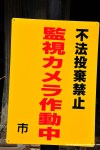
The Restaurant Kent, on Japanese haikyo blogs mostly known as the Good Omen Garden, is one of the staples of urban exploration in Japan. Located on quite a long country road connecting Osaka with Miyazu (home of the famous sandbar Amanohashidate, one of Japan’s three scenic views) the Restaurant Kent was one of the most popular local haikyo when I started doing urban exploration three years ago. Nowadays it lost quite a bit of its popularity, probably because it was photographed to death over the years – or maybe because there are a couple of signs announcing camera surveillance… which I totally respect if it’s true.
In this case the claim was complete bullshit, which annoys the heck out of me as it just cost me time and nerves. The signs looked rather new, so maybe they were put up before the local city administration set up the cameras (government involvement, even on the lowest level, is always a bad thing since it usually means serious business – private companies might hire some slackers, but you don’t want to mess with bureaucrats, especially in a country like Japan…), but when I visited the Restaurant Kent in March of 2011 there were no cameras or other forms of security; a topic I usually leave out, but if somebody lies to me blatantly I have to set the record straight!

Sadly there is not much else to report about the Restaurant Kent, since nobody seems to know a lot of facts about the place. I don’t even know if it was named after the county of Kent in South East England – or after the hugely popular cigarette brand “Kent”, which famously used carcinogenic blue asbestos in their filters from 1952 till 1956 (I guess at least British American Tobacco made cigarettes healthier after all…). The restaurant area itself seemed to be quite small, but neat. Previous explorers set up some tableware in front of a chair with armrests, but other than that there was not much to see.
The Good Omen Garden seemed to be much bigger – one of those festivity locations Japan so desperately needs when you want to be loud and / or with some friends. My buddy Dan and I found several party rooms of various sizes (Western Style and Japanese style, i.e. either carpet floor and tables or tatami floor and furniture that is long gone now…) equipped with all kinds of electronics including laser disc karaoke machines, beamers, microphones (not for karaoke as they were installed to the ceiling…) and mountings for camera and / or additional lighting. One room even featured a disco ball, although it was quite severely damaged – and so was the fake wedding cake one floor down outside. At the first look the Good Omen Garden didn’t seem that big, but then it turned out that there was a second building behind the first one, connected by a kitchen on the upper floor. There were more rooms, including some guest rooms for overnight stays and the usual array of baths for men and women.
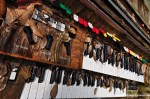
My favorite item though wasn’t in the building, it was outside in the backyard – a wooden electronic organ, beyond repair thanks to years of abuse from vandals and weather; nevertheless an unusual and strangely beautiful sight.

Since the Kent Restaurant / Good Omen Garden was along a busy road, but not within a city, town or even village, there were almost always cars parked outside. But nobody had the intention to bother us, I guess the camera warning signs outside worked. When Dan and I were about to leave though, a pickup-truck with a small crane parked next to the building. We “escaped” through the front entrance while two or three men entered the building through the restaurant. On official order or to loot? We’ll never find out. Dan and I were kind of in a hurry anyway, since on the way to the Kent Restaurant we spotted a location I’ve never seen anywhere else before. But that’s a story for another time. Probably Christmas time…

(If you don’t want to miss the latest article you can *follow Abandoned Kansai on Twitter* and *like this blog on Facebook* – and of course there is the *video channel on Youtube*…)

Read Full Post »

Ruins in Japan are often in such good condition that they are not recognizable as ruins at first sight. One example would be the World Peace Giant Kannon on Awaji Island, Hyogo prefecture – Kannon not being a spelling mistake, but the Japanese name for the bodhisattva associated with compassion, Guanyin. Other spellings include Kan’on, Kanzeon and Kwannon with the latter being the name giver for Canon, which was founded as Kwanon in 1934 and had the bodhisattva in its logo. I guess a World Peace Giant Cannon only exists in the minds of some really crazy people…

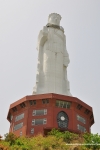
In 2010 I actually drove past the 80 meters tall World Peace Giant Kannon on its 20 meters tall socket building. Sure, it looked interesting, but the bright white statue seemed to be rather new in the warm sunlight of that day, so I didn’t even consider stopping. When I got back home and looked up what the statue really was I found out that most important of all it was abandoned… (It’s the 4th tallest statue in Japan and the 13th tallest in the world. Including the socket it ranks 3 and 10.)

The World Peace Giant Kannon is actually part of the Heiwa Kannon Temple (heiwa meaning peace…), which was founded and funded by Toyokichi Okunai, a realtor who became rich dealing with office buildings, private apartments and business hotels in Osaka. The basis is a 5 storey building, 20 meters tall. The first floor was home to all kinds of religious exhibits as well as well as information about the famous Shikoku Pilgrimage (consisting of 88 temples along a 1200 kilometers long hiking course which usually takes between 30 and 60 days to complete). The other floors were stuffed with Mr. Okunai’s private collections – transportation, watches, china, art, armors. The fourth floor was home to a sightseeing restaurant, a banquet hall and a souvenir shop. If you look up the 80 meters tall statue on top of the building you can see some kind of a “collar” right below the statue’s head – that turned out to be an observation platform.

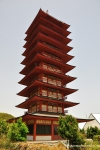
Although attracting up to 2000 visitors per day it seems like a lot of people were appalled by this mix of religion and commerce, some even accused Mr. Okunai of heresy. When Mr. Okunai died in 1988 his wife took over the management of the World Peace Giant Kannon until her death in February of 2006. After her death the Okunais’ real estate company closed the place right away and the Heiwa Kannon Temple started to fall in disrepair quickly, probably due to the lack of management of Mrs. Okunai during her final years. The Lehman Brothers took over, but they failed badly themselves at the time. Put to auction several times in 2007 and 2008 by the Kobe District Court nobody bid any money (which reminds me of the *Former Iranian Consulate* in Kobe…), so the temple was shifted to a separate company in September 2008. Since the World Peace Giant Kannon was liable to collapse (its exterior is molded of gypsum and resulted in the statue’s nickname Whiplash Kannon”) a committee was established in May 2009 by the local government, which took measures against the further deterioration of both the World Peace Giant Kannon and the nearby 10-storey pagoda in September of 2011. Just a couple of months after my buddy Gianluigi and I explored the place…

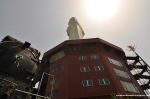
Walking up to the Heiwa Kannon Temple is actually quite impressive. The huge pagoda is right next to a parking lot and a closed restaurant. From there we had to walk up a hill to the back of the socket building. There we found all kinds of statues and items that didn’t go together very well, including a miniature version of the Statue of Liberty and an original Class D51 steam locomotive, the D51 828. We circled the socket building quickly and found an easy entry. The first floor was almost empty as most religious exhibits were gone. A quick look at the office on that floor didn’t give us much insight, so we headed up one of two staircases (one in the north, one in the south) that connected the floors. Some of them were locked, but we gained access to the restaurant on the fourth floor and the tatami room on the fifth floor. Approaching the fifth floor we heard voices, so we talked loudly to make ourselves heard. A minute or two later a young couple in their early 20s rushed past us, the guy holding a photo camera and the girl’s clothes not really being in order – your guess here is as good as mine…

The tatami room once held the Mr. Okunai’s armor, but nowadays well armored soldiers of another kind were all over the floor: suzumebachi, Japanese Giant Hornets, 5 centimeters long killer machines. Luckily they were dead and it wasn’t summer yet, so Gian and I concentrated on the task at hand. In one of the hallways leading to the staircases we found an elevator – and nearby a mysterious claustrophobically narrow und pitch-black staircase that began to wind upwards. After spending a couple of minutes on the rooftop of the socket building admiring the beautiful gigantic Kannon statue we headed back inside and up the staircase. It was dark, the air was bad and some door-like openings revealed unpleasant views at the inside of the statue – even without knowing that people were discussing repairing the Kannon it was pretty clear that investments were necessary. After climbing stairs for about 10 minutes (it felt much longer…) we finally reached the observation platform, which offered both stunning and scary views. The location of the World Peace Giant Kannon between the coast of Awaji Island and the gentle hills was breathtaking – and so were the cracks in the gypsum everywhere. Buildings in Japan are barely constructed for eternity, but this one definitely has seen better days!

And so Gian and I walked down stairs for about 85 meters and left after spending surprisingly much time at this obviously quite popular abandoned statue – passing the also abandoned pagoda a group of about half a dozen Japanese twens was walking up the hill to have a look themselves. And I am sure they weren’t the last visitors as the maintenance work at the Heiwa Kannon Temple started not earlier than four months later…

(If you don’t want to miss the latest article you can *follow Abandoned Kansai on Twitter* and *like this blog on Facebook* – and of course there is the *video channel on Youtube*…)

Read Full Post »

« Newer Posts - Older Posts »