Feeds:
Posts
Comments

Archive for the ‘Restaurant’ Category

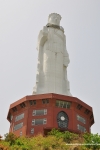
Ruins in Japan are often in such good condition that they are not recognizable as ruins at first sight. One example would be the World Peace Giant Kannon on Awaji Island, Hyogo prefecture – Kannon not being a spelling mistake, but the Japanese name for the bodhisattva associated with compassion, Guanyin. Other spellings include Kan’on, Kanzeon and Kwannon with the latter being the name giver for Canon, which was founded as Kwanon in 1934 and had the bodhisattva in its logo. I guess a World Peace Giant Cannon only exists in the minds of some really crazy people…

In 2010 I actually drove past the 80 meters tall World Peace Giant Kannon on its 20 meters tall socket building. Sure, it looked interesting, but the bright white statue seemed to be rather new in the warm sunlight of that day, so I didn’t even consider stopping. When I got back home and looked up what the statue really was I found out that most important of all it was abandoned… (It’s the 4th tallest statue in Japan and the 13th tallest in the world. Including the socket it ranks 3 and 10.)

The World Peace Giant Kannon is actually part of the Heiwa Kannon Temple (heiwa meaning peace…), which was founded and funded by Toyokichi Okunai, a realtor who became rich dealing with office buildings, private apartments and business hotels in Osaka. The basis is a 5 storey building, 20 meters tall. The first floor was home to all kinds of religious exhibits as well as well as information about the famous Shikoku Pilgrimage (consisting of 88 temples along a 1200 kilometers long hiking course which usually takes between 30 and 60 days to complete). The other floors were stuffed with Mr. Okunai’s private collections – transportation, watches, china, art, armors. The fourth floor was home to a sightseeing restaurant, a banquet hall and a souvenir shop. If you look up the 80 meters tall statue on top of the building you can see some kind of a “collar” right below the statue’s head – that turned out to be an observation platform.

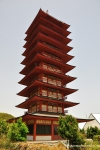
Although attracting up to 2000 visitors per day it seems like a lot of people were appalled by this mix of religion and commerce, some even accused Mr. Okunai of heresy. When Mr. Okunai died in 1988 his wife took over the management of the World Peace Giant Kannon until her death in February of 2006. After her death the Okunais’ real estate company closed the place right away and the Heiwa Kannon Temple started to fall in disrepair quickly, probably due to the lack of management of Mrs. Okunai during her final years. The Lehman Brothers took over, but they failed badly themselves at the time. Put to auction several times in 2007 and 2008 by the Kobe District Court nobody bid any money (which reminds me of the *Former Iranian Consulate* in Kobe…), so the temple was shifted to a separate company in September 2008. Since the World Peace Giant Kannon was liable to collapse (its exterior is molded of gypsum and resulted in the statue’s nickname Whiplash Kannon”) a committee was established in May 2009 by the local government, which took measures against the further deterioration of both the World Peace Giant Kannon and the nearby 10-storey pagoda in September of 2011. Just a couple of months after my buddy Gianluigi and I explored the place…

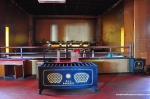
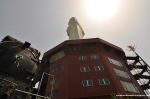
Walking up to the Heiwa Kannon Temple is actually quite impressive. The huge pagoda is right next to a parking lot and a closed restaurant. From there we had to walk up a hill to the back of the socket building. There we found all kinds of statues and items that didn’t go together very well, including a miniature version of the Statue of Liberty and an original Class D51 steam locomotive, the D51 828. We circled the socket building quickly and found an easy entry. The first floor was almost empty as most religious exhibits were gone. A quick look at the office on that floor didn’t give us much insight, so we headed up one of two staircases (one in the north, one in the south) that connected the floors. Some of them were locked, but we gained access to the restaurant on the fourth floor and the tatami room on the fifth floor. Approaching the fifth floor we heard voices, so we talked loudly to make ourselves heard. A minute or two later a young couple in their early 20s rushed past us, the guy holding a photo camera and the girl’s clothes not really being in order – your guess here is as good as mine…

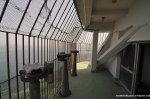
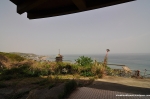
The tatami room once held the Mr. Okunai’s armor, but nowadays well armored soldiers of another kind were all over the floor: suzumebachi, Japanese Giant Hornets, 5 centimeters long killer machines. Luckily they were dead and it wasn’t summer yet, so Gian and I concentrated on the task at hand. In one of the hallways leading to the staircases we found an elevator – and nearby a mysterious claustrophobically narrow und pitch-black staircase that began to wind upwards. After spending a couple of minutes on the rooftop of the socket building admiring the beautiful gigantic Kannon statue we headed back inside and up the staircase. It was dark, the air was bad and some door-like openings revealed unpleasant views at the inside of the statue – even without knowing that people were discussing repairing the Kannon it was pretty clear that investments were necessary. After climbing stairs for about 10 minutes (it felt much longer…) we finally reached the observation platform, which offered both stunning and scary views. The location of the World Peace Giant Kannon between the coast of Awaji Island and the gentle hills was breathtaking – and so were the cracks in the gypsum everywhere. Buildings in Japan are barely constructed for eternity, but this one definitely has seen better days!

And so Gian and I walked down stairs for about 85 meters and left after spending surprisingly much time at this obviously quite popular abandoned statue – passing the also abandoned pagoda a group of about half a dozen Japanese twens was walking up the hill to have a look themselves. And I am sure they weren’t the last visitors as the maintenance work at the Heiwa Kannon Temple started not earlier than four months later…

(If you don’t want to miss the latest article you can *follow Abandoned Kansai on Twitter* and *like this blog on Facebook* – and of course there is the *video channel on Youtube*…)
Read Full Post »

When *Michael* and I drove to the Himeyuri Park we had no idea what to expect. Would we be able to find it? Would it be really abandoned? Would there be security? Would we be able to get in? Or was demolished already? And was it really a cactus park, so close to the cemetery-turned cactus park *Okinawa Seimeinooka Park*?

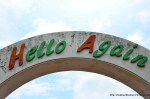
A huge sign at the entrance still welcomed potential visitors, but the road to the parking lot was blocked, so we tried to find some kind of back entrance. On the way there we were impressed by the massive walls surrounding the place – as I found out later is was 2.5 kilometers long, up to 10 meters high and made of 150.000 tons of Okinawan limestone! Our efforts were fruitless – and we didn’t have a chance to look at the entrance, so we turned around and walked straight up to the place. Who knows, maybe a gigantic security guard was waiting for innocent urban explorers like us with a whole selection of deadly weapons?

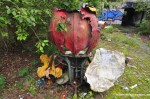
Well, there was no gigantic security guard. Not even a skinnyfat one. Just an empty parking lot for 240 cars. (I didn’t count – whenever I throw in facts I know about the Himeyuri Park it’s thanks to research I did after I returned to Kansai; we had zero information about the park when exploring it!) Right in front of the parking lot we found a couple of gigantic shade-giving metal cowboy hats, so called ten gallon hats – those were actually big enough to easily hold 10 gallons / 40 liters, not just three liters like the real hats. Well, they could have hold that much liquid if they wouldn’t have been in rather bad shape and even lost most of their shade-giving properties; giving no protection to the stacks of pamphlets and merchandise on the tables underneath the hats.

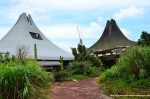
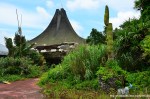
After we checked out the rest of the surroundings we found a way into the park that was clearly divided into two parts, represented in this article by two videos. Right at the entrance was a big building with a huge gift shop and a restaurant (the kitchen interior being completely removed), the tall pointy roofs visible from quite a distance. In the back Michael and I found several office rooms and a locker room for the employees – all areas have been pretty much completely vandalized, although this clearly abandoned cactus amusement park never popped up on any Japanese or Western haikyo blog, at least not to my knowledge. The place was damaged so badly that I had to find out afterwards that the Himeyuri Park was actually a Wild West themed cactus park – hence the enormous cowboy hats at the entrance. But all the other signs, like prairie schooners and similar stuff, were long gone. I found a totem pole in the second main part, the actual cactus park, but I didn’t think much about it since Japanese theme parks tend to take elements from all kinds of places and create a strange mix.

The restaurant and gift shop building was in a dilapidated state, especially since both pointy roofs were severely damaged and offered no protection against the elements anymore. Everything was wet and moldy, not really a nice place to be at. It seems like they sold all kinds of souvenirs there, like Disney merchandise, photos and the previously mentioned Okinawan shirts called kariyushi shirts. (They started out as a marketing tool in the 1970s to attract tourist, which means that they were introduced to Okinawa 40 years after Ellery Chun invented the modern Aloha shirt! Those were made of leftover kimono fabric and so the circle is complete…) Of course there also was cactus-related stuff, like cactus ice cream. Also worth mentioning are the weird coconut shaped lamps hanging from the ceiling – I didn’t know why, but their tackiness caught my attention several times.
The office part of the building wasn’t as wet, but not less vandalized. Things were scattered all over the floors in most of the rooms and there is not much to say about it since it was just another vandalized office area you can see at an estimated 75% of all abandoned places. One room was kind of interesting since it looked like a 70s living room with carpeted floor and some more or less comfy looking chairs. It also contained some documents and a stack of business cards belonging to a person working for the Taiwan Pineapple Corporation – and this is where the story gets messed up and rather interesting. For example the small fact that the address given on the business card isn’t in Okinawa… it’s in Ryukyu, Okinawa’s old name…

As for the park’s unusual history: Himeyuri Park was opened in 1983 (earlier than the Mexico Cactus Park Sarabanda!) as a subsidiary of the Tohnan Botanical Garden (東南植物楽園, Southeast Bontanical Gardens) and closed due to poor business performance in 2005 (later than the Mexico Cactus Park Sarabanda…). But before that happened it was bought by the Taiwan Pineapple Corporation, a subsidiary of the Typhone Group, one of Taiwan’s most powerful companies. But this investment wasn’t just a business decision, it was mostly political. At the time Taiwan tried to expand its influence in Japan, especially Okinawa – not a surprise given the fact that the Okinawan Islands are rather close to Taiwan. It actually seems like the Kuomintang, the Chinese Nationalist Party, was behind the deal, trying to negotiate a no visa entrance to Japan for all Taiwanese tourists and businessmen in return for an investment of up to 1 billion dollars. Lee Teng-hui, Taiwan’s president and chairman of the Kuomintang from 1988 till 2000, was friends with the father of Ohbayashi Yukino, the director of the Tohnan Botanical Garden – who also was from Taiwan. At one point Lee met the Okinawan governor at Tohnan and repeated the claim that the Senkaku Islands in fact belong to Taiwan. (The Senkaku Islands are five uninhabited islands and three barren rocks in the East China Sea. They are administered by Japan and claimed by the People’s Republic of China as well as by Taiwan (the Republic of China) for territorial reasons.) Despite that statement Lee’s efforts weren’t ill-willed with the intent to undermine or infiltrate Okinawa, they were supposed to bring both countries closer together as Lee grew up at a time when Taiwan was occupied (and to some degree modernized) by Japan.
But business at Himeyuri Park was bad and after Lee’s influence vanished the Taiwan Pineapple Corporation sold the management rights in 2003 to a company called Yakushido (short for Yakushi-do Seiyaku Kako (薬師堂製薬化工, Hall of the Medicine Buddha Pharmaceutical Chemical Industry / Yakushi Hall Pharmaceutical Chemical Industry – the company is known so little I couldn’t even find out what they do exactly or if they still exist). And now it gets really complicated as Himeyuri Park was closed shortly afterwards and then reopened in 2004, just to be closed again in 2005. On October 20th 2005 the Ryukyu Shimpo (Ryukyu News(paper)) reported online that the Himeyuri Park was closed one day prior after the entrance to the parking lot was blocked on October 18th. It seems like in February of 2005 the owners of Himeyuri Park (most likely the Taiwan Pineapple Corporation) started to receive payments from Yakushido after settling some rental contract issues in front of Naha’s summary court (probably dating back to 2003). The total sum was 40 million Yen and Yakushido paid some installments, but something wasn’t working out – so operations were shut down. The newspaper article was rather vague and so the end of Himeyuri Park lies… well, not in the dark, but somewhat in the shadows…
(This whole section about Himeyuri Park’s history was a gigantic puzzle with lots of endlessly long Japanese sentences – it would be missing almost completely if it wouldn’t have been for the generous and extensive help of my incredibly smart and dedicated friend Mayuko; thanks a lot!)
Oh – in September of 2010 there was a sign in front of the park stating in Japanese “For sale – 28.000 tsubo” (about 80.000 square meters) and a phone number. The sign was gone (if I remember correctly…) when Michael and I explored the place in May of 2012, so the park either has a new owner or the real estate company in charge (based in Naha) stopped caring…
But now back to the exploration!

Separated from main building by one of those gigantic limestone walls was the actual park part of the park. According to several tourist and advertising sites the Himeyuri Park had 100.000 cacti and other plants, amongst them 4000 banyan; fig trees from the Himalaya. Highlights of the park were of course the 450 different kinds of cacti, up to 10 meters tall and up to 1000 years old. Every year there was a special event called Flower Aquarium where large displays depicted ocean animals composed by 275.000 flowers in vases. Opening hours were from 8.30 a.m. to 6 p.m. (9 a.m. to 5.30 p.m. from October to March) and the entrance fee was 850 Yen for adults (430 Yen for ages 3 to middle school) when the park closed, in 1994 it was 720 Yen for adults and 360 Yen discounted.
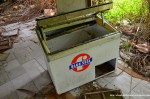
The huge maze like area is mostly overgrown now, making it hard to navigate and even harder to spot most of the abandoned cacti. In the center of the park was a rest house, pretty unspectacular, though it had a rusty freezer with a Blue Seal logo on it. (Blue Seal is the most popular ice cream brand in Okinawa, going back to 1948 when it was founded as Foremost Co.)

If it wouldn’t have been for the cactus theme Himeyuri Park would have been quite an uninteresting exploration – moldy, vandalized, overgrown. But how often do you get the chance to explore an abandoned cactus park? One that to this very day doesn’t appear on any Japanese urbex blogs, and I was actually looking for articles! So overall it was an exciting 3 hours from driving to the park to leaving it. Nothing worth *flying to Okinawa* for, but most definitely a nice chance from the usual vandalized and moldy hotels you can find everywhere…

(If you don’t want to miss the latest article you can *follow Abandoned Kansai on Twitter* and *like this blog on Facebook* – and of course there is the *video channel on Youtube*…)
Read Full Post »

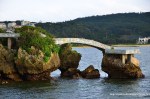
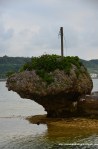
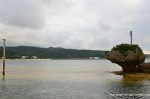
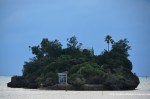
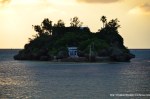
The Dolphin Island Restaurant is one of those weird, unique places I love Japan for – and it’s one of the few urbex insider tips in Okinawa. It is also one of the toughest places to access. Not because of security, but because of timing. Nowadays located just a stone’s throw away from the Okinawan coast the Dolphin Island Restaurant can be reached by wading through the water if the timing is right and the tide is low…

After a day of exploration *Michael* was kind enough to revisit one of the places he explored when *he went to Okinawa in 2011*. The Dolphin Island Restaurant is a gorgeous little island, sadly there is little to nothing known about its history. Massive concrete and wooden electricity posts let me come to the conclusion that the current supply came from the mainland about 300 meters to the east and that it was constructed in the 1950s or 60s. Nowadays you can almost walk up to the place from the north, getting as close as maybe 10 meters, but I doubt the area looked like that when the restaurant island was still open for business. Judging by the shape of the close-by warehouse area / harbor I’m pretty sure that this part of Okinawa is artificial land, one of the many reclamation projects Japan did in the past couple of decades – this one was limited by the Dolphin Island, but it got as close as possible…
I can imagine that business was though back in the days, because without access via a bridge all the visitors must have gotten to the island by boat – and that most likely meant no business on stormy days and that it took quite some effort by potential guests to reach the restaurant.
It’s said that the Dolphin Island Restaurant was not only a restaurant, but also hosted an aquarium – hence the name “Dolphin Island” or “Hiituu Island” in Okinawan dialect.
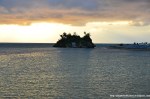
Since it was getting late that day and the tide was already rising I refrained from wading through the water and stayed on dry land. With proper equipment like airtight bags to get my camera to the island safely I might have taken a swim, but given the situation that day I decided to just take some photos and a video. Later on Michael and I went to the original coast line and took some pictures from the beach, waiting for the sun to set – not our lucky day, because the sky got cloudy for the few couple of minutes we were hoping for a spectacular horizon…

And with that the Dolphin Island Restaurant became the third location on Okinawa (after the *Nakagusuku Hotel Ruin* and the *Sunset View Inn Shah Bay*) I would like to revisit one day… Well, at least the last location on Michael’s and my *trip to Okinawa* was a great success – somewhat of an original find and a really unique location with an exciting and unusual history! Up next on Abandoned Kansai…

(If you don’t want to miss the latest article you can *follow Abandoned Kansai on Twitter* and *like this blog on Facebook* – and of course there is the *video channel on Youtube*…)

Read Full Post »

Urban exploration in Okinawa? Not exactly my first association when I think of the former kingdom of Ryukyu. For me it would be more like sun, beaches and… Karate Kid 2 – a movie I’ve never seen, or at least I can’t remember seeing it, but in Germany it had the tagline “Entscheidung in Okinawa” (something like “Decision in Okinawa”) and I guess that stuck with me ever since. Okinawa = Karate Kid – but I always thought it was the third one, not the second one…

When my haikyo buddy *Michael Gakuranman* and I went on a *road trip to southern Honshu* earlier this year we were talking about future expeditions. Michael mentioned that he went to Okinawa just a couple of months prior and that he explored a huge hotel he really wanted to re-visit. So he suggested a haikyo trip to Okinawa. And I was skeptical. Going to Okinawa to revisit a hotel? I knew right away which hotel Michael was talking about since it is one of the few famous abandoned places in Okinawa (Okinawa really isn’t famous for urban decay, not even amongst urban explorers), but him saying that he wants to stay a whole day there didn’t exactly seal the deal. But I am currently re-discovering Japan as a tourist (I travelled a lot in spring!) and the chances to go to Okinawa are limited, so what the heck. Let’s go to Okinawa and do some urbex! It would surely beat the beaten tracks of urbex in Kanto!

A couple of years ago the concept of budget airlines finally reached Japan and if you book early you can get really good deals. To make sure that we both arrive and departure at around the same time and we both would get reasonable rates Michael was kind enough to take care of the booking – 10.800 Yen for the roundtrip Osaka-Naha-Osaka; booyah! A Shinkansen train ticket Osaka to Hiroshima costs about the same – one way…

Late May isn’t exactly the best time to go to Okinawa since May and June are two out of three most rainy months down there, but again… why not? It’s Okinawa and I’ve never been there. The places we planned to explore sounded kind of okayish on paper, but I was more interested in Okinawa itself. The local atmosphere, the local architecture, the local food. Biggest surprise: shikuwasa (pronounced something like sheek-wasa), a Okinawan citrus fruit and the basis for all kinds of food and drinks – juice, cake, wine, mochi, sodas, chiffon cake, syrup (for kakigori), fruits chews, … In the humid pre-summer heat the most refreshing taste I ever had the pleasure to enjoy. Another popular local fruit is the pineapple. Close to the city of Nago are actually two pineapple theme parks close to each other – separated by the Okinawa Fruits Land. Michael and I visited the Nago Pineapple Park on one of the three days we spent in Okinawa. Not much of a park it features one of the tackiest rides possible – automatically driven carts through a pineapple field, telling you everything you (never) wanted to know about pineapples in horrendously pronounced English. And that was it for the park part – we basically paid 600 Yen to enter a gift shop. One of the most awesome gift shops ever though. Here you could buy (and sample!) all kinds of pineapple and (some) shikuwasa related products. Wine, cookies, chocolates, prize-winning cakes, dried fruits, different kinds of fresh pineapples, pineapple charcoal soap (!) and of course the usual gift shop stuff like plush dolls, key chains and whatnot. Awesome place, expensive though – I nevertheless loved it.

Over the course of our visit Michael and I managed to enjoy a good mix of urban exploration and tourist stuff, although Okinawa isn’t exactly famous for urban exploration. Luckily the urbex locations turned out to be way more interesting than they looked on paper, including an original find – one location freaked me out so much that I got fed up and left, one of the worst urbex experiences I ever had. So in the end we saw three abandoned hotels, two abandoned cactus parks and one abandoned restaurant island on the course of three days. As for touristy locations we visited the already mentioned Nago Pineapple Park, Shuri Castle (awesome!), Nakagusku Castle, the Underground Naval Headquarters of WW2 (overrated – it almost always makes me cringe a little seeing Japan presenting WW2…) and of course Kokusai Dori, the main tourist / night life street in Naha, Okinawa’s capital.

I didn’t plan to write about this trip so quickly, but last weekend opened up out of nothing and the East Asian rainy season (tsuyu) hitting Japan basically rendered it useless for outdoor activities – and overall I loved the trip, so it was the next best thing to get this series of articles started. The weather was constantly changing, but sunny most of the time. The food was awesome (I’m still not a fan of goya though…) and the places we visited were interesting. Life in Okinawa seems to be much more relaxed that in mainland Japan. For example: Taxi drivers in Osaka wear suits and white gloves, taxi drivers in Okinawa wear kariyushi – basically the Okinawan version of the Hawaiian shirt. And what’s not to love about an island that has strong reservations about Americans and Japanese alike? 😉

And finally here’s an alphabetical list of the upcoming articles about this haikyo trip to Okinawa:
Dolphin Restaurant Island
Himeyuri Park
Lequio Resort Hotel
Nakagusku Hotel Ruin – The Background Story
Nakagusku Hotel Ruin – The Exploration
Okinawa Cactus Park / Okinawa Seimeinooka Park
Sunset View Inn Shah Bay

(If you don’t want to miss the latest article you can *follow Abandoned Kansai on Twitter* and *like this blog on Facebook* – and of course there is the *video channel on Youtube*…)
Read Full Post »

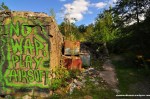
What do you do when you get thrown off your horse? You get right back on! And that’s what Sebastian and I did after we ran into some trouble at the *Cambrai-Fritsch-Kaserne*. Since Sebastian came up with the (almost) deserted US Army base it was my turn to select a place to explore – and I chose the Clubhotel Messel a.k.a. Clubhotel Sehr / Clubhotel Seher.

At the time of my visit the place was virtually unknown to the internet. It was obvious that plenty of vandals, arsonists and paintball players were there before me, but it was almost impossible to find any hard information about the place on the net – luckily that change earlier this year when the German urbex community, usually more interested in photos than the historical background of abandoned places, took care of that situation.

It seems like the Clubhotel Messel (named after the municipality of Messel near Darmstadt, usually known for the UNESCO World Heritage site Messel Pit where all kinds of fossils were found) was not only a single hotel, but a conglomerate of businesses, all part of the frivolous nightlife industry. The nightclub “Broadway-Bar” and the hotel “Je t’aime” were right next to the “Swimming Pool / Sauna Club d’Amour” and the “Nightclub d’Amour” – basically one big brothel complex, one of the biggest in the Rhine-Main area. Since all establishments were owned by a guy named Wolfgang Sehr the place was also called Clubhotel Sehr or, misspelled, Clubhotel Seher. The special attraction of the Clubhotel was a mini zoo including a pair of cheetahs – the cages are still in the forest! I’m not exactly sure when the place opened, but I guess it grew kind of organically and was in full bloom in the late 70s and throughout the 80s. In January of 1988 it was mentioned by leading news magazine Der Spiegel in an article about a scandal regarding nuclear waste. A company called Transnuklear Hanau (a subsidiary of Nukem – I’m not joking!) illegally imported 1942 barrels of nuclear waste from Belgium and of course there were bribery and other manipulations / irregularities involved – one of them was a bill to the amount of 14010 Mark (roughly 7000 Euros) after some managers of the nuclear industry had a fun night at the Clubhotel. (The article mentioned a nightclub called “Mon Bijou” and a fine dining restaurant named “La Chandelle“ – probably both part of the Clubhotel complex.

The Spiegel report was the beginning of the end of the Clubhotel, although the details are vague since everything happened before the age of the internet. It seems like the German State wasn’t very fond of the local sex businesses and started to shut them down one after another – either in the late 80s or early 90s. Some of the brothel owners went to jail for procurement and promotion of prostitution; and according to an article by the Frankfurter Allgemeine Zeitung (FAZ) in late 1994 Sehr was convicted of those crimes…

When the brothel complex was abandoned but still in good condition the Zeitung für Darmstadt (Newspaper for Darmstadt) reported in 1993 that the State of Hesse had plans to reconvert the place into a *deportation prison* for 250 illegal aliens. These considerations were terminated abruptly when parts of the club hotel complex burned down to the ground on January 25th of 1994 as the Zeitung für Darmstadt reported in early 1994. It seems like the then owner, most likely still Sehr, tried to commit insurance fraud to make up for the millions he lost when the place was shut down. (The guy definitely went to jail – I’m just not sure if it was for one or both of the alleged crimes.)

Later in the 90s the Clubhotel made the news when paintball players occupied the premises and actually started to do minor construction work. The rural district Darmstadt-Dieburg intervened and a court of law decided that the “Magic Boys Rhein Main” needed to find another location for their colorful war games… (The small building next to the big outdoor pool was their safe house and Gotcha related graffiti are still all over the place.)

For more than a decade all kinds of people came to the Clubhotel for all kinds of reasons. Some people played paintball, others airsoft. Some homeless people looked for shelter in one of the smaller buildings that weren’t affected by arson and of course photographers came to… well, do what photographers do. It seems like for a while artists lived on the premises and in summer of 2011 Sebastian and I had a quick look. Only to find a rather uninteresting burned out hotel and some vandalized smaller buildings. In the early 80s the Clubhotel must have been quite a sight – nowadays it’s just another unspectacular rotting place in the woods. Luckily it has a story worth telling. But maybe this patch of land in the middle of nowhere will find new beauty and glory soon. On March 26th of 2012 a public auction of the property by court order took place and on May 13th Echo-Online reported that the (new?) owner of the site is looking at plans to build a new hotel – probably for the whole family this time, not only for dads…


Read Full Post »

When you think of Japan which other country comes to mind?
Probably Korea since it’s a neighboring country and both countries share an inglorious common history. China, of course, a major influence for centuries – from city planning to food. Most likely the United States as no other country had more impact on Japan in the past 70 years. Maybe Germany due to 150 years of more or less intense friendship and a similar post-war history.
Japan and New Zealand? A rather odd combination. Surprisingly *Michael* and I visited not only one, but two New Zealand themed amusement parks while on a *road trip in southern Honshu*. A couple of weeks ago I wrote about the *Hiroshima New Zealand Farm*, a closed but not abandoned theme park in Hiroshima prefecture. This time I’ll present you the clearly abandoned Yamaguchi New Zealand Village – same concept, same company, but without the shadow of a doubt a “lost place”; BTW: I really dislike the term Lost Place, which is used for urban exploration locations in Germany – not as bad “Handy”, which is used for mobile phones (!), but nevertheless a term that makes me cringe.

Arriving at the huge deserted parking lot of the New Zealand Village, it was pretty clear that we wouldn’t run into gardeners or other caretakers. The wooden handrail leading up to the entrance area was getting brittle and all kinds of plants grew without any attempt to tame them. Opened in July of 1990 after spending 1.8 billion Yen (currently about 16.5 million Euros or 21.7 million Dollars) the park’s attendance figures peaked in 1991 at 428.000 – in the following years the numbers dropped to about one third of that per annum before Farm Co. Ltd. put an end to it in 2005 by closing the park. Initially the 30 ha (300,000 m2) large New Zealand Village was put on hiatus for up to three years with the intent of re-opening it again one day, but that never happened. I don’t know if somebody took care of it for a while like they do at the New Zealand Farm (which is in its fourth year of closing), but nowadays the New Zealand Village is clearly abandoned…
(Just for comparison: *Nara Dreamland* peaked at 1.6 million visitors a year and closed when the number was as low as 400.000 – Universal Studios Japan in Osaka welcomes about 8 million guests a year.)

Exploring the New Zealand Village couldn’t have been more relaxed. Located in the middle of nowhere Michael and I enjoyed a wonderful sunny day on the copious premises.
The entrance area was dominated by a gift shop called カンタベリー (Canterbury), vandalized, but still stocked with quite a few examples of fake food Japan is so famous for – in this case all kinds of sweets. We found replicas of mini cakes, both Western and Japanese (mochi), all made of plastic and therefore still nice to look at.
In close proximity was the Jersey Factory that produced and sold homemade bronzer… sorry… handmade butter! And pretty much next to this place with a name that has no connection to New Zealand was a huge building that had New Zealand all over the place: Restaurant Rotorua, Newzealand Farm, Kiwi Country. Why give it one name when you can give it three? Or four, since all to the left it said “Main Bazaar”.

This food dominated commercial zone of the New Zealand Village, which overall had way less of a village feeling than the New Zealand Farm, was followed by the wide, open landscape I knew from other versions of the nature themed parks. And I loved it! I usually don’t feel very comfortable in abandoned buildings, but open areas like mining towns and amusement parks I really enjoy (if they are really abandoned), especially on sunny spring days!

What made the New Zealand Village in Yamaguchi different from those in Hiroshima and Shikoku was the variety of strange pedal-powered vehicles. Cars, bikes and really unique constructions – they were scattered all over the park, a plethora of rental… thingies. I took photos of many of them and maybe one day in the future I will publish a special picture set about them.
Another thing that made this installment of the New Zealand parks special (but not in a good way!) was the already mentioned presence of vandalism. It wasn’t “ZOMGWTFBBQ!?” bad, but since vandalism is always uncalled for it was nevertheless sad to see. Call me old-fashioned and naïve, but I like my abandoned places easy to access and naturally decayed. Luckily the amount of vandalism decreased the further we got away from the entrance, so by the time we reached the stables and Sheep House with its museum of 19th century farm equipment and a couple of taxidermy items in the making, vandalism was nothing but a bad memory.

What really bugged me about exploring the Yamaguchi New Zealand Village was the time pressure. Like I already mentioned, this was part of a road trip to the south of Honshu and the schedule was kind of tight. A place like this deserves a whole day of exploring and taking pictures, probably with some hours after sunset for some special photos – a luxury not available to us. So when Michael and I left after 3 hours (which is generous for most places – *Sekigahara Menard Land* I left after about 20 minutes…) it was with a bittersweet aftertaste, amplified by a bunch of beatniks who entered the parking lots just before we left. Us driving away was accompanied by the sound of burnouts in the distance…

(If you don’t want to miss the latest article you can *like Abandoned Kansai on Facebook* – and of course there is the *video channel on Youtube*…)

Addendum 2014-07-11: According to a friend of mine all the buildings have been demolished – R.I.P.!

Read Full Post »

Expectations are one of the worst things in life. Especially when they are as high as mine were driving up to the top of Mount Noro in Hiroshima prefecture. What did I expect? A speedway abandoned in 1974 and a shuttered amusement park, also left behind in 1974. I didn’t see any photos in advance, but I read a slightly cryptical Japanese description and the satellite view on GoogleMaps was very promising. Sadly the location didn’t live up to the expectations, so *Michael* and I were about to face the first disappointment of our *road trip to southern Honshu*… which wasn’t as bad in retrospect.

Mount Noro (insert stupid joke about the Noro virus in Japan here) near Hiroshima is one of the city’s most popular recreational areas for hikers, mountain climbers, campers and flower lovers. It’s said that it offers a stunning view at both sunrise and sunset. Aside from the fact that Michael and I were way to too late for the first and way too early for the second we wouldn’t have been able to see either anyways – the 839 meters high mountain was covered by low hanging clouds from about its second half. Occasionally the visibility was only a couple of meters and it looked more like rain than clearing up. When we reached the entrance of what I hoped would be the abandoned Mount Noro Speed Park (a.k.a. Mount Noro Circuit) at an elevation of 830 meters (Japanese people like their race tracks high above sea level as we know from the *Hiroshima Kart Pista*) we realized that the place was reused at least once since we were welcomed by signs telling us that we found the Moriyama Auto Camp. Close, but no cigar…

It turned out that this location has quite a history. A history I only found out about after we visited the place – like I mentioned earlier: Before our visit I had only vague information about a racetrack and an amusement park. The Mount Noro Amusement Park was a typical mid-size theme park of the 60s with a couple of merry-go-rounds and a rollercoaster, and it opened in April of 1968. In close proximity the Mount Noro Speed Park followed with an opening ceremony in October 1969. The intent was to make Mount Noro more attractive for tourists. As we all know: Those hiking eco freaks that headed for the mountain until then weren’t spending much money while amusement parks were THE cash cows of 1960s Japan, where the tired workers of the East Asian Wirtschaftswunder (economic miracle) were looking to spend their hard earned bucks. Sadly the business people behind the big tourist plans didn’t expect two things to happen: The traditional nature lovers complained about the dramatically increased noise level on Mount Noro – and in 1973 / 1974 an oil crisis hit the world. The combination of those events forced both the amusement park as well as the speedway to close their doors for good in 1974. Which was incredibly sad in the case of the 932 meters long and technically quite demanding Mount Noro Speed Park as it was quickly used for races of national fame, including the “All Japan 200km Stock Car Race” which was held annually from May 1970 on.

Sad for Michael and I was the fact that the weather was bad and that the race track was in such horrible state we weren’t even sure we found the right place – especially with those Moriyama Auto Camp signs at the entrance. We entered the place (adults 500 Yen, children 200 Yen, cars 3500 Yen…) and were quite a bit confused about the routing along the slope, which seemed rather unusual for a speedway. And the empty pond with the garbage cans also didn’t really fit in. Down the road we reached a bifurcation – left: Moriyama Auto Camp; right: Moriyama Auto Camp. Well, that didn’t help much…

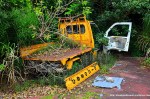
We continued to the left only to find a huge abandoned trailer advertising Fukutome Ham, the inside filled with some seats (no meats…), garbage and a seriously damaged suzumebachi nest. For those not aware of this danger for all urban explorers and hikers: suzumebachi are also know as Asian Giant Hornets (Vespa mandarinia), aggressive nasty beasts with a body length of 5 cm and a sting that injects large amounts of potent poison, potentially deadly for both other animals and humans.

We continued up the mountain along the seriously damaged asphalt road only to find half demolished bath rooms at what once was the pit lane of the speedway. The surrounding building was gone, making all the faucets, toilets and showers open air installations. 300 Yen for 5 minutes was written on the shower doors, the curtains behind moldy and nasty.

Further down the pit lane, a bit above the race track, we found a two-storey building. The lower floor once housed a restaurant and I guess it dated back to the speedway days. The upper floor once was the home of somebody. Quite an unspectacular house with the usual remains of an abandoned building.

On the way back to our car we saw a camping trailer next to the former race track. It looked way more modern than anything else on the premises, so I kept a safe distance while Michael had a closer look. Through the window he saw a calendar from 2012 and a working clock, so we wondered why somebody would rather live in a trailer than in the furnished room in the building three minutes away – and decided to leave as none of us were eager to ask the person who made this choice.

Right at the entrance we had a closer look at the attendant’s hut with the charming painting. I guess the previously mentioned empty pond once was an attraction of the Moriyama Auto Camp – rainbow trout fishing. The hut also revealed that the now abandoned area had a size of 71000 m2 and once offered 40 campfire places – just not right before it closed as this information was blacked out on the flyer. Reason for the leaflet was the opening of the place on July 1st of an undisclosed year. Leaving the hut my eyes caught one final item, the flyer of a Bihoku Auto Village, announcing its grand opening on June 26th 1999. I was confused. Same place, again a different name? Luckily not as it turned out later – just the flyer of a similar place elsewhere in Hiroshima prefecture… (And still in business!)

I never went camping in Japan and obviously I was disappointed that the expected abandoned race track turned out to be a converted one, but the rainy / foggy weather was a blessing in disguise. Walking along the seriously damaged speedway with that kind of weather created quite an eerie atmosphere I actually enjoyed more in retrospect than I was aware of at the time. But it took quite some effort to find out about and get to the Mount Noro Speed Park / Moriyama Auto Camp as to my knowledge it hasn’t appeared on any other urbex / haikyo blog yet… Would I spend that much time on it again? Probably not. Do I regret having it done? Definitely not! I especially enjoy exploring new kinds of abandoned locations, especially if they are in the middle of nowhere. And in that regard this haikyo was a great success – I’d always prefer my first abandoned auto camp over the 20th abandoned hotel!

(If you don’t want to miss the latest article you can *follow Abandoned Kansai on Twitter* and *like this blog on Facebook* – and of course there is the *video channel on Youtube*…)

Read Full Post »

The Mt. Hiei Artificial Ski Slope is an abandoned ski resort near the top of Mount Hiei on the border between Kyoto prefecture and Shiga prefecture. Famous for its Enryaku Tempel and the Kokuhoden Museum this holy mountain was once thought to be the home of gods and demons in the Shinto belief system. Interestingly enough the predominantly religion on Mt. Hiei has always been Buddhism. The monk Saicho founded the Enryaku-ji in 788 as the first outpost of the Tiantai / Tendai sect and it remained the Tendai headquarters till this very day, although it was famously destroyed by Oda Nobunaga in 1571 to vanish the rising power of the local warrior monks, killing about 20,000 people (including civilians) in the area. The temple was rebuilt soon after and is one of the main tourist attractions in Shiga prefecture today, accessible via two cable car lines, several beautiful hiking trails and a toll road for cars, motorcycles and busses.

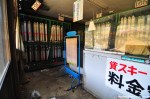
Along the “Kitayama East Course” lies the Mt. Hiei Artificial Ski Slope, probably the most visited haikyo in all of Japan. On an average day during the hiking seasons in spring and autumn you’ll never be alone in the area as people are constantly passing by – about half a dozen hiking trails meet here and a close-by cable car station, serving the longest funicular line in Japan, attracts hundreds of people a day. Most hikers barely notice the abandoned ski lift and ski slope, hardly anybody peeks through the broken windows of the gear rental store or has a look at the undamaged closed restaurant. Why wasting a thought on that ugly stain when the surrounding nature is of such beauty? Because beauty lies in the eye of the beholder and though the ski resort on Mount Hiei was rather small it nevertheless offers a few neat angles now that it is abandoned.

Wanna know some facts about the resort? Okay, this is what I was able to find out: The Mt. Hiei Artificial Ski Slope was opened in 1964 and on November 1st of 2002 the newspaper Kyoto Shimbun reported that the ski resort was closed for good after a hot summer in 2000 and a way too warm winter in 2001 – followed by a year of temporary closing; which explains why both the restaurant and the rental store are still stocked with all kinds of items. In the almost 40 years of operation the already mentioned facilities welcomed customers for both a summer and a winter season. In winter a combination of natural and artificial snow (provided by a snow gun) offered fun for the whole family, in summer grass skiing was the business of choice. A lift transported guest for a distance of 170 meters so they could enjoy the pretty short slope of up to 200 meters with a vertical drop of 38 meters.

Oh, before I forget: The nearby “Garden Musem Hiei”, a flower park, once was an amusement park with a haunted house, a small Ferris wheel and a viewing platform, but I guess it was converted quickly enough to never been considered abandoned.

And that’s it for now from Mount Hiei. For now, because the ski resort was actually my second urbex trip there and my fourth or fifth overall – I really like Mount Hiei! Next time I’ll take you there I’ll either show you an abandoned rest house on a steep slope or a mysterious construction I’ve never seen anywhere else on the internet…

(If you don’t want to miss the latest article you can *follow Abandoned Kansai on Twitter* and *like this blog on Facebook* – and of course there is the*video channel on Youtube*…)

Read Full Post »

*Nara Dreamland* is the current haikyo hot spot in Kansai, maybe in all of Japan. But the area including Osaka, Nara, Kyoto and Kobe is also the home of a classic urbex location: the Maya Tourist Hotel. (A.k.a. Maya Kanko Hotel, Mayakan, Mount Maya Hotel, Mount Maya Onsen Hotel, and Gunkan Hotel – Battleship Hotel / Warship Hotel; similar to *Gunkanjima*, the now also abandoned Battleship Island off the coast of Nagasaki.)
Mount Maya is one of the highest peaks of the Rokko Mountain Range that spreads from the west end of Kobe to Takarazuka (near Osaka) and is one of the most popular recreational areas in Kansai. In 646 the Tenjo-ji (忉利天上寺), a Buddhist temple, was founded near the top of the mountain at the behest of Emperor Kotoku. During the 8th century a monk named Kobo brought a statue from China to the temple – a depiction of Maya, Buddha’s mother; and that’s how the Mount Maya got its name. (The original temple was burned to the ground by a pyromaniac in 1975. The remains are still a popular destination for hikers, although the temple was reestablished further north and at a higher place.)
The Maya Tourist Hotel is located halfway up the mountain and in walking distance of the original Tenjo-ji. It should be obvious how the place got its name… Something I still haven’t figured out is why it took me almost a year to go to the Maya Hotel and another 17 months to write about it, although the hotel is basically in my backyard, just a couple of minutes down the rail on a single line (yes, no need to switch trains!).
Going to the Maya Hotel was actually my first exploration I haven’t done by myself or with a friend, but with a fellow urban explorer: Michael Gakuran. Mike was passing through the area on his way back home from a summer trip to the Seto Inland Sea and asked if I was interested in a joint adventure – and since he runs one of few blogs I actually read it was a pleasure to say yes. Michael likes his abandoned places rather high profile (who can blame him for that?) and so we pretty quickly narrowed it down to the Maya Hotel. The downside of that location: It’s right next to an active cable car station whose employees have a reputation for calling the police if they see trespassers on their way to or on the premises of the Maya Hotel (you have a beautiful view at the roof of the hotel from the cable car station). Since Mike and I are both rather dedicated explorers we decided to tackle the place hardcore style: During my research about the place I found out that there was a steep closed hiking trail up the mountain that leads there without getting close to the cable car station. To be able to take some photos on the rooftop we met at a Hankyu line station before 5.30 in the morning, hiked about 400 meters up the insanely steep, spider web covered abandoned hiking trail to finally reach the hotel; drenched in sweat and out of breath. Osaka / Kobe summers are everything but nice, the temperature barely ever falls below 30 degrees Celsius (even at night!) and the humidity is breathtaking. Especially in the morning, especially hiking up a forest trail, especially close to an abandoned and rotting hotel. Getting up Mount Maya that morning was my worst hiking experience without getting in physical danger and the third worst overall. Oh, and did I mention that I’m not a fan of alarm clocks at 4.30 in the morning? They tend to make me grumpy…
Luckily the anticipation of exploring a legendary abandoned building dominated over my morning grouchiness and so Michael and I reached the Maya Hotel in good spirits. Until we reached the entrance. Which was recently boarded up and ripped apart again. Carefully we got closer, gigantic flying insects the size of table tennis balls buzzing around and landing on us. Footsteps inside. 100%! What should we do? Getting inside? Waiting to be eaten alive by the insects? After a short deliberation we decided it would be better to take our chances with whoever was inside than with the nasty beasts outside, so we passed through the cracked open plywood and entered undaunted by death – only to find out that the footstep noises were created by dripping water. Of course we weren’t convinced right away, but after 5 minutes… well, 10 – okay, after 15 minutes we were confident that we were alone in the big hotel.
The history of the Maya Hotel started in 1929. Four years after the Maya Cable Car (officially Maya Cable Line (摩耶ケーブル線, Maya Kēburu-sen) began to transport tourists to the foot of Tenjo-ji the same company decided it would be a good idea to have a hotel up there – so they built it right next to the upper terminus. Construction began on May 15th 1929 and the Maya Tourist Hotel opened after a record time of just 6 months on November 16th. 15 years later, late in World War 2 on February 11th 1944, the Maya Cable Car was shut down as a non-essential line and the next year the hotel was forced to close, too. I’m not sure though if it was before or after the damages through air raids occurred – on top of Mount Maya were anti-aircraft guns installed and I guess taking them out damaged the hotel. Shortly after the war plans to turn the hotel into an officer’s club for the U.S. Forces fell through. In 1960 the cable car company decided to sell the severely damaged hotel and the new owner began renovations on September 1st. On August 28th 1961 the once so luxurious lodging was renovated to shine in new splendor – with parts from the French luxury ocean liner “SS Île de France” which was disassembled in the spring of 1959 in Osaka. But the grand re-opening wasn’t followed by a streak of good luck and so the Maya Tourist Hotel was forced to close its doors again in 1967, this time after suffering severe damages from a typhoon and a resulting mudslide. A final and finally rather long-term future began in 1974 when the place was re-opened again as the “Maya Student Center”. But the student center was closed in 1994 and the destiny of the Maya Hotel was sealed on January 17th 1995 when it suffered severe damage from the Great Hanshin Earthquake that killed almost 6.500 people – in the aftermath the construction was boarded up and fenced off, and its rise to become one of the most famous abandoned places (haikyo) in Japan began.
Since time was of the essence when Michael and I arrived at the more than 80 years old Maya Hotel we went right to the rooftop to take some photos outside before the crew of the cable car station would appear for work. The atmosphere was utterly eerie. Half of the mountain was covered by low hanging clouds, so at first our sight was quite limited while the sun tried to break through. I felt like in the middle of a horror film, but at the same time I knew there was an active cable car station just a stone’s throw away. A weird, slightly surreal situation. The chimney on the top of the roof collapsed a couple of years ago and was lying there like a gigantic crumbling grey cigar. Crushed through a lower roof on the southern side I saw the famous plane tire that once actually stuck in the roof. (Nobody seems to know where the tire is from and when it got onto, or better: into, the roof. It’s the tire of a B-29 Superfortress though – used in WW2 and retired in 1960.) The tranquility of the place was amazing, totally worth getting up at a time people should rather go to bed and climbing up a mountain at the worst time of the year. Sadly we had to hurry since 8 a.m., our personal roof deadline, came closer – the cable car started at 8.30 a.m. and we wanted to be out of sight with a little bit of a buffer. Only minutes after we got back inside of the Maya Tourist Hotel we heard a sound signal from the cable car station.
Exploring the inside of the Maya Hotel was almost as exciting as exploring the outside. Since the place was abandoned almost two decades ago with little renovation in the years before, there were only a few pieces of furniture left, the most striking one a red leather couch clearly not part of the original inventory As far as I know it was part of a video shooting – at least three Japanese bands used the abandoned hotel as a location for their music videos. Not to mention the countless photo shoots. Urbex, fashion, nudes – its stunning architecture made the Maya Hotel one of the most photographed modern ruins in Japan, probably in the world. Luckily most visitors carry a tremendous amount of respect for the place, so vandalism is a surprisingly minor factor. I guess when you deal with the hassle of getting to the Maya Tourist Hotel without being discovered you rather enjoy the breathtaking theater hall, the beautiful dining room and all the big and little surprises waiting for curious and careful explorers. And you have to be careful visiting the Maya Hotel! Water is running down the walls and dripping from the ceilings, broken stuff is lying around everywhere and the floors are severely damaged. Nevertheless the Maya Hotel as a whole is stunningly beautiful, magical, just fascinating. Nowadays most abandoned hotels get trashed before they get the chance to age properly – the Maya Hotel was abandoned several times and the 1920s architecture offers a completely different basis than the usual concrete blocks that look like they were designed by the same architect and interior designer.
Now I have to bring this pretty long article to an end somehow; maybe by linking to nk8513’s blog, you can find his collection of old photos and leaflets *here* (it’s in Japanese, but even if you go there just for the picture material you won’t regret it). Well, other than that let me say that this was my last exploration before I got a wide angle lens and a tripod, so the photos are not nearly as spectacular as I hoped they would turn out to be – considering the age of this blog it’s actually quite old material. I hope the three videos will make up for it a little bit… Oh, and thanks for reading till the very end!
(If you don’t want to miss the latest article you can *follow Abandoned Kansai on Twitter* and *like this blog on Facebook* – and of course there is the*video channel on Youtube*…)


Read Full Post »

Nippon No Haikyo, probably the most famous Japanese book about urban exploration / haikyo since it was recommended plenty of times by both Japanese and foreign blogs because of its huge amount of maps, recommended Yashima as one of the top abandoned places in West Japan. In my opinion Nippon No Haikyo is vastly overrated – while some maps are quite detailed others are completely useless. Even more so since an estimated 50% of the places (at least on the West Japan list) are either demolished or completely trashed by now. At the same time some of the best haikyo locations, like *Nara Dreamland*, are missing completely. But I guess you’ll get what you pay for: a 4 year old book about a topic that can change within a week or two. Especially in Japan, where old buildings are replaced by parking lots while you are on vacation. (It actually happened in my neighborhood…)
So whenever I visit a location described in Nippon No Haikyo I’m prepared for the worst, just in case. Which was a good thing in the case of Yashima – more than half of the buildings that were responsible for the praisal are gone now; four, to be specific. All that was left of them: 3 leveled building grounds, ready for new construction to begin. Construction that most likely won’t happen.
Yashima (屋島, roof island) has attracted people for centuries. The famous temple Yashima-ji on top of the mountain, founded as a Ritsu school temple in 754 by Ganjin (a.k.a. Jianzhen, 688–763), is the 84th stop of the Shikoku 88 temple pilgrimage. On March 22nd 1185 the Battle of Yashima took place in the waters around Yashima, resulting in one more defeat for the Taira, who owned a castle on top of the mountain. (Which is being reconstructed as I write these lines…) The whole story was later made popular in an epic poem called “The Tale of the Heike” (平家物語, Heike Monogatari).
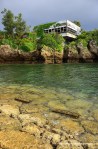

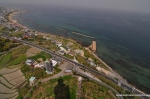
A famous temple, stunning views of the Seto Inland Sea, a historical battle. What else do you need to attract tourists? Right, an aquarium! The Yashima Mountaintop Aquarium (屋島山上水族館, Yashima Sanjo Suizokukan) was opened in 1969 and reopened as the New Yashima Aquarium (新屋島水族館, Shin Yashima Suizokukan) in 2006. In-between some (not so) smart businessmen took advantage of the Japanese asset price bubble (1986 to 1991) to build some rather big hotels on Yashima, creating way more beds on the 300 meter high mountain than necessary. Because let’s be honest: Yashima is a daytrip location, not a place to stay overnight. (Heck, I made it a daytrip although I live in Osaka!) Around the turn of the millennium most of those new hotels were already forced to close, only a few smaller ryokan north of Yashima Temple survived. It seems like the closed hotels were still standing there when Nippon No Haikyo was written in 2007, maybe for two or three more years – when I visited in late 2011 most of them were gone… The Lost Ruins of Mount Yashima.
(I used this posting for a big update of my *Map of Demolished Places in Japan* – it’s really worth a look!)

Read Full Post »

« Newer Posts - Older Posts »