All abandoned: Chernobyl / Pripyat, Nara Dreamland, Anti-Zombie Fortress, Japanese Sex Museum – and many, many more! Plus: North Korea Special – 2 trips, 16 days / 14 nights! As seen on CNN…
Some locations just have a sound to them that is irresistible, places you want to visit purely based on their names. Like the *Abandoned Japanese Sex Museum*, *Nara Dreamland* or the *Zone of Alienation* – names that create images even without knowing anything about them. When I heard about the Olympic Ruins Of Sapporo I knew I had to see them at one point or the other. There have been only 21 Olympic Winter Games so far and although the ones in Sapporo were held 40 years ago I was stunned to hear that some of the locations were abandoned – which, admittedly, is kind of naïve given the fact that even some event locations of the Olympic Summer Games in Athens (2004!) are already abandoned!
Since my first day in Sapporo was surprisingly sunny and I had some time to kill till my fellow explorer would arrive, I took the opportunity to not wait for a second trip to Hokkaido and have a look at the Olympic ruins right away. Sadly the whole thing sounded a lot better in theory than it ended up to be…
First of all: The skiing season in Hokkaido starts in early December, but I was in Sapporo in late November – so there were no buses running, only taxis. When I told the (female) train station staff that I will walk instead I was taken away by a prime example of a typical wave of Japanese surprise and disbelief. Still hilarious even after six years…
5 kilometers, 400 meters altitude difference and 1.5 hours later (I took my time…) I finally reached the Olympic Ruins Of Sapporo 1972. In the 1972 Winter Olympics this area was the bobsleigh goal house – the track was constructed from reinforced concrete between October 1969 and January 1972 for 433 million Yen and highlighted by 127 lamps for night runs. After Nagano was rewarded the 1998 Winter Olympics the bobsleigh track in Sapporo (1563 meters long, 132 meters vertical drop, 14 turns) was dismantled in 1991, but the goal house wasn’t.
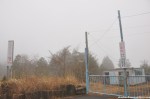
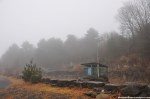
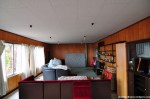
Since I was stopping by at another location first it was already getting dark by the time I arrived halfway up Mount Teine. The area around the bobsleigh goal house was covered by snow completely, making it difficult to approach safely and impossible to reach the back area and the green shack halfway up a slope. I was able to enter the basement though, where all kinds of crap and some heavy machines were rotting and rusting. Sadly I forgot my flashlight at the hotel, so I wasn’t able to enter the ground floor or the first floor, both in a quite dilapidated state anyway. It also made me hurry quite a bit so I would get back to civilization at daylight to limit the risk of breaking some body part due to black ice or getting run over by one of the few cars speeding up and down the mountain. Furthermore I am a jeans and T-shirt guy all year round, not well prepared for winters since there are no winters in Osaka… and it got pretty friggin cold up there after a while, especially after the sun was hiding from about 3 p.m. on!
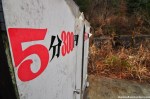
So in the end it was a quick look at an unspectacular location, but I was able to take some photos of an abandoned building with the Olympic rings on it – and that made me feel like a winner!
Abandoned Kansai in Hokkaido… Who would have thought that? Up till now I never made it further east than the center of Japan’s main island Honshu. I limited myself to the western half of Japan, because that was the reason I started this blog. Heck, initially I wanted to limit myself to the Kansai region; hence “Abandoned Kansai”, not “Abandoned Japan” or “Abandoned West Japan”. But then the “once in a while” hobby urban exploration turned into a regular thing and only weeks later I went to different regions, then to different islands – and in spring of 2012 I did a *haikyo trip to Okinawa* together with my urbex buddy *Michael Gakuran*. “What’s next?” was the big question, and the answer was found quickly – we already explored Japan’s most western prefecture, so we kind of had to explore Japan’s most eastern prefecture, Hokkaido!
Usually I plan my urbex trips on short notice. One time I brought my urbex equipment to work on Friday to see how I feel during the day, booked a hotel in the afternoon and left for a weekend trip right after work. Flexibility like that is impossible when partnering up for a long distance trip, so Michael and I booked plane tickets weeks ahead – and according to the weather forecast we ended up with a rainy weekend; a long weekend even, to which we added some days. Luckily the forecast was as reliable as always in Japan and so 4 out of my 5 days in Hokkaido were sunny and slightly snowy, only the last one came with 8° Celsius and rain.
Since I arrived almost a day earlier than Michael the original plan for me was to do some sightseeing in Sapporo. To my surprise the weather was sunny to cloudy, no rain at all, so instead of visiting indoor classics like the Sapporo Clock Tower, the Ishiya Chocolate Factory or the Sapporo Beer Museum I opted for a little hike to Mount Teine, once home to some of the sports events at the 1972 Winter Olympics in Sapporo. One day of good weather? I had to take advantage of that! Then it turned out that the next three days were pretty nice, too – which is a big advantage when doing urban exploration as you spend a lot of time outdoors…
On the last day Michael and I split – while he drove for hours to infiltrate a location he asked me to keep secret for now, I went on to do some really touristy stuff, like visiting the old harbor town of Otaru and taking a glass blowing lesson. My favorite touristic place though was the Sapporo night view from the freshly renovated observation platform on top of Mount Moiwa – stunningly beautiful! It was soooooo cold up there, but the view was absolutely amazing! I went there on the first day before visiting the Sapporo White Illumination and I strongly recommend to pay Mt. Moiwa a visit – I would love to shoot a time-lapse video from up there…
Overall the trip to Hokkaido was a great mix of urbex and tourist stuff. Five days I really enjoyed, probably more than any five consecutive days I spent in Osaka this year… So this is a list of the abandoned places I ended up visiting:
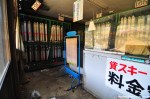
Advantest Research Institute Bibai Bio Center Canadian World Park Hokkaido House Of Hidden Treasures Horonai Coal Mine Substation Mt. Teine Ski Lift
National Sanatorium Sapporo Olympic Ruins Of Sapporo 1972 Sankei Hospital
Sapporo Art Village
Showa-Shinzan Tropical Plant Garden Tenkaen – Japan’s Lost China Theme Park
Expectations are one of the worst things in life. Especially when they are as high as mine were driving up to the top of Mount Noro in Hiroshima prefecture. What did I expect? A speedway abandoned in 1974 and a shuttered amusement park, also left behind in 1974. I didn’t see any photos in advance, but I read a slightly cryptical Japanese description and the satellite view on GoogleMaps was very promising. Sadly the location didn’t live up to the expectations, so *Michael* and I were about to face the first disappointment of our *road trip to southern Honshu*… which wasn’t as bad in retrospect.
Mount Noro (insert stupid joke about the Noro virus in Japan here) near Hiroshima is one of the city’s most popular recreational areas for hikers, mountain climbers, campers and flower lovers. It’s said that it offers a stunning view at both sunrise and sunset. Aside from the fact that Michael and I were way to too late for the first and way too early for the second we wouldn’t have been able to see either anyways – the 839 meters high mountain was covered by low hanging clouds from about its second half. Occasionally the visibility was only a couple of meters and it looked more like rain than clearing up. When we reached the entrance of what I hoped would be the abandoned Mount Noro Speed Park (a.k.a. Mount Noro Circuit) at an elevation of 830 meters (Japanese people like their race tracks high above sea level as we know from the *Hiroshima Kart Pista*) we realized that the place was reused at least once since we were welcomed by signs telling us that we found the Moriyama Auto Camp. Close, but no cigar…
It turned out that this location has quite a history. A history I only found out about after we visited the place – like I mentioned earlier: Before our visit I had only vague information about a racetrack and an amusement park. The Mount Noro Amusement Park was a typical mid-size theme park of the 60s with a couple of merry-go-rounds and a rollercoaster, and it opened in April of 1968. In close proximity the Mount Noro Speed Park followed with an opening ceremony in October 1969. The intent was to make Mount Noro more attractive for tourists. As we all know: Those hiking eco freaks that headed for the mountain until then weren’t spending much money while amusement parks were THE cash cows of 1960s Japan, where the tired workers of the East Asian Wirtschaftswunder (economic miracle) were looking to spend their hard earned bucks. Sadly the business people behind the big tourist plans didn’t expect two things to happen: The traditional nature lovers complained about the dramatically increased noise level on Mount Noro – and in 1973 / 1974 an oil crisis hit the world. The combination of those events forced both the amusement park as well as the speedway to close their doors for good in 1974. Which was incredibly sad in the case of the 932 meters long and technically quite demanding Mount Noro Speed Park as it was quickly used for races of national fame, including the “All Japan 200km Stock Car Race” which was held annually from May 1970 on.
Sad for Michael and I was the fact that the weather was bad and that the race track was in such horrible state we weren’t even sure we found the right place – especially with those Moriyama Auto Camp signs at the entrance. We entered the place (adults 500 Yen, children 200 Yen, cars 3500 Yen…) and were quite a bit confused about the routing along the slope, which seemed rather unusual for a speedway. And the empty pond with the garbage cans also didn’t really fit in. Down the road we reached a bifurcation – left: Moriyama Auto Camp; right: Moriyama Auto Camp. Well, that didn’t help much…
We continued to the left only to find a huge abandoned trailer advertising Fukutome Ham, the inside filled with some seats (no meats…), garbage and a seriously damaged suzumebachi nest. For those not aware of this danger for all urban explorers and hikers: suzumebachi are also know as Asian Giant Hornets (Vespa mandarinia), aggressive nasty beasts with a body length of 5 cm and a sting that injects large amounts of potent poison, potentially deadly for both other animals and humans.
We continued up the mountain along the seriously damaged asphalt road only to find half demolished bath rooms at what once was the pit lane of the speedway. The surrounding building was gone, making all the faucets, toilets and showers open air installations. 300 Yen for 5 minutes was written on the shower doors, the curtains behind moldy and nasty.
Further down the pit lane, a bit above the race track, we found a two-storey building. The lower floor once housed a restaurant and I guess it dated back to the speedway days. The upper floor once was the home of somebody. Quite an unspectacular house with the usual remains of an abandoned building.
On the way back to our car we saw a camping trailer next to the former race track. It looked way more modern than anything else on the premises, so I kept a safe distance while Michael had a closer look. Through the window he saw a calendar from 2012 and a working clock, so we wondered why somebody would rather live in a trailer than in the furnished room in the building three minutes away – and decided to leave as none of us were eager to ask the person who made this choice.
Right at the entrance we had a closer look at the attendant’s hut with the charming painting. I guess the previously mentioned empty pond once was an attraction of the Moriyama Auto Camp – rainbow trout fishing. The hut also revealed that the now abandoned area had a size of 71000 m2 and once offered 40 campfire places – just not right before it closed as this information was blacked out on the flyer. Reason for the leaflet was the opening of the place on July 1st of an undisclosed year. Leaving the hut my eyes caught one final item, the flyer of a Bihoku Auto Village, announcing its grand opening on June 26th 1999. I was confused. Same place, again a different name? Luckily not as it turned out later – just the flyer of a similar place elsewhere in Hiroshima prefecture… (And still in business!)
I never went camping in Japan and obviously I was disappointed that the expected abandoned race track turned out to be a converted one, but the rainy / foggy weather was a blessing in disguise. Walking along the seriously damaged speedway with that kind of weather created quite an eerie atmosphere I actually enjoyed more in retrospect than I was aware of at the time. But it took quite some effort to find out about and get to the Mount Noro Speed Park / Moriyama Auto Camp as to my knowledge it hasn’t appeared on any other urbex / haikyo blog yet… Would I spend that much time on it again? Probably not. Do I regret having it done? Definitely not! I especially enjoy exploring new kinds of abandoned locations, especially if they are in the middle of nowhere. And in that regard this haikyo was a great success – I’d always prefer my first abandoned auto camp over the 20th abandoned hotel!
Spring time is long weekend trip time! While Kansai doesn’t have much of a winter it nevertheless can be quite cold, especially when having a hobby involving taking pictures in abandoned places, other places of Japan can be snowed in for months with meters of snow… So when the sun finally warms the hearts of Japan and causes the first sunburn of the young year it’s time to explore places beyond my beloved Kansai – whether it be *Kyushu with Enric* two years ago or Shikoku with Gianluigi last year (a series of articles yet to come…), it became kind of a tradition for me to go on an urbex spring trip with a friend of mine. This time *Michael Gakuran* and I teamed up for a road trip to the southern end of Honshu, Japan’s main island – Chugoku, to be exact, the area west of Kansai. A trip with such exciting places that I decided to start writing about it right away – the last pictures are barely 50 hours old…
At this point I don’t want to give away too much about the locations we visited or which order we visited them in. But there were 8 of them in 3 days. 3 long days I might add, with me getting up at 6.30 a.m. on a Sunday, at 6 a.m. on a vacation day and at 5 a.m. on a national holiday. As I mentioned before: I’m a morning grouch; and by “morning” I mean any point in time which is followed by “a.m.”…
But the trip wasn’t just exhausting, it was also exiting, fun, frustrating, satisfying, rich in variety, surprising, delicious (I finally ate Hiroshima Okonomiyaki in Hiroshima prefecture and bought the best local sweets outside of Kyoto – mikan dango) and insanely expensive.
Why insanely expensive? It’s because at the end of the first day a serious mishap happened to me. We were on our way to a hotel to stay for a night when we saw this huge, blue and white flame at a gigantic industrial plant – probably coke oven gas burning at a cokery. (Addendum 2012-06-11: I guess I was wrong about the gas – Gert from South Africa wrote me: “This couldn’t be coke oven gas burning, because coke gas got a very very hot orange (impurities) or yellow (cleaner) flame. But the flame in the video is actually blast-furnace or corex, midrex, finex gas flame (more methane content in gas).” Thanks a lot for pointing that out! I really appreciate it and changed the title of the video below, too.)
We decided to make a stop to take picture or two and when I got out of the car to marshal Michael I grabbed my bag and I don’t know how or why, but my beloved D90 camera flew through the air and crashed hard to the concrete ground. The body cracked open a couple of millimetres so I could see the insides. Parts of the electronics were still working (e.g. I could use the screen to look at the photos on the memory card), but since the lens mount was part of what cracked it was impossible to take pictures anymore. Mad props to Tokina BTW! The mounted 11-16mm lens survived without a scratch or any other damages as I found out with relief the next day.
Sunday evening past 7 p.m. – of course I was in shock at first, because going on a photo trip without a camera is pretty pointless. So we headed towards the flame to take some picture which I couldn’t do since my photo camera broke and Mike couldn’t do because of the lighting, lenses and passing traffic. So I took the video you can find below the article – it doesn’t fully capture the beauty of the flame, but it will always remind me of the death of my favourite camera so far (I also included the last JPG I ever took with it, even though it wasn’t related to urbex). Back at the car we decided to look for an electronics store, although it was almost 8 p.m. on a Sunday evening. After a couple of minutes we found a shopping mall, but it didn’t have a camera store. The staff at the mall was very nice, telling us where to find an electronics store – but it closed at 8. Michael, who did all the talking since his Japanese is WAY better than mine, wasn’t discouraged by that and asked for the phone number of the store. Although the store was closed Michael called and somebody picked up. He told them my tricky situation and they agreed to let us into the store if we hurry – so I got into a taxi and went straight to the store. There a guy with pretty decent English helped me at the camera department. I was hoping to replace the D90 with another one, but they didn’t have them in stock. A lower model was out of the question, so the only option was a D7000. Which they didn’t have in stock either. Just the display model – which they couldn’t sell me without the kit lens since it was a display model. After some deliberation and the certainty that not buying that display model would mean losing at least 5 hours the next morning looking for another camera (electronic stores in Japan usually open at 10 a.m.) I half voluntarily upgraded from a Nikon D90 to a Nikon D7000. With a bad feeling since I not only spent a huge chunk of money, but I also had to learn by doing how to handle a new camera. While I’m very pleased with how the photos of all locations turned out it was quite unnerving at times to get the shots I wanted to take.
Now just a few quick words about the locations we visited. The undisputed highlight of the tour was the abandoned Japanese Sex Museum. Both Michael and I had high expectations and we were not the slightest disappointed, shooting in almost complete darkness for the majority of the 4 hours we spent there. Another glorious highlight to me was the Kart Pista Hiroshima race track – why it was a highlight you’ll find out soon. Since theme parks are one of my favourite types of abandoned place we visited two of them and I loved them both. 4 world class haikyo in 3 days – plus 2 good ones (a Meiji Era army fortress and a quite tricky hotel) as well as 2 more we took pictures of because we went there and it would have been a waste not to cover them… a strip bar in an onsen town (euphemistically called “theater”) and a car camp site. To my knowledge all of these places never appeared on English speaking blogs, some of them are even unknown to the Japanese urbex crowd. So please enjoy the preview pictures and come back for much more information, photos and about one hour of video material!
The Mt. Hiei Artificial Ski Slope is an abandoned ski resort near the top of Mount Hiei on the border between Kyoto prefecture and Shiga prefecture. Famous for its Enryaku Tempel and the Kokuhoden Museum this holy mountain was once thought to be the home of gods and demons in the Shinto belief system. Interestingly enough the predominantly religion on Mt. Hiei has always been Buddhism. The monk Saicho founded the Enryaku-ji in 788 as the first outpost of the Tiantai / Tendai sect and it remained the Tendai headquarters till this very day, although it was famously destroyed by Oda Nobunaga in 1571 to vanish the rising power of the local warrior monks, killing about 20,000 people (including civilians) in the area. The temple was rebuilt soon after and is one of the main tourist attractions in Shiga prefecture today, accessible via two cable car lines, several beautiful hiking trails and a toll road for cars, motorcycles and busses.
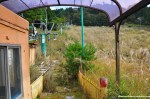
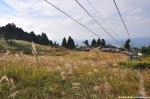
Along the “Kitayama East Course” lies the Mt. Hiei Artificial Ski Slope, probably the most visited haikyo in all of Japan. On an average day during the hiking seasons in spring and autumn you’ll never be alone in the area as people are constantly passing by – about half a dozen hiking trails meet here and a close-by cable car station, serving the longest funicular line in Japan, attracts hundreds of people a day. Most hikers barely notice the abandoned ski lift and ski slope, hardly anybody peeks through the broken windows of the gear rental store or has a look at the undamaged closed restaurant. Why wasting a thought on that ugly stain when the surrounding nature is of such beauty? Because beauty lies in the eye of the beholder and though the ski resort on Mount Hiei was rather small it nevertheless offers a few neat angles now that it is abandoned.
Wanna know some facts about the resort? Okay, this is what I was able to find out: The Mt. Hiei Artificial Ski Slope was opened in 1964 and on November 1st of 2002 the newspaper Kyoto Shimbun reported that the ski resort was closed for good after a hot summer in 2000 and a way too warm winter in 2001 – followed by a year of temporary closing; which explains why both the restaurant and the rental store are still stocked with all kinds of items. In the almost 40 years of operation the already mentioned facilities welcomed customers for both a summer and a winter season. In winter a combination of natural and artificial snow (provided by a snow gun) offered fun for the whole family, in summer grass skiing was the business of choice. A lift transported guest for a distance of 170 meters so they could enjoy the pretty short slope of up to 200 meters with a vertical drop of 38 meters.
Oh, before I forget: The nearby “Garden Musem Hiei”, a flower park, once was an amusement park with a haunted house, a small Ferris wheel and a viewing platform, but I guess it was converted quickly enough to never been considered abandoned.
And that’s it for now from Mount Hiei. For now, because the ski resort was actually my second urbex trip there and my fourth or fifth overall – I really like Mount Hiei! Next time I’ll take you there I’ll either show you an abandoned rest house on a steep slope or a mysterious construction I’ve never seen anywhere else on the internet…
I can’t even remember how I found out about the Karadate Golf Center in Himeji. In late 2009 / early 2010 I did quite a bit of research about abandoned places in Japan and I guess one of the leads I had was that one. I just remember that I didn’t even found pictures, just a Japanese list of (operating) driving ranges – and that one of them had a footnote that it was closed / demolished. When I went to an abandoned shrine in Himeji in July of 2010 I went to the Karadate Golf Center, too, since it was only a few kilometers away from the shrine.
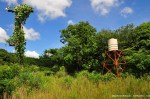
Located on top of a small mountain close to Mount Shosha (a filming location of “The Last Samurai” with Tom Cruise and Ken Watanabe) the Karadate Golf Center offered a stunning view on Himeji and the Seto Inland Sea, but due to its rather remote location (a couple of hundred meters away from the next houses at the end of a now too abandoned winding road) I guess it wasn’t a financial success – and the competition for driving ranges is tough in Japan! At the time I went there GoogleMaps still showed the driving range and a small building in satellite mode, but now these remains are only visible when switching to map mode. When I went there I found the golf center gone, with only a few signs left that it has ever been there: A fence, some bricks on the ground, a water tower, a lamp post… The driving range itself was almost completely overgrown, only two baskets sitting on the ground in the northern part. Unless you have a faible for old lamps the Karadate Golf Center is a demolished and hence uninteresting haikyo. But of course I had to see it for myself… And the view there was really nice!
Bathing is a very important aspect of Japanese culture, deeply rooted in centuries-old traditions. Although most apartments and houses have their own baths nowadays (unlike 30 years ago), public bath houses are still popular even in residential areas of big Japanese cities. Onsen and sentō are gender-separated places of tranquility where people enjoy a relaxing hot bath (usually around 40°C) after a hard day of work or an intense workout. Onsen towns in the middle of nowhere are popular vacation destinations for the Japanese domestic tourism and a must see / do for many foreign visitors.
Waterparks with slides and wave pools on the other hand are not nearly as popular in Japan as they are in the States or Europe. Most of the time they are considered one amongst many attractions of amusement parks (like at Nara Dreamland) – and indoor waterparks are even more rare.
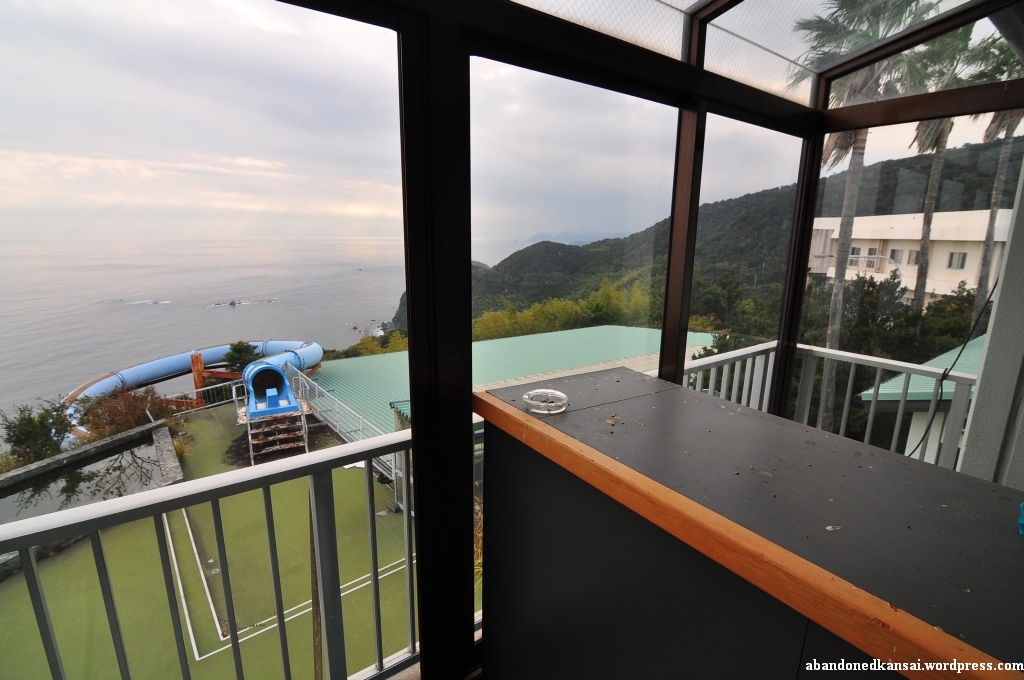
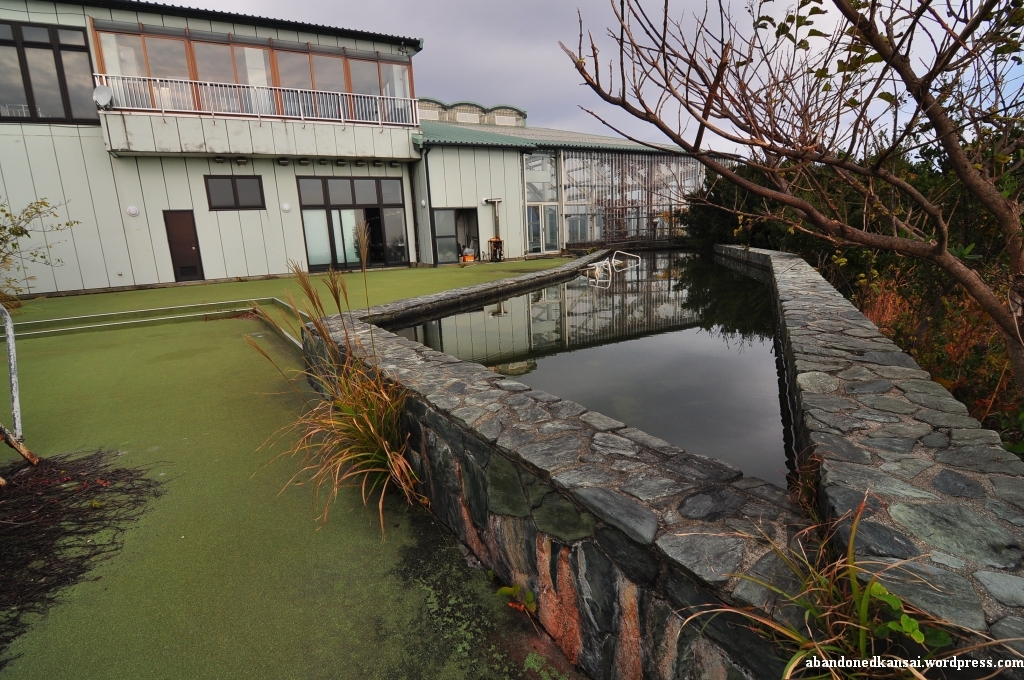
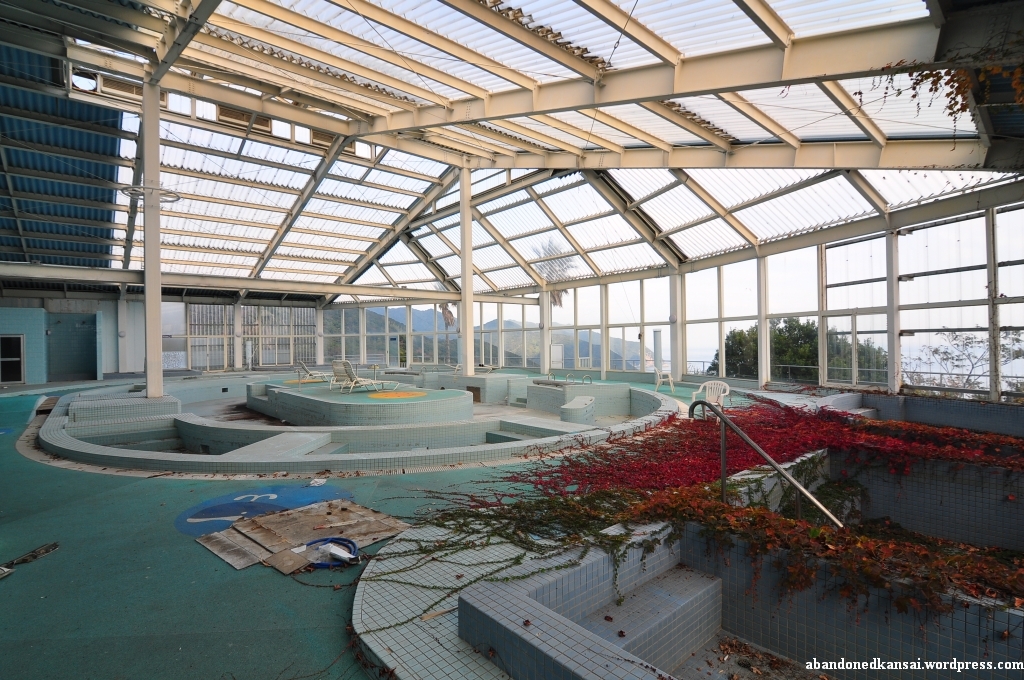
From what I was able to find out the Tokushima Countryside Healthspa (お水荘ヘルスピア), an indoor water park with some hotel rooms, was opened in 1975 (under a different name) to complement a countryside farm, attracting visitors with millions of flowers. It was renovated and expanded in 1994 to be re-opened under its current name – making dance shows and karaoke new selling points. Due to its remote location (35 minutes by bus from the next train station) and the economic crisis the number of guests decreased while the debt piled up to 800 million Yen – and lowering the entry fee from reasonable 1700 Yen per day (10 a.m. to 10 p.m.) with special promotions (Ladies Day on Thursdays for 850 Yen and Friends Day on Fridays for 1000 Yen) didn’t help either – at the end they reportedly sold tickets for as low as 100 Yen… So in 2002, after 27 years, the lights went out at Tokushima Countryside Healthspa.
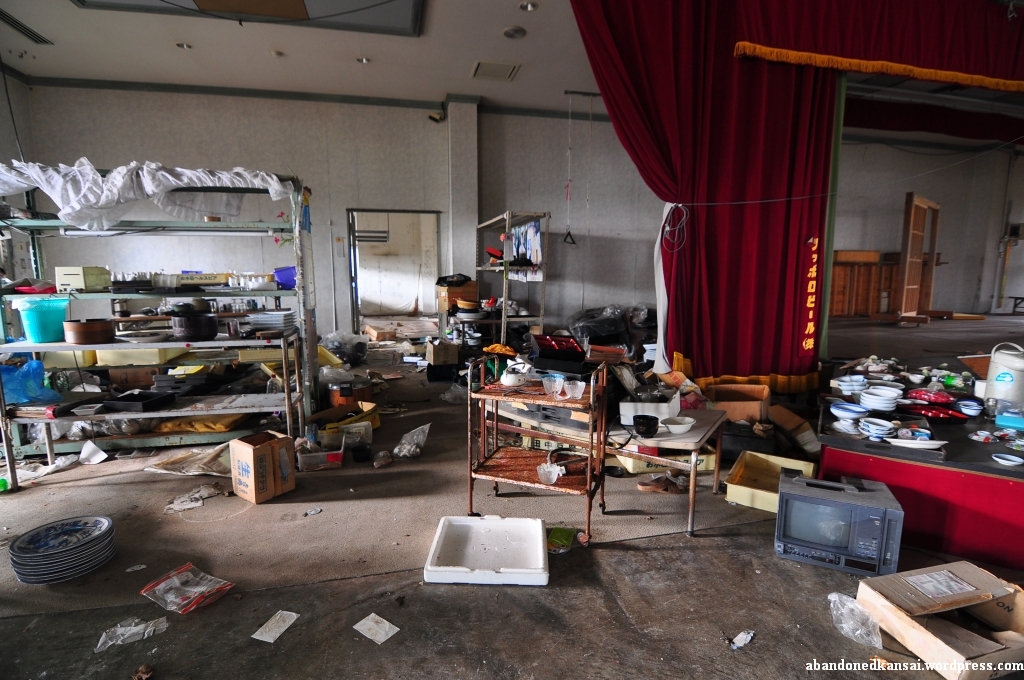
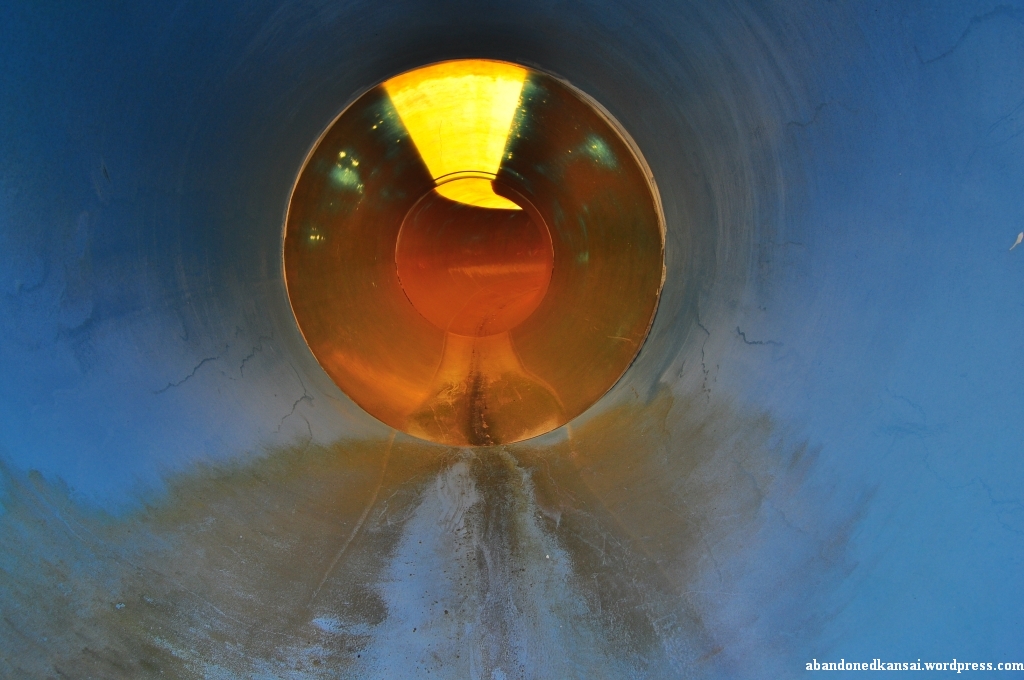
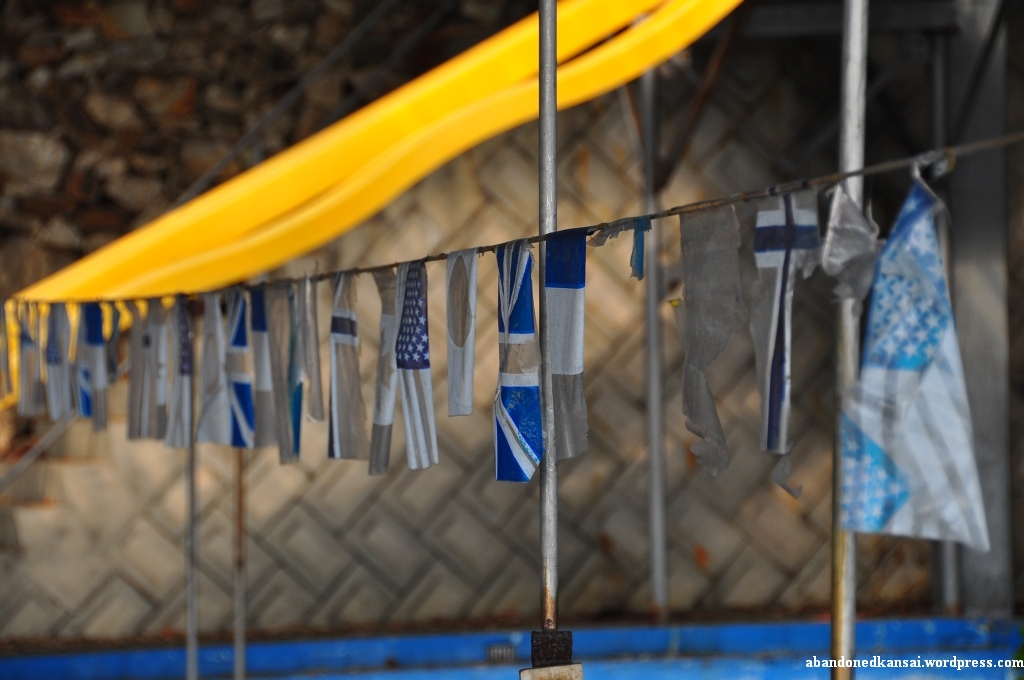
I have to admit: I love indoor waterparks. It’s one of the few leisure activities I really miss living in Japan. Back home in Germany you can find quite a few abandoned public swimming pools, indoor and outdoor, but no abandoned waterparks. So I enjoyed every minute of the two hours I spent there. The hotel part was quite vandalized and rather boring, so I left it rather quickly to go over to the swimming pools and the waterslide. On the way I passed a kitchen and some functional rooms. In two of them quite a few goods and training equipment were lined up, here and there I found price tags scattered all over the place – it seems like the owner tried to sell as much as possible before closing for good. The now empty main pool looked pretty much like a rather local indoor water park in Germany and I loved how red and green leafed plants were growing inside; if there ever was a zombie attack you know where to go to if the Shime Coal Mine is already occupied – if you know what I mean…
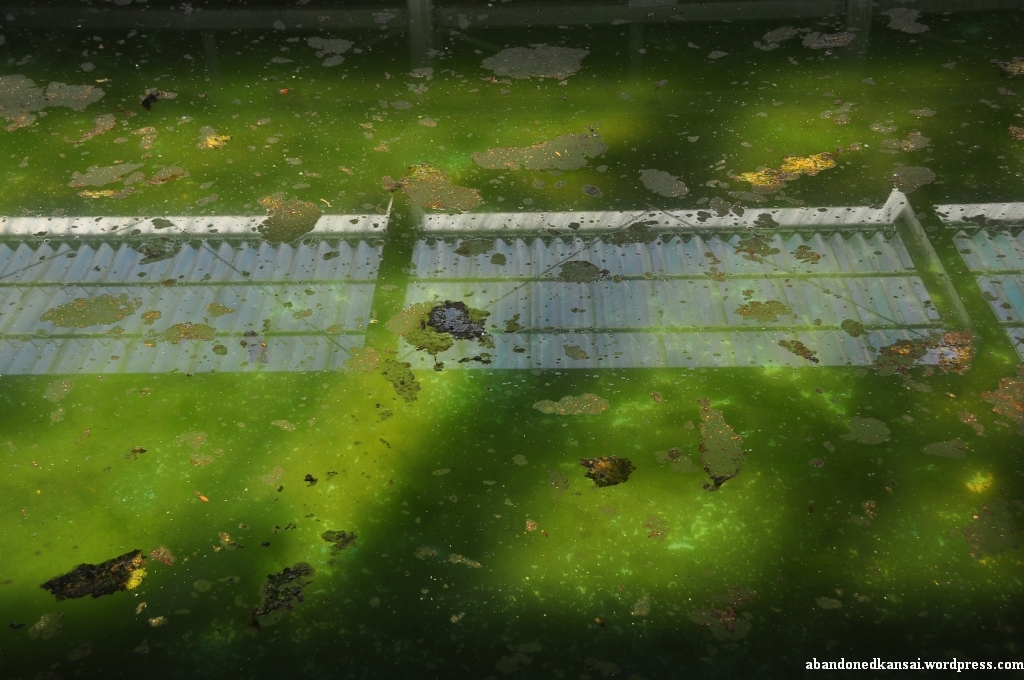
The outside waterslide at the bold cliff looked absolutely amazing, the weather just contributing to the atmosphere, so please have a look at the videos, too. Next to the waterslide was a staircase leading down to a pool, now filled with moldy brackish water, two dead greenish doves lying at the pool edge. Again, amazing atmosphere – kinda spooky, but not dangerous at all; neither physically nor in the form of security or other “guests” thanks to the remote location.
Like pretty much all of the previous and upcoming locations of my Haikyo Road Trip To Shikoku the Tokushima Countryside Healthspa was a unique, relaxed and fascinating place to explore. Shikoku, an urbex heaven!
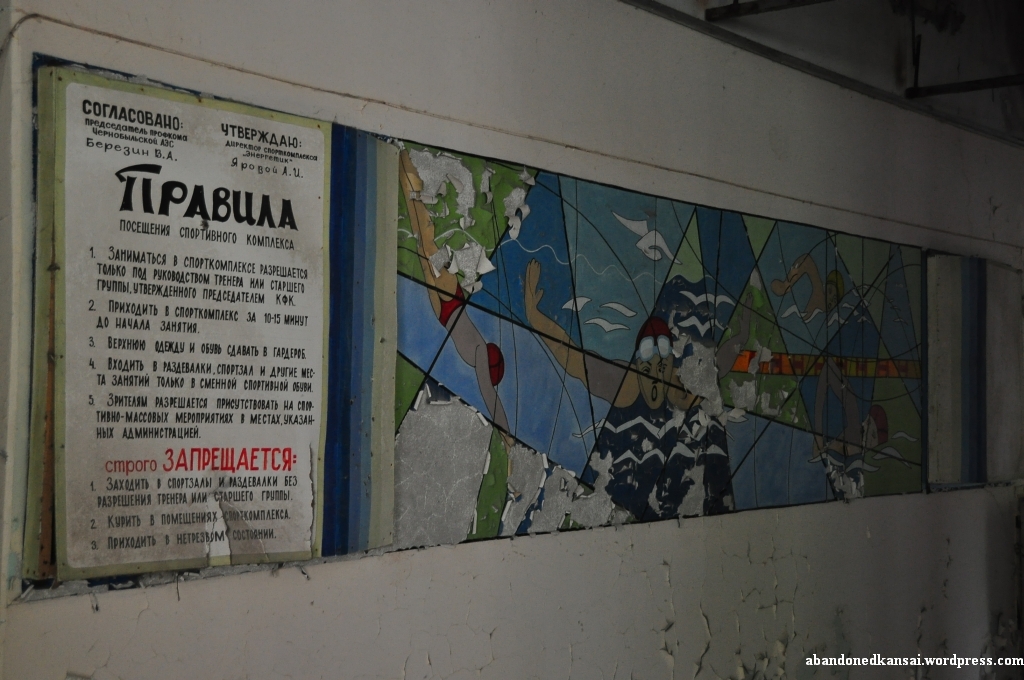
After enjoying the stunning view from the roof top of an apartment building in Pripyat’s north we drove back to the center of the city to visit a classic sightseeing spot pretty much all visitors to the Zone Of Alienation and quite a few fans of video games know very well – the swimming pool “Lazúrnyj” (Azure).
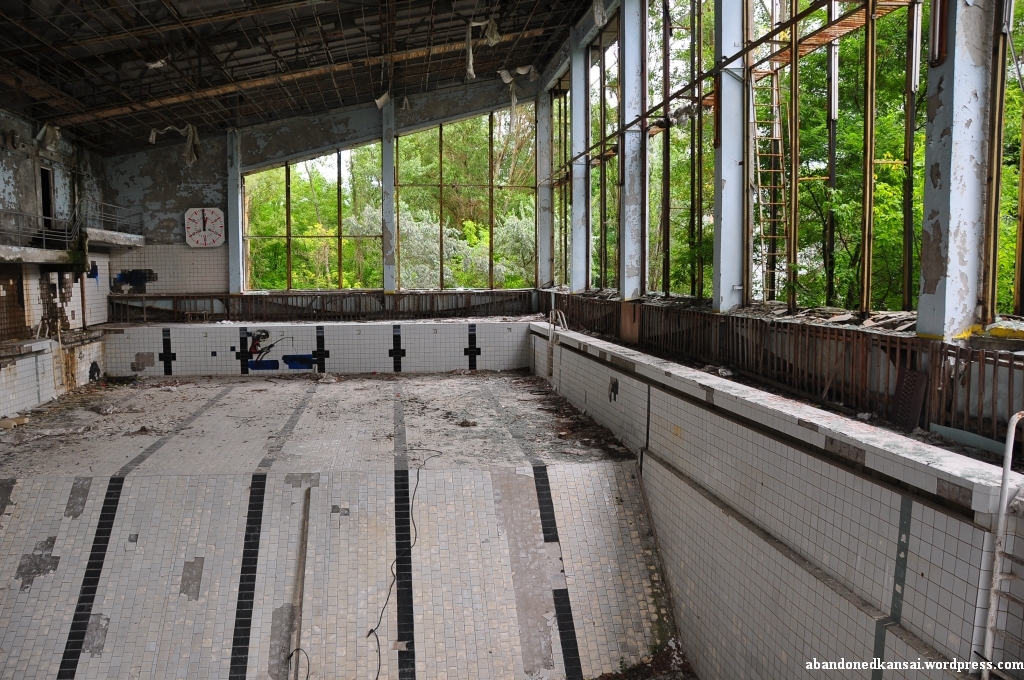
Although being one of actually three indoor swimming pools in Pripyat, Azure is by far the most famous one in town since it was featured as a level in the video game “Call of Duty 4: Modern Warfare” and now is part of the standard program for day groups. Furthermore Azure wasn’t just a swimming pool, it also housed a gymnasium – and it wasn’t abandoned right away with the city according to Maxim. Liquidators and other people working in the Zone Of Alienation used the pool as long as 1997 when it was finally abandoned – sadly there are no photos available anywhere about the that period of time.
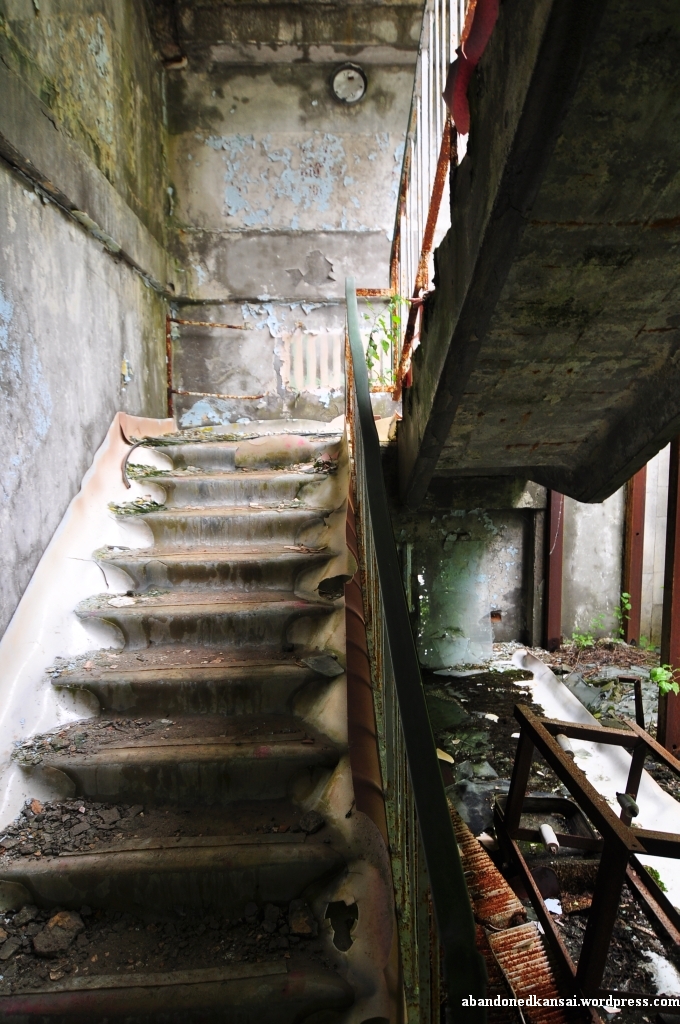
Since I took some outdoor pictures first I lost contact with the other guys even before entering the building. The entrance area looked pretty run-down and vandalized, so I made my way up the first staircase I saw – it was covered in plastic sheeting, now scruffy and cracked. Public baths, especially in Japan where I currently live, are supposed to be spotlessly clean, but of course Azure was in as bad shape as the rest of the city and therefore the building felt even a little bit more depressing. The rather small gymnasium wasn’t nearly as impressive as the huge one with the great view at the Palace of Culture, but the swimming pool itself was quite a sight, even without having played the previously mentioned video game.
(If you would like to know more about my trip to the Zone Of Alienation please *click here* to get to the “Chernobyl & Pripyat” special. For a map of the area please *click here*.)
The Palace of Culture was a typical institution of the Eastern bloc. The huge buildings were the meeting point for people to enjoy all kinds of recreational activities like sports and arts – and of course they were used for political indoctrination. The PoC usually included a cinema (some of them with several screens), a concert hall, dance studios, a swimming pool, study halls, a boxing ring, rooms with a variety of instruments, an area with tools for all kinds of do-it-yourself stuff and many, many more things – and of course Pripyat had a Palace of Culture, too, being one of more than 137,000 in the Soviet Union in 1988…
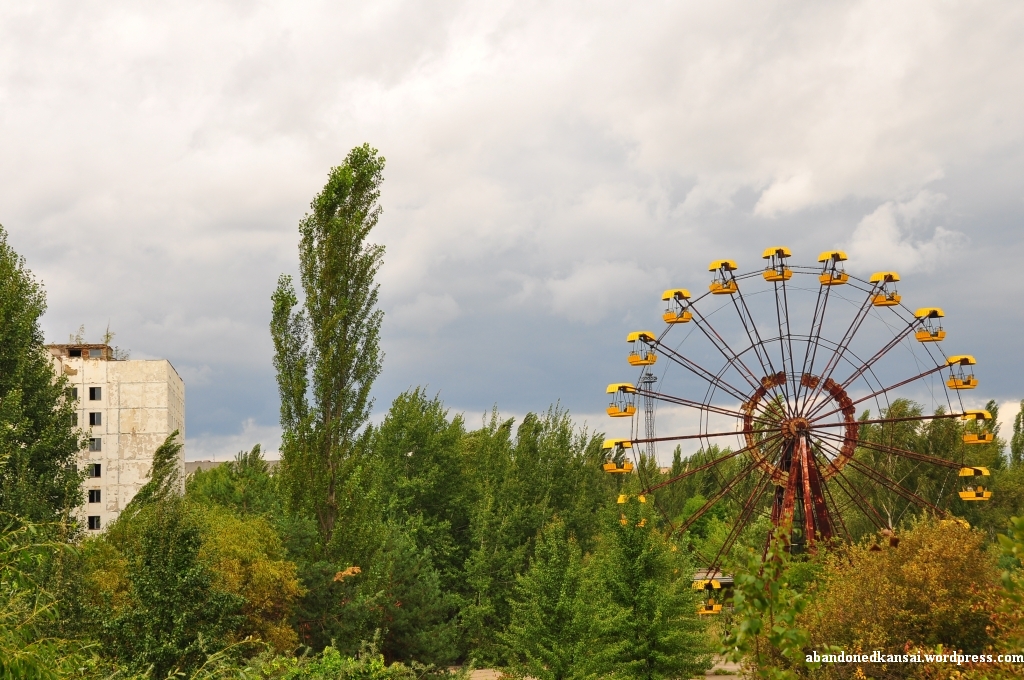
Energetik, the local Palace of Culture, was located directly at Pripyat’s center square, Lenin Square, and nowadays is one of the most visited locations in the world’s most famous abandoned city. One reason is that Energetik is on the way to everybody’s favorite Pripyat motive, the amusement park’s ferris wheel – the other is that the building offers a lot of variety on a relatively small space. Crossing Lenin Square Maxim was raving about how beautiful the place must have been 30 ago, given that the huge open space once was the home of a good part of the previously mentioned 33,000 rose plants.
I, on the other hand, was just fascinated by the unique, sad beauty that makes Pripyat what it is today. Struck by awe I entered the Palace of Culture and didn’t even know where to start taking pictures. Anywhere else in the world exploring this building would have taken at least half a day, but I somehow had the feeling that I would have that much time – in the end I had about 50 minutes…
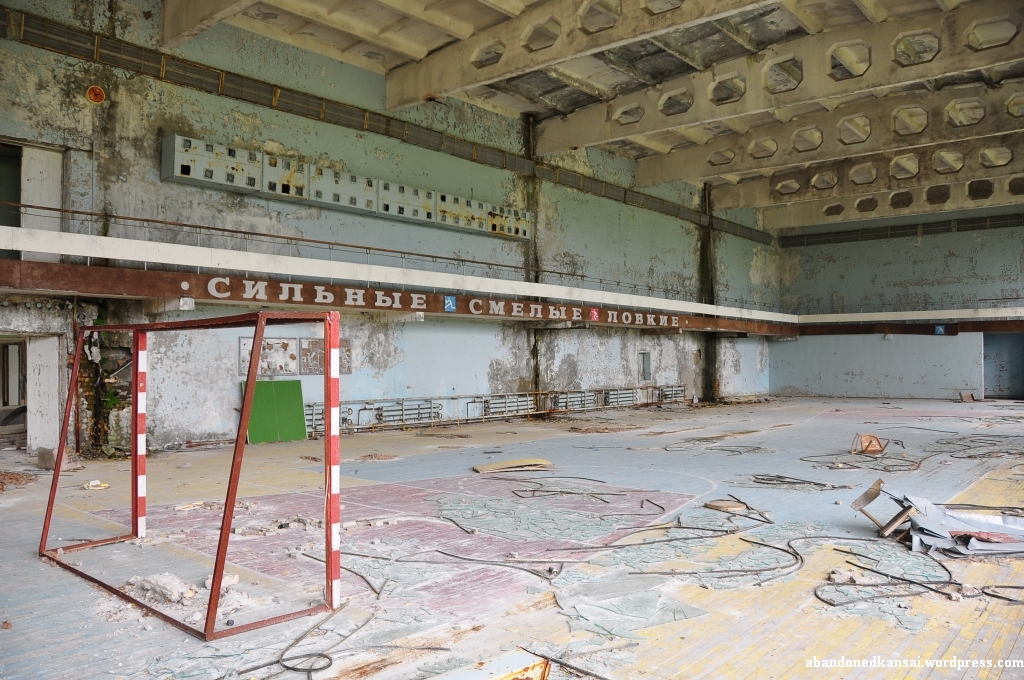
Pripyat’s Palace of Culture is actually in pretty bad shape. Like most other buildings in the zone there isn’t a single window still intact, so the forces of nature – up to 40 degrees Celsius in summer, down to minus 20 in winter – did quite some damage in the past; and having tourists visiting the place every other day doesn’t help much either I guess. Most of the rooms were severely vandalized (a long time ago though!), the cinema barely recognizable. Bushes and little trees were growing inside of some rooms and many of the mural paintings were crumbling away…
Exploring the different kinds of rooms was an amazing experience, but one moment stuck with me in a special way. It happened when I walked through a hallway towards what I assumed was the main gymnasium in the building. As I entered the huge room I looked outside the gigantic front of window frames and saw the famous ferris wheel 100 meters away in the background. Unexpected and absolutely mind-blowing… still gives me goose-bumps when I think back now.
Sadly only a couple of minutes later Maxim made us hurry-up for the first time – the amusement park was waiting just for us…
(If you would like to know more about my trip to the Zone Of Alienation please *click here* to get to the “Chernobyl & Pripyat” special. For a map of the area please *click here*.)









































 Abandoned Kansai