Feeds:
Posts
Comments

Archive for the ‘Visited in 2014’ Category

I love unique abandoned places. Deserted *hotels* and *schools* you can find by the dozen in Japan, even desolate *amusement parks* are plenty all over the country; though their number is decreasing. But when I explored this cinema / theater / community center somewhere in the mountains of *Tohoku* I instantly fell in love with it.

From the outside the building didn’t look like much, a greyish boarded-up construction the size of a barn with a simple sign in Japanese above the locked entrance: 講堂, auditorium. Before I could even look for another way inside, Ben and Michael already grinned at me through a window. One hop later I stood on a brittle wooden floor with a few holes where previous explorers crashed through with one foot. Looking for nails I figured out where the supporting beams were and took a couple of photos in the room I was in before going to the main storage in the back. There was a plethora of items scattered on the ground and an old bike standing in the middle of the room. The most interesting objects though were a can of Tyrolean Cheese and another one labelled “QBBチーズ“, QBB Cheese. Austrian cheese and Australian cheese. I wonder whether whoever bought them did it on purpose or not. I understand the Austrian cheese, but Australia never stroke me for being famous for its milk products.

From the back I went through another brittle side room to the main auditorium, where several rows of rusty seats offered space for about 150 people. Sadly it was overcast outside, which made it hard to take pictures without a tripod in the main room – and even worse in the basically pitch-black movie projector room accessible via a small staircase near the main entrance, past the swing doors. Luckily I brought a tripod, but the process was still rather time consuming, especially upstairs in tiny room the with two big “Sun Arc” arc lamp projectors. (I strongly recommend watching the video at the end of this article, it will give you a much better impression of the place than the photos I took!)

It were objects like those projectors, like the cheese cans, like the bike, that made this abandoned auditorium so interesting. Probably my favorite item in the building (aside from the spectacular looking cinema projectors) was a small piece of paper, pinned to the wood next to the stage. It was a 5 point checklist to make sure that the fire extinguisher was okay – and it had seven handwritten, dated remarks on it; the last one from August 7th 1967, Showa 42 by Japanese count. But there was more to discover. Old stuff you don’t get to see much these days, like an all kanji bathroom sign and the concrete urinal at the men’s restroom; that must have been a challenge to clean. Probably with the powdered soap we found a can / box of on a table in the auditorium’s back.

I think I could have stayed at least another 30 minutes at this truly amazing building, probably 30 minutes in the dark room upstairs alone. Sadly we had to move on, but I am really happy that I had the opportunity to explore this wonderful place!

(*Like Abandoned Kansai on Facebook* if you don’t want to miss the latest articles and exclusive content – or subscribe to the *video channel on Youtube* to receive a message right after a new video is online…)

Read Full Post »

Abandoned or not abandoned, that’s the question more often than not in Japan – and sometimes the answer is “both”, like in the case of the Osarizawa Mine…

Now famous for its abandoned ice blue chemical pools, the Osarizawa Mine’s history spans more than 1300 years, dating back to the year 708, when mining began as a family business. Back then mining for gold began in small tunnels with children as young as five years old. Over the years the mine became bigger and bigger, especially after copper ore was found. The business began to explode, literally and figuratively, when the use of Gunpowder was introduced in 1865. In 1893 Mitsubishi took over and massively modernized the Osarizawa Mine, introducing a telephone system in 1894 and a hydroelectric power station in 1896. At the beginning of the 20th century the mine became essential for Japan’s expansion and war efforts – up to 4500 employees worked around the clock in shifts and carved up to 100.000 tons of copper ore per month from the mountain; the total tunnel length reached 700 kilometers around that time. Soon after the war the Osarizawa Mine became unprofitable; refinement stopped in 1966 and in 1978 the mine was closed altogether. But only temporarily!
Only four years later, in 1982, Osarizawa reopened as a tourist mine called “Mine Land Osarizawa” – complete with a museum, eateries and a gift shop. In 2008, the 1300th anniversary of the mine, the complex was renamed “Historic Site Osarizawa Mine” and continued to be a successful tourist attraction in the northern part of Akita prefecture.

When Ben, Mike and I first arrived there, we had a quick look at the lowest level of the mine, past a Japanese only “Do not enter” sign, where we found some buildings still in use, but also some massive abandoned concrete structures – a few of them already collapsed. 15 minutes later we were back in the car, looking for the already mentioned ice blue chemical pools… and instead found the also mentioned tourist attraction Historic Site Osarizawa Mine. Thinking that we could learn something about the mine and its layout we put down 1000 Yen and joined the (Japanese only) tour – which was quite interesting, but didn’t reveal anything about the layout. Hungry afterwards we enjoyed a tonkatsu burger with edible gold flakes at a reasonable 580 Yen; luckily even a bad burger is still good food…
Minutes later I spotted the pools and a passing group of people from the parking lot, so we jumped into the car and headed there. If a regular tourist group could ignore the “Do not enter” signs, so could we! Nevertheless worried that we could be stopped by one of the many employees of the historic site at any second, we quickly headed over to the pools and started shooting, but nobody cared about what we were doing. Every once in a while some random tourist at the parking lot had an eye on us, but that was it – so we headed further up the mountain. Sadly most of the interesting buildings in that area were demolished, so there was actually not that much to see and in the end the Osarizawa Mine turned out to be the least interesting one of the three big *Tohoku* mines. At least for us three sneaking people. Because since none of us had a look at the *official website* before the trip, I only found out minutes ago that there was not only a mining tunnel tour, but also a guided outdoor tour – we probably wouldn’t have gotten as close to the pools as we did, but we most likely would have seen more of the mine’s remains in other areas. Like the tourist group I saw leaving the premises. Instead we headed off after seeing the pools from above.

Overall visiting the Osarizawa Mine was an interesting experience, but also an unfulfilling and kind of rushed one. The chemical pools definitely were a highlight, the gold flake burger was a curiosity (so was the “Do not enter” sign in a pile of snow at the parking lot!), and the fact that all three of us bought Osarizawa Mine branded souvenirs was downright bizarre! If you are ever in the area, I recommend to have a look and spend 2000 Yen on both guided tours – it might spare you the feeling of slight disappointment I have right now…

And finally a fun fact at the end: There is actually a secondary mineral called Osarizawaite, IMA approved in 1961! It has rhombohedral crystals, a greenish yellow color and the chemical formula PbCuAl2(SO4)2(OH)6.

(*Like Abandoned Kansai on Facebook* if you don’t want to miss the latest articles and exclusive content – or subscribe to the *video channel on Youtube* to receive a message right after a new video is online…)

Read Full Post »

If you are a regular reader of Abandoned Kansai, then you know that sometimes it takes me years to write articles about locations I explored – and I apologize for that! Today I’ll try to change it up again and write about my trip to Tohoku before it even ends; “Instant Article”, so to say.

Currently I am sitting on a Nozomi Shinkansen from Tokyo to Osaka, and what better way to use those quiet moments than to reflect a little bit on the past five days? (Sleep! But who needs that?) I also realized that I haven’t written yet an article for this week’s update, and since the photos of this trip are basically all I have with me currently… here we go! 🙂

It’s been a while that my old *haikyo* buddy Michael and I went urbexing in *Hokkaido* together, 1.5 years to be specific, and we were talking about going on the road again for quite some time now. Since we are both living busy lifes in Japan, it was a matter of coordinating and allocating days – and the period of choice became the second half of Golden Week, the most miserable travel period in Japan as even the laziest couch potatoe decides to help clogging up trains and highways, if for no other reason than because everybody else is doing it. As for where were to go: Michael suggested Tohoku, to which I hesitantly agreed – since Tohoku is a pain to get to from Kansai, I basically only knew the most famous urbex locations there, and I was aware that there was a lot of driving involved. Michael was, too – one of many reasons to bring his friend Ben on board, another interesting fella from the UK, who was a great addition to our former team of two!

The plan was to visit Kejonuma Leisure Land and the Wagakawa Water Power Plant on the way north, where we wanted to explore the three big Tohoku mines Matsuo, Osarizawa and Taro – plus some minor places along the way. While the Leisure Land was nothing but amazing, the water power plant turned out to be a colossal waste of time; to get inside you have to cross one of two nearby rivers on foot, which can be done rather easily in late summer… but not in spring, when the melting waters of the surrounding mountains rush through. The three mines on the other hand were extremely interesting and quite different from each other. Each one of them deserves at least an own article, maybe even more. Sadly most of the additional side locations were cut for different reasons, except for the Naganeyama Ski Jump, for which my fellow explorers didn’t even want to leave the car, and a locked up school in Fukushima prefecture. What made this trip real special though, was the fact that we were able to visit one of the few remaining open sex museums in Japan, which was quite an interesting experience after exploring two abandoned ones in the *south* and in the *north* of Japan.

Living in Osaka and being spoiled by the incredibly high level of food quality there (Osaka is usually referred to as Japan’s kitchen, while Kansai in general is considered Japan’s birthplace) I was surprised to experience that the Tohoku area doesn’t even come close to that. While I only had less than five bad meals in more than seven years living in Kansai, I don’t think I had a really good one during the whole trip; except maybe lunch near the sex museum, which is in Tochigi prefecture and threrfore not Tohoku anymore. At the Osarizawa Mine, mostly a tourist attraction now, I had a tonkatsu burger (deep fried pork chop burger) with gold leaves… and even that was barely eatable despite the allmighty „even a bad burger is still good food“ rule. Most restaurants on the way though were serious disappointments.

Overall it was an exhausting trip with up to 7 hours of driving per day (altogether Mike and Ben drove 1946 kilometers, most of it on days 1 and 4, when we were getting to and from Tohoku) and less than 6 hours of sleep per night in average; which isn’t that bad, but not enough when doing a dangerous hobby like urban exploration. Although we were very careful, all three of us had more or less minor accidents – luckily we all got away again without any serious damage. (Except the one to the wallet, as everything gets super expensive in Japan during Golden Week…)

Sadly I won’t be able to publish these lines from the Shinkansen, so there will be a gap of at least about an hour between me writing and you reading this article, but I hope you’ll enjoy this quick write-up nevertheless. In the upcoming weeks I’ll publish half a dozen more detailed articles about this road trip – and I am sure some of them will blow your mind! I saw only a handful locations in the past five days, but almost all of them were spectacular must sees. Here’s an alphabetical list, followed by some photos:
Abandoned Japanese Cinema
Kejonuma Leisure Land
Kinugawa Onsen Sex Museum
Kuimaru Elementary School
Matsuo Mine
Naganeyama Ski Jump
Osarizawa Mine
Taro Mine
Wagakawa Water Power Plant

(*Like Abandoned Kansai on Facebook* if you don’t want to miss the latest articles and exclusive content – or subscribe to the *video channel on Youtube* to receive a message right after a new video is online…)

Read Full Post »

The Jonan Junior High School a.k.a. the White School is one of those abandoned places that are spectacular in very subtle ways.
Japan’s countryside is full of old schools, ranging from barely open for business to closed and preserved to closed and locked up to just abandoned to collapsed. But one thing all of them have in common – they are brown wooden buildings, inside and outside; at best they have a protecting frontage to prevent or at least slow down decay. (*A prime example for such a school you can see here.*)

At first sight the Jonan Junior High School was just one more of those schools somewhere in the Japanese mountains. From the distance it didn’t even look abandoned. Closed at best / worst. But upon closer look it became quickly evident that *Rory* and I found the right place. Fenced off by a rusty barbed wire metal construction, the back of the school revealed a partly collapsed wooden restroom building. After we found a way on the premises we were lucky to find a way in – a couple of boarded-up window were proof that somebody had taken care of the school for a while, and that vandalism is a problem even in countryside towns.
At first the White School is amazing – a large wooden hallway, almost looking endless through an ultra wide-angle lens. Whoever closed the school decided to take out the interior walls that made up the classrooms, so the wooden two-storey building basically consisted of two long hallways, two gigantic rooms with support logs and two staircases, plus smaller rooms on the upper floor. All painted white! But after about 15 minutes of excitement one quickly realizes that there is not much else. A photo on the wall on the lower floor, some rather random items left behind in one of the small rooms on the upper floor, that’s i t. And that’s usually all you get to see when the White School appears on the internet.
Luckily there was more to see. Several more buildings actually, but none of them were painted white, so I guess nobody gives them much attention. First there was the apartment of the caretaker. The kitchen was still in decent condition, but the floor of the living room collapsed and it was rather dark inside. And then there were three smaller school buildings, looking similar from the outside, but brown inside. And indeed, after being flashed by the white empty main building the common brown areas looked rather boring, almost dull.

Nevertheless it was a great experience to finally explore the White School. It came to my attention quite a while ago and due to circumstances out of my control it took me a while to finally have a look myself – and I enjoyed it as it is such a unique place to see. Not worth to spend a day trip on, but perfect when on the way to an even better location, borderline mind-blowing, to be honest… But that’s a story for another time! 🙂

(*Like Abandoned Kansai on Facebook* if you don’t want to miss the latest articles and exclusive content – or subscribe to the *video channel on Youtube* to receive a message right after a new video is online…)

Read Full Post »

Nara Dreamland soon to be reopened – all the details exclusively on Abandoned Kansai! (Unless you speak Japanese…)

For almost eight years people were wondering: Why do the owners of *Nara Dreamland* pay for a nasty security guard to keep intruders away? Some thought they had too much money while others claimed that they wanted to avoid vandalism, so they could rent out the place as a movie set – Japanese horror movies are famous all over the world, or at least they were for a while, before they were beaten by the descendants of their common Korean ancestors. For years I tried to get in contact with the owners (first Daiei, then a company called “Dreamland”, represented by “L.A. Investment” in Nara) to get official permission to shoot there, just to run into a wall of silence. On January 31st 2014 the Nara Shimbun reported that the city of Nara foreclosed Nara Dreamland and put it up to auction as Dreamland owed about 650 Million Yen (currently 4.6 million EUR or 6.3 million USD) in taxes; previous negotiations about tax reductions failed – and local residents opposed the city’s idea of buying the property to build a crematorium (no kidding!).

The new owner, a company called “Nara Dreamland: The New” (Japanese people and English, always good for a laugh!), went to work quickly. Not only did they finally answer  the letters I wrote months ago to their predecessors, they also invited me and a couple of well-known Japanese urban explorers over to Nara on Sunday, March 30th, as they appreciated “the support of our most devoted fans”, so CEO Katsuhiro Yuenchi. I went to Nara with a bilingual friend and the story embargo was just lifted seconds before this article went online… it will probably hit the mainstream news tomorrow. And news they had for us, unexpected big news! (In case you wonder about the timing: In Japan most companies start their business years on the first day of the second quarter.)

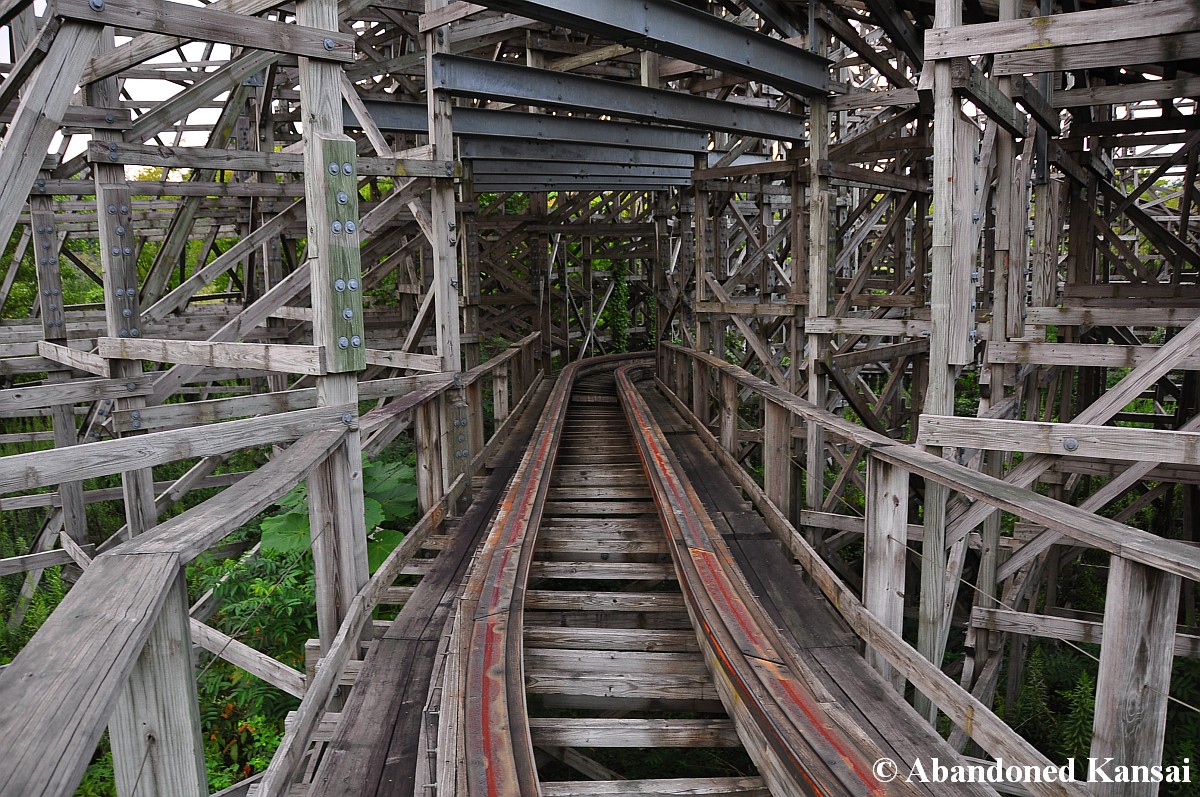
As you already know from the headline, Nara Dreamland is about to re-open soon! Renovations began right after the acquisition in January to make a ridiculously tight deadline: April 26th, just in time for Golden Week, one of the most important vacation periods in Japan. Mainstreet USA and the Cinderella Castle are already almost completely renovated, dozens of experienced woodworkers and technicians currently make sure that the Aska roller-coaster will be ready to go, while the park’s other famous ride, the Screw Coaster… is getting screwed. After almost a decade of negligence the coaster was so rusted and overgrown that new management decided to demolish and replace it. The merry-go-rounds and other small rides in the back of the park are under repair as we speak, so are the BBQ area and the monorail, for which brand-new trains will be imported from the States, hopefully arriving on time for the grand reopening. New attractions include a freefall tower and a Ferris wheel – although the latter one will actually be an old friend! A couple of months ago the giant wheel *Igosu 108* disappeared from Shiga prefecture *as I mentioned on Facebook a while ago*. Structurally sound and completely repainted it now makes Nara Dreamland visible from far away. At least one major attraction like that will be added every year, according to the new management of Nara Dreamland. Sadly they guys were also a bit stuck up and told us to leave our cameras behind in the bus before they gave us the grand tour. Well, most of the attractions and buildings were under construction and partly or completely scaffolded anyway, but I am sure official promo photos will be released soon.

To stick with the park’s tradition and to stand out from the competitors, the new Nara Dreamland will be a pay-as-you-go amusement park, which means that the entrance fee will be only 500 Yen (free during Golden Week 2014!) and that you’ll have to pay for every ride – between 200 and 800 Yen. Dreamland’s water park is currently fenced off and will open completely overhauled  from early July till late August / early September, like most other water parks in Japan, too.

Personally I am very excited about this news! I’ve been to Nara Dreamland at least once a year since 2009 and I am happy that I can finally enter for a small fee without sneaking around. Sure, it is a loss for the whole Japanese urbex community – but at the same time it is such a big win for Nara and all of Kansai! (Sorry, no “new” abandoned location today. Just remember: The sweet is never as sweet without the sour!)

(For all your Nara Dreamland needs please have a look at the *Nara Dreamland Special*. If you don’t want to miss the latest article you can *like Abandoned Kansai on Facebook* or subscribe to the *video channel on Youtube*…)

CNN Loved This Photo So Much, They Put It On Their Front Page (Archive Photo)

CNN Loved This Photo So Much, They Put It On Their Front Page (Archive Photo)

Read Full Post »

« Newer Posts