All abandoned: Chernobyl / Pripyat, Nara Dreamland, Anti-Zombie Fortress, Japanese Sex Museum – and many, many more! Plus: North Korea Special – 2 trips, 16 days / 14 nights! As seen on CNN…
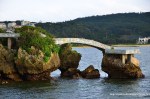
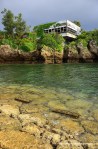
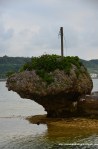
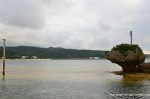
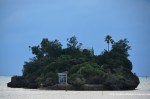
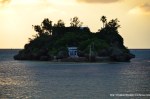
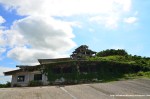
The Dolphin Island Restaurant is one of those weird, unique places I love Japan for – and it’s one of the few urbex insider tips in Okinawa. It is also one of the toughest places to access. Not because of security, but because of timing. Nowadays located just a stone’s throw away from the Okinawan coast the Dolphin Island Restaurant can be reached by wading through the water if the timing is right and the tide is low…
After a day of exploration *Michael* was kind enough to revisit one of the places he explored when *he went to Okinawa in 2011*. The Dolphin Island Restaurant is a gorgeous little island, sadly there is little to nothing known about its history. Massive concrete and wooden electricity posts let me come to the conclusion that the current supply came from the mainland about 300 meters to the east and that it was constructed in the 1950s or 60s. Nowadays you can almost walk up to the place from the north, getting as close as maybe 10 meters, but I doubt the area looked like that when the restaurant island was still open for business. Judging by the shape of the close-by warehouse area / harbor I’m pretty sure that this part of Okinawa is artificial land, one of the many reclamation projects Japan did in the past couple of decades – this one was limited by the Dolphin Island, but it got as close as possible…
I can imagine that business was though back in the days, because without access via a bridge all the visitors must have gotten to the island by boat – and that most likely meant no business on stormy days and that it took quite some effort by potential guests to reach the restaurant.
It’s said that the Dolphin Island Restaurant was not only a restaurant, but also hosted an aquarium – hence the name “Dolphin Island” or “Hiituu Island” in Okinawan dialect.
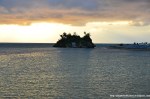
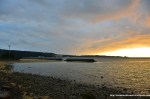
Since it was getting late that day and the tide was already rising I refrained from wading through the water and stayed on dry land. With proper equipment like airtight bags to get my camera to the island safely I might have taken a swim, but given the situation that day I decided to just take some photos and a video. Later on Michael and I went to the original coast line and took some pictures from the beach, waiting for the sun to set – not our lucky day, because the sky got cloudy for the few couple of minutes we were hoping for a spectacular horizon…
And with that the Dolphin Island Restaurant became the third location on Okinawa (after the *Nakagusuku Hotel Ruin* and the *Sunset View Inn Shah Bay*) I would like to revisit one day… Well, at least the last location on Michael’s and my *trip to Okinawa* was a great success – somewhat of an original find and a really unique location with an exciting and unusual history! Up next on Abandoned Kansai…
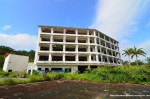
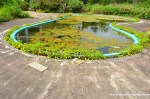
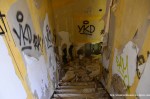
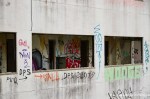
The Lequio Resort Okinawa, to the net usually known as the Rekio Hotel thanks to the usual katakana transcription problems, is one of those countless hotel ruins you can find all over Japan and that most urban explorers only visit because nobody has torn them down yet. The most interesting thing I can say about the place is the fact that it was built in the 1970s during the Okinawan hotel boom and right in time for the Okinawan Ocean Expo in 1975 – like the *Nakagusuku Hotel Ruin*, the most amazing unfinished hotel I’ve ever seen. Unlike the Nakagusku Hotel the Lequio Resort was actually finished and opened, at least for a while. Nowadays it’s completely vandalized and gutted, almost as bare Okinawa’s all outshining haikyo further down south. Bare except for the impressive amount of graffiti – almost as plenty, but barely ever as good as at the *La Rainbow Hotel* in Okayama. Built halfway up a mountain overlooking a gorgeous bay the Rekio Hotel offered some stunning views and visitors should be very careful where their steps lead them, because the place is a death trap with barely any safety barriers. The elevator shaft was cracked open on every floor and the balconies had no railings, except for some low hanging ropes on some of them. The vandalized state and the exposed position of the hotel make it and everybody inside susceptible for the always present winds, so seriously: Be careful when you go there. If you go there, because there is really not much to see. My favourite part was the glasses shaped pool, now green, moldy and pretty disgusting. But overall *Michael* and I spent just about an hour at the Lequio Resort – which is a ridiculously short amount of time for a hotel of that size, considering that it took me more than 12 minutes to shoot a walking tour there. If the Rekio Hotel would have been one of my first explorations I’m sure it would have been an exciting adventure, but after seeing so many abandoned hotels it turned out to be barely more than a footnote in my (imaginary) haikyo book…
(Addendum 2012-07-19: It seems like “Lequio” was the Portuguese name for Okinawa when it was still the kingdom of Ryukyu – thanks to my dear colleague and regular reader Mayuko for that information!)
Exploring the Sunset View Inn Shah Bay (combining two dozen cottages and the Shah Bay hotel) was one of the worst urbex experiences I ever had – so bad that I cut it short and left after about half an hour. I could have easily faked an interesting article about a smooth exploration since I took enough photos and even a short video, but what’s the point? Not all urbex trips go as planned and not all explorations are successful. Here’s one that turned out to be a nerve-wrecking waste of time.
The Sunset View Inn is (or better: was) a resort complex in the northern part of Okinawa on top of a mountain with a gorgeous view, but pretty much in the middle of nowhere even by Okinawan standards. When *Michael* and I drove up there using narrow countryside roads and half-overgrown streets of decent size I already was kind of aware that we were slipping into a disaster. Tired from the previous day we arrived on the mountain top with no food, drinks or umbrellas at the nearby scenic outpost when it just started to drizzle again. Michael opted for a bathroom break (yes, there was a maintained concrete restroom at an abandoned scenic outpost…) while I walked down the road for a couple of dozen meters as I thought I saw an abandoned concrete building behind a wall of green – I was right. Sadly I didn’t bring my camera, but it was unspectacular anyway; just a vandalized one floor concrete building, probably a restaurant. Of course the rain got stronger, so I had to wait for about ten minutes before I could reunite with Michael. It still drizzled heavily when my haikyo buddy told me that he saw house with some activity and a sign that says that the police will be called if somebody gets close to the hotel. Great. Could it get any worse? Yes: When we climbed over a road block on the way to the hotel Michael made me aware of another sign informing potential visitors about security patrolling the area. And of course the rain was pouring heavily again. Hot, humid, hungry, tired, potential security, heavy rain, no umbrella – a nightmare scenario. After about 150 meters the road split. Right cottages, left the Shah Bay hotel. We decided to have a look at the cottages first, but even their slightly vandalized state didn’t make me more confident. I felt uneasy and would have probably left at that point if I would have been alone. The road lining up the cottages lead back to the entrance area where Michael told me the occupied house with the warning sign was… Was the street leading there? Could security get to us by car? (The way we entered was blocked for vehicles.) Or even worse: silently on foot? I mentioned it before in other articles – I’m tired of vandalized hotels, and those abandoned cottages looked all the same, were all moldy, had all the typical look, feel and smell of abandoned Japanese accommodations. Michael didn’t seem to be that excited either, so after about ten minutes we decided to turn around and go to the hotel. Hot, wet, sweaty, nervous, tired and bored we approached the big deserted building when all of a sudden Michael yelled whisperingly “There’s a car coming, there’s a car coming!” (or something like that) – so we sprinted and dug into the wet bushed while the rain continued to get stronger. Of course there was no car coming, but now we were completely wet and at least I was a nervous wreck and getting seriously paranoid. As I mentioned twice recently (*here* and *here*) I am not into infiltration, I have explored way too many haikyo (especially hotels) and I am just too old for this shit! But the situation got worse. We entered the empty lobby of the hotel with a beautiful, untouched area straight out of a museum to the left when all of a sudden I thought I heard footsteps. We ran again, this time hiding in the close-by former gift shop. While my knees were screaming in pain I still heard footsteps – irregularly, louder and quieter. After two or three minutes I had enough. I already told Michael at the cottages that I didn’t like the current situation and while hiding at the gift shop I finally draw the line – this far and not a single step further. So I left. Michael decided to stay and joined me at the car about an hour later. It turned out that the footsteps were a mix of dripping water and an unspecified animal making noises – we couldn’t get in contact because the phone reception up there was close to non-existent. I couldn’t have gotten back in anyways since tourists in cars were coming up constantly to pay a visit to the abandoned observation point. So I took a couple of photos there and in passing found out that the first warning sign wasn’t at the house where people lived, but at an derelict kiosk a couple of meters away, outside of the premises – small details…
I know this article doesn’t fit the self-publicizing image of urban explorers hiding from the police, dodging security and doing all kinds of “cool” things. But that’s not me anyways. I’m just a regular guy who likes to take pictures of urban decay. This exploration turned into a small disaster for many reasons and I’m actually still shocked that Michael and I, two of the most experienced foreign urban explorers in Japan, stumbled into this adventure the way we did. But then again… Isn’t the only currency in this bankrupt world what we share with someone else when we are uncool?
Would I go back to the Sunset View Inn Shah Bay with sufficient supplies on a sunny day? Most likely yes. The area looked awesome and the map close to the abandoned viewpoint showed that the resort had more to offer than the cottages and the hotel – there was also a stone garden, a huge fountain, an area for band practice, a gateball course, tennis courts, a sports club house, a BBQ area, some kind of race track and two pools. I had seen the pools on a satellite photo and it really hurt that I missed them. Luckily I was able to take abandoned hotel pool shots later that day when we visited another one of those concrete giants that obviously never get demolished in Japan.
Chances that the Sunset View Inn Shah Bay will get demolished are rather slim, too. Opened in 1986 in the structurally weak north of Okinawa by a successful businessman from Naha (sounds familiar, eh?) the resort went bankrupt and closed in 1995, less than 10 years after the hopeful opening. So no Persian investor as the name might have implied. Shah is actually an old Okinawan / Ryukyuan word, meaning salt – the owner of the resort named the Shah Bay hotek after he saw the term on a map in Matthew Perry’s “The Japan Expedition”. (Matthew Perry as in “the guy who forced Japan to open its ports for foreign ships”, not the “Friends” goofball!) Shah Bay once was the name of the bight at the feet of the hotel, the one that made the sunset view so remarkable, the one that people still try to see from the once so wonderful vantage point…
A place known to the net simply as Okinawa Cactus Park was one of the haikyo I really wanted to see when *Michael Gakuran* and I went to Okinawa earlier this year. The official name of the park was Mexico Cactus Park Sarabanda. It was opened in 1993 and closed in September of 1999, its big Mayan style head becoming an Okinawa urbex icon. The park wasn’t a super spectacular place (although there were 150.000 plants of more than 800 kinds) or a very popular one, but it was unique. I’ve never been to a cactus park before and for sure not to an abandoned one.
When Michael and I drove up to the place I had a very bad feeling – the road and the parking lot were in way too good condition and not blocked at all. As soon as we saw the main building it was pretty clear that we were either at the wrong location or the place had been refurbished / converted. Luckily Michael is a chatty guy fluent in Japanese, so he walked up to the next best person and found out that we were at the right spot at the wrong time. The cactus park, abandoned for more than 10 years, had been reconverted about 1.5 years prior to our visit, unnoticed by the Japanese urbex scene (where I borrowed the term haikyo (ruin) from, just in case you are a rather new reader).
“Cactus Park – Rest in Peace” would have been a more appropriate headline for this article than you might have expected, because the former theme park was actually converted into a graveyard. A gorgeous graveyard I might add. Located at the southern coast of Okinawa the whole area is just beautiful (I marked it on my *Map of Demolished Places in Japan*). And instead of leveling the whole cactus park the architectural office responsible for the new design did a great job using existing structures. All the old roads and paths of the former cactus park were still there, so was the main building at the entrance and a smaller building close to the cliffs, offering a stunning view and a place to rest. The cacti were all removed, except for maybe a dozen on a big rock close to the entrance – traces of the former theme park were there, but we had to look closely to find them.
The new name of the huge area is Okinawa Seimeinooka Park (沖縄清明の丘公園) and it’s a non-profit cemetery not only for all confessions, but for all religions. The barrier-free area has the size of 68830 square meters and offers space for a total of 1.740 graves which strangely correlates to the parking lot with 174 spaces (I assume those 1.740 graves include the spaces of the “joint enshrinement grave”). Each grave has a size between 2 and 15 square meters and costs 140.000 Yen per square meter (one-off) plus 10.000 Yen per year.
Michael and I were both a bit disappointed not to be able to explore an abandoned cactus park, but we agreed that they did a wonderful job converting it. We didn’t spend too much time on the premises, but before we left Michael talked to one of the employees at the beautiful Roman style main building. To my total surprise he found out that there were two cactus parks in the area in the late 90s. This one, the Mexiko Cactus Park Sarabanda, and another one called Himeyuri Park – not to be confused with the Peace Memorial Park and the Himeyuri no To monument. The Himeyuri Park was also closed and abandoned, but not destroyed and reconverted. So off we went to our next adventure on our *trip to Okinawa*…
When *Michael* and I approached the Nakagusuku Hotel Ruin I knew we were in for a treat. I’ve explored enough ruins (about 200 so far…) to recognize a triple A, a five star, a first class abandoned place. But in this case I had no clue about the epic glory that was waiting for us. I actually didn’t find out until 5 hours into our exploration. At that point I was lying on the hot concrete roof of the hotel in the merciless Okinawan sun, hiding from a group of tourists visiting the Nakagusuku Castle, when a gigantic Lockheed C-130 Hercules (Edit: Thanks to La Mian World I now know that it was a C17 Globemaster! Which replaced the Hercules…) was heading towards me as if it was trying to bomb both the castle and the hotel…
“But how did it come to this?”, I hear ya say. Well, it’s a long story. Come closer, and I’ll tell ya. It all started… earlier that day. And what a day that was. It’s what I call… an excellent exploration day. (To everybody not admiring Conker’s Bad Fur Day: Sorry for this silly paragraph, I just had to do it. And if by any chance Robin Beanland and / or Chris Seavor read this: Thanks for creating one of the best platformers ever, a true masterpiece!)
If I would have judged Nakagusuku Hotel Ruin after the first two hours I would have been disappointed. Yes, it was big. Yes, it was made of concrete. Yes, it was abandoned. Yes, it was overgrown. But entering the place and following the beaten paths countless urban explorers and by-chance-visitors have walked along for more than 30 years was actually quite disillusioning. The hotel looked awesome from the distance, but the entrance area was rather dull. It even had a burned-out area, though there was hardly anything to burn. I didn’t want to stray too far away from Michael since last time he visited the place he saw a white pick-up truck driving by and I read in one report that there was security. So at one point, probably two hours into our little adventure, I walked up to Michael and told him that I was bored – after he spent about half an hour taking pictures of a column of ants at the wall of a small room. My highlight up to that point? Taking photos of a singing bird sitting at one of the smaller roofs outside…
We continued to the north across a little covered bridge over a small road (leading up the hill to the top part of the hotel) – and there things started to become interesting. While the architecture at the entrance area was quite quirky (wide aisles, small rooms and corners that didn’t have a clear purpose) all of a sudden it became downright weird. The annex wasn’t properly connected to the main building, it was about a meter too low. And there were no stairs, not even a ladder. But it got stranger… and stranger… and stranger. (You can see all of that in the video I published with *the first article about the Nakagusuku Hotel Ruin*.) The staircase in the annex… it wasn’t high enough for an adult to walk upright and it was freakishly narrow. Nevertheless that’s where we headed next. If we were incautious Michael and I could have been seen from the castle, but we had a great view at the overgrown lower parts of the hotel and at the landmark top of it. Michael wasn’t happy with the cloud situation, so while he killed some time on the roof I took the long video I published with the last article – we agreed to meet in the burned out main hall later. From there we walked up the mountain and entered the annex complex again. Basically the area you can see in the first half of the third video. Michael and I left the building to take some photos when all of a sudden we heard voices. We ducked down, being as quiet as possible. The voices came closer… two female, one male – obviously American tourists who saw the hotel ruin when visiting the castle ruin. They passed by us without noticing us when Michael realized that the cloud was finally gone, so we went back to the little tower of the annex building. While still on a lower floor the family came back and we decided to scare them a little bit. Sadly we were quite indecisive about it, so by the time Michael yelled at them in Japanese with a low aggressive voice right out of a classic samurai movie they were already too far down the road for us to see their reaction. Well, it wasn’t that funny anyway…
So up the annex building and taking more photos outside. That’s when Michael realized that he could walk across the roof of the covered bridge to reach the roof of the main building. I’m sure it was perfectly safe, but since I saw another way to reach the main building’s roof I made my way through the main building when I received a phone call from Michael – he was pinned down on the roof thanks to a bunch of tourists at the castle. So I went back to get his tripod and finally made it to the upper part of the main building to get onto the roof myself. Five minutes later I was lying there with the C-130 Hercules flying over my head… and I couldn’t get a close-up since I had my ultra wide-angle lens mounted and not a snowball’s chance in hell to switch it in time. (Edit: Thanks to La Mian World I now know that it was a C17 Globemaster, not a Hercules…)
After having seen most of the Nakagusuku Hotel Ruin Michael and I were willing to take more risks and finally walked up the hill to the exposed skeleton part of the hotel ruin. On the ground floor there we made an unexpected discovery – a completely burned out and rusted car INSIDE the building. It definitely was a car, but in absolutely abysmal condition, so I have no idea which manufacturer or model it was. Then we went to the top of the building and enjoyed a spectacular view – the hotel, the castle, the small cities and of course the Pacific Ocean and the East Chinese Sea. A slight breeze and the gorgeous view almost made us forget that we were completely exposed.
On the way back to the exit I shot the second and the third video, both published with this article. Although the exploration was great I was kind of eager to get out of the deserted hotel after seven hours when Michael found a building we hadn’t been to yet. Which lead to a lower floor, which lead to a balcony, which lead to a whole new world. The annex building we explored 4 hours earlier was actually the gateway to an area mostly overgrown and lower than the rest of the construction, reminding me of Mayan or Aztec temple in the middle of the jungle. The sun was already setting (it was past 5 p.m. which basically prefaces the end of the day in Japanese spring time…) and bathed the area in warm light. As much as I wanted to get out of there, this part of the hotel was just way too gorgeous to be left behind without us having seen it. So we went deeper and deeper, up and down staircases, through walls of green and past all kinds of weird and sometimes dangerous architecture (one photo shows a flight of stairs separated by a massive concrete handrail – if you would have walked up the right side you would have banged your head unless you are smaller than 30cm…). I really wonder if there was no construction supervision agency in Japan back in the 70s… or what they did all day. Or what the architect was paid for. If there was an architect. Why nobody on the construction site said “If we do it like that people won’t be able to use it properly…”. But whatever, for people with a predilection for the surreal it’s a mind-blowing place to see, although some things don’t make sense at first. Like when Michael jumped into the now empty pool and had no clue where he was, because things just didn’t made sense at first sight. From the pool we had an awesome view looking up to the hotel complex, some overgrown concrete water slides in the background. At that point we were in such a hurry that we didn’t even set up our tripods for good photos – snapshots, snapshots, snapshots. When we finally left the lost civilization area we did it via a part of the building that was home to the cage like installations you can see at the end of the last video where my camera ran out of memory space. It seems like the hotel had a rather decently sized half-underground zoo, although I’m pretty sure that no animal ever lived there. The main area there was composed of a maze of stairs, most of them basically unusable thanks to the ubiquitous misplanning – I loved it, though I’m about 1.90 meters tall. It’s hard to believe that a place like that exists, especially when coming from a country where the state’s building control department is such a powerful institution.
After about eight hours Michael and I finally left the Nakagusuku Hotel Ruin, exhausted but happy.
When Michael told me about the hotel *two months prior to our visit* I was skeptical. When I saw it that morning I was excited. After two hours I was slightly disappointed – and from that point on it grew on me. And it actually kind of still does. The Nakagusku Hotel Ruin is one of the most amazing places I ever had to the pleasure to explore. The location was gorgeous, the fact that most of it was never finished lessened the effect of the always present vandalism, the warm and sunny spring day and a couple of singing birds following us up the mountain was heartwarming, no security present was a pleasant surprise, the size of the site was enormous (I think it would take about an hour of straight ambling without stopping to look at details to see the whole complex) – but what really separated the Nakagusuku Hotel Ruin from most other places was the constant flow of surprises. The architecture of the place was mind-blowing in so many ways, and items like the wrecked car made it such a unique exploration. It actually made it an exploration. At so many other urbex spots you get what you expect and once you’ve seen one floor you’ve basically seen 90% of the site. The Nakagusuku Hotel Ruin put exploration back in urban exploration – I never knew what to expect behind the next corner, on the next floor, below the next overgrown flight of stairs. And although I spent about eight hours on the premises the Nakagusku Hotel Ruin became one of the few places I really want to revisit, if possible in late winter (whatever that means in Okinawa…) when there is a little less vegetation – without the shadow of a doubt the best abandoned hotel I’ve ever been to, probably the most amazing urbex hotel in the world!
ADDENDUM 2013-2-12: On February 9th user stuzbob left a comment on one of the videos, shedding some light on the car remains: “The engine appears to be a Nissan J-series and the remains of the leaf springs and solid frame at the back lead me to conclude that it was, at one time, a Nissan 520 or 521 pickup.” Thanks a lot stuzbob, much appreciated!
The Nakagusuku Hotel Ruin on the Japanese island of Okinawa is a prime example for a problem pretty much everybody has when writing about abandoned places – how to name the location? I could have called it the N# Hotel or the N# Hotel Ruin, but it would have been pretty pointless, because the name is revealed with a location description when you google “urban exploration Okinawa”. First hit, at least at the time I am writing this article. I could as well mark it on a map, but I’m still reluctant to do that since the Nakagusuku Hotel Ruin clearly is not a tourist attraction – the Nakagusuku Castle (中城城), right next to the hotel ruin, on the other hand is a tourist attraction. A major one, since they are a UNESCO World Heritage Site – and it’s visible on a lot of photos and videos I took. Gusuku is a term to describe Okinawan castles (jo, 城) and in Japanese it actually uses the same kanji – and that makes a gusuku-jo a castle-castle. But this article is not about the castle ruin, it’s about the hotel ruin, which actually is a place of many names. Most people refer to it as the Nakagusku Hotel Ruin in English, but I’ve also seen it been called the Royal Hotel (I have no clue why…) and the Nakagusuku Takahara Hotel / Nakagusuku Kogen Hotel – both names are based on the common Japanese term for the place, 中城高原ホテル. The first two characters mean Nakagusuku, the last three mean hotel. Characters three and four can be read takahara or kogen / kougen. The latter reading makes more sense as it means plateau – the Nakagusuku Plateau Hotel, because it’s actually on the Nakagusuku plateau…
The complex naming of this deserted hotel is rather suiting, because nothing about the Nakagusku Hotel Ruin is simple or small. The place is actually gigantic and fascinating. So gigantic and fascinating that I decided to split up the article in two. This first one will be about the background information, a soon to come second one will describe my experiences exploring the never finished hotel.
Yep, the Nakagusku Hotel Ruin is an unfinished building – carcass and interior completion are both unfinished. The story is that a rich business man from Naha, Okinawa’s capital about 10km to the southwest, wanted to take advantage of the beautiful location right next to the Nakagusku Castle, where both the Pacific Ocean and the East Chinese Sea are visible. Locals warned him not to build a hotel there since the area overgrown by jungle like vegetation was the home to countless old graves – of course he ignored the advice, even when a Buddhist monk told him that the land was sacred and that he was building too close to a tomb inhabited by restless souls. Upon hearing that some of the workers quit – and others died by accidents on the construction site. Having spent millions of dollars on the vast concrete construction the unnamed businessman wanted to prove that the hotel wasn’t cursed, so he pledged that he would sleep on the premises until the building was finished. After three nights he went insane and people still don’t agree if he was institutionalized or if he committed suicide – or both.
That’s the folklore story you can read in most articles about the Nakagusku Hotel Ruin. Another version, less spectacular, is that the hotel was built under the responsibility of the Nakagusku Park Union (中城公園組合), which was in charge of the Nakagusku Castle since it was declared important cultural property by the government’s Cultural Properties Protection Committee in 1955. The first plans became a political issue when the information became public that the hotel was supposed to be built too close to or actually on the castle ruin, risking its status as a cultural property site (and making it impossible to become a UNESCO World Heritage Site, a program that was ratified in 1972). So the planned construction site of the hotel was moved from the castle’s rampart further to the west, away from the historical ruin. Construction of the massive concrete hotel began in the first half of the 1970s and was supposed to be finished right on time for the opening of the Okinawa International Marine Exhibition (better known as “Expo 75”) on July 20th of 1975. But of course the inevitable happened: The contractor went bankrupt and the access road was specified as part of the “preservation of cultural properties zone” after Okinawa became part of Japan a couple of years prior (between the end of WW2 in 1945 and May 15th of 1972 Okinawa was run by a U.S. military government), bringing the construction of the Nakagusuku Hotel to a complete standstill – permanently. (I had to compile / confirm this version of the hotel ruin’s background story from different Japanese sources, so if there is an inaccuracy I apologize in advance.)
And to end the stories about the history of the Nakagusuku Hotel Ruin with another one based on rumors, not on facts: It’s said that a part of the hotel was used as a brothel for several years – the upper part, where the now burned interior was already finished. A highly unlikely story, since that brothel would have been within sight of a major tourist attraction and kind of tough to access, especially at night – I can’t imagine that happening without the knowledge of the authorities…
Okay, so much for the background story. The next article will be about exploring the huge concrete carcass, spending about 8 hours on the premises, so there is plenty to tell you – and to show you! All the photos below are from the easy to access parts most urban explorers see, and so is 22 minute long video, representing maybe a third of the huge complex. *If you like what you see below you better read the next article, too, because it will blow you away!*
Urban exploration in Okinawa? Not exactly my first association when I think of the former kingdom of Ryukyu. For me it would be more like sun, beaches and… Karate Kid 2 – a movie I’ve never seen, or at least I can’t remember seeing it, but in Germany it had the tagline “Entscheidung in Okinawa” (something like “Decision in Okinawa”) and I guess that stuck with me ever since. Okinawa = Karate Kid – but I always thought it was the third one, not the second one…
When my haikyo buddy *Michael Gakuranman* and I went on a *road trip to southern Honshu* earlier this year we were talking about future expeditions. Michael mentioned that he went to Okinawa just a couple of months prior and that he explored a huge hotel he really wanted to re-visit. So he suggested a haikyo trip to Okinawa. And I was skeptical. Going to Okinawa to revisit a hotel? I knew right away which hotel Michael was talking about since it is one of the few famous abandoned places in Okinawa (Okinawa really isn’t famous for urban decay, not even amongst urban explorers), but him saying that he wants to stay a whole day there didn’t exactly seal the deal. But I am currently re-discovering Japan as a tourist (I travelled a lot in spring!) and the chances to go to Okinawa are limited, so what the heck. Let’s go to Okinawa and do some urbex! It would surely beat the beaten tracks of urbex in Kanto!
A couple of years ago the concept of budget airlines finally reached Japan and if you book early you can get really good deals. To make sure that we both arrive and departure at around the same time and we both would get reasonable rates Michael was kind enough to take care of the booking – 10.800 Yen for the roundtrip Osaka-Naha-Osaka; booyah! A Shinkansen train ticket Osaka to Hiroshima costs about the same – one way…
Late May isn’t exactly the best time to go to Okinawa since May and June are two out of three most rainy months down there, but again… why not? It’s Okinawa and I’ve never been there. The places we planned to explore sounded kind of okayish on paper, but I was more interested in Okinawa itself. The local atmosphere, the local architecture, the local food. Biggest surprise: shikuwasa (pronounced something like sheek-wasa), a Okinawan citrus fruit and the basis for all kinds of food and drinks – juice, cake, wine, mochi, sodas, chiffon cake, syrup (for kakigori), fruits chews, … In the humid pre-summer heat the most refreshing taste I ever had the pleasure to enjoy. Another popular local fruit is the pineapple. Close to the city of Nago are actually two pineapple theme parks close to each other – separated by the Okinawa Fruits Land. Michael and I visited the Nago Pineapple Park on one of the three days we spent in Okinawa. Not much of a park it features one of the tackiest rides possible – automatically driven carts through a pineapple field, telling you everything you (never) wanted to know about pineapples in horrendously pronounced English. And that was it for the park part – we basically paid 600 Yen to enter a gift shop. One of the most awesome gift shops ever though. Here you could buy (and sample!) all kinds of pineapple and (some) shikuwasa related products. Wine, cookies, chocolates, prize-winning cakes, dried fruits, different kinds of fresh pineapples, pineapple charcoal soap (!) and of course the usual gift shop stuff like plush dolls, key chains and whatnot. Awesome place, expensive though – I nevertheless loved it.
Over the course of our visit Michael and I managed to enjoy a good mix of urban exploration and tourist stuff, although Okinawa isn’t exactly famous for urban exploration. Luckily the urbex locations turned out to be way more interesting than they looked on paper, including an original find – one location freaked me out so much that I got fed up and left, one of the worst urbex experiences I ever had. So in the end we saw three abandoned hotels, two abandoned cactus parks and one abandoned restaurant island on the course of three days. As for touristy locations we visited the already mentioned Nago Pineapple Park, Shuri Castle (awesome!), Nakagusku Castle, the Underground Naval Headquarters of WW2 (overrated – it almost always makes me cringe a little seeing Japan presenting WW2…) and of course Kokusai Dori, the main tourist / night life street in Naha, Okinawa’s capital.
I didn’t plan to write about this trip so quickly, but last weekend opened up out of nothing and the East Asian rainy season (tsuyu) hitting Japan basically rendered it useless for outdoor activities – and overall I loved the trip, so it was the next best thing to get this series of articles started. The weather was constantly changing, but sunny most of the time. The food was awesome (I’m still not a fan of goya though…) and the places we visited were interesting. Life in Okinawa seems to be much more relaxed that in mainland Japan. For example: Taxi drivers in Osaka wear suits and white gloves, taxi drivers in Okinawa wear kariyushi – basically the Okinawan version of the Hawaiian shirt. And what’s not to love about an island that has strong reservations about Americans and Japanese alike? 😉
Being a mountainous country Japan has lots of cable cars and ropeways. And it seems like every single one of them was built in the late 1920s / early 1930s. A lot of them were demolished after just a couple of years in the 1940s to support the war efforts of Imperial Japan (every piece of metal counted…) – amongst others the *Mount Atago Cable Car* and the *Rokko Ropeway*. The Yashima Cable Car (YCC) had a bit more luck. Opened on April 21st 1929 it too was suspended as a nonessential line on February 11th 1944. But although some material was taken away (I’m not sure what exactly though…) it didn’t mean the end of the YCC: On April 16th 1950 the Yashima Cable Car opened again for business. And business was good thanks to the famous Yashima Shrine on top of Mount Yashima, about a kilometer away from the YCC terminal. I guess it got even better when some businessmen decided to make Mount Yashima a full-blown tourist attraction (*you can read all about it here*), but when the plan fell through the Yashima Cable Car was in trouble, too. On October 16th 2004 operations were suspended again, but it took almost a year (August 31st 2005) until the line was officially closed and abandoned.
According to a tourist guide book first published in the 1980s the cable car ran from 7 a.m. to 7 p.m., charging 1160 Yen for the roundtrip. It seems like prices went up and service hours were cut down, so in 1999 the cable car ran every 20 minutes from 8 a.m. to 5.40 p.m., charging 700 Yen one way and 1300 Yen for a roundtrip.
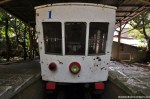
At the time of my visit the lower terminus of the Yashima Cable Car (屋島登山口駅, yashima tozanguchi eki – Yashima Trailhead Station) stood locked-up and abandoned on the foot of Mount Yashima near the trailhead up the mountain. The road leading there was almost as abandoned – I could vividly imagine how good business must have been 20, 30 years ago for the now closed restaurants and souvenir shops. Right next to the station were a taxi stand and a metalworking company, making some noise and keeping an eye on the inaccessible station building. The 858 meter long cable car track was accessible though, with car #1 parked right at the platform. And it was beautiful! On the one hand it was hard to believe that the place had been abandoned just six years ago, on the other hand there were no signs of vandalism and everything had just the right amount of decay – and the beautiful weather on the day of my visit didn’t hurt the atmosphere either…
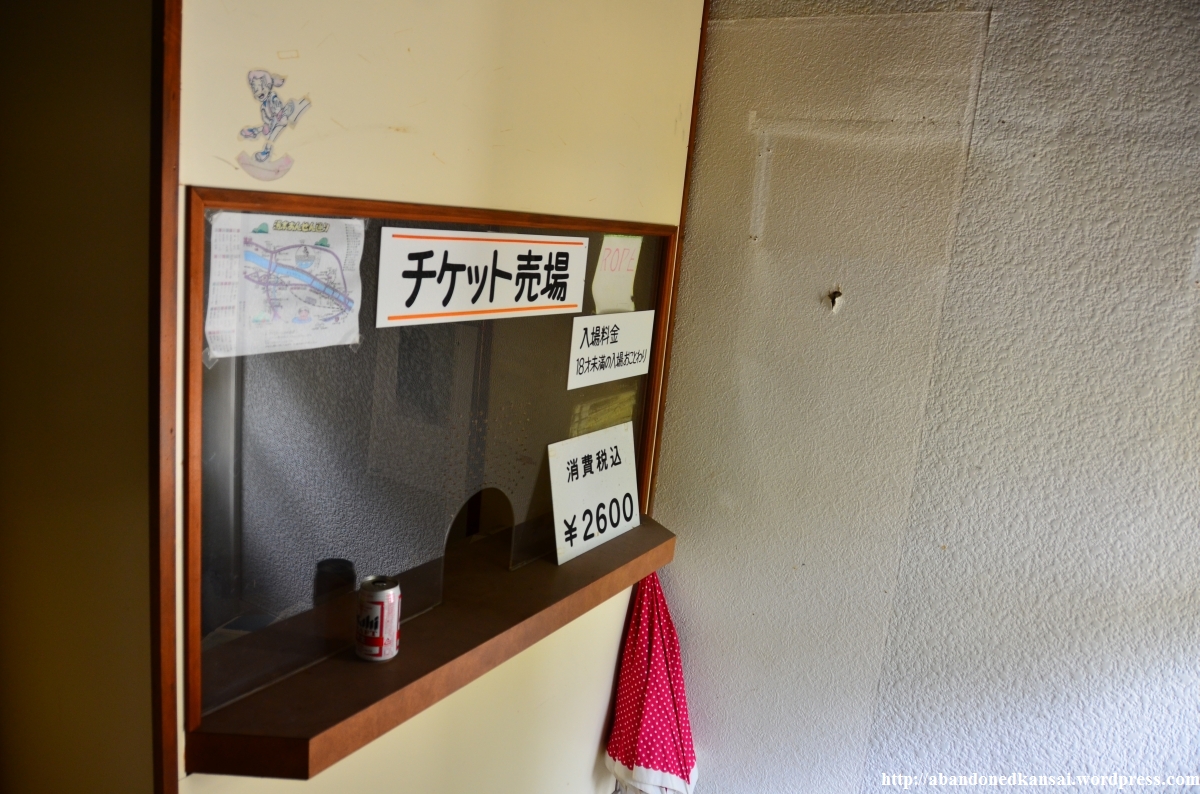
Hot Spring Theater – that’s what was written in four kanji (温泉劇場, onsen gekijo) at the front of the building. And this was clearly a euphemism in many ways. First of all: The small building didn’t look like a theater at all. Which isn’t a surprise, because “hot spring theater” is common code for a Japanese strip club in an onsen town. So the only play on the stage of this theater was happening between the hand of “actress” and the rest of her body… I guess what set the Onsen Town Theater apart from a classic strip club was the fact that the stage looked like a theater stage and didn’t extend into the audience. Full frontal! The seats by the way were gone, so basically all we had was a dark empty room and a dull stage in a rather inconspicuous building. If it wouldn’t have been for some signs stored in a room next to the entrance *Michael* and I might have missed the stage and therefore the purpose of the building. Smaller signs at the counter of the main entrance announced the rather steep admission charge of 2.600 Yen and the fact that you had to be 18 years old to enter. I’m still not sure though if the Onsen Town Theater really was a strip club or maybe rather a brothel – or both. The building had a second floor and up there were not only a couple of small rooms and a seedy looking waiting area. Right at the top of the stairs was another counter with a surprisingly low and small opening with curtains – and behind the counter I saw quite a few paper slips looking like receipts. Did the performing ladies live up here? Or did they offer extra services? I guess we’ll never know…
And with this little mystery my report about the *road trip to southern Kyushu* ends. Right on time, because tomorrow the Gakuranman and I will leave for another road trip. Urbex in Okinawa – here we come!
Well, Franklin D. Roosevelt, Sir, Mr. President. That’s not entirely accurate. But you’ve most likely never been into urban exploration… As an urban explorer there is one other thing you have to fear and most urbexers do fear: watchdogs. It took me more than 150 explorations to finally run into one, but that one proved to be an insurmountable hurdle. Not only for myself, but also for my haikyo buddy *Michael*.
On the way up to the Noga Hotel we stopped to take a couple of photos from the foot of the mountain as it was already early afternoon and we most likely wouldn’t have the chance to take some on the way down. Little did we know that those would be the only photos of the Noga Hotel we’d take that day…
Halfway up the mountain we were stopped by a gate blocking the street – decorated with four huge signs telling us why we shall not pass. A seemingly endless list starting at private property up ahead (so what, this was a public road…) and ending with the local cities authorities trying to prevent illegal waste disposal and forest fires; well, who could argue with environmental reasons that are pleaded to keep people away from an abandoned hotel that is falling apart? Right, we could, so we opened the gate and continued driving, but soon we decided that it might not be a good idea, since an unlocked gate means that whoever decided to put it there actually wants people to pass – which meant that we would most likely run into somebody at one point or the other. So we went back down the mountain and walked up again. A very good decision, because just a couple of 100 meters after the point where we turned around the car we found a second gate. Not just a gate, more like a checkpoint. I was walking a couple of meters ahead of Michael when I saw the control point and it took just a few seconds for a watchdog to bark as if there was no tomorrow. So I ran. Although going to the gym 4 times a week I haven’t been running that fast since I was caught by the security guard at *Nara Dreamland*. Luckily just down the road was a fenced off deadlock; a fence to prevent cars, not humans. So we ran down that road to hide from whatever might have followed us and waited. And waited. And waited. Until Michael decided to have a look at the checkpoint himself – I preferred to wait at the hideout. While Michael was away I heard another big dog barking, probably from where the hotel was – Michael on the other hand only heard some animal scratching as he told me when he came back. Which was at the exact same moment when a van on the way down passed the fence of the dead end road, causing us keep our heads down for another couple of minutes. While I was willing to admit defeat and move on to another location Michael really wanted to get to the hotel, although it was getting late afternoon already; either passing the checkpoint or straight ahead up the mountain through the forest, path or not. Having been lost in the mountain before I strongly objected to the latter idea, so we agreed that Michael would first check if somebody from the van was waiting at our car and then come up again to have a really close look at the checkpoint. Maybe the dog was gone?
About two minutes after I received a text message that the car was clear 4 more vans passed my position on the way down – I tried to call Michael, but it was already too late. When he reached me out of breath several minutes later he told me that the guys in the vans ignored him completely. Neither for the first time nor for the last time on our *road trip to southern Honshu* I asked myself the question when you can consider a place really abandoned. Or if abandonment is the basis for urban exploration. The grey area between exploration and infiltration – and that a place somebody hires security for is not really abandoned by the word’s true meaning. But I guess that’s part of the beauty of that hobby, too. Everybody defines those lines for themselves. The same applies for graffiti. To me they are a form of vandalism when put onto abandoned buildings (I like them as art on designated areas or canvas!), and I guess I’m also more conservative (or cautious – or cowardly?) when it comes to explorations as I’m trying to avoid trouble; except for *Nara Dreamland*: I visited that place against better judgement way too often!
Against better judgement I also agreed to walk up to the checkpoint again as Michael was eager to try his luck as a dog whisperer – or preferably talking to a security guard, if there was one. We were about to get back to the main road when the sound of motors made us hide again. Four more cars went down the mountain and we finally agreed that we won’t make it to the Noga Hotel that way that day. But maybe on another day or sneaking up a different way…