Feeds:
Posts
Comments

Archive for the ‘Factory’ Category

Every once in a while you come across words in English that are actually German. Some of them you might know, like kindergarten or rucksack, others are not that well-known, like schadenfreude (malicious joy). Given that Great Britain is the home of modern rail transportation I didn’t expect to find a German term that doesn’t have an equivalent in English, but here we are: Ausbesserungswerk (composed of Ausbesserung = repair / correction and Werk = plant / facory). I never found a spelling with a lower case A, so I guess unlike the previous examples Ausbesserungswerk never became officially an English term, but there is an English Wikipedia entry, so that’s good enough for me…
So, what’s an Ausbesserungswerk? Well, an Ausbesserungswerk is a repair and upgrade shop for railway vehicles and their components. While the so-called Bahnbetriebswerke (train yard / depot / engine terminal – you get the idea…) take care of maintenance, small repairs and cleaning, the Ausbesserungswerke are responsible for bigger repairs, general inspections and modernization. Originally there were 84 Ausbesserungswerke all over Germany, but today there are only 18 left.

One of the closed, abandoned and partly demolished one is / was in the lovely town of Schwetzingen, famous for its palace Schloss Schwetzingen.
On October 14th 1912 the citizen’s committee of Schwetzingen unanimously decided to build an Ausbesserungswerk northeast of the train station. Construction began in 1913 and was finished in 1917 to be opened in 1918. Perfect timing, because due to World War I there was a huge demand for the repair of railroad vehicles and from its opening on the Ausbesserungswerk was the biggest employer in the Schwetzingen area for decades to come, with about 1100 people in 1920.
During World War II the Ausbesserungswerk was fortified with bunkers, some of them are still in existence today. Armored observation towers against air raids were installed on the top of some buildings and in late 1943 a shooting range was built on the business premises – resulting in air raids by the Royal Air Force on March 19th 1945, damaging the buildings and killing 22 employees.
From the 1960s on the Ausbesserungswerk Schwetzingen was in decline. The German post-war economic miracle was in full bloom and a lot of employees switched to more lucrative jobs. At first they were replaced by guest workers, but when there was less and less work the amount of employees was continuously reduced from 1974 with the objective to close the Ausbesserungswerk; against the will of the staff council and the works management. But resistance was futile and on October 11th 1983 the Federal Minister of Transportation signed a document to close the Ausbesserungswerk Schwetzingen. In April of 1987 some employees were relocated to the Ausbesserungswerk in Karlsruhe (closed in 1997, mostly demolished by now) and on December 31st 1989 more than 70 years of railroad history ended in Schwetzingen…
In the following years some of the buildings were used as a half-way house for ethnic German immigrants and applicants for asylum, but most of them were just left to decay and rot – kind of insane, since a couple of buildings of the Ausbesserungswerk were put under monumental protection, which means that they can’t be torn down just like that. That came into effect when in Mai of 2011 all the other buildings were demolished, to make room for a logistics center of the manufacturer of sports equipment, Decathlon, scheduled to be opened in April of 2013. The protected buildings were handed over to the city of Schwetzingen for free, shifting the responsibility (and cost…) to the general public. The federal state of Baden-Württemberg granted 1.5 million Euros in 2010 to redevelop the protected area in the southern part of the Ausbesserungswerk and the city of Schwetzingen is deciding these days what to do with the money and the buildings – most likely a mixed use for both residential and commercial purposes. Those plans might have been affected by a case of arson committed by an 18 year old homeless guy on March 21st 2012, causing damages to the amount of 100.000 Euros, but I’m not sure how or if at all.

The Ausbesserungswerk Schwetzingen was the first urbex location in Germany I ever visited. My trip back home in 2011 was rather rainy and disappointing in general, so when there finally was a sunny day I took my chance and had a look. It was a weird feeling though, since everything felt a bit “more real”. In Japan I can always pretend to not being able to read signs, that I got lost, that I don’t understand a word. In Germany those excuses are a lot harder to make, especially since I am not a good bullshitter in the first place. (On the other hand some things are a lot easier – on later explorations I was able to ask people passing by about the history of places and even ask for permission to take photos, both rather impossible for me to do in Japan…)
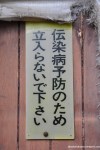
Sadly there wasn’t much to see anymore. Most buildings were either in really bad condition or completely bolted up with metal plates. There was an abandoned TV, some instructions signs on walls and a rule book regarding laundry and other aspects of daily life living in the half-way house, but that’s pretty much it. A nice stroll, 1.5 to 2 hours, the most interesting part probably the small playground for children in the back of the half-way house – nothing spectacular, but far from being a disappointment…

(If you don’t want to miss the latest article you can *follow Abandoned Kansai on Twitter* and *like this blog on Facebook* – and of course there is the *video channel on Youtube*…)

Read Full Post »

More often than not I barely have any information about the places I visit in advance. Sometimes I only saw a photo and have a general idea where to look for the location. It was like that when visiting the *Bibai Bio Center* – and the Horonai Substation was not much different. A red brick building somewhere in the middle of nowhere – and a road leading there. That was it. I didn’t expect a spectacular location… and I didn’t find one. Nevertheless it was a good exploration with an interesting history, the first one on my *haikyo trip to Hokkaido*. *Michael* thought so, too – although he almost paid a steep price for making a snow angel…

History

The Horonai Mine has an incredibly and unusually long history, dating back to the early years of the Meiji Era (1868-1912). Back then it was a time of new departures and Hokkaido still was kind of unknown territory. Japan recently opened itself to the world after more than two and a half centuries of information and immigration control, relying heavily on foreign experts to accomplish in a couple of decades what Europe and the States took about a century – industrialization. Just a decade prior Hokkaido was still known as Ezochi and for its renitent inhabitants, but the new government in the newly appointed capital Tokyo pushed for the development of Japan’s most northern prefecture… and population rose from 58.000 to 240.000 in the mere ten years of the 1870s. Agriculture and mining became the prefecture’s most important industries – and while agriculture is still important (especially wheat, potatoes, pumpkins, corn, raw milk, and beef), mining isn’t. The amount of abandoned mines in Hokkaido is incredible, but since most of them are in extremely rural areas, often hours away from bigger cities, we decided to visit the Horonai Coal Mine as an example – because it wasn’t completely out of the way, came with an electrical substation and, to our surprise, with the Horonai Shrine.
It wasn’t until writing this article though that I found out that the Horonai Mine was actually Hokkaido’s oldest modern mine and that Hokkaido’s first railroad, the Horonai Railway, was built to establish and operate the Horonai Mine. It’s said that in 1868 a local resident discovered coal in Horonai, but it wasn’t until 1872 that the village received any attention, leading to a survey in 1873. Expecting massive amounts of high quality coal in Horonai plans were made concrete in 1877 and money was raised through industrial bonds in 1878 after important statesmen like Ito Hirobumi and Yamagata Aritomo visited the area in previous years and campaigned to establish a mine. Further surveys were conducted in May of 1878 and the mine was opened on December 18th 1878, reaching full production almost four years later in June of 1882.
Plans for the Horonai Railway, necessary to transport the coal mined in Horonai to places where it could be used, were finalized in December of 1879, so construction of the railway began in January of 1880, installation began in July of the same year – technology and knowledge was imported from the United States by J.U. Crawford, who oversaw the railway construction project for the Japanese government; the line was officially opened on September 13th 1883 and was used for the transportation of passengers as well as coal.
In 1889 both the mine and the railroad were privatized, probably for little money, as both of them were not profitable at all. This happened a lot in the late 19th century in Japan, strengthening the so-called zaibatsu (gigantic family controlled holding companies, amongst them still famous corporations like Mitsubishi, Mitsui, Sumitomo and Kawasaki), but also countless mid-sized companies (although sometimes even profitable companies were given away for a fraction of what they were worth…). Business continued for another 100 years and ended in 1989, when most of the buildings were demolished for security reasons – and because back then industrial heritage wasn’t considered worthy of preservation. (The Völklingen Ironworks in Völklingen, Germany, and the Zollverein Coal Mine Industrial Complex in Essen, Germany, were actually spearheading the idea of maintaining old industrial buildings, becoming UNESCO World Heritage Sites in 1994 and 2001 respectively.)
A not so fun “fun fact”: Like many other mines in Hokkaido, Horonai was taking advantage of prison labor. Not only during times of war, but in the early years, both before and after privatization. In 1883 250 prisoners worked next to 228 general laborers. In 1890 there were 1.043 prisoners and 183 normal workers “employed”, the forced labor accounting for more than 80% of the work force, extraction and transportation almost exclusively relying on prison labor! (It was actually thanks to the prison laborers that the Horonai Mine survived the first couple of years. From 1882 to 1888 the mine was deep in the red with only one profitable year and couldn’t even afford to implement mechanized coal transport – that actually happened only after it was privatized and exploited prisoners as cheap labor for years. And after the extraction costs per ton of coal were cut down to one sixth over the course of six years till privatization in 1889.)
The Horonai Mine also gathered some local fame in Japan when it was used as the setting of the second Season of Survivor (サバイバー) in 2002 – after Palau, but before the Philippines and North Mariana. Probably the most original setting ever and by now much more exotic than all those islands in the Pacific Ocean; they look all the same to me anyway! (I usually don’t link to other people’s Youtube videos, but *here is the intro to that season* in 240p. Don’t miss the *video I took at mine in late November* in 720p!)

Exploration

When we arrived on location the initial situation wasn’t promising. Several hundred meters before we reached the substation we had to park the car as the road was completely snowed in. Luckily there were tire tracks (we were able to walk in) from a more suitable vehicle, but the road itself wasn’t accessible with the small car we rented. As we got ready to walk up the hill we saw a guy and his dog coming back to their car. Nothing unusual, until we saw that the guy was carrying a rifle. Not the usual BB guns you have everywhere in Japan. A real friggin rifle! Even if he wasn’t shooting trespassers we were wondering what he was hunting in the forest ahead of us… and if his prey might want to get a shot at hunting us…
Nevertheless we followed the previously mentioned tire tracks deeper into the valley. To the right we saw several concrete ruins of the Horonai Mine, abandoned in 1989, when the mine was closed after 110 years. Everywhere along the road we found information signs (Japanese only…) and it seems like the area was converted into a “coal mine scene park” in 2005. It turned out that the first abandoned place on our trip wasn’t actually that abandoned, more like a tourist attraction – like the *Shime Coal Mine*, a.k.a. the *Anti-Zombie Fortress*. Of course there were no tourists seen anywhere, so I guess the place is only of interest in the snow-free summer months… and basically inaccessible the rest of the year. Michael of course was eager to head over to concrete remains, but given the deep snow and the unknown terrain I was able to convince him to look for the substation first – especially since the grey leftovers didn’t look like they contained anything interesting.

It took us about half an hour to walk from the parking lot to the substation and the tire tracks ended a couple of dozen meters before reaching our destination thanks to a collapsed tree on the road – from that point on we had to walk through the snow which was about 30 centimeters deep.
The Horonai Substation, a two-storey brick-clad concrete building, was built in the 1920s, more than 40 years after the mine was opened, and received its electricity from a coal fired power plant in Shimizusawa. That plant, which was fuelled by coal from the Yubari Mine, not the Horonai Mine, is still in existence and closed in 1991, but was not visited by yours truly as the roads leading there would have required a separate day trip.
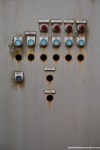
Sadly there wasn’t that much to see: The metal constructions of the transformers and the brick covered building – locked by a solid chain, but luckily Michael found another way in. The building clearly was in use during summer months, featuring some kind of exhibition with lots of exhibits and huge control panels from the good old days.
More interesting was the Horonai Shrine, which obviously was completely covered by snow, too, and probably as half-abandoned as the Horonai Substation. Located right next to the substation on a small plateau up a slope, the shrine offered a nice view at the remains below. At that point it started to snow and I don’t know why, but there is an amazing peacefulness about deserted snow-covered shrines. Michael was still down at the substation, so all I heard was snow falling – perfect tranquility.
Overall the Horonai location wasn’t spectacular, but at that point I hadn’t explored many snow covered (more or less) abandoned places, so it was a good start into the trip!

Snow Angel

Oh, after all those paragraphs about the mine’s history I almost forgot about the snow angel! It seems like either Michael or I have a serious amount of bad luck when exploring together. In spring I broke my D90 on our *haikyo trip to southern Honshu* – and I already mentioned Michael’s misstep at the *Hokkaido Sex Museum*. His bad luck started earlier though, when he insisted on making a snow angel on the way back to the car. I thought it was a bad idea in the first place as it was cold and he was jumping spine first onto unknown ground (concrete, rocks, metal, …), but everything went fine until the point when Michael first took off his glasses and then stood up shortly after, realizing that his glasses were gone. In a comedy movie kind of situation he asked me to watch my steps – the last words barely left his mouth when he moved one of his legs and we both heard a crushing sound. The spectacle frame under his boot wasn’t only bent, but broken. Well, bent and broken. Michael, the designated driver on this tour since my license isn’t valid in Japan, had some contact lenses with him, but they would have only last for two or three days – shorter than the trip. So on the way to our second hotel we were looking for a glasses store. 5 minutes to 8 p.m. (i.e. closing time) on a national holiday (!) I spotted one. Not only were they able to fix Michael’s glasses in a miracle operation taking almost half an hour, they did it for free and also give mine a new polish. Quite a few people complain about the (lack of post-buy) service in Japan (and I admit that sometimes it can drive you nuts!), but the glasses shops here are amazing and saved not only the day, but kind of the whole trip…

(If you don’t want to miss the latest article you can *follow Abandoned Kansai on Twitter* and *like this blog on Facebook* – and of course there is the *video channel on Youtube*…)

Read Full Post »

All I knew about the Bibai Bio Center when I added it to the itinerary of the *haikyo trip to Hokkaido* was its name and a photo similar to the first one I published myself – just without the snow. I was intrigued by the strange looking tower and the ripped upper floor of what seemed to be the main building. At that time the GoogleMaps satellite image was so blurry that it was basically useless. So when *Michael Gakuran* and I drove up to the place we had no idea what to expect – or how to get in…

Blessing and curse of visiting Hokkaido in late November is the fact that most of the huge island is already covered by snow; which is nice to look at, but limits the accessibility of certain areas and buildings. The Bibai Bio Center, way bigger than expected (about 100 meters by 200 meters!), was one of those areas / buildings. Well, there was an easy way in, but luck wasn’t on our side as we found a whole crew of workers repairing the street and / or lamp posts right in front of the bio center! So we had to find another way in, which turned out to be surprisingly difficult as there were several houses and companies nearby, the surroundings of the buildings were completely overgrown with all kinds of plants – and the whole area was covered by 20 to 30 centimeters of snow. At this point I was actually willing to call it a day and move on to the next location. It was cold, we had to deal with unknown terrain, the building looked rubbish and we were in constant danger of being spotted by workers, local residents or even cars passing by. Michael on the other insisted on getting in somehow, clearing the way from the backyard of a private home like a minesweeper, using his tripod to find possibly dangerous spots under the snow – which worked out surprisingly well, except for one or two missteps… and the fact that we gained about two meters of ground per minute.

Once inside the Bibai Bio Center my impression of the place changed completely! Sure, it was run down and there was not much to see, at least not much you could describe as spectacular or even unusual, but for some reason I totally fell in love with the level of decay, the little things here and there, and especially the colors. The colors were amazing! Most of the rooms had a wooden floor and were severely damaged, moss and mold had taken over, so it was basically impossible to step inside. The more interesting and challenging were the shots I was able to take from the hallway. I fondly remember a ceiling lamp lying on the ground, surrounded by moss and mushrooms. Or a stack of tatami mats rotting away at different levels of decay – the side on the hallway was still intact, the middle was black and the window side was already green thanks to growing moss… and all of that in late November in Hokkaido!
Usually I am the one who finishes shooting a place first, but this time it was Michael who got bored and made me hurry a bit. I shot a quick video at the first building, which seemed to be kind of a dormitory or a school (or maybe both?), and then we moved on to other parts of the vast area.
Through a corridor we reached a lower building connected to the first one. Here we found several offices with stacks of scientific magazines from the 1980s about plants. Since most ceilings in that part of the building must have collapsed years ago the offices were in horrible condition, but one of them had a calendar on the wall, dating back to 1992.

Sadly there are not many sources anywhere revealing information about the Bibai Bio Center – and I won’t go down the slippery Resident Evil, T-virus, Umbrella Corporation road…
Its full name must have been “Fuji Foods Bibai Bio Center Co., Ltd.” and it looks like it was a company that produced processed food and perishable goods, like enokitake – enoki mushrooms, a key ingredient in Japanese, Chinese and Korean cuisine. Originally the land was used by a company called White Birch Wooden Yarn (白樺毛糸) before Fujishokuhin (= Fuji Foods) took over and added quite a few buildings and machinery.
Those buildings Michael and I were exploring after leaving the office area, but first we had a quick look at the shiny silver sphere on top of a tall pillar that caught my eyes months earlier and was basically the main reason for me to go to the Bibai Bio Center. I am still not sure what it was exactly, I guess a water tower, but there was some strange antenna attached to one side… maybe a lightning rod?
On the way there we found a vandalized and tagged abandoned car partly covered by snow. I guess no abandoned place is complete without an abandoned car!
The factory buildings with all kinds of tanks, boilers and containers attached to their sides weren’t in good condition either. Some of them were damaged by fires, other must have been collapsed thanks to the masses of snow they had to deal with for 20 Hokkaido winters. One of the huge halls, featuring wooden tiles on the floor, was filled with dozens of huge trash bags (the white boxes on that photo I took were supposed to be filled with enoki mushrooms according to their labeling), another one was basically empty. There weren’t a lot of shelves or production machinery, so I guess a lot of the interior was sold – either to other companies or for scrap. Or maybe we missed some stuff as we were rushing through the gigantic area way too big to squeeze it into a three location per day exploration schedule. Places like a growth chamber I was only able to see from the corner of my eye. Definitely a place to come back to if I ever get the opportunity to travel to Hokkaido again!

As leaving the Bibai Bio Center the way we came in (or just waltzing outside the front gate since the workers were gone at that point…) would have been way too easy, Michael decided to explore new territory… again. Attached to the huge halls were some kinds of metal covered supply tunnels. We saw a collapsed one from the outside, so when Michael saw a small opening in a wall from the inside to explore an intact one of course he was gone before I had the opportunity to yell “Objection!”. Being about 50% older, taller and heavier than Michael I don’t like narrow spaces and maybe I should have just left via a more secure way, but of course I acted against my conscience and followed him. Big mistake. The supply tunnel ended in a collapsed part from where we had to jump down back into the snow. From there we had to climb through a window into another building and from there we went outside again, back to the area we came in – but about 150 meters to the east. Walking along another one of those snow covered supply tunnels (outside this time…) we got miserably cold and wet within minutes and I almost poked an eye out thanks to the resilient plants. And as if being cold and wet and wearing snow filled hiking boots wasn’t bad enough I slipped down a tiny slope at the final drainage and landed straight on my behind, filling my jeans with snow from the top, too. The fun of urban exploration in winter! At that point I thought I couldn’t get any colder – little did I know that the *Canadian World* an hour later would easily top that…

(If you don’t want to miss the latest article you can *follow Abandoned Kansai on Twitter* and *like this blog on Facebook* – and of course there is the *video channel on Youtube*…)

Read Full Post »

The Papierfabrik Knoeckel, Schmidt & Cie. (Papierfabrik = paper mill) was without the shadow of a doubt the urbex highlight of my vacation to Germany in 2011. Ever since I moved to Japan in 2006 I spend a couple of weeks in summer back home in Germany, visiting family and friends. As much as I love Japan – I really hate the summers there. It’s hot, it’s humid and it’s dark at 8 p.m. the latest. German summers are less hot, way less humid and you can have a BBQ outside till 10 p.m. or even later. There’s actually stuff you can do after work, not just crawling under the next air-condition – which most likely is set to a smoldering 28° Celsius anyway since Japan pretends to save energy ever since Fukushima happened. (Ironically the ACs are set to 28°C in winter, too – heating is no problem, but if you wanna have some cool air you are considered the devil…) I started with urban exploration in late 2009 and when I came back to Germany in 2010 I visited *Pripyat and Chernobyl* as well as two locations in Luxembourg I yet have to write about. No urbex in Germany in 2010 for me. 2011 on the other hand saw me visiting places like the *Clubhotel Messel* and the *Cambrai-Fritsch Kaserne* – and the latter one almost prevented me from actually entering the Papierfabrik Knoeckel as I ran into some security trouble at the CFK the day before I visited the paper mill with my old friend *Gil*.

Located on both sides of a valley in the Palatinate region of Germany the Papierfabrik Knoeckel is virtually impossible to miss – if you found the right valley you are golden. The downside of that fact is the traffic ahead and behind you. Getting a parking spot is not the problem – entering the factory without being seen is. Like I said, I ran into some trouble the day before (on a former military basis, to make things worse), so I wasn’t exactly eager to jump a fence and run while being watched by potentially dozens of people. The backside of the factory seemed to be a bit quieter, so we walked along a forest road up a slope… only to run into a house where a dog started to bark and didn’t stop for at least an hour! We followed another road leading down to the factory, the damn dog still barking. Now we were separated from the factory by a small river (maybe three meters wide), once a fundamental element of every paper mill as water ran machines. Two bridges and a building span across that river, but our options were limited soon – one bridge was fenced off and the other was equipped with a modern security camera. Caught the day before, dog barking in the background, an active security system. My urge to enter the factory went down to zero and in the end it became another key moment regarding my dislike of infiltration. Not nearly as bad as the experiences at the *Noga Hotel* or the *Sunset View Inn Shah Bay Resort*, but another stepstone…
To make a long story short: We entered somehow, it was an amazing location, and it took us four hours to leave. Four overly cautious, nerve-wrecking hours that weren’t really fun at all – in hindsight it’s always easy to say that it was totally worth it since nothing went wrong, but the potential for disaster was there…
In the end I took some really neat photos at the Papierfabrik Knoeckel. Photos that work very well in both monochrome and color – which makes it one of my favorite locations in Germany, at least now that I am sitting in front of my PC. The reasons why the photos turned out that way, is because the Papierfabrik has a lot of history and grew organically. Old buildings weren’t demolished, they were reused and new buildings were constructed in addition. Some buildings still had large ciphers fitted to their walls – 1914 and 1952 I remember vividly. But the paper mill was older. Much older. 1888 saw the founding of the Knoeckel, Schmidt & Cie. GmbH (GmbH = Gesellschaft mit beschränkter Haftung, which equals a modern Limited = company with limited liability) which turned into the Knoeckel, Schmidt & Cie. Papierfabriken AG on January 29th of 1923. (Papierfabriken means paper factories, AG = Aktiengesellschaft = joint-stock company) In 1945/46 production was partially stopped due to a shortage of raw materials and coal – the company survived World War 2 without any damages. Which is even more surprising since the factory had its own railway siding. The reason for that is the fact that paper is incredibly heavy and larger amounts are easier and more cheaply transported by trains. At one point the rival Robert Cordier AG (which produces paper since 1836!) bought 99.78 percent of the Knoeckel, Schmidt & Cie. shares (which was turned back into a GmbH in 1995 after a loss of 1.4 million Deutschmarks (0.7 million Euros) within half a year), but on August 18th of 2000 the Robert Cordier AG filed for bankruptcy. Knoeckel, producing glassine, translucent vellum paper and special papers for technical applications, wasn’t making money anymore after 112 years…
On May 30th of 2006 a conflagration that took 9 hours to extinguish destroyed several disused production sheds, making the abandoned buildings even more dangerous due to a higher risk of collapse.
Today the Papierfabrik Knoeckel shares the fate of many abandoned buildings – potential private investors, local politicians and citizens’ groups are arguing what to do with the 55.000 square meter area, but can’t agree on anything. And so the paper mill continues to decay, attracting more and more urban explorers, graffiti sprayers and vandals…

This is the *second time* I decided to publish a photo set in monochrome. I actually converted all photos and selected two sets – one in color, one in monochrome. There were hardly any overlaps, so I might publish a color set in the future, maybe along with an update on the state of the paper mill. I even converted the videos to monochrome, just for the sake of atmosphere. Exploring this location I felt like being transferred back in time to the 40s, 50s or 60s; decades most of us associate with monochrome photography. I hope you welcome this decision…

(If you don’t want to miss the latest article you can *follow Abandoned Kansai on Twitter* and *like this blog on Facebook* – and of course there is the *video channel on Youtube*…)

Read Full Post »

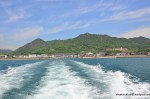
Okunoshima is urban exploration for beginners. Actually it’s more like a vacation day than urbex – with an inglorious past, probably one of the darkest chapters in Japan’s history. And it’s an island with many names. In Japan Okunoshima (大久野島) is famous as usagi shima (ウサギ島), Rabbit Island. People with a more twisted look at life call it Poison Gas Island, though the Japanese term doku gas shima (毒ガス島) is way less common – but I doubt that this is the result of a more positive Japanese mindset…

Located in the Seto Inland Sea about 50 kilometers east of Hiroshima Okunoshima disappeared before if became famous. Back in the 1920s Japan signed the Geneva Protocol of 1925 that banned the use of chemical and biological weapons – but it didn’t say anything about development, production, storage or transfer. At the time being up to no good and started making trouble in the neighborhood, Japan immediately began to take advantage of that loophole. And with that Japan became the only country to use chemical weapons  in World War II, killing an estimated 80.000 Chinese soldiers and civilians according to historian Chi Hsueh-jen! (Not only with the knowledge, but with the permission of Emperor Hirohito… which probably should have lead to his prosecution as a war criminal. Sadly, hard evidence was found only decades later by Yoshiaki Yoshimi, a professor of modern Japanese history at the prestigious Chuo University and a founding member of the “Center for Research and Documentation on Japan’s War Responsibility”. My deep respect for the man, I’m sure his research made him more enemies than friends…)
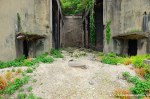
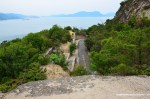
The location of choice was the small and barely known island of Okunoshima, off the beaten tracks in case of a major accident, but still close enough to the important military city Hiroshima. From 1927 to 1929 an existing fish cannery on Okunoshima was “modernized” with a desalination plant, a refrigeration system and a power plant – and at the same time all foxes, martens, cats and rats were systematically eradicated. Okunoshima was erased from maps and Japan did everything to keep its existence a secret. Shipping routes were changed and trains along the coast had to close their window shutters, so did ferries passing the island. Plain-clothed members of the infamous Japanese military police kempeitai made sure everybody followed those rules and didn’t dare to sneak a peek. To avoid any activity on Okunoshima being seen from mainland Japan the old fish cannery was blown up, keeping the new installations intact – and the old pier in the west was replaced by a new one further south, closer to the research and production facilities. Huge storages for gigantic tanks were carved into the mountain and the soil was used to create ramparts as visual covers. In 1929 production began with high secrecy and under horrible conditions.

Since most of Japan’s leading scientists were under the supervision of western secret services they couldn’t be involved directly in the top secret base on Okunoshima. Production had to be executed by educated amateurs. Most of them were Korean forced laborers who worked in the production of medicine or soap before, locals looking for a good salary – and later on the military pressured more than 1000 local high school students into working on Okunoshima; at first only those with good grades in natural sciences, in the final years of WWII pretty much everybody available. The workers were given protective suits that weren’t really protective because the aggressive chemicals made the PVC brittle – thousands were injured because of that and during accidents, many died of their injuries because there were no doctors on the island and nobody was allowed to seek medical help on the Japanese mainland for the reason of secrecy. The production halls were cold in winter and smoldering in summer. Imagine wearing a plastic suit in a climate that sometimes makes it hard to breathe even when in shorts and T-shirt…

About 6.600 tons of mustard gas (Yperite), lewisite, phosgene and other poison gases were produced and stored temporarily on Okunoshima between 1929 and 1944 before being put to use by the Japanese military. While the gases were tested on rabbits on Okunoshima the scientists there worked together with the infamous *Unit 731* on at least two occasions in 1940 and 1943 – they tested mustard gas on Chinese prisoners. (In case you don’t know Unit 731: Have a look at Wikipedia and make sure you don’t wanna eat soon. Their initiator and commanding officer *Shiro Ishii* was one of the most despicable people to ever walk on this planet, the Japanese Josef Mengele, maybe even worse – but thanks to some Americans, especially from Fort Detrick, the weasel was never prosecuted, although he should have been executed for his war crimes. Ishii didn’t even have to flee Japan since he was able to negotiate immunity for himself and his closest allies. Instead he lived a peaceful life with his family until is death in 1959 at age 67.)

After World War II ended in 1945 the remaining poison gas was dumped in the ocean, buried or burned – the factories were blown up or used as housing or storage (e.g. for ammunition during the Korean War). This was done by Japanese contractors under the supervision of the Americans, but what happened to the rabbits used as laboratory animals is rather unclear. Some say they were released by workers after the Japanese military left the island – others claim that they were all killed by the American military and the current rabbits on Okunoshima are descendants of a dozen pets released by a Japanese school class in 1972. One thing is for sure: Since all natural enemies of the rodents were killed in the late 1920s they don’t have to fear any predators and so they breed like… well… rabbits.

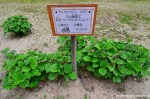
Okunoshima stayed a forgotten island for a few decades until in 1988 something unusual happened, at least by Japanese standards: A poison gas museum opened on the Poison Gas Island. Of course emphasizing the harsh conditions for the workers in the factory, because as everybody knows, at least everybody educated by the Japanese school system: Japan was the victim of WWII. Well, sadly that is the common self-awareness, which explains South Park episodes like Whale Whores (and Chinpokomon…) – episodes that show an understanding of Japan most people, including Japanese, don’t have. And so all the photos of poison gas inflicted wounds in the 2 room museum are not from WWII, but from the Iran-Iraq War of 1980-1988. And while most ruins on Okunoshima have signs in Japanese and English (which is quite commendable since it’s unusual for any location that far off the beaten tracks!) the ones at the museum are mostly in Japanese only. (Which reminds me of the Peace Center in Osaka, where most of the surprisingly critical exhibits are labeled in Japanese only while all the others are bilingual, Japanese and English – shamed be he who thinks evil of it…)

Nowadays Okunoshima is a popular tourist spot, visited by about 100.000 people a year, many of them staying overnight at the hotel or the camping ground on the island. Not so much because of the poison gas factory ruins or the museum, but because of the rabbits. Like I said, no predators, so 100s of them are roaming freely, probably making Okunoshima the world’s largest petting zoo. Usually when I am on my way to an abandoned place and there is some noise in the bushes close-by it’s a snake. Or a boar. Or a monkey. Maybe even a bear. On Okunoshima it’s a rabbit. Or a bunch of them. Charging at any person that is passing by, hoping for some food. And they are so adorable! I came for the ruins, but I stayed for the rabbits. Seriously, I spent much more time taking photos of rabbits than taking photos of ruins – when I found out that there were remains of a Meiji era fort from the Russo-Japanese War of 1904/05 I almost considered it a burden, not another photo opportunity…

Pretty much all rabbits on Okunoshima are hand-tame. The ones near the ferry terminals and the hotel are by far the biggest ones. I’m sure they get fed 24/7! If you like your rabbits smaller and a little bit more shy I recommend going off the beaten tracks – to the tennis courts (de-facto abandoned, at least some of them), to the former gunpowder storage or any trail up the mountain. Don’t worry, even there you don’t have to look for rabbits… they will find you! (And you don’t have to worry about snakes, boars, monkeys or bears – you are not even allowed to bring cats or dogs to the island.)

As for my day on Okunoshima: I did a full circle, starting at ferry terminal 2 and ending at ferry terminal 1, since I left on the second to last boat departing from the island; you can *have a look at GoogleMaps* as Okunoshima is a tourist attraction. And I refrained from renting a bike, because I wanted to take my time and enjoy the relaxing atmosphere on the island. The weather started out sunny and ended overcast, poison for photography, but surprisingly I didn’t mind. All of a sudden I didn’t care that much for the gas factory ruins. Many of them were fenced off by ridiculously low bars, but for once I did respect those barriers that were more symbolic than effective. After learning about the place’s history all those chunks of concrete blackened with soot weren’t that important anymore. Okunoshima’s history was just overwhelming. Why disrespect a place that saw and caused so much pain and suffering? When at the same time you can spend a relaxing day at the beach and play with cute little bunnies!

Going to Okunoshima was a wonderful experience and I kind of left with a heavy heart – I visited in spring on a warm day, probably still a little bit too cold to go swimming, and I had plans for the next day. But if you ever have the chance to go to Okunoshima from late spring to early autumn make sure to bring a loved one (as well as your kids, if you have some) and stay overnight at the hotel – just make sure to make a reservation months ahead as the hotel is very busy. Unless you are afraid of ghosts and fear that hordes of Chinese war victims, Japanese workers and laboratory rabbits will haunt you…

(If you don’t want to miss the latest article you can *follow Abandoned Kansai on Twitter* and *like this blog on Facebook* – and of course there is the *video channel on Youtube*…)

Oh, before I forget: A shortened German version of this article, “Die Insel der Versuchskaninchen / Okunoshima – Zwischen Giftgas und Kaninchen” (The Island of Guinea Pigs / Okunoshima – Between Poison Gas and Rabbits), was published on Spiegel Online / einestages on Monday – you can *read it here*.

Read Full Post »

Takarazuka is one of those bedroom towns at the foot of the Rokko Mountains, home to thousands of commuters working in Kobe and Osaka. Like Nishinomiya and Ashiya (both to the south) Takarazuka is a rich suburb. While Nishinomiya is famous for sake and the Hanshin Tigers in all of Japan till this very day, Takarazuka’s brightest days are in the past – although it’s still a beautiful place to live and attracts hordes of tourists every weekend. The days of Hanshinkan Modernism, which made Takarazuka one of THE places to be in the early 20th century, may be long gone, but a few parts of this cultural heyday survived for almost a century. Prime example being the Takarazuka Revue, an all-female musical theater troupe, founded in 1913 by the president of Hankyu Railways to attract more people to come to Takarazuka and its hot springs – and of course to sell train tickets… 99 years later the revue is popular as always with ticket prices up to 11.000 Yen. While the hot springs are outshined by the nearby Arima Onsen town Takarazuka gained a new attraction in 1994 when the Osamu Tezuka Manga Museum (Takarazuka’s Tezuka Osamu Memorial Hall) opened its door. This three floor museum is dedicated to Osamu Tezuka (who would have thought it?), the godfather of anime, father of manga, Japan’s Walt Disney – and creator of Astro Boy, Kimba the White Lion (still in development hell at Nintendo?) and Black Jack. Oh, and of course there are dozens of hiking trails in the mountains to Takarazuka’s west and north!

Being one modern and tidy city Takarazuka is way less famous for abandoned places. I’ve actually never seen one on any of the Japanese haikyo blogs. The more surprised I was when I spotted some rusty machinery on my way back from a hiking trip a couple of years ago, long before I started urban exploration as a hobby. So when I remembered the rusty gold a few months ago I saved it for one of those “I wanna explore an abandoned place, but I don’t wanna get up at 6 a.m. to ride several trains for 3 or 4 hours” days. In February of 2012 I finally went back to Takarazuka again – after lunch, because I could!

When I was exploring the Takarazuka Macadam Industrial Plant I wasn’t sure what the place was exactly. Judging by the look of the surroundings and the machinery left behind I guessed it was another limestone mine, an industry almost omnipresent in Japanese countryside – just without the chemical plant the *White Stone Mine* had. A stone crusher was also missing, which is kind of ironic in retrospect given the fact that the kanji for macadam are the same as the ones used in the Japanese term for “crushing stones”. So basically all I found were a couple of loading bays (probably with sorting devices to separate small stones from bigger ones) and conveyor belts; plus controls for the machinery. Some installed within wooden huts in dangerously desolate state, some in wooden boxes just nailed and bolted to concrete walls; I guess waterproof wasn’t invented back then…

Exploring the area was especially exciting since I’ve never seen the place anywhere on the internet before – and it was dangerous! Every step forward, every corner revealed more unsound wood and brittle metal. I guess somebody lived for a while in one of the shacks and left behind, among other things, a suitcase full of porn. Yes, not just a couple of magazines – a whole suitcase full of the censored Japanese school girl porn that seems to be so common for abandoned places in this country… I guess you could call it the Porn Shack.

The other thing that really fascinated me was the already mentioned wooden box containing some of the controls for some of the machinery. Being located at the foot of a mountain range Takarazuka gets its share of rain, so I really wonder who thought it would be a good idea to nail a wooden control box to a concrete wall – and put a metal control panel right next to it. One can only imagine how much maintenance those things needed…

And finally a couple of words about the history of the place – stuff I found out after I explored the plant based on the information gathered there; and of course the internet was a big help… The whole rusty thing is / was owned by a company which could (should?) be translated as Osaka Macadam Industrial Place (大阪砕石工場, Osaka Saiseki), which is still a major player in the earthwork / crushed stone industry with 350 employees and several plants all over Japan. But my limestone assumption was wrong, hence the lack of a chemical plant. Osaka Saiseki was founded 1934 and the macadam plant in Takarazuka was opened in 1938. I assume the area I explored was the old separation and transportation line that was abandoned when the plant moved further into the valley to continue ripping some chunks out of the Rokko mountain range…

Read Full Post »

I have to admit: Finding and exploring the abandoned poultry farm in Okayama prefecture was one of the most rewarding and exciting experiences since I started urban exploration. It was unusual in many ways and I’m so eager to tell you about it, that this has become the fastest published article in Abandoned Kansai history – the events, photos and videos are just 5 days old…
Gosh, where to start? Pretty much everything about this exploration was unusual. The whole thing started when in 2011 a *red factory* / mine popped up on Japanese blogs several times. Urban exploration usually means going to places where many men (and women) have gone before, so I did some research, but didn’t get more than the information that the red mine was supposed to be in Okayama prefecture. So when I kind of randomly looked at the satellite mode of GoogleMaps I found two places with red roofs in the mountains that might have been abandoned. While I found confirmation about the smaller one that it was really a factory, the larger one I had no lead on. A still quite blurry satellite image, that’s it. No information on other blogs, no marking on a Japanese haikyo map, no Streetview – darn, not even a link to a Panoramio photo nearby. Just a bunch of buildings with red roofs standing rather close to each other, kind of similar to the satellite image when you look at the *White Stone Mine*. I didn’t know what they were or even if they were still there as the satellite photos of GoogleMaps tend to be a couple of years old. Nevertheless I grabbed my equipment and a book (The Hunger Games, which I really enjoyed!) last Saturday early in the morning and boarded a train – and another one, and another one, and…
After I finally reached a small station in the middle of nowhere I left the tiny town it was in quickly and walked along a country road for about half an hour, reaching a small settlement close to where I suspected the red roof shacks to be. I was on my own for this exploration – it’s hard to find people to get up when it’s still dark outside to go to a cold place in the middle of the mountains, especially when you can’t promise a spectacular site; or in this case: anything at all. While I was walking past gorgeous little wooden Japanese houses with the stunning roofing tiles and neat gardens a small pickup truck with two senior citizens passed me and turned left down the road – where I suspected the red roof shacks to be. My heart sank almost as quickly as when Gil and I approached the *Deportation Prison Birkhausen-Zweibrücken* back in Germany. And like half a year ago I was right: Getting passed by a truck near an abandoned place is barely ever a good sign. When I reached the small gravel road that supposed to lead to the red roof shacks I found the street and the whole area fenced off. Not with a sturdy fence that is easy to climb. No, one of those half-ass ones you basically have to trample down to get across – unless you are willing leave and get home. But at that point it wasn’t the decision to be made. Because the previously mentioned senior citizens were there, early on a Saturday morning of all days… inspecting the fence and making sure that it reached about a meter over the little river so nobody can go around it – like *Enric* and I did at the *Iimori Mine* two years ago. Since those guys looked like they came to stay I climbed a nearby small mountain with a cemetery. My hope was to get a glimpse into the valley, to at least confirm that the red roof shacks were still there. But that didn’t work out either. Slightly frustrated I came down the mountain and made my way back to the train station when I realized that I will miss the once per hour train by about five minutes even if I’d run. At that point I became rather frustrated and angry. Why the heck did I get up early on a Saturday winter morning to ride trains for hours to go all by myself to a cold mountain valley where I didn’t know what to expect just to find it fenced off and guarded by two old guys? While I was silently cursing on my way through the settlement outside the little town I heard a small pickup truck behind me. When it passed I saw the two old guys sitting in there and I stopped… I had at least half an hour to kill and even then I would make the next train. Why not getting back to that stupid fence?
So that’s what I did. I hurried back to the fence only to find that Japanese planning never disappoints. Since I couldn’t make it around the fence I just followed it for a while. Up another mountain and another cemetery. And there it was, an opening in the fence, at least a meter wide, probably to allow hikers and mourners to reach the top of the mountain. I followed the fence back (on the other side, of course!), only to find a rather steep slope along a wastewater pipe or something like that. Luckily somebody set up a rope there, so it was quite easy to get up and down, ignoring the fact that I ripped my fingers on the cutting plastic, but well, small sacrifices…
Finally on the other side of the fence at the gravel road I hurried deeper into the valley. The road here was overgrown and barely visible, but to my left I saw a couple of shacks in abysmal condition. I was relieved. A lot! Whatever I saw on the satellite pictures was still here. But the feeling of relief didn’t lower the tension at all. At this point I was still visible from the street and being alone in a fenced off area in the Japanese mountains isn’t the best situation to be in. No need to worry about poisonous snakes in January, but I ran into both wild boars and wild monkeys before… and there are wild bears in Japan, too. I tried to ignore those worries and hurried deeper into the valley on this overcast, hazy winter morning. And there it was – the big red building with the intact roof. And at first sight it was clear: This wasn’t the red mine / factory I hoped it would be… it was better!
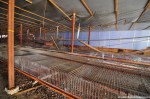
The first thing that caught my eyes was the small silo in front of the open, but rather uninviting building. When I entered I saw cages inside. Dozens, hundreds of them. With the roof still intact the building was pretty dark towards the middle, so I got outside again, circumvented the place and entered from the back. It seemed like nobody had been here in years. And there’s where I found a couple of Lyon Debeaker machines (to „stop losses from picking, cannibalism, fighting, and egg eating”). A silo, cages, debeakers… no need to be a modern Sherlock Holmes to conclude that this was an abandoned poultry farm. An abandoned poultry farm that, to my knowledge, hasn’t been mentioned on any urban exploration / haikyo blog. Ever. Not in Japanese, not in English. So this wasn’t the nth mine to visit – no, this was a unique place. An abandoned poultry farm in Japan!
Finding new places is always exciting to some degree, but in most Japanese prefectures you can’t throw a stone without hitting an abandoned private home or small business, so it isn’t actually that unusual. Finding a yet unknown gigantic abandoned animal farm in the middle of nowhere on the other hand… that’s kind of the urbex definition of “jackpot”. I was truly happy for a short moment, until I realized that I had only a little bit more than an hour to shoot the huge place – I could afford to skip a train, but I would have to catch the next one to make it on time to the second place on my agenda that day. Nevertheless I forced myself into taking my time at the mostly undamaged building. Doing some bracket shots and taking photos with long exposure time in the dark parts of the one room building.
Separating the one intact building from two dozen severely damaged shacks was a small, mostly dried out river. I followed it for a while back towards the fence to find a place where the river bank on both sides was rather low so I could make it on the other side. I had about one third of my time left to cover 80% of the area, so I decided to leave my tripod behind and take some freehand photos, which turned out fine; nevertheless I wish I had an additional hour or two, but there was this other mysterious red roofed building on my schedule. So I hurried a bit making my way through the poultry farm and took a video on my way back to the tripod. I then crossed the tiny river and walked carefully up to the fence, but nobody was in sight. Just to be sure I climbed the mountain again and ripped my fingers just a little bit more. Back down the mountain and through the settlement. This time with a big smile on my face. I had found a huge yet unknown unique abandoned place in the middle of nowhere without any help and explored it all by myself on a cold Saturday morning – the only thing making this experience even sweeter was the fact that I almost failed when the two old guys showed up at the fence at the same time as myself.
What an absolutely awesome adventure!
(If you don’t want to miss the latest article you can *follow Abandoned Kansai on Twitter* and *like this blog on Facebook* – and of course there is the*video channel on Youtube*…)

Read Full Post »

The White Stone Mine (also known as the White Limestone Mine, the Fujiwara Mine, and the Shiraishi Mine – I guess it can be read Shiroishi Mine, too…) is one of the most famous abandoned places / haikyo in Japan. For years people seemed to be quite vague about its location, but ever since GoogleMaps offers high-res satellite photos of the area pretty much everyone can confirm the whereabouts after a bit of research – when I first heard about the White Stone Mine 2 years ago all I saw was a greenish brown mush 4 hours away by train, plus another 70 to 80 minutes by foot. Not worth the hassle, especially since I had many 100% confirmed places rather close-by back then. And I was still an urbex noob after all. In autumn of 2010, almost a year after my discovery, Michael Gakuran told me that he wanted to revisit the mine with some friends of his and asked me if I wanted to tag along. Michael and I met twice before for some explorations and it was always great fun, so I didn’t hesitate a second to join the small group.
When I started me trip to the middle of nowhere the weather was great – sunny, 15 degrees Celsius, a nice autumn day. When I arrived at the train station to meet Michael and his friends, a couple of stations before the terminal stop, the weather was still nice. Then we drove towards the mountains and all of a sudden the weather turned. Cloudy… grey clouds… When we finally reached the mine at around 12.30 (traffic can be a trial of patience in Japan…) it started to drizzle – of course I didn’t bring an umbrella. But well, after almost 6 hours I was standing in front of the biggest mine I’ve ever been to and I was looking forward to finally take some photos.
The White Stone Mine is gigantic! Close to three dozen buildings spread across an area of about 500 x 100 meters. Despite its size there is not much known about the Shiraishi Mine. It was founded by two brothers in 1921 and mining ended in 1969, supposedly after severe damage from a typhoon; the last office on the premises shut down in 1974. But the White Stone Mine was not only a limestone mine, it was also a huge chemical plant with facilities to extract calcium carbonate – a very important base substance for the paper industry. I guess in Japan calcium carbonate is mostly used for construction materials (especially cement), but also for the purification of iron in a blast furnace (at least when the White Stone Mine was still in business). Japan’s cement industry is actually huge – Japan still is the #5 consumer, #4 producer and #3 exporter of cement in the world. Japan’s coast line is famous for its sheer endless amount of concrete tripods and when you go hiking you can see surprisingly many concrete roads in the middle of nowhere – it seems like politics and the cement industry are heavily intertwined…
Exploring the White Stone Mine was exciting, sadly we were running out of time quickly. The sun goes down early in Japan, especially on a late October day in the mountains, even more so when it’s raining. Michael was a great experienced guide who was able to point out some of the best and the worst spots of the gigantic area quickly. An area I saw maybe 30% of. Although the mine was abandoned about 40 years ago it seems like there’s still somebody taking care of the premises: Michael pointed out differences to what he saw half a year prior (tarps covering wooden buildings here, new “Keep out!” signs there…) Although we kind of rushed through the lower area of the mine it already got dark by the time we reached the big silos up the slope. When we got back to the car it was already pitch-black outside and raining heavily. Nevertheless it was a great trip and totally worth the long train ride. A train ride I have to do again one day to explore the other 70% of that gorgeous mine… To be honest, I think it will take at least a full day to explore the whole area, maybe two or three days to shoot the whole mine properly. I doubt I’ll have time for that, but the White Stone Mine is definitely one of the few places I would really like to revisit! Even for (half) a day…
(If you don’t want to miss the latest article you can *follow Abandoned Kansai on Twitter* and *like this blog on Facebook* – and of course there is the*video channel on Youtube*…)

Read Full Post »

Sometimes I wish urban exploration was as simple as googling “awesome abandoned location nearby”, hopping on the train for ten minutes, taking two dozen nice photos and then spending the rest of the day at the beach sipping icecold beverages. Sadly it’s not. It’s never that simple and sometimes things go completely wrong.
Like me visiting the Sakito Mine in northern Kyushu. I was a bit nervous about the place right from the beginning since it’s in the highly unreliable “Nippon No Haikyo” book (by now at least half of the places in the damn thing must be gone…) and GoogleMaps, my trustworthy friend to confirm locations with high resolution satellite images, delivered rather blurry results until a couple of weeks ago. I found some homepages about the place on the internet, but most of the photos were rather old, like 2003-ish. The Sakito Mine was actually the location I skipped on *my first trip to Kyushu* to give *Gunkanjima* another try, so it was kind of a given thing I had to include it to my itinerary; the mine being rather close to Sasebo didn’t hurt either…
After my long and exhausting trip to *Ikeshima* I was eager to finally see the remains of the Sakito Mine, but things went from bad to worse by the hour. When I started my trip on a nice Thursday morning the weather forecast promised four days of hot and scorching Japanese sun, but Friday was already overcast. When I woke up early again the next morning the situation didn’t change, but I wasn’t worried a lot. Ikeshima was way too exciting to be worried again so soon!
I got to the ferry terminal on time only to find out that the boat to the island the Sakito Mine was on would leave with a delay of ten minutes. Usually that doesn’t really matter, but of course it made me miss my bus to the mine, so I had the choice of either waiting 80 minutes for the next bus or walking the eight kilometers. I kind of remembered the bus route, so I decided to walk – still not worried about the overcast weather. Big mistake. About halfways down the road, not a single person (or shop) in sight, it started to drizzle. Not very strongly, but in combination with the high humidity and a rather cold breeze not exactly comfortable. After a while it stopped and when I was finally dry it started again. Not real rain (which would have made me look for shelter), but drizzle. So I continued to walk along the coast, following the road up and down – getting wet and drying.
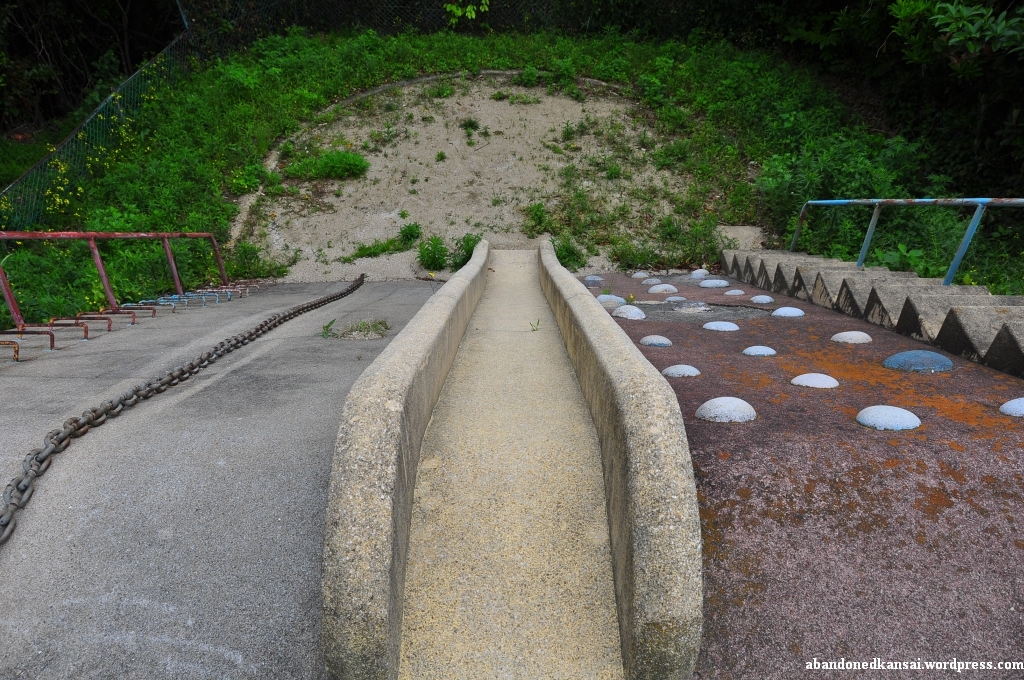
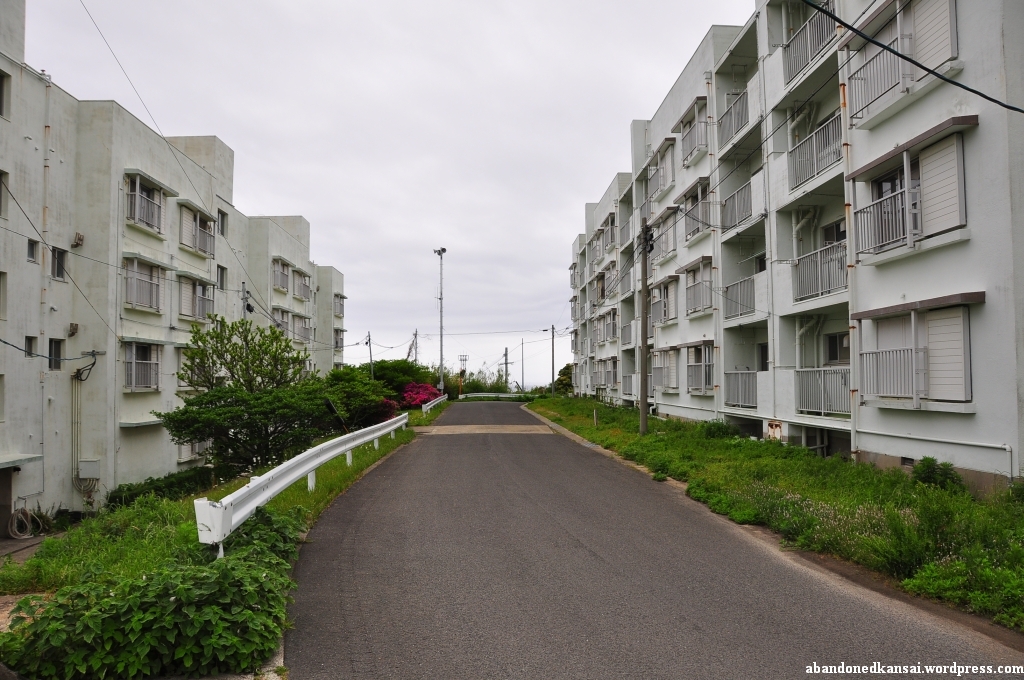
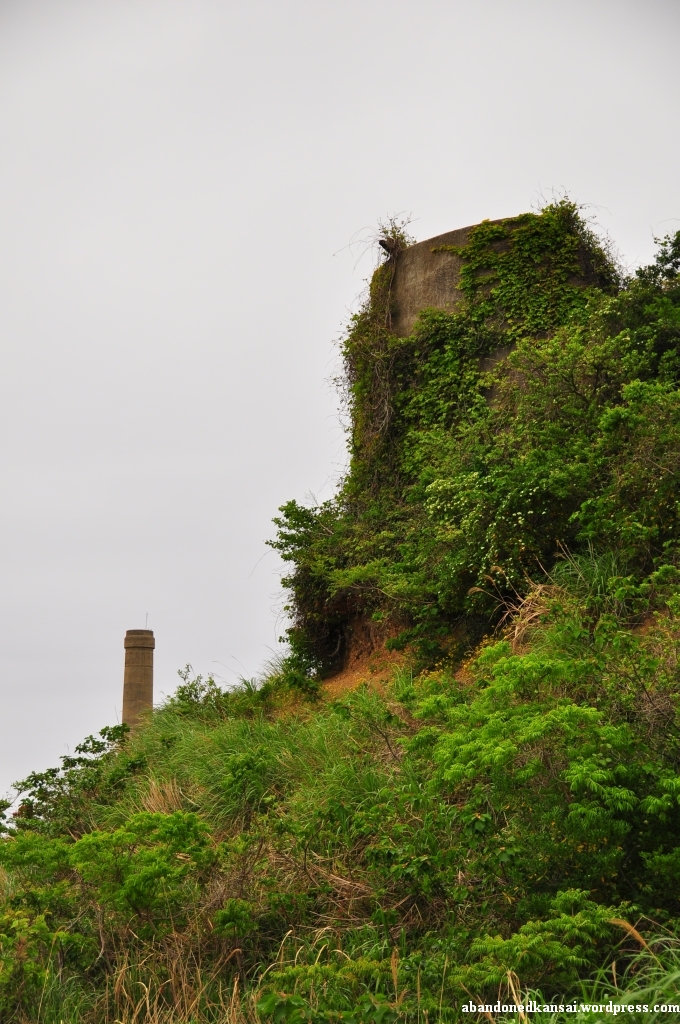
After about two hours I finally reached the area where I expected to find the leftovers of the Sakito Mine. I saw some of the remnants in the distance, overgrown and clearly blocked by (active) private property – so I looked for other remains, especially the apartment buildings I saw on Japanese photos and maps. When I found a chimney I remembered seeing on photos my spirits were finally lifted again. I saw more overgrown, out of reach concrete stuff (I wasn’t even able to identify it…), and then some apartment buildings appeared, reminding me of the ones I saw the day before on Ikeshima. I got closer and realized that they were once part of the mine, but that they have been fully renovated a couple of years ago – nevertheless they were almost completely abandoned, but still in good shape. Maybe one out of ten apartments still housed residents and the nearby playground wasn’t in good shape either – it wasn’t overgrown yet, but it didn’t look like a lot of children played there recently.
I knew that I was in the right area, and I also knew that most of the mine had been demolished right after it was shut down – but I was looking for some apartment buildings close to a huge park and restaurant. North of it actually, just down the road. When I reached the park the drizzle became rain and the light breeze became wind – it was raining almost horizontally. I fould shelter under some kind of resting stop, but I felt miserable: wet, tired, frustrated, unsure if there even were some remains left. The rain turned into drizzle again and I continued to follow the road. I found the fork to the north and of course it started to rain strongly again. This time I found shelter under a tree and after ten minutes I continued to follow the road down the mountain, only to find out that the blurry shadows on GoogleMaps were… blurry shadows – they surely weren’t the apartment buildings I was hoping for. Okay, wrong crossing… I followed the road to a different direction and to a street blocked by a massive metal blockade. That must have been it! I broke through the thick bushes next to it and followed the road for some dozen meters – only to find a flat area, big enough for some apartment blocks, but completely flattened; a wonderland for weeds. So I got back to the side road, saw another “Don’t trespass” sign and went down a rather steep road to a bay – again no signs of apartment buildings, although there should have been some of them visible according to the layout map I saw of the mine. I returned to the main road and followed it a bit more, not willing to give up. When I spotted the tip of another chimney I disappeared through the bushes again, this time to the south. I was able to take photos of some overgrown chimneys, but I couldn’t get closer as I didn’t trust the ground there – and the photos didn’t turn out well in front of the greyish sky. By now the weather was a draining mix of rain and… non-rain, leaving me contantly wet to some degree. Back to the main street I saw another possible location to the north, so I added some more scratches to my arms – again without getting the chance to take some photos.
At this point I gave up. I was tired, I was wet, I was dirty – and I’m sure I smelled pretty badly. At least the street I was walking along had some bus stops, so I didn’t have to walk all the way back to the harbor – but the next bus was coming in 30 minutes and the rain was getting worse again. I decided to go back to the shelter near the park down the road when a car passed me by, turned around and then again behind me. A few seconds later it stopped right next to me and an elderly couple asked me (in English!) where I wanted to go and if I needed a lift. Not that it happens very often, but usually I decline offers like that – not out of fear (it’s Japan…), but because I don’t wanna be a hassle for anybody. This time I gladly accepted. I was too tired and too disencouraged to worry about being a hassle. I just wanted to get out of the rain.
Being a foreigner in Japan you surprisingly often come across xenophobic people. Not at the typical tourist spots, but at shopping malls, off the beaten track roads and way too often in subway trains when they think you don’t understand Japanese at all. But the senior citizen couple I met in Kyushu were by far the nicest people I ever met in Japan, topping even the guy who helped Jordy and me at the *F# Elementary School* a couple of months earlier. They were from Beppu, but on vacation for Golden Week. Super nice people, and it was lovely to see them interact – they were exactly how you imagine kind older Japanese people to be; including the man talking (he did business internationally and therefore was used to speak English a bit) while his wife clearly understood more of what I said and translated for him what I said. They drove me all the way back to the harbor, a fact I’m still amazed about. I wasn’t trying to hitchhike and I must have looked miserably after walking in drizzle and rain without an umbrella for hours – but they turned around to offer me a ride, a male foreigner of all people. Not a lot of people would do that in Japan. Or anywhere else in the world. I doubt the two will ever read this article, but just in case: Thank you very much again, you lifted my spirits a lot and made my day a lot less miserable!
Back in Sasebo I was ready to go home one day earlier, but the staff at the little inn I stayed told me that the weather would be fine the next day. No more rain, so I stuck with my original plan. I took a shower and went to Base Street for a third time – and finally I got my “Special Size” burger, 15 cm in diameter, the best burger I ever had. Still as good as it was 14 months earlier and the perfect ending of a day full of ups and downs… (Well, lots of downs, but two insanely huge ups!)

Read Full Post »

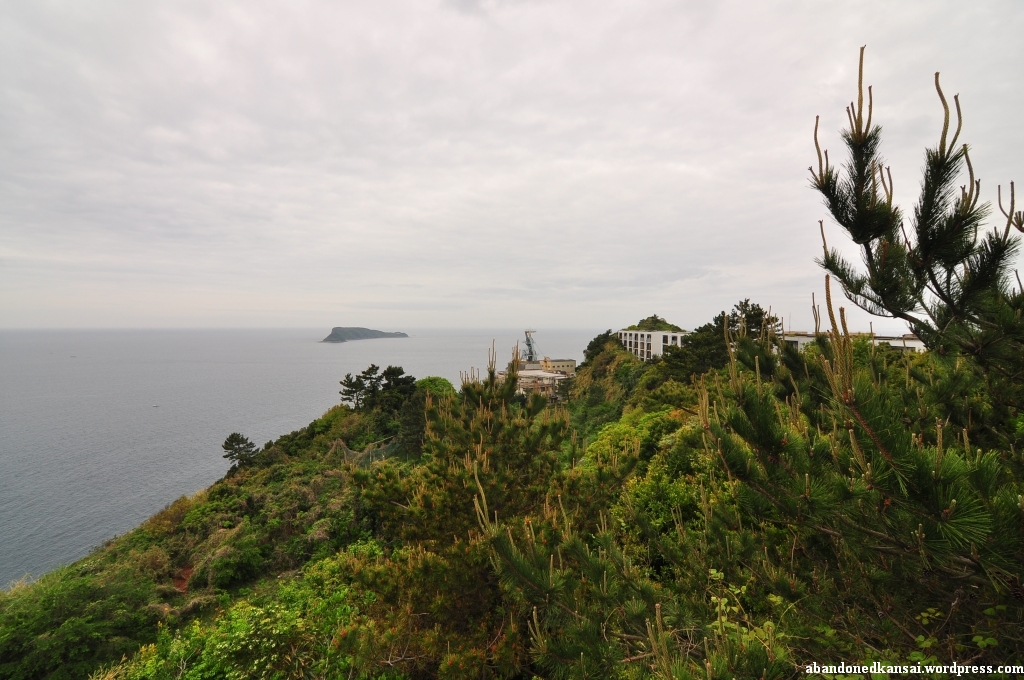
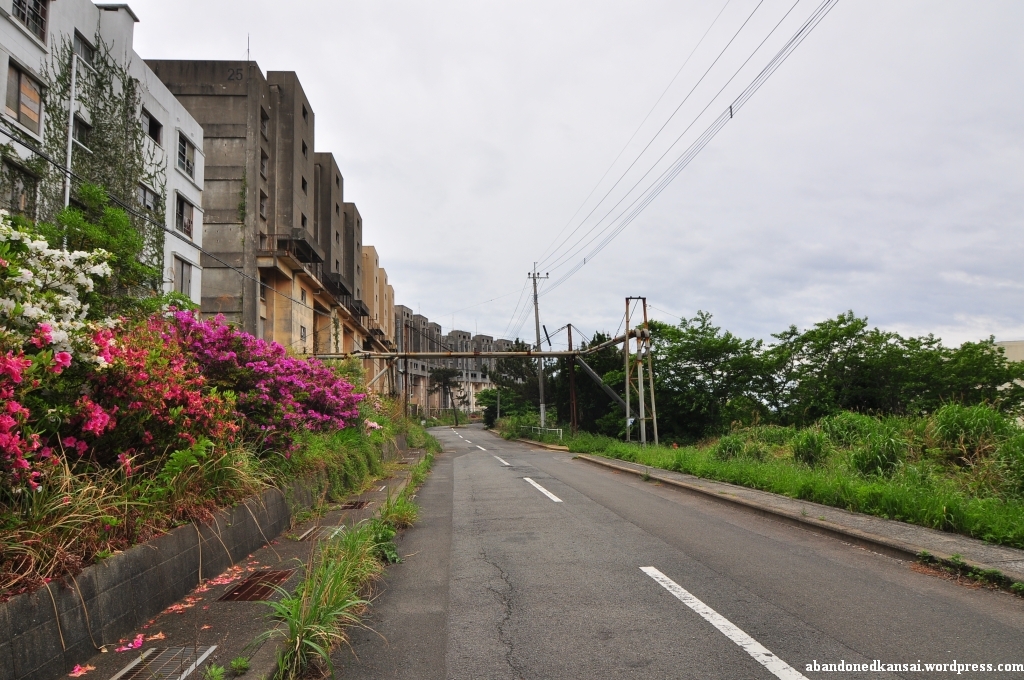
After I left the apartment building and shot the first video I was looking for a new approach to Ikeshima. So I left the area with three-storey buildings and headed towards a bunch of row bungalows with little garden. Some of them were still inhabited and it seemed like the people living there took care of their former neighbors’ gardens. I continued to walk uphill and reached a small park with an observation platform – the highest point of the island. Although the stairs leading up were really rusty and maybe should have been off-limits I went up and had a look around. What a nice view!

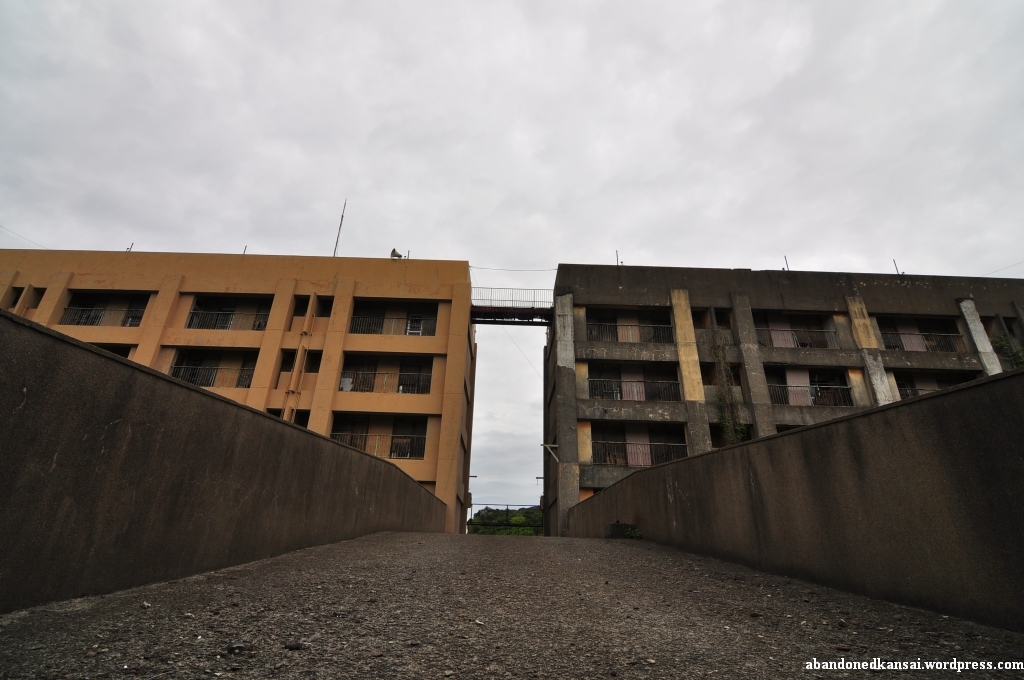
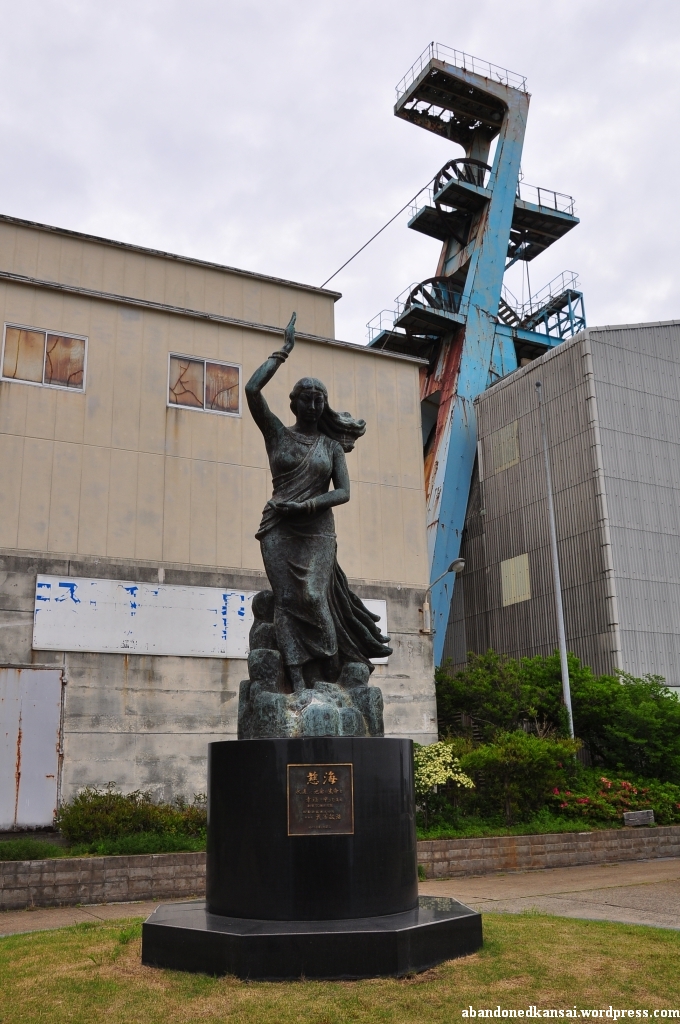
A building with a headframe caught my eye, so I carefully went down again and walked toward the coop – which is sometimes mistaken for a hospital due to some “Safety first” signs. On my way I came across what turned out to be one of the most fascinating building complex I’ve ever seen, totally reminding me of my trip to *Chernobyl and Pripyat*. Its foundation was on the lower end of a slope, with bridges connecting the upper floors with the street I was walking along. A really fascinating construction, even more beautiful from its base as I found out later. But for now the headframe was more important, so I walked down some concrete steps with a severely damaged handrail to the backside of the coop. The rear entrance was actually open, but I refrained from entering. A sign displayed some kind of opening hours of the Mitsui Matsushima Resources Company (三井松島リソーシス株式会社), the subsidiary of Mitsui Matsushima responsible for taking care of the trainee program that ended in 2007. The front entrance had the same or a similar sign. So I took some photos from the outside of the building and walked up the street towards the apartment complex.
To get a better grasp of the whole complex I put down my tripod (including the camera) and my backpack on the side of the road and headed for the bus stop right in front of it. There was some kind of roundabout and the moment I wasn’t visible from the street a small pickup truck (actually a kei truck or Japanese mini truck) passed by and stopped next to my belongings. “Great… trouble!”, I thought and made myself visible. Two guys in their 50s or 60s got out of the truck and when I came closer they addressed me in a mix of Japanese and English – and I answered the same way.
What I was doing here?
Just taking some photos…
Interested in history?
Yep, a lot!
From America?
No, Germany.
At this point their faces lit up a bit and we switched from 75% Japanese to 75% English. Then they asked me if I wanted to see their offices. Wait, what? Yeah, they were working at the coop building with the headframe, they told me. So I picked up my belongings and jumped on the truck bed. Knowing that there wouldn’t be any oncoming traffic the driver sped up quite a bit and hurried down the mountain, but somehow I managed to take some slightly blurry photos without falling off the truck.
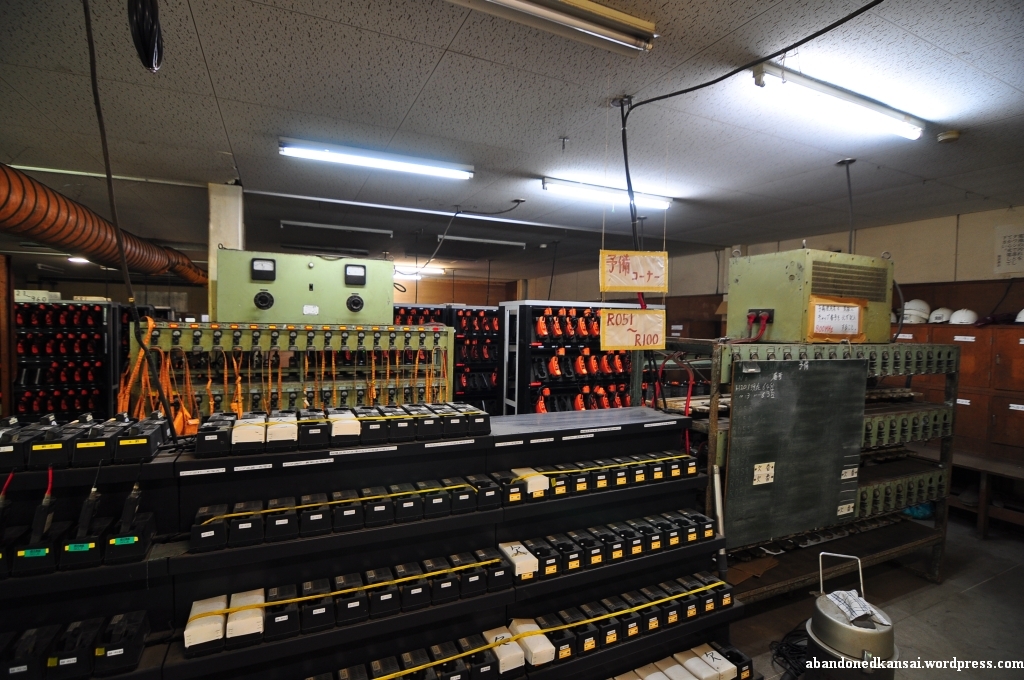
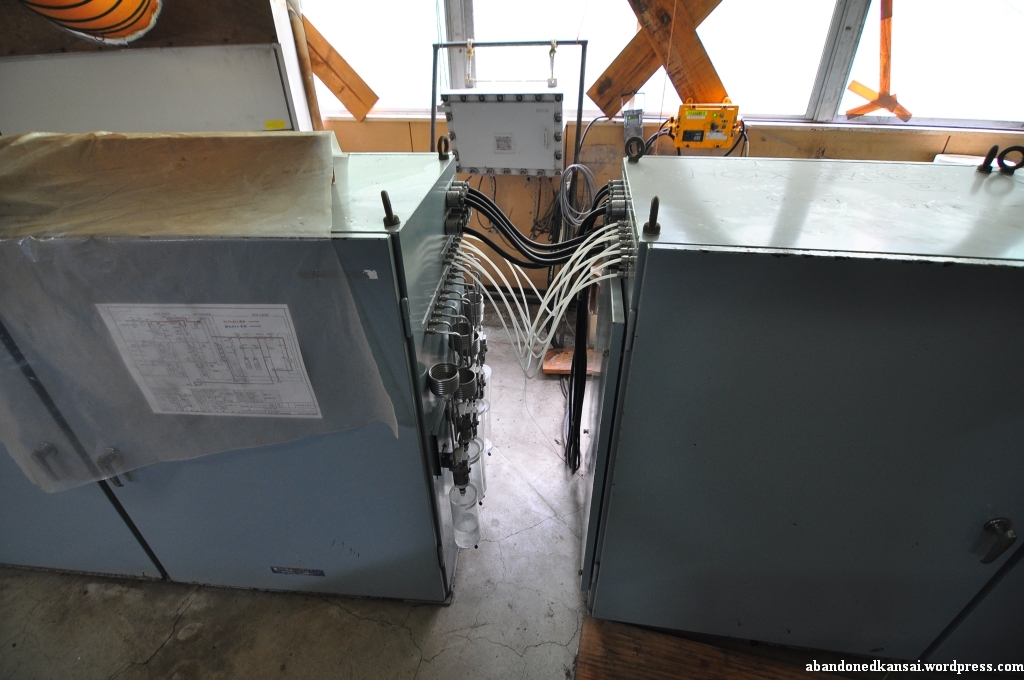
The front door of the building was also unlocked and the guys guided me to the second floor. There were several offices and the entrance to the mine shaft. Lighting was horrible and the guided tour was so quick that most pictures turned out to be blurry. I snatched some shots of the room where the mobile radios as well as other equipment were stored (and charged), then we went through some more offices and by the time I realized what I was doing I was outside again and said goodbye to my guide – I barely spent ten minutes inside the coop, but I was able to take some rare photos. What a great opportunity!

Since the guys gave me a one way ride I walked up the street again and back to the apartment complex. This time I put down my belongings where they weren’t visible from the street and started to take pictures and videos. The weather seemed to brighten up a bit and just looking at the amazing apartment complex put a smile on my face. Such a great building, such a nice atmosphere… I felt at ease and my worries about living up to the uniqueness of Ikeshima were gone. Now that I’m writing these lines I’m again not sure if the pictures and videos can really put you there, but looking at the material for the first time in a couple weeks makes me daydream a bit. As far as I could see all entrances were boarded up or even bricked up, there was quite a bit of barbed wire and the previously mentioned bridges looked very dilapidated from below – but I didn’t even have the urge to enter the complex. It was just nice being there. With the apartment complex, more apartment buildings further down the slope, and an overgrown children’s playground on an additional level between the two housing sections. A couple of minutes before I continued my exploration of Ikeshima the van parked in front of the bus stop continued its tour after quite a long break (the driver must have taken a rest in the little hut next to it) and I felt good. Really good.
Half of my time on Ikeshima was over and I was curious *what the afternoon would bring* – it didn’t disappoint…
(Since the inhabitants of Ikeshima consider their island a tourist attraction I added it to the *Map Of Demolished Places And Tourist Spots* and created *a new map just for Ikeshima*. If you don’t want to miss the latest postings you can *follow Abandoned Kansai on Twitter* and *like this blog on Facebook* – and of course there is the *video channel on Youtube*…)

Read Full Post »

« Newer Posts - Older Posts »