Feeds:
Posts
Comments

Archive for the ‘Ferris Wheel’ Category

I’ve been urbexing for almost 15 years. During that time I’ve never written any articles about equipment, despite being very happy with three different Nikon DSLRs, two Manfrotto tripods, and a Sanyo video camera – which broke in 2019 after almost 15 years of recording countless hours at hundreds of locations as well as places like Chernobyl and North Korea. Videos I always considered a bonus anyway… and I’m still having a hard time thinking of myself as a photographer, given that I have no formal education in that field and only do it as a hobby. A really time-consuming hobby, but nevertheless just a hobby. I also don’t have a background in technology, so what’s the point of reviewing camera equipment when I just have an opinion based on learning by doing? Well, that doesn’t keep countless “influencers” and Youtubers from churning out incompetent nonsense, but I wouldn’t want to be found dead with either label on me! And like my favorite professor at university once said in regards to papers we had to hand in: “Don’t claim anything you can’t proof!”

Fortunately there is no need to be technical or scientific about this Insta360 X4 article, because unfortunately we never got that far…
Like I said, I always considered video walkthroughs of the locations I explore a bonus. I started them pretty much right away, but at first I didn’t even publish them, because I only took them for myself. And even when I published them, I didn’t edit them. No cuts, no voice overs. Just me walking around breathing heavily into the silence. That all came to a sudden halt when my Sanyo stopped working after exploring the abandoned *Trump Hotel*, also wiping out the recordings of the whole day. At that point I was tired of doing the videos anyway – and my co-explorers were increasingly annoyed, because I added 10 to 30 minutes at the end of every exploration for the walkthrough. So I stopped doing them.
For the past 18 months I’ve been exploring solo again (don’t ask, it’s complicated and often quite frustrating, to be honest), but a few weeks ago a colleague of mine showed me an older model Insta360 video camera that a visiting cousin from the States forgot at his place in Japan. I was fascinated by the easy to use 360 photos and videos, so I did some research and decided to get one. I’ve read reviews, I’ve read product pages – I did my best to make an informed decision, because at first I considered buying the X2 or X3 as older models often are cheaper with only slightly fewer / worse features. The X2 was out of the race when I read in a review that it required a smartphone to be activated – something I didn’t read anywhere about the X3 and X4. I guess because it’s an idea that is so stupid that it probably was a one-time mistake by Insta360, facing so much backlash that they removed the requirement from following models. The price difference between the X3 and X4 wasn’t very big and since the latter was only four weeks old at the time, the price on Amazon and in brick and mortar stores was the same, so I decided to get it at my local Yodobashi Camera (street block sized electronics stores with hundreds of employees each, in case you are not familiar with the chain), where I’ve been a customer for almost 18 years – ever since I moved to Japan.
BIG MISTAKE!

Yodobashi Camera was extremely stingy, giving only 1% points on the video camera, despite a promotional campaign of giving 13% points for purchases over amount X – except for (small print)… But when you shell out 80k Yen on a new video camera you are looking forward to use, store points are the last thing you worry about anyway. Fortunately I still had some of those points, which I used to get a seriously overpriced MicroSD card, because without it the video camera would be useless and I wanted to try it out on the weekend before an upcoming urbex trip. 83500 Yen poorer, but with a big smile on my face I left Yodobashi Camera on a Friday evening after an otherwise pretty horrible week.

Saturday was supposed to be a great day, though it started with a rude awakening / realization…
After sleeping in and having a delicious breakfast, I enjoyed a nice unboxing. The first slight disappointment was when I realized that the included battery was dead. Well, not dead dead, but completely empty. Whatever, an hour or two wouldn’t make a difference. It would not dent my great mood for sure. That came a few hours later when the battery was fully charged. I booted the small brick for the first time, its screen came to life, asking me to choose a language – and then the screen showed what the camera was seeing… for about a second or so. Then some text popped up and my heart sank. You gotta be kidding me! What I was looking at was a screen telling me to download an app by Insta360 to a smartphone, iOS or Android, to unlock the video camera. What. The. Heck? I literally felt it in my fingers how my blood-pressure exploded, because unlike pretty much every person on the planet above the age of 6 years I don’t own a smartphone. Never have. In the late 90s I had a black and white Nokia for work (yes, I’m not the youngest anymore, though I started working full-time in my early 20s). When I moved to Japan I had a flip phone or two, but for the past 15 years or so I didn’t have any mobile phone at all, smart or not, because I don’t like them as they turn way too many people into dumb zombies. So here I had a brand-new, quite expensive video camera… that forced me to make it usable by using another device with cameras? Who comes up with stupid ideas like that?!
Certainly not Nikon! Their D7500 DSLR I bought just weeks prior worked with a partly charged battery and regular SD cards straight out of the box 5 minutes after purchase – without any charging or unlocking BS!
So I started to do some research… and didn’t find much. Like I said, I couldn’t care less about smartphones, apps and all that stuff, so I tried to find a solution to unlock the darn X4 via PC or MicroSD card. Of course I couldn’t find anything about that either, so I contacted Insta360 directly – who apparently didn’t read my message and instead sent me a standard reply. So I got back to them, apologized for not describing my problem properly (I’ve been in Japan too long…), and this time got an answer that at least implied that they understood the situation I was in – without being able to help, because though it seems to be nowhere stated on the box, the promo material or even on the X4 website (at least back in mid / late May, maybe they changed it by now)… you really need a smartphone and the Insta360 app to use a newly bought X4 video camera, that seems to work perfectly fine, but is made not usable on purpose by the manufacturer. Which absolutely blows my mind!
How is that even legal?
How can a company force you to use a completely unrelated piece of expensive technology that actually partly does the job of the product you just bought, to make your purchase usable? Without mentioning that essential detail with big warnings before purchase! And in addition, forces you to use an app, which does who knows what in the background without one knowing?
What’s next? You need an electric bike with WiFi to unlock your newly bought car? And if you don’t… sucks to be you, it’s completely useless!

Yodobashi Camera – (The Lack Of) Customer Service In Japan!
After some back and forth it was Monday and I came to the conclusion that I won’t be able to use the Insta360 X4, because it really needs a smartphone to unlock, which wasn’t properly communicated. So after work I went back to Yodobashi Camera, my go-to electronics store for the past almost 18 years. Never had a problem with them, because all the products I bought worked as intended right out of the box. So I went back to the cashier counter where I bought the video camera… and already ran into the first minor bump in the road – apparently I hadn’t paid for it in the camera department, but a neighboring one, which wasn’t a problem on Friday evening, but very well on Monday evening. So I went 20 meters over to the camera department and told them about my unfortunate situation: That I had bought this video camera three days prior, but couldn’t use it, because it doesn’t work without a smartphone, which wasn’t properly communicated by Insta360 or Yodobashi Camera. But I was very careful with everything, I didn’t even remove the protective film from either of the lenses. Some air through the teeth sucking, some going back behind the counter to talk to a superior and then something like the following conversation – it’s in quotation marks, but they are not really quotes, you know… just something like that, from memory:
“I can’t sell this anymore, you opened the box. You can’t return it.”
“But I can’t use the video camera.”
“I can’t sell this anymore, you opened the box. You can’t return it.”
“I don’t have a smartphone. The X4 is useless to me.”
“I can’t sell this anymore, you opened the box. You can’t return it.”
“I did proper research and I only found out about this after I opened the box and tried to use the X4.”
“I can’t sell this anymore, you opened the box. You can’t return it.”
“I bought a D7500 last month, it worked out of the box…”
“I can’t sell this anymore, you opened the box. You can’t return it.”
“Then take it back and ask Insta360 to exchange the X4 – you have dozens of them here, you probably have to return one once in a while anyway.”
“I can’t sell this anymore, you opened the box. You can’t return it.”
“Are you serious? I’ve been a customer here for almost 18 years, spent millions at your store and other ones in the building that has your name. Never had a problem – and the first time I have, you are stonewalling me?”
“I can’t sell this anymore, you opened the box. You can’t return it.”
“Really?”
“I can’t sell this anymore, you opened the box. You can’t return it.”

At this point I gave up and exchanged a few more e-mails with Insta360 (“You should try to return the X4 where you bought it!” No kidding…), but their responses quickly became as useless and repetitive as the one of the guy at Yodobashi Camera – who is just a small cog in a big machine, so I don’t blame him; he’s punished enough with the lighting in the store and the uniform he has to wear all day.
So here we are, after me falling for the usual misconception about (customer) service in Japan, because I rarely ever had a real problem anywhere. It’s great as long as everything is within procedures – if somebody has planned for it, it most likely will go smoothly. Service is great. When service becomes customer service though, i.e. an individual customer needs help that requires improvisation outside of the planned service… you’re basically on your own. The only thing flexible in Japan is bamboo.

Nevertheless I still have moments when I wonder: AITAH?
I’m a huge believer in personal responsibility. If I make a mistake, I stand by it. I find behavior like ordering 20 items of clothes in different sizes and colors with the intention of sending 18 of them back despicable. In fact I’ve never sent anything back that I’ve ordered online, except for two USB-HDDs – and only because they didn’t work. I don’t do fast fashion, I don’t buy garbage from questionable sites like Shein oder Temu, I don’t replace electronics unless they are broken. (RIP, Nikon D7100!) I did due diligence before buying the Insta360 X4 and to this day everything in that (opened…) box is in mint condition. If I would have known about the smartphone requirement, I wouldn’t have bought the X4. It’s the reason why I didn’t buy the X2.
This is actually only the second time that I tell this story to anybody, because part of me is a bit ashamed that this series of unfortunate events happened – despite all the research before buying. But spending more than 80k on a useless brick of tech isn’t exactly something to be proud of. I don’t regret much in my life, but buying the Insta360 X4 I regret. And buying it at Yodobashi Camera is something I regret, too. Maybe Amazon would have been more accommodating with returns…
But I guess it is what it is – only money in the end. And no videos for Abandoned Kansai in the future. Heck, even if I would get the currently useless X4 to work, I would always be reminded of this story. Screw video cameras! Never was a fan, now I dislike them almost as much as smartphones. Which kind of closes the circle. But I’ll make sure to never ever even consider buying anything from Insta360 again – I still don’t understand how it’s even legal that they can do this. What’s next to unlock their cameras? Having to send them a voice message, swearing loyalty to Winnie the Xi(thead)? Apparently they can do anything without people questioning it…
I went back to Yodobashi Camera once more though, two days ago. I spent the remaining shop points I had on presents for my nephews without having to pay a single sen – my goal was it to hit +/- 20 points/Yen, but going to exactly 0 was priceless – and so I left the Yodobashi Camera building one last time with a big smile on my face. Upon arriving back home I cut up my loyalty card after almost 18 years. It probably doesn’t mean much to a large store chain like that. But it meant a lot to me!

Thank you for reading till the end and… What has your worst experience with Japanese (customer) service been? Write it in the comments!

(*Like Abandoned Kansai on Facebook* or *follow us on Twitter* if you don’t want to miss the latest articles and exclusive content – and subscribe to the *video channel on Youtube* to receive a message right after a new video is online…)

Read Full Post »

How to enter Spreepark?

That never really was a question. I knew I would find my way into Germany’s most famous abandoned theme park, though I wasn’t sure if I really wanted to. When I first saw the sad leftovers of what once was Spreepark im Plänterwald on a sunny early Monday afternoon my heart sank a bit – all the horror stories about vandalism at famous abandoned places in Europe seemed to have come true at first sight, even from the outside. I just had arrived in Berlin to abysmal weather forecasts (rain, rain, rain and… rain), so I headed there immediately after I dropped some luggage at my freshly booked hotel – a mild disaster in comparison to what I am used to living in Japan. In Japan you go to the clearly labelled tourist information and you name your budget and the part of the city you are interested in. At Tegel Airport I first had to ask somebody if there was a tourist information at all and the first reaction I got there upon voicing my general request was „We charge three Euros for a hotel reservation!“ – I guess it’s needless to say that it’s a free of charge service in Japan. After not being asked, I tried to state my budget and the area of the city I was interested in, to which I had to deal with a rather rude „First I have to find out what’s available!“ Jawohl, mein Fräulein! Of course the hotel she found was 50% above my budget, which provoked her to the following snarky comment: „You can go to the city center and try to find a cheaper hotel on your own!“ After booking, the tourist information “lady” tried to send me on my way with the hotel’s address printed on top of a legal document 5 pages long, but without a map or information about how to get to the damn city center. Gosh, you gotta love Berlin… (It turned out that the hotel was not only over the price I had in mind, but it was also overpriced. Breakfast was 10 EUR extra per day, WiFi in the room an additional 5 EUR, the room had no fridge or complimentary toiletries like a toothbrush, and the bed was about half as wide of what I am used to from Japan – where I pay about half as much per night, but including all of the above!) If you think I sometimes rant too much about Japan, don’t get me started about Germany! 😉

Well, there I was, finally, at the Spreepark, just 15 minutes on foot away from the S-Bahn station Plänterwald, named after the city forest of the same name. The park opened in 1969 as the only amusement park in the German Democratic Republic a.k.a. East Germany. Called Kulturpark Plänterwald (cultural park Plänterwald) back then, it was privatized and renamed in 1991, one year after Germany’s reunification. Originally a pay as you go amusement park, the concept was changed in 90s as the Spreepark Berlin GmbH under owner Norbert Witte added more and more attractions – nevertheless visitor numbers dropped from 1.5 million per year to 400.000 per year, followed by the bankruptcy of the GmbH in 2001. In early 2002, Witte, his family and some employees made authorities believe that they would ship 6 attractions to repair, instead they sent them to Lima, Peru, where they opened a new theme park called Lunapark – later Witte and his son were convicted for trying to smuggle 167 kilograms of drugs upon returning back to Germany. The gutted park itself closed for the public in 2002 and became a famous spot for urban explorers, despite round the clock security. Taking advantage of that huge interest, a company offered official photo tours from August 2009 on, a café called Mythos opened in April 2011 on the weekends and from Mai 2011 on the park’s train Santa Fe Express became its first official active attraction again – and Spreepark turned into a zombie amusement park; looking (and probably smelling) dead, but being somewhat alive…
In early 2014 the city took over and I was told that for the first time in 12 years there were neither security nor official tours – and by coincidence I went to Berlin anyway, so I had a look myself. Remains of the park can be found as far as 500 meters away from the entrance, where I saw a huge ad box for the park, promoting raffles for free tickets. From there a path lead through the forest to the main entrance, damaged lamp posts from the GDR era on both sides of the way. Upon arrival the first thing I saw was a parked car right inside the gates, so I assumed somebody was on the premises, which made me have a look around first. A couple of minutes later I found several spots to enter Spreepark comfortably, but at the same time the sun was gone and it began to rain… heavily… at least for a while – the forecast was right after all. I took shelter in a little hut right next to the Spree and when the sun came out again I continued to circle Spreepark in full, amazed that the fence had more holes than Swiss cheese! On the way I saw several vandalized signs, a vandalized wooden kiosk and a locked up, fenced off and slightly vandalized restaurant for day-trippers called “Zum Eierhäuschen” (The Egg House), dating back to the 19th century and made famous by Theodor Fontane’s novel Der Stechlin.
Upon getting closer to the main entrance again, I finally saw the park’s landmark, a Ferris wheel 45 meters high – and to my surprise it was moving! I took a quick video, when I saw some people inside of the park, walking towards one of the gates… Half a dozen left, one stayed behind, so I talked to the guy and asked him when the next tour would start – it turned out that he wasn’t a tour guide, but security. Damn! He also told me that he kicks everybody out straight away and calls the police when he sees somebody twice – and that I was notice. Damn! And the Ferris wheel wasn’t running, it was moved by the wind… damn! Not my day…
Well, after a dozen years of vandalism and removing attraction, Spreepark was a rundown piece of crap anyway – and after 5 years of official tours and thousands of people entering illegally, there was no way I could have taken a photo inside you haven’t seen a million times on the internet anyway. So I decided to stay outside, taking some pictures from there – not spectacular ones, but new ones, stuff you probably haven’t seen yet; and to enjoy the atmosphere there for another hour or two. Minutes later I talked to a group of British students on a school trip to Berlin, who were eager to enter, but couldn’t decide whether or not to risk it. Then I went back to the Ferris wheel to have another look, when all of a sudden I saw a guy inside running like crazy, followed by a police car outside. The guy was able to hide and the police car left without catching him, but to me this was great – I am not used to that doing urbex in Japan, it’s a lot more mellow here! I headed back to the main entrance, when I saw two young women inside, just carelessly walking around, obviously not the slightest worried about security or the police – an attitude I saw repeatedly on two more locations the following day; people in Berlin don’t seem to have a sense of guilt whatsoever, their level of entitlement was amazing to see – though I guess some of them get crushed at the police station… 🙂 Despite that, I still had no urge to get inside and take some photos – again, there was close to nothing for me to gain. One big element of urbex is risk assessment. Spreepark is photographed to death and I have been to much better abandoned amusement parks in the past. *Nara Dreamland* for example – I was willing to take the risk to go there five years ago, when it was virtually unknown. Now it’s a vandalized piece of garbage much like Spreepark, and I pity the fools who nowadays risk getting caught by security and the Japanese police. At the same time I don’t mind taking a risk if it’s worth it – just three days ago I explored an abandoned capsule hotel right across the street from a police station, because it’s a unique location and I was able to take some amazing photos that no one has ever taken before; *click here for a first impression on Facebook*.
Anyway, I sat down on a bench, looking through the photos on my camera, when I was approached by an older man. We talked for a while and it turned out that he lived in the area for like 40 years and knew all about the park and its history, not happy with the current situation. He confirmed that the Ferris wheel hasn’t been used in a while and that it is actually very dangerous to get close to it as the authorities are worried that the whole thing might fall over as the foundations are completely rotten and a very strong wind could bring it down.

Wow, this visit really had it all – security, police, neighbors, wannabe explorers, risk takers; and me enjoying the atmosphere.
About four weeks later Spreepark made national news when four men started two fires that destroyed parts of the park. The city’s reaction? Increased security, a new fence all around the park… and new photo tours, probably starting in 2015.

(*Like Abandoned Kansai on Facebook* if you don’t want to miss the latest articles and exclusive content – and subscribe to the *video channel on Youtube* to receive a message right after a new video is online…)

Read Full Post »

I love abandoned amusement parks. Who doesn’t? There is nothing like a deserted merry-go-round, a brittle jungle gym or a rusty Ferris wheel with flaking paint.
Japan’s most famous rusty Ferris wheel with flaking paint is the very iconic one at the Kejonuma Leisure Land – a lot of urbex photographers actually give the impression that there is nothing else left of Kejonuma Leisure Land, yet there is so much more to see!
When *Mike* suggested the *road trip to Tohoku* a while ago, I realized that the leisure land would be on our way north, and a perfect opportunity to break up the long drive on the first day. Luckily both Mike and *Ben* agreed – and so we reached our first location after about 6 hours on the road…

Kejonuma Leisure Land was opened in 1979 as Kejonuma Hojou Land (writer’s note: hojou means recreation) and had up to 200.000 visitors per year, which is quite an impressive number for a not so densely populated area like Tohoku. It seems like KLL was a pay as you go amusement park, featuring not only the rather famous Ferris wheel, but in addition to that a lot more attractions, like a go-kart track, a merry-go-round, “coffee cups”, trampolines, a huge jungle gym, a driving range, a six hole golf course, an indoor gateball venue and a Fuji Heavy Industries FA-200 airplane on a hydraulics stand! It even offered three different kinds of accommodations in form of a campsite, about a dozen small huts and a hotel – plus a small amphitheater for concerts and probably theater productions.
In 2000 the park was closed, but somewhat maintained, as the owner still kept an interest in his property. In fact he started to drill for hot water in 2003 and actually succeeded, paving the way for an onsen hotel or even resort. I found a flyer for a Kejonuma Park Hotel, which mentions the golf facilities and the hot springs, but none of the amusement park rides, so there is a good chance that the hotel was expanded and open for business for quite a few years after the theme park closed. (On advertising bags that still mention the KLL, the hotel was called Kejonuma Tourist Hotel…)
Although technically not abandoned, Kejonuma Leisure Land is mostly overgrown now and partly inaccessible depending on the season. Despite that, the owner of the land and everything on it is known for granting access permission to photographers and film crews, with the result that KLL is on national TV every once in a while. If you enter the premises without said permission though… be prepared to face the consequences!

Ben, Mike and I arrived at Kejonuma Leisure Land at around 3 o’clock in the afternoon on a mostly sunny day – and it was just beautiful to shoot. Like I said, most urban explorers associate “Ferris wheel” when thinking of KLL, but the place has so much more to offer – especially the derailed mini train named Fairyland Pegasas (sic!) kept me coming back time and again. The Ferris wheel itself totally lived up to its reputation and I could have easily spent an hour just shooting that one attraction. But the clock of course kept on ticking and there was plenty to see. My favorite discovery I made on the metal steps of the rusty trampoline framework – a lizard enjoying the afternoon sun. It even didn’t mind that I took a couple of photos…
From the amusement park area we moved up to a dozen small abandoned huts with blue roofs and from there to the driving range. I never played golf, so I was surprised to see the dozens of tee machines with Taito labels, “heso roboα“ (へそロボα). If you are into video games, you might remember Taito for classics like Space Invaders, Jungle Hunt or Bubble Bobble. It turns out that the company started in 1953, producing vending machines and jukeboxes, yet neither the English nor the Japanese Wikipedia page mentions golf equipment; nevertheless the heso robo (heso = navel or center) seems to be a staple at Japanese driving ranges.
The rest of the exploration was a little bit rushed again – the sun was setting and we were running out of light. Plane outside, through the auditorium, a quick look at the very tempting looking Kejonuma Park Hotel before heading back to the main area for a quick walkthrough video and some final photos.

When adding the Kejonuma Leisure Land to our itinerary I had quite high expectations, but I didn’t expect the close to perfect exploration I actually experienced. *Nara Dreamland’s* little cousin turned out to be everything I was hoping for, plus a little extra. A safe outdoor exploration of an abandoned amusement park on a lovely spring day with a beautiful sunset… that’s as good as it gets!

(*Like Abandoned Kansai on Facebook* if you don’t want to miss the latest articles and exclusive content – or subscribe to the *video channel on Youtube* to receive a message right after a new video is online…)

Read Full Post »

Urban exploration in China is something I thought I would never do – and actually only did by chance. In October of 2013 I was on my way to a second trip to North Korea; not *Pyongyang and the southern parts* again, but North Hamgyong province and the Special City Rason in the north of the DPRK. To reach those areas you don’t fly into Pyongyang via Beijing, but you enter and exit by land. Meeting point for those trips is the Chinese city Yanji, an up and coming 400.000 people town quite close to Russia and less than an hour away from the North Korean border. The tour to Korea ended on a Monday evening… and since Korean Air doesn’t offer any flights on Tuesdays I was stuck in Yanji for a whole day. My buddy Nikolai, who spent a couple of months learning Korean in this town without any tourist attractions at all, told me about a half-abandoned amusement park in the city center. “Half-abandoned” sounded like a dying amusement park to me, one with fewer visitors than necessary, one that is supposed to close soon. Little did I know that he meant an amusement park where literally half of the attractions were abandoned. And that’s not even the weirdest thing about it!

The People’s Park (人民公園) in Yanji looks like a normal public park when entering from the south – a big pond full of water plants, a couple of peddlers selling food and plastic toys, some sculptures (including tasteful nudes), a few benches, and senior citizens playing games at tables. After a couple of minutes you’ll reach animal cages and stalls filled with all kind of more or less exotic animals… as the People’s Park features a free public zoo. But that’s not all! Right where the zoo ends is a small dump area with a couple of abandoned seats, small stands and parts of carnival rides – and at first I thought that was what Nikolai meant when talking about the half-abandoned park. Boy, was I wrong!

Within earshot of the rusty remains I spotted small Ferris wheel, blasting some music into the silence of this sunny Tuesday noon. Customers? None. Potential customers? Only a few more.
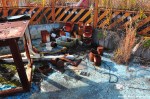
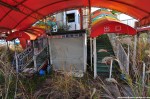
The (not so) big wheel was surrounded by 15 to 20 other carnival rides. Two or three of them were also open and running, half a dozen others looked more or less well maintained – and the rest of them were actually abandoned, except for the single demolished one; paint flaking off, weeds growing through a mini roller coaster, seats weathering, concrete crumbling.
This place was so friggin weird! It looked like an abandoned pay-as-you-go amusement park, but it wasn’t, because every other minute you would run into some sweethearts looking for entertainment, and there was music playing in the background all the time; some of it being karaoke sung by a few senior citizens further up the hill. It was so creepy and bizarre – and calming yet very exciting at the same time! Usually I have to sneak around and jump some fences, especially when exploring abandoned theme parks… but not this time! Relaxed I made my way from attraction to attraction and took pictures of whatever I wanted at my own speed, not worrying about anything. When I thought it couldn’t get any better (except for being there on a misty day!) I hit the weirdo jackpot!
I’ve seen a haunted house or two in my lifetime, but none with a naked female torso breaking through the wall on the upper floor, a big hand trying to hold her back, partly covering one boob – next to a monstrous mutant face. But that’s not all! To the left and mid-air was a nude couple (male and female) in a grotesque pose, attacked by two gigantic green snakes – the guy’s face full of panic, the girl’s face barely visible, but clearly in agony, one of the snakes biting into her left shoulder and half of the exposed torso.
The back of the abandoned haunted house wasn’t a tiny bit less bizarre and probably my favorite area in the whole park. There I found a couple of concrete or gypsum animals lying on the ground and standing around, the greyish material spalling off in huge chunks, revealing steel wires underneath. Next to a path nearby was a huge Buddha statue rotting away, made of a Styrofoam looking material – accompanied by the concrete statue of a naked Chinese fairy, right in front of a white rabbit with red eyes carrying a gigantic mushroom… which at this point I felt I must have smoked earlier!

The *second abandoned Japanese sex museum* meets *Nara Dreamland*… with no security standards whatsoever. One of the remaining running rides was a monorail through half of the park. It’s height? About two meters – and no protection at all. I was able to touch the rail at any time and even smaller people carelessly stretching could get hurt seriously by one of the monowheel looking cars. Trash, broken glass and mirrors, rusty metal, brittle animal figures – everything was scattered in the woods around the park and nobody seemed to care about it.
The carnival section of the People’s Park in Yanji was one long bizarre exploration and one of my favorite abandoned amusement parks overall. Deserted theme parks are generally creepy, but the fact that this one was only half-abandoned took it to a whole new level!

(If you don’t want to miss the latest article you can *like Abandoned Kansai on Facebook* or subscribe to the *video channel on Youtube*…)

Read Full Post »

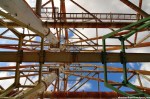
Abandoned ferris wheels usually come with abandoned theme parks. But when I visited *Expoland* in Osaka the ferris wheel was just demolished. And so were the giant wheels in all the other *abandoned amusement parks* I visited – except for the *big wheel in Pripyat* – which was actually pretty small… So usually the ferris wheel is one of the first things to be demolished when an amusement park closes – to be re-built at another park or to be sold for scrap metal. Not in the case of Igosu 108…
You might have seen photos of this abandoned ferris wheel at other blogs and you might ask yourself “Why is Florian calling the ferris wheel ‘Igosu 108’ – it says びわ湖タワー (Biwako Tower) in huge letters right in the middle of the thing and everybody calls it that way when writing about it?!”. Well, my Japanese might not be the best, but just because something is written somewhere doesn’t mean it’s the name of the place. And in this case it isn’t. The name of the ferris wheel is Igosu 108 – the name of the surrounding amusement park, now mostly gone, was Biwako Tower. To be more precise: The name of an observation tower, now gone, was Biwako Tower. This tower was 63.5 meters high and had a rotating observation platform that went up and down to give visitors a spectacular view across Lake Biwa, the largest freshwater lake in Japan. Biwako Tower was built in 1965 and extended to an amusement park in 1967. In addition to the observation platform there was a small ferris wheel, a rollercoaster, a pachinko parlor, water bumper car and several other small rides. But that’s not all! Biwako Tower also included an onsen (hot spring / spa) and a wedding hall – plus the usual array of restaurants, shops and stuff like that. Thanks to free parking and no entrance fee Biwako Tower was hugely successful and attracted up to 50.000 people a day!
In 1992 the last attraction was built – now the last one standing: Igosu 108 (イーゴス108). I can’t say for sure, but I guess the name is a combination of sugoi (すごい, meaning “great”) backward and 108 – the height of the ferris wheel, at the time the largest ferris wheel in the world. It was soon considered a landmark of Shiga prefecture and Lake Biwa, but couldn’t stop the downfall of Biwako Tower. Speaking of which: Since the ferris wheel was higher than the name-giving attraction Biwako Tower was transformer into a bungee jumping platform.
On August 31st of 2001 Biwako Tower finally closed its doors – just half a year after Universal Studios Japan opened in Osaka. Most of Biwako Tower was demolished in late 2003 / early 2004 with the exception of Igosu 108. Some small attractions survived partly (like a fortune teller booth, Fantasy Land and Bumper Boat), but the rest was transformed into big supermarkets and other stores, their parking lot replacing the pachinko parlor. Two sources claim that Igosu 108 still has an owner who announced in 2007 that the ferris wheel will re-open in 2008, but that never happened. According to them an operator puts Igosu 108 into motion once a month to make sure that everything is still working.
Having visited what’s left of Biwako Tower in December of 2010 (together with Damon and Andrew right after leaving the *Love Hotel Gion*) I kinda doubt that claim. While the outer part is easy to access Igosu 108 is protected by a typical Japanese orange site fence. The noisy kind that doesn’t have a door to let people in and out easily. I didn’t have a closer look at the controls of the ferris wheel, but the whole place looked quite rusty and run-down. To reactivate Igosu 108 you would need way more than just a bucket of paint and a “Reopened!” sign…
(If you don’t want to miss the latest postings you can *follow Abandoned Kansai on Twitter* and *like this blog on Facebook* – and of course there is the*video channel on Youtube*…)

Addendum 2013-11-28: Igosu 108 was dismantled in autumn of 2013…

Read Full Post »