All abandoned: Chernobyl / Pripyat, Nara Dreamland, Anti-Zombie Fortress, Japanese Sex Museum – and many, many more! Plus: North Korea Special – 2 trips, 16 days / 14 nights! As seen on CNN…
Well, Franklin D. Roosevelt, Sir, Mr. President. That’s not entirely accurate. But you’ve most likely never been into urban exploration… As an urban explorer there is one other thing you have to fear and most urbexers do fear: watchdogs. It took me more than 150 explorations to finally run into one, but that one proved to be an insurmountable hurdle. Not only for myself, but also for my haikyo buddy *Michael*.
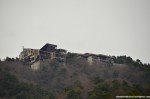
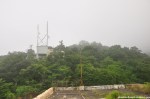
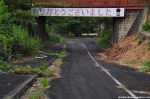
On the way up to the Noga Hotel we stopped to take a couple of photos from the foot of the mountain as it was already early afternoon and we most likely wouldn’t have the chance to take some on the way down. Little did we know that those would be the only photos of the Noga Hotel we’d take that day…
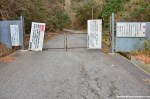
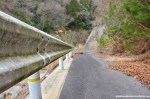
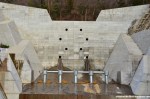
Halfway up the mountain we were stopped by a gate blocking the street – decorated with four huge signs telling us why we shall not pass. A seemingly endless list starting at private property up ahead (so what, this was a public road…) and ending with the local cities authorities trying to prevent illegal waste disposal and forest fires; well, who could argue with environmental reasons that are pleaded to keep people away from an abandoned hotel that is falling apart? Right, we could, so we opened the gate and continued driving, but soon we decided that it might not be a good idea, since an unlocked gate means that whoever decided to put it there actually wants people to pass – which meant that we would most likely run into somebody at one point or the other. So we went back down the mountain and walked up again. A very good decision, because just a couple of 100 meters after the point where we turned around the car we found a second gate. Not just a gate, more like a checkpoint. I was walking a couple of meters ahead of Michael when I saw the control point and it took just a few seconds for a watchdog to bark as if there was no tomorrow. So I ran. Although going to the gym 4 times a week I haven’t been running that fast since I was caught by the security guard at *Nara Dreamland*. Luckily just down the road was a fenced off deadlock; a fence to prevent cars, not humans. So we ran down that road to hide from whatever might have followed us and waited. And waited. And waited. Until Michael decided to have a look at the checkpoint himself – I preferred to wait at the hideout. While Michael was away I heard another big dog barking, probably from where the hotel was – Michael on the other hand only heard some animal scratching as he told me when he came back. Which was at the exact same moment when a van on the way down passed the fence of the dead end road, causing us keep our heads down for another couple of minutes. While I was willing to admit defeat and move on to another location Michael really wanted to get to the hotel, although it was getting late afternoon already; either passing the checkpoint or straight ahead up the mountain through the forest, path or not. Having been lost in the mountain before I strongly objected to the latter idea, so we agreed that Michael would first check if somebody from the van was waiting at our car and then come up again to have a really close look at the checkpoint. Maybe the dog was gone?
About two minutes after I received a text message that the car was clear 4 more vans passed my position on the way down – I tried to call Michael, but it was already too late. When he reached me out of breath several minutes later he told me that the guys in the vans ignored him completely. Neither for the first time nor for the last time on our *road trip to southern Honshu* I asked myself the question when you can consider a place really abandoned. Or if abandonment is the basis for urban exploration. The grey area between exploration and infiltration – and that a place somebody hires security for is not really abandoned by the word’s true meaning. But I guess that’s part of the beauty of that hobby, too. Everybody defines those lines for themselves. The same applies for graffiti. To me they are a form of vandalism when put onto abandoned buildings (I like them as art on designated areas or canvas!), and I guess I’m also more conservative (or cautious – or cowardly?) when it comes to explorations as I’m trying to avoid trouble; except for *Nara Dreamland*: I visited that place against better judgement way too often!
Against better judgement I also agreed to walk up to the checkpoint again as Michael was eager to try his luck as a dog whisperer – or preferably talking to a security guard, if there was one. We were about to get back to the main road when the sound of motors made us hide again. Four more cars went down the mountain and we finally agreed that we won’t make it to the Noga Hotel that way that day. But maybe on another day or sneaking up a different way…
Spring time is long weekend trip time! While Kansai doesn’t have much of a winter it nevertheless can be quite cold, especially when having a hobby involving taking pictures in abandoned places, other places of Japan can be snowed in for months with meters of snow… So when the sun finally warms the hearts of Japan and causes the first sunburn of the young year it’s time to explore places beyond my beloved Kansai – whether it be *Kyushu with Enric* two years ago or Shikoku with Gianluigi last year (a series of articles yet to come…), it became kind of a tradition for me to go on an urbex spring trip with a friend of mine. This time *Michael Gakuran* and I teamed up for a road trip to the southern end of Honshu, Japan’s main island – Chugoku, to be exact, the area west of Kansai. A trip with such exciting places that I decided to start writing about it right away – the last pictures are barely 50 hours old…
At this point I don’t want to give away too much about the locations we visited or which order we visited them in. But there were 8 of them in 3 days. 3 long days I might add, with me getting up at 6.30 a.m. on a Sunday, at 6 a.m. on a vacation day and at 5 a.m. on a national holiday. As I mentioned before: I’m a morning grouch; and by “morning” I mean any point in time which is followed by “a.m.”…
But the trip wasn’t just exhausting, it was also exiting, fun, frustrating, satisfying, rich in variety, surprising, delicious (I finally ate Hiroshima Okonomiyaki in Hiroshima prefecture and bought the best local sweets outside of Kyoto – mikan dango) and insanely expensive.
Why insanely expensive? It’s because at the end of the first day a serious mishap happened to me. We were on our way to a hotel to stay for a night when we saw this huge, blue and white flame at a gigantic industrial plant – probably coke oven gas burning at a cokery. (Addendum 2012-06-11: I guess I was wrong about the gas – Gert from South Africa wrote me: “This couldn’t be coke oven gas burning, because coke gas got a very very hot orange (impurities) or yellow (cleaner) flame. But the flame in the video is actually blast-furnace or corex, midrex, finex gas flame (more methane content in gas).” Thanks a lot for pointing that out! I really appreciate it and changed the title of the video below, too.)
We decided to make a stop to take picture or two and when I got out of the car to marshal Michael I grabbed my bag and I don’t know how or why, but my beloved D90 camera flew through the air and crashed hard to the concrete ground. The body cracked open a couple of millimetres so I could see the insides. Parts of the electronics were still working (e.g. I could use the screen to look at the photos on the memory card), but since the lens mount was part of what cracked it was impossible to take pictures anymore. Mad props to Tokina BTW! The mounted 11-16mm lens survived without a scratch or any other damages as I found out with relief the next day.
Sunday evening past 7 p.m. – of course I was in shock at first, because going on a photo trip without a camera is pretty pointless. So we headed towards the flame to take some picture which I couldn’t do since my photo camera broke and Mike couldn’t do because of the lighting, lenses and passing traffic. So I took the video you can find below the article – it doesn’t fully capture the beauty of the flame, but it will always remind me of the death of my favourite camera so far (I also included the last JPG I ever took with it, even though it wasn’t related to urbex). Back at the car we decided to look for an electronics store, although it was almost 8 p.m. on a Sunday evening. After a couple of minutes we found a shopping mall, but it didn’t have a camera store. The staff at the mall was very nice, telling us where to find an electronics store – but it closed at 8. Michael, who did all the talking since his Japanese is WAY better than mine, wasn’t discouraged by that and asked for the phone number of the store. Although the store was closed Michael called and somebody picked up. He told them my tricky situation and they agreed to let us into the store if we hurry – so I got into a taxi and went straight to the store. There a guy with pretty decent English helped me at the camera department. I was hoping to replace the D90 with another one, but they didn’t have them in stock. A lower model was out of the question, so the only option was a D7000. Which they didn’t have in stock either. Just the display model – which they couldn’t sell me without the kit lens since it was a display model. After some deliberation and the certainty that not buying that display model would mean losing at least 5 hours the next morning looking for another camera (electronic stores in Japan usually open at 10 a.m.) I half voluntarily upgraded from a Nikon D90 to a Nikon D7000. With a bad feeling since I not only spent a huge chunk of money, but I also had to learn by doing how to handle a new camera. While I’m very pleased with how the photos of all locations turned out it was quite unnerving at times to get the shots I wanted to take.
Now just a few quick words about the locations we visited. The undisputed highlight of the tour was the abandoned Japanese Sex Museum. Both Michael and I had high expectations and we were not the slightest disappointed, shooting in almost complete darkness for the majority of the 4 hours we spent there. Another glorious highlight to me was the Kart Pista Hiroshima race track – why it was a highlight you’ll find out soon. Since theme parks are one of my favourite types of abandoned place we visited two of them and I loved them both. 4 world class haikyo in 3 days – plus 2 good ones (a Meiji Era army fortress and a quite tricky hotel) as well as 2 more we took pictures of because we went there and it would have been a waste not to cover them… a strip bar in an onsen town (euphemistically called “theater”) and a car camp site. To my knowledge all of these places never appeared on English speaking blogs, some of them are even unknown to the Japanese urbex crowd. So please enjoy the preview pictures and come back for much more information, photos and about one hour of video material!
The La Rainbow Hotel & Tower (a.k.a. as the Graffiti Hotel) was one of my favorite explorations of 2011. I knew about that place for quite a while and I guess it’s one of the most popular abandoned places in west Japan for a number of reasons. First of all it’s in that ineffable “Nippon No Haikyo” book – and then of course there are the countless colorful graffiti, the unusual architecture and the observation tower with its moveable platform…
I’m always happy to introduce friends to my urban exploration hobby, so when my buddy Luis showed some interest in accompanying me I suggested a place I wanted to go for a long time; one I’ve never made it to due to the rather long train ride there. (About 3 hours plus and at least half an hour of walking – or 2 hours for double the fare taking one stop on the fastest Shinkansen.)
Usually the journey to an abandoned place isn’t exactly a fun time, but thanks to some very interesting and insightful conversations with Luis we both arrived at the La Rainbow Hotel & Tower in a very good mood – which got even better once we realized that the place was off the main street and had no security whatsoever; which came with both the good and the bad aspects (easy to access, relaxing photo and video shoots for hours / vandalism, arson, …).
One thing was perfectly clear from the first second: The La Rainbow Hotel (I never got why Japanese love to mix languages!) was a pretty big building! It was so huge the floors were not only connected by staircases and elevators, but also by escalators.
To my surprise the number of guest rooms was rather limited. There were none on the first floor. Or on the second floor. Neither on the fifth or sixth floor. So here’s a floor overview:
1F: entrance to the hotel, exit of the observation tower, ticket machines, arcade, bathes
2F: entrance to the observation tower, front desk of the hotel, party rooms, kitchen
3F: guest rooms 301-327
4F: guest rooms 401-437
5F: upper entrance to the building via a bridge, kitchen, family restaurant “La Rainbow”
6F: bar, beer garden
Having learned from previous experiences (never explore a floor when you are not sure in which condition the rooms below are in…) Luis and I made our way up. 1F, 2F, 3F, 4F, 5F, 6F. The hotel was equipped with several large Japanese style gathering / party rooms, one of them even still had a karaoke machine, but some of the guest rooms were Western style. This was rather interesting, especially since it looked like as if the rooms were designed and furnished individually – a common thing in love hotels, but not in standard tourist hotels. Another huge difference from normal hotels: the gigantic window fronts of most of the rooms. The La Rainbow Hotel had ceiling to floor windows with a rather nice view at the Seto Inland Sea and the Great Seto Bridge.
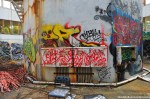
The main difference between the La Rainbow Hotel and any other abandoned hotel I’ve been to before (and after…) was the huge amount of graffiti. Like everywhere else in the world abandoned places and graffiti go hand in hand, and most of the time they are nothing more than a couple of ugly scribblings. Not in the case of the La Rainbow Hotel. The graffiti there were real pieces of art most of the time. And they were everywhere! I guess about a third of all walls received a new layer of paint, often as big as 2.5 x 4 meters. The absolute highlight in that regard was the basement of the La Rainbow Tower. Having the observation platform hovering over your head isn’t exactly a calming feeling, but the graffiti down there on a gigantic circular concrete canvas… As much as I usually despise graffiti at abandoned places, even I have to admit that they looked beautiful there! Especially since they were rather well made and offered quite a bit of variety…
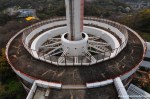
Speaking of the observation platform: It was attached to a tower 150 meters high (the highest observation platform of its kind in the world when it was built – not only in Japan!) and it was moveable not only vertically, but the platform was also able to spin around the tower. 23 meters in diameter the viewing cabin offered space for 150 guests at a time, the fare was 800 Yen for adults and 500 Yen for children. With the proper lighting (which was installed…) it must have been quite a sight after sunset. Well, it actually was. In the basement of the tower Luis and I found a box with several old photos of when both places were still welcoming customers – and especially the nighttime shots with long exposure time were stunningly beautiful!
Too bad the life of the now abandoned revolving observation tower was as short as that of the adjunct hotel. Little is known about the history of the unfortunate pair, but it seems like the place was the another product of the real estate bubble. From 1978 till 1988 the Great Seto Bridge (also known as Seto-Ohashi Bridge or the Japanese name Seto Ōhashi / 瀬戸大橋) was constructed… and some people decided that a bridge like that needs a place to welcome all the visitors who would come from all over Japan to have a look – ignoring the fact that the area already had some hotels due to the Washuzan Highland amusement park nearby.
The question is: Who were those people? A local taxi driver told Luis that the hotel was built by the Okayama prefecture and run for three years in the mid 1990s before it was privatized. The new owners gave up after only one more year as the general Japanese population wasn’t as fascinated by the bridge as the local politicians hoped it would be. The bridge is a great way to get to Shikoku, but “Hey, let’s stay for a night at a fancy hotel with rather small rooms and look at the bridge!” didn’t come to many people’s minds.
The more likely story is that a private investment group burned quite a bit of money when they opened the hotel and tower in 1988. They named the place after one of their two golf courses and were making big bucks at the time with their 400 seat seafood restaurant and two cruise ships. It was one of the companies that dreamed of making the area a “Japanese Venice”, actually buying large quantities of land on small islands like Yoshima. Since the Seto Sea boom bursted along with the Japanese asset price bubble (1986 to 1991) the La Rainbow Hotel & Tower soon faced financial issues and was closed for good in 1997 – something the internet and our taxi driver to a second location agreed on.
The latter story is more likely for two reasons: First of all I found a brochure by said real estate investment group laying out the whole La Rainbow project. And in 1990 the actress and singer Youki Kudoh (who later played alongside Ethan Hawke, Zhang Ziyi, Ken Watanabe, Jackie Chan and Max von Sydow in movies like Snow Falling On Cedars, Memoris of a Geisha and Rush Hour 3) did a commercial for the place usually referred to as Hotel La Rainbow in Japanese. (I named it slightly different here for the purpose of readability. Technically you have “La Rainbow”, the tower, and “Hotel La Rainbow”, the hotel.)
It’s said that the first round of vandalism was unleashed on the place by a motorcycle gang, but that kind of sounds like an urban legend – like the one you get with pretty much every abandoned countryside onsen hotel, where the last owner committed suicide. After the rough guys left the complex was taken over by graffiti artists and the usual vandals and arsonists…
Oh, by the way: The strange sounds you can hear in some of the videos are neither ghosts nor Imperial Stormtroopers charging at the building – initially I thought they were birds, but in fact those were the steels cables of the tower hitting each other and the tower itself due to high wind; quite irritating and spooky at first…
Sometimes you just gotta be lucky. Like I was on February 11th 2011.
Living in central Kansai you kind of forget about winter. Temperatures drop to 5° Celsius and people complain about how cold it is. There are barely ever minus degrees. Sure, if you hop on a train and go to the nearby mountains you can enjoy some snow. But in the Osaka Plain? Not so much. In the first 4.5 years of me being in Japan it happened once that it snowed strong enough for the white beauty to accumulate on the ground – but that was long before I started urban exploration.
On February 10th I met with some current and former colleagues to have a couple of drinks as the next day was a national holiday – a flip dark chill winter bastard though dry. I remember mentioning how much I missed snow and that there hasn’t been some in three years. Well… When I woke up the next morning at around 9.30 a.m., slightly hung over, I opened the curtains so see… snow! Everywhere! And it was still coming down in beautiful large flakes. I slightly panicked as it was already quite late (for a haikyo trip). Where should I go to? A new place or revisiting one? And which one of them? Would there be snow, too? I always wanted to see *Mt. Atago* covered in snow, but in addition to the train ride I’d need to take a bus… and they were most likely cancelled. My mind spun for a couple of minutes before I came to the conclusion that there was only one place to go. A place I never wanted to go back to: Nara Dreamland!
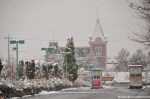
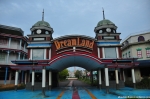
So I took a quick shower, made sure that my equipment was ready and headed to the train station. 80 minutes later I was in Nara, pleased to see that the whole city was covered by a thick layer of snow, too. Reaching the Dreamland it was still snowing heavily and I went straight for the *Eastern Parking Lot* with the parking garage, the hotel and the iconic main entrance. The DreamStation in the background was definitely a welcomed bonus, but most important of all: You can enter without jumping fences or ignoring “No trespassing!” signs; you just have to know where – definitely a plus in case security shows up with the police… About half an hour later it stopped snowing and almost instantly I heard dripping water. Yes, even before the sky turned from dark grey to light grey the snow began melting! I sped up to take some more pictures of this oh so familiar place (noticing unpleasant changes like the ugly graffiti at the former pachinko parlor) and hurried over to the western parking lot, another one of my (rather risk-free) favorites. By the time I was actually ready to enter Nara Dreamland itself half of the snow was already gone. Happy with the pictures I already took and not willing to risk them I decided to call it a day and went back to JR Nara Station – where I found barely any proof that this was a very snowy day…
But I really was lucky that day. Lucky that it snowed. Lucky that it was a national holiday and I didn’t have to work. Lucky that I didn’t oversleep completely. Lucky that I decided to go to Nara Dreamland. While a Japanese blog was quicker than I taking and posting night shots of Nara Dreamland I’m happy to present the first snow photos of Nara Dreamland, although it took me almost a year to post them. Please enjoy and tell your friends!
(For all your Nara Dreamland needs please have a look at the Nara Dreamland Special. For a look at the area around Nara Dreamland on GoogleMaps, including some fancy icons linking to articles on Abandoned Kansai and videos on YouTube, please *click here*. If you don’t want to miss the latest postings you can *follow Abandoned Kansai on Twitter* and *like this blog on Facebook* – and of course there is the*video channel on Youtube*… Oh, and don’t worry: Nara Dreamland is neither Japan’s last abandoned theme park nor is it in immediate danger of being demolished. NDL will make many more appearances on this blog, most likely all of them with unique videos…)
*Nara Dreamland* is the current haikyo hot spot in Kansai, maybe in all of Japan. But the area including Osaka, Nara, Kyoto and Kobe is also the home of a classic urbex location: the Maya Tourist Hotel. (A.k.a. Maya Kanko Hotel, Mayakan, Mount Maya Hotel, Mount Maya Onsen Hotel, and Gunkan Hotel – Battleship Hotel / Warship Hotel; similar to *Gunkanjima*, the now also abandoned Battleship Island off the coast of Nagasaki.)
Mount Maya is one of the highest peaks of the Rokko Mountain Range that spreads from the west end of Kobe to Takarazuka (near Osaka) and is one of the most popular recreational areas in Kansai. In 646 the Tenjo-ji (忉利天上寺), a Buddhist temple, was founded near the top of the mountain at the behest of Emperor Kotoku. During the 8th century a monk named Kobo brought a statue from China to the temple – a depiction of Maya, Buddha’s mother; and that’s how the Mount Maya got its name. (The original temple was burned to the ground by a pyromaniac in 1975. The remains are still a popular destination for hikers, although the temple was reestablished further north and at a higher place.)
The Maya Tourist Hotel is located halfway up the mountain and in walking distance of the original Tenjo-ji. It should be obvious how the place got its name… Something I still haven’t figured out is why it took me almost a year to go to the Maya Hotel and another 17 months to write about it, although the hotel is basically in my backyard, just a couple of minutes down the rail on a single line (yes, no need to switch trains!).
Going to the Maya Hotel was actually my first exploration I haven’t done by myself or with a friend, but with a fellow urban explorer: Michael Gakuran. Mike was passing through the area on his way back home from a summer trip to the Seto Inland Sea and asked if I was interested in a joint adventure – and since he runs one of few blogs I actually read it was a pleasure to say yes. Michael likes his abandoned places rather high profile (who can blame him for that?) and so we pretty quickly narrowed it down to the Maya Hotel. The downside of that location: It’s right next to an active cable car station whose employees have a reputation for calling the police if they see trespassers on their way to or on the premises of the Maya Hotel (you have a beautiful view at the roof of the hotel from the cable car station). Since Mike and I are both rather dedicated explorers we decided to tackle the place hardcore style: During my research about the place I found out that there was a steep closed hiking trail up the mountain that leads there without getting close to the cable car station. To be able to take some photos on the rooftop we met at a Hankyu line station before 5.30 in the morning, hiked about 400 meters up the insanely steep, spider web covered abandoned hiking trail to finally reach the hotel; drenched in sweat and out of breath. Osaka / Kobe summers are everything but nice, the temperature barely ever falls below 30 degrees Celsius (even at night!) and the humidity is breathtaking. Especially in the morning, especially hiking up a forest trail, especially close to an abandoned and rotting hotel. Getting up Mount Maya that morning was my worst hiking experience without getting in physical danger and the third worst overall. Oh, and did I mention that I’m not a fan of alarm clocks at 4.30 in the morning? They tend to make me grumpy…
Luckily the anticipation of exploring a legendary abandoned building dominated over my morning grouchiness and so Michael and I reached the Maya Hotel in good spirits. Until we reached the entrance. Which was recently boarded up and ripped apart again. Carefully we got closer, gigantic flying insects the size of table tennis balls buzzing around and landing on us. Footsteps inside. 100%! What should we do? Getting inside? Waiting to be eaten alive by the insects? After a short deliberation we decided it would be better to take our chances with whoever was inside than with the nasty beasts outside, so we passed through the cracked open plywood and entered undaunted by death – only to find out that the footstep noises were created by dripping water. Of course we weren’t convinced right away, but after 5 minutes… well, 10 – okay, after 15 minutes we were confident that we were alone in the big hotel.
The history of the Maya Hotel started in 1929. Four years after the Maya Cable Car (officially Maya Cable Line (摩耶ケーブル線, Maya Kēburu-sen) began to transport tourists to the foot of Tenjo-ji the same company decided it would be a good idea to have a hotel up there – so they built it right next to the upper terminus. Construction began on May 15th 1929 and the Maya Tourist Hotel opened after a record time of just 6 months on November 16th. 15 years later, late in World War 2 on February 11th 1944, the Maya Cable Car was shut down as a non-essential line and the next year the hotel was forced to close, too. I’m not sure though if it was before or after the damages through air raids occurred – on top of Mount Maya were anti-aircraft guns installed and I guess taking them out damaged the hotel. Shortly after the war plans to turn the hotel into an officer’s club for the U.S. Forces fell through. In 1960 the cable car company decided to sell the severely damaged hotel and the new owner began renovations on September 1st. On August 28th 1961 the once so luxurious lodging was renovated to shine in new splendor – with parts from the French luxury ocean liner “SS Île de France” which was disassembled in the spring of 1959 in Osaka. But the grand re-opening wasn’t followed by a streak of good luck and so the Maya Tourist Hotel was forced to close its doors again in 1967, this time after suffering severe damages from a typhoon and a resulting mudslide. A final and finally rather long-term future began in 1974 when the place was re-opened again as the “Maya Student Center”. But the student center was closed in 1994 and the destiny of the Maya Hotel was sealed on January 17th 1995 when it suffered severe damage from the Great Hanshin Earthquake that killed almost 6.500 people – in the aftermath the construction was boarded up and fenced off, and its rise to become one of the most famous abandoned places (haikyo) in Japan began.
Since time was of the essence when Michael and I arrived at the more than 80 years old Maya Hotel we went right to the rooftop to take some photos outside before the crew of the cable car station would appear for work. The atmosphere was utterly eerie. Half of the mountain was covered by low hanging clouds, so at first our sight was quite limited while the sun tried to break through. I felt like in the middle of a horror film, but at the same time I knew there was an active cable car station just a stone’s throw away. A weird, slightly surreal situation. The chimney on the top of the roof collapsed a couple of years ago and was lying there like a gigantic crumbling grey cigar. Crushed through a lower roof on the southern side I saw the famous plane tire that once actually stuck in the roof. (Nobody seems to know where the tire is from and when it got onto, or better: into, the roof. It’s the tire of a B-29 Superfortress though – used in WW2 and retired in 1960.) The tranquility of the place was amazing, totally worth getting up at a time people should rather go to bed and climbing up a mountain at the worst time of the year. Sadly we had to hurry since 8 a.m., our personal roof deadline, came closer – the cable car started at 8.30 a.m. and we wanted to be out of sight with a little bit of a buffer. Only minutes after we got back inside of the Maya Tourist Hotel we heard a sound signal from the cable car station.
Exploring the inside of the Maya Hotel was almost as exciting as exploring the outside. Since the place was abandoned almost two decades ago with little renovation in the years before, there were only a few pieces of furniture left, the most striking one a red leather couch clearly not part of the original inventory As far as I know it was part of a video shooting – at least three Japanese bands used the abandoned hotel as a location for their music videos. Not to mention the countless photo shoots. Urbex, fashion, nudes – its stunning architecture made the Maya Hotel one of the most photographed modern ruins in Japan, probably in the world. Luckily most visitors carry a tremendous amount of respect for the place, so vandalism is a surprisingly minor factor. I guess when you deal with the hassle of getting to the Maya Tourist Hotel without being discovered you rather enjoy the breathtaking theater hall, the beautiful dining room and all the big and little surprises waiting for curious and careful explorers. And you have to be careful visiting the Maya Hotel! Water is running down the walls and dripping from the ceilings, broken stuff is lying around everywhere and the floors are severely damaged. Nevertheless the Maya Hotel as a whole is stunningly beautiful, magical, just fascinating. Nowadays most abandoned hotels get trashed before they get the chance to age properly – the Maya Hotel was abandoned several times and the 1920s architecture offers a completely different basis than the usual concrete blocks that look like they were designed by the same architect and interior designer.
Now I have to bring this pretty long article to an end somehow; maybe by linking to nk8513’s blog, you can find his collection of old photos and leaflets *here* (it’s in Japanese, but even if you go there just for the picture material you won’t regret it). Well, other than that let me say that this was my last exploration before I got a wide angle lens and a tripod, so the photos are not nearly as spectacular as I hoped they would turn out to be – considering the age of this blog it’s actually quite old material. I hope the three videos will make up for it a little bit… Oh, and thanks for reading till the very end!
(If you don’t want to miss the latest article you can *follow Abandoned Kansai on Twitter* and *like this blog on Facebook* – and of course there is the*video channel on Youtube*…)
Nippon No Haikyo, probably the most famous Japanese book about urban exploration / haikyo since it was recommended plenty of times by both Japanese and foreign blogs because of its huge amount of maps, recommended Yashima as one of the top abandoned places in West Japan. In my opinion Nippon No Haikyo is vastly overrated – while some maps are quite detailed others are completely useless. Even more so since an estimated 50% of the places (at least on the West Japan list) are either demolished or completely trashed by now. At the same time some of the best haikyo locations, like *Nara Dreamland*, are missing completely. But I guess you’ll get what you pay for: a 4 year old book about a topic that can change within a week or two. Especially in Japan, where old buildings are replaced by parking lots while you are on vacation. (It actually happened in my neighborhood…)
So whenever I visit a location described in Nippon No Haikyo I’m prepared for the worst, just in case. Which was a good thing in the case of Yashima – more than half of the buildings that were responsible for the praisal are gone now; four, to be specific. All that was left of them: 3 leveled building grounds, ready for new construction to begin. Construction that most likely won’t happen.
Yashima (屋島, roof island) has attracted people for centuries. The famous temple Yashima-ji on top of the mountain, founded as a Ritsu school temple in 754 by Ganjin (a.k.a. Jianzhen, 688–763), is the 84th stop of the Shikoku 88 temple pilgrimage. On March 22nd 1185 the Battle of Yashima took place in the waters around Yashima, resulting in one more defeat for the Taira, who owned a castle on top of the mountain. (Which is being reconstructed as I write these lines…) The whole story was later made popular in an epic poem called “The Tale of the Heike” (平家物語, Heike Monogatari).
A famous temple, stunning views of the Seto Inland Sea, a historical battle. What else do you need to attract tourists? Right, an aquarium! The Yashima Mountaintop Aquarium (屋島山上水族館, Yashima Sanjo Suizokukan) was opened in 1969 and reopened as the New Yashima Aquarium (新屋島水族館, Shin Yashima Suizokukan) in 2006. In-between some (not so) smart businessmen took advantage of the Japanese asset price bubble (1986 to 1991) to build some rather big hotels on Yashima, creating way more beds on the 300 meter high mountain than necessary. Because let’s be honest: Yashima is a daytrip location, not a place to stay overnight. (Heck, I made it a daytrip although I live in Osaka!) Around the turn of the millennium most of those new hotels were already forced to close, only a few smaller ryokan north of Yashima Temple survived. It seems like the closed hotels were still standing there when Nippon No Haikyo was written in 2007, maybe for two or three more years – when I visited in late 2011 most of them were gone… The Lost Ruins of Mount Yashima.
(I used this posting for a big update of my *Map of Demolished Places in Japan* – it’s really worth a look!)
# What is Nara Dreamland?
– Nara Dreamland is an abandoned amusement park in Nara, Japan. It was closed in 2006 and abandoned without getting demolished – which makes it quite a unique urbex location since all the roller coasters, merry-go-rounds, souvenir shops, arcades and other attractions are still there. (Although it’s up for discussion if the place is really abandoned. It’s closed, that’s for sure, but the owner of the park obviously still cares about it to some degree…)
# Where is Nara Dreamland?
– That’s the kind of questions I usually don’t answer. But since NDL has entries in four language versions of Wikipedia, three of them giving away the exact location of Nara Dreamland, I can as well link to *my own map at GoogleMaps*. The address was / is:
Nara Dreamland
1900 Horen-cho
630-8113 Nara
But just because you know where it is I wouldn’t recommend going there. You might wanna read the next question(s) before rushing out…
# Does Nara Dreamland have security?
– YES! Some people got lucky and didn’t run into security at Nara Dreamland, I got away with plugged feathers – others got roasted and served to the police. The whole park is surrounded by fences, most parts with spikes and / or barbed wire. Warning signs once asked people to call the police if they see somebody suspicious, now the latest signs I saw announced a fine of 100.000 Yen, about 950 Euros / 1300 Dollars! Furthermore there were reports that the guy patrolling there tries to blame caught trespassers for vandalism to get more money out of them. And vandalism becomes more and more of a problem…
# Is there any vandalism at Nara Dreamland?
– Sadly yes. Lots of it. When I explored Nara Dreamland for the first time in December of 2009 there were barely any signs of vandalism. Almost two years later there are graffiti at the former pachinko parlor at the Eastern Parking Lot. The Parking Garage’s staircase is completely sealed now and the Hotel is boarded up again. Inside the park you can see how people smashed the control station of a merry-go-round – the fire extinguisher still on top of broken glass. The Main Street USA clone with all the souvenir shops has barely any undamaged windows and several doors were kicked in, even of buildings that were clearly just a false front. It’s actually pretty sad how fast the place goes down the drain – especially since the graffiti people took over; and not the good ones…
# I’ve heard Nara Dreamland is a rip-off of Disneyland in Anaheim. Is that true?
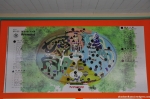
– Definitely. Disneyland was opened in 1955, Nara Dreamland followed in 1961. You have copies of the Sleeping Beauty Castle, Adventureland, Main Street USA, Autopia, Skyway, Tea Party Cup Ride, Submarine Voyage, Flying Saucers, the monorail, the fire station, a pirate ship, double decker omnibusses, vintage cars, and a train station (called DreamStation). Even the entrance looked the same! Of course the layout of the park was very similar – aerial shots make them look like twins. And of course there is the story of Kunizo Matsuo, the man behind Nara Dreamland.
# Can you tell me more about the history of Nara Dreamland?
– Sure. After World War II Japan’s industry was booming. People worked hard and needed some places to relax. The United States were not only occupiers, but also the helping hands for the reconstruction of the country – and the new role models. In the second half of the 1950s a Japanese businessman called Kunizu Matsuo, president of the Matsuo Entertainment Company, visited the States and the brand-new amusement park Disneyland in Anaheim near Los Angeles – and was quite impressed. Something like that would be perfect for Japan, he decided. He became a mediator for the Japanese Dream Sightseeing Company (JDSC) and had direct contact with Walt Disney. The plan was to bring Disneyland to Japan – not to Tokyo, but to the old capital Nara (710 – 794), the cradle of Japanese culture. Matsuo also was in direct contact with Disney’s engineers to create the Japanese version of Disneyland. But Nara Disneyland never came true. Towards the end of the construction phase JDSC and Disney couldn’t agree on license fees for all the famous Disney characters like Mickey Mouse, Pluto, Donald Duck and Goofy – so the Japanese side created their own mascots and abandoned the idea of Nara Disneyland. I have no idea how JDSC and Disney settled in the end (I’m sure JDSC had to pay quite a bit of money for Disney’s “help” even without getting the permission to use Cinderella & Co.), but while Nara Dreamland opened in 1961 it took Disney another 20 years to finally open Tokyo Disneyland on April 15th of 1983. Coincidentally (?) this year marked the beginning of the downfall for Nara Dreamland – the number of visitors began to decrease and JDSC including Nara Dreamland was bought by the supermarket chain Daiei in 1993. Eight years later, in 2001, Universal Studios Japan (USJ) opened in Osaka, just about 40 kilometers away. USJ annihilated Nara Dreamland and the once so glamorous place was forced to shut its doors on August 31st of 2006.
# What were the names of the mascots at Nara Dreamland? And are there famous non-Disney characters present at Nara Dreamland?
I’m sorry, but I have no idea about the mascots. All I know is that there are two of them, a male one and a female one. I don’t even know if they had names…
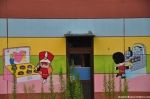
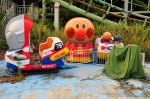
As for other characters: There are no specially themed rides, but Anpanman is pretty visible at Nara Dreamland. (In case you don’t know Anpanman: He’s the most popular fictional character amongst Japanese age 0 – 12 for 10 consecutive years. Anpanman was created by Takashi Yanase in 1968 as a manga character, but spread to other media quickly (including movies, animated shorts, a TV show and dozens of video games). Nowadays Anpanman is everywhere – imagine Hello Kitty, but popular with girls and boys…)
# Why was Nara Dreamland closed?
– A declining amount of visitors for many, many years – and most of all Universal Studios Japan. By the time USJ opened in 2001 Nara Dreamland already was a rundown theme park decades after its prime. Universal Studios Japan on the other hand was brand-new and high-tech, probably the most modern amusement park of its time. Tokyo Disneyland started the struggle (yes, even though 400km away TDL was direct competition for NDL!) and Universal Studios knocked it down – Nara Dreamland didn’t have a snowball’s chance in hell… (Surprisingly enough *Expoland* in Osaka wasn’t affected that much by USJ and closed mainly because of bad press after a 19 year old university student from Shiga prefecture died on a roller coaster in 2007 – and Hirakata Park (also known as HiraPa – ひらかたパーク / ひらパー) between Osaka and Kyoto still doesn’t show any signs of giving up…)
At the height of its success Nara Dreamland welcomed 1.6 million visitors per year, when it closed the number was as low as 400k. Universal Studios Japan on the other hand had 11 million visitors (!) in its first year of operation…
# What was Nara Dreamland’s main attraction?
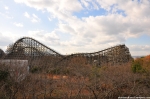
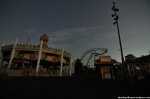
– Nara Dreamland’s main attraction was (and still is!) the Aska roller coaster (木製コースターASKA, Mokusei kōsutā ASKA), a wooden coaster built by Intamin and opened in 1998. The track was 1081 meters long and reached a height of 30 meters. The trains consisted of seven waggons for four guests each (two rows with two seats). They reached a speed of 80 km/h (almost 50 mp/h) and accelerated with up to 2.8g. Aska is named after Asuka, a city close to Nara – from 538 to 710 it was the capital of Yamato, one of the earliest states on Japanese ground, and the location of many imperial palaces as well as important temples and shrines, some of them still in existence today.
I took a video walking along parts of the abandoned Aska roller coaster – you can check it out on *Youtube*.
# Was it expensive to visit Nara Dreamland?
– The signs at the abandoned Nara Dreamland indicate that it was a pay-as-you-go amusement park (as was Disneyland when it opened in 1955!) – which means that you had to pay a low entrance fee, but then additionally for every single ride. So basically it was up to you how much you spent there. Sadly I never paid much attention to the prices, so let me have a look at some photos and see what I can come up with… Parking was 200 Yen for bikes, 1.200 Yen for cars and 2.000 Yen for busses. Bobsleigh (ボブスレー), the steel roller coaster modeled after Disney’s Matterhorn Bobsleds, was 600 Yen and a haunted witch cave put a hole of 300 Yen in your pocket. As for food: A beer was 500 Yen, chuhai was 400 Yen, takoyaki were 300 Yen, yakisoba was 400 Yen and the Family BBQ Set was 3.200 Yen. I don’t know how much the entrance fee was, but if you get caught by security now it costs you a whopping 100.000 Yen!
# I’ve heard there is a Yokohama Dreamland. Is it related?
– Well, there was a Yokohama Dreamland – it operated from October 1st 1964 to February 17th 2002 and closed, not really surprisingly, because of financial issues. It was located in the Totsuka ward of Yokohama. Unlike Nara Dreamland it was completely demolished – and replaced by a prison. And to finally answer the question: Yes, it was the sister park of Nara Dreamland with a similar layout, similar attractions and the same branding.
# Is there an official homepage?
– There was: http://www.nara-dreamland.co.jp/ (I didn’t make it clickable as it doesn’t work anymore anyways – save your time…)
You can find a copy *here*. (2003, Japanese only)
# How often have you been to Nara Dreamland?
– Never when it was still open and 5 times since it was closed.
# Do you have any plans to go back?
– Concrete, solid plans? No. Security there is the main reason for me not to go anymore. I know people visited the place without getting caught, but I made my own experiences and they were not all pleasant…
If you are less into facts about Nara Dreamland and you rather want to more about what it’s like to explore this abandoned theme park I recommend reading the articles I’ve just mentioned.
# Do you have material for more articles about Nara Dreamland?
– Yes! As of August 2014 I have material for about half a dozen articles, including some very unique photos…
# Is there a place even creepier than Nara Dreamland?
– Yes! It’s a half-abandoned amusement park called *People’s Park* – thanks to the constant music in the background and its nude statues it’s creepy as heck!
# What about that killer robot called Mascot 6-22? Is it really roaming Nara Dreamland?
– Killer robots at Nara Dreamland?! No, this is not another *April Fool’s joke*, this is the internet!
Nara Dreamland has been kind of my backyard for the past five years and I thought I’ve heard pretty much all stories about it… until one of Abandoned Kansai’s regular readers, Justin, asked me about the fully animatronic Mascot 6-22 in a private message via *Facebook* – and I had no idea what he was talking about. I did some research and there seems to be a theory out there in the depth of the internet, that Disney created Nara Dreamland to find out whether the fake park would be popular enough to justify the construction of an official Disneyland; which happened more than 20 years later. As if that wouldn’t be ridiculous enough, somebody claimed that the official new mascots were not poor students in poorly tailored costumes, but in fact robots – and that series 6, unit 22 was so special, that they didn’t turn it off, but let it roam freely in the park after it closed in 2006, defending a solar power station and giving everybody who tries to deactivate him an electric shock. But that’s not all! Some people actually seem to believe that the Japanese military asked Disney if they should take out “Mascot 6-22”, but they declined as the thing was showing interesting program adaptations.
Seriously, what the heck? The whole story is so ridiculous I won’t even spend the time to point out all the things that are wrong with it! Yes, I know, both the origin and the end of Nara Dreamland are somewhat in the dark, but come on, people… that’s a bit much, don’t ya think?
# I’ve heard that Nara Dreamland has been sold in late 2015. Is that true?
– Yes, that’s true. It seems like the previous owner owed the city of Nara 650 million Yen in ground tax, so the city foreclosed Dreamland and sold it to the only bidder for 730 million Yen – a real estate company called SK Housing. What plans they have is unclear though, because there are strict limitations on how the land Nara Dreamland is on can be used in the future…
# What are those strange noises I can hear at Nara Dreamland?
– If the noises are not coming from one of the nearby sports arenas, they are most likely caused by ushigaeru (ウシガエル) a.k.a. American bullfrogs. They freaked me out the first time I heard them in 2010, because they sounded like somebody opening a heavy metal door / gate…
If you have any unanswered questions about Nara Dreamland please let me know – I might update this posting every once in while. A lot of the information given here was only available in Japanese so far, some stuff I came up with by actually going to NDL – so if you use material for your own articles please be so kind and mention / link to this FAQ. Thanks a lot!
All of the following photos were taken in 2009 and 2010, most of them previously unpublished. The photos I took later will be published in two separate articles at some point in the future.
(If you don’t want to miss the latest article you can *like Abandoned Kansai on Facebook* and *follow this blog on Twitter* – and of course there is the *video channel on Youtube*…)
Love hotels always fascinated me. From the first time I heard about them and even more so after the first time I visited one. So of course an abandoned love hotel was always quite high on my “Places I want to go to” list, but while Kanto is swamped with that type of haikyo there seem to be barely any in Kansai. It took me more than a year to find the love hotel Gion, and technically I guess it’s more like a love motel…
Since I guess not everybody reading this blog is familiar with that kind of “popular Japanese subculture”. So, what is a love hotel? First of all – the love hotel industry is not a subculture at all, it’s one of the biggest money makers in Japan! A love hotel (also known as fashion hotel, amusement hotel, boutique hotel, couples hotel, romance hotel or leisure hotel) is a hotel where you can get rooms not only for a whole night, but also by the hour. They originated in the Edo period in Edo (nowadays Tokyo) and Kyoto, the then-capital – appearing to be tea rooms or normal inns, used by both prostitutes and normal couples. When prostitution was abolished in 1958 love hotels (then known as “bring-along inns”) started to boom – litte known fact: Even Nintendo ran a love hotel in 1963, just about 10 years before they started entering and revolutionizing the video games industry. The modern term “love hotel” derives from the “Hotel Love”, which was built in 1968 and attracted customers with a rotating sign. While some love hotels are basically more or less normal hotels without windows (if you see a hotel without windows in Japan you can be sure it’s a love hotel…) and an extremely discrete front desk other love hotels have very creative theme rooms for almost every taste – from princess bedrooms to BDSM stuff, from train compartments to whatever cliché fantasy you can imagine. The furnishing and equipment of those rooms vary heavily on the price – in addition to the standard stuff you have in a normal hotel room (TV, free tea, hairdryer, …) you usually get a games console, a karaoke machine and some condoms; some hotels have vending machines with sex toys in the hallway or the lobby. If you are willing to pay more there are basically no limits – insanely huge HDTVs, jacuzzis, massage chairs, private balconies on the top floor to enjoy the night sky and in some cases even a private swimming pool. While “rests” are about 2000 to 4000 Yen an hour “stays” cost about 8000 to 16000 Yen per room per night (usually from 10 or 11 p.m. on for 10 or 12 hours, depending on the hotel) – super luxurious rooms can cost up to 60.000 Yen per night in cities like Kyoto or Tokyo. (1000 Yen = 9 Euros / 13 US-$)
Nowadays the turnover of the love hotel industry in Japan is a whopping 4 trillion Yen per year, equivalent to about 36,000,000,000 Euros or 52,000,000,000 US-$ as of September 2011 – generated by 500 million visits to 37,000 love hotels all over the country. Love hotels are considered a whacky underground thing by many foreigners, while in fact they are part of daily life, turning over double of what the anime industry does.
Why are love hotels so successful in Japan? Because Japanese walls are thin and a lot of even not so young Japanese people are still living with their parents; the so-called parasite singles (パラサイトシングル, parasaito shinguru) enjoy the carefree and comfortable life of living at home up till their early 30s when even the late bloomers are getting married. If they want to have some passionate hours with their girlfriends, boyfriends or club acquaintances they go to a love hotel (and so do most adulterers…). It’s clean, it’s anonymous (most lovel hotel visitors don’t see any staff person!) and it’s affordable, especially if you have a job and still live with your parents. And the novelty factor of the rooms is a big plus, too!
So one day in November I met up with Damon and Andrew at a small train station somewhere in Shiga – all three of us were eager to finally explore an abandoned love hotel; especially Damon, who seems to find secret porn stashes at pretty much every location he goes to. Sadly the haikyo Love Hotel Gion didn’t have any of the (fake) glamour and sexiness you experience at a fashion hotel that’s still in business. It wasn’t even a real hotel, more like a motel – 8 row bungalows with rather deep open garages in front of them to prohibit people from getting an easy look at the license plates of the parked cars. The lot in front was quite big, so I guess another row bungalow or two were already demolished. And the one still standing was in pretty bad shape overall. Some of the “rooms” I didn’t fully explore, because the floors and roofs were falling apart, but one or two were barely touched. The downside of that was that it was pitch-black in there – luckily I brought my tripod. The layout of the bungalow sections was pretty much the same for all of them. A little lobby at the entrance, a windowless bath including a tiled tub to the left and then a bedroom straight ahead. Most of the bedrooms were covered by landscape wallpapers while the rest of the rooms had crimson wallpapers. Very, very 70s porn! (Or how an innocent young man like myself imagines something filthy like that!) Sadly most of the rooms were empty except for fixtures and solid bed frames. In one of the mini apartments we found a jukebox in questionable condition, but the most interesting detail was the wall mosaic in one of the bathrooms – it depicted two nude women in front of a horse, of one of them you could see the pubic area. Shaved, with just a little bit of hair left; except for the final stone – that one was red…
(If you don’t want to miss the latest postings you can *follow Abandoned Kansai on Twitter* and *like this blog on Facebook* – and of course there is the *video channel on Youtube*…)
Today I had a look at some rather old videos shot at locations I already wrote articles about. None of them were intended to be published, so the camera work might be a bit rushed occasionally, but I decided to upload them anyways as I think there might be some interest in them out there in the world wide web. While some of my videos only get a couple of dozen views quite a few of them were watched by thousands of people – *this one* will actually reach 30.000 views soon. Please enjoy! *Nara Dreamland – Aska Rollercoaster*
After visiting the Sky Rest New Muroto in the southern part of Shikoku Jordy and I got back on the road to find an abandoned school in the middle of nowhere about 50 kilometers away. While the most popular way of finding places to explore seems to be (mostly useless) books like Nippon No Haikyo and doing research on the internet the most effective way to do it actually is to rent a car and hit the road. In our case we stumbled across two amazing abandoned places (or haikyo (廃墟), ruins, as they are known in Japan) on our way to the school: an abandoned hotel and an abandoned Pachinko parlor in amazing condition.
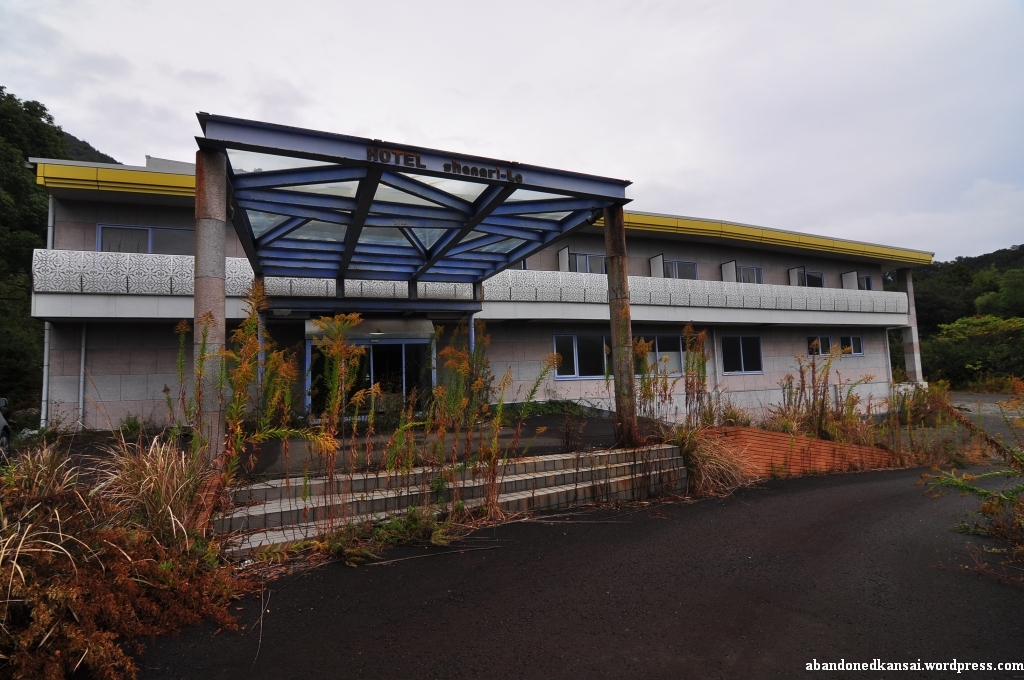
After about half an hour on the road I saw a huge sign advertising a hotel – and the sign looked like it wasn’t taken care of for at least a decade. I told Jordy about it and we decided to turn around. Driving up a hill for only a short distance there it was, the shangri-la (yes, lower case spelling…). Very unspectacular from the outside Jordy cracked some jokes about how the place doesn’t live up to its name, but we were disabused soon…
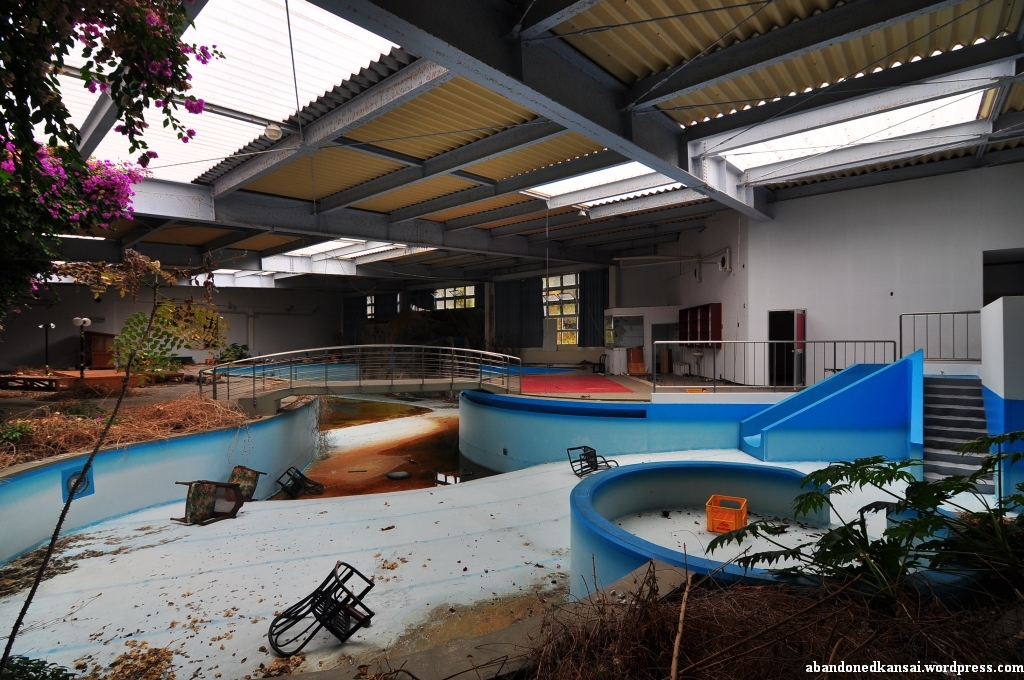
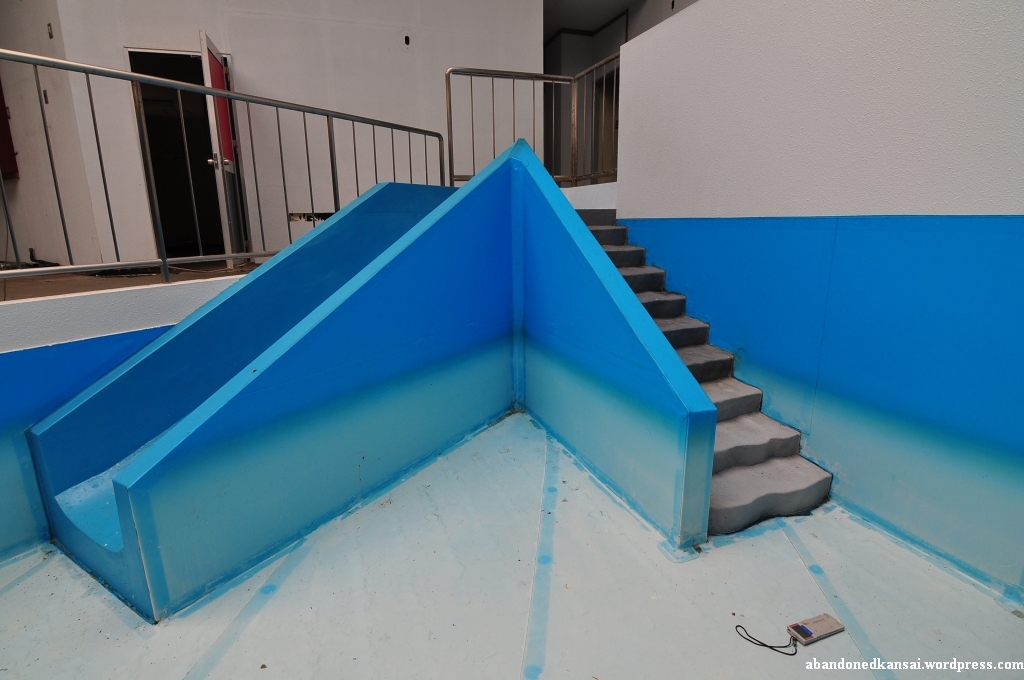
With the front desk gone and the kid’s play area and gift shop almost empty, the shangri-la became interesting when I entered the office behind the front desk. Amongst the mess of documents and office items like ink cartridges scattered all over the floor I found a photo album with wedding pictures. Was the shangri-la maybe more than it appeared from the outside? It was. Right around the corner was a rental counter for towels and other bathing equipment and from there I could already see the indoor water park – huge by Japanese standards, well below average being used to European facilities like that. Nevertheless fascinating, especially since the pool was quite complex with several small water slides and a bridge across to where I assume once a bar was.
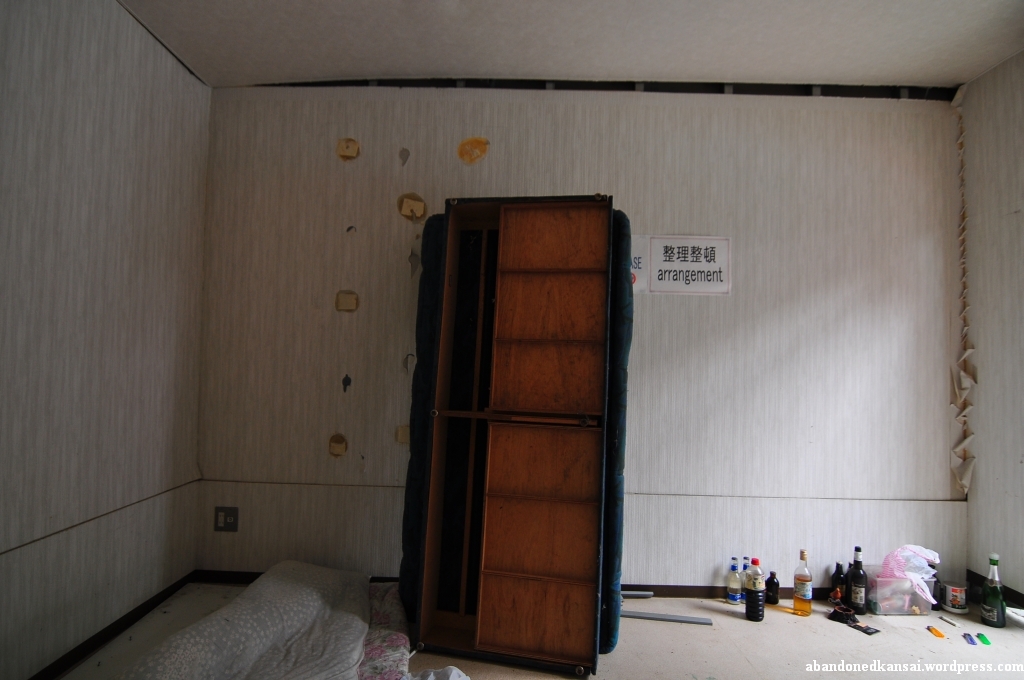
The rest of the ground floor was occupied by a kitchen, another bar and a small recreational area outside. The hotel part of the shangri-la was on the second floor. All rooms were empty by the time of my visit, but one of them was labeled “CHAPEL”, so I guess it’s easy to say that the shangri-la was a wedding hotel.
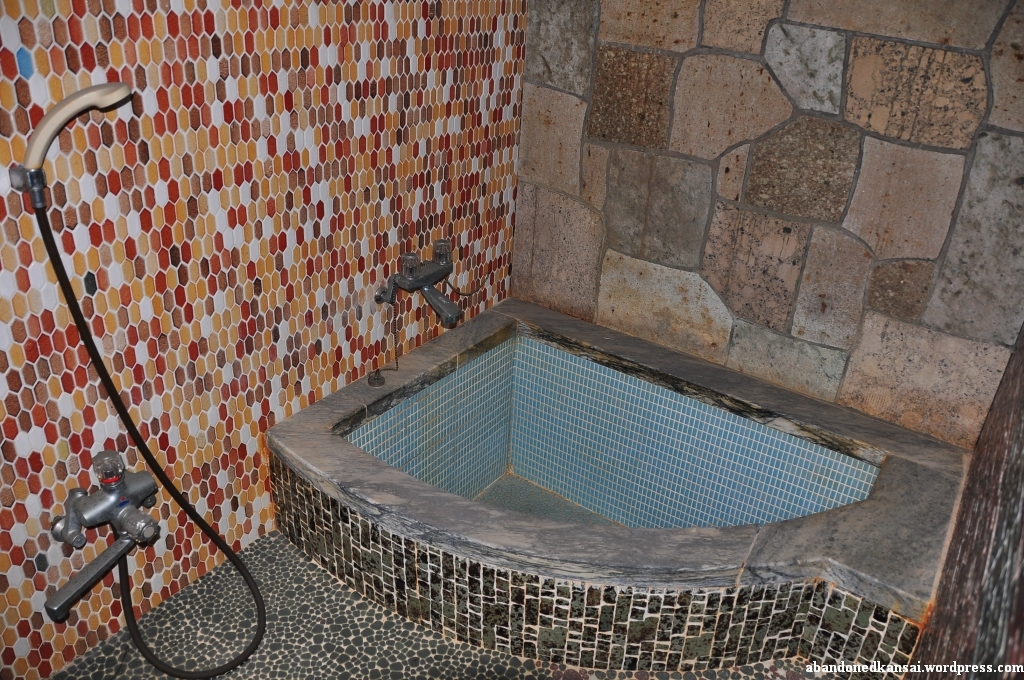
No Japanese hotel is complete without two shared baths (one for men, one for women) and the ones here were quite nice, including a rather spacious sauna considering the size of the shangri-la.
Jordy and I weren’t the first visitors to the shangri-la in the 10 years since it was closed (judging by the ad for a marathon in November of 2000), but to my surprise I’ve never seen it on the internet before. There was a bit of chaos here and there, but almost none of the typical signs of vandalism ruining the more famous… ruins. No arson, hardly any smashed interior, no broken windows – hardly any mold, well-lit, secluded. A truly great place to explore!

















































 Abandoned Kansai