Feeds:
Posts
Comments

Archive for the ‘Shrine’ Category

I’ve been urbexing for almost 15 years. During that time I’ve never written any articles about equipment, despite being very happy with three different Nikon DSLRs, two Manfrotto tripods, and a Sanyo video camera – which broke in 2019 after almost 15 years of recording countless hours at hundreds of locations as well as places like Chernobyl and North Korea. Videos I always considered a bonus anyway… and I’m still having a hard time thinking of myself as a photographer, given that I have no formal education in that field and only do it as a hobby. A really time-consuming hobby, but nevertheless just a hobby. I also don’t have a background in technology, so what’s the point of reviewing camera equipment when I just have an opinion based on learning by doing? Well, that doesn’t keep countless “influencers” and Youtubers from churning out incompetent nonsense, but I wouldn’t want to be found dead with either label on me! And like my favorite professor at university once said in regards to papers we had to hand in: “Don’t claim anything you can’t proof!”

Fortunately there is no need to be technical or scientific about this Insta360 X4 article, because unfortunately we never got that far…
Like I said, I always considered video walkthroughs of the locations I explore a bonus. I started them pretty much right away, but at first I didn’t even publish them, because I only took them for myself. And even when I published them, I didn’t edit them. No cuts, no voice overs. Just me walking around breathing heavily into the silence. That all came to a sudden halt when my Sanyo stopped working after exploring the abandoned *Trump Hotel*, also wiping out the recordings of the whole day. At that point I was tired of doing the videos anyway – and my co-explorers were increasingly annoyed, because I added 10 to 30 minutes at the end of every exploration for the walkthrough. So I stopped doing them.
For the past 18 months I’ve been exploring solo again (don’t ask, it’s complicated and often quite frustrating, to be honest), but a few weeks ago a colleague of mine showed me an older model Insta360 video camera that a visiting cousin from the States forgot at his place in Japan. I was fascinated by the easy to use 360 photos and videos, so I did some research and decided to get one. I’ve read reviews, I’ve read product pages – I did my best to make an informed decision, because at first I considered buying the X2 or X3 as older models often are cheaper with only slightly fewer / worse features. The X2 was out of the race when I read in a review that it required a smartphone to be activated – something I didn’t read anywhere about the X3 and X4. I guess because it’s an idea that is so stupid that it probably was a one-time mistake by Insta360, facing so much backlash that they removed the requirement from following models. The price difference between the X3 and X4 wasn’t very big and since the latter was only four weeks old at the time, the price on Amazon and in brick and mortar stores was the same, so I decided to get it at my local Yodobashi Camera (street block sized electronics stores with hundreds of employees each, in case you are not familiar with the chain), where I’ve been a customer for almost 18 years – ever since I moved to Japan.
BIG MISTAKE!

Yodobashi Camera was extremely stingy, giving only 1% points on the video camera, despite a promotional campaign of giving 13% points for purchases over amount X – except for (small print)… But when you shell out 80k Yen on a new video camera you are looking forward to use, store points are the last thing you worry about anyway. Fortunately I still had some of those points, which I used to get a seriously overpriced MicroSD card, because without it the video camera would be useless and I wanted to try it out on the weekend before an upcoming urbex trip. 83500 Yen poorer, but with a big smile on my face I left Yodobashi Camera on a Friday evening after an otherwise pretty horrible week.

Saturday was supposed to be a great day, though it started with a rude awakening / realization…
After sleeping in and having a delicious breakfast, I enjoyed a nice unboxing. The first slight disappointment was when I realized that the included battery was dead. Well, not dead dead, but completely empty. Whatever, an hour or two wouldn’t make a difference. It would not dent my great mood for sure. That came a few hours later when the battery was fully charged. I booted the small brick for the first time, its screen came to life, asking me to choose a language – and then the screen showed what the camera was seeing… for about a second or so. Then some text popped up and my heart sank. You gotta be kidding me! What I was looking at was a screen telling me to download an app by Insta360 to a smartphone, iOS or Android, to unlock the video camera. What. The. Heck? I literally felt it in my fingers how my blood-pressure exploded, because unlike pretty much every person on the planet above the age of 6 years I don’t own a smartphone. Never have. In the late 90s I had a black and white Nokia for work (yes, I’m not the youngest anymore, though I started working full-time in my early 20s). When I moved to Japan I had a flip phone or two, but for the past 15 years or so I didn’t have any mobile phone at all, smart or not, because I don’t like them as they turn way too many people into dumb zombies. So here I had a brand-new, quite expensive video camera… that forced me to make it usable by using another device with cameras? Who comes up with stupid ideas like that?!
Certainly not Nikon! Their D7500 DSLR I bought just weeks prior worked with a partly charged battery and regular SD cards straight out of the box 5 minutes after purchase – without any charging or unlocking BS!
So I started to do some research… and didn’t find much. Like I said, I couldn’t care less about smartphones, apps and all that stuff, so I tried to find a solution to unlock the darn X4 via PC or MicroSD card. Of course I couldn’t find anything about that either, so I contacted Insta360 directly – who apparently didn’t read my message and instead sent me a standard reply. So I got back to them, apologized for not describing my problem properly (I’ve been in Japan too long…), and this time got an answer that at least implied that they understood the situation I was in – without being able to help, because though it seems to be nowhere stated on the box, the promo material or even on the X4 website (at least back in mid / late May, maybe they changed it by now)… you really need a smartphone and the Insta360 app to use a newly bought X4 video camera, that seems to work perfectly fine, but is made not usable on purpose by the manufacturer. Which absolutely blows my mind!
How is that even legal?
How can a company force you to use a completely unrelated piece of expensive technology that actually partly does the job of the product you just bought, to make your purchase usable? Without mentioning that essential detail with big warnings before purchase! And in addition, forces you to use an app, which does who knows what in the background without one knowing?
What’s next? You need an electric bike with WiFi to unlock your newly bought car? And if you don’t… sucks to be you, it’s completely useless!

Yodobashi Camera – (The Lack Of) Customer Service In Japan!
After some back and forth it was Monday and I came to the conclusion that I won’t be able to use the Insta360 X4, because it really needs a smartphone to unlock, which wasn’t properly communicated. So after work I went back to Yodobashi Camera, my go-to electronics store for the past almost 18 years. Never had a problem with them, because all the products I bought worked as intended right out of the box. So I went back to the cashier counter where I bought the video camera… and already ran into the first minor bump in the road – apparently I hadn’t paid for it in the camera department, but a neighboring one, which wasn’t a problem on Friday evening, but very well on Monday evening. So I went 20 meters over to the camera department and told them about my unfortunate situation: That I had bought this video camera three days prior, but couldn’t use it, because it doesn’t work without a smartphone, which wasn’t properly communicated by Insta360 or Yodobashi Camera. But I was very careful with everything, I didn’t even remove the protective film from either of the lenses. Some air through the teeth sucking, some going back behind the counter to talk to a superior and then something like the following conversation – it’s in quotation marks, but they are not really quotes, you know… just something like that, from memory:
“I can’t sell this anymore, you opened the box. You can’t return it.”
“But I can’t use the video camera.”
“I can’t sell this anymore, you opened the box. You can’t return it.”
“I don’t have a smartphone. The X4 is useless to me.”
“I can’t sell this anymore, you opened the box. You can’t return it.”
“I did proper research and I only found out about this after I opened the box and tried to use the X4.”
“I can’t sell this anymore, you opened the box. You can’t return it.”
“I bought a D7500 last month, it worked out of the box…”
“I can’t sell this anymore, you opened the box. You can’t return it.”
“Then take it back and ask Insta360 to exchange the X4 – you have dozens of them here, you probably have to return one once in a while anyway.”
“I can’t sell this anymore, you opened the box. You can’t return it.”
“Are you serious? I’ve been a customer here for almost 18 years, spent millions at your store and other ones in the building that has your name. Never had a problem – and the first time I have, you are stonewalling me?”
“I can’t sell this anymore, you opened the box. You can’t return it.”
“Really?”
“I can’t sell this anymore, you opened the box. You can’t return it.”

At this point I gave up and exchanged a few more e-mails with Insta360 (“You should try to return the X4 where you bought it!” No kidding…), but their responses quickly became as useless and repetitive as the one of the guy at Yodobashi Camera – who is just a small cog in a big machine, so I don’t blame him; he’s punished enough with the lighting in the store and the uniform he has to wear all day.
So here we are, after me falling for the usual misconception about (customer) service in Japan, because I rarely ever had a real problem anywhere. It’s great as long as everything is within procedures – if somebody has planned for it, it most likely will go smoothly. Service is great. When service becomes customer service though, i.e. an individual customer needs help that requires improvisation outside of the planned service… you’re basically on your own. The only thing flexible in Japan is bamboo.

Nevertheless I still have moments when I wonder: AITAH?
I’m a huge believer in personal responsibility. If I make a mistake, I stand by it. I find behavior like ordering 20 items of clothes in different sizes and colors with the intention of sending 18 of them back despicable. In fact I’ve never sent anything back that I’ve ordered online, except for two USB-HDDs – and only because they didn’t work. I don’t do fast fashion, I don’t buy garbage from questionable sites like Shein oder Temu, I don’t replace electronics unless they are broken. (RIP, Nikon D7100!) I did due diligence before buying the Insta360 X4 and to this day everything in that (opened…) box is in mint condition. If I would have known about the smartphone requirement, I wouldn’t have bought the X4. It’s the reason why I didn’t buy the X2.
This is actually only the second time that I tell this story to anybody, because part of me is a bit ashamed that this series of unfortunate events happened – despite all the research before buying. But spending more than 80k on a useless brick of tech isn’t exactly something to be proud of. I don’t regret much in my life, but buying the Insta360 X4 I regret. And buying it at Yodobashi Camera is something I regret, too. Maybe Amazon would have been more accommodating with returns…
But I guess it is what it is – only money in the end. And no videos for Abandoned Kansai in the future. Heck, even if I would get the currently useless X4 to work, I would always be reminded of this story. Screw video cameras! Never was a fan, now I dislike them almost as much as smartphones. Which kind of closes the circle. But I’ll make sure to never ever even consider buying anything from Insta360 again – I still don’t understand how it’s even legal that they can do this. What’s next to unlock their cameras? Having to send them a voice message, swearing loyalty to Winnie the Xi(thead)? Apparently they can do anything without people questioning it…
I went back to Yodobashi Camera once more though, two days ago. I spent the remaining shop points I had on presents for my nephews without having to pay a single sen – my goal was it to hit +/- 20 points/Yen, but going to exactly 0 was priceless – and so I left the Yodobashi Camera building one last time with a big smile on my face. Upon arriving back home I cut up my loyalty card after almost 18 years. It probably doesn’t mean much to a large store chain like that. But it meant a lot to me!

Thank you for reading till the end and… What has your worst experience with Japanese (customer) service been? Write it in the comments!

(*Like Abandoned Kansai on Facebook* or *follow us on Twitter* if you don’t want to miss the latest articles and exclusive content – and subscribe to the *video channel on Youtube* to receive a message right after a new video is online…)

Read Full Post »

The average year in Japan starts with a first shrine visit called “hatsumode” – the not so average year, too. So let’s keep this Abandoned Kansai tradition and start the year with an abandoned shrine… a spooky one! Halloween meets hatsumode!
The Abandoned Dolls Shrine was one of the strangest sites I’ve ever laid eyes on. I’m sure it was always a bit surreal, but seeing dozens of dirty dolls in a building that could collapse any second is more than just a bit uncommon – especially since some of those toys had been tempered with. The most harmless variation was just sitting them on an old chair to be able to the better / more interesting (?) photos, while some other poses were just straight bizarre! Who undresses a female baby doll and ties it, hands over head, to a wall? Leaving them in the original wrapper wasn’t always a better solution though as some of them looked like they were suffocated by their own packaging. All of this happening in a double function house as the monk seemed to live in this place of worship – which had seen better days and was on the brink of collapse; I’ve seen massive steel gymnasiums that have been flattened by the weigh of snow, so whenever news will reach me that the Abandoned Dolls Shrine collapsed, I won’t be surprised! Unfortunately I don’t know anything about this creepy beauty, but it looked abandoned for decades. Two at least, maybe even three or four.
The Abandoned Dolls Shrine was not only one of the smallest and spookiest locations I’ve ever explored, it also turned out to be the last I write about before the 10th anniversary of Abandoned Kansai – on January 8th 2010 I decided to start a blog on WordPress to publish some texts and photos, because at the time only a handful of foreigners wrote occasionally about abandoned places in Japan… and they were all based in Tokyo / Kanto, while I was and still am living in Osaka / Kansai. 10 years later I’m still running Abandoned Kansai – and thanks to a backlog of several dozen locations plus a few new explorations every now and then, I guess I will continue to do so for a few more years…

(*Like Abandoned Kansai on Facebook* or *follow us on Twitter* if you don’t want to miss the latest articles and exclusive content – and subscribe to the *video channel on Youtube* to receive a message right after a new video is online…)

Read Full Post »

More often than not I barely have any information about the places I visit in advance. Sometimes I only saw a photo and have a general idea where to look for the location. It was like that when visiting the *Bibai Bio Center* – and the Horonai Substation was not much different. A red brick building somewhere in the middle of nowhere – and a road leading there. That was it. I didn’t expect a spectacular location… and I didn’t find one. Nevertheless it was a good exploration with an interesting history, the first one on my *haikyo trip to Hokkaido*. *Michael* thought so, too – although he almost paid a steep price for making a snow angel…

History

The Horonai Mine has an incredibly and unusually long history, dating back to the early years of the Meiji Era (1868-1912). Back then it was a time of new departures and Hokkaido still was kind of unknown territory. Japan recently opened itself to the world after more than two and a half centuries of information and immigration control, relying heavily on foreign experts to accomplish in a couple of decades what Europe and the States took about a century – industrialization. Just a decade prior Hokkaido was still known as Ezochi and for its renitent inhabitants, but the new government in the newly appointed capital Tokyo pushed for the development of Japan’s most northern prefecture… and population rose from 58.000 to 240.000 in the mere ten years of the 1870s. Agriculture and mining became the prefecture’s most important industries – and while agriculture is still important (especially wheat, potatoes, pumpkins, corn, raw milk, and beef), mining isn’t. The amount of abandoned mines in Hokkaido is incredible, but since most of them are in extremely rural areas, often hours away from bigger cities, we decided to visit the Horonai Coal Mine as an example – because it wasn’t completely out of the way, came with an electrical substation and, to our surprise, with the Horonai Shrine.
It wasn’t until writing this article though that I found out that the Horonai Mine was actually Hokkaido’s oldest modern mine and that Hokkaido’s first railroad, the Horonai Railway, was built to establish and operate the Horonai Mine. It’s said that in 1868 a local resident discovered coal in Horonai, but it wasn’t until 1872 that the village received any attention, leading to a survey in 1873. Expecting massive amounts of high quality coal in Horonai plans were made concrete in 1877 and money was raised through industrial bonds in 1878 after important statesmen like Ito Hirobumi and Yamagata Aritomo visited the area in previous years and campaigned to establish a mine. Further surveys were conducted in May of 1878 and the mine was opened on December 18th 1878, reaching full production almost four years later in June of 1882.
Plans for the Horonai Railway, necessary to transport the coal mined in Horonai to places where it could be used, were finalized in December of 1879, so construction of the railway began in January of 1880, installation began in July of the same year – technology and knowledge was imported from the United States by J.U. Crawford, who oversaw the railway construction project for the Japanese government; the line was officially opened on September 13th 1883 and was used for the transportation of passengers as well as coal.
In 1889 both the mine and the railroad were privatized, probably for little money, as both of them were not profitable at all. This happened a lot in the late 19th century in Japan, strengthening the so-called zaibatsu (gigantic family controlled holding companies, amongst them still famous corporations like Mitsubishi, Mitsui, Sumitomo and Kawasaki), but also countless mid-sized companies (although sometimes even profitable companies were given away for a fraction of what they were worth…). Business continued for another 100 years and ended in 1989, when most of the buildings were demolished for security reasons – and because back then industrial heritage wasn’t considered worthy of preservation. (The Völklingen Ironworks in Völklingen, Germany, and the Zollverein Coal Mine Industrial Complex in Essen, Germany, were actually spearheading the idea of maintaining old industrial buildings, becoming UNESCO World Heritage Sites in 1994 and 2001 respectively.)
A not so fun “fun fact”: Like many other mines in Hokkaido, Horonai was taking advantage of prison labor. Not only during times of war, but in the early years, both before and after privatization. In 1883 250 prisoners worked next to 228 general laborers. In 1890 there were 1.043 prisoners and 183 normal workers “employed”, the forced labor accounting for more than 80% of the work force, extraction and transportation almost exclusively relying on prison labor! (It was actually thanks to the prison laborers that the Horonai Mine survived the first couple of years. From 1882 to 1888 the mine was deep in the red with only one profitable year and couldn’t even afford to implement mechanized coal transport – that actually happened only after it was privatized and exploited prisoners as cheap labor for years. And after the extraction costs per ton of coal were cut down to one sixth over the course of six years till privatization in 1889.)
The Horonai Mine also gathered some local fame in Japan when it was used as the setting of the second Season of Survivor (サバイバー) in 2002 – after Palau, but before the Philippines and North Mariana. Probably the most original setting ever and by now much more exotic than all those islands in the Pacific Ocean; they look all the same to me anyway! (I usually don’t link to other people’s Youtube videos, but *here is the intro to that season* in 240p. Don’t miss the *video I took at mine in late November* in 720p!)

Exploration

When we arrived on location the initial situation wasn’t promising. Several hundred meters before we reached the substation we had to park the car as the road was completely snowed in. Luckily there were tire tracks (we were able to walk in) from a more suitable vehicle, but the road itself wasn’t accessible with the small car we rented. As we got ready to walk up the hill we saw a guy and his dog coming back to their car. Nothing unusual, until we saw that the guy was carrying a rifle. Not the usual BB guns you have everywhere in Japan. A real friggin rifle! Even if he wasn’t shooting trespassers we were wondering what he was hunting in the forest ahead of us… and if his prey might want to get a shot at hunting us…
Nevertheless we followed the previously mentioned tire tracks deeper into the valley. To the right we saw several concrete ruins of the Horonai Mine, abandoned in 1989, when the mine was closed after 110 years. Everywhere along the road we found information signs (Japanese only…) and it seems like the area was converted into a “coal mine scene park” in 2005. It turned out that the first abandoned place on our trip wasn’t actually that abandoned, more like a tourist attraction – like the *Shime Coal Mine*, a.k.a. the *Anti-Zombie Fortress*. Of course there were no tourists seen anywhere, so I guess the place is only of interest in the snow-free summer months… and basically inaccessible the rest of the year. Michael of course was eager to head over to concrete remains, but given the deep snow and the unknown terrain I was able to convince him to look for the substation first – especially since the grey leftovers didn’t look like they contained anything interesting.

It took us about half an hour to walk from the parking lot to the substation and the tire tracks ended a couple of dozen meters before reaching our destination thanks to a collapsed tree on the road – from that point on we had to walk through the snow which was about 30 centimeters deep.
The Horonai Substation, a two-storey brick-clad concrete building, was built in the 1920s, more than 40 years after the mine was opened, and received its electricity from a coal fired power plant in Shimizusawa. That plant, which was fuelled by coal from the Yubari Mine, not the Horonai Mine, is still in existence and closed in 1991, but was not visited by yours truly as the roads leading there would have required a separate day trip.
Sadly there wasn’t that much to see: The metal constructions of the transformers and the brick covered building – locked by a solid chain, but luckily Michael found another way in. The building clearly was in use during summer months, featuring some kind of exhibition with lots of exhibits and huge control panels from the good old days.
More interesting was the Horonai Shrine, which obviously was completely covered by snow, too, and probably as half-abandoned as the Horonai Substation. Located right next to the substation on a small plateau up a slope, the shrine offered a nice view at the remains below. At that point it started to snow and I don’t know why, but there is an amazing peacefulness about deserted snow-covered shrines. Michael was still down at the substation, so all I heard was snow falling – perfect tranquility.
Overall the Horonai location wasn’t spectacular, but at that point I hadn’t explored many snow covered (more or less) abandoned places, so it was a good start into the trip!

Snow Angel

Oh, after all those paragraphs about the mine’s history I almost forgot about the snow angel! It seems like either Michael or I have a serious amount of bad luck when exploring together. In spring I broke my D90 on our *haikyo trip to southern Honshu* – and I already mentioned Michael’s misstep at the *Hokkaido Sex Museum*. His bad luck started earlier though, when he insisted on making a snow angel on the way back to the car. I thought it was a bad idea in the first place as it was cold and he was jumping spine first onto unknown ground (concrete, rocks, metal, …), but everything went fine until the point when Michael first took off his glasses and then stood up shortly after, realizing that his glasses were gone. In a comedy movie kind of situation he asked me to watch my steps – the last words barely left his mouth when he moved one of his legs and we both heard a crushing sound. The spectacle frame under his boot wasn’t only bent, but broken. Well, bent and broken. Michael, the designated driver on this tour since my license isn’t valid in Japan, had some contact lenses with him, but they would have only last for two or three days – shorter than the trip. So on the way to our second hotel we were looking for a glasses store. 5 minutes to 8 p.m. (i.e. closing time) on a national holiday (!) I spotted one. Not only were they able to fix Michael’s glasses in a miracle operation taking almost half an hour, they did it for free and also give mine a new polish. Quite a few people complain about the (lack of post-buy) service in Japan (and I admit that sometimes it can drive you nuts!), but the glasses shops here are amazing and saved not only the day, but kind of the whole trip…

(If you don’t want to miss the latest article you can *follow Abandoned Kansai on Twitter* and *like this blog on Facebook* – and of course there is the *video channel on Youtube*…)

Read Full Post »

Ever since I visited the abandoned Ishikiri Shrine in Himeji I am asking myself which kind of places are really worth writing about. I’ve been to demolished places places before and after – but are they really worth writing about? How about historical places like castles or forts – especially when used as tourist spots? I wish all places could be as exciting and stunning as *Nara Dreamland*, *Gunkanjima* and *Pripyat*, but let’s be honest: most of them are not. (And Gunkanjima and Pripyat actually became tourist spots…) Interestingly enough the Ishikiri Shrine wasn’t the worst place I’ve visited; not even close. I guess it just sparked those thoughts as I grew up in Germany in an area where you have abandoned castles and really old churches every couple of kilometers. Heck, I once went kayaking on the river Neckar (near Heidelberg) and at one point I was able to see three abandoned castle ruins at the same time!
And what castles are for Germany shrines are for Japan – times 10. Or 100. Maybe 1000. They are everywhere. You can barely throw a stone without hitting one (not that I’ve tried… I guess nobody would appreciate that kind of behavior!). At first visitors to Japan are all excited. “How beautiful – and look, there’s another one!” – but after a while this wears off, even for the tourists. Living in Japan for five years I barely notice shrines and temples anymore, unless they are famous tourist attractions – or abandoned. The Ishikiri Shrine in Himeji (not to be confused with the rather famous Ishikiri Shrine in Osaka!) is one of the few abandoned ones. About a third up a small mountain with the former priest’s house right at the bottom the shrine entrance is beautiful – a stone torii at the edge of a bamboo forest, offering much welcomes shade in the summer hear. The main part of the Ishikiri Shrine consists of a now empty building, probably once used for storage, and the shrine itself as well as another small building. Sadly I have no idea about the history of the Ishikiri Shrine – even the few Japanese blogs that write about it only speculate, for example that it was built about 60 years ago and might have been an offshoot of the Osaka shrine of the same name. The place actually got so popular that somebody screwed tight the door of the shrine building with two wooden beams and put up a sign asking people not to break in. The priest’s house at the foot of the mountain was in such bad shape and in July of 2010 already so much overgrown that I only took some outside shots and didn’t even enter – I guess I’m not that much into private houses… especially when people are always near praying at / taking care of another shrine that is not abandoned.
The Ishikiri Shrine is far from being a haikyo highlight, but it was nevertheless a nice little summer hike in the outskirts of Himeji. Furthermore abandoned shrines are rather rare since there are (almost) always some locals taking care of even the smallest places of prayers. Too bad I wasn’t able to find out more about the shrine’s past…

Read Full Post »

After I came back to Japan from my trip to Germany (meeting family and friends) and Ukraine (visiting Prypiat and Chernobyl) I kinda lost my drive a bit – living in Japan is way more wearing than you might think and which haikyo could really compete with an abandoned city in the middle of a radioactively contaminated zone? Going with Mike Grist to Nara Dreamland was exciting, but I’ve been to Dreamland before. Going to the Doctor’s Shack with the Gakuranman was interesting, but the place was already trashed pretty badly. Haikyo hiking alone was relaxing, but… well, it was haikyo hiking. Been there, done that many times. Eight weeks and tons of German sweets after I returned to Kansai I met Michael Gakuran again…
About 4 months ago Michael posted a location he called The Lost Subterranean Shrine, an original find he located in early summer. If he would have kept the location a secret and took it to his grave I don’t think anybody could have blamed him for that. You just don’t come across tunnels with religious artifacts – and vandalism as well as theft are common urbex problems, also in Japan. Nevertheless Michael guided me there and I’m even more grateful for that than I was when he showed me the Doctor’s Shack.
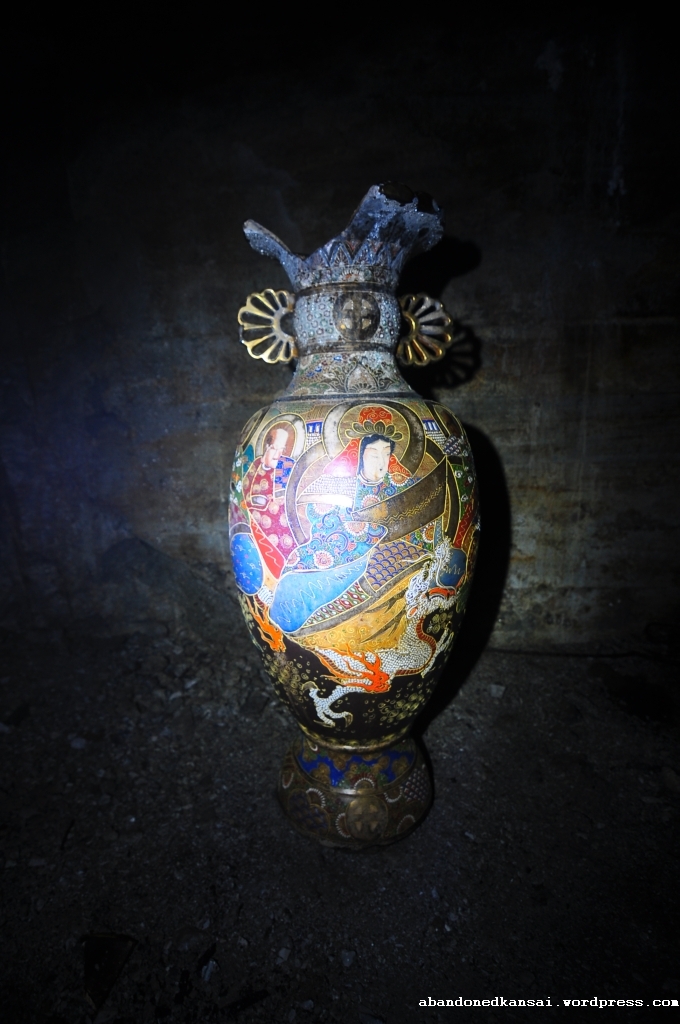
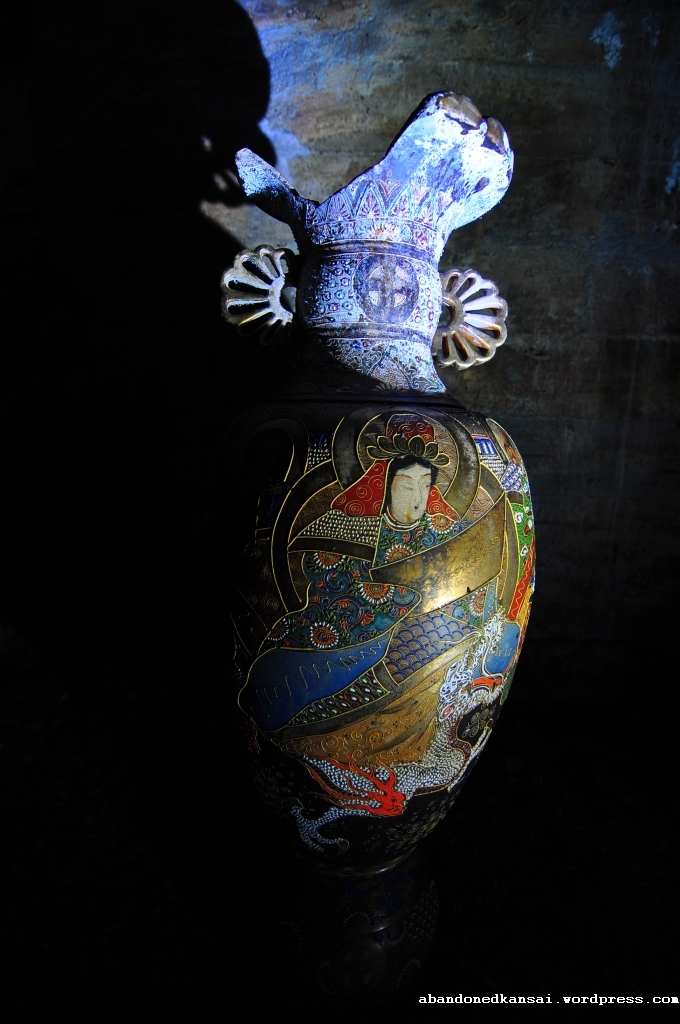
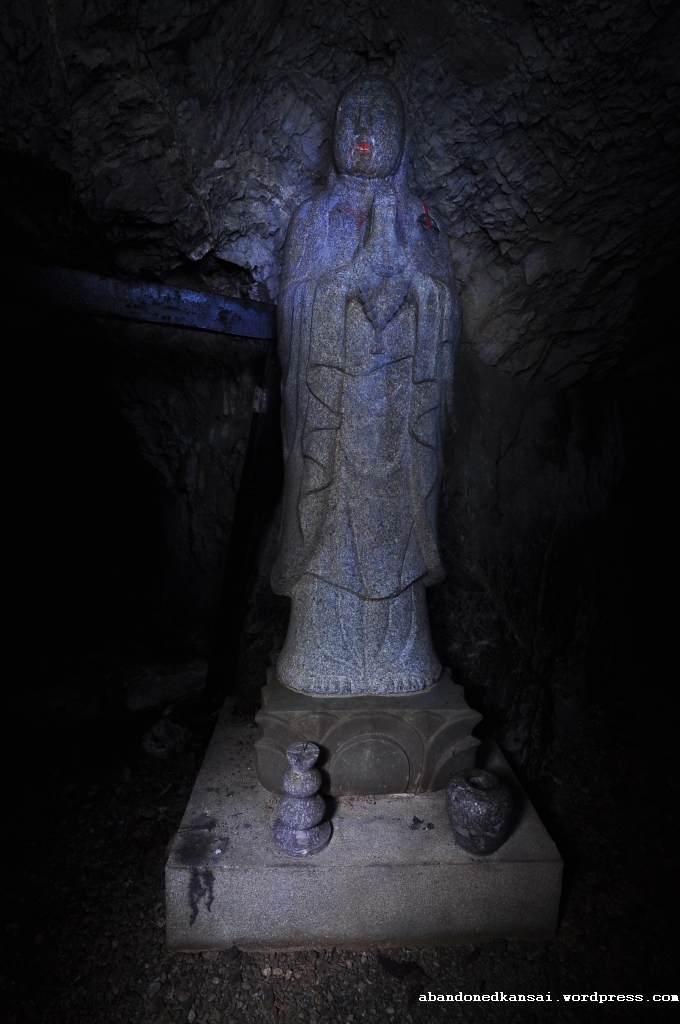
Reaching the entrance of the Lost Subterranean Shrine I was exhausted: Half up a mountain and lunch skipped the pouring rain was killing me – especially since I didn’t bring an umbrella. Michael removed the gate at the entrance to the tunnel and we both let out a little scream looking at the hand size creatures on the walls – Michael of joy (he loves critters of all kinds), me of disgust as I like my nature tamed – or grilled… I decided to keep the soaking wet towel on my head, just in case one of those chitin bastards decided to fall on me, and entered the tunnel, which at about 1.70 meters was 20 cm too low for me. This posture of humility was kind of appropriate considering what I was about to see, but it was nevertheless far from being comfortable. Neither was the insanely high humidity you could actually see in the beams of the flashlights we were carrying. After about 40 meters into the tunnel I saw a statue standing at a bifurcation, brightened by the beam of my flashlight – left: dead end, right: continue. After another 40 meters we reached a cave of maybe 15 by 15 meters with two rather small stone tables and a couple of stone stools around. The head end of the room had kind of an altar with several statues, vases and busts, flanked by a beautiful but damaged vase to the left and a simple brown one to the right – judging by their style the items must be from the south; Okinawa, maybe even Taiwan or China. On the main end of the altar were two openings right at the ground, leading to a secret room as Michael found out previously. Being 1.92m tall and blessed with a broad back I passed on crawling through the tight openings and started shooting. Or at least I tried. I never shot in complete darkness before and since I had my wide-angle lens mounted I couldn’t even use the flash since it creates nasty shadows on the pictures – switching the lens was not an option either as the humidity was crazy inside the cave and it was raining outside. Luckily I had some experience shooting manual thanks to my visit to Nara Dreamland at night and so I grabbed my tripod and two flashlights and started improvising. Playing around with different settings and ways to direct the lights was fun, but extremely exhausting, especially at the altar part because there the ceiling was way lower than in the rest of the comfortably sized cave room. Since it was getting dark outside our time was limited and after about half an hour we had to leave, although I wasn’t nearly pleased with what I had seen on the LCD of my D90 – we had quite a walk in front of us through pouring rain, making me worried if my camera would survive.
Well, the camera survived and I was even spared the week long cold I expected to get. What I got instead was a couple of surprisingly good shots of the vases and busts – never trust a camera monitor, especially when feeling tired and worn out.
Looking back at the exploration of the Lost Subterranean Shrine from the comfort of my apartment actually re-ignited my haikyo fire. When I came home that day I was just exhausted: It took me almost 16 hours and 9000 Yen to get to the place and back, I got caught by a rainstorm, had to drag myself up half a mountain, it was cold and humid, the walls were covered with really nasty beasts, I had to shoot under the most difficult conditions so far and on the way home I was soaking wet, smelling so bad I couldn’t stand it myself. But it’s not the average abandoned hotel on a sunny day that’ll stay in my mind. It’s an adventure like this with a friend like Michael and pictures like those…

(*Like Abandoned Kansai on Facebook* if you don’t want to miss the latest articles and exclusive content – and subscribe to the *video channel on Youtube* to receive a message right after a new video is online…)

Addendum 2010-12-01: As I mentioned in the comments I wrote e-mails to my former professors for Japanese History and I’m very grateful they answered quickly although they had barely any information about the place.
One assumed that the busts might depict the former owner / founder of another haikyo in walking distance, the rest being typical items of a butsudan plus some items the man might have liked when he was still alive. Another professor had a closer look at the vases and thinks that they are not that old, rather from “modern” industrial production, since their colors are very strong and not faded at all – maybe pre-WWII, especially since the busts include suits, not kimonos; going along with what sumi said. She guesses that the items were put there during WWII to protect them from American bombardments during the war. It’s possible that the owner(s) didn’t survive the war and therefore the place was forgotten. Then I asked an archaeologist for advice and she wrote me that the items by themselves are of no monetary value whatsoever. Stuff like that would be available in local “antique” junk shops, even the busts have more personal / sentimental value than actual monetary value.
Since we can’t be sure that the place is really abandoned (just because it looks like it doesn’t mean that nobody goes there anymore or claims it as their possession) and the things don’t seem to be of real value I decided not to take any actions. Maybe the place will be left alone for another 30 or 40 years and then the cave and its items might be interesting to some local historians…

Read Full Post »