Feeds:
Posts
Comments

Archive for the ‘Wakayama’ Category

I’ve been urbexing for almost 15 years. During that time I’ve never written any articles about equipment, despite being very happy with three different Nikon DSLRs, two Manfrotto tripods, and a Sanyo video camera – which broke in 2019 after almost 15 years of recording countless hours at hundreds of locations as well as places like Chernobyl and North Korea. Videos I always considered a bonus anyway… and I’m still having a hard time thinking of myself as a photographer, given that I have no formal education in that field and only do it as a hobby. A really time-consuming hobby, but nevertheless just a hobby. I also don’t have a background in technology, so what’s the point of reviewing camera equipment when I just have an opinion based on learning by doing? Well, that doesn’t keep countless “influencers” and Youtubers from churning out incompetent nonsense, but I wouldn’t want to be found dead with either label on me! And like my favorite professor at university once said in regards to papers we had to hand in: “Don’t claim anything you can’t proof!”

Fortunately there is no need to be technical or scientific about this Insta360 X4 article, because unfortunately we never got that far…
Like I said, I always considered video walkthroughs of the locations I explore a bonus. I started them pretty much right away, but at first I didn’t even publish them, because I only took them for myself. And even when I published them, I didn’t edit them. No cuts, no voice overs. Just me walking around breathing heavily into the silence. That all came to a sudden halt when my Sanyo stopped working after exploring the abandoned *Trump Hotel*, also wiping out the recordings of the whole day. At that point I was tired of doing the videos anyway – and my co-explorers were increasingly annoyed, because I added 10 to 30 minutes at the end of every exploration for the walkthrough. So I stopped doing them.
For the past 18 months I’ve been exploring solo again (don’t ask, it’s complicated and often quite frustrating, to be honest), but a few weeks ago a colleague of mine showed me an older model Insta360 video camera that a visiting cousin from the States forgot at his place in Japan. I was fascinated by the easy to use 360 photos and videos, so I did some research and decided to get one. I’ve read reviews, I’ve read product pages – I did my best to make an informed decision, because at first I considered buying the X2 or X3 as older models often are cheaper with only slightly fewer / worse features. The X2 was out of the race when I read in a review that it required a smartphone to be activated – something I didn’t read anywhere about the X3 and X4. I guess because it’s an idea that is so stupid that it probably was a one-time mistake by Insta360, facing so much backlash that they removed the requirement from following models. The price difference between the X3 and X4 wasn’t very big and since the latter was only four weeks old at the time, the price on Amazon and in brick and mortar stores was the same, so I decided to get it at my local Yodobashi Camera (street block sized electronics stores with hundreds of employees each, in case you are not familiar with the chain), where I’ve been a customer for almost 18 years – ever since I moved to Japan.
BIG MISTAKE!

Yodobashi Camera was extremely stingy, giving only 1% points on the video camera, despite a promotional campaign of giving 13% points for purchases over amount X – except for (small print)… But when you shell out 80k Yen on a new video camera you are looking forward to use, store points are the last thing you worry about anyway. Fortunately I still had some of those points, which I used to get a seriously overpriced MicroSD card, because without it the video camera would be useless and I wanted to try it out on the weekend before an upcoming urbex trip. 83500 Yen poorer, but with a big smile on my face I left Yodobashi Camera on a Friday evening after an otherwise pretty horrible week.

Saturday was supposed to be a great day, though it started with a rude awakening / realization…
After sleeping in and having a delicious breakfast, I enjoyed a nice unboxing. The first slight disappointment was when I realized that the included battery was dead. Well, not dead dead, but completely empty. Whatever, an hour or two wouldn’t make a difference. It would not dent my great mood for sure. That came a few hours later when the battery was fully charged. I booted the small brick for the first time, its screen came to life, asking me to choose a language – and then the screen showed what the camera was seeing… for about a second or so. Then some text popped up and my heart sank. You gotta be kidding me! What I was looking at was a screen telling me to download an app by Insta360 to a smartphone, iOS or Android, to unlock the video camera. What. The. Heck? I literally felt it in my fingers how my blood-pressure exploded, because unlike pretty much every person on the planet above the age of 6 years I don’t own a smartphone. Never have. In the late 90s I had a black and white Nokia for work (yes, I’m not the youngest anymore, though I started working full-time in my early 20s). When I moved to Japan I had a flip phone or two, but for the past 15 years or so I didn’t have any mobile phone at all, smart or not, because I don’t like them as they turn way too many people into dumb zombies. So here I had a brand-new, quite expensive video camera… that forced me to make it usable by using another device with cameras? Who comes up with stupid ideas like that?!
Certainly not Nikon! Their D7500 DSLR I bought just weeks prior worked with a partly charged battery and regular SD cards straight out of the box 5 minutes after purchase – without any charging or unlocking BS!
So I started to do some research… and didn’t find much. Like I said, I couldn’t care less about smartphones, apps and all that stuff, so I tried to find a solution to unlock the darn X4 via PC or MicroSD card. Of course I couldn’t find anything about that either, so I contacted Insta360 directly – who apparently didn’t read my message and instead sent me a standard reply. So I got back to them, apologized for not describing my problem properly (I’ve been in Japan too long…), and this time got an answer that at least implied that they understood the situation I was in – without being able to help, because though it seems to be nowhere stated on the box, the promo material or even on the X4 website (at least back in mid / late May, maybe they changed it by now)… you really need a smartphone and the Insta360 app to use a newly bought X4 video camera, that seems to work perfectly fine, but is made not usable on purpose by the manufacturer. Which absolutely blows my mind!
How is that even legal?
How can a company force you to use a completely unrelated piece of expensive technology that actually partly does the job of the product you just bought, to make your purchase usable? Without mentioning that essential detail with big warnings before purchase! And in addition, forces you to use an app, which does who knows what in the background without one knowing?
What’s next? You need an electric bike with WiFi to unlock your newly bought car? And if you don’t… sucks to be you, it’s completely useless!

Yodobashi Camera – (The Lack Of) Customer Service In Japan!
After some back and forth it was Monday and I came to the conclusion that I won’t be able to use the Insta360 X4, because it really needs a smartphone to unlock, which wasn’t properly communicated. So after work I went back to Yodobashi Camera, my go-to electronics store for the past almost 18 years. Never had a problem with them, because all the products I bought worked as intended right out of the box. So I went back to the cashier counter where I bought the video camera… and already ran into the first minor bump in the road – apparently I hadn’t paid for it in the camera department, but a neighboring one, which wasn’t a problem on Friday evening, but very well on Monday evening. So I went 20 meters over to the camera department and told them about my unfortunate situation: That I had bought this video camera three days prior, but couldn’t use it, because it doesn’t work without a smartphone, which wasn’t properly communicated by Insta360 or Yodobashi Camera. But I was very careful with everything, I didn’t even remove the protective film from either of the lenses. Some air through the teeth sucking, some going back behind the counter to talk to a superior and then something like the following conversation – it’s in quotation marks, but they are not really quotes, you know… just something like that, from memory:
“I can’t sell this anymore, you opened the box. You can’t return it.”
“But I can’t use the video camera.”
“I can’t sell this anymore, you opened the box. You can’t return it.”
“I don’t have a smartphone. The X4 is useless to me.”
“I can’t sell this anymore, you opened the box. You can’t return it.”
“I did proper research and I only found out about this after I opened the box and tried to use the X4.”
“I can’t sell this anymore, you opened the box. You can’t return it.”
“I bought a D7500 last month, it worked out of the box…”
“I can’t sell this anymore, you opened the box. You can’t return it.”
“Then take it back and ask Insta360 to exchange the X4 – you have dozens of them here, you probably have to return one once in a while anyway.”
“I can’t sell this anymore, you opened the box. You can’t return it.”
“Are you serious? I’ve been a customer here for almost 18 years, spent millions at your store and other ones in the building that has your name. Never had a problem – and the first time I have, you are stonewalling me?”
“I can’t sell this anymore, you opened the box. You can’t return it.”
“Really?”
“I can’t sell this anymore, you opened the box. You can’t return it.”

At this point I gave up and exchanged a few more e-mails with Insta360 (“You should try to return the X4 where you bought it!” No kidding…), but their responses quickly became as useless and repetitive as the one of the guy at Yodobashi Camera – who is just a small cog in a big machine, so I don’t blame him; he’s punished enough with the lighting in the store and the uniform he has to wear all day.
So here we are, after me falling for the usual misconception about (customer) service in Japan, because I rarely ever had a real problem anywhere. It’s great as long as everything is within procedures – if somebody has planned for it, it most likely will go smoothly. Service is great. When service becomes customer service though, i.e. an individual customer needs help that requires improvisation outside of the planned service… you’re basically on your own. The only thing flexible in Japan is bamboo.

Nevertheless I still have moments when I wonder: AITAH?
I’m a huge believer in personal responsibility. If I make a mistake, I stand by it. I find behavior like ordering 20 items of clothes in different sizes and colors with the intention of sending 18 of them back despicable. In fact I’ve never sent anything back that I’ve ordered online, except for two USB-HDDs – and only because they didn’t work. I don’t do fast fashion, I don’t buy garbage from questionable sites like Shein oder Temu, I don’t replace electronics unless they are broken. (RIP, Nikon D7100!) I did due diligence before buying the Insta360 X4 and to this day everything in that (opened…) box is in mint condition. If I would have known about the smartphone requirement, I wouldn’t have bought the X4. It’s the reason why I didn’t buy the X2.
This is actually only the second time that I tell this story to anybody, because part of me is a bit ashamed that this series of unfortunate events happened – despite all the research before buying. But spending more than 80k on a useless brick of tech isn’t exactly something to be proud of. I don’t regret much in my life, but buying the Insta360 X4 I regret. And buying it at Yodobashi Camera is something I regret, too. Maybe Amazon would have been more accommodating with returns…
But I guess it is what it is – only money in the end. And no videos for Abandoned Kansai in the future. Heck, even if I would get the currently useless X4 to work, I would always be reminded of this story. Screw video cameras! Never was a fan, now I dislike them almost as much as smartphones. Which kind of closes the circle. But I’ll make sure to never ever even consider buying anything from Insta360 again – I still don’t understand how it’s even legal that they can do this. What’s next to unlock their cameras? Having to send them a voice message, swearing loyalty to Winnie the Xi(thead)? Apparently they can do anything without people questioning it…
I went back to Yodobashi Camera once more though, two days ago. I spent the remaining shop points I had on presents for my nephews without having to pay a single sen – my goal was it to hit +/- 20 points/Yen, but going to exactly 0 was priceless – and so I left the Yodobashi Camera building one last time with a big smile on my face. Upon arriving back home I cut up my loyalty card after almost 18 years. It probably doesn’t mean much to a large store chain like that. But it meant a lot to me!

Thank you for reading till the end and… What has your worst experience with Japanese (customer) service been? Write it in the comments!

(*Like Abandoned Kansai on Facebook* or *follow us on Twitter* if you don’t want to miss the latest articles and exclusive content – and subscribe to the *video channel on Youtube* to receive a message right after a new video is online…)

Read Full Post »

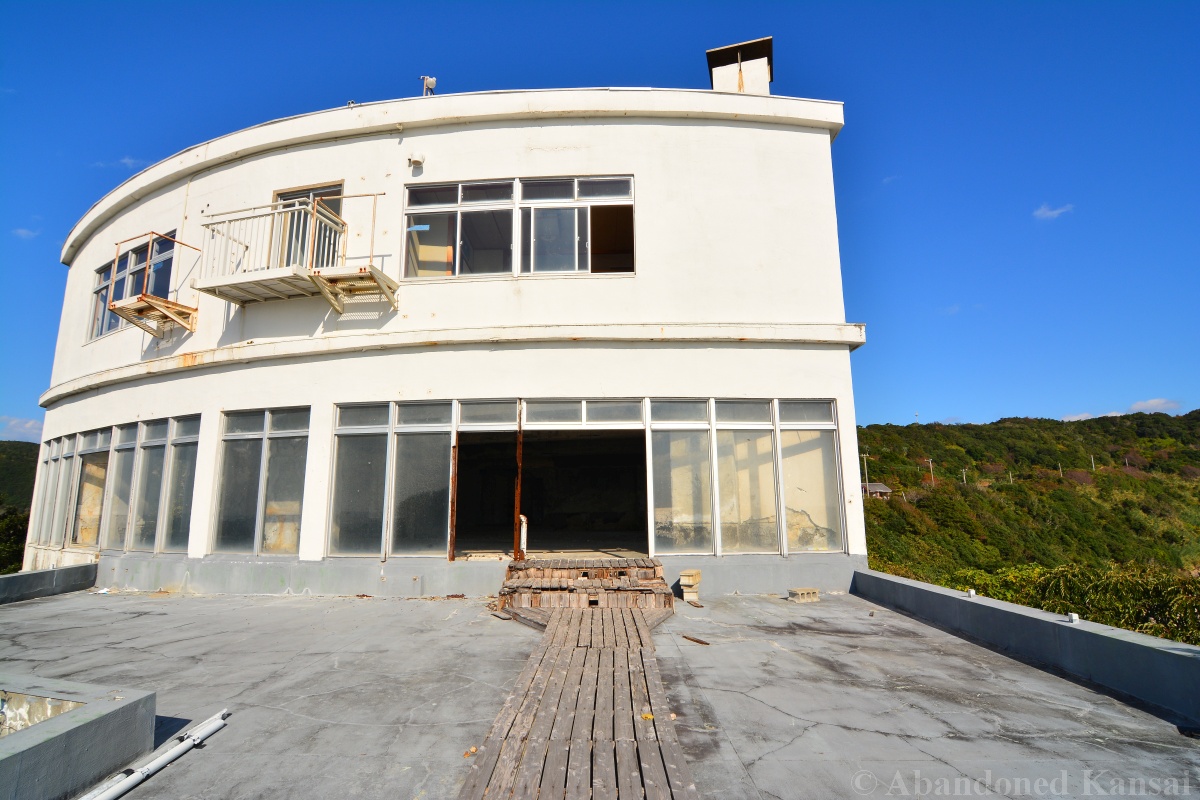
Abandoned hotels are a dime a dozen in Japan, but when it comes to location, hardly any of them can hold a candle to the Cape Palace! (Though there was some arson…)

The now abandoned Cape Palace was a luxury hotel built in the 1960s in southern Wakayama on the tip of a cape with gorgeous ocean views from all 44 guest rooms as well as pretty much everywhere else within the accommodation. It was famous for its various hot spring baths (including a rotenburo at the very tip of the cape, only accessible by passing through the whole hotel) and the seafood dinners – the hotel even has a small fleet of boats, so the guests could enjoy fishing trips.
There’s not much information out there about the Cape Palace, but it seems like it closed in 2011 when a typhoon hit the coast and caused massive damage to the almost 50 year old hotel, basically turning it into an economic total loss.
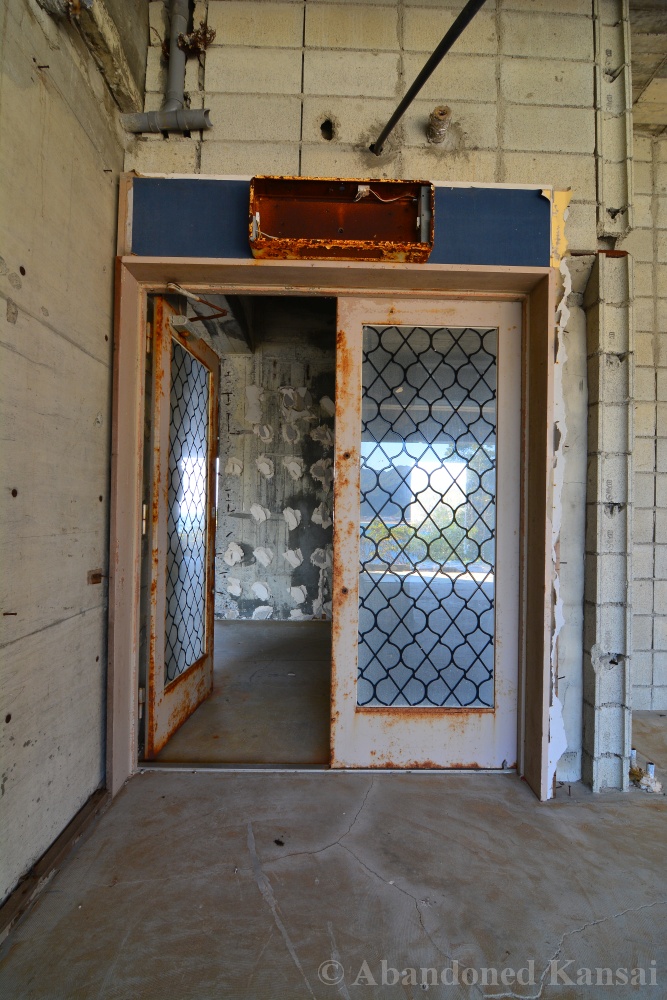
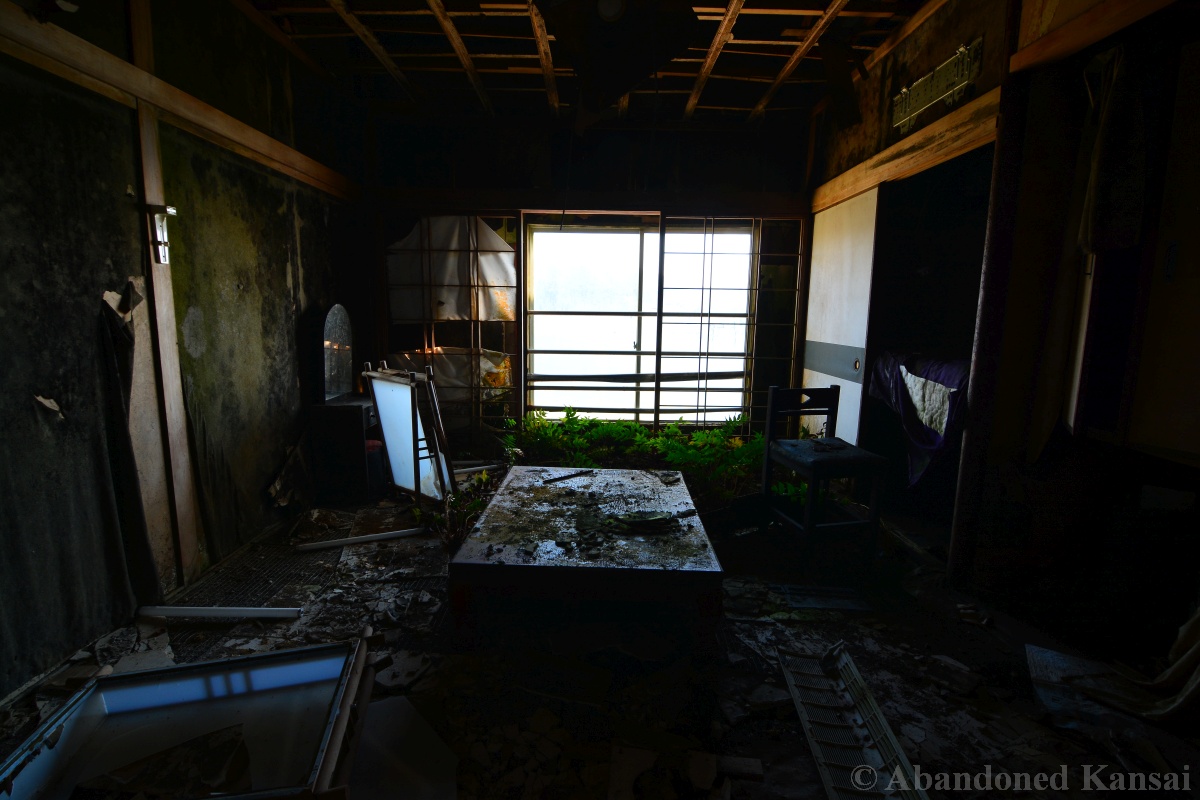
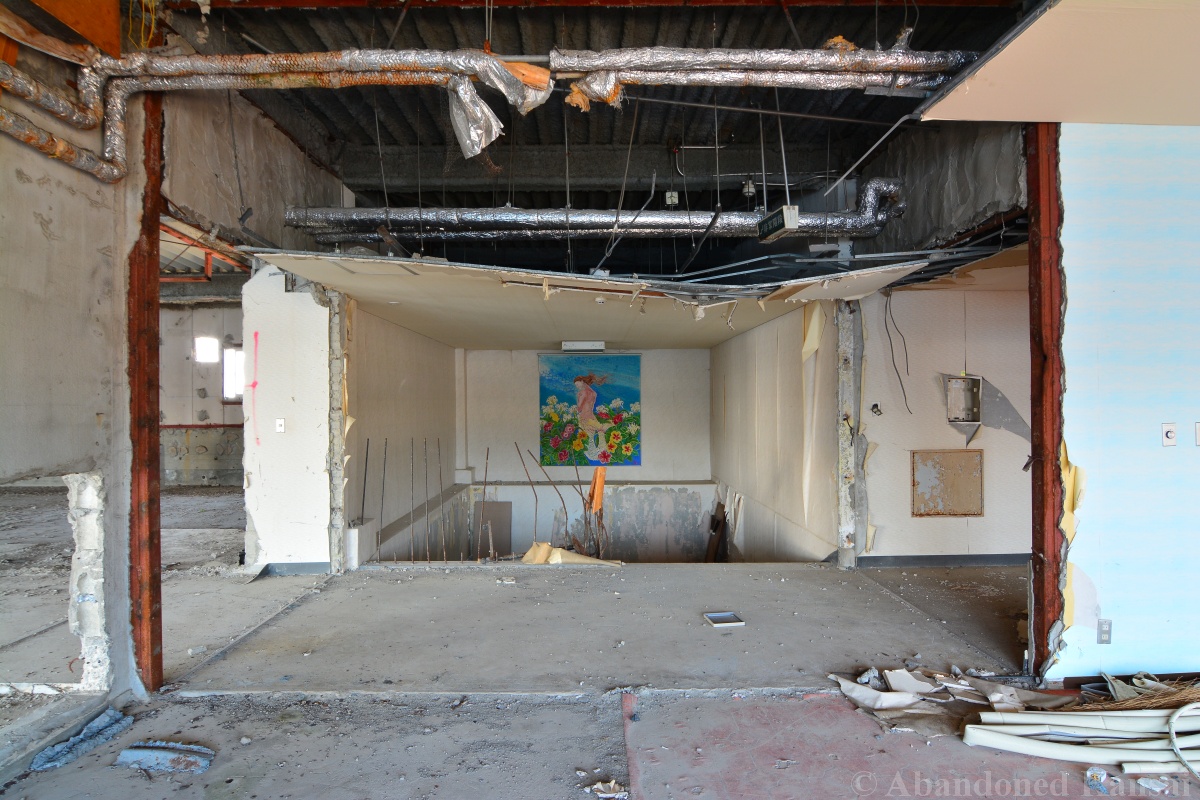
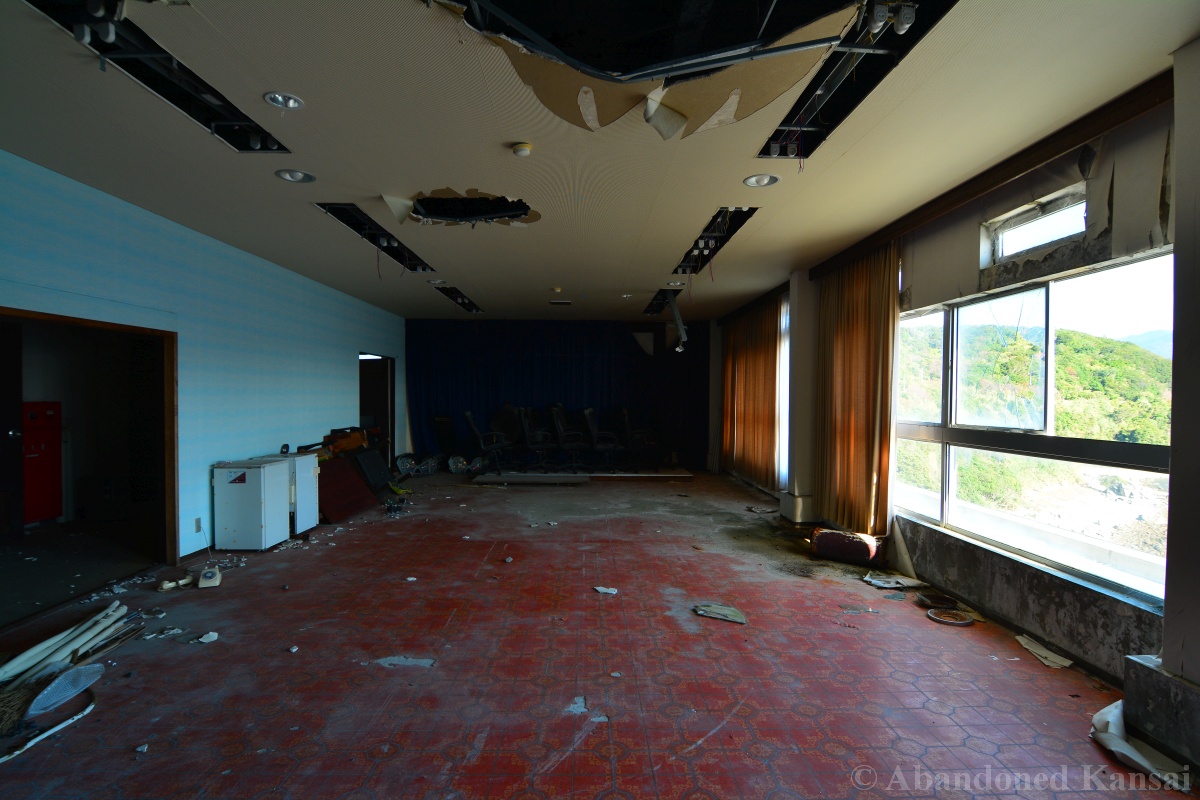
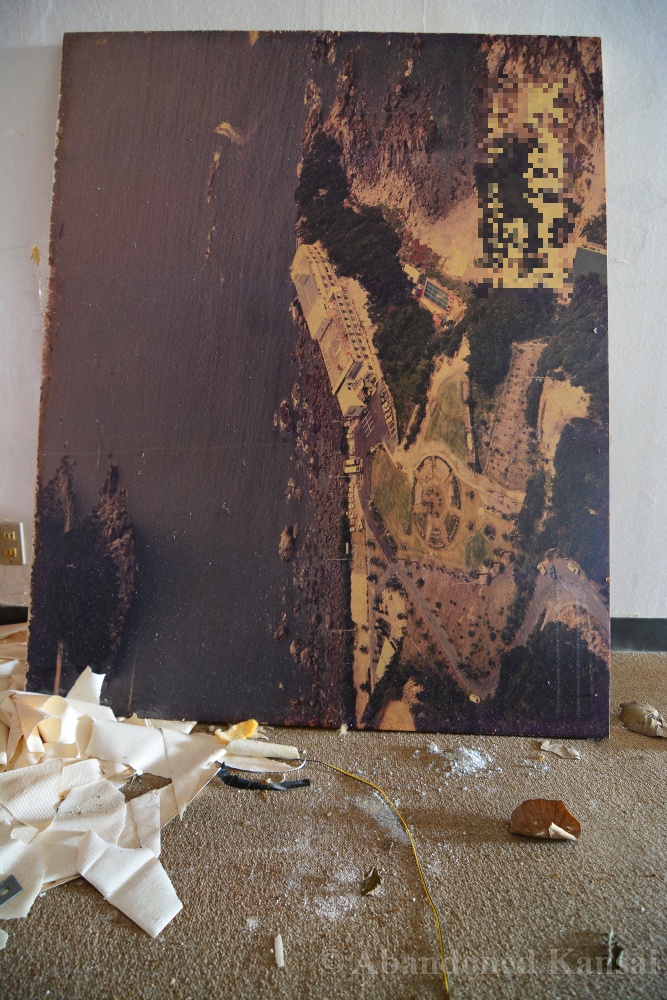
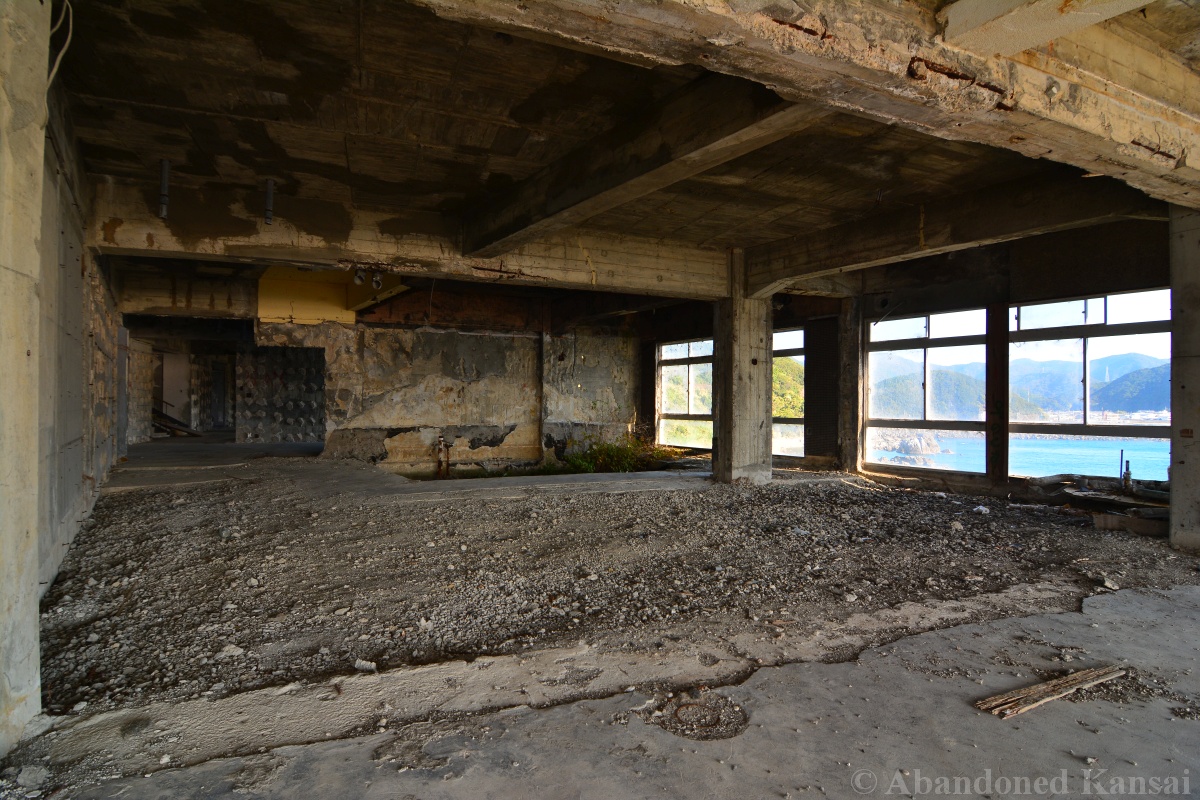
I first explored the Cape Palace back in 2015 as a day trip from Osaka with two regular explorer friends of mine. Access was surprisingly easy – we were able to drive up right to the front door… which was wide open. Since the hotel was located on a cape a bit off the main road, we were basically completely out of sight. To our surprise the ground floor had been completely gutted, at first we were not even sure if we had found a construction ruin or an abandoned hotel, especially since there was no demolition machinery outside, no signs of workers anywhere. The upper floor though made it pretty clear that the hotel had been in business before – plenty of rooms with the original interior and some cluttered ones with stuff from all over the hotel. The former party room still featured a large laser disc collection – I didn’t have a closer look, but most likely karaoke LDs. Right outside the hotel, at the bottom of the cape was a large beach. Not a nice sandy one, a pebbly one… so I guess the large outdoor pool next to it was quite popular with the hotel guest then. One of the rooms featured a large aerial shot of the hotel in its glory deal, if you are interested in what the setup looked like. (It also showed the long gone ground golf area – ground golf being a simplified version of regular golf, extremely popular amongst senior citizens in Japan; I’ve mentioned it several times before.)

Overall the Cape Palace was a nice and easy exploration, nothing spectacular though, except for the views. There was little left of the main interior, but I’m sure in 2010 the place had a very unusual retro atmosphere and something like two foreign guests a year as it was definitely off the beaten tracks.

(*Like Abandoned Kansai on Facebook* or *follow us on Twitter* if you don’t want to miss the latest articles and exclusive content – and subscribe to the *video channel on Youtube* to receive a message right after a new video is online…)
Read Full Post »

Old meets new and fails – only to be revived and remodeled years later. The unusual revival of the Wakayama Ryokan…

It’s pretty much impossible to predict which abandoned places become popular and which are hardly ever explored by the urbex community – similar to which places are vandalized regularly and which are spared.
When the Wakayama Ryokan showed up with the exact address on a big Japanese urbex site about six years ago I was convinced that it would be the next urbex hot spot in Kansai. Consisting of a modern hotel style building and a wooden traditional part full of nooks and crannies, the Wakayama Ryokan was the best of both worlds – and in almost pristine condition with hardly any signs of vandalism. Located on a slope overlooking a local harbor, the ryokan offered stunning views – and probably amazing seafood when it was still open.
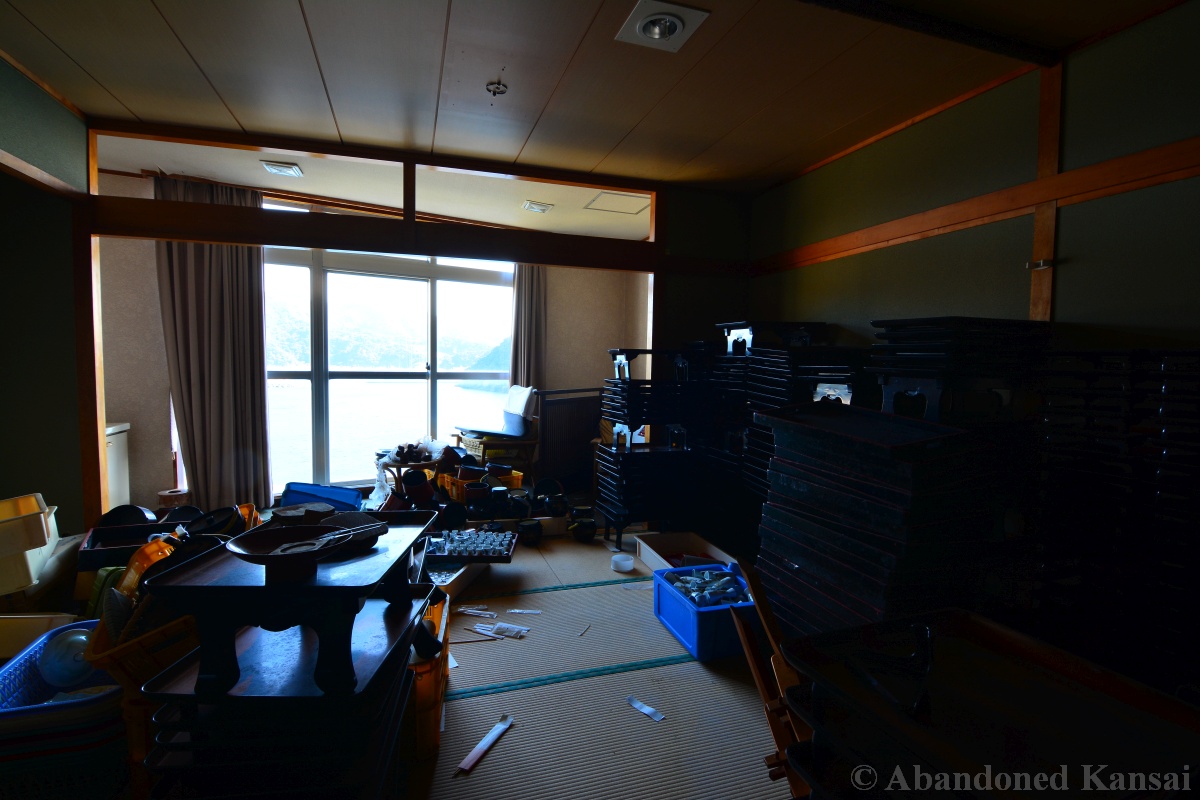
When I explored the Wakayama Ryokan more than five and a half years ago, I did it solo and didn’t pay attention to not film / take pictures of things that could be clues – probably because I never expected the amount of lurkers his blog attracts by now. But even back then I knew that I didn’t want to be the foreigner who spills the beans to an non-Japanese speaking audience, so I wrote about other places first… until I kind of forgot about it. Despite the fact that I enjoyed the exploration and was eager to share some of the photos – especially the wooden parts in the east and the norths were gorgeous, despite or maybe because first signs of decay. The modern part was still in good condition overall. Some signs of metal thieves and an emptied fire-extinguisher here an there, but overall in good condition. Some rooms were actually filled with packed boxes full of… stuff; most of it table ware and other typical ryokan items. But yet another reason why I didn’t want to drag too much attention to this wonderful location.
Fast forward to five years later, the spring of 2017. I was passing by the Wakayama Ryokan on the way to another location when I realized that the front featured several new wooden signs, announcing an “Art Station” to be opened in the summer of this year. Well, it’s autumn now, so I assume that this international art museum, bar, café, theater, inn, kiosk, music room, … is open to the public now – though given my experiences with Japanese schedules, I wouldn’t be surprised if postponed till spring 2018 or gave up completely.

Back in 2012 the Wakayama Ryokan was one of my first accommodations in really good condition – and I explored it solo, which is always equally nerve-wrecking and exciting experience, so this place holds a special place in my heart forever. Especially the traditional wooden part was as Japanese as it gets, which is why I published as many photos as possible, though I am sure it would look even more impressive edited down to 30 or even 20 picture – but I know that a lot of you out there like those “Japanese images”, so I hope you’ll enjoy the gallery overall.

(*Like Abandoned Kansai on Facebook* if you don’t want to miss the latest articles and exclusive content – and subscribe to the *video channel on Youtube* to receive a message right after a new video is online…)

Read Full Post »

You can’t always get what you want… Sometimes you don’t even get what you expect. In this case in abandoned school – which turned out to be an abandoned bungalow village…

Closed schools are a dime a dozen in Japan. About half of them are maintained for emergencies or local festivals, some have been converted into hostels or cafés. The rest, which I am after, is without supervision and slowly decaying or getting quickly vandalized. After exploring an abandoned hotel at the coast of Wakayama (soon to come to Abandoned Kansai!), my buddies Dan and Kyoko were heading to the mountains to explore said school… which not turned out to be what we expected. It was still there, but mostly locked and nailed up. Signs inside implied that it had been used as a café probably not too long ago – so did the roofed outdoor area in front of it, with countless tables and chairs. Since we came there in winter, maybe it was still used in the warmer months of the year? But most likely it was connected to the bungalow village above, consisting of about 30 huts. And while the former school was still in good condition (even still featured some hospitality related certificates and price lists on the wall), ready to be reopened as a restaurant or emergency shelter, the huts had suffered a lot more from the ravages of time and vandalism… and seemed to be out of use for much longer. But who knows, maybe people just showed the school more respect?
By the time we reached the school and the bungalows on top of a plateau in the mountains of Wakayama, the sun was already setting – and we couldn’t start exploring right away since we were followed by an old man in a kei truck, who obviously was suspicious of a car full of strangers from a strange city. So we parked the car and pretended to go for a walk, this was along the famous hiking trail kumano kodo anyway, while the guy was parking just a few meters from where left our car. After about ten minutes he had enough and drove away, costing us valuable daylight time…
The Wakayama Bungalow Village was another “better than nothing” exploration you probably won’t find on many urbex blogs, showcasing once again that there is indeed vandalism in Japan; especially when it can be done out of sight… The pool across the street turned out to be a pretty neat bonus, but overall the whole day was more about spending quality time with friends than exciting explorations. More about those hopefully soon again, when I have a little bit more time for elaborate articles as I am currently busy with a couple of… other things  – more about those soon, too! 🙂

(*Like Abandoned Kansai on Facebook* if you don’t want to miss the latest articles and exclusive content – and subscribe to the *video channel on Youtube* to receive a message right after a new video is online…)


Read Full Post »

What kind of places should be considered when doing urban exploration? I think everybody has their own definition – I try to focus on abandoned modern ruins, but every once in a while I make exceptions (security on site, historic ruins), especially when the situation is ambiguous. *Gunkanjima* for example could be considered both a modern and a historic ruin, probably as it is currently transitioning from a classic urbex location to a tourist attraction. Similar arguments could be made for *Okunoshima* and the *Nakagawa Brick Factory*; while the first has proper barriers and information signs, the latter is a historic ruin without historians taking adequate care of it.
Tomogashima and its old fort I always considered a historic ruin that shouldn’t make it to websites about abandoned places as it reminds me of the countless historic ruins back home: More than 100 years old, accessible by public transportation, proper barriers and information signs, mentioned in tourist guides, partly or fully maintained. If you include places like that, you could keep yourself busy writing about hundreds or even thousands of castles in Germany alone. BUT: Tomogashima appears on most Japanese urbex blogs and I receive messages about legal “urbex” spots in Japan on a regular basis, so I guess it’s about time to dig up six year old photos and long repressed memories…

Tomogashima is a small island off the coast of Wakayama, right between Awaji Island and the mainland, in the Kitan Strait (紀淡海峡, Kitan kaikyō) – the fort and its cannons were prtecting the Bay of Osaka with cities like Kobe, Osaka and Sakai as well as quick access to Kyoto and Nara. Well, technically Tomogashima is a cluster of four islands (Jinoshima (地ノ島), Kamishima (神島), Okinoshima (沖ノ島) and Torajima (虎島)) – and when people talk about Tomogashima, they usually refer to Okinoshima (shima / jima = island, hence Tomogashima, not Tomogashima Island); the only one that is accessible by public transportation and the one of most interest to tourists. Take the train to Kada Station (near Wakayama City), walk to the harbor and take a boat to the island – four connections per day from March till November (except Tuesday and Wednesday), two the rest of the year; with a handful of exceptions (for example Golden Week and summer holidays), of course – your can *find the detailed schedule in Japanese here*. 2000 Yen for the roundtrip isn’t exactly cheap, but you are going off the beaten tracks… and those places usually cost a buck or two extra.
The islands were originally used by Buddhist monks for a practice called shugendō (修験道) back in the seventh and eighth century (to develop spiritual experience and power…), but are now famous for their ruins of Meiji era (1868-1912) military fortifications and a beautiful lighthouse.
And while Jinoshima, Kamishima and Torajima are indeed uninhabited, Okinoshima has in fact a low population running both a camping ground and a guest house (including a café / bar!) called Uminoya, making Tomogashima by definition neither abandoned nor uninhabited, no matter how many people on the internet claim differently! I know, the truth hurts sometimes, but Tomogashima is / are NOT ABANDONED! (There are even four (!) public toilets on the island…)
As for the brick fort, I guess you can consider it abandoned, despite the fact that some people still take care of it – putting up information and do not cross this rope signs… But like I said, for my taste those ruins are too old, they are too empty, they have too much historical significance. They are mentioned in all kinds of guides, are too well-signposted and attract thousands of tourists per year. That has little to nothing to do with urban exploration… but I hope you’ll like the photos anyway! 🙂

When I made my way to Tomogashima back in 2010, it was much less popular than it is now, and I expected it to be really abandoned and full of spectacular military ruins – instead I found myself amongst tourists in what looked a little bit like an open air museum to me. In addition to that, the mid-July summer heat and humidity, the rocky paths and the fact that Okinoshima is a constant up and down quickly took a toll on me, so my expectations differed completely from reality.
Visiting Tomogashima makes a lovely day trip or even weekend trip though, when you know what you are in for – especially in summer! Okinoshima and Torashima are combined about three kilometers long, there are two signposted hiking trails and countless minor routes you can take, Okinoshima features several more or less rocky beaches, and you can actually learn something about Japanese military history. And if you are an anime fan, you might be excited to hear that Tomogashima reportedly inspired the Studio Ghibli movie “Laputa: Castle in the Sky” – though there are similar island all over Japan, so I wouldn’t bet on it without 100% verifying it…

Also, if you are interested in touristy urbex spots, you might want to have a look / keep an eye on the irregularly updated *Urbex for Tourists* special here on *Abandoned Kansai*!

(*Like Abandoned Kansai on Facebook* if you don’t want to miss the latest articles and exclusive content – and subscribe to the *video channel on Youtube* to receive a message right after a new video is online…)
Read Full Post »

Finding abandoned places is 95% hard work in the form of long hours doing research – and 5% luck; unless you count the limitless amount of dilapidated and rather uninteresting shacks you pass by driving around the Japanese countryside. Then the ratio is probably more like 50/50…
The Wakayama Beach Hotel was one of those 5% lucky finds. An amazing find actually, and it became my favorite abandoned hotel instantly. In spring of 2012 I was on a day trip with a friend of mine from Germany, Dom, when we saw this rather big hotel somewhere along the nearly endless coast of Wakayama prefecture. Abandoned or not? That’s always the exciting question after discoveries like that. The front of the hotel looked like it was just closed for lunch break, but something was strange about the building; for example the fact that hotels usually don’t close for lunch. They are either open or not. So I decided to have a closer look at the back of the hotel, where we ran into a woman walking her dog – since all of us were still on public ground, more or less, we exchanged greetings and went separate ways. From the back Dom and I were able to have a look at the heating room through an open window and at a small greenhouse-like garden over a wall – both looked like they had been abandoned years ago. A pristine, but shut down hotel building on the one hand, an unkempt garden on the other. This was a strange case. At the back of the hotel was also a scary spiral staircase, not really up to modern security standards. Luckily it was Dom’s first urbex experience, as noobs tend to be braver – or they are scared to pieces, but it turned out that Dom belonged to the first group. Before I could even think about it, he went to the closest emergency exit door, grabbed the handle, turned it and… opened the door! I wasn’t surprised that emergency doors were unlocked, I just didn’t expect that they could be opened from the outside…

Seconds later Dom and I were inside the Wakayama Beach Hotel, bright light shining through windows to the left, a rather dark hallway with guest rooms to the right. Since I didn’t have a flashlight with me, the choice was easy: we headed left first. Another turn to the left and I knew we hit the jackpot as we entered an entertainment room with dried out plants – as well as two billiard tables, a table tennis plate, some toy vending machines and half a dozen video game arcade machines. This was so awesome and I was 99% sure that the place was abandoned, until… I heard a strange BANG! A friggin cat outside was hitting her damn tail against the window, almost giving me a heart attack.
From the entertainment room I headed over to the public baths. Both the male as well as the female versions were in almost spotless condition – sweep through and replace the dried out plants with fresh ones and you would be good to go. Same with the rooms along the dark hallway. A couple of minutes of dusting and voila, you’d be able to welcome guests again. Since I didn’t bring a flashlight I was unable to take photos in most of the rooms as it was too dark for my camera to focus – and the videos turned out to be dark and grainy and a bit blurry, too; sorry for that, but it might help you understand how I felt wandering through this spooky, unknown territory. As exciting as it is to make an original find, it’s also nerve-wrecking as you don’t know anything about the place – the layout, the security status, the biohazard lab in the basement… And the next shock followed soon, when I realized that the red emergency light near the fire hydrant in the hallway was still burning! One element of a building being abandoned is that nobody feels responsible for paying the electricity bill – and when nobody pays the electricity bill, usually the power gets cut. But according to several calendars in the kitchen and other places, the hotel wasn’t used anymore for at least three years… yet there was still power, at least for the HAL-like lights.
That in mind Dom and I went downstairs to the ground floor, with its lobby, a bar stuck in the 70s and a gift shop – and an irregular sound in the background, as if two pieces of wood were hit against each other. It was spooky, especially when I saw a cat running across the room and down the small staircase to the basement. I totally fell in love with the bar area, so I took a couple of photos there, but that clicking wooden sound started to drive me nuts!

When Dom and I finally left the Wakayama Beach Hotel we had spent more than two hours there, constantly changing our minds whether this place was really abandoned or just closed – which didn’t really matter in the end, as urban exploration is one big grey area in that regard anyway; the hotel was definitely out of use for several years. (*Nara Dreamland* and tons of famous “abandoned” places all over the world still have security, which makes them “not abandoned” by definition; if they were, nobody would pay for security…)
Over the past four and a half years I’ve been to several abandoned hotels in really good condition, but what made the Wakayama Beach Hotel so special was its amazing 70s style lobby, the beautiful shared baths and of course the entertainment room with the arcade machines – the whole hotel had this exciting vibe of several past decades, but in almost new condition, as if it was time-warped to 2012; with its own power source for the HAL lights…

(*Like Abandoned Kansai on Facebook* if you don’t want to miss the latest articles and exclusive content – or subscribe to the *video channel on Youtube* to receive a message right after a new video is online…)

Read Full Post »

After *a surprisingly successful recent exploration in China* it’s about time to write about a surprisingly unsuccessful exploration in Japan I did 3.5 years ago.
On a nice spring day I made my way to Wakayama prefecture to check out the Kuratani Onsen, which had a reputation for being one of the most beautiful abandoned onsen in all of Japan. The next train station was about 1.5 hours away, but I didn’t mind the walk towards one of Wakayama’s gorgeous mountain ranges. Along the way I saw a small abandoned house, emptied, windows smashed – rather uninteresting, despite me being rather inexperienced back then. Probably somebody’s weekend home in the 1990s.

A few minutes later I finally reached the Kuratani Onsen… and I was shocked by its condition. Parts of the building complex were collapsed, probably under the weight of snow in the winter – the downside of unmaintained wooden buildings, gorgeous as they usually are. The rest was trashed beyond believe. But not just vandalized, filled with trash up to my knees in parts. It’s generally amazing how much garbage you find in remote areas in Japan as waste disposal can be quite expensive in the land of the rising sun. But what kind of person would drive to an abandoned building and get rid of their trash there?
Not only was the whole place nasty because of it, the trash also attracted all kinds of animals – spiders, flies, bugs; probably some rodents, too. This was probably the most disgusting abandoned place I’ve ever visited – and since it was before my “jeans and hiking boots even in summer when doing urbex” habit, I didn’t even try to make my way across all that garbage. Instead I took a path on the right side of the building to make it to the upper floor, smashed to pieces and probably not safe either… The metal entrance part was already too rusty for me to trust it on a solo exploration. And so I left with a couple of crappy photos after about half an hour. Not my shortest exploration ever (that title still belongs to the more or less failed *Sekigahara Menard Land* snow expedition earlier the same year), but probably one of the most disappointing ones.
And that’s pretty much it… One man’s trash is another man’s treasure, so I hope you were not too disappointed by this week’s article (though I wouldn’t blame you, but not all of my explorations are spectacular, so sometimes I have to write about duds, too) – but if you were, you might consider *liking Abandoned Kansai on Facebook*. Especially in weeks with an unspectacular location I upload some exclusive preview material there – the photos scheduled for later this week will show you some amazing locations that I’m sure you will like as much as I do!

Read Full Post »

After about a dozen *haikyo* trips all on my own I took a dear friend and colleague to the Iimori Mine in Wakayama. Doing urban exploration on your own or going with somebody are completely different experiences with both advantages and disadvantages, so I was a bit sceptical at first – but now I have to admit that I prefer to go with company. Especially since Enric and I complement each other very well.

When we arrived at the Iimori Mine we were surprised to see that our destination was located in a beautiful mountainous area with lots of orange groves. Yes, orange groves. In the middle of the mountains. In Japan. In December! Stunned by the gorgeous nature we walked around for a while exploring the groves and looking for alternative ways to get to the mine: The straightforward entrance was blocked by a company and closed off by a barbwire fence to a water canal – at least we thought so…

We went up a hill and after an adventurous climb along a steep slope we made it to the second highest level of the mine ruins. There it turned out how good it is to have a partner who complements you. While I’m more of a planner who hasn’t climbed over a fence or even wall in about 20 years, Enric was totally fearless finding a way through the forest up the hill. I guided Enric to the mine, he guided me in.
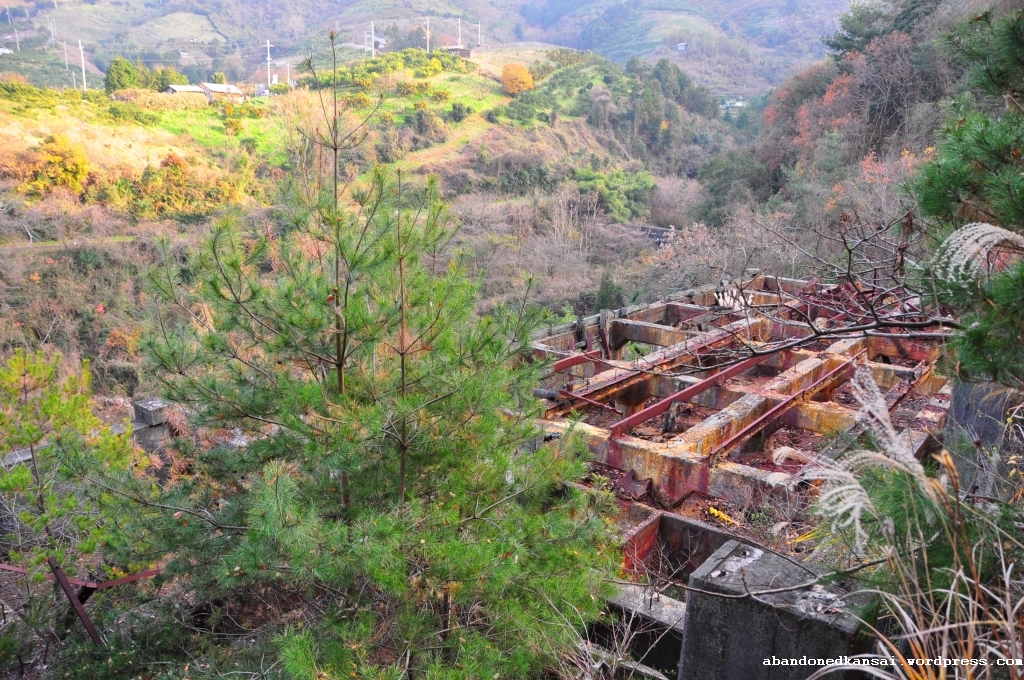
If you like taking pictures of rust and concrete Iimori Mine is the place to go! The amount of great subjects is almost endless and shooting took us quite a while. On the way back we had to get further up again and that’s how we made it to the top part which offered a stunning view down the valley. By that time it was already afternoon and since the sun goes down rather early in Japan we decided to call it a day.

But the fence bothered me… Since we only reached the upper parts of the mine I wanted to have at least a quick look at the barbed wire fence – which turned out to be a good idea since the fence not only had a gate without barbwire, but it ended 30cm before it reached the water canal – so you can easily walk around it! Another example of great Japanese planning… For once not being afflicted by it, we took our chances and entered the lower part of the mine although the sun was already setting.

While the upper part was all about concrete and rust, the lower part was more about concrete and jungle. The vegetation there was pretty thick even in the middle of winter and at a certain point I had to give up to advance further – partly because of the climbers and trees, partly because it was actually getting dark.

When I looked for historical information about the Iimori Mine on the internet I was disappointed to find barely anything. No longer texts, no pictures. All I know is that it was an iron sulphide mine opened in 1878, bought by Furukawa Mining in 1918 and closed down in 1970.

Overall the Iimori Mine is a great urbex destination. Beautiful location, completely different looks depending on the way you approach it and an endless amount of pictures to be taken. On the downside there are no real buildings left – just a wild construction of concrete, metal / rust and (partly burned) wood. (Even vandals spare the place since there is barely anything left to be destroyed without a serious amount of dynamite.)
In case you are an urbex newbie going on your own, I would recommend to gain some experience first – the Iimori Mine is a dangerous place and should be approached with respect. Especially in summer, when it seems to be infested with snakes…

Read Full Post »