Feeds:
Posts
Comments

Archive for the ‘Kagawa’ Category

I’ve been urbexing for almost 15 years. During that time I’ve never written any articles about equipment, despite being very happy with three different Nikon DSLRs, two Manfrotto tripods, and a Sanyo video camera – which broke in 2019 after almost 15 years of recording countless hours at hundreds of locations as well as places like Chernobyl and North Korea. Videos I always considered a bonus anyway… and I’m still having a hard time thinking of myself as a photographer, given that I have no formal education in that field and only do it as a hobby. A really time-consuming hobby, but nevertheless just a hobby. I also don’t have a background in technology, so what’s the point of reviewing camera equipment when I just have an opinion based on learning by doing? Well, that doesn’t keep countless “influencers” and Youtubers from churning out incompetent nonsense, but I wouldn’t want to be found dead with either label on me! And like my favorite professor at university once said in regards to papers we had to hand in: “Don’t claim anything you can’t proof!”

Fortunately there is no need to be technical or scientific about this Insta360 X4 article, because unfortunately we never got that far…
Like I said, I always considered video walkthroughs of the locations I explore a bonus. I started them pretty much right away, but at first I didn’t even publish them, because I only took them for myself. And even when I published them, I didn’t edit them. No cuts, no voice overs. Just me walking around breathing heavily into the silence. That all came to a sudden halt when my Sanyo stopped working after exploring the abandoned *Trump Hotel*, also wiping out the recordings of the whole day. At that point I was tired of doing the videos anyway – and my co-explorers were increasingly annoyed, because I added 10 to 30 minutes at the end of every exploration for the walkthrough. So I stopped doing them.
For the past 18 months I’ve been exploring solo again (don’t ask, it’s complicated and often quite frustrating, to be honest), but a few weeks ago a colleague of mine showed me an older model Insta360 video camera that a visiting cousin from the States forgot at his place in Japan. I was fascinated by the easy to use 360 photos and videos, so I did some research and decided to get one. I’ve read reviews, I’ve read product pages – I did my best to make an informed decision, because at first I considered buying the X2 or X3 as older models often are cheaper with only slightly fewer / worse features. The X2 was out of the race when I read in a review that it required a smartphone to be activated – something I didn’t read anywhere about the X3 and X4. I guess because it’s an idea that is so stupid that it probably was a one-time mistake by Insta360, facing so much backlash that they removed the requirement from following models. The price difference between the X3 and X4 wasn’t very big and since the latter was only four weeks old at the time, the price on Amazon and in brick and mortar stores was the same, so I decided to get it at my local Yodobashi Camera (street block sized electronics stores with hundreds of employees each, in case you are not familiar with the chain), where I’ve been a customer for almost 18 years – ever since I moved to Japan.
BIG MISTAKE!

Yodobashi Camera was extremely stingy, giving only 1% points on the video camera, despite a promotional campaign of giving 13% points for purchases over amount X – except for (small print)… But when you shell out 80k Yen on a new video camera you are looking forward to use, store points are the last thing you worry about anyway. Fortunately I still had some of those points, which I used to get a seriously overpriced MicroSD card, because without it the video camera would be useless and I wanted to try it out on the weekend before an upcoming urbex trip. 83500 Yen poorer, but with a big smile on my face I left Yodobashi Camera on a Friday evening after an otherwise pretty horrible week.

Saturday was supposed to be a great day, though it started with a rude awakening / realization…
After sleeping in and having a delicious breakfast, I enjoyed a nice unboxing. The first slight disappointment was when I realized that the included battery was dead. Well, not dead dead, but completely empty. Whatever, an hour or two wouldn’t make a difference. It would not dent my great mood for sure. That came a few hours later when the battery was fully charged. I booted the small brick for the first time, its screen came to life, asking me to choose a language – and then the screen showed what the camera was seeing… for about a second or so. Then some text popped up and my heart sank. You gotta be kidding me! What I was looking at was a screen telling me to download an app by Insta360 to a smartphone, iOS or Android, to unlock the video camera. What. The. Heck? I literally felt it in my fingers how my blood-pressure exploded, because unlike pretty much every person on the planet above the age of 6 years I don’t own a smartphone. Never have. In the late 90s I had a black and white Nokia for work (yes, I’m not the youngest anymore, though I started working full-time in my early 20s). When I moved to Japan I had a flip phone or two, but for the past 15 years or so I didn’t have any mobile phone at all, smart or not, because I don’t like them as they turn way too many people into dumb zombies. So here I had a brand-new, quite expensive video camera… that forced me to make it usable by using another device with cameras? Who comes up with stupid ideas like that?!
Certainly not Nikon! Their D7500 DSLR I bought just weeks prior worked with a partly charged battery and regular SD cards straight out of the box 5 minutes after purchase – without any charging or unlocking BS!
So I started to do some research… and didn’t find much. Like I said, I couldn’t care less about smartphones, apps and all that stuff, so I tried to find a solution to unlock the darn X4 via PC or MicroSD card. Of course I couldn’t find anything about that either, so I contacted Insta360 directly – who apparently didn’t read my message and instead sent me a standard reply. So I got back to them, apologized for not describing my problem properly (I’ve been in Japan too long…), and this time got an answer that at least implied that they understood the situation I was in – without being able to help, because though it seems to be nowhere stated on the box, the promo material or even on the X4 website (at least back in mid / late May, maybe they changed it by now)… you really need a smartphone and the Insta360 app to use a newly bought X4 video camera, that seems to work perfectly fine, but is made not usable on purpose by the manufacturer. Which absolutely blows my mind!
How is that even legal?
How can a company force you to use a completely unrelated piece of expensive technology that actually partly does the job of the product you just bought, to make your purchase usable? Without mentioning that essential detail with big warnings before purchase! And in addition, forces you to use an app, which does who knows what in the background without one knowing?
What’s next? You need an electric bike with WiFi to unlock your newly bought car? And if you don’t… sucks to be you, it’s completely useless!

Yodobashi Camera – (The Lack Of) Customer Service In Japan!
After some back and forth it was Monday and I came to the conclusion that I won’t be able to use the Insta360 X4, because it really needs a smartphone to unlock, which wasn’t properly communicated. So after work I went back to Yodobashi Camera, my go-to electronics store for the past almost 18 years. Never had a problem with them, because all the products I bought worked as intended right out of the box. So I went back to the cashier counter where I bought the video camera… and already ran into the first minor bump in the road – apparently I hadn’t paid for it in the camera department, but a neighboring one, which wasn’t a problem on Friday evening, but very well on Monday evening. So I went 20 meters over to the camera department and told them about my unfortunate situation: That I had bought this video camera three days prior, but couldn’t use it, because it doesn’t work without a smartphone, which wasn’t properly communicated by Insta360 or Yodobashi Camera. But I was very careful with everything, I didn’t even remove the protective film from either of the lenses. Some air through the teeth sucking, some going back behind the counter to talk to a superior and then something like the following conversation – it’s in quotation marks, but they are not really quotes, you know… just something like that, from memory:
“I can’t sell this anymore, you opened the box. You can’t return it.”
“But I can’t use the video camera.”
“I can’t sell this anymore, you opened the box. You can’t return it.”
“I don’t have a smartphone. The X4 is useless to me.”
“I can’t sell this anymore, you opened the box. You can’t return it.”
“I did proper research and I only found out about this after I opened the box and tried to use the X4.”
“I can’t sell this anymore, you opened the box. You can’t return it.”
“I bought a D7500 last month, it worked out of the box…”
“I can’t sell this anymore, you opened the box. You can’t return it.”
“Then take it back and ask Insta360 to exchange the X4 – you have dozens of them here, you probably have to return one once in a while anyway.”
“I can’t sell this anymore, you opened the box. You can’t return it.”
“Are you serious? I’ve been a customer here for almost 18 years, spent millions at your store and other ones in the building that has your name. Never had a problem – and the first time I have, you are stonewalling me?”
“I can’t sell this anymore, you opened the box. You can’t return it.”
“Really?”
“I can’t sell this anymore, you opened the box. You can’t return it.”

At this point I gave up and exchanged a few more e-mails with Insta360 (“You should try to return the X4 where you bought it!” No kidding…), but their responses quickly became as useless and repetitive as the one of the guy at Yodobashi Camera – who is just a small cog in a big machine, so I don’t blame him; he’s punished enough with the lighting in the store and the uniform he has to wear all day.
So here we are, after me falling for the usual misconception about (customer) service in Japan, because I rarely ever had a real problem anywhere. It’s great as long as everything is within procedures – if somebody has planned for it, it most likely will go smoothly. Service is great. When service becomes customer service though, i.e. an individual customer needs help that requires improvisation outside of the planned service… you’re basically on your own. The only thing flexible in Japan is bamboo.

Nevertheless I still have moments when I wonder: AITAH?
I’m a huge believer in personal responsibility. If I make a mistake, I stand by it. I find behavior like ordering 20 items of clothes in different sizes and colors with the intention of sending 18 of them back despicable. In fact I’ve never sent anything back that I’ve ordered online, except for two USB-HDDs – and only because they didn’t work. I don’t do fast fashion, I don’t buy garbage from questionable sites like Shein oder Temu, I don’t replace electronics unless they are broken. (RIP, Nikon D7100!) I did due diligence before buying the Insta360 X4 and to this day everything in that (opened…) box is in mint condition. If I would have known about the smartphone requirement, I wouldn’t have bought the X4. It’s the reason why I didn’t buy the X2.
This is actually only the second time that I tell this story to anybody, because part of me is a bit ashamed that this series of unfortunate events happened – despite all the research before buying. But spending more than 80k on a useless brick of tech isn’t exactly something to be proud of. I don’t regret much in my life, but buying the Insta360 X4 I regret. And buying it at Yodobashi Camera is something I regret, too. Maybe Amazon would have been more accommodating with returns…
But I guess it is what it is – only money in the end. And no videos for Abandoned Kansai in the future. Heck, even if I would get the currently useless X4 to work, I would always be reminded of this story. Screw video cameras! Never was a fan, now I dislike them almost as much as smartphones. Which kind of closes the circle. But I’ll make sure to never ever even consider buying anything from Insta360 again – I still don’t understand how it’s even legal that they can do this. What’s next to unlock their cameras? Having to send them a voice message, swearing loyalty to Winnie the Xi(thead)? Apparently they can do anything without people questioning it…
I went back to Yodobashi Camera once more though, two days ago. I spent the remaining shop points I had on presents for my nephews without having to pay a single sen – my goal was it to hit +/- 20 points/Yen, but going to exactly 0 was priceless – and so I left the Yodobashi Camera building one last time with a big smile on my face. Upon arriving back home I cut up my loyalty card after almost 18 years. It probably doesn’t mean much to a large store chain like that. But it meant a lot to me!

Thank you for reading till the end and… What has your worst experience with Japanese (customer) service been? Write it in the comments!

(*Like Abandoned Kansai on Facebook* or *follow us on Twitter* if you don’t want to miss the latest articles and exclusive content – and subscribe to the *video channel on Youtube* to receive a message right after a new video is online…)

Read Full Post »

About four years ago there was a brief period of time in which there were three abandoned New Zealand themed parks in Japan; in Kagawa, Hiroshima and Yamaguchi – and to the best of my knowledge I am the only urban explorer to visit them all. One of them even twice…

There are many reasons to revisit abandoned places. At some I run out of time, so I come back to see more. At some mother nature prevents a full exploration with lavish vegetation in summer or snow in winter. Some I fell in love with and want to enjoy again. And then there are those nearby places I shoot several times in different seasons just because they are there and I have nothing better to do. The *Shikoku New Zealand Village* (in Kagawa prefecture) though I revisited for several reasons, despite the fact that I had been there just half a year prior: Different seasons (March vs. September), there was construction machinery parked nearby during my first visit, during summer I bought a toy drone that I wanted to try at a suitable place, and my friend Chris from New Zealand was interested in going – so we went.

Exploring a location a second time is equally different as exploring it with a friend. Exploring the Shikoku New Zealand Village a second time with a friend almost made me feel like coming home, showing him my old neighbourhood. (If you haven’t read the *article about my original exploration*, I recommend doing it now as I won’t repeat certain information in this article.) This time we entered straight away without scouting the perimeter, heading through a park like area straight to the barn – which was actually accessible this time. And people say there is no vandalism in Japan… Anyway, while I was still taking pictures inside, Chris headed towards the back of the barn where he found something I had overlooked the first time – a small museum like the one at the *Yamaguchi version* right next to what I assume was the sheep show; including information about different kinds of breeds. One of them was called “Romney”, which probably isn’t that funny anymore now, but 3.5 years ago, at the time of my visit, good old Mitt was running for president of the United States, so this made me chuckle at least a little bit.
From the small auditorium we continued to the little kart track and then deeper into the park, to the souvenir shop / restaurant called Oakland, with the landslide in front of it. (If you read the previous article, you know what I mean!) And to my total surprise… the landslide was gone! Right in front of the building was a brand-new road with a freshly secured slope, including a low fence. Now, why on earth would anybody repair a road at an abandoned themed park? We had no idea, so we continued to explore the park. Well, Chris explored, I just took some more pictures of the same old… and a video walkthrough of the Oakland House, which was accessible this time, too. Speaking of videos: Thanks to the nearby model plane airport I was able to fly my toy drone without making much extra noise, but the combination of me being a horrible pilot and the weather being overcast by the time I started filming created some barely watchable videos of which I chose the least eyesore one. It doesn’t have sound for obvious reasons… and the video is a bit choppy. But hey, what do you expect from a cheap five year told tech toy in this day and age? (Drones in general are not really urbex compatible, even modern ones with good or optional cameras – indoors they are hard to navigate and the rotors blow everything up / away, outdoors they tend to catch the attention of people passing by…)

And that’s pretty much it. Chris and I had a good time exploring the Shikoku New Zealand Village (again), and I was prepared to go back for a third round, but that never happened. Recent updates of the GoogleMaps satellite view though show that the construction work on the premises continued. All buildings except for the entrance and the Oakland House have been demolished, the pond has been drained, lots of vegetation has been removed, the ground levelled – the Shikoku New Zealand Village now is a huge solar farm… (And so is the nearby model plane airport!)

(*Like Abandoned Kansai on Facebook* if you don’t want to miss the latest articles and exclusive content – and subscribe to the *video channel on Youtube* to receive a message right after a new video is online…)

Read Full Post »

Japan is a linguistically and culturally extremely homogenous country. Of its 127 million inhabitants about 98.5% are ethnic Japanese, 0.5% are Korean and 0.4 are Chinese – leaving a whopping 0.6% others; including yours truly. Those 0.6% “others” include about 210.000 Filipinos, mostly of Japanese descent, and 210.000 Brazilians, also mostly of Japanese descent – which means that only about 0.3% of Japan’s population are neither Japanese, Chinese, Korean, Filipino-Japanese nor Brazilian-Japanese.
I’m sure you’ve heard the term gaijin before (外 gai = outside, 人 jin = person), a short version of the term gaikokujin (外国gaikoku = foreign country, 人 jin = person). People are still arguing if it’s pejorative term, but personally I don’t like it very much, because it’s such a simple term, pushing everybody who is not Japanese to the outside – which is a precarious thing in a country where a group is still so much more important than an individual.

Integration?

Becoming a foreigner in Japan is actually an achievement by itself. Japan isn’t eager to let many people in and therefore the requirements to get a long-term visa are rather high – usually you have to have either a Bachelor’s degree or several years of work experience; in both cases an employer has to vouch for you. Other possibilities are investor visas or some kind of artist visa, but there quite a bit of cash is involved; and so is with the spousal visa… 😉
Once in the country the Japanese government couldn’t care less about you as long as you renew your visa when it expires and pay your taxes – and those are usually handled by the company you work for anyway. While there are long and public discussions about integration in European countries there is zip in Japan. Language classes and tests? Bah, humbug! On the other hand you shouldn’t expect anybody to be able to speak English anywhere, despite the huge English school industry in Japan; especially at the immigration office, where you can address the staff in English as much as you want – they’ll always reply in Japanese, even though most of the time they obviously understood what you’ve said…
But Japan in general isn’t set up for integration, probably because of the educational system. You have your childhood friends, you have your high school friends, you have your university friends and you have your work friends – usually four different groups that keep you busy for the rest of your life; with no need to make additional friends at any point; or many opportunities for that matter, like community colleges or sports clubs, both extremely popular in Germany, especially after moving to a new area. (With the result that many foreigners in Japan stick with each other, too – I don’t think I know any foreigner here who has more Japanese than foreign friends; and by that I mean friends, not Facebook acquaintances…)

Xenophobia?

With that few foreigners in the country and that strong of a national identity I am still not sure if Japan is an above average racist country or not. People are definitely more polite in general than let’s say in my home country Germany (sorry guys, but certain things really are better in Zipangu…), especially in everyday service situations like shopping, but I experienced some of the weirdest behavior here, probably because hardly any Japanese school kid has foreign co-pupils, while I went to school with people of Italian, Austrian, Indian, Pakistani, Turkish, Japanese, British, Polish and Bavarian descent – and because the average Japanese person doesn’t think that you can understand what they say.
Sometimes they most likely mean no evil (like that one time when I had a dinner date with a Japanese girl at an Indian restaurant and all of a sudden all the tables around us talked about their oversea vacations, their foreign alibi friends and how great it would be to be able to be fluent in English…), sometimes I’m not sure (remember me *not getting a hotel room after the clerk found out that I’m a foreigner*?) – and sometimes they actually do mean harm. For example that young Japanese couple and their two friends who have beaten a Nepali restaurant owner to death in January 2012; one of them were quoted afterwards “I thought the foreigner had shoved me, so I got angry and kicked him many times.” (Note the use of “foreigner”? I’m sure it was “gaijin” in the original… Not “the man”, or “the Nepali” – “the foreigner”…)

Discrimination

It’s just a completely different mindset regarding foreigners and discrimination in general – and most people don’t even question it, because to them it’s normal. Like most countries Japan has a long history of discrimination. It even went through a time when a social class system with all its downsides was officially established; during the Edo period (1603 to 1868). Back then the burakumin (a.k.a. eta, “an abundance of filth”) were the outcasts and usually connected to jobs dealing with public sanitation or death (butchers, tanners, …), but when the class system was abolished the discrimination didn’t end. More than 100 years later, in 1975, there was a huge scandal when an anti-discrimination organization found out that a company in Osaka sold copies of a handwritten 330-page book listing names and locations of former burakumin settlements. Companies bought that book to compare the listed locations with the addresses of applicants – to prevent them from hiring descendants of burakumin; some famous firms like Daihatsu, Honda, Nissan and Toyota were among those companies… Two generations later the issue finally is no more, instead the average Japanese “discriminist“ focuses on foreigners – and I am so tired of and annoyed by comments about “those dog eating Koreans” or “those Chinese comfort women who try to screw the Japanese state”… (“Comfort women” is a Japanese euphemism for the sex slaves of the Imperial Japanese military in World War 2. While some (Japanese) historians like Ikuhiko Hata claim that there were 20.000 volunteer prostitutes, others found that up to 400.000 women were hired under false pretenses or even kidnapped into “comfort stations” all over Asia; but even the “few” volunteers made a bad choice as about 75% of the comfort women died during the war due to mistreatment and diseases. Shinzo Abe, the current Japanese prime minister, claimed during his first term in 2007 that the Japanese military didn’t keep sex slaves during WW2, although the government admitted to the fact in 1993 after decades of denial!)

New Zealand Village

Despite their share of xenophobia the average Japanese seems to love to travel and is actually interested in experiencing foreign countries; especially non-Asian countries… They barely ever jump all in, backpacking all by themselves – more like group vacations with Japanese speaking travel guides. Or an even safer version: themed parks in Japan! Recently I wrote a vastly popular article about the *Chinese themed park Tenkaen*, but in spring I was able to visit the rather unknown *New Zealand Farm in Hiroshima* and the *New Zealand Village in Yamaguchi*. Even less known, and after more than a thousand words of introduction we finally get to it, is the Shikoku New Zealand Village. It was actually the first of the three I visited, but due to certain circumstances I never got to write about it. (If you missed the articles about the other two New Zealand parks I recommend reading them first for background information…)
I don’t remember how I found out about the Shikoku New Zealand Village, but I’m sure it wasn’t an urbex article, because to the best of my knowledge till that very day nobody has ever written about the place. I remember seeing a photo of the entrance to the parking lot though, with heavy machinery in the background. That was on a Thursday – worried that the place was in the process of being demolished I went there two days later, despite the facts that the weather forecast wasn’t favorable and it took me about 4 hours to get there. And except for the photo and the name I didn’t know anything about the park – not what it was, not when it was closed, not if there was security, not how to get in. You know, the risky kind of exploration…
I saw the first surprise when walking up to the parking lot – there was a rather big house right next to it, with wet laundry in the garden. The parking lot was blocked by barricades, entering via a muddy road to the side was difficult due to rusty barbed wire and lots of vegetation. After getting a decent grasp of the situation I decided to jump the blockade at the parking lot and walk right in, my heart pounding like mad. At the time I had more than 150 explorations under my belt, nevertheless I was and still am nervous exploring new and unchartered territory. As soon as I entered the place I heard motor noises… Not a big car motor, probably some gardening tool? Well, after a couple of seconds I realized that it was a model aircraft – and as soon as one landed another one started for almost all of the two and a half hours I spent at the Shikoku New Zealand Village.
Now that you’ve already seen the Tenkaen and the other two New Zealand villages the Shikoku one might not seem that exciting or spectacular, but to me it was the first themed park I ever visited, and I was all by myself, so to me it was extremely adventurous. Cautiously I progressed – first the sheep race track and the archery station, then a barn I wasn’t able to enter. From there I reached a bike race track before I walked back to the main street leading to the Oakland House; basically a restaurant and a souvenir shop. When I walked around the corner I stumbled across surprise number 2: the road in front of me was gone – a landslide washed it away! Now that’s something you don’t see every day… The rest of the park was less spectacular though. Two more barns, a long slide on a slope, a pond, a bakery and a BBQ area.
What was absolutely fantastic about the Shikoku New Zealand Village was the almost complete lack of vandalism. No broken windows, no kicked in doors, no graffiti. Sure, I wasn’t able to enter all the buildings, but that didn’t matter to me, because nothing was bolted up or destroyed – unlike at *Nara Dreamland* for example. Natural decay at its best…

(If you don’t want to miss the latest article you can *follow Abandoned Kansai on Twitter* and *like this blog on Facebook* – and of course there is the *video channel on Youtube*…)

Addendum 2016-01-13: A while after my first exploration of the Shikoku New Zealand Village I revisited this awesome location. *Here is what happened since then.*

Read Full Post »

Quite a while ago I wrote about my experiences exploring the *lower terminus of the Yashima Cable Car* – and after I was done I took the bus up the mountain. Usually I would have taken the hiking trail up there (or would have walked along the abandoned track like I did several times at the *Mount Atago Cable Car*), but since I lost quite some time in the morning thanks to a Shinkansen standstill (thanks, JR – the extra fee for the bullet train was really worth the money… grumble…) I took the easy way up. It was also a good way to check out the cable car’s competition, which made me wonder if the bus was already running when the cable car was still operating. Sure, the trip took about 10 minutes instead of 5, but it ended right next to Yashima Shrine (not a kilometer away) and the price was ridiculously low in comparison: 100 Yen each way!
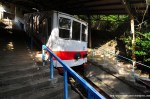
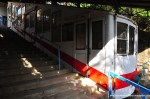
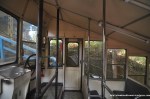
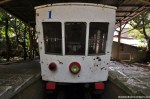
The upper terminus of the Yashima Cable Car (屋島山上駅, yashima sanjo eki, Yashima Mountaintop Station) was as locked up and untouched as the lower terminus – but the building itself was much more beautiful. Rather small, like most cable car stations, it totally reminded me of the *Maya Hotel* in Kobe. I think I’m a sucker for that art deco style of the 1920s and 30s. At the time of my visit the area was used by construction workers of the nearby Yashima Castle reconstruction site – there were parked cars everywhere and their container office almost blocked the access to the cable car track. Luckily none of the workers were in sight when I arrived, so I was able to sneak to the back and took some pictures: car #2 was already waiting for me as I expected, sadly slightly vandalized by some spray paint on the windows of the right side. Similar to the lower terminus the amount of decay was just perfect – the car, the handrails, the building itself. A perfect abandoned beauty, worthy the cover of a book or a magazine.

Read Full Post »

Being a mountainous country Japan has lots of cable cars and ropeways. And it seems like every single one of them was built in the late 1920s / early 1930s. A lot of them were demolished after just a couple of years in the 1940s to support the war efforts of Imperial Japan (every piece of metal counted…) – amongst others the *Mount Atago Cable Car* and the *Rokko Ropeway*. The Yashima Cable Car (YCC) had a bit more luck. Opened on April 21st 1929 it too was suspended as a nonessential line on February 11th 1944. But although some material was taken away (I’m not sure what exactly though…) it didn’t mean the end of the YCC: On April 16th 1950 the Yashima Cable Car opened again for business. And business was good thanks to the famous Yashima Shrine on top of Mount Yashima, about a kilometer away from the YCC terminal. I guess it got even better when some businessmen decided to make Mount Yashima a full-blown tourist attraction (*you can read all about it here*), but when the plan fell through the Yashima Cable Car was in trouble, too. On October 16th 2004 operations were suspended again, but it took almost a year (August 31st 2005) until the line was officially closed and abandoned.
According to a tourist guide book first published in the 1980s the cable car ran from 7 a.m. to 7 p.m., charging 1160 Yen for the roundtrip. It seems like prices went up and service hours were cut down, so in 1999 the cable car ran every 20 minutes from 8 a.m. to 5.40 p.m., charging 700 Yen one way and 1300 Yen for a roundtrip.
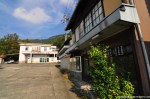
At the time of my visit the lower terminus of the Yashima Cable Car (屋島登山口駅, yashima tozanguchi eki – Yashima Trailhead Station) stood locked-up and abandoned on the foot of Mount Yashima near the trailhead up the mountain. The road leading there was almost as abandoned – I could vividly imagine how good business must have been 20, 30 years ago for the now closed restaurants and souvenir shops. Right next to the station were a taxi stand and a metalworking company, making some noise and keeping an eye on the inaccessible station building. The 858 meter long cable car track was accessible though, with car #1 parked right at the platform. And it was beautiful! On the one hand it was hard to believe that the place had been abandoned just six years ago, on the other hand there were no signs of vandalism and everything had just the right amount of decay – and the beautiful weather on the day of my visit didn’t hurt the atmosphere either…

Read Full Post »

Nippon No Haikyo, probably the most famous Japanese book about urban exploration / haikyo since it was recommended plenty of times by both Japanese and foreign blogs because of its huge amount of maps, recommended Yashima as one of the top abandoned places in West Japan. In my opinion Nippon No Haikyo is vastly overrated – while some maps are quite detailed others are completely useless. Even more so since an estimated 50% of the places (at least on the West Japan list) are either demolished or completely trashed by now. At the same time some of the best haikyo locations, like *Nara Dreamland*, are missing completely. But I guess you’ll get what you pay for: a 4 year old book about a topic that can change within a week or two. Especially in Japan, where old buildings are replaced by parking lots while you are on vacation. (It actually happened in my neighborhood…)
So whenever I visit a location described in Nippon No Haikyo I’m prepared for the worst, just in case. Which was a good thing in the case of Yashima – more than half of the buildings that were responsible for the praisal are gone now; four, to be specific. All that was left of them: 3 leveled building grounds, ready for new construction to begin. Construction that most likely won’t happen.
Yashima (屋島, roof island) has attracted people for centuries. The famous temple Yashima-ji on top of the mountain, founded as a Ritsu school temple in 754 by Ganjin (a.k.a. Jianzhen, 688–763), is the 84th stop of the Shikoku 88 temple pilgrimage. On March 22nd 1185 the Battle of Yashima took place in the waters around Yashima, resulting in one more defeat for the Taira, who owned a castle on top of the mountain. (Which is being reconstructed as I write these lines…) The whole story was later made popular in an epic poem called “The Tale of the Heike” (平家物語, Heike Monogatari).
A famous temple, stunning views of the Seto Inland Sea, a historical battle. What else do you need to attract tourists? Right, an aquarium! The Yashima Mountaintop Aquarium (屋島山上水族館, Yashima Sanjo Suizokukan) was opened in 1969 and reopened as the New Yashima Aquarium (新屋島水族館, Shin Yashima Suizokukan) in 2006. In-between some (not so) smart businessmen took advantage of the Japanese asset price bubble (1986 to 1991) to build some rather big hotels on Yashima, creating way more beds on the 300 meter high mountain than necessary. Because let’s be honest: Yashima is a daytrip location, not a place to stay overnight. (Heck, I made it a daytrip although I live in Osaka!) Around the turn of the millennium most of those new hotels were already forced to close, only a few smaller ryokan north of Yashima Temple survived. It seems like the closed hotels were still standing there when Nippon No Haikyo was written in 2007, maybe for two or three more years – when I visited in late 2011 most of them were gone… The Lost Ruins of Mount Yashima.
(I used this posting for a big update of my *Map of Demolished Places in Japan* – it’s really worth a look!)

Read Full Post »