All abandoned: Chernobyl / Pripyat, Nara Dreamland, Anti-Zombie Fortress, Japanese Sex Museum – and many, many more! Plus: North Korea Special – 2 trips, 16 days / 14 nights! As seen on CNN…
Usually I stay away from exploring regular Japanese houses. It happened way too often that I thought “Oh, this house / apartment building looks abandoned!” and upon closer look it actually was not. Japan has an unbelievable amount of rundown yet inhabited buildings, especially in the countryside and the outskirts of bigger cities – and I don’t want to get in trouble!
When *Rory* and I drove through the countryside on one of our exploration trips, my fellow explorer tried to point my attention to a slightly dilapidated concrete building to the left – and even without looking at it I dismissed the idea, because “there are cars parked”. Well, last time I saw the building half a year prior there were cars parked, but this time I jumped the gun. Rory was indeed right: the cars were gone, leaving behind a building that looked abandoned… and so we stopped.
Still not 100% convinced that the building was really abandoned I left the lead to Rory and had a look at the surroundings – a couple of storage shacks inhabited by half a dozen cats, some garden plots with Napa cabbage (the key ingredient of kimchi…), a few open windows; no real proof that this simple, ugly building was really abandoned. Access of course was easy – two staircases in the back lead to four floors with two apartments each. (The video shows one staircase, the photos I selected are from apartments on both staircases.)
While all apartments basically had the same layout, their interior was like a box of chocolates – we never knew what we were gonna get! Some apartments looked like you could move it in right away if you had low standards, others were completely moldy and a serious health hazard, while the third kind was covered by spider webs. Some were packed with brand-new boxed items, the strangest being the ones labelled “Glycerin Enema Mune 60”, others were filled with all kinds of trashed. Some showed signs of families with children, others most likely were bachelor pads. In one apartment was a calendar – showing last month’s date; which would explain why there were cars parks at the building half a year prior to our visit.
Since the apartment building was just outside of a small town, Rory and I went for a walk after we were done exploring. It was getting dark anyway, so we thought it would be nice to enjoy a countryside sunset. Countryside people in Japan tend to be much friendlier than city folks according to my experience, so it didn’t surprise me at all when a local woman started a conversation with Rory when he took a picture of a cat with an improvised Elizabethan collar – and she confirmed that the apartment building was abandoned just two months prior to our visit after it fell into disrepair.
When approaching and exploring the apartment building I didn’t think it was a good idea being there, but in retrospect it was quite an interesting experience. I still wouldn’t drive hours to get there, but it wasn’t a bad location as far as original finds go!
When I started this cute little blog almost four years ago I thought its name would say it all: Abandoned Kansai. Abandoned places in Kansai, nothing else. Soon I went to Chubu, then Kyushu – later to Shikoku, Chugoku, Okinawa and Hokkaido. I still manage to stay away from wacky Japanese stuff that make other blogs so popular, but I started to stray with Chernobyl and then this year with North Korea – the “urbex only” blog turned into a “dark tourism” blog, which isn’t a bad thing at all.
Given that I am located in Japan, I did my first “foreign” exploration in the summer of 2010, much to my own surprise not in my home country Germany, but in the lovely Grand Duchy of Luxembourg. Back then Abandoned Kansai was a really small blog with about 2000 views per month (which is less than now per day in average!), urbex in general was a lot less popular, and even most of my friends weren’t interested in what I was doing… except for my old neighborhood friend Alexandra, one of the most amazing people I know. (When I visit family and friends now, three years later, I go on explorations with half a dozen different people…)
Alexandra and I planned to go to Luxembourg the day after I returned from *Pripyat and Chernobyl* – and upon departure I felt sick like hardly ever before. I’ll spare you the details, but even a single sip of water rushed through my body at the speed of light, finding exits I didn’t know existed! It was too short notice to cancel, especially since there was no alternative date available, so we went anyway – and my first German exploration partner was absolutely lovely about it. Goal of our day trip: Esch-sur-Alzette, all over Europe known for two abandoned places called Terres Rouge and Centrale Thermique. (In case you wonder: Luxembourg is trilingual – French, German and Luxembourgish.)
Upon arrival Alexandra and I realized that the area wasn’t that abandoned, so we parked at one of the many active companies still around. Right to our left we found a gorgeous red brick building, so we decided to have a closer look. With most of its windows and concrete guttering smashed to pieces, this former production facility was clearly abandoned. I took a couple of photos from the outside and through the broken windows, when Alexandra grabbed a door handle and asked “Why don’t we go inside?” – I hadn’t even seen that entrance and was so happy she took over and kept this exploration going! Mostly empty inside, there were just a few hints what the building was used for. There were tons of switches and plugs, the halls were equipped with cranes, circuit schedules indicated the former installation of baths for tech stuff. Some equipment was labelled “Klöckner Moeller”, though I still wasn’t sure until last week whether the place was run by that company or just used their equipment – my guess was that it indeed was a subsidiary of Klöckner-Moeller as the company is known to have had subsidiaries in several countries. Founded by an engineer named Franz Klöckner 1899 in Cologne, Germany, the company started to produce electrical switching apparati. In 1911 Hein Moeller joined the company and after proofing himself for more than 30 years it was renamed Klöckner-Moeller in 1942. Renamed Moeller GmbH in 1999 the business was bought by the Eaton Corporation in 2008 and again renamed to Eaton Industries GmbH in 2010. Guess what! I was wrong.
Upon having a closer look at the photographical evidence while writing this article I am pretty sure that the factory building in Esch-sur-Alzette actually belonged to a company called Ateliers Francois Frieseisen, still in business just a couple of kilometers away from their previous location under its shortened name Ateliers Frieseisen after being “revived” by Roger Serafini in 2007. Founded by Francois Frieseisen in 1970 the Ateliers Frieseisen was and is a metalworking company – and therefore in need of Klöckner-Moeller equipment. While the company’s website is available in French only, the equipment in the now abandoned workshop was bilingual, French and German. Well, most of it either in French or in German, which kind of implies that the building had different owners over the course of time; not really a surprise given its assumed age of about 100 years plus / minus a couple of decades.
To reach certain areas of the factory building we had to leave and enter again through a huge door on the other side, where we ran into some fellow photographers. After a quick converstion lead by Alexandra (who is fluent in French, while I chose Latin back in 6th grade with a lot less success) we explored the rest of the building before we finally moved on to the gigantic thermal power plant widely known under the simple French term Centrale Thermique…
The Love Hotel tinna is one of those locations that are giving me a headache. On the one hand I am happy about every exploration, on the other hand… this was barely an exploration and I have hardly enough material for an article. About 20 months ago I was walking along a countryside road on the way to an abandoned place I was looking forward to explore, when I came across the tinna Love Hotel by chance. Not sure how the rest of the day would turn out I passed without a closer look, but considered having one on the way back. If it wouldn’t have been for the ropes blocking off the car entrance I probably wouldn’t have even realized that the place was abandoned or at least closed.
Two hours later I was on my way back to the train station – and since I wasn’t in a hurry I indeed had a closer look. Entering the premises and getting out of sight was quick and easy, the ropes were more or less symbolic. Luckily the sensors at the entrance must have been for triggering lights back in the days, because they surely didn’t cause an alarm to go off.
The back of the love hotel looked a little more abandoned, but just barely. Each room came with a separate garage – you drove in and shut the plastic curtain to get your car some privacy. The room rates (rest / stay) were written at signs next to the doors – which were all locked. That fact makes this article even duller, especially since I don’t know anything about the history of the Love Hotel tinna. I guess it was abandoned just weeks or a few months prior to my visit, but it’s hard to tell for sure. On the other hand: a lot of westerners don’t know much about love hotel, so here you can finally see some exterior shots. For interior shots you might want to have a look at the two articles about love hotels I published in 2011 and 2012. The one about the *Love Hotel Gion* is all about love hotels in general and how big the business is (a whopping 50 billion $-US!), the one about the *Furuichi Love Hotel* is more about dating in Japan and why some Japanese women were once called “Leftover Christmas Cake”…
Tottori is famous for its sand dunes, vast natural parks and pear omiyage – not for urban exploration. Located in the Chugoku region at the Sea of Japan (a.k.a. Korea East Sea and Japanese Sea) and therefore at the northern coast of Japan, Tottori is a little bit off the beaten tracks – most tourists travelling south of Tokyo continue via Kyoto, Osaka and Kobe to Himeji, Hiroshima and Kyushu along the Seto Inland Sea. Only a handful of Western tourists switch to one of the express trains from Kansai to Tottori (city), the capital of Tottori (prefecture) – there is no Shinkansen service as a northern line connecting Osaka and Shimonoseki via Tottori and Matsue was proposed in 1973 and then shelved indefinitely. The least populous of Japan’s prefectures (3.5 million inhabitants, less than the city Yokohama) is generally rather rural and agriculture is the most important economical factor – pears, scallions, yams and watermelons from Tottori are famous in all of Japan.
One thing Tottori is not famous for is urban exploration. Nevertheless I had plans to go to Tottori for almost a year, but for some reason I never followed through. The places I wanted to visit there were not that spectacular, the weather wasn’t consistent for a whole weekend, the season wasn’t right or I simply had other plans. In spring of 2012 everything came together finally, so I hopped on the first of eight special direct trains to Tottori and enjoyed the 2.5 hour long ride through the stunning Chugoku Mountains. After finding and checking into a hotel I did some haikyo hiking to another location and finally arrived at the gorgeous Tottori Sand Dunes in the late afternoon – running out of time, as so often.
The Sand Dune Palace turned out to be quite a rundown building secured by rusty barbed wire, only worth taking pictures of thanks to its relative fame and the round viewing platform which gave this old rest house (built in 1965) a little bit of an edge by making it more round… The salty sea air was gnawing through anything metal, especially lamp posts and handrails. All the bells and whistles, like door handles and lamps looked so 60s that it almost hurt the eyes. Really nothing special, so I headed over to the dunes to find my way to the beach in order to take some sunset photos. On the way back, late into dusk, I made another quick stop to take a couple of night shots, but then I had to leave to catch the last bus back to the city – it was an exhausting day and sadly not everything lived up to my expectations; for example the Sand Dune Palace – the pear sweets on the other hand were divine and if you ever go to Tottori, make sure to try the “nashi usagi” (literally “pear rabbits”, mochi filled with pear jam).
The Abandoned German Villa I explored more than two years ago – a place so mysterious that it doesn’t even have an “official” name in the German urban exploration and geocaching communities. Some explorers call it Villa Zimmermann (“villa carpenter”), others Villa Waldeslust (“villa forestlust”, kind of analog to the word wanderlust…) or Villa Kinderheim (“villa children’s home”) – probably due to the fact nobody seems to know much about the villa’s history, except that it first was a mansion, then a brothel and finally a children’s home. Or at least that’s what one person said and the rest just runs with it, because I’ve never seen any proof or even a timeline to support that claim. The geocachers of course use a fourth name including the village the villa is in – which basically gives away its location even without exact coordinates as that village has like three different streets… Or better: they used, past tense, as the cache is archived now – probably because it attracted too many cachers and therefore too much attention. Luckily I did some research two years ago, and to quote a geocaching visitor from back then: “Today we were the fourth group to log this cache!” The fourth group in one day! Wow… The *Deportation Prison Birkhausen* comes to mind.
Exploring the Abandoned German Villa was an interesting experience as it looked so familiar and strange at the same time. Familiar, because I grew up in Germany with houses like that. Strange, because I picked up urban exploration as a hobby while in Japan – and locations like that of course are hard to find in the Far East.
Surrounded by massive walls and fences it was easy to see that the villa once must have been the mansion of a very rich family – probably built in the 1920s plus / minus a decade. The main gate, protecting a private road of about 150 or 200 meters leading up to the main building, was completely overgrown, so my old high school friend Torsten and I had to find another way in, which was surprisingly easy, despite the lush vegetation. Once on the premises we didn’t have to worry about getting spotted by anybody as pretty much everything there was overgrown.
The first area we explored was a really old garage / storage building – a paradise for spiders and bugs; nothing nasty though, because we are talking about urbex in Germany. Nature loves Germany! Back in the days this building must have been state of the art, with the ground being tiled and the walls being plastered. We continued along the private road for a couple of last meters, ignored the villa to the left and had a look at the barn, clearly modernized just years before the whole thing was abandoned. The lower part, most likely stables for rabbits and probably something like donkeys, looked a lot like the garage we just left, the upper part on the other hand was a rather nice wooden construction with only few signs of decay. In the forest behind the barn we found a small brick-built shack with a couple of old stuff inside – a perfect setup for a stunning nativity play.
Back on the other side Torsten and I first explored an annex of the villa, including a small basement too dark to take photos at without a tripod, but the heating system there revealed that it was installed in 2001 and last serviced in 2003. I was especially fascinated by the three generations of electricity switches right next to each. Sights like that make me love urban exploration so much! On the other hand the place saw quite a bit of vandalism and everything was dirty and full of spider webs. The sweet is never as sweet without the sour.
The main building, the Abandoned German Villa, was where we went next. Three floors plus an attic, solid stone, but clearly modernized every once in a while; for example using double-glazed windows. Sadly there was more vandalism than interior, nevertheless it was really interesting to explore the layout of the villa, seeing signs for its use as a private home, a brothel and a boarding house. I am sure when first occupied the villa was just gorgeous, with lots of space for a big family, especially considering how most people lived in the early 20th century. In the basements we found signs of a cheesy bar area, probably installed in the 1960s/70s during the mansion’s brothel days. In the attic and on the upper floor were signs of the last residents – a John Sinclair magazine (popular German pulp fiction with more than 2200 issues since 1973… and still counting!), amateur art, letters written in careless handwriting.
Torsten and I were already on our way out when we discovered another overgrown building the size of a single family home a little bit to the side. It took some effort to get past the blackberry bushes, but like at the dirty annex two hours prior, the sweet is never as sweet without the sour. The interior of the building was mostly empty and quite moldy, but it was all about the details again. For example neither of us dared to go down to the basement, just based on the smell coming up and the mushrooms growing on the stairs. Personally I loved the stickers on the walls and the doors, clearly from the 80s, with subjects like theme parks, clothing and electronics (Eifelpark – Der größte Wild- und Erlebnispark der Eifel / Eifelpark – The biggest wildlife and adventure park in the Eifel). Easy to miss details included the locks on the outside face of the room doors. If the villa and its surrounding buildings were really used as a boarding school, I guess some of the residents were locked in as punishment or security measures. My favorite detail of them all though was the wallpapers in a room on the ground floor. Not because they were mostly gone, but because there were several layers of them… and upon closer look one of those layers were actually newspapers glued to the wall! Old newspapers, in fact. A piece on the ground had written “February 23rd 1929” on it. A small readable article was about an 18-year-old student in Berlin, who was a member of the right-wing organization “Der Stahlhelm” and shot during a brawl with communists – “slyly”, according to the piece, so it probably was a right-wing newspaper.
Despite quite a bit of vandalism the Abandoned German Villa was a wonderful place to explore – little details were everywhere to be found, most of them revealed more about the location’s history. It wasn’t a spectacular exploration like the *Nakagusuku Hotel Ruin*, but the countless details totally made up for it. It took me a while to write about the villa, but it’s still one of my favorite explorations in Germany! (Next time with a tripod though, because even on a sunny day the place is gloomy like hell…)
Abandoned Japanese towns must be the most common type of *haikyo*. For decades people have been moving from the countryside to the cities… and the trend continues: Almost 70% of Japan’s population live on 3.3% of the land – it’s a mountainous country, and the further you drive into the valleys, the more half-abandoned villages you’ll see; some are deserted completely, especially those so remote that they are almost completely cut off from the outside world in winter. (And that’s the main reason why ghost towns don’t show up at urbex blogs so much – only a few, like *Mukainokura*, are easily accessible; for most of them you need to have a car or a motorcycle…)
Across one of those hamlets my buddy Rory and I stumbled on our way to an off the beaten tracks location somewhere in the mountains of the Shiga / Mie / Gifu triangle. We thought it would be a good idea taking a direct way along a narrow one lane road stretching up and down several mountains instead of using the ridiculously expensive highways in Japan. It was a sunny day in March not only in Osaka (where there is no winter…), but also in Shiga. So we drove up one mountain in beautiful weather and started to descent on the other side… when all of a sudden we saw snow on the side of the road. We descended further and further, snow slowly creeping closer until we started driving on it. When we saw said hamlet, we made a quick stop to take a picture or two and continued driving… until we hit a dead end. The snow was getting too high and there was no way we were able to continue. So we turned around – and got stuck in the snow right in the middle of the hamlet (GoggleMaps doesn’t have a name for it, so I just simply call it Japanese Ghost Town). So I got out of the car and started pushing, successfully. Until we got stuck again a couple of hundred meters down the road, up the mountain. This time I needed the help of some boards that were conveniently placed right next to the road (coincidence?), but to both of our great relief we got grip right away and returned to the weather divide, this time without further incidents. Down the mountain on the Shiga side we found out that the only regular road nearby was still closed for winter, so we made our way back to Osaka as we were running out of time anyway.
Half a year later, November 2013, on our way to the remote haikyo Rory and I wanted to explore in spring – this time the first location of the day, not the third. Beaten by that darn valley six months prior and dangerously close to winter we decided to give the narrow mountain road another try. When we reached the hamlet this time there was no snow in sight, so we got out of the car and considered the place an original find. What started as “a quick look” turned into an hour long full exploration of about a dozen houses, most of them partly collapsed. All the buildings were Japanese style, which means mostly wood, so even the rather undamaged buildings were quite brittle once we found a way inside (without using force, of course) – half a dozen more winters with heavy snow and they will be flattened, too. To make the houses more stable and more durable, some outside walls were clad with thin metal plates. One of the houses still had an active digital (!) wattmeter above the entrance door and where we parked the car we found a laminated sheet of paper with information about an on demand taxi as a replacement for a regular bus service. My favorite item though was an abandoned bike, clearly an older model, maybe from the 50s or 60s. A really lovely piece of rust!
After we left the hamlet, we continued beyond the point where were forced to turn around half a year prior – and then we got lost in the mountains and reached dead ends… several times… losing massive amounts of time. The car’s navi more or less useless, we finally found a real road that lead us back to civilization, so we headed for the main road that was closed in March because of snow. This time we passed this point, too, only to get stopped in front of a tunnel – mudslides had severely damaged the road on the other side more than a year prior, so the tunnel was closed indefinitely, yet the road was open for hikers to reach a popular trailhead in spring, summer and autumn.
Running out of time again, Rory and I made our way back to Osaka, hoping to reach Location X on a third attempt. Or by finally trying a different route…
After I finished exploring the modern parts of the *Japanese Countryside University* I remembered some roped-off areas that I didn’t dare to step in out of respect for an elderly artist who was nothing but kind to me when I first entered the premises – but when he left, my urbex instincts kicked in and I just had to have a look. All those buildings I had already seen, they looked way too new for a university founded in 1964, so there must have been more… and there were!
The Japanese Countryside University definitely consisted of two parts; an older one from the 1960s and a newer one from the 1980s. The older part originally was a six floor main building across the street from the train station. On the third floor was a back exit / entrance leading to a book store and the old dormitory via a strange dark tunnel contruction that had written “Rape!” all over it. (Well, not really, but I felt like I could have been assaulted at any time and I was pretty sure that I was alone…) Down from the street a road was leading up, too, to what originally probably was a parking lot and now is the 1980s building complex.
Since I was coming from that elevated area I made my way through the pretty vandalized old dormitory, quite a mindblowing contrast to the immaculate modern building right next to it. It seems like the Japanese Countryside University was a women’s college with a 10 p.m. curfew, but all that was living in those original buildings now were a couple of gigantic and pretty fast spiders. Not like the colorful ones sitting in their webs everywhere, no, more like thin tarantula looking ones, the size of saucers…
From the dormitory I went straight to the old university building at the street and I understood immediately why the new buildings were constructed on elevated ground – even on a Sunday the noise was pretty annoying. Sadly most of the building was empty, so there wasn’t that much to see, nevertheless it was an interesting exploration. On the way out I took a couple of photos of the former sports ground. The soccer / track area was gone completely, but the tennis courts were still intact; somewhat overgrown though, reminding me of the *Asahi Sports Center*.
The Japanese Countryside University is still virtually unknown to the internet and I might have been the first foreigner to ever lay eyes on it, so this was a true exploration with new sights around every corner – not necessarily a spectacular one, but a new one! When I was planning this exploration I put together two train schedules for that day. One giving me 40 minutes to explore the Japanese Countryside University, in case the place was inaccessible, demolished or just uninteresting. The alternative plan gave me 1 hour and 40 minutes to explore, which is probably about the average time I spend at an abandoned place. More than 3 hours and 250 photos after my arrival I finally left this spectacularly unspectacular location I was longing to explore for more than a year – luckily it totally lived up to the high expectations I had.
Do I write and publish the article I have been thinking about for several weeks now – or do I keep my mouth shut? In October I went back to the DPRK for a second time, an experience even more intense than *the first trip in spring*, way more disturbing, way more conflicting. On the one hand I enjoyed both trips tremendously, on the other hand I saw and experienced things I would like to share with all of you. But if I do it in an honest way, I probably shouldn’t show my face again in North Korea for a third time…
When I first visited the “Hermit Kingdom” in spring of 2013 I did it with a slightly ignorant attitude, willing to enjoy the experience, knowingly accepting that I will be fooled and restricted. And I actually enjoyed the tour. A lot! So much that I visited the DPRK again in October of 2013, this time the northern parts; North Hamgyong province and Rason.
The guides in Pyongyang were nice and surprisingly open-minded, the food was fantastic, Pyongyang with its high-rise buildings and solar-powered streetlights was a lot more modern than expected, the photography and video limitations were a lot more loose than (almost) everybody claims… and the bowing in front of statues, the bumpy countryside roads, the regular power-cuts outside of Pyongyang, the restrictions of free movement – all of that was commonly accepted as North Korean quirkiness in a combination of group effort and voluntary Stockholm Syndrome; it became natural within hours, everybody always gave the home team the benefit of the doubt. And I was intrigued, I wanted to see and experience more… despite my friends and family universally thought that it wasn’t a good idea, some of them being worried about the articles I wrote about my first trip, about remarks I made in the comments.
Of course I went anyway, fueled by what appeared to be authentic moments – and I still think that some of them actually were honest and unstaged, like the *picnic at the Taesongsan Park & Fun Fair*. I also believe that life in Pyongyang is decent, but I had to come back with a clear mind and travel to the countryside to get a look at the costs of it, because Pyongyang isn’t a typical example of North Korean progress – it’s an exception, a severely subsidized prestige project that only exists because the almighty political elite doesn’t care much about, and in some regards even sucks dry, the rest of the country. The power-cuts in Nampo and Kaesong weren’t the exceptions, they were just small glimpses at reality in the DPRK outside of Pyongyang – and the southern parts of North Korea are quite blessed. The temperatures are rather mild in comparison to North Hamgyong, the economy is comparatively successful thanks to the train and ship connections to China, and the much larger amount of Western tourists doesn’t hurt either…
Fool me once…
I really enjoyed my first trip to the DPRK, but after going there a second time, I have to admit that I’ve been fooled a lot more than I thought while writing about my experiences. The strange thing is: I liked my second trip to North Korea even more than the first one! Despite (or maybe because?) it dawned on me that this trip was a lot more real – a much better look at the current state of the DPRK, yet still just a scratch on the surface. On the first trip pretty much everybody ate up what the guides / guards / guardguides / guideguards had to say, but this time the vibe was different. People behaved even better, but for different reasons. Some were hardcore North Korea fans, others just wanted to allay all the worries our constant companions might have had about us to get a little bit more freedom and insight than previous visitors. I don’t think the minders were blatantly lying to us, but they were controlling all information – what we heard, what we saw, what we smelled, what we tasted. And when you are in almost total control and nobody questions that power, it is actually quite easy to shape impressions just by leaving things out. Some of it became very apparent during this second tour, some of it only while I was reconstructing the experience with the help of my photos, the adjusted itinerary, GoogleMaps and Wikimapia. (I added lots of new locations to my original GoogleMap about North Korea. *Please click here to have a look.*)
The fact that shocked me the most after my return was that we passed three of the biggest concentration camps in North Korea by less than 10 km! When we visited the city Hoeryong right at the beginning of the tour, our guide kept repeating that the city is famous for its three beauties: Beautiful women, beautiful white peaches and beautiful earthenware. I knew that he was bullshitting us just by looking at photos of Hoeryong’s most famous daughter, Kim Jong-suk, the wife of Kim Il-sung and mother of Kim Jong-il – no offense, but when I talk about the beauty of German women I don’t get Angela Merkel associated! (And after this comment I guess I better not return to North Korea…) Luckily Germans are more forgiving and Mrs. Merkel won’t throw me and my family into jail for the rest of our lives. Speaking of which: Hoeryong is famous for another thing, though it’s everything but beautiful – Kwan-li-so 22, Labor Camp 22; one of North Korea’s biggest and harshest concentration camps, where (according to two defected eyewitnesses) 1500 to 2000 people per year get worked or tortured to death, up to 4% of its total population. Maybe got, as the camp might have been closed in 2012 – which means that those prisoners were either killed or continue their sufferings in other camps. All of that I didn’t know at the time when I was spending a night at a hotel in Hoeryong, just about 5 kilometers away from the camp’s gate… (BTW: Prisoners only receive(d) a small amount of the food per day, despite a food factory in the camp’s labor colony Haengyong-ri. Like everywhere else in the country most of it was delivered to the capital Pyongyang, even if the locals and prisoners were starving, like during the Arduous March between 1994 and 1998.)
Get them while they are young!
Other examples for leaving out information we experienced at two kindergartens, where we were about to watch typical performances by local children; singing, dancing and playing musical instruments. At the first kindergarten we walked through long hallways on the first floor with Hello Kitty and other colorful child-oriented images painted to the walls, then we were rushed through a staircase directly to the third floor, where the children were waiting to perform for us. I was able to sneak five meters down a hallway on the second floor and took quick photos of a painting depicting two snowmen being attacked by armed children, a subject that didn’t go along well with the stuff I saw on the first floor. Back home I asked friends what was written on the snowmen: American Bastard and a derogatory play on words about a former president of South Korea…
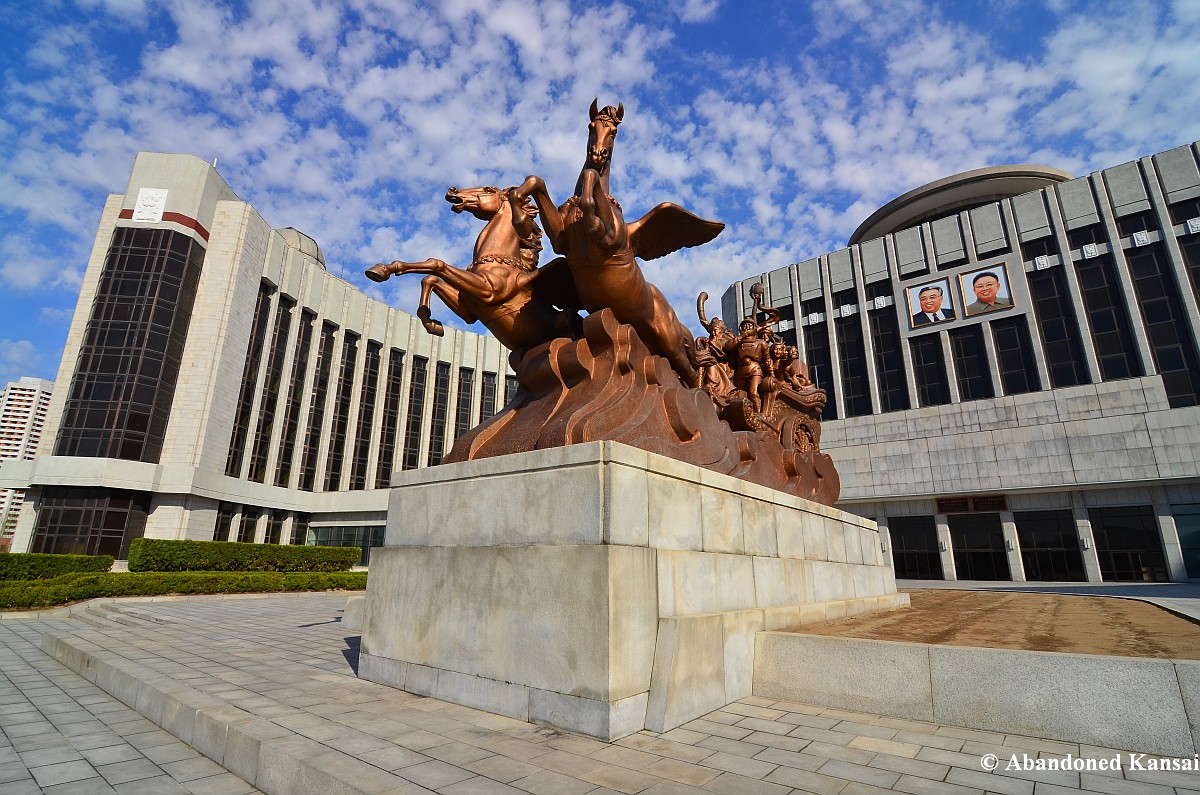
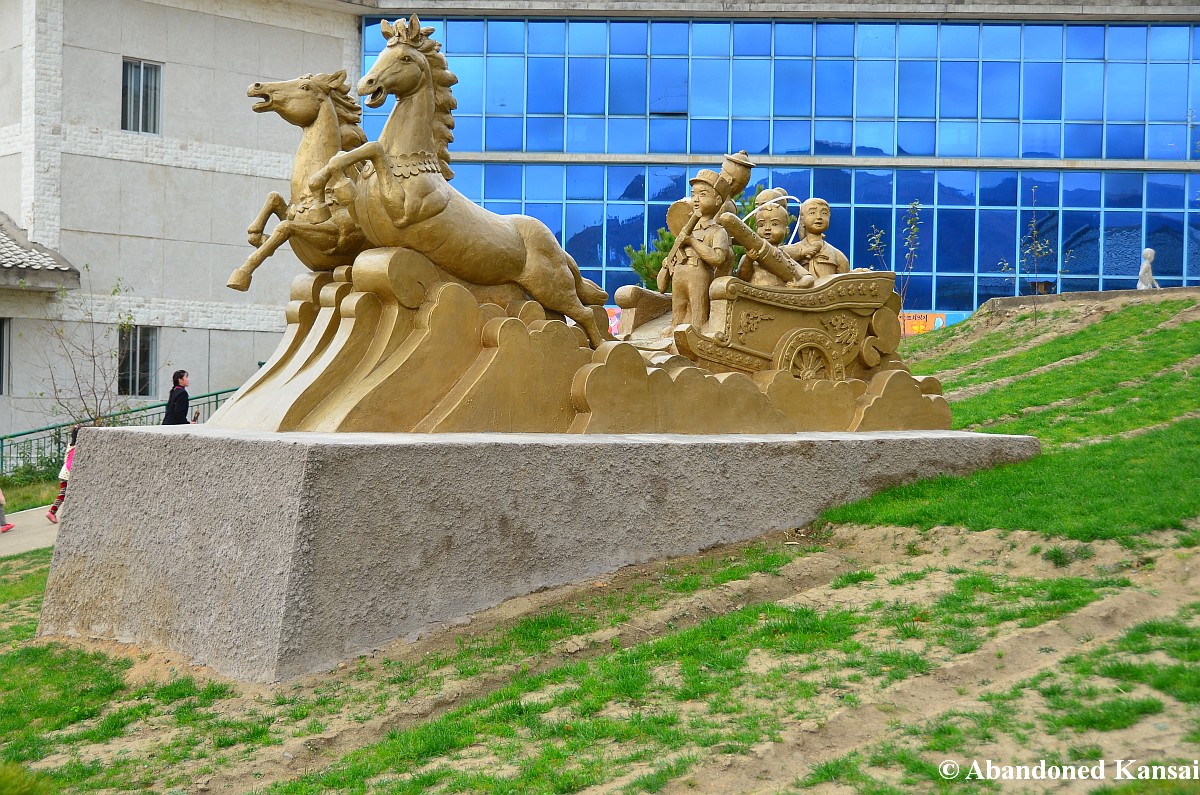
At the other kindergarten (with a different layout) we weren’t shown much of the second floor neither – and this time it was a fellow traveler who found a room she later described as “a war museum”. Sadly I wasn’t able to see it myself, but it goes without saying that our Korean guides didn’t mention it. They also didn’t mention the huge chariot sculpture in front of the kindergarten. At first sight it looked a lot like a simplified version of the one in front of the *Mangyongdae Schoolchildren’s Palace* in Pyongyang, which is all about the future and having fun. The one in Rason? Well, the first child is holding an automatic rifle in his hand, the second one a missile. Nobody pointed out those details…
Instead we went through yet another musical performance, because North Koreans like to sing and dance – I don’t. Malicious gossip has it that it’s because they don’t have anything else, but hey, they love it, so if it helps the understanding among nations I suffer through 20 minutes of creepily smiling kids at a kindergarten… or a guide singing the national anthem / their favorite NK pop song. Usually both the kids and the adults (guides, waitresses…) are pretty good at what they are doing, which eases the suffering. What really started to irritate me is that you never know when you get dragged into the whole thing. You are never safe… not at kindergartens, not at schools, not at restaurants, not at BBQs, not even on the bus. What is announced and starts as a more or less harmless performance can end with you starring it – and I HATE that kind of attention. At the same time you don’t want to be impolite, so you basically have to choose between the devil and the deep blue sea. One time on the first trip all the guides, one after another, were singing the national anthem of North Korea on the bus – and then kept nagging all tourists into singing theirs. My only way out was to claim that Germany is so anti-nationalistic now, that it is actually punishable to sing the national anthem without written permission by the government; interestingly enough not only the Korean guides but also some of my fellow travelers from all over the world believed that story… (And yes, the singing and dancing was even more intense on the second trip!)
While I visited North Korea for a second time in October I felt like being part of “Hunger Games – The Musical”: A totalitarian system concentrating all the power and wealth in the capital… and everybody was singing and dancing all the time! This wasn’t the rather cozy Pyongyang bubble anymore, this was a glimpse at a system that is plain and simple batshit crazy. Back in spring I actually thought that the DPRK was a little bit misunderstood and just needs some good PR, that Pyongyang was just a sample of what’s going on in all of North Korea, but obviously I was wrong. North Korea needs massive change from the inside, the mindset of the population has to change drastically. And I don’t blame individual average people, most of them are just doing what they are told to do (look at the communism loving Russians that now hump capitalism like a pet bunny does its favorite plush toy…), they are simply trying to survive without getting into trouble themselves, probably being traumatized by decades of subjugation from psychotic despots! I’m sure it’s not all bad in North Korea, but it definitely isn’t as good as tourists are made believe when visiting Pyongyang…
It will take me a couple of months to write about my second trip, especially since this time I want to have the whole set written before I start publishing it. Like last time I have no political or financial agenda, and I will write about my vacation as I experienced it. I just wanted to give all of you a heads up that this time it won’t be as positive and naïve – it will be full of love for the coast and the mountains, for fearless toddlers and curious language students. But you will also read some completely messed-up stories about extreme poverty and regular power-outs, about electric fences along the coastline and despicable acts towards children, about denunciation, double standards and deception – and about how I will rather never go back to North Korea again than deliberately ignoring or even sugar-coating the things that I’ve experienced…
Border guards don’t like to be filmed, yet I managed to tape me walking from China into North Korea. (As far as I know we were the second Western tourist group ever to enter North Korea on foot from Tumen, China!)
At the end of the video you can hear a guideguard approaching me after he caught me taking this video, despite him announcing that it’s okay to take pictures from the bus just 5 minutes earlier…
One of the most beautiful hours I had in North Korea – sunrise at the beach of the homestay village while most of my fellow travelers were still sleeping.
After *a surprisingly successful recent exploration in China* it’s about time to write about a surprisingly unsuccessful exploration in Japan I did 3.5 years ago.
On a nice spring day I made my way to Wakayama prefecture to check out the Kuratani Onsen, which had a reputation for being one of the most beautiful abandoned onsen in all of Japan. The next train station was about 1.5 hours away, but I didn’t mind the walk towards one of Wakayama’s gorgeous mountain ranges. Along the way I saw a small abandoned house, emptied, windows smashed – rather uninteresting, despite me being rather inexperienced back then. Probably somebody’s weekend home in the 1990s.
A few minutes later I finally reached the Kuratani Onsen… and I was shocked by its condition. Parts of the building complex were collapsed, probably under the weight of snow in the winter – the downside of unmaintained wooden buildings, gorgeous as they usually are. The rest was trashed beyond believe. But not just vandalized, filled with trash up to my knees in parts. It’s generally amazing how much garbage you find in remote areas in Japan as waste disposal can be quite expensive in the land of the rising sun. But what kind of person would drive to an abandoned building and get rid of their trash there?
Not only was the whole place nasty because of it, the trash also attracted all kinds of animals – spiders, flies, bugs; probably some rodents, too. This was probably the most disgusting abandoned place I’ve ever visited – and since it was before my “jeans and hiking boots even in summer when doing urbex” habit, I didn’t even try to make my way across all that garbage. Instead I took a path on the right side of the building to make it to the upper floor, smashed to pieces and probably not safe either… The metal entrance part was already too rusty for me to trust it on a solo exploration. And so I left with a couple of crappy photos after about half an hour. Not my shortest exploration ever (that title still belongs to the more or less failed *Sekigahara Menard Land* snow expedition earlier the same year), but probably one of the most disappointing ones.
And that’s pretty much it… One man’s trash is another man’s treasure, so I hope you were not too disappointed by this week’s article (though I wouldn’t blame you, but not all of my explorations are spectacular, so sometimes I have to write about duds, too) – but if you were, you might consider *liking Abandoned Kansai on Facebook*. Especially in weeks with an unspectacular location I upload some exclusive preview material there – the photos scheduled for later this week will show you some amazing locations that I’m sure you will like as much as I do!
Urban exploration in China is something I thought I would never do – and actually only did by chance. In October of 2013 I was on my way to a second trip to North Korea; not *Pyongyang and the southern parts* again, but North Hamgyong province and the Special City Rason in the north of the DPRK. To reach those areas you don’t fly into Pyongyang via Beijing, but you enter and exit by land. Meeting point for those trips is the Chinese city Yanji, an up and coming 400.000 people town quite close to Russia and less than an hour away from the North Korean border. The tour to Korea ended on a Monday evening… and since Korean Air doesn’t offer any flights on Tuesdays I was stuck in Yanji for a whole day. My buddy Nikolai, who spent a couple of months learning Korean in this town without any tourist attractions at all, told me about a half-abandoned amusement park in the city center. “Half-abandoned” sounded like a dying amusement park to me, one with fewer visitors than necessary, one that is supposed to close soon. Little did I know that he meant an amusement park where literally half of the attractions were abandoned. And that’s not even the weirdest thing about it!
The People’s Park (人民公園) in Yanji looks like a normal public park when entering from the south – a big pond full of water plants, a couple of peddlers selling food and plastic toys, some sculptures (including tasteful nudes), a few benches, and senior citizens playing games at tables. After a couple of minutes you’ll reach animal cages and stalls filled with all kind of more or less exotic animals… as the People’s Park features a free public zoo. But that’s not all! Right where the zoo ends is a small dump area with a couple of abandoned seats, small stands and parts of carnival rides – and at first I thought that was what Nikolai meant when talking about the half-abandoned park. Boy, was I wrong!
Within earshot of the rusty remains I spotted small Ferris wheel, blasting some music into the silence of this sunny Tuesday noon. Customers? None. Potential customers? Only a few more.
The (not so) big wheel was surrounded by 15 to 20 other carnival rides. Two or three of them were also open and running, half a dozen others looked more or less well maintained – and the rest of them were actually abandoned, except for the single demolished one; paint flaking off, weeds growing through a mini roller coaster, seats weathering, concrete crumbling.
This place was so friggin weird! It looked like an abandoned pay-as-you-go amusement park, but it wasn’t, because every other minute you would run into some sweethearts looking for entertainment, and there was music playing in the background all the time; some of it being karaoke sung by a few senior citizens further up the hill. It was so creepy and bizarre – and calming yet very exciting at the same time! Usually I have to sneak around and jump some fences, especially when exploring abandoned theme parks… but not this time! Relaxed I made my way from attraction to attraction and took pictures of whatever I wanted at my own speed, not worrying about anything. When I thought it couldn’t get any better (except for being there on a misty day!) I hit the weirdo jackpot!
I’ve seen a haunted house or two in my lifetime, but none with a naked female torso breaking through the wall on the upper floor, a big hand trying to hold her back, partly covering one boob – next to a monstrous mutant face. But that’s not all! To the left and mid-air was a nude couple (male and female) in a grotesque pose, attacked by two gigantic green snakes – the guy’s face full of panic, the girl’s face barely visible, but clearly in agony, one of the snakes biting into her left shoulder and half of the exposed torso.
The back of the abandoned haunted house wasn’t a tiny bit less bizarre and probably my favorite area in the whole park. There I found a couple of concrete or gypsum animals lying on the ground and standing around, the greyish material spalling off in huge chunks, revealing steel wires underneath. Next to a path nearby was a huge Buddha statue rotting away, made of a Styrofoam looking material – accompanied by the concrete statue of a naked Chinese fairy, right in front of a white rabbit with red eyes carrying a gigantic mushroom… which at this point I felt I must have smoked earlier!
The *second abandoned Japanese sex museum* meets *Nara Dreamland*… with no security standards whatsoever. One of the remaining running rides was a monorail through half of the park. It’s height? About two meters – and no protection at all. I was able to touch the rail at any time and even smaller people carelessly stretching could get hurt seriously by one of the monowheel looking cars. Trash, broken glass and mirrors, rusty metal, brittle animal figures – everything was scattered in the woods around the park and nobody seemed to care about it.
The carnival section of the People’s Park in Yanji was one long bizarre exploration and one of my favorite abandoned amusement parks overall. Deserted theme parks are generally creepy, but the fact that this one was only half-abandoned took it to a whole new level!





 Abandoned Kansai