Feeds:
Posts
Comments

Archive for the ‘Restaurant’ Category

I’ve been urbexing for almost 15 years. During that time I’ve never written any articles about equipment, despite being very happy with three different Nikon DSLRs, two Manfrotto tripods, and a Sanyo video camera – which broke in 2019 after almost 15 years of recording countless hours at hundreds of locations as well as places like Chernobyl and North Korea. Videos I always considered a bonus anyway… and I’m still having a hard time thinking of myself as a photographer, given that I have no formal education in that field and only do it as a hobby. A really time-consuming hobby, but nevertheless just a hobby. I also don’t have a background in technology, so what’s the point of reviewing camera equipment when I just have an opinion based on learning by doing? Well, that doesn’t keep countless “influencers” and Youtubers from churning out incompetent nonsense, but I wouldn’t want to be found dead with either label on me! And like my favorite professor at university once said in regards to papers we had to hand in: “Don’t claim anything you can’t proof!”

Fortunately there is no need to be technical or scientific about this Insta360 X4 article, because unfortunately we never got that far…
Like I said, I always considered video walkthroughs of the locations I explore a bonus. I started them pretty much right away, but at first I didn’t even publish them, because I only took them for myself. And even when I published them, I didn’t edit them. No cuts, no voice overs. Just me walking around breathing heavily into the silence. That all came to a sudden halt when my Sanyo stopped working after exploring the abandoned *Trump Hotel*, also wiping out the recordings of the whole day. At that point I was tired of doing the videos anyway – and my co-explorers were increasingly annoyed, because I added 10 to 30 minutes at the end of every exploration for the walkthrough. So I stopped doing them.
For the past 18 months I’ve been exploring solo again (don’t ask, it’s complicated and often quite frustrating, to be honest), but a few weeks ago a colleague of mine showed me an older model Insta360 video camera that a visiting cousin from the States forgot at his place in Japan. I was fascinated by the easy to use 360 photos and videos, so I did some research and decided to get one. I’ve read reviews, I’ve read product pages – I did my best to make an informed decision, because at first I considered buying the X2 or X3 as older models often are cheaper with only slightly fewer / worse features. The X2 was out of the race when I read in a review that it required a smartphone to be activated – something I didn’t read anywhere about the X3 and X4. I guess because it’s an idea that is so stupid that it probably was a one-time mistake by Insta360, facing so much backlash that they removed the requirement from following models. The price difference between the X3 and X4 wasn’t very big and since the latter was only four weeks old at the time, the price on Amazon and in brick and mortar stores was the same, so I decided to get it at my local Yodobashi Camera (street block sized electronics stores with hundreds of employees each, in case you are not familiar with the chain), where I’ve been a customer for almost 18 years – ever since I moved to Japan.
BIG MISTAKE!

Yodobashi Camera was extremely stingy, giving only 1% points on the video camera, despite a promotional campaign of giving 13% points for purchases over amount X – except for (small print)… But when you shell out 80k Yen on a new video camera you are looking forward to use, store points are the last thing you worry about anyway. Fortunately I still had some of those points, which I used to get a seriously overpriced MicroSD card, because without it the video camera would be useless and I wanted to try it out on the weekend before an upcoming urbex trip. 83500 Yen poorer, but with a big smile on my face I left Yodobashi Camera on a Friday evening after an otherwise pretty horrible week.

Saturday was supposed to be a great day, though it started with a rude awakening / realization…
After sleeping in and having a delicious breakfast, I enjoyed a nice unboxing. The first slight disappointment was when I realized that the included battery was dead. Well, not dead dead, but completely empty. Whatever, an hour or two wouldn’t make a difference. It would not dent my great mood for sure. That came a few hours later when the battery was fully charged. I booted the small brick for the first time, its screen came to life, asking me to choose a language – and then the screen showed what the camera was seeing… for about a second or so. Then some text popped up and my heart sank. You gotta be kidding me! What I was looking at was a screen telling me to download an app by Insta360 to a smartphone, iOS or Android, to unlock the video camera. What. The. Heck? I literally felt it in my fingers how my blood-pressure exploded, because unlike pretty much every person on the planet above the age of 6 years I don’t own a smartphone. Never have. In the late 90s I had a black and white Nokia for work (yes, I’m not the youngest anymore, though I started working full-time in my early 20s). When I moved to Japan I had a flip phone or two, but for the past 15 years or so I didn’t have any mobile phone at all, smart or not, because I don’t like them as they turn way too many people into dumb zombies. So here I had a brand-new, quite expensive video camera… that forced me to make it usable by using another device with cameras? Who comes up with stupid ideas like that?!
Certainly not Nikon! Their D7500 DSLR I bought just weeks prior worked with a partly charged battery and regular SD cards straight out of the box 5 minutes after purchase – without any charging or unlocking BS!
So I started to do some research… and didn’t find much. Like I said, I couldn’t care less about smartphones, apps and all that stuff, so I tried to find a solution to unlock the darn X4 via PC or MicroSD card. Of course I couldn’t find anything about that either, so I contacted Insta360 directly – who apparently didn’t read my message and instead sent me a standard reply. So I got back to them, apologized for not describing my problem properly (I’ve been in Japan too long…), and this time got an answer that at least implied that they understood the situation I was in – without being able to help, because though it seems to be nowhere stated on the box, the promo material or even on the X4 website (at least back in mid / late May, maybe they changed it by now)… you really need a smartphone and the Insta360 app to use a newly bought X4 video camera, that seems to work perfectly fine, but is made not usable on purpose by the manufacturer. Which absolutely blows my mind!
How is that even legal?
How can a company force you to use a completely unrelated piece of expensive technology that actually partly does the job of the product you just bought, to make your purchase usable? Without mentioning that essential detail with big warnings before purchase! And in addition, forces you to use an app, which does who knows what in the background without one knowing?
What’s next? You need an electric bike with WiFi to unlock your newly bought car? And if you don’t… sucks to be you, it’s completely useless!

Yodobashi Camera – (The Lack Of) Customer Service In Japan!
After some back and forth it was Monday and I came to the conclusion that I won’t be able to use the Insta360 X4, because it really needs a smartphone to unlock, which wasn’t properly communicated. So after work I went back to Yodobashi Camera, my go-to electronics store for the past almost 18 years. Never had a problem with them, because all the products I bought worked as intended right out of the box. So I went back to the cashier counter where I bought the video camera… and already ran into the first minor bump in the road – apparently I hadn’t paid for it in the camera department, but a neighboring one, which wasn’t a problem on Friday evening, but very well on Monday evening. So I went 20 meters over to the camera department and told them about my unfortunate situation: That I had bought this video camera three days prior, but couldn’t use it, because it doesn’t work without a smartphone, which wasn’t properly communicated by Insta360 or Yodobashi Camera. But I was very careful with everything, I didn’t even remove the protective film from either of the lenses. Some air through the teeth sucking, some going back behind the counter to talk to a superior and then something like the following conversation – it’s in quotation marks, but they are not really quotes, you know… just something like that, from memory:
“I can’t sell this anymore, you opened the box. You can’t return it.”
“But I can’t use the video camera.”
“I can’t sell this anymore, you opened the box. You can’t return it.”
“I don’t have a smartphone. The X4 is useless to me.”
“I can’t sell this anymore, you opened the box. You can’t return it.”
“I did proper research and I only found out about this after I opened the box and tried to use the X4.”
“I can’t sell this anymore, you opened the box. You can’t return it.”
“I bought a D7500 last month, it worked out of the box…”
“I can’t sell this anymore, you opened the box. You can’t return it.”
“Then take it back and ask Insta360 to exchange the X4 – you have dozens of them here, you probably have to return one once in a while anyway.”
“I can’t sell this anymore, you opened the box. You can’t return it.”
“Are you serious? I’ve been a customer here for almost 18 years, spent millions at your store and other ones in the building that has your name. Never had a problem – and the first time I have, you are stonewalling me?”
“I can’t sell this anymore, you opened the box. You can’t return it.”
“Really?”
“I can’t sell this anymore, you opened the box. You can’t return it.”

At this point I gave up and exchanged a few more e-mails with Insta360 (“You should try to return the X4 where you bought it!” No kidding…), but their responses quickly became as useless and repetitive as the one of the guy at Yodobashi Camera – who is just a small cog in a big machine, so I don’t blame him; he’s punished enough with the lighting in the store and the uniform he has to wear all day.
So here we are, after me falling for the usual misconception about (customer) service in Japan, because I rarely ever had a real problem anywhere. It’s great as long as everything is within procedures – if somebody has planned for it, it most likely will go smoothly. Service is great. When service becomes customer service though, i.e. an individual customer needs help that requires improvisation outside of the planned service… you’re basically on your own. The only thing flexible in Japan is bamboo.

Nevertheless I still have moments when I wonder: AITAH?
I’m a huge believer in personal responsibility. If I make a mistake, I stand by it. I find behavior like ordering 20 items of clothes in different sizes and colors with the intention of sending 18 of them back despicable. In fact I’ve never sent anything back that I’ve ordered online, except for two USB-HDDs – and only because they didn’t work. I don’t do fast fashion, I don’t buy garbage from questionable sites like Shein oder Temu, I don’t replace electronics unless they are broken. (RIP, Nikon D7100!) I did due diligence before buying the Insta360 X4 and to this day everything in that (opened…) box is in mint condition. If I would have known about the smartphone requirement, I wouldn’t have bought the X4. It’s the reason why I didn’t buy the X2.
This is actually only the second time that I tell this story to anybody, because part of me is a bit ashamed that this series of unfortunate events happened – despite all the research before buying. But spending more than 80k on a useless brick of tech isn’t exactly something to be proud of. I don’t regret much in my life, but buying the Insta360 X4 I regret. And buying it at Yodobashi Camera is something I regret, too. Maybe Amazon would have been more accommodating with returns…
But I guess it is what it is – only money in the end. And no videos for Abandoned Kansai in the future. Heck, even if I would get the currently useless X4 to work, I would always be reminded of this story. Screw video cameras! Never was a fan, now I dislike them almost as much as smartphones. Which kind of closes the circle. But I’ll make sure to never ever even consider buying anything from Insta360 again – I still don’t understand how it’s even legal that they can do this. What’s next to unlock their cameras? Having to send them a voice message, swearing loyalty to Winnie the Xi(thead)? Apparently they can do anything without people questioning it…
I went back to Yodobashi Camera once more though, two days ago. I spent the remaining shop points I had on presents for my nephews without having to pay a single sen – my goal was it to hit +/- 20 points/Yen, but going to exactly 0 was priceless – and so I left the Yodobashi Camera building one last time with a big smile on my face. Upon arriving back home I cut up my loyalty card after almost 18 years. It probably doesn’t mean much to a large store chain like that. But it meant a lot to me!

Thank you for reading till the end and… What has your worst experience with Japanese (customer) service been? Write it in the comments!

(*Like Abandoned Kansai on Facebook* or *follow us on Twitter* if you don’t want to miss the latest articles and exclusive content – and subscribe to the *video channel on Youtube* to receive a message right after a new video is online…)

Read Full Post »

An abandoned Roadside Restaurant might not sound like the most exciting location, but sometimes it offers a good opportunity for a little rant… 🙂

I’ve been in a bit of an exploration slump since 2019 – quality I’m still very pleased with, but quantity has been suffered due to empty promises, wives, kids, and / or pets; (un?)fortunately none of them were mine, which makes the whole thing even more disappointing. And as y’all can imagine, Covid-19 didn’t exactly help. Though it did offer new opportunities, to be frank. In recent years Japan has become much more popular among tourists from overseas – to a point where overtourism had become a problem. Personally I stopped going to places neighboring places like Kyoto or Himeji for leisure around 2014 or 2015, but even at sightseeing spots off the beaten Shinkansen tracks it happened more and more often that I’ve heard more Chinese or Spanish at tourist spots than Japanese – which is a real atmosphere killer to me. (And yes, my reaction would be same hearing predominantly Russian at the Coliseum, Italian at the Louvre, French at the remains of the Berlin Wall or German at the Red Square.) Since Japanese people traditionally lived a life of social distancing (Do you know the Japanese term for ghosting? It’s “regular communication”…) and are used to wearing masks, their country was hit by Covid-19 much less than most other countries, so the imposed restrictions were much less… restrictive. Especially travel restrictions within the country. During infection peaks it was recommended not to travel, and I followed all those recommendations, but when it was allowed, I used the opportunity – and saw Matsue Castle with nobody else around, the snow monkeys with maybe 20 other people, and on a six day trip to Hokkaido I didn’t see another Caucasian except for at New Chitose Airport. So instead of lamenting about having fewer people to urbex with I used my new won spare time to visit some places I considered lost forever to the Eurasian hordes (don’t let that get to your heads, people from Eastasia, Oceania, or the Disputed Territories – all animals are equal…). Now, when I travel not for urbex I prefer to travel light – no tripod, sometimes even just one instead of two lenses. I also obviously don’t plan around abandoned places, but look for interesting museums, local food, unusual experiences, and beautiful scenery. But at this point it seems like I don’t have to look for abandoned places anymore, they tend to find me – whether I’m prepared or not. And if I’m not prepared, I either have to ignore the place or make the best of it…

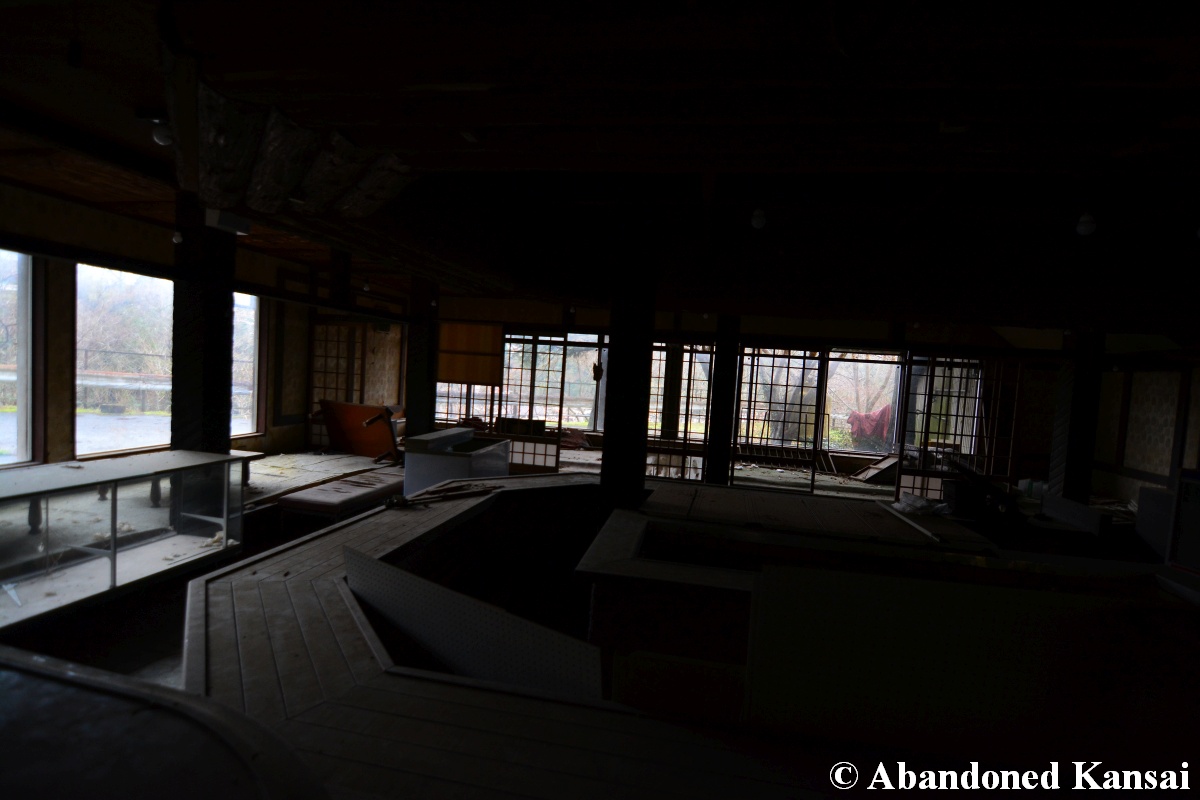
In the case of the Roadside Restaurant I tried to make the best of it. It was a rainy day, I didn’t have my tripod with me, and to be honest, I wasn’t really in the mood for a solo exploration. But the place was a bit out of sight and easy to access, so I played the cards that I was dealt and went inside. Congratulations, another abandoned restaurant – well, not all abandoned places in Japan can look like *Nara Dreamland* or the *Hachijo Royal Hotel*, otherwise even Japan wouldn’t have several millions of them. Most abandoned places in Japan actually look like this one here and not like the average one on Abandoned Kansai! After all I’m doing my best to find “beautiful” / interesting abandoned places and take pictures to make them look “attractive”, but sometime the amount of abandoned places in Japan surprises even me – not counting the dilapidated buildings that are still in use!
Anyway, there’s not much to say about the Roadside Restaurant. It was there, I went inside, I took some pictures freehand at crazy high ISO, prepared them for this blog and wrote this rant.
So here we are… Another Tuesday… Confronted with mediocrity… Hoping for something better next week… Just like in real life! But please keep showing your support… or one week there might not be a next week…

(*Like Abandoned Kansai on Facebook* or *follow us on Twitter* if you don’t want to miss the latest articles and exclusive content – and subscribe to the *video channel on Youtube* to receive a message right after a new video is online…)

Read Full Post »

This is an Abandoned Kansai classic! First explored in late 2009 and published in early 2010, Arima Wanda Garden a.k.a. *Doggy Land* was one of the original original finds!

When I first considered giving urban exploration a try and make it a hobby in mid 2009 one thing was clear as day to me: I didn’t just want to follow other people’s footsteps and seek out places dozens of more experienced explorers have been to before me (more like hundreds 11 years later…). I wanted to look for places unknown to the internet, original finds! The first three original finds I’ve located have been the abandoned theme park *Expoland* (now demolished and replaced by the gigantic shopping mall Expocity), the *Hitler Surgical Hospital* (demolished and replaced by an apartment building) and dog themed park called Arima Wanda Garden.
Writing about abandoned places puts you under constant struggle between wanting to present beautiful locations and trying to keep them and their location as secret, so not every shmock goes there and tramples through – or even worse, steals from or vandalizes the place. Both Expoland and the hospital had already been under demolition by the time I ended taking pictures of them, so there was nothing to worry about. But Arima Wanda Garden and many places after that forced me to make a decision between writing about them and exposing them that way, even if using a limited selection of photos (for example not publishing anything with a logo) and a fake name – or not writing about them at all until they’ve been demolished or other people did the dirty work of exposing them first. In recent years I tended to choose option 2 – I have at least two dozen places in my vault that are truly spectacular, but publishing an article about them with all the photos and information I have would probably turn them into tourist spots, some of them actually really dangerous for a variety of reasons. In the case of Arima Wanda Garden I initially decided to write about it with a limited selection of photos, no video walkthrough, without references where it was, and under the fake name *Doggy Land*. Six and a half years and several recent appearances on Japanese blogs later I revisited the once pristine Doggy Land and found it severely vandalized – so I published an article about *Arima Wanda Garden* in 2017 with the full original photo set, video walkthrough, and real name; there was not much damage it could cause that hadn’t been done already. Almost three years later I finally publish the photos and video walkthrough of my 2016 revisit with this article…

Revisiting Arima Wanda Garden was bittersweet. During my first two visits in late 2009 / early 2010 it was in nearly pristine condition and I had to climb over a fence next to a rather busy road. In 2016 I was able to step through a low unlocked window and leave that entrance building through an open door on the other side. What I found was a much wilder, much more vandalized park. The first time around all the buildings were still locked, this time most doors were open and a lot of windows were broken. It was sad to see Arima Wanda Garden in that kind of state, on the other hand it looked so different that it almost felt like a new exploration. Usually I avoid revisits as I tend to explore locations fully the first time and only little things change from on year to another – but those six and a half years definitely made a difference! You can see for yourself and find out more about Arima Wanda Garden by *clicking here to get to the comprehensive article I posted in 2017*.

(*Like Abandoned Kansai on Facebook* or *follow us on Twitter* if you don’t want to miss the latest articles and exclusive content – and subscribe to the *video channel on Youtube* to receive a message right after a new video is online…)

Read Full Post »

A nice little original find along of one of Japan’s most beautiful coastlines – the Seto Inland Sea Rest Stop!

The Seto Inland Sea separates three Japanese main islands (Honshu, Kyushu, Shikoku) from each other and is part of eleven prefectures. While some areas are highly industrialized (especially the part from Kansai Airport to Himeji and near cities like Hiroshima, Takamatsu, and Tokushima) others are popular tourist spots famous for their beauty – like Miyajima, the Seto Naikai National Park, and Shodoshima). And where you have tourists, you almost automatically have abandoned tourist infrastructure, like hotels and restaurants.
The Seto Inland Sea Rest Stop was a large restaurant and omiyage shop in one of those touristy areas – closed and boarded up about 15 years ago according to the last calendar. I found this place by chance on GoogleMaps and it turned out to be a nice, quick exploration I’ve never seen anywhere else before… or after. Not a spectacular place, but with lots of parking space and rather easy access – and relaxed original finds I’ll take over photographed to death spots any day, especially since this one hasn’t been vandalized (yet). A fun little spot that offered some nice photo opportunities with an abandoned, but not rundown / destroyed look. If it was for me, I’d do one of those every other weekend…

(*Like Abandoned Kansai on Facebook* or *follow us on Twitter* if you don’t want to miss the latest articles and exclusive content – and subscribe to the *video channel on Youtube* to receive a message right after a new video is online…)

Read Full Post »

Once a prosperous rest stop between two famous onsen, now an almost completely overgrown complex of restaurants and souvenir shops – reclaimed by nature, tough to access, especially in summer.

Omiyage (basically overpriced snacks, sold at tourist spots, you are expected to buy for family and especially co-workers) are one of the many curses you have to deal with when living in Japan – and like so many pain in the a$$ traditions, this one started a long time ago as something slightly different. Back in the Edo period (1603-1868) people barely ever traveled (because it was basically forbidden) and if they did, it was usually a pilgrim to a shrine – and expensive. So people at home collected money to support the pilgrims and in return received a “present from the shrine” (miyage – the o is a honorific prefix), usually something non-perishable like a charm. When the Edo period ended and Japan in general stopped acting like North Korea now, traveling became faster and cheaper – and the pilgrim aspect became less important. Nowadays most people travel for fun and shrines are only part of the sightseeing program. People staying at home stopped financially supporting travelers, but still expect a small present – no charms, because despite the fact that a lot of Japanese people identify on paper with two or even three religions, people here are not really religious anymore. So instead of charms, travelers buy boxes and bags of sweet or savory snacks, depending on what the visited area is “famous” for. And in Japan every second conglomerate of huts is famous for something! Yet a big portion of those snacks is just locally branded, rather generic stuff. At the coast you get shrimp crackers, at places known for wagyu you get beef flavored crackers, various areas in Japan are known for fruits, so you get all kind of apple / pear / mikan flavored cakes, cookies, drinks, hard candy – often in the same packaging, just with the local area / city name. Real local delicacies like Kyoto’s yatsuhashi are rather rare. But all those omiyage, sold in specialized shops near tourist attractions, have three things in common:
1.) They are insanely overpriced. Best example are Kit Kat – if you get nationwide distributed bags 12 pieces cost you about 298 Yen (plus tax), in cheaper supermarkets two bags for 500 Yen (plus tax). Sold only in certain regions a dozen pieces in a box will set you back 800 Yen (plus tax) – that’s three times as much! But then you can try flavors like Purple Sweet Potato (Okinawa), Wasabi (Shizuoka & Kanto), and Red Bean Sandwich (Hokuriku). There are countless different packages and flavors of Kit Kat in Japan – the smaller the amount and the more unique the flavor the higher is the price per piece, of course.
2.) They are a serious waste problem, because most omiyage are individually wrapped. You have up to 2 dozen individually wrapped cookies sitting in a plastic tray, sealed in a plastic bag, surrounded by a carton or plastic box wrapped in paper of rather high quality with colorful printing– and when you buy it, you get a small plastic bag for each box and all of that in a large plastic or paper bag.
3.) They are expected – and therefore a major pain, especially when you travel a lot! Wanna be the unpopular person at the office? Dare to not bring something from a trip you’ve mention to colleagues – NOT a good idea! But it’s also a pain for people who don’t travel a lot, because they are under pressure to contribute. I’ve seen colleagues bringing “omiyage” from touristy places that are closer to work than my apartment!
In my experience it’s a Japanese thing and overseas tourists don’t give a damn about omiyage though. They see the overpriced snacks and stick with souvenirs instead. Westerners usually get the kitschy classics, like beckoning cats or Hello Kitty sweat rags… Asian tourists tend to be even worse, buying things like rice cookers that were probably assembled by their third cousin once removed – and by once removed I mean: Once removed from their original job to spend some time in a reeducation… in an educational summer fun land camp…

Anyway, like I said, most omiyage shops are in close proximity of tourist attractions, but some of them are part of rest areas along busy roads, usually build at locations with a scenic view – highway rest stops, michi no eki (Road Stations / 道の駅) or independent businesses. This one apparently was an independent rest stop with a couple of restaurants and most likely different shops – omiyage, souvenirs, fresh local produce, … There is not much reliable information about this place available, but apparently it was built in the 1970s and was used until sometime around the year 2000 plus/minus a couple of years. Since they cut they construction site from a pretty jungle-like lot and didn’t build anything directly at the street (except for road access, of course), the whole thing disappeared behind a green wall within years. If you are lucky and approach from the right angle you might see one of the restaurants stick out in winter – in summer and four years after my exploration I’m sure you need to know where to go and how to wield a machete (which is probably not a good idea as most mass murderers in Japan use knives due to the lack of access to guns, so if you get caught by the police in Japan even with a pocket knife you have some serious explaining to do!).

Exploring the Jungle Omiyage Rest House took about an hour and wasn’t that spectacular, in all honesty – but it was a gorgeous January day in a very beautiful area, a no risk location, and afterwards I had the pleasure to take a relaxing bath at one of Japan’s top 5 onsen. So no reason to complain, I had a wonderful time there!

(*Like Abandoned Kansai on Facebook* or *follow us on Twitter* if you don’t want to miss the latest articles and exclusive content – and subscribe to the *video channel on Youtube* to receive a message right after a new video is online…)
Read Full Post »

Food in Japan is amazing – but the competition is boiling and not all eateries survive; some even become abandoned…

Having long term success in the Japanese restaurant business is tough, even for established brands from overseas. Burger Kings are hard to find, Wendy’s gave up. When one of the first Coldstone Creameries opened in West Japan’s largest shopping mall the lines were 2.5 hours long. Half a year later you could walk up to the counter most of the times, two years later the store was gone. I think the first Krispy Kreme a few years ago in Osaka had a similar destiny: Lines around the block, regular business, closed after a year or so. The standards are high and especially in densely populated areas food is available everywhere 24/7. Even the main roads through the countryside are littered with restaurants – most of them offering rather simple dishes like Japanese curry, soba, and udon… but still!
Of course not all of them can survive. While closed kombini are usually de-branded and blend in with the countless other abandoned dull buildings in the suburbs and countryside, independent restaurants tend to be just closed, sometimes boarded up.
The Countryside Restaurant & Karaoke was closed almost 20 years ago and boarded up tightly at first sight, so my expectations were pretty low, but it looked kinda cool from the outside, which justified a quick stop. It turned out that there was a way in after all – and that the place has visitors that loves to break glass. Windows, doors, glass cabinets, coolers. You name it. If it originally had a solid piece of glass, it was broken now. That probably contributed to a decent amount of air circulation, which means that the place was dusty, but not overly moldy – which is always a plus in my book, because so many abandoned places in Japan rot away, creating unbearable smells upon closer looks. Unfortunately there was also not much left behind after almost 20 years of abandonment, except for a few tables, the broken stuff and a mummified mouse… The back area with the karaoke rooms looked a bit spooky, but it was pretty much empty of course, too. Typical 60s building abandoned 30 years later.

Overall the Countryside Restaurant & Karaoke was a decent exploration, especially since this is not a popular location and I hadn’t seen any inside pictures before exploring it last weekend (yep, those photos are not even two and a half days old…) – a good place for a quick stop on the way to other locations (*Facebook* followers know more!), but not as good as the *Japanese Restaurant & Onsen* or the *Japanese Yakiniku Restaurant*.

(*Like Abandoned Kansai on Facebook* or *follow us on Twitter* if you don’t want to miss the latest articles and exclusive content – and subscribe to the *video channel on Youtube* to receive a message right after a new video is online…)
Read Full Post »

Common cuisine and uncommon architecture – this now abandoned BBQ restaurant once offered food… and food for thought!

Yakiniku is the Japanese term for “grilled meat” and a widely popular dish from Okinawa to Hokkaido. The nowadays often romanticized samurai days of Japan’s history (which include neither Okinawa nor Hokkaido…) were actually rather miserable for pretty much everybody involved – a poor agrarian state under autocratic rule, where even the 1% weren’t rich and the poorer explored the poorest. For centuries rice wasn’t food for the average people, but a way to pay taxes… and beef consumption was forbidden before the Meiji Restoration in 1871; yep, no Kobe Beef 150 years ago! But the Meiji Restoration changed Japan fundamentally in many ways, including the way people ate. All of a sudden beef consumption was not only permitted, it was actively promoted as one of many ways to introduce western culture. Over the years yakiniku changed from western style steaks and roasts via Jingisukan (“Genghis Khan”, grilled lamb / mutton, named after the famous Mongol leader) in the 1930s to a Korean style BBQ from WW2 on; consisting of beef, pork, chicken, seafood, vegetables, and so called horumon (“discarded items”), cuts like heart, liver, stomach, intestines and even uterus. Usually up to four people share a shichirin (round charcoal grill) which is located in the center of a table. You choose from a menu what you want (for example: three portions of vegetables, two portions of beef loin, two portions of pork belly, 3 portions of chicken thighs, and three portions of squid) – the raw food is delivered on plates and you put it on the shichirin yourself; everybody at the table then picks pieces when they are done to their liking. Some places offer all you can eat from about 2000 Yen on (about 18 USD), but yakiniku can also quickly set you back the equivalent of several hundred USD if you go to a good restaurant – if you order à la carte at an average yakinikuya you’ll probably end up paying about 4000 Yen including drinks.

When I first saw the Japanese Yakiniku Restaurant on a Japanese website I had no idea what it was. The page only showed outside photos of this partly overgrown, massive square concrete building and the round pods surrounding it – and I fell instantly in love with the unusual construction as I clearly have a thing for brutalist architecture. (BTW: If you are in Frankfurt, Germany, before April 3rd consider visiting the “Deutsches Architekturmuseum” – they currently host an amazing exhibition about brutalism, bilingual, of course; *please click here for more information*) And so I kept looking for that mysterious place until I found it about a year later, this time with the information that it was an abandoned restaurant.
Unfortunately the weather and I weren’t on good terms last autumn. The forecast predicted rain for the evening, but if course it started to drizzle just minutes after we arrived at the deserted place mid-morning shortly after 10. I did some quick outdoor shots from a distance, but by the time I got closer to the building the drizzle had turned into regular rain. Luckily one of the concrete pods was open – it wasn’t exactly spacious inside, but it offered a really nice photo opportunity. The other ones were all still locked and due to the weather and the glass doors it was pretty much impossible to take decent photos of the pods with the untouched interior. Exploring the main building it became pretty apparent that the Japanese Yakiniku Restaurant wasn’t closed for good from one day to the next. The main dining area was pretty much empty and even in the private black dining room the table including the shichirin had been removed; the kitchen was gone completely, except for a hot water heater. Back outside the rain had become heavier and prevented me from finishing the exploration the way I wanted it to finish – I grew quickly tired of becoming soaking wet and having to dry my lens every two shots, so I called it a day and looked for a still open place to have lunch… which turned out to be a local delicacy – deer curry; delicious!
Interesting abandoned restaurants are not very common even in Japan, so if you enjoyed the Japanese Yakiniku Restaurant, I recommend having a look at the *Tottori Countryside Restaurant*

(*Like Abandoned Kansai on Facebook* if you don’t want to miss the latest articles and exclusive content – and subscribe to the *video channel on Youtube* to receive a message right after a new video is online…)
Read Full Post »

Abandoned houses are a dime a dozen in the Japanese countryside and I pass by 99 percent without even remembering them a minute later – the one I stopped at last weekend though was very well worth the effort!

According to the latest estimates, there are about 8 million empty houses in Japan, 3 million of them abandoned. Some of them form ghost villages like *Mukainokura*, others are hidden gems in little town, like the *Tokushima Countryside Clinic* – but most of them are just small partly collapsed houses or even huts; rotting structures made of wood, clay, straw, and corrugated iron, long beyond repair and not even worth a second look.

On Sunday, while enjoying a cherry blossom viewing and exploring abandoned buildings trip to the countryside, my fellow travelers and I spotted a rather tall wooden house with a thatched roof located a below street level. It was still in sight of the next settlement, but a couple of hundred meters away from it. The front of the house was already collapsed, probably when a load-bearing pillar or wall finally gave in under the weight of tons of snow in yet another beautiful, but devastating countryside winter.
Approaching the house I didn’t expect much, except for a nice snapshot of the front for a possible collective article about abandoned Japanese houses in the countryside. Sadly it was drizzling at the time, the sky a greyish mess, so the photos of the front turned out to be quite bad actually. When my fellow explorers Ruth and Chelsey had a closer look I took the opportunity to circle the house and had a look at the back, where an outhouse and a storage were added to the structure – seconds later I fell in love with the tiny bathroom next to the two toilets, featuring a traditional wood-fired metal bathtub that looked more like something you should prepare large amounts of soup in. The crammed space and the sparse light coming through the tainted frosted glass was just… fascinating.
When the girls popped their heads in I told them how I usually don’t stop at random houses and that I would be done in a few minutes as this was an excellent place to take two or three great photos, but not a location for a whole set – and then I moved on to take pictures of the small urinal next door, of the can of insecticide, of the brush hanging at the wooden wall. So many small interesting details caught my eyes, and the more photos I took, the more details I found! Soon later we upgraded the planned 5 minute stop to a full exploration that took almost 2 hours in total. While I was busy taking photos, my fellow explorers actually explored. First they confirmed what I already assumed – that the building was not safe to enter and a potential deathtrap; which wasn’t too much of a loss as the inside of the building didn’t look that interesting and would have been a nightmare to shoot on a difficult light day light that anyway. Luckily they also found half a dozen large old signs leaning against one of the exterior walls – and those explained both the size of the building as well as the outhouse area. What we found once had been a rest stop, a countryside cafè for hungry and tired travelers; an abandoned cigarette machine still visible in the background.

For the past seven years I ignored pretty much every abandoned house I saw in the countryside, always in a hurry to get to the next location I knew was abandoned, I knew was promising. On Sunday I realized that it’s not only time to slow down, but to stop every once in a while. The Japanese Countryside Rest Stop wasn’t a loud spectacular location like *Nara Dreamland*… it was a quiet spectacular location. Very Japanese in every aspect. A place that took us back in time by decades. No signs of vandalism, because people don’t stop when they pass by. Their loss, our win – and that’s why I love this photo set so much more than most of the others I published so far…

(*Like Abandoned Kansai on Facebook* if you don’t want to miss the latest articles and exclusive content – and subscribe to the *video channel on Youtube* to receive a message right after a new video is online…)
Read Full Post »

Gulliver’s Kingdom, based on Jonathan Swift’s Gulliver’s Travels, has been the most famous deserted theme park in Japan… once upon a time, before *Nara Dreamland* was even abandoned. Closed in 2001 after only four years of business and two years after the financing Niigata Chuo Bank collapsed (which also ran the *Niigata Russian Village*), it was mostly demolished in 2007 – ten years ago and two years before I started exploring. And yet I receive e-mails asking about Gulliver’s Kingdom on a regular basis; where it is / was, if it is still there, whether or not I’ve been there. Time to answer all those questions publicly: Sadly I’ve never been to Gulliver’s Kingdom as it has been demolished two years before I started exploring myself – so it’s not there anymore, but it has been located at the NW foot of Mount Fuji, only 14 kilometers away from Fuji-Q Highland and in sight of the Fujiten Ski Resort.
Another famous abandoned place in sight of Mount Fuji? The Kurodake Drive-In a.k.a. Global Environment and Energy Museum!

An abandoned environment and energy museum in Japan? What a friggin surprise! Man, I would have loved to write a rant about how fake eco Japan is, but I am running out of time and I haven’t written yet a single line about the history and exploration of this strangely wonderful location. Just don’t buy into the eco bullshit, Japan is everything but; with a few exceptions of course. Whether it’s winter illuminations, individually wrapped cookies, electronic waste along countryside roads, sun-blinds to block daylight all year long yet at the same time lights inside on, the insane amount of plastic bags / bottles / containers handed out every day, apartment buildings lit up like Christmas trees – and don’t get me started rambling about the lack of insulation and ACs set to 28°C in winter… (In summer you can’t go below 28°C during the humid 33°C heat that is punishing everybody all day and all night, because we all have to work together and save electricity. But in winter it’s absolutely no problem to go from 0° to 28° because… heating apparently doesn’t require electricity and the warmth comes from the positive energy we created when saving electricity in summer!)
Please don’t buy the fairy tale of eco Japan, just because some garden in Kyoto has put up a crotch so a tree can grow a branch the way it wants instead of pruning it. (I’m not saying Japan is worse than most countries, but if you promote a certain image you better live up to it… or deal with the criticism.)
Construction of the Kurodake Drive-In started in 1965 as part of the Atami Highland project on a mountain ridge above the famous onsen town Atami, in the 1950s by far the most popular spa town in all of Japan with more than 11 million visitors per year – the new attraction featured a gorgeous, unobstructed view at Mount Fuji along the Izu Skyline, some hiking trails, a nearby pond with a boat rental, and the Kurodake Drive-In, which opened as a miso shop, restaurant for up to 300 guests at the same time (up to 1000 cars and 300 high-capacity busses stopped there per day!), and upper terminus of the Atami Highland Ropeway (or Atami Cactus Park Ropeway), connected by said ropeway to Atami and the Atami Cactus Park – with the largest gondolas in the world at the time, for up to 121 people (!). The grand-opening of this 1.3 billion Yen investment was on October 1st 1967. Less than three years later, in summer of 1970, the owner of the miso shop went bankrupt and caused a financial earthquake in the area, which lead to the suspension of the ropeway for about three weeks in June 1970. In July the Atami Highland Ropeway resumed operation, only to be shut down for good in December, barely three years after it was built.
Strangely enough there is not much information about what happened after that. It seems like the ropeway remained idle but intact and somewhat operational until 1983, when it was finally dismantled. The cactus park? I’m not sure… I think it closed for good in 1973. The Kurodake Drive-In definitely survived the longest, but I don’t know in detail what happened exactly after the miso shop went bankrupt. It probably was turned into a general souvenir shop, before somebody shoved the Global Environment and Energy Museum into the crown-shaped building. The last account of somebody being there I found was from April 2002 – strangely enough their photo didn’t feature the museum signage on the roof nor did the (Japanese) article mention it. Since I also read that the State seized the property in 2002 (much like *Nara Dreamland* and the *Arai Mountain And Spa*) I guess it’s safe to assume that the museum was installed after that – but before the building was finally closed and abandoned in November 2008. (Last second addition: Apparently the museum was run by an NPO called “Forever Green”; if I ever revisit the place, I’ll try to find out more, but that’s it for now as time is up…)

I absolutely loved exploring the Kurodake Drive-In, despite the fact that it was little more than a vandalized restaurant. I loved the scenery upon arrival, I loved the exterior of the building, I loved the lighting in some areas (especially the lamps in the office), I loved the items left behind (like the Lotte Chewing Gum vending machine or the three animal shaped bottles), I loved the interior staircases – I just loved being there. It could have been an empty building, instead in revealed itself little by little, step by step. I instantly connected with the Kurodake Drive-In and the feeling held on till I was yanked out of there by my impatient co-explorers. Other places I explored in the past might have been more interesting objectively, but I never really felt them; like the *Japanese Strip Club*. The Kurodake Drive-In on the other hand I really enjoyed – to me it’s one of the most underrated abandoned places in Japan…

(Please *like Abandoned Kansai on Facebook* if you don’t want to miss the latest articles and exclusive content – and subscribe to the *video channel on Youtube* to receive a message right after a new video is online…)

Read Full Post »

There is probably no other country in the world where access to food is easier and faster than in Japan. Not only has the land of the rising sun the highest number of vending machines per capita (one machine per 23 people!), it also has a borderline insane amount of convenience stores – the numbers are constantly changing, but in 1996 there was one store for every 2000 people living in Japan; of course in addition to all the supermarkets, shopping malls and countless restaurants. It’s amazing how many tiny eateries with just a dozen seats survive both in the huge cities as well as in the countryside. Though less and less in the countryside. On pretty much every road you drive along outside of the big cities you can find two shacks made of old containers or leftover wood and corrugated iron with fading “udon”, “soba” or “omiyage” (souvenirs) signs in front of them for each restaurant still open. The surviving ones tend to be mom and pop run cafés / restaurants with rustic interiors and surprise menus that offer anything from sandwiches to pizza to classic Japanese food to curry to… Those places obviously are hit or miss, but two of them stuck with me so much that I would like to mention them here:
Café Pickles (coordinates: 34.354730, 135.796344) is a small café outside of Yoshino in Wakayama prefecture – if you ever go to Yoshino or Mount Koya by car, stop by and try their katsu sandwich; probably the best sandwich of my life, and it came with a great salad, a cup of soup and some fresh (!) fruit on whipped cream for something like 1000 Yen. That place in the middle of Osaka would be a gold mine!
The best curry of my life I had at a small nameless restaurant along the Ozasa Highway in the mountains of Nagano prefecture (coordinates: 36.521435, 138.333017). It came with a topping and probably a salad and / or soup, but what really stuck with me was the amazing dark curry flavor, that we had to wait about 30 minutes for our order (because cooking a homemade meal takes time!), despite us being the only customers there – and the lovely owner who cut up some delicious Nagano apples for us while we were waiting.

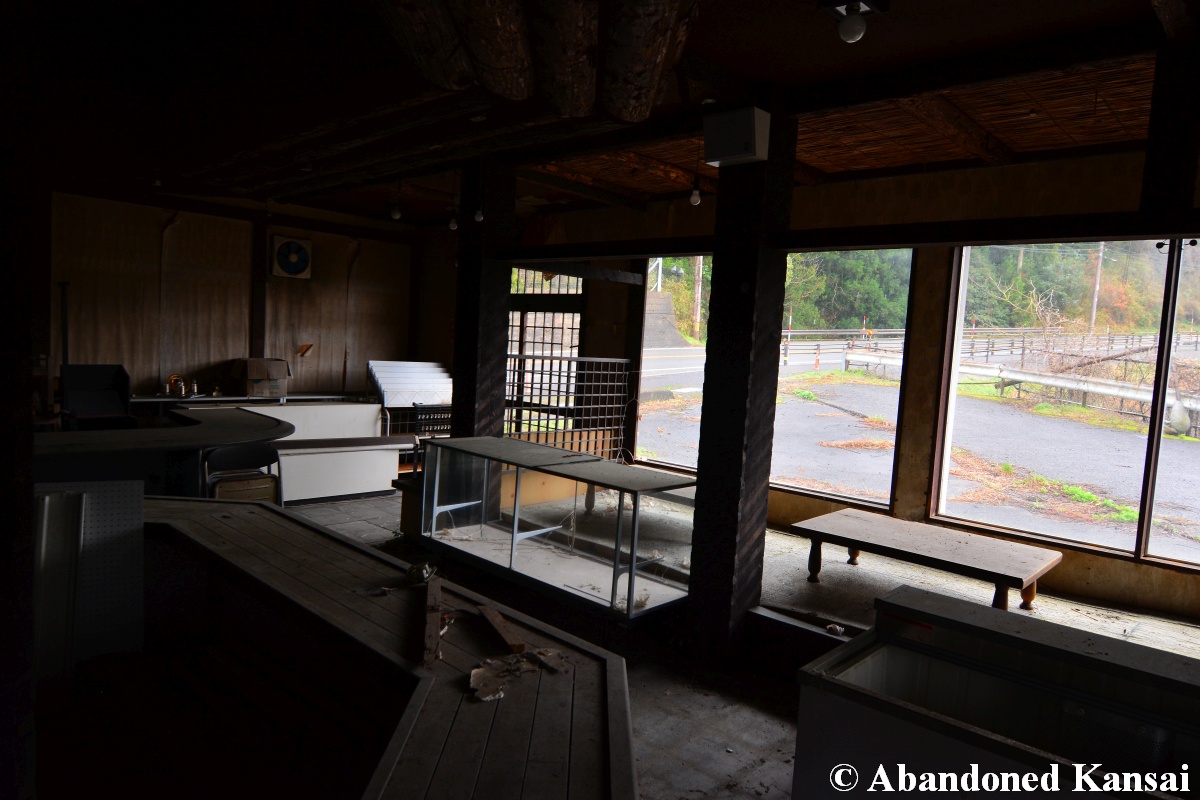
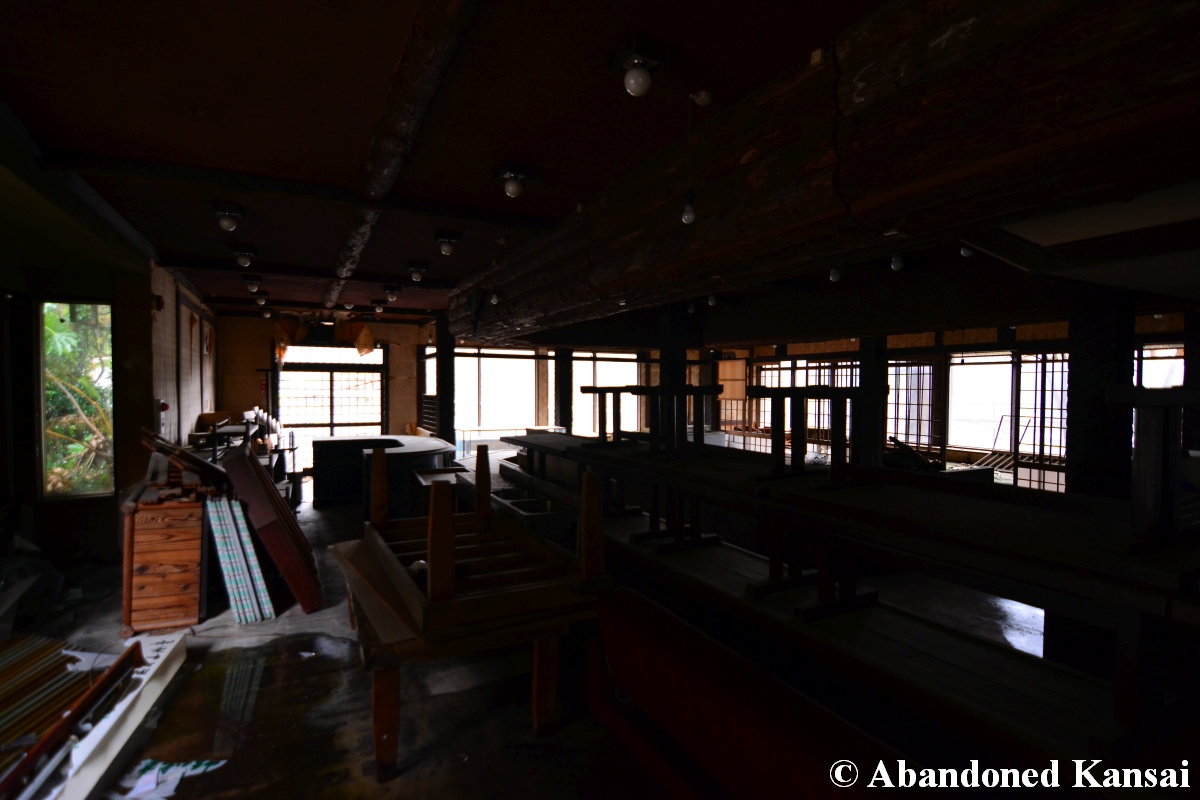
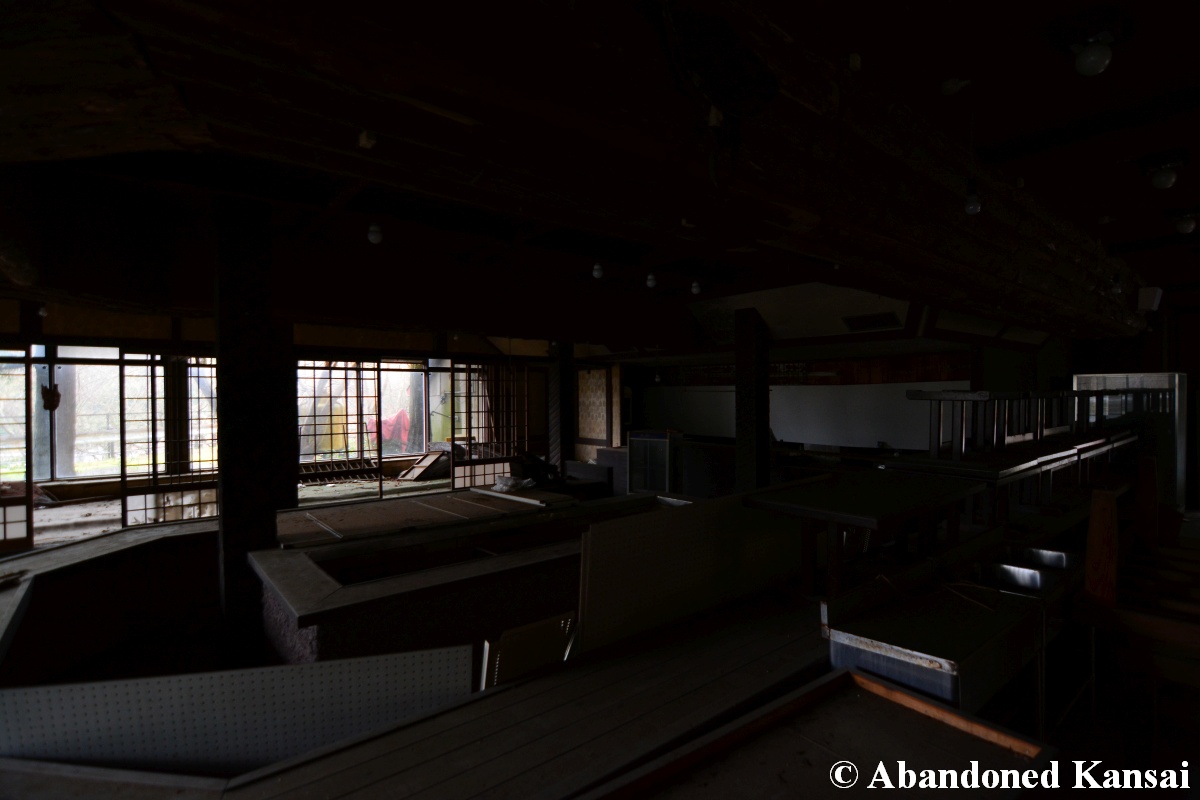
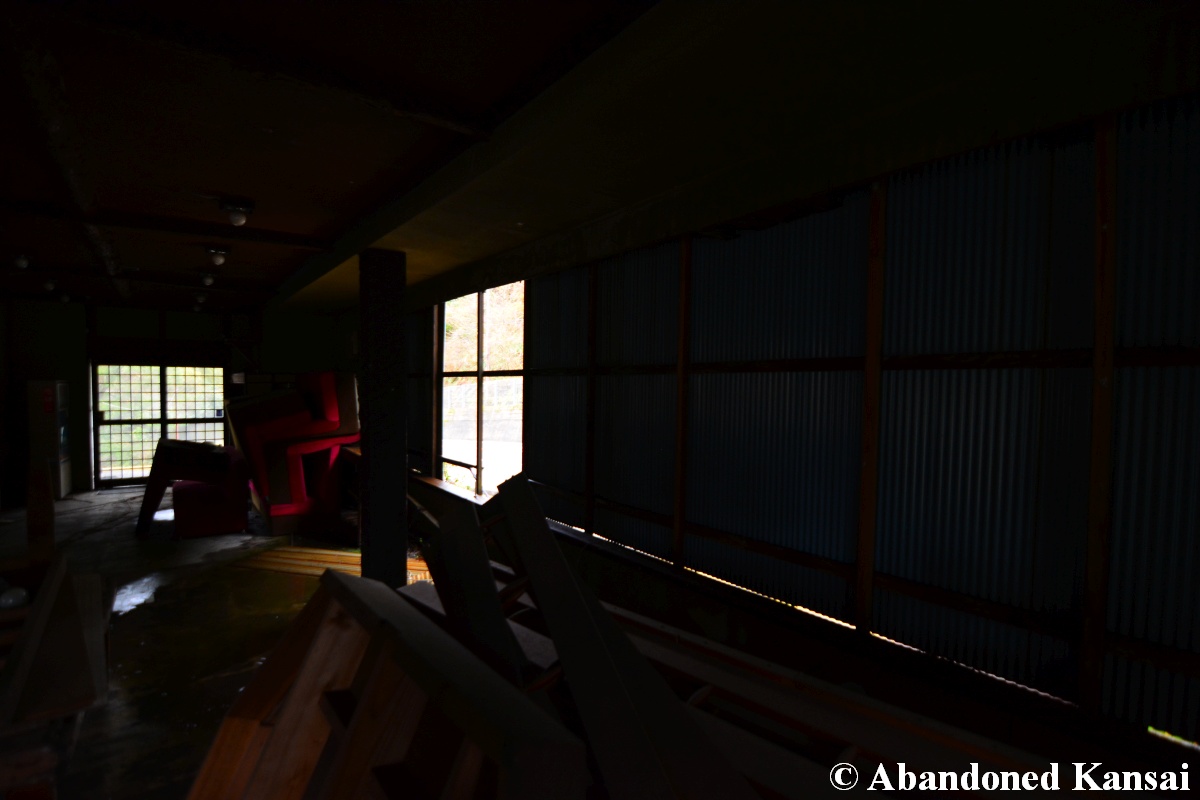
Usually we just pass by the countless closed and abandoned food shacks as there are way too many to check them out all – and the few we checked as inexperienced explorers years ago turned out to be pointless wastes of time. The Tottori Countryside Restaurant on the other hand looked like one of those very promising eateries in the middle of nowhere. Decent size, rustic exterior and even more rustic interior. At first look the place seemed to be boarded up thoroughly, but upon closer investigation it turned out that one of the wooden doors was unlocked; tough to open thanks to years of neglect, but unlocked.
To be honest with you, I didn’t like the place very much. The former dining room was cluttered with all kinds of things, as if the owners laid out everything they had, trying to figure out what to take with them. There was not much light inside the building, which made it kinda tough to take photos without a tripod. And the kitchen? Was probably the 100th abandoned kitchen I have seen in a variety of buildings. Not the worst one by a long shot, but nothing worth taking pictures of, except for the Coke machine they slapped a huge Pepsi sticker on. The upper floor consisted of a couple of small rooms, pretty much all cluttered, too. There we found a calendar or two on the walls, indicating that the restaurant has been abandoned in 1997, more than 15 years prior to our visit. Other than that… just more junk.

Overall a nice little original find, probably more interesting from the outside than the inside – at least to me and my fellow explorers. I think for our taste, it was too close to daily life. If you’ve never been to Japan, this location is probably infinitely more interesting, but to us, there was nothing we haven’t seen a thousand times before. Well, except for that slightly Darth Vader / Mickey Mouse looking sign outside, advertising coffee and cigarettes…

(*Like Abandoned Kansai on Facebook* if you don’t want to miss the latest articles and exclusive content – and subscribe to the *video channel on Youtube* to receive a message right after a new video is online…)

Read Full Post »

Older Posts »