All abandoned: Chernobyl / Pripyat, Nara Dreamland, Anti-Zombie Fortress, Japanese Sex Museum – and many, many more! Plus: North Korea Special – 2 trips, 16 days / 14 nights! As seen on CNN…
The West Sea Barrage is an eight kilometer long system of dams, three locks (capable of handling 2,000 to 50,000 ton ships) and 36 sluices near Nampo. It was built from 1981 to 1986 to close off the Taedong River from the Yellow Sea – the goal was to prevent seawater from entering the Taedong, causing floods. At the same time the Taedong’s water level was supposed to be raised under controlled conditions to improved ship traffic and to make it easier to irrigate fields along the river. Critics claim that the raised water levels destroyed farmland, contributing to the famine that struck North Korea from 1994 to 1998.
Considered a major technological accomplishment the West Sea Barrage is a standard stop for international tourists as well as foreign dignitaries – nevertheless photography was strictly limited until a couple of years ago, since the dam was considered strategically important (if you watched the Vice documentary, this is one of the many aspects where it is completely outdated). Even the former US president Jimmy Carter visited the West Sea Barrage during his stay in the DPRK in June 1994. (Interestingly enough Carter arrived by boat, not by car – I assume you can guess why…)
After a good night’s sleep at the *Ryonggang Hot Spring House* we drove to the West Sea Barrage, more specifically: P’i Do Island, which was included into the dam’s construction. There you can find a visitor center, which is also home to the P’i Do Lighthouse, the tallest and most powerful lighthouse in North Korea, its focal plane at 86 meters. The tower itself is 33 meters high and shaped like an anchor, so it’s also a nice looking monument.
Visits to the P’i Do Lighthouse usually start with the local guide showing you a video tape about the construction of the West Sea Barrage (which was actually quite interesting, despite the fact that it was what most people would consider “a cheesy propaganda video” – nevertheless I liked it quite a bit!), followed by a Q&A session about the dam. Then you go outside to take some photos and leave when your group guides tell you to… The underwhelming opening to a generally slow day.
Rides on the Pyongyang Metro usually were one of the prime examples for how everything on a tour to North Korea is staged – now it is a prime example for how the country opens up to its visitors.
It was the second visit to the DPRK for Jeff, one of the great people of my tour group. Back in 2007 he visited the country for the first time and of course back then a ride on the subway was part of the itinerary, too. For Jeff an underwhelming experience as back then the group was told which train and which wagon to enter – basically an (almost?) empty wagon. Most people describe their experience like that actually. No stops, no freedom, no contact with locals. Again, my experience was quite different.
Since Puhung Station was right across the street from the *Mansudae Art Studio* we accessed the deepest subway system in the world right from there – locals entering and leaving the station via one of the three escalators. (Although the middle one wasn’t running – it wasn’t necessary since the station wasn’t that busy on a Monday afternoon.) In (ex-)communist countries subway stations were / are showpieces – *I’ve been to several stations in Kiev*, so I knew what to expect and Pyongyang didn’t disappoint. While the entrance kind of looked like a bomb shelter (which it will be used for if North Korea ever gets attacked) the platform of the station was absolutely gorgeous. Slightly dim, but lit by beautiful chandeliers. At this point our group got quite excited, with people running back and forth to take photos – and I have to admit our guides looked a bit more nervous. Some people might claim they were worried about… us making contact with people, us taking photos we might not should take, us doing whatever. In my opinion they were actually worried that one of us could get lost, because the metro was quite busy. Not “Tokyo rush hour” busy, but “a good chance to get lost (on purpose / accidentally)” busy. When Mr. Yu tried to get us on a train he was widely ignored as most people were still taking photos – so the train left, and the next one, too; both times accompanied by a wave of locals flushing the station. We finally got close enough together to call us a group again when the next train arrived – and people just headed in, splitting over two wagons. Most likely not according to Mr. Yu’s plans, but rolling with the punches was going both ways… The first ride was a short one as we left the train at the next stop, Yonggwang. Judging by the look on his face Mr. Yu was glad that everybody listened to the plan and actually got off. On past rides Yonggwang Station was the end of the tour on the Pyongyang Metro – which lead to claims that there were no more than two stations and / or all the other ones were secret. While it is rather likely that there are indeed some secret stations for the military (which isn’t uncommon in other countries, too…) there are definitely 17 stations on two lines (locals can change at Jonu / Jonsung, it’s a walk of about 300 meters). So we got off at Yonggwang, took some photos and entered a rather crowded train to ride four more stops to Kaeson – the station right next to the *Arch of Triumph* and the Kaeson Fun Fair; one photo in the arch set actually shows the subway entrance, so I’ll include it here again. Since we skipped a couple of trains before, we were a little bit behind schedule – some quick photos at Kaeson Station and off we went to our bus as countless kids at the *Mangyongdae Children’s Palace* were already waiting for us to show their talents…
Air Koryo is the state owned and government run airline of North Korea, based at Pyongyang’s Sunan International Airport. It was founded under the name SOKAO in 1950 as a joint venture between North Korea and Soviet Russia, but had to suspend business shortly after due to the Korean War. A successor was established in 1954 under the name of Choson Minhang and started operations in late September of 1955 before being renamed Air Koryo in 1993. Air Koryo from the beginning was placed under the control of the Civil Aviation Administration, a part of the North Korean Airforce – which means that all pilots are military officers. Due to North Koreas close affiliation with the soviets all airplanes in the fleet of Air Koryo are Russian models. Antonovs, Ilyushins, Tupolevs. During the Cold War Air Koryo flew to more than three dozen destinations within Korea and all over the world – nowadays there are only three regular international connections (Beijing three times a week, Shenyang twice a week and Vladivostok once a week) plus a couple of charter flights. In Europe Air Koryo is blacklisted since March 2006, though that ban was lifted four years later for two newly acquired Tupolev Tu-204s.
It was on board of one of those two machines that my fellow travelers and I started our trip to Pyongyang in Beijing. Some websites still recommend using Air China (or the 24 hour train…) to get to North Korea’s capital, but I would have chosen Air Koryo anyway if I would have been asked to choose. How often do you have the opportunity to fly Air Koryo?!
Interestingly enough our predominantly white Air Koryo plane was parked right next to a predominantly blue plane by Korean Air – the flag carrier and largest airline of South Korea. Since the Korean Air machine took off before we even boarded I had the great opportunity to take a photo of both machines at the same time when the Seoul bound machine was on its way to the runway. Two planes, one photo. It didn’t cross my mind at the time, but I am sure North Koreans would have loved the picture, them being all about one united Korea. (And so would have the dozen Christians wearing “A United Korea 4 The World” sweatshirts that boarded the plane with us. I seriously hope they were able to leave the country without running into trouble – they might love Korea, but (North) Korea doesn’t love missionaries. And those guys looked like they were on a mission from God…)
Air Koryo actually was the first positive surprise of my *trip to the DPRK*. After using *Ukraine International Airlines to Kiev* three years prior, my expectations on (former) communist airlines were as low as they can get; but the Tupolev Tu-204 was a perfectly fine modern plane with the usual seat spacing, the flight attendants were as friendly as they were beautiful (and they were gorgeous!) and the food was living up to international standards, too.
When checking in I was asking for a seat away from the wings to be able to look outside and maybe take a quick video secretly. At that point the photography situation was a bit up in the air (no pun intended…) – we were told that it’s okay to take photos on board, but not of the stewardesses; and nobody asked about video or footage through the windows. So I took a few quick snapshots until one of the other foreign travelers was shut down when he violated the instructions we got and took photos of a flight attendant… Even worse: After we all settled in and were ready to take off about a dozen Koreans boarded the plane and occupied seats all over the aircraft cabin. Just a coincidence? Or a way to keep an eye on the foreigners at a time when the official guides were still waiting for our arrival in Pyongyang? I felt a bit uneasy, but decided to give the rather young fella sitting next to me the benefit of the doubt. Which turned out to be right about an hour later. Lunch was just served and I was wondering if it was okay to take a photo of the meal – as we all know from Western media: Taking pictures most likely is a crime… So I slowly unwrapped all the small containers and before I could even start to eat my meal the guy in the neighboring seat pulled out his smart phone and took a photo himself. Easy going! The same situation a couple of minutes later. While I was wondering whether it was okay to take some photos of the landscape passing by (there could have been airports or train stations or military camps – or worse!) we were informed that we just entered Korean airspace – and all of a sudden everybody took photos, including our late arriving Koreans. Lesson learned: Don’t shove a lens into somebody’s face and you can take photos of pretty much everything you want…
Air Koryo’s home airport Pyongyang Sunan International Airport is as small as you think it is – two landing strips, one of them closed permanently. There are 10 regular international flights a week at Sunan (7 by Air Koryo, 3 by Air China), plus charter flights and some cargo flights – that’s it! There are no official statistics about flight movements within the DPRK, but I doubt that there are many, given the rather high cost of air transport and the regime’s problem to get fuel.
On the positive side: Immigration is a piece of cake. You show your filled out forms, your passport and your visa – and then you are in. No bag checks, no other bullshit. When you want to enter Japan on the other hand you get treated like a criminal as they take your finger prints and a photo. Every… friggin… time! I’m on my third Japanese long-term visa, I never ran into trouble, I always pay my taxes – nevertheless I get treated like a murder suspect every time I come back from an overseas trip… Welcome home! (Of course this treatment only applies to foreigners, Japanese people just waltz in…)
The Saikaibashi Corazon Hotel Monorail is one of those surprise locations you stumble upon every once in a while. *A year ago during Golden Week* I was on my way to the *Saikaibashi Public Aquarium* and went down some steps minding my own business when all of a sudden I saw something overgrown through the bushes. At first I thought it was the entrance of the aquarium, but getting closer it was pretty clear that this was some abandoned transportation device. A red cabin with very dirty greenish windows. So my second idea (which lasted for the rest of the trip) was that this monorail granted access to the aquarium and therefore was somehow connected to it.
Well, I was wrong, in more than one way. First of all the Saikaibashi Corazon Hotel Monorail technically isn’t really a monorail, at least not in the modern way – it’s more like a slope car (スロープカー/ surōpukā), kind of a sub-category of modern monorails. At least the Japanese term is a brand name of Kaho Manufacturing, so it might not be the proper word to use either, but I guess we’ll go with it from now on.
Since I didn’t know what a slope car was I better give an explanation in case you don’t either. A slope car is a small automated monorail that provides accessibility for handicapped or elderly people, usually transporting them between entrance gates / parking lots / buildings by avoiding stairs at steep slopes. In 1966 Yoneyama Industry invented a fright-only monorail system to be used in mikan orchards (mikan are very delicious seedless and easy-peeling tangerines). A system to transport construction workers and lumberjacks was developed later, but it wasn’t until the 1990s when the system became popular for the general public when Kaho Manufacturing entered the market with great success in Japan and Korea, installing 80 slope cars of their Slope Car brand alone.
I don’t know when the Saikaibashi Corazon Hotel Monorail opened or closed, but I guess it was after 1990. In 1996 it was still operating as I found a report in Japanese written by a guest of the hotel. He was using the slope car at the Corazon Hotel not to reach the Saikaibashi Aquarium, which was already abandoned at the time, but to get to the waterfront below the hotel. From there guests of the Corazon Hotel were able to board a boat once or twice a day to get to the nearby and then quite popular Huis Ten Bosch amusement park, a Netherlands themed park; Nagasaki and the Netherland have a close common history of more than 400 years, sadly the theme park never lived up to that history and is in danger of becoming an abandoned place for about 10 years now – half its existence. I guess at one point in time after 1996 the boat connected to Huis Ten Bosch was cancelled and with that there was no use for the slope car (capacity: 12 people) since the aquarium was already close a long time ago…
Every once in a while you come across words in English that are actually German. Some of them you might know, like kindergarten or rucksack, others are not that well-known, like schadenfreude (malicious joy). Given that Great Britain is the home of modern rail transportation I didn’t expect to find a German term that doesn’t have an equivalent in English, but here we are: Ausbesserungswerk (composed of Ausbesserung = repair / correction and Werk = plant / facory). I never found a spelling with a lower case A, so I guess unlike the previous examples Ausbesserungswerk never became officially an English term, but there is an English Wikipedia entry, so that’s good enough for me…
So, what’s an Ausbesserungswerk? Well, an Ausbesserungswerk is a repair and upgrade shop for railway vehicles and their components. While the so-called Bahnbetriebswerke (train yard / depot / engine terminal – you get the idea…) take care of maintenance, small repairs and cleaning, the Ausbesserungswerke are responsible for bigger repairs, general inspections and modernization. Originally there were 84 Ausbesserungswerke all over Germany, but today there are only 18 left.
One of the closed, abandoned and partly demolished one is / was in the lovely town of Schwetzingen, famous for its palace Schloss Schwetzingen.
On October 14th 1912 the citizen’s committee of Schwetzingen unanimously decided to build an Ausbesserungswerk northeast of the train station. Construction began in 1913 and was finished in 1917 to be opened in 1918. Perfect timing, because due to World War I there was a huge demand for the repair of railroad vehicles and from its opening on the Ausbesserungswerk was the biggest employer in the Schwetzingen area for decades to come, with about 1100 people in 1920.
During World War II the Ausbesserungswerk was fortified with bunkers, some of them are still in existence today. Armored observation towers against air raids were installed on the top of some buildings and in late 1943 a shooting range was built on the business premises – resulting in air raids by the Royal Air Force on March 19th 1945, damaging the buildings and killing 22 employees.
From the 1960s on the Ausbesserungswerk Schwetzingen was in decline. The German post-war economic miracle was in full bloom and a lot of employees switched to more lucrative jobs. At first they were replaced by guest workers, but when there was less and less work the amount of employees was continuously reduced from 1974 with the objective to close the Ausbesserungswerk; against the will of the staff council and the works management. But resistance was futile and on October 11th 1983 the Federal Minister of Transportation signed a document to close the Ausbesserungswerk Schwetzingen. In April of 1987 some employees were relocated to the Ausbesserungswerk in Karlsruhe (closed in 1997, mostly demolished by now) and on December 31st 1989 more than 70 years of railroad history ended in Schwetzingen…
In the following years some of the buildings were used as a half-way house for ethnic German immigrants and applicants for asylum, but most of them were just left to decay and rot – kind of insane, since a couple of buildings of the Ausbesserungswerk were put under monumental protection, which means that they can’t be torn down just like that. That came into effect when in Mai of 2011 all the other buildings were demolished, to make room for a logistics center of the manufacturer of sports equipment, Decathlon, scheduled to be opened in April of 2013. The protected buildings were handed over to the city of Schwetzingen for free, shifting the responsibility (and cost…) to the general public. The federal state of Baden-Württemberg granted 1.5 million Euros in 2010 to redevelop the protected area in the southern part of the Ausbesserungswerk and the city of Schwetzingen is deciding these days what to do with the money and the buildings – most likely a mixed use for both residential and commercial purposes. Those plans might have been affected by a case of arson committed by an 18 year old homeless guy on March 21st 2012, causing damages to the amount of 100.000 Euros, but I’m not sure how or if at all.
The Ausbesserungswerk Schwetzingen was the first urbex location in Germany I ever visited. My trip back home in 2011 was rather rainy and disappointing in general, so when there finally was a sunny day I took my chance and had a look. It was a weird feeling though, since everything felt a bit “more real”. In Japan I can always pretend to not being able to read signs, that I got lost, that I don’t understand a word. In Germany those excuses are a lot harder to make, especially since I am not a good bullshitter in the first place. (On the other hand some things are a lot easier – on later explorations I was able to ask people passing by about the history of places and even ask for permission to take photos, both rather impossible for me to do in Japan…)
Sadly there wasn’t much to see anymore. Most buildings were either in really bad condition or completely bolted up with metal plates. There was an abandoned TV, some instructions signs on walls and a rule book regarding laundry and other aspects of daily life living in the half-way house, but that’s pretty much it. A nice stroll, 1.5 to 2 hours, the most interesting part probably the small playground for children in the back of the half-way house – nothing spectacular, but far from being a disappointment…
When exploring abandoned places you are barely ever the first to visit, mainly because you have to find out about them somehow, which means that somebody had to write or tell you about them – so pretty much the best case scenario is that you haven’t seen too many photos and videos about a location before visiting it. That applied for most spots on my *haikyo trip to Hokkaido*, which is quite unusual, but Hokkaido isn’t exactly popular amongst foreign urban explorers (or Japanese haikyoists…) since it is rather off the beaten tracks. Those barely spoiled locations are especially exciting to explore, since there is only little known about them – how to get in, condition, size, dangerous parts, security…
Whether that’s a good thing or not lies in the eye of the beholder. I like my explorations with as little surprises as possible, to be honest with you, but at the same time I favor locations that haven’t been photographed to death; preferably places that are in the middle of nowhere with not a soul within a couple of kilometers. About 75% of the locations I visited in Hokkaido I knew little more about than their names and a handful of photos before exploring them myself – but the Mount Teine Ski Lift was special and stood out of even that group. Before walking up to the *Olympic Ruins Of Sapporo 1972* I had a look at the surroundings via GoogleMaps and saw a ski lift with two photos of abandoned constructions – but they weren’t named properly and I didn’t even know if they were just misplaced and in fact part of the Olympic Ruins. It turned out that they were a separate location, but although I know its name now researching it wasn’t exactly easy.
When I was walking up to the Mount Teine Ski Lift (which most likely was part of the still active Sapporo Teine Resort) I saw an old bus stop sign of the JR Hokkaido Bus line, although the staff at the JR Teine Station told me there were no busses running; maybe an old sign that was never removed… Not worthless though, as the sign had the name of the stop written on it: 千尺. The first kanji is common – sen, one thousand. But the second I couldn’t read, so I took a photo to find out later. Now I know that it means shaku, which is a traditional unit of measure in Asia, not in daily use anymore in Japan; about 303 mm or almost one foot. So the place was basically called “303 Meters”, although the slope was actually much longer; about 2 kilometers to be more specific. To get to the top you had to use two different lifts and it turned out that the mountain station of the second left was in proximity of the former start of the Olympic Bobsleigh track before it was dismantled, while the *Olympic Ruins Of Sapporo 1972* were the goal – it’s all connected…
If you google the term you’ll end up with links to the Gosenshaku Hotel, a rather high end accommodation in the Japanese Alps, about 1000 km away from the Senshaku ski lift. If you do some more googling in Japanese you might stumble across two year old photos on which the rest house is in way better shape. Now almost completely collapsed it was in decent condition just 24 months prior to my visit – and several (now unreadable) signs revealed more information; sadly the Japanese guys hosting those photos didn’t care to write anything about the place. It seems like the full name was “Teine Olympia Senshaku Highland”. Unlike the bobsleigh ruins, this ski lift didn’t show off the Olympic Rings, so it’s safe to say that it wasn’t part of the official venues; even more so since according to the Japanese Wikipedia the Olympia Highland was established in 1974 and opened in 1976, four years after the games were held. Instead it was a skiing slope for the general public – with lockers, rental gear, food and arcade machines. The chartered shuttle bus service was stopped in August of 2001 and 15 months later Kamori Kanko bought the place (they also own Noboribetsu Bear Park and Noboribetsu Marine Park Nixe near the *Tenkaen, Japan’s Lost China Theme Park*). And at that point I got lost a bit as I found contradictive information about combining two skiing areas, about places getting closed that still have active homepages, about areas that look the same, but have different names… Long story short: I still have no idea when Senshaku was closed!
All I know is that it was exciting walking up to the Senshaku area as I had little to no idea what to expect. While Sapporo itself was still basically snow free the 150 meters of additional elevation and not being in the city anymore made a difference of about 5 to 10 cm – just enough to be fun without being annoying. Of course a car was parked in front of the entrance upon my approach, but I decided to ignore the guy and just walked straight up the hill. I also ignored the mostly collapsed building to the left and had a quick look at the dilapidated ski lift to the right – being all by myself and already rather cold I refrained from climbing that death trap and made my way up the mountain to take some photos of the towers and to take some ultra-wide angle shots of the whole place. Up there I found a big cart with several ropes connected to it, probably used to transport goods up the mountain, though I didn’t find any information about it, even during the research I did for this article. While taking photos of the wagon I heard some wild noises that didn’t sound too friendly. I didn’t see any animals, but I wasn’t exactly eager to have any confrontation, so I grabbed my video camera and walked back down the hill. The video ended abruptly when I turned down the camera as soon as I saw a man standing between the lift and the rest house – preemptive obedience, Japan’s unofficial motto. It turned out that the guy didn’t mean no harm and just had a look himself, but it was good to stop anyway since him walking through the video several times or even talking to me wouldn’t have been good either. Obviously he wasn’t eager to talk to me… and left before I was done taking more photos of the ski lift.
The former rest house was in horrible condition and I only spent a couple of minutes exploring it – because it looked more dangerous than interesting, and because the sun was already setting behind Mount Teine and I still had to walk up the mountain to see the *Olympic Ruins of Sapporo 1972*…
Abandoned Kansai in Hokkaido… Who would have thought that? Up till now I never made it further east than the center of Japan’s main island Honshu. I limited myself to the western half of Japan, because that was the reason I started this blog. Heck, initially I wanted to limit myself to the Kansai region; hence “Abandoned Kansai”, not “Abandoned Japan” or “Abandoned West Japan”. But then the “once in a while” hobby urban exploration turned into a regular thing and only weeks later I went to different regions, then to different islands – and in spring of 2012 I did a *haikyo trip to Okinawa* together with my urbex buddy *Michael Gakuran*. “What’s next?” was the big question, and the answer was found quickly – we already explored Japan’s most western prefecture, so we kind of had to explore Japan’s most eastern prefecture, Hokkaido!
Usually I plan my urbex trips on short notice. One time I brought my urbex equipment to work on Friday to see how I feel during the day, booked a hotel in the afternoon and left for a weekend trip right after work. Flexibility like that is impossible when partnering up for a long distance trip, so Michael and I booked plane tickets weeks ahead – and according to the weather forecast we ended up with a rainy weekend; a long weekend even, to which we added some days. Luckily the forecast was as reliable as always in Japan and so 4 out of my 5 days in Hokkaido were sunny and slightly snowy, only the last one came with 8° Celsius and rain.
Since I arrived almost a day earlier than Michael the original plan for me was to do some sightseeing in Sapporo. To my surprise the weather was sunny to cloudy, no rain at all, so instead of visiting indoor classics like the Sapporo Clock Tower, the Ishiya Chocolate Factory or the Sapporo Beer Museum I opted for a little hike to Mount Teine, once home to some of the sports events at the 1972 Winter Olympics in Sapporo. One day of good weather? I had to take advantage of that! Then it turned out that the next three days were pretty nice, too – which is a big advantage when doing urban exploration as you spend a lot of time outdoors…
On the last day Michael and I split – while he drove for hours to infiltrate a location he asked me to keep secret for now, I went on to do some really touristy stuff, like visiting the old harbor town of Otaru and taking a glass blowing lesson. My favorite touristic place though was the Sapporo night view from the freshly renovated observation platform on top of Mount Moiwa – stunningly beautiful! It was soooooo cold up there, but the view was absolutely amazing! I went there on the first day before visiting the Sapporo White Illumination and I strongly recommend to pay Mt. Moiwa a visit – I would love to shoot a time-lapse video from up there…
Overall the trip to Hokkaido was a great mix of urbex and tourist stuff. Five days I really enjoyed, probably more than any five consecutive days I spent in Osaka this year… So this is a list of the abandoned places I ended up visiting:
Advantest Research Institute Bibai Bio Center Canadian World Park Hokkaido House Of Hidden Treasures Horonai Coal Mine Substation Mt. Teine Ski Lift
National Sanatorium Sapporo Olympic Ruins Of Sapporo 1972 Sankei Hospital
Sapporo Art Village
Showa-Shinzan Tropical Plant Garden Tenkaen – Japan’s Lost China Theme Park
Quite a while ago I wrote about my experiences exploring the *lower terminus of the Yashima Cable Car* – and after I was done I took the bus up the mountain. Usually I would have taken the hiking trail up there (or would have walked along the abandoned track like I did several times at the *Mount Atago Cable Car*), but since I lost quite some time in the morning thanks to a Shinkansen standstill (thanks, JR – the extra fee for the bullet train was really worth the money… grumble…) I took the easy way up. It was also a good way to check out the cable car’s competition, which made me wonder if the bus was already running when the cable car was still operating. Sure, the trip took about 10 minutes instead of 5, but it ended right next to Yashima Shrine (not a kilometer away) and the price was ridiculously low in comparison: 100 Yen each way!
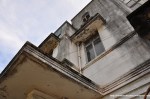
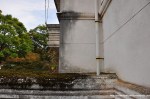
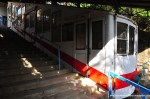
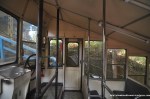
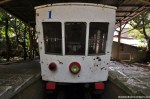
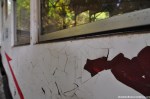
The upper terminus of the Yashima Cable Car (屋島山上駅, yashima sanjo eki, Yashima Mountaintop Station) was as locked up and untouched as the lower terminus – but the building itself was much more beautiful. Rather small, like most cable car stations, it totally reminded me of the *Maya Hotel* in Kobe. I think I’m a sucker for that art deco style of the 1920s and 30s. At the time of my visit the area was used by construction workers of the nearby Yashima Castle reconstruction site – there were parked cars everywhere and their container office almost blocked the access to the cable car track. Luckily none of the workers were in sight when I arrived, so I was able to sneak to the back and took some pictures: car #2 was already waiting for me as I expected, sadly slightly vandalized by some spray paint on the windows of the right side. Similar to the lower terminus the amount of decay was just perfect – the car, the handrails, the building itself. A perfect abandoned beauty, worthy the cover of a book or a magazine.
A couple of weeks before I went to Germany to visit family and friends last year I received an e-mail from Sebastian, a reader of this blog. He told me about exploring a rather recently closed US Army base in Darmstadt – half an hour away from where I was staying for my vacation. I really love abandoned military installations, so we continued talking via e-mail and agreed to meet up to have a look at the Cambrai-Fritsch-Kaserne (CFK) together.
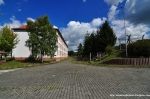
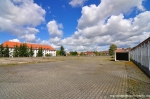
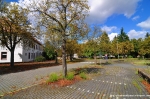
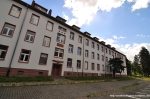
The Cambrai-Fritsch-Kaserne (Cambrai-Fritsch Barracks) in Bessungen, now part of Darmstadt-Eberstadt, was built from 1936 to 1938 as two barracks next to each other – the southern part was known as Cambrai-Kaserne (named after the French city of Cambrai where Paul von Hindenburg had his headquarters during World War I and where the first tank battle in history took place in 1917), the northern part was called Freiherr-von-Fritsch-Kaserne (named after Generaloberst Werner von Fritsch, Nazi Germany’s Commander of the Army at the time). Most of the buildings on the premises were named after locations where famous WWI battles took place, like Verdun or Flandern.
The Fritsch-Kaserne opened on October 12th of 1938 and was home to the 1st Battalion of the 33rd Artillery Regiment, part of the 33rd Infantry Division. Later that month the 3rd Battalion moved into the Cambrai-Kaserne.
During the final days of World War II the US Army took over the Cambrai-Fritsch-Kaserne in March of 1945, making it the home of the 22nd Signal Brigade, the 233rd Base Support Battalion and the 440th Signal Battalion. Lots of service and recreational institutions were located at the CFK in the decades to come – AAFES Food Court, American Red Cross, Andrews Federal Credit Union, Darmstädter Catering Center, PX (post exchange), SATO Travel, Shopette, U.S. Post office, USO and standard facilities like a motor pool, a gym, a movie theater, a sports field and a bowling center.
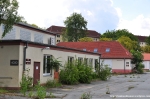
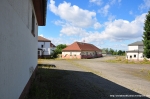
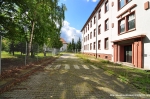
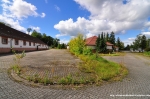
When I met Sebastian on a warm, sunny summer day he told me right away that the CFK was closed, but not really abandoned. The high barbed wire fences were in exceptionally good condition 3 years after the Cambrai-Fritsch-Kaserne was shut down in 2008 – and Sebastian also mentioned that security guards were still patrolling the outskirts of the premises a couple of evenings per week. Well, we met in the morning, so what could happen, right? Let’s get this infiltration started! Like the *Federal Armed Forces Depot Pfeddersheim* the CFK is now the responsibility of the Institute for Federal Real Estate (Bundesanstalt für Immobilienaufgaben / BIMA) – they have to decide what to do with the 25 hectare (250.000 square meters or 2,7 million square feet) big area. Most likely it will be reconverted into housing for 2500 people, but German bureaucracy is slow and of course nothing has been decided yet. Not in summer of 2011 and AFAIK not in late spring of 2012. But while the BIMA obviously doesn’t care anymore about the depot in Pfeddersheim they seem to smell money when it comes to the CFK – housing for 2500 people, that’s serious real estate! And that’s why the keep the area in good shape by hiring gardeners and plumbers to take care of the premises. All the buildings we tried to enter were locked, hardly any of them were damaged by vandalism or graffiti.
It’s an absolutely mind-blowing experience to explore closed US army barracks, especially with a rather tight security system like this one. The weather was amazing that day and the video material I shot turned out to be nice, too. It was a perfect exploration until… well, we were less than 30 meters away from our top secret entrance / exit when it became clear that infiltration is for pros and neither of us was Solid Snake. I will spare you the details, but like running into security at *Nara Dreamland* this wasn’t exactly a fun experience. No legal consequences since we could convince the people involved that we were just harmless photographers, but this was pretty much the day I realized that urban exploration and urban infiltration are two different things – and I decided that I will limit myself to UE and abandon UI.
Sebastian and I were lucky that day, but entering the Cambrai-Fritsch-Kaserne without permission can have serious, serious consequences, so I highly recommend to stay away or to take photos through the fence.
To all the American (ex-)soldiers reading this article, most of them probably stationed at the Cambrai-Fritsch-Kaserne: When I was a pupil in the 80s my elementary school was way ahead of its time and had a friendship program with the Benjamin Franklin Village in Mannheim. I have nothing but pleasant associations with that exchange program and I consider this exploration a “Thank you!” for the kindness I experienced during that time (I think we went bowling as a big group and then had lunch at our exchange partner’s home, which is a pretty big thing when you are 8 or 9 years old and barely understand each other’s languages!) – I hope I was able to bring back some fond memories of your time in Germany!
Being a mountainous country Japan has lots of cable cars and ropeways. And it seems like every single one of them was built in the late 1920s / early 1930s. A lot of them were demolished after just a couple of years in the 1940s to support the war efforts of Imperial Japan (every piece of metal counted…) – amongst others the *Mount Atago Cable Car* and the *Rokko Ropeway*. The Yashima Cable Car (YCC) had a bit more luck. Opened on April 21st 1929 it too was suspended as a nonessential line on February 11th 1944. But although some material was taken away (I’m not sure what exactly though…) it didn’t mean the end of the YCC: On April 16th 1950 the Yashima Cable Car opened again for business. And business was good thanks to the famous Yashima Shrine on top of Mount Yashima, about a kilometer away from the YCC terminal. I guess it got even better when some businessmen decided to make Mount Yashima a full-blown tourist attraction (*you can read all about it here*), but when the plan fell through the Yashima Cable Car was in trouble, too. On October 16th 2004 operations were suspended again, but it took almost a year (August 31st 2005) until the line was officially closed and abandoned.
According to a tourist guide book first published in the 1980s the cable car ran from 7 a.m. to 7 p.m., charging 1160 Yen for the roundtrip. It seems like prices went up and service hours were cut down, so in 1999 the cable car ran every 20 minutes from 8 a.m. to 5.40 p.m., charging 700 Yen one way and 1300 Yen for a roundtrip.
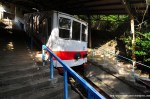
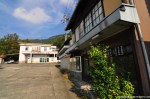
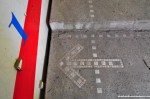
At the time of my visit the lower terminus of the Yashima Cable Car (屋島登山口駅, yashima tozanguchi eki – Yashima Trailhead Station) stood locked-up and abandoned on the foot of Mount Yashima near the trailhead up the mountain. The road leading there was almost as abandoned – I could vividly imagine how good business must have been 20, 30 years ago for the now closed restaurants and souvenir shops. Right next to the station were a taxi stand and a metalworking company, making some noise and keeping an eye on the inaccessible station building. The 858 meter long cable car track was accessible though, with car #1 parked right at the platform. And it was beautiful! On the one hand it was hard to believe that the place had been abandoned just six years ago, on the other hand there were no signs of vandalism and everything had just the right amount of decay – and the beautiful weather on the day of my visit didn’t hurt the atmosphere either…















 Abandoned Kansai