Feeds:
Posts
Comments

Archive for the ‘Europe’ Category

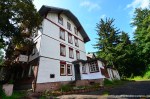
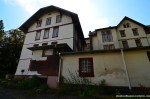
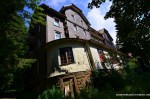
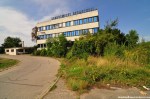
Abandoned furniture stores are quite rare, I’ve actually never heard of one before. Most of the times they are located near shopping malls and either the direct competition takes over and slams their name on it – or some other giant store is happy about aquiring cheap real estate with lots of selling space. Möbel Erbe was different though – and it ended in a fascinating but sad story about greed and incompetence…

First of all, just in case your German is rusty: Möbel means furniture. So Möbel Walther is a furniture store named after the Walther family, Möbel Kraft was named after the Kraft family and Möbel Erbe… right, after the Erbe family.

Until the mid-2000s the Erbe family owned two huge furniture stores, one in Hanau near Frankfurt (more than 50000 square meters, which equals about 538200 square feet) and one in Schkeuditz near Leipzig (about 25k sqm). There might have been a third store, but more likely is that some authors were confused by stores of the same name or by not knowing much about geography.  (E.g. Dölzig is near Schkeuditz, but it’s highly unlikely that Möbel Erbe would have run two stores of that size within five Kilometers of each other.) It was generally tough to find information about the company’s history, specifics about furniture stores are not exactly popular a topic on the internet…
What I was able to find out was that in 2000 Möbel Erbe expanded their original company home with a 5-storey, 30000 sqm building right across the street and connected it with a glass bridge. The so-called “Eurostore” aimed at a younger audience, kind of an IKEA clone. Successfully, according to news reports from 2002, when owner Thomas Erbe was awarded the “OSKAR für den Mittelstand” (OSKAR for Small and Medium Sized-Businesses”) by the Oskar Patzelt Foundation; kind of the Academy Award of enterprises in Germany – which is why the Academy of Motion Picture Arts and Sciences sued… and settled out of court after seven years in 2005, with the prize being renamed to “Großer Preis des Mittelstandes” (Grand Prize of Small and Medium Sized-Businesses). Erbe reportedly was chosen from almost 1000 companies after being nominated four times in previous years. Basically a rock-solid company from all I know, with more than 100 Million Euros revenue per year…

In 2005 strange things happened… In February media reported that the furniture store chain “Sconto” was trying to get permission to build another store in Großaurach near Hanau, but residents and politicians there voiced opposition. Sconto belongs to Kurt Krieger, who also owns Möbel Kraft, Möbel Walther as well as Höffner – plus probably some more, but the company structure is complicated and at least one of his daughters, Sonja Krieger, is in the business, too; acting indepedently, of course. Anyway, Sconto in Großaurach near Hanau wasn’t going to happen and so on July 1st Höffner announced the acquisition of Möbel Erbe out of nowhere; Kurt Krieger in control of Hanau, Sonja Krieger in control of Schkeuditz; and Thomas Erbe told a newspaper that he considered himself responsible personally that nobody gets fired.
Three weeks later Sonja Krieger announced that Möbel Erbe in Schkeuditz would be closed due to the store’s catastrophic economical situation she said she wasn’t aware of before… Yeah, right. Daddy’s in the furniture business since 1967 and is #2 right behind IKEA in Germany and they had no clue what they were buying… so they had to close… by the end of August! Right. But it gets worse!
Four weeks after the aquisition of Möbel Erbe in Hanau and just one week after his daughter fired 120 people in Schkeuditz (the Krieger family conglomerate owned two gigantic stores nearby and didn’t offer any of the former Erbe employees jobs there…) Kurt Krieger announced that Möbel Erbe in Hanau would be closed. But he wasn’t in a rush. While his daughter gave her employees only five weeks notice, “Karate Kurti” was nicer and gave them seven weeks… The reasons given? Same as is in Schkeuditz, the catastrophic economical situation of the store. This time 230 employees were fired, despite (or because of…) the fact that the Krieger family owned two other mega stores less than a dozen kilometers away from Möbel Erbe in Hanau, which was closed in mid-September. But it gets worse!
On December 27th a Sconto furniture store opened in Hanau… in the building formerly occupied by the Eurostore. Yes, in the exact same Möbel Erbe extension Kurt Krieger bought along with the main building… and whose employees he fired just four months prior! Oh, BTW, according to media reports Kurt Krieger’s personal fortune is about 600 million Euros…
(This is the story how I pieced it together from about two dozen news reports I found online. If any former employee or other insiders know more about the story please feel free to correct me or add bits and pieces!)

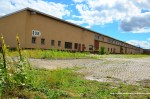
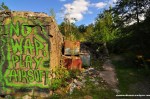
Eight years after the main store was closed, it is still empty and in worse shape than ever. The latest media reports about the completely vandalized building are from 2011, stating that Kurt Krieger suggested several business plans about food retail and electronic stores, all of which were declined by the Hanau city council, which decided in 2005 that they won’t allow any other retail stores on the premises in an attempt to proctect retailers in downtown Hanau from mega stores in the outskirts. So the inevitable happened and airsoft players, graffiti sprayers and vandals took over.

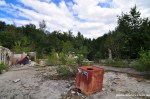
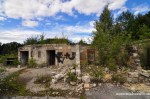
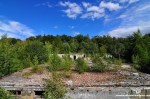
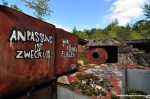
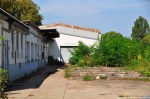
Interestingly enough I had never heard of the abandoned Möbel Erbe Furniture Store before, despite its quite exposed location – it was actually my sister who spotted it from the car when we were on our way to some closed / abandoned military bases in Hanau, including the *Pioneer Kaserne* I wrote about a couple of weeks ago. For some reason the place doesn’t seem to be very popular with German urban explorers… but I actually enjoyed it. Sure, there was not much to see and the huge storage in the back was partly demolished already, but if you had a closer look you could find some interesting things, like the almost completely broken window front or a couple of items like old order forms and left-behind 5.25” floppy disks. Möbel Erbe probably would have been a disappointment if it was supposed to be the exploration highlight of the day, but as an original find it was a perfect snack on the way to other locations…

(If you don’t want to miss the latest article you can *like Abandoned Kansai on Facebook* or subscribe to the *video channel on Youtube*…)

Read Full Post »

The Pioneer Kaserne in Hanau is one of those countless former American military bases that currently are in kind of a limbo – the US Army gave it back to Germany (under the management of the BImA), but the local government hasn’t decided what to do with it. During the Cold War Hanau was one of the biggest US garrisons in the area, in case the Red Army would try to break through the Fulda Gap and attack Frankfurt. Back then up to 30.000 soldiers and civilians were working at the Pioneer Kaserne and other locations like the Francois Kaserne (returned to Germany in 1992), Coleman Barracks (1992) Hessen-Homburg Kaserne (1992), Grossauheim Kaserne (1993), Hutier Kaserne (1994/2007), Fliegerhorst Langendiebach (2007) Hanau AAF, Wolfgang Kaserne (2008), York Hof (2008) and the Argonner Kaserne (2008) – one third of Hanau’s total population. While most of the other locations already found new purposes and are currently converted (or have been in the past), the destiny of the Pioneer Kaserne and its two housing areas is still up in the air. With a total size of more than 600.000 square meters the Pioneer area is gigantic, nevertheless it’s only about a quarter of all the military estate Hanau has / had to integrate into its city planning concept…

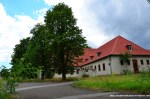
Like pretty much all closed military bases rather close to city centers (like the *Cambrai-Fritsch-Kaserne* in Darmstadt), the Pioneer Kaserne is kind of fortified – of course it is, it’s a huge former military base! But unlike most others, this one didn’t have any “Trespassing is strictly forbidden!” signs. No, the local security company is more subtle. They only put up signs stating “Das Betreten des Geländes erfolgt auf eigene Gefahr” (“Entering the premises happens at your own risk”) – right next to a sign warning about watchdogs… including a drawing of a German shepherd. I guess the message is clear!
Despite those threa–… announcements… I did my best to avoid the usual “fence from the outside” photos you can usually find on the internet, resulting in quite a few scratches and bruises… Oh, and if you ever worked at the Kaserne or nearby: the KFC is gone now, but the Café del Sol still is really popular. Thanks to the watchdogs and the security guards pretty much all the buildings are in fantastic condition, so let’s hope that the city of Hanau will find a new purpose for the Pioneer Kaserne soon!

(If you don’t want to miss the latest article you can *like Abandoned Kansai on Facebook* or subscribe to the *video channel on Youtube*…)

Read Full Post »

The Hochspeyer Munitions Storage (HMS, a.k.a. Ammunition Storage Annex Hochspeyer) was one of the most fascinating and mysterious military installations I visited during my trip to Germany in the summer of 2013. I actually wanted to visit the place two years prior right after exploring of what was left of *Sembach Air Base*, but sadly we ran out of time back then after my buddy Gil and I were surprised by a cloudburst…

Just a couple of weeks ago I came back with my friend Catherine. The Palatine area is perfect to combine long walks with urban exploration, so I chose the forests around K-Town (commonly known as Kaiserslautern) for a little catch up trip. The first location we went to turned out to be proof of Germany’s interesting energy policy and a terrible disaster for fans of abandoned military bases as it was converted into a gigantic solar farm; the next one, Hochspeyer Munitions Storage, on the other hand was kind of a jackpot.
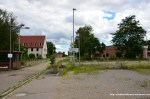
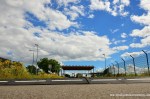
We entered the premises via a road blocked by two concrete barriers – no cars allowed, only bikes and pedestrians. We actually didn’t see a single “Don’t trespass!” or “Trespassers will be shot!” sign, so we felt very comfortable there, despite the fact that there was not much to see at first. Just a single green building, the interior smashed to pieces, and a big asphalted area with only basic foundations left – probably a motor pool half a century ago. Heck, even the fence was mostly gone, with only a couple of concrete posts left. Although I did quite a bit of research on the Hochspeyer Munitions Storage I am still not sure whether or not this area was officially part of it – if it was, it was mostly demolished and abandoned decades ago. But the HMS dates back to the 1960s, so it’s rather likely that both area saw activity at the same time back in the days. And while one part was left deserted, the other got modernized again and again…
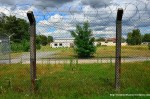
Deeper into the forest Catherine and I found a locked gate, part of a really tall barbed-wire fence with a series of lamp posts every 25 meters set 5 meters behind the fence. Despite its location in the middle of the woods this area was carefully deforested and secured – trespassers could be seen easily from large distances. Abandoned or not, the people who planned this area knew what they were doing, eager to keep people out. Everything there was in great condition at first sight: the fence, the gate, the locks, the lamp posts, the security perimeter… only some open doors at a building in the distance indicated that the area really might have been abandoned. So we looked for a way in and indeed found one.
We quickly approached the green building, eager not to be seen from people on or off the premises – with Ramstein Air Base not being far away we saw plenty of stuff flying across our heads. The flat part consisted of a machinery room, restrooms and a couple of office / conference rooms, the rather high part seemed to have been a storage and / garage, probably to de/load vehicles. SIgns were either in English or bilingual, English and German. The most interesting one was just airbrushed onto the wall:
Explosive Limits
1.1  5,000  lbs
1.2  5,000  lbs
1.3  10,000  lbs
1.4  Physical Capacity
Personnel Limits
2 Supervisors
5 Workers
2 Casuals
Okay… this definitely wasn’t the average administrative building you see when entering abandoned military bases, this was serious stuff! And everything looked pretty new, aside from some vandalism. Was this area really abandoned?

Catherine and I continued to explore the area. Next we found the former main gate with the gatehouse. One window open, others smashed – raw violence, because those windows were made from bulletproof glass. Again, serious stuff. When I opened a small door on the back I could feel that it was really heavy, despite the fact that it opened smoothly. The interior of the building was mostly gone, but you could see that once it must have been stuffed with tons of electronic devices. Probably not too long ago, given that you could basically start to reuse the building after a couple of hours of repairs. Nothing too serious, but probably costly.

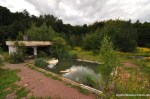
I have to admit that I felt a bit more more uneasy inside the fenced area than outside in the 60s foundation area, and that didn’t change when finally reached the bunker area, tire tracks still on the ground, low vegetation, filled water reservoirs after a hot summer, the pool liner still in great condition. This site was definitely closed, but was it really abandoned? That thought resounded my mind like spoken words in the open bunkers. The acoustics there were fantastic, especially since I am so used to shut bunkers, sitting there inaccessibly everywhere in forests all over German. Finally being able to enter some of them was amazing, one of those minor urbex highlights you stumble across every once in a while. As was a nearby tool shack, where the silhouettes of the equipment were painted onto the wall, so even Private Paula would know where to put things back. Another minor highlight was that one bunker that was built differently in many ways and had a gigantic safe built in, installed by Garny – founded 200 years ago in 1813. (This was a newer model, of course…)

Usually it takes me months, sometimes even years, to write about my explorations, but the Hochspeyer Munitions Storage was a truly exciting exploration, one that made me write this article while I was still in Germany, taking an afternoon of doing research about what the place really was.
Sadly not much is known about the Hochspeyer Munitions Storage. At first I thought it was related to the *Sembach Air Base* I mentioned earlier, which it probably was at one point, but since the airfield there was closed it seems like the HMS was part of the famous Ramstein Air Base; some guy in a German internet forum claimed at one point it was a sub-camp of the USAF Depot Morbach-Wenigerath, now known as Energiepark Morbach (energy park Morbach).
The few facts are that the HMS was 88 acres big (about 356000 square meters), had 30 bunkers, was part of the USAFE (United States Air Forces in Europe), that the road there was built in 1957 thanks to a Captain Joseph T. Sampson – and that it was closed in 2007 as part of “Air Force Smart Operations for the 21 Century” (AFSO21) to save a couple of bucks. In early 2007 Ramstein’s 435th Munitions Squadron started transporting material from Hochspeyer to their main base, the last truck leaving on October 12th of the same year. Apparantly most of it were BLU-109 bombs, nasty buggers that are used against HDBTs (Hard and Deep Buried Targets) and can break through 1.8 meters of ferroconcrete before exploding. Which explains the setup of the facility – it’s the kind of technology you don’t want to have fallen into wrong hands… and the kind of technology local civilians shouldn’t know about.
The rest is vague. Some people claim that the area was returned to Germany, others say that it is still under the control of the USAFE. (Since there were no warning signs in German I assume the area still belongs to the US. In cases like that the Bundesanstalt für Immobilienaufgaben (BIMA, Institute for Federal Real Estate) usually takes over – and they are pretty good at putting up signs. Making good use of the area? Not so much. Putting up signs? Hell yeah!) Some people claim the premises are abandoned, others say that they are still used for emergency drills and patrolled by security – or in this case rather security police.

Whatever is true, I am happy that I was able to explore the Hochspeyer Munitions Storage without causing trouble for me and my companion. It was a very memorable experience and I did as much research as possible afterwards, but if you know more about the place, having worked there or being a (hobby) historian, please feel free to add facts and anecdotes in the comments section!

(If you don’t want to miss the latest article you can *follow Abandoned Kansai on Twitter* and *like this blog on Facebook* – and of course there is the *video channel on Youtube*…)

Read Full Post »

Sometimes you just gotta be lucky. Like my friend Nina and I were when we were walking up to the former Ammunition Depot Achern in the southern part of Germany. We didn’t know anything about the location except that it was there – and when we tried the handle of the gate it opened to our surprise. Right next to the entrance we found a small building in excellent condition, locked, a bicycle inside, the logo of the Technisches Hilfswerk (THW) on the side. In case you are not familiar with German institutions – the THW is a Federal Office, the official English name is Federal Agency for Technical Relief; the THW helps in cases of floods, earthquakes and other disasters. So the depot wasn’t part of the Bundeswehr (Federal Armed Forces) anymore, but now belonged to the THW… interesting, from military to civil protection. Right next to the building the road split 3 ways and we walked down the most southern one, towards the 17 former ammunition bunkers of different sizes and an abandoned train used for training missions. We took a couple of photos and then we heard voices… Damn! When we reached the end of the road we headed north to the middle road and saw a couple of guys on a training mission. Since they didn’t see us and we didn’t want to cause any trouble we took the most northern road and headed back to the entrance, continuing to take photos as we made a strange discovery in that area: A huge aviary inhabited by dozens of exotic birds. The former ammunition depot really wasn’t that abandoned…

I forgot how we knew, but when we came back to the entrance we realized that somebody must have had entered or left since we got inside. Maybe the gate was not fully closed anymore or we left it open and it was closed now. Maybe there was another bike… I forgot, but I remember that we knew that people were still coming / going. Being back to safety I got gutsier again while Nina decided to wait at the entrance just in case somebody would show up and lock the gate without us knowing; which would have been bad, because the place once was a restricted military area and still is in the possession of the German state – if we would have gotten caught we most likely would have been in trouble; but if we would have gotten locked in, there most likely wouldn’t have been a way out due to lots of barbed wire everywhere… and probably motion detectors on the fences. Nevertheless I went back inside to take a quick video before we finally left after about half an hour altogether.

I mentioned it before and I’ll stick with it: I don’t like infiltration and this was (hopefully…) the last time I did it; mainly because I misjudged the situation – I actually wasn’t aware that the THW is a Federal Agency, I thought it was a private NGO / NPO like the Red Cross, probably because 99% of its members are volunteers… So I guess I dodged at bullet at the abandoned ammunition depot! 🙂

(If you don’t want to miss the latest article you can *follow Abandoned Kansai on Twitter* and *like this blog on Facebook* – and of course there is the *video channel on Youtube*…)

Read Full Post »

Every once in a while you come across words in English that are actually German. Some of them you might know, like kindergarten or rucksack, others are not that well-known, like schadenfreude (malicious joy). Given that Great Britain is the home of modern rail transportation I didn’t expect to find a German term that doesn’t have an equivalent in English, but here we are: Ausbesserungswerk (composed of Ausbesserung = repair / correction and Werk = plant / facory). I never found a spelling with a lower case A, so I guess unlike the previous examples Ausbesserungswerk never became officially an English term, but there is an English Wikipedia entry, so that’s good enough for me…
So, what’s an Ausbesserungswerk? Well, an Ausbesserungswerk is a repair and upgrade shop for railway vehicles and their components. While the so-called Bahnbetriebswerke (train yard / depot / engine terminal – you get the idea…) take care of maintenance, small repairs and cleaning, the Ausbesserungswerke are responsible for bigger repairs, general inspections and modernization. Originally there were 84 Ausbesserungswerke all over Germany, but today there are only 18 left.

One of the closed, abandoned and partly demolished one is / was in the lovely town of Schwetzingen, famous for its palace Schloss Schwetzingen.
On October 14th 1912 the citizen’s committee of Schwetzingen unanimously decided to build an Ausbesserungswerk northeast of the train station. Construction began in 1913 and was finished in 1917 to be opened in 1918. Perfect timing, because due to World War I there was a huge demand for the repair of railroad vehicles and from its opening on the Ausbesserungswerk was the biggest employer in the Schwetzingen area for decades to come, with about 1100 people in 1920.
During World War II the Ausbesserungswerk was fortified with bunkers, some of them are still in existence today. Armored observation towers against air raids were installed on the top of some buildings and in late 1943 a shooting range was built on the business premises – resulting in air raids by the Royal Air Force on March 19th 1945, damaging the buildings and killing 22 employees.
From the 1960s on the Ausbesserungswerk Schwetzingen was in decline. The German post-war economic miracle was in full bloom and a lot of employees switched to more lucrative jobs. At first they were replaced by guest workers, but when there was less and less work the amount of employees was continuously reduced from 1974 with the objective to close the Ausbesserungswerk; against the will of the staff council and the works management. But resistance was futile and on October 11th 1983 the Federal Minister of Transportation signed a document to close the Ausbesserungswerk Schwetzingen. In April of 1987 some employees were relocated to the Ausbesserungswerk in Karlsruhe (closed in 1997, mostly demolished by now) and on December 31st 1989 more than 70 years of railroad history ended in Schwetzingen…
In the following years some of the buildings were used as a half-way house for ethnic German immigrants and applicants for asylum, but most of them were just left to decay and rot – kind of insane, since a couple of buildings of the Ausbesserungswerk were put under monumental protection, which means that they can’t be torn down just like that. That came into effect when in Mai of 2011 all the other buildings were demolished, to make room for a logistics center of the manufacturer of sports equipment, Decathlon, scheduled to be opened in April of 2013. The protected buildings were handed over to the city of Schwetzingen for free, shifting the responsibility (and cost…) to the general public. The federal state of Baden-Württemberg granted 1.5 million Euros in 2010 to redevelop the protected area in the southern part of the Ausbesserungswerk and the city of Schwetzingen is deciding these days what to do with the money and the buildings – most likely a mixed use for both residential and commercial purposes. Those plans might have been affected by a case of arson committed by an 18 year old homeless guy on March 21st 2012, causing damages to the amount of 100.000 Euros, but I’m not sure how or if at all.

The Ausbesserungswerk Schwetzingen was the first urbex location in Germany I ever visited. My trip back home in 2011 was rather rainy and disappointing in general, so when there finally was a sunny day I took my chance and had a look. It was a weird feeling though, since everything felt a bit “more real”. In Japan I can always pretend to not being able to read signs, that I got lost, that I don’t understand a word. In Germany those excuses are a lot harder to make, especially since I am not a good bullshitter in the first place. (On the other hand some things are a lot easier – on later explorations I was able to ask people passing by about the history of places and even ask for permission to take photos, both rather impossible for me to do in Japan…)
Sadly there wasn’t much to see anymore. Most buildings were either in really bad condition or completely bolted up with metal plates. There was an abandoned TV, some instructions signs on walls and a rule book regarding laundry and other aspects of daily life living in the half-way house, but that’s pretty much it. A nice stroll, 1.5 to 2 hours, the most interesting part probably the small playground for children in the back of the half-way house – nothing spectacular, but far from being a disappointment…

(If you don’t want to miss the latest article you can *follow Abandoned Kansai on Twitter* and *like this blog on Facebook* – and of course there is the *video channel on Youtube*…)

Read Full Post »

Since I’ve been terribly busy recently both at work and with several urbex projects / explorations it sadly has to be a short article this week; a location that took me just a couple of minutes to shoot, actually – the Kurhaus Sand (or Hotel Sand).

When I went on vacation to Germany in summer this year I met up with a kindergarten friend of mine, Nina. She became a regular reader of this blog and was eager to explore with me, so I planned a daytrip to the Schwarzwald (Black Forest) area of Germany. I had several leads there and thanks to an early start we managed to visit 7 (!) different locations on one day – possible only because some of them weren’t accessible; one of them being the Kurhaus Sand. Strangely enough a name that works both in English and German, but since kurhaus isn’t nearly as common as kindergarten let me give you a quick translation: health resort.

And that’s basically what the Kurhaus Sand was – a health resort in one of Germany’s most beautiful regions, the Black Forest. Not much more than a couple of houses in the middle of nowhere, Sand isn’t even a village. Its origin though is the now abandoned kurhaus. Around 1845 a mountain shelter was build on sandy soil (hence the name Sand, which means sand… Captain Obvious strikes again!) as a refugee for forestry workers. A couple of years later somebody started to sell beverages, with little success (the hut was subsidized by the city…), but after some state investments in 1874 the hut was turned into an inn under the direction of the retired country constable Josef Martin Weis at the age of 57. The place became more and more popular amongst hikers and in 1884 the previous head chef August Maier became the new tenant. In the early 1890s Maier bought, enlarged and enhanced the inn and re-opened it as the Kurhaus Sand in the presence of Frederick II, Grand Duke of Baden – the last Grand Duke of Baden. The area continued to thrive, so around 1920 a gas station was added, in 1930 a post office opened and in 1936 a police station started its service. During those days the ownership of the Kurhaus Sand changed several times, but I’ll spare you the details.

Nowadays all of these installations are closed. Only the 1949 opened Bergwaldhütte (Mountain Forest Hut), a convalescent home for children and later for policemen, is still in business – offering food and drinks for all travelers coming through on the popular Schwarzwaldhochstraße (Black Forest High Street).

When Nina and I drove up to the Kurhaus Sand we were forced to stay inside the car for a couple of minutes as a cloudburst made it impossible to start our exploration right away. When we were finally able to get close we were still not sure if the Kurhaus Sand was really abandoned or not as the place isn’t really popular amongst German urban explorers. The building was in pretty good condition, but since there was no activity during a time that is considered the busiest vacation time in Germany it must have been abandoned… We were able to walk around the building clockwise once – no signs of anybody, no signs of vandalism, but also no way to enter the building…

It wasn’t until my return to Japan that I found out that a family named Wiedemann were the owners of the Kurhaus Sand from the 1930s on. In 1977 Günter Milz took over and turned the place into a popular destination for day trippers – he modernized the hotel part (baths, elevator, …) and his restaurant became famous for the cuisine of Baden; like Flädlesuppe, Käsespätzle, Maultaschen and Schupfnudeln. Milz retired in 1994, but I couldn’t find any information about the almost 20 years since then. Given the decent condition the Kurhaus Sand is still in it must have been opened for business for another couple of years, but who knows? Thanks to its remote condition hardly anybody would go there just to vandalize it… Luckily there are many local historians in Germany – maybe one of them finds this article and can add some information?

Read Full Post »

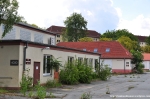
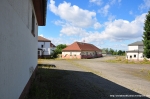
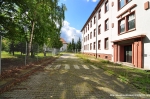
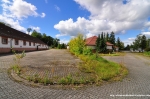
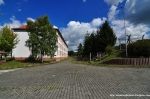
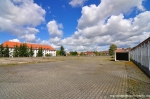
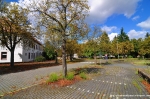
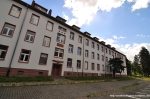
The Taylor Barracks in Mannheim-Vogelstang are one of those locations that are not really abandoned, but have the looks and feel of a deserted place. Cleared by the US Army on August 30th 2011 the Taylor Barracks are now under the administration of the BImA (Bundesanstalt für Immobilienaufgaben / Institute for Federal Real Estate), which has to decide what will happen to this former military base.

The Taylor Barracks, named after Private 1st Class Cecil V. Taylor who died in the last days of World War II and who posthumously received a Silver Star for courage in the face of the enemy, were built in 1939/40 by Nazi Germany’s Wehrmacht as Scheinwerfer-Kaserne (Searchlight Barracks) – most likely because it was home to the Flakscheinwerfer-Abteilung 299 (299th Anti-aircraft Searchlight Detachment) to defend Mannheim from bombings. From April 1948 on many, many US Army units were stationed at the Taylor Barracks; way too many to name them all. In the early years most of them were Ordnance Companies and Engineer Companies, later on a lot of supply and service battalions found their homes in Mannheim-Vogelstang.

(Fun fact: When I told my dad, a musician basically all of his life, that I had a look at the Taylor Barracks he told me that he played there on the opening night of a military club. When he asked for a whiskey coke the bartender handed him half a gallon of Jim Beam! The 70s must have been an interesting time…)

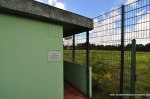
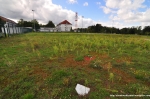
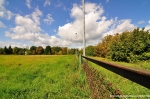
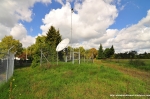
In the summer of 2012 the Taylor Barracks stood there waiting for a new purpose. Most of the buildings were in pristine condition, only some metal started to rust here and there. Also in pristine condition was the fence around the 46ha big premises – about 2.5 meters high and secured by barbed wire there was no way to enter the closed base. In areas considered a special security risk, like fence sections with streetlights, additional rolls of razor tape were installed on top of the fence and / or on the ground. And so the exploration I hoped for turned into nothing more than just quite a long walk…

Addendum 2013-09-09: It turns out that the good people at the BImA are great sports – instead of going after me for taking photos they link to Abandoned Kansai on their official page about the Taylor Barracks! 🙂 They also link to newspapers, the official homepage of the city of Mannheim and several others… but Abandoned Kansai is first! You can *have a look here*, but be aware that their website is in German…)

(If you don’t want to miss the latest article you can *follow Abandoned Kansai on Twitter* and *like this blog on Facebook* – and of course there is the *video channel on Youtube*…)

Read Full Post »

What do you do when you get thrown off your horse? You get right back on! And that’s what Sebastian and I did after we ran into some trouble at the *Cambrai-Fritsch-Kaserne*. Since Sebastian came up with the (almost) deserted US Army base it was my turn to select a place to explore – and I chose the Clubhotel Messel a.k.a. Clubhotel Sehr / Clubhotel Seher.

At the time of my visit the place was virtually unknown to the internet. It was obvious that plenty of vandals, arsonists and paintball players were there before me, but it was almost impossible to find any hard information about the place on the net – luckily that change earlier this year when the German urbex community, usually more interested in photos than the historical background of abandoned places, took care of that situation.

It seems like the Clubhotel Messel (named after the municipality of Messel near Darmstadt, usually known for the UNESCO World Heritage site Messel Pit where all kinds of fossils were found) was not only a single hotel, but a conglomerate of businesses, all part of the frivolous nightlife industry. The nightclub “Broadway-Bar” and the hotel “Je t’aime” were right next to the “Swimming Pool / Sauna Club d’Amour” and the “Nightclub d’Amour” – basically one big brothel complex, one of the biggest in the Rhine-Main area. Since all establishments were owned by a guy named Wolfgang Sehr the place was also called Clubhotel Sehr or, misspelled, Clubhotel Seher. The special attraction of the Clubhotel was a mini zoo including a pair of cheetahs – the cages are still in the forest! I’m not exactly sure when the place opened, but I guess it grew kind of organically and was in full bloom in the late 70s and throughout the 80s. In January of 1988 it was mentioned by leading news magazine Der Spiegel in an article about a scandal regarding nuclear waste. A company called Transnuklear Hanau (a subsidiary of Nukem – I’m not joking!) illegally imported 1942 barrels of nuclear waste from Belgium and of course there were bribery and other manipulations / irregularities involved – one of them was a bill to the amount of 14010 Mark (roughly 7000 Euros) after some managers of the nuclear industry had a fun night at the Clubhotel. (The article mentioned a nightclub called “Mon Bijou” and a fine dining restaurant named “La Chandelle“ – probably both part of the Clubhotel complex.

The Spiegel report was the beginning of the end of the Clubhotel, although the details are vague since everything happened before the age of the internet. It seems like the German State wasn’t very fond of the local sex businesses and started to shut them down one after another – either in the late 80s or early 90s. Some of the brothel owners went to jail for procurement and promotion of prostitution; and according to an article by the Frankfurter Allgemeine Zeitung (FAZ) in late 1994 Sehr was convicted of those crimes…

When the brothel complex was abandoned but still in good condition the Zeitung für Darmstadt (Newspaper for Darmstadt) reported in 1993 that the State of Hesse had plans to reconvert the place into a *deportation prison* for 250 illegal aliens. These considerations were terminated abruptly when parts of the club hotel complex burned down to the ground on January 25th of 1994 as the Zeitung für Darmstadt reported in early 1994. It seems like the then owner, most likely still Sehr, tried to commit insurance fraud to make up for the millions he lost when the place was shut down. (The guy definitely went to jail – I’m just not sure if it was for one or both of the alleged crimes.)

Later in the 90s the Clubhotel made the news when paintball players occupied the premises and actually started to do minor construction work. The rural district Darmstadt-Dieburg intervened and a court of law decided that the “Magic Boys Rhein Main” needed to find another location for their colorful war games… (The small building next to the big outdoor pool was their safe house and Gotcha related graffiti are still all over the place.)

For more than a decade all kinds of people came to the Clubhotel for all kinds of reasons. Some people played paintball, others airsoft. Some homeless people looked for shelter in one of the smaller buildings that weren’t affected by arson and of course photographers came to… well, do what photographers do. It seems like for a while artists lived on the premises and in summer of 2011 Sebastian and I had a quick look. Only to find a rather uninteresting burned out hotel and some vandalized smaller buildings. In the early 80s the Clubhotel must have been quite a sight – nowadays it’s just another unspectacular rotting place in the woods. Luckily it has a story worth telling. But maybe this patch of land in the middle of nowhere will find new beauty and glory soon. On March 26th of 2012 a public auction of the property by court order took place and on May 13th Echo-Online reported that the (new?) owner of the site is looking at plans to build a new hotel – probably for the whole family this time, not only for dads…

Read Full Post »

A couple of weeks before I went to Germany to visit family and friends last year I received an e-mail from Sebastian, a reader of this blog. He told me about exploring a rather recently closed US Army base in Darmstadt – half an hour away from where I was staying for my vacation. I really love abandoned military installations, so we continued talking via e-mail and agreed to meet up to have a look at the Cambrai-Fritsch-Kaserne (CFK) together.

The Cambrai-Fritsch-Kaserne (Cambrai-Fritsch Barracks) in Bessungen, now part of Darmstadt-Eberstadt, was built from 1936 to 1938 as two barracks next to each other – the southern part was known as Cambrai-Kaserne (named after the French city of Cambrai where Paul von Hindenburg had his headquarters during World War I and where the first tank battle in history took place in 1917), the northern part was called Freiherr-von-Fritsch-Kaserne (named after Generaloberst Werner von Fritsch, Nazi Germany’s Commander of the Army at the time). Most of the buildings on the premises were named after locations where famous WWI battles took place, like Verdun or Flandern.
The Fritsch-Kaserne opened on October 12th of 1938 and was home to the 1st Battalion of the 33rd Artillery Regiment, part of the 33rd Infantry Division. Later that month the 3rd Battalion moved into the Cambrai-Kaserne.
During the final days of World War II the US Army took over the Cambrai-Fritsch-Kaserne in March of 1945, making it the home of the 22nd Signal Brigade, the 233rd Base Support Battalion and the 440th Signal Battalion. Lots of service and recreational institutions were located at the CFK in the decades to come – AAFES Food Court, American Red Cross, Andrews Federal Credit Union, Darmstädter Catering Center, PX (post exchange), SATO Travel, Shopette, U.S. Post office, USO and standard facilities like a motor pool, a gym, a movie theater, a sports field and a bowling center.

When I met Sebastian on a warm, sunny summer day he told me right away that the CFK was closed, but not really abandoned. The high barbed wire fences were in exceptionally good condition 3 years after the Cambrai-Fritsch-Kaserne was shut down in 2008 – and Sebastian also mentioned that security guards were still patrolling the outskirts of the premises a couple of evenings per week. Well, we met in the morning, so what could happen, right? Let’s get this infiltration started! Like the *Federal Armed Forces Depot Pfeddersheim* the CFK is now the responsibility of the Institute for Federal Real Estate (Bundesanstalt für Immobilienaufgaben / BIMA) – they have to decide what to do with the 25 hectare (250.000 square meters or 2,7 million square feet) big area. Most likely it will be reconverted into housing for 2500 people, but German bureaucracy is slow and of course nothing has been decided yet. Not in summer of 2011 and AFAIK not in late spring of 2012. But while the BIMA obviously doesn’t care anymore about the depot in Pfeddersheim they seem to smell money when it comes to the CFK – housing for 2500 people, that’s serious real estate! And that’s why the keep the area in good shape by hiring gardeners and plumbers to take care of the premises. All the buildings we tried to enter were locked, hardly any of them were damaged by vandalism or graffiti.
It’s an absolutely mind-blowing experience to explore closed US army barracks, especially with a rather tight security system like this one. The weather was amazing that day and the video material I shot turned out to be nice, too. It was a perfect exploration until… well, we were less than 30 meters away from our top secret entrance / exit when it became clear that infiltration is for pros and neither of us was Solid Snake. I will spare you the details, but like running into security at *Nara Dreamland* this wasn’t exactly a fun experience. No legal consequences since we could convince the people involved that we were just harmless photographers, but this was pretty much the day I realized that urban exploration and urban infiltration are two different things – and I decided that I will limit myself to UE and abandon UI.
Sebastian and I were lucky that day, but entering the Cambrai-Fritsch-Kaserne without permission can have serious, serious consequences, so I highly recommend to stay away or to take photos through the fence.

To all the American (ex-)soldiers reading this article, most of them probably stationed at the Cambrai-Fritsch-Kaserne: When I was a pupil in the 80s my elementary school was way ahead of its time and had a friendship program with the Benjamin Franklin Village in Mannheim. I have nothing but pleasant associations with that exchange program and I consider this exploration a “Thank you!” for the kindness I experienced during that time (I think we went bowling as a big group and then had lunch at our exchange partner’s home, which is a pretty big thing when you are 8 or 9 years old and barely understand each other’s languages!) – I hope I was able to bring back some fond memories of your time in Germany!

(If you don’t want to miss the latest article you can *follow Abandoned Kansai on Twitter* and *like this blog on Facebook* – and of course there is the *video channel on Youtube*…)

Read Full Post »

After a couple of explorations with family and friends during my summer vacation 2011 it was about time to fly solo for the first time in Germany. The place to go: an abandoned shipyard along the river Rhine in a really nice little town called Germersheim, the city of syringa and the nightingale, just south of the way more famous Speyer. Germersheim was first mentioned in written form in 1090, but it was most likely founded more than a 1000 years prior to that. One of many beautiful small towns in the Rhine-Neckar Metropolitan Region.

It was kind of by chance that I stumbled across the place since I never saw it on the usual German urbex blogs and homepages – but the more excited I was about it. So enjoy, dear German urban explorers. While you can…

At first I was actually thinking about calling this location Shipyard G# – but that would have prohibited me from writing about the long and and turbulent history of the Shipyard Germersheim. Founded as “Oberrheinische Schiffswerft Spatz & Co GmbH” (Upper-Rhenish Shipyard Spatz & Co., Ltd.) in 1927 the company was renamed to “Germersheimer Schiffswerft” (Shipyard Germersheim) in 1953 after the “Reederei Reichel & Co” (Shipping Company Reichel & Co.) bought into the dockyard – but for whatever reasons the sign on top of the buildings says “Schiffswerft Germersheim”. In 1989 the company had to file for bankrupcy, but a rescue company with the creative name “Neue Germersheimer Schiffswerft” (New Shipyard Germersheim) was founded. Interesting fact: When Germany granted a guarantee to build two ships it was ordered by Brussels in December of 1990 to withdraw it since the whole procedure was repugnant to the Treaty of Rome (the whole thing was rather complicated, but it had something to do with a development aid project for the benefit of Senegal – we’ll kinda get to that topic later on again…). The new company was nevertheless successful for a couple of years, but finally failed in 2002. In 2009 a few scenes of an episode of the most popular German crime TV show “Tatort” (there is an English Wikipedia entry about the series if you wanna look it up… more than 800 episodes since 1970 – eat that, CSI!) called “Tod auf dem Rhein” (Death on the Rhine) was shot at the abandoned (New) Shipyard Germersheim and broadcasted in early 2010. A guy passing by on his bike told me that there are plans to tear everything down to build some mansions (with marinas, I guess), but nothing has happened yet to my knowledge…

The shipyard started by building inland cargo ships and pusher crafts, but later added tugboats, tankers and passenger ships to their portfolio. In the Spatz years the dockyard was also famous for (and a European leader in) repairing and conversions. More international fame was gained with the towboat Zongwe and the coastal motor vessel Lukuga, both built in pieces at the shipyard in Germersheim and assembled on location at Lake Tanganyika. In 1990, after the reboot, the ferry Le Joola (80 meters long, 12.5 meters wide, designed for 536 passengers and and a crew of 44) was built to cruise the coast of Senegal – one of the biggest ships ever to be built on the Upper-Rhine. 2002 turned out to be a horrible year for both the shipyard and the Le Joola. The ferry capsized and sank off the coast of Senegal, more than 1800 people died while 65 were rescued, making it the second largest naval desaster since World War 2.

I actually didn’t know any of that background when exploring the shipyard on a hot and humid late summer day. The gate to the area with access to the Rhine was wide open, so I had a look at the backside first. Later I spotted some anglers and probably some geocachers at the waterfront, too (there is a cache on the premises or at least very close by… lost places geocaches are becoming more and more popular and people go there with their whole families). Back at the main street I saw that the sliding gate at the entrance and the porter’s office were closed – the door to the management office building was secured by an additional chain with a heavy lock. I decided to have a look at the rest of the area from the outside to think about how to enter, so that’s what I did. After visiting the *Kawaminami Shipyard* just a couple of months prior it was interesting to see a dockyard that survived way longer although it was founded earlier. Some of the construction buildings were very old, probably from the founding days – too bad they were pretty much empty. So was the office building – way more modern, but empty. And moldy! I’m sure the hot and humid day didn’t help, but I could actually feel how it became more difficult to breathe inside of the building – that’s why I kinda hurried to get out of there again.

It’s hard to imagine that once 140 people were planning, constructing and welding ships at this quiet, almost tranquil place. All the machines were gone and about half of the former dockyard area was already taken over by another business – one that continues the metal work and painting: a car tuning and repair shop. (At least that’s what it looked like from the distance, I didn’t get really close to avoid drawing any kind of attention.)

Visiting the Shipyard Germersheim was a great experience overall. Sunny weather, a pretty much unknown and rather unique location with a long history und barely any hazards – it’s good to know that there are still places to uncover back home in Germany…

(*Like Abandoned Kansai on Facebook* if you don’t want to miss the latest articles and exclusive content – and subscribe to the *video channel on Youtube* to receive a message right after a new video is online…)

Addendum 2014-08-06: Three years later I *revisited the Shipyard Germersheim* – only to find it completely vandalized… 😦

Read Full Post »

« Newer Posts - Older Posts »